 Kim Kardashian and Lewis Hamilton aren’t keeping their hands to themselves.
The Kardashians star and the Formula One driver weren’t afraid to put on some PDA during their recent getaway to Europe,…
E! Online (US) – Top Stories









Kim Kardashian and Lewis Hamilton aren’t keeping their hands to themselves.
The Kardashians star and the Formula One driver weren’t afraid to put on some PDA during their recent getaway to Europe,…
E! Online (US) – Top Stories

 Joe Giudice is speaking up for his daughter Milania Giudice.
As the 20-year-old seeks professional help to navigate a challenging year, including an arrest for assault in May and the death of her…
E! Online (US) – Top Stories
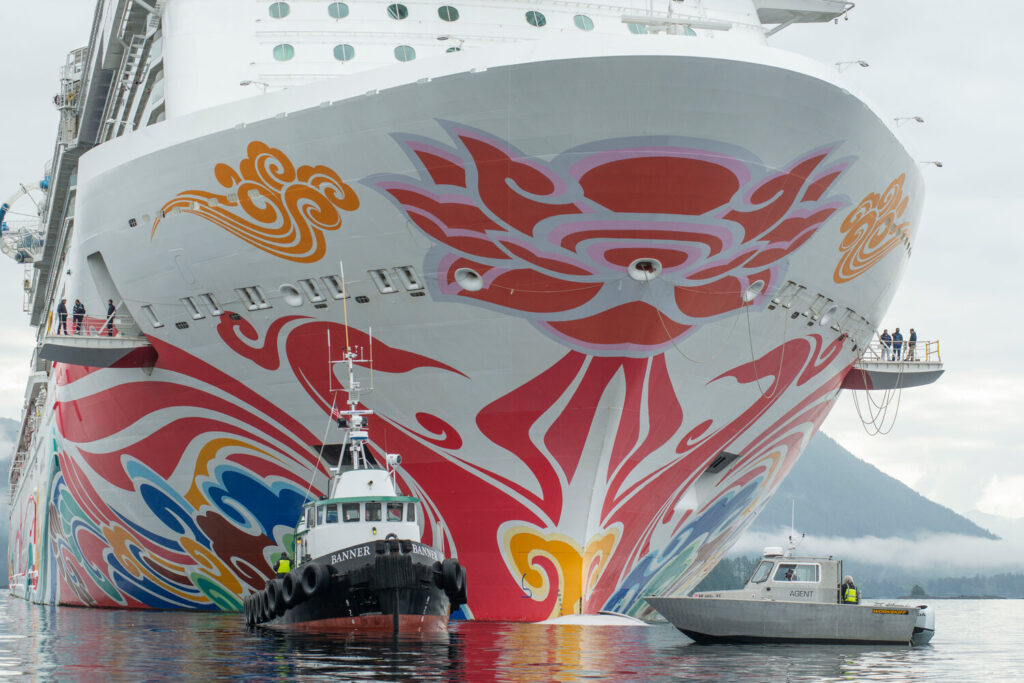
A dead fin whale was pulled from the bulbous bow of the cruise ship Norwegian Joy this morning as the ship made its way toward the Sitka Sound Cruise Terminal for its port call in Sitka.
The fin whale was removed from the bow and towed by a…

The Nisg̱a’a and Tahltan Nations, together with Arrow Transportation Systems, on Sept. 9 celebrated the official opening of the Portland Canal Marine Terminal, in Stewart, British Columbia, just up the road from Hyder, Alaska, targeting ore shipments from Canadian mines.
It is the first majority Indigenous-owned port in British Columbia, “marking an important milestone in Indigenous-led infrastructure ownership, transportation and economic development,” according to an announcement by the owners.
The terminal is owned through Portland…

The salmon and the ooligan that spawn in the Unuk and Stikine rivers have no say in the expansion of mining operations in British Columbia. Neither do the Alaskan tribes that live on the same rivers.
The power lies across the border in Canada, where the mining companies and the provincial, federal and Tahltan Nation authorities have joined forces in a modern-day gold rush to expand the Red Chris Mine at the headwaters of the Stikine River. Plans are also underway to restart the idled Eskay Creek Mine on the Unuk River.
The investment of a half-billion Canadian dollars supporting the expansion of the Red Chris mine by Prime Minister Mark Carney’s government has heightened an international conflict between the Native peoples and others in southeastern Alaska and the First Nations people in Canada who support the project.
Seven tribal nations could be affected by the Eskay Creek Mine, and the Red Chris expansions poses similar threats, according to officials with the Southeast Alaska Indigenous Transboundary Commission, of SEITC, a collective of 14 Haida, Tlingit and Tsimshian nations that have united to uphold stewardship over the lands, waters and sacred sites in their territories.
“The expansion of Red Chris means more risk in the headwaters of a river that has sustained our people since time immemorial, “ said SEITC President Esther Aaltseen Reese, Eagle Tsaagweidí (Killerwhale) from Ḵéex̱ʼ Kwáan (Kake), who lives down river of the Red Chris Mine.
“We are salmon people,” Reese told ICT. “The Stikine is part of who we are. We are already seeing contamination from Red Chris entering waters that feed the Stikine, yet British Columbia approved a major expansion without consulting the tribal nations downstream whose ways of life are on the line.”
The Tahltan Nation, which has agreements in place for both mining projects, did not respond to questions about the project posed by ICT via email.
In November 2025, the SEITC filed a judicial review in the British Columbia supreme court to force “meaningful consultation” with Alaskan tribes on mining projects in the headwaters of the Unuk, Stikine and Taku rivers.
“There is no legal or moral basis for B.C. to exclude our tribes who have deep ancestral ties and relationships to land and territory on both sides of the border,” Reese said in a statement issued at the time. “We deserve a seat at the table when decisions are made upstream that could obliterate our way of life.”
British Columbia’s Ministry of Environment and Parks, which oversees major projects such as mining, pipelines and facilities, responded to ICT questions in a written statement.
“We are not expediting projects at the expense of meeting our consultation obligations or compromising our high standards of environmental protection — we are finding opportunities that can do both in our processes,” according to the statement.
In regards to concerns from Alaskan tribes, officials said, “The matter of consultation with Alaska tribes for the environmental assessment of the Eskay Creek project near the B.C./Alaska border is currently before the courts, we are not able to comment.”
Environment and Climate Change Canada, the federal government’s department overseeing environmental issues, said protection of the environment is key.
“The Government of Canada is committed to the protection of freshwater and works cooperatively with the United States to ensure careful stewardship of shared waters,” according to the statement.
Eskay Creek Mine
The Unuk and Stikine rivers are part of the transboundary watershed, a collection of rivers, streams and tributaries that also include the Taku and Salmon rivers that flow south from British Columbia into Alaska and then on to the Pacific Ocean.
The watershed is crucial spawning grounds for salmon and other fish, and provides sustenance to Indigenous people and others along the rivers.
Cindy Wagner, Haida/Tsimshian, is concerned that the rapid expansion of mining in Canada will have significant environmental impacts on the transboundary watersheds in Alaska.
Wagner, assistant executive director of the SEITC, and her husband, Louis Wagner Jr., live downstream of the Eskay Creek Mine on the Annette Islands Reserve in Alaska on the Unuk River, where she has lived and fished all her life.
She has seen first hand the impact of mining on the Unuk.
The Eskay Creek Mine operated from 1994 to 2008, and the ooligan fishery on the river was closed in 2001. In recent years, ooligan, a small fish also known as eulachon, have begun to return, along with salmon and mackerel.
But she fears that could change with the reopening now underway of the Eskay Creek Mine on a much-larger scale. The mine received its Environmental Assessment Certificate in January.
“This is all for the Unuk River,” Wagner told ICT. “It’s a major salmon river, an ooligan spawning river, a mackerel spawning river, and vital to southeast Alaska.”
Reese says her people are concerned about a possible overflow or dam breach at the tailings ponds that collect the mining byproducts. In 2014, a breach at the Mount Polley copper and gold mine tailings dam resulted in billions of liters of wastewater spilling into the waterways. The mine is owned by Imperial Metals, which also owns a share of the Red Chris mine.
“Contamination or a failure at Red Chris could travel downstream, across the border, and through one of the most intact salmon systems left in the world,” Reese said. “The cumulative impacts of multiple large mines only magnify that risk.”
A waterway in transition
Tribes on the American side of the border have been living with the impact of mining for decades and fighting, to no avail, to stop expansion, local officials said.
On June 19, however, the province of British Columbia approved the transition of the Red Chris mine from an open-pit mine to a block cave mine that would largely be underground. On July 2, the Canadian government approved the funding support.
The Tahltan Nation in British Columbia has signed on with Red Chris mine’s owners and operators, Newmont Corporation and Imperial Metals, according to a statement from the companies.
The outlook is not as rosy downstream. The Annette Islands Reserve of the Metlakatla Alaska Native Community is Alaska’s only reservation, with other Native lands transferred to Alaska Native Corporations under the Alaska Native Claims Settlement Act, or ANCSA.
The reserve sits on the pristine Alexander Archipelago about 250 miles south of Juneau.
Wagner has lived off the Unuk River for most of her life, and in recent years has been defending Alaska’s waterways against mining development in Canada.
“I have always been fishing, even as a child,” she said. “My parents brought us out, all four of us, on a little 35-foot boat … I met my husband. The first time I helped him was down on his brother’s boat. He was selling ooligan and he didn’t have anyone to help him, and so I helped him.”
Wagner and her husband have always watched the waters of the Unuk River, and taken note of how clean and deep they were, and how the fish changed in appearance and in number. Then, in 1999, after the Eskay Creek Mine began operating, they noticed that industrial waste was piling up in the low part of the river.
“We are way up this river,” Wagner said. “How does a rusted-up oil drum get this far? How does all this plastic and old tarps and old pallets get up here? This looks to be an important part where the moose stepped into the river to get across, and it’s blocked with junk.”
The fish noticed, too, she said.
“In about 2001, we started noticing the ooligan bypassing the Unuk River,” she said.
Ooligan are different from mackerel and salmon, which return to the waters where they were spawned. Ooligan go to where the water is best, she said.
Dramatic escalation
The Unuk River was beginning to recover after the Eskay Creek Mine shut down in 2008, Wagner said, when a mining boom began on the Canadian side, in an area in northwest British Columbia called the “Golden Triangle.”
By 2022, just two mines were in operation, BruceJack and Red Chris. But four mines were proposed, seven were under development and seven more exploration projects were underway, mostly to dig for gold, according to a provincial report on mines. The ore extracted from the ground is processed to pull out the valuable gold and copper that it can contain.
Guy Archibald, executive director of the transboundary commission and a self-described “reformed miner,” said the transition from an open-pit mine to a block cave mine at Red Chris will mean a dramatic escalation involving hydraulic fracturing, known as fracking, a controversial method also used for extracting natural gas.
Archibald said the SEITC member nations “upholding their sovereign rights and defending the transboundary Stikine, Taku and Unuk Rivers from rapidly expanding mining development occurring in the Canadian headwaters.”
An environmental chemist, Archibald has been with the commission since its inception in 2014. Before that, he worked in the uranium industry in southeastern Utah and the oil shale industry in western Colorado in the 1970s and 1980s, he said.
Archibald explained the process behind a block cave mine.
“They’ve mined out the ore body that’s closest to the surface, and in order to go deeper, they’re going to have to access it underground,” he said. “They’re going to drive a ramp underneath the ore body, and then … they’re going to fracture the ore body pretty much the same as they do hydraulic fracturing, fracking for natural gas.”
The crumbled ore falls into the ramp and is carted above ground, he said.
“They’re going to just start scooping it out from the bottom as this cavity, this cave, just naturally collapses in,” he said. “It’s just going to turn into a big crater in the earth, and that’s block cave mining.”
The practice is not new, but in the past, miners would use drilling. With this project, they’ll use fracking.
“Block cave mining has been around for a long time,” Archibald said. “The only difference I see with the way Red Chris is doing it is by doing the hydraulic fracturing from the surface, drilling down and then pumping high pressure water into the ore body to break it up.”
The introduction of fracking to the block cave operation is a major concern to the SEITC. Officials say the mine can’t contain its current tailings, which already end up in the groundwater.
“The studies have been showing the tailings dam leaks into the groundwater 26 percent of its volume every year,” Archibald said. “Those tailings have to be constantly covered with water so that they don’t oxidize and turn acidic. We already have downstream pollution problems in groundwater and surface water…Using more water to frack this ore body is not going to help that situation.”
‘A critical step’
The Red Chris mine operation is a joint venture partnership between the Newmont Corporation, which owns 70 percent, and Imperial Metals, which owns 30 percent.
The Red Chris was one of 18 major projects named by Canada’s Major Projects Office, the new federal department created by the Carney government to push forward his “Build Canada Strong” strategy. The half-billion-dollar investment may be just the beginning.
“With the authorizations granted by the province and the support of the Tahltan Nation, the stage has been set for the development of Red Chris into a Block Cave mine,” Imperial President Brian Kynoch said, following the approval of the British Columbia government. “These approvals are a critical step in advancing a final investment decision by the joint venture partnership.”
Newmont officials welcomed the news in a statement promising that the project would not only increase Canada’s copper production by an estimated 15 percent but that the infrastructure could be a hub for mining for decades.
“The project is expected to extend the life of the current Red Chris mine by approximately 14 years and sets the foundation for decades of potential additional mining,” Newmont stated. “It represents a significant opportunity to create long-term value for Newmont’s shareholders, strengthen critical mineral supply chains, and deliver long-term benefits for local communities, Indigenous partners, British Columbia, and Canada.”
Canada’s Major Projects office is promoting both production and Indigenous participation, stating that the project was “developed in close collaboration with the Tahltan Nation, whose Traditional Territory overlaps directly with the mine site” and that “the project supports reconciliation while strengthening Canada’s role as a reliable supplier of critical minerals.”
Provincial leaders have changed the laws, however, to eliminate participation of U.S. tribes when it comes to environmental impacts. The province passed Bill 15 in April to amend the dispute resolution processes in British Columbia’s Environmental Assessment Act to limit participation of tribes in the U.S. and exclude them as “participating Indigenous nations.”
Archibald says the moves have raised concerns for taxpayers as well.
“Subsidizing the Red Chris just furthers the privatization of profit while transferring the risk on to the taxpayer,” he said. “If Newmont and Imperial Metals can’t afford their own infrastructure, what assurance do we have that adequate funds will be available for long-term tailings management, closure, and cleanup to protect the Stikine River for hundreds of years into the future?”
The Eskay Creek Mine, owned by Skeena Gold + Silver, is an open-pit gold and silver mine that is being redeveloped with a projected 12-year mine life.
In approving the mine’s expansion, British Columbia Premier David Eby hailed the relationship with First Nations.
“Today marks success for yet another multibillion-dollar investment in our province that will deliver prosperity, jobs and stability for all British Columbians, achieved in true partnership with the Tahltan,” Eby said in a Jan. 27, 2026, press release. “Congratulations to all who were involved in this important work. Those who want to end our work with First Nations would not have delivered these thousands of jobs, period. Following their advice would leave us poorer, tied up in court and in a place of uncertainty.
Kerry Carlick, president of the Tahltan Central Government, issued a statement in the same press release.
“This is a hugely important day,” Carlick said. “TCG’s decision to consent to the Eskay Creek Project reflects a historic, precedent-setting process that affirms Tahltan Nation’s authority over development in our Territory, recognized by the Province and Skeena Gold + Silver.”
When asked to comment regarding concerns of Indigenous Alaskans about environmental concerns, a spokesperson for Skeena Gold + Silver responded that they had answered those concerns.
“We have already addressed many questions regarding concerns from the Alaskan groups, as we were going through our permitting process,” Galena Maleger, the vice president of investor relations told ICT in an email. “There is a significant amount of information available online as to how Eskay Creek is adhering to the highest standards in environmental management.”
Looking ahead
Downstream on the Unuk River, Wagner and her husband are already seeing more and more boats hauling material north to the dam site. They can only imagine the size of the massive project based on the garbage that piles up in the river.
Wagner has a message for the Tahltan Nation whose members will profit from the two mines.
“I think they should be more aware of what’s coming down the river, because it’s not staying up there on their territory,” Wagner said. “It’s coming down on my territory, my tribe’s territory, all southeast territory, and we have to deal with it.”
This story was originally published by ICT.
The post Modern Day Gold Rush: Mining projects opposed by Alaska tribes get support from Canada, British Columbia and First Nation appeared first on Chilkat Valley News.

In 2026, many fast food chains launched new menu items, and chicken sandwiches were part of that novelty wave. People were loving this restaurant’s version!

Mashed – Fast Food, Celebrity Chefs, Grocery, Reviews

 Presley Gerber’s body has now been cremated.
Five days after the 27-year-old son of supermodel Cindy Crawford and her husband Rande Gerber died of a suspected overdose inside a rehab facility in…
E! Online (US) – Top Stories

The Chilkat Valley News and KHNS will host a live candidate forum at 6:30 p.m. tonight in the Chilkat Center.
Moderators Rashah McChesney and Avery Ellfeldt will question four candidates for two open positions on the assembly and two candidates vying for the mayor’s seat.
You also can tune into KHNS 102.3 in Haines or 91.9 in Skagway or listen live via khns.org.
Assembly candidates are Lee Robinson, Anne Marie Palmieri, Beau Bradley…

 Selma Blair’s intentions? Having fun with her hair.
The Cruel Intentions alum stepped out with a noticeably shorter ‘do during Variety’s Power of Women event Sept. 23, with her hairstylist…
E! Online (US) – Top Stories

Mary Peltola listens to a question posed by moderator Michelle Egan at a candidate forum held by the Alaska Oii and Gas Association on Aug. 27, 2026. Next to Peltola is i Sen. Dan Sullivan. Peltola, a Democrat and former U.S. House member, is challenging Sullivan. (Photo by Yereth Rosen/Alaska Beacon)
Alaska observers say it is too early to say how reports of bad behavior by Democratic U.S. Senate candidate Mary Peltola might affect the state’s closely watched election, and some supporters suggested this week that she may be subject to a double standard because of her gender.
“While it’s surprising news, I think there’s a very hefty proportion of people who go, ‘It’s a hit job. It’s typical politics,’ and kind of brush it off,” said Ivan Moore of Alaska Survey Research, a political polling firm active in the race.
“It takes a lot to swing someone over from being a Peltola voter to all of a sudden going, ‘Oh, OK, I’ll vote for Sullivan.’ So we’ll see,” Moore said.
On Wednesday, the New York Times published an anonymously sourced article documenting abusive behavior by the former Alaska congresswoman, now a leading candidate for Senate. The article said she was hostile to her staff and used slurs and profanity to privately criticize others.
The article detailed accounts from former staff members who said she required aides to feed her family’s pet chameleon and said that in 2024, she wrote that she hoped a local Planned Parenthood board member would “die of a botched abortion.”
That comment came after the group was slow to endorse Peltola in that year’s election. This year, she does not appear on the group’s endorsement list.
“Planned Parenthood has been called worse and withstood more in its 100+ years; we’ll talk with her about what was reported when she’s Senator-elect,” said Morgan Lim, Alaska state director for Planned Parenthood Alliance Advocates. “Nothing has changed in the stakes of this race and we remain laser-focused on ousting Sullivan from the Senate — making sure Alaska voters know that Dan Sullivan is an anti-abortion, anti-LGBTQ fanatic who will continue to rubber stamp Trump’s judicial nominees.”
Peltola declined to talk to Alaska reporters on Wednesday evening after a meet-and-greet with union members in Anchorage.
Peltola was elected in 2022 to fill the remainder of Congressman Don Young’s term after his death that spring. She subsequently won the general election in November and served a two-year term of her own.
Her time in office coincided with a period of personal loss. Five months after she began her full term, her mother died. Three months after that, her husband died in a plane crash. She sued his employer a year and a half later, and a trial is set to begin in March.
Harry Child, a spokesman for Peltola’s campaign, said by text that the Times article is exaggerated.
“Like any person who has gone through multiple personal tragedies in the span of a few months, Mary sometimes struggled to deal with her grief. But she treats her staff with respect and care, and she maintains close positive relationships with her staff spanning her nearly 30 years in public service,” he said. “Exaggerating and outright lying about moments from the hardest period of her life, and falsely presenting them as a pattern of behavior, is wrong.”
Polling indicates Peltola, a Democrat, is in a close race against Republican incumbent Dan S. Sullivan for one of Alaska’s two U.S. Senate seats. The winner of that election may decide whether Democrats or Republicans hold a majority of the Senate.
Moore said he doesn’t know whether the Times article will affect the eventual result.
Readers of the Anchorage Press said they don’t think it will, with some labeling the Times article a “nothingburger.”
The Times found something similar in a followup article of its own. A spokesperson for the Alaska Democratic Party called the initial article “a hit piece.”
“Mary grew up working on a fishing boat and was made in the mold of great Alaskan leaders that came before her. She’s the only candidate in this race who will actually fight to lower costs and put Alaska first, and Alaskans will send her to the Senate this fall because she will deliver,” the spokesperson said.
Nate Adams, a spokesperson for the Sullivan campaign, said by email, “Nearly 30 people close to Mary Peltola were interviewed and more than 100 screenshots informed this reporting. What the Times printed is only a fraction of it, so imagine what was left out, and what else Mary Peltola is hiding from Alaskans.”
Jim Lottsfeldt, a veteran political campaigner who is working on pro-Peltola efforts this year, said he sees somewhat of a double standard in the way she’s being treated.
Her predecessor, Young, was notorious for profane, scurrilous and even violent behavior while in office, and former Sens. Ted Stevens and Frank Murkowski were known for their hot tempers.
“Stevens blew his stack, and we were all like, ‘That’s great, because he blew his stack for our benefit.’ And then you had Don Young saying the most outrageous things occasionally, but got like tons of things passed,” Lottsfeldt said. “So when all this stuff happens with the guys, nobody really clutches their pearls, and now we have little Mary Sunshine, Mary Peltola, who may have said the word f**k when she was mad, and now we’re acting like it’s a major political story, and I don’t think it is.”
After the Times published its initial article, the Beacon contacted more than a dozen former Peltola aides in an attempt to verify its contents. Some, speaking anonymously, said they could not confirm all the incidents described by the Times but said the article matched the tone and mood of their time in her Congressional office or with her campaign.
They asked to not be named in order to offer frank opinions and because their current jobs may require them to work with Peltola in the future.
But at least some defended their former boss.
Kate Consenstein worked for Peltola in the Alaska Legislature and now runs a communications firm in Anchorage. The Peltola campaign suggested her as someone whose experience doesn’t match the Times article.
“I wouldn’t want to engage in denying the veracity or the accuracy of those people’s accounts, especially because I don’t know who they are,” she said, “but I would just say the person that I worked for, and the person that I still know, is kind, generous, and not an abusive boss.”
Current U.S. Sen. Lisa Murkowski is a Republican who endorsed Peltola’s 2024 U.S. House run but is backing Sullivan this year. She told reporters in Washington, D.C. on Thursday, “I do acknowledge that while she was here in her first term, she was not only thrown into a very challenging situation immediately running for campaign, but then to lose her husband in that airplane crash and to deal with all of that. That’s pressure that is hard for anybody to bear.”
Sullivan, also interviewed by D.C. reporters on Thursday, said, “I think it’s very sad, very disturbing that so many Alaskans had to get put through that kind of severe abuse, which is very disturbing, but not surprising.”
Tyson Fick, a fisherman from Juneau who worked as a special assistant in Peltola’s congressional office, said there’s no doubt that Peltola would want a “mulligan” for some of the things she said, and he feels she was frequently second-guessed by East Coast staff.
“She never, I thought, was abusive, but also she often got some inadequate staff work,” he said.
“Having been around some operations where they were a little more, you know, systematic and organized, it was hard for me. I had to get out of there. I love Mary. I’ll be with Mary till I die, but I knew I couldn’t sign up for them again,” he said.
Fick and other Alaskans interviewed for this article were particularly critical of Anton McParland, a non-Alaskan who replaced Alex Ortiz as Peltola’s chief of staff. Ortiz, who declined to comment for this article, had previously worked for Young.
In addition to the personal losses that Peltola suffered, there was also a conflict between the people Peltola brought from Alaska and the people she hired from the East Coast.
Peltola and Fick are fishermen and accustomed to salty language, he said. Someone with a trust fund may not understand it, he said.
“Sometimes you say some salty stuff just for effect, and it doesn’t reflect a cultural bias … I get that words mean things, and words hurt, and people get their feelings hurt, and maybe it’s not right, but there’s also times when you’re under super stress, and you’re grieving, that stuff comes out like in inopportune moments, and it’s like, yeah, we could communicate better, we could do better, but also we could have — I could have done better for her,” Fick said.