Categories
Entertainment

Donald Trump Warns Iran Over Alleged ‘Dirty Bomb’ Plot: ‘We Take It Very Seriously’

Reading Time: 3 minutes

US intelligence indicates Iran has been developing plans to target senior Trump administration officials with a so-called dirty bomb or a chemical weapon in Washington, seven US officials told CNN.

The officials are still debating whether Iran could, or would, actually carry out such a plot.

Sources familiar with the latest intelligence described the plans as an effort to keep options open for now, not a sign that an attack is imminent.
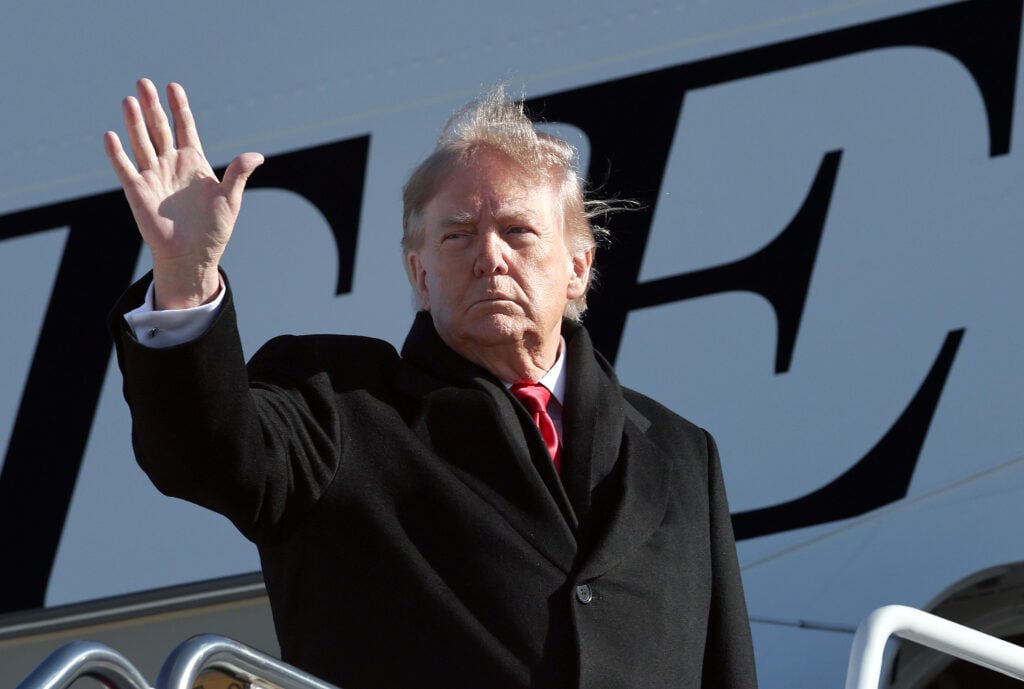
U.S. President Donald Trump boards Air Force One on November 16, 2026 at Joint Base Andrews, Maryland.
U.S. President Donald Trump boards Air Force One on November 16, 2026 at Joint Base Andrews, Maryland. (Photo by Win McNamee/Getty Images)

Two of the sources said the plot is very specific, though, and includes locations and targets. The situation has reportedly set off a wave of contingency planning inside the US government.

The White House is downplaying the danger. Spokesperson Lauren Bis said in a statement that the US is keeping an eye on every possible threat, but that there are currently no credible threats against the homeland.

A senior official has also reportedly said it is “unlikely” that Iran would attack the US with a dirty bomb.

Even one of the sources close to the intelligence questioned whether Iran could pull it off, saying it’s debatable whether the country actually has the personnel to carry out such a plan.

Still, US officials reportedly see the intelligence as a sign of an alarming willingness by Iran to escalate. There is no evidence Tehran has decided to move forward, according to the sources.

That escalation comes as Iran faces heavy pressure from continuing US military strikes and a severe economic blockade that senior administration officials say is “devastating” the country.

The US and Iran have been in conflict since February, when Trump launched the war. Intermittent diplomatic talks to end it are ongoing, and Trump said last week that the war would be over “pretty soon.”

Separately, Trump reportedly warned Iran over an alleged plot against administration officials, saying the US was treating it very seriously.

Officials held several meetings over the past week on how to counter the threat, two of the sources said. One described that planning as “prudent.”

The threats from Iran also led the Secret Service to move Treasury Secretary Scott Bessent to a military residence last week.

Iranian plots against current and former US officials go back to Trump’s first term. They include a 2024 plan to hire a hitman to assassinate Trump, and they have largely focused on chances to kill officials while traveling abroad.

Officials warned that the US is highly vulnerable to an attack with unconventional weapons. Iran wouldn’t necessarily need to smuggle trained operatives into the country, since it would only have to persuade someone already living in the US to carry out an attack.

US intelligence has also picked up Iranian communications claiming the country has hidden bomb-making materials inside the US, according to one source. Officials are split on how credible that is.

One source said that because the border was so porous for much of the past decade, it would have been easy to bring in operatives who could acquire and stash bomb components.

Another source said many national security officials assume nuclear materials have been prepositioned in the US for years, if not decades. In that source’s view, Iran’s capability hasn’t grown. What has changed is its incentive.

The Defense Department referred questions to the Office of the Director of National Intelligence, which declined to comment.

A spokesperson for Iran’s Mission to the United Nations in New York said Iran considers the use of chemical weapons under any circumstances “completely illegitimate” and flatly rejected the accusations as false and fabricated. The statement did not directly address the dirty bomb intelligence.

So what is a dirty bomb? It is a conventional bomb packed with radioactive material, and it is very different from a nuclear bomb, which relies on nuclear fission and would be exponentially more destructive.

A dirty bomb can still spread dangerous radiation across several blocks or even miles. Experts say most casualties would likely come from the blast itself rather than the radiation.

The devices are no harder to build than any conventional bomb. The tough part is getting hold of the radioactive material.

One of the sources compared such a device to a suicide bomber, calling it a weapon of terror rather than precision, and warned it could make people seriously ill and leave certain areas uninhabitable.

We will have further updates on this developing story as new information becomes available.

Donald Trump Warns Iran Over Alleged ‘Dirty Bomb’ Plot: ‘We Take It Very Seriously’ was originally published on The Hollywood Gossip.

​The Hollywood Gossip

Categories
Music

Ella Langley Wins 2026 CMA Music Video of the Year

The CMA just announced its first winners for 2026…and no surprise, Ella Langley is already picking up trophies. Continue reading…​Country Music News – Taste of Country

Categories
Music

Ella Langley Wins 2026 CMA Music Video of the Year

The CMA just announced its first winners for 2026…and no surprise, Ella Langley is already picking up trophies. Continue reading…​The Boot – Country Music News, Music Videos and Songs

Categories
Entertainment

Why Christina Ricci Says Cher “Holds a Grudge” Against Her

Christina Ricci, CherIf Christina Ricci could turn back time, she would patch up her relationship with Cher. 
The Addams Family star revealed that while she and the Grammy winner—who starred in…
​E! Online (US) – Top Stories

Categories
Alaska News

Can you tell which Southern state you’re in by the pie on the menu?

Holiday drivers in the South can find a different pie in nearly every state, and several have made theirs official by law. Florida and Louisiana … Read moreThe post Can you tell which Southern state you’re in by the pie…

Categories
Alaska News

A lawyer began canning cranberries over a century ago, and families still argue about it

Cranberry sauce shows up on the table in two main ways. One is a pot of berries cooked with sugar and water, sometimes with a … Read moreThe post A lawyer began canning cranberries over a century ago, and families…

Categories
Entertainment

Fiona the Hippo Undergoing Medical Care After Eating Hat

Fiona The HippoFiona the Hippo is on the mend. 
The Cincinnati Zoo confirmed that its famous semi-aquatic animal, who gained worldwide fame for her premature birth in 2017, is receiving medical treatment after…
​E! Online (US) – Top Stories

Categories
Entertainment

Will Smith Sued by Former Friend Over Alleged Groping

Reading Time: 3 minutes

Will Smith is being sued for sexual battery by his former close friend Bilaal Salaam, who claims the actor grabbed his genitals at a 2019 Hollywood after-party for Aladdin.

Smith’s legal team has flatly denied the allegation, calling it false and saying the incident “never happened.”

The lawsuit was obtained by TMZ, and it lays out a detailed account of what Salaam, a musician, says went down after the premiere of Smith’s live-action Disney film.

Will Smith attends Apple Original Films' "Emancipation"  Los Angeles premiere at Regency Village Theatre on November 30, 2022 in Los Angeles, California.
Will Smith attends Apple Original Films’ “Emancipation” Los Angeles premiere at Regency Village Theatre on November 30, 2022 in Los Angeles, California. (Photo by Matt Winkelmeyer/Getty Images)

According to the suit, Salaam shot a video with Smith during the party. He claims Smith remarked that Salaam’s nipples were “looking shiny” and “glossy” while they were filming.

Salaam alleges Smith then started moaning, which left him so embarrassed that he walked off to stand by himself in a corner of the room.

He claims Smith later came over to him and grabbed his penis over his clothes, holding on for roughly 10 seconds.

According to the filing, Salaam shoved Smith away and objected loudly.

The suit claims Smith apologized right away. Salaam says the actor then approached him a second time later in the night, this time with his wife, Jada Pinkett Smith, by his side.

During that second conversation, Salaam alleges, Smith apologized again and said he was a bit inebriated.

Salaam further claims Smith begged him to keep quiet about the incident, allegedly saying people would think he was gay and that it would destroy his career.

In the filing, Salaam says he felt “ashamed, humiliated, and afraid of those consequences.”

He also claims he told Smith he would not forgive him, but that he would put the matter behind him.

It’s the second time this year that Smith has been sued for sexual harassment. A musician named Brian King Joseph filed suit in January.

Smith’s camp is not mincing words. A lawyer for the actor said in a statement, “This claim is false. It never happened.”

The attorney went on to accuse Salaam of a pattern of attacks on the family. “For years now, Bilaal Salaam has made outrageous, salacious and false claims about Will Smith and his family that have all been thrown out or proven false,” the lawyer said.

“He has done it time and time again, with each new fabrication more outrageous than the last and all completely untrue,” the statement continued. “We will continue to contest his lies vigorously in the courts.”

This isn’t the first time Salaam has taken the Smith family to court. He and the actor have already been locked in ongoing litigation involving Pinkett Smith.

Salaam is separately suing Pinkett Smith for $3 million, accusing her of physically threatening him.

Pinkett Smith has denied any wrongdoing in that case. She has also filed a motion asking the court to dismiss portions of Salaam’s lawsuit against her.

The new complaint means Salaam now has legal claims pending against both Smith and Pinkett Smith, with the couple’s lawyers fighting him on two fronts.

The allegations in the sexual battery suit have not been proven in court, and Smith’s attorney has made clear the actor plans to fight the case.

Will Smith Sued by Former Friend Over Alleged Groping was originally published on The Hollywood Gossip.

​The Hollywood Gossip

Categories
Uncategorized

How the US power rivalry with Russia and China is turning outer space into the next battlefront

The Air Force secretary’s recent announcement that the U.S. has weapons deployed in Earth’s orbit marks the first time a space power has acknowledged a role in space weaponization. Vithun Khamsong/Getty Images

U.S. Air Force Secretary Troy Meink recently confirmed that the United States has weapons deployed in Earth’s orbit. To date, the U.S. Space Force, the space service branch of the U.S. armed forces, has provided relatively few details about what these weapons are or what they can do except that they are what Meink called “on-orbit space control weapons.”

Meink’s announcement is significant, but not necessarily because the U.S. is the first country to place weapons in orbit. For years, the U.S., Russia and China have accused each other of developing and testing such capabilities, although none has publicly acknowledged deploying space weapons – until now.

We are scholars of space law and governance, and our research illustrates the challenges of uniting diverse groups to establish norms related to the use of resources, safety zones and conflict prevention in new domains such as space. Without better communication and deeper coordination between the world’s space powers, we could witness the beginning of a space arms race.

Failed attempts to prevent a space arms race

In 1981, the United Nations added the Prevention of an Arms Race in Outer Space, known as PAROS, to its agenda.

More than four decades of diplomatic efforts under PAROS have produced meager results, though there was a United Nations agreement in 2024 that made progress on reducing threats.

Despite many countries’ proclamations supporting space arms control, no multilateral treaty banning weapons in space has been adopted. With global arms control generally in retreat, and the apparent lack of political will among the three major space powers, efforts to control space weapons have reached an impasse.

The question increasingly is not whether an arms race in space can be prevented, but how it will be managed.

Ambiguities allow weaponization

The Outer Space Treaty of 1967, to which all major space powers are parties, is often described by scholars, practitioners and policymakers as the constitution of outer space.

Article IV of the treaty remains the only legally binding international provision specifically regulating weapons in outer space. The article prohibits countries from placing nuclear weapons or other weapons of mass destruction in orbit around Earth. It also imposes a broader prohibition on military activities on the Moon and other celestial bodies, including establishing military bases, testing weapons and conducting military maneuvers.

However, the article does not prohibit conventional weapons in Earth’s orbit. That omission is significant. The treaty can be understood as implicitly permitting what it does not prohibit: the placement of such weapons in orbit.

China has used these ambiguities as cover for its own space weaponization efforts. In a 2007 test, China destroyed one of its own satellites while in orbit, and it has recently deployed a mysterious space plane.

China, nonetheless, reacted critically to the recent U.S. weapons announcement. In September 2026, it urged Washington to stop expanding its military presence in space. That same month, Russia renewed calls for the demilitarization of outer space.

Both countries have long advocated stronger international restrictions on space weapons. Russia and China twice jointly proposed a treaty prohibiting the placement of weapons in outer space. The U.S. opposed the proposals in 2014, pointing to their failure to also cover important ground-based, anti-satellite weapons.

But Russian and Chinese declarations in favor of keeping weapons out of space sit uneasily alongside their own activities.

Two men dressed in suits and ties shake hands on a stage.
Secretary of the Air Force Troy Meink, right, announced in September 2026 that the U.S. has weapons stationed in Earth’s orbit.
Kevin Dietsch/Getty Images

In 2020, U.S. Space Command, part of the Defense Department, accused Russia of testing a space-based anti-satellite weapon after an orbiting Russian satellite released a projectile. Russia said the spacecraft was performing an inspection mission.

In 2024, the United States said Russia had launched another satellite, Cosmos 2576, which it assessed to be a “counter space” weapon capable of attacking other satellites.

China has similarly demonstrated increasingly sophisticated operations in orbit. Five Chinese spacecraft conducted satellite flybys in 2024, an exercise that a senior U.S. Space Force officer later described as practicing “dogfighting in space.”

None of this proves that every suspicious Russian or Chinese spacecraft is a weapon. Many technologies used for servicing, inspection and maneuvering around satellites are inherently dual-use. But it does put Moscow’s and Beijing’s calls to keep weapons out of space in perspective.

It also illustrates the security threat now taking shape. Washington can point to Russian and Chinese activities to justify its own weapons. Moscow and Beijing can now point to acknowledged U.S. weapons to help justify their actions, which could result in a self-fulfilling prophecy.

War in space

Space has been part of warfare for decades. The 1991 Gulf War has sometimes been called the first “space war” because of the unprecedented role satellites played in navigation, communications, intelligence and targeting. But satellites primarily supported military operations taking place on the ground.

That distinction has gradually eroded. NATO formally recognized space as a military theater in 2019.

Russia’s 2022 invasion of Ukraine then demonstrated something different, in which the very definition of a weapon was challenged.

Hours before Russian troops crossed the border, a cyberattack disrupted the U.S. satellite network Viasat, in what was dubbed by commentators as the first “space-cyber war.” Space-based services were no longer merely supporting military operations but were themselves deliberately targeted as part of a military campaign.

The acknowledgment of weapons in orbit represents another step in that evolution. Space assets are transitioning from systems that primarily support warfare in other domains to systems that can be weapons, targets and participants in combat and are often replete with vulnerabilities that could be exploited by an adversary.

That does not mean future space warfare will resemble Star Wars dogfights or Starfleet armadas taking on Borg cubes. But the emerging battlefield is likely to be much more complicated. Satellites can be disrupted through jamming and spoofing, disabled through cyberattacks, approached or manipulated by other spacecraft, attacked from Earth or potentially attacked by weapons already in orbit.

This makes the connection between space and cyberspace particularly important. A country seeking to neutralize an adversary’s satellites may have several options, ranging from a cyberattack or electronic interference to physically damaging it. At the same time, space-based critical infrastructure has never been more vital to the functioning of the global economy.

Military strategy therefore has to adapt not merely to warfare in space but to warfare across an increasingly interconnected space-cyber nexus.

An arms race that must now be managed

The important question is no longer whether space will become militarized. It has been militarized for decades. Nor is it even whether states will develop weapons capable of affecting objects in space. Several already have done so.

The new question is how nations manage a strategic environment in which weapons are openly deployed in orbit, satellites are increasingly being targeted, and attacks can move between the space and cyber domains.

Public acknowledgment may itself have strategic consequences.

The U.S. Space Force argues that revealing the existence of its orbital weapons can strengthen deterrence by making adversaries aware that it possesses capabilities with which to respond. But transparency can also accelerate competition.

Russia and China can now point to U.S. weapons to justify deploying their own. The same logic and its consequences animated debates during the Cold War.

Forty-five years after the United Nations began debating the prevention of an arms race in outer space, that arms race increasingly looks less like something to prevent than something governments must learn to manage.

The Conversation

Scott Shackelford receives funding from the U.S. Air Force Office of Scientific Research to study the nexus of space-cyber power, which will culminate in the publication of an edited volume on this topic. Indiana University is also a member of the Space ISAC.

Eytan Tepper receives funding from the U.S. Air Force Office of Scientific Research to study and lay the foundations for a theory of space-cyber power. Indiana University is also a member of the Space ISAC.

​Politics + Society – The Conversation

Categories
Uncategorized

The stunning transformation of the Southern Democratic Party, in one lifetime

Mississippi Democratic Gov. Ross Barnett waves a Confederate flag before the start of an Ole Miss-Kentucky football game on Sept. 29, 1962, in Jackson, Miss. AP Photo/Jim Bourdier, File

Two of the biggest surprises of the 2026 election cycle were Democratic U.S. Senate victories in the Deep South. In addition to Annie Andrews’ victory in South Carolina, Scott Colom won a close contest in Mississippi, a place that historian James Cobb called “The Most Southern Place on Earth.”

Colom is not Mississippi’s first Black U.S. senator. Two Black Republicans represented the state during Reconstruction, when state legislatures still selected U.S. senators. But Colom is the state’s first popularly elected Black U.S. senator. He is also the first Democrat that Mississippians have sent to the Senate since 1982.

It is tempting to read this change using a familiar political science term: party realignment. But as political scientists who study political campaigns and Southern politics, we see an equally important transformation in the electorate – the people who can cast votes.

Simply put, the Democratic Party in the South was transformed from a party that defended white supremacy and Black disenfranchisement into one in which Black voters became a central constituency. The Democrats who held Mississippi’s Senate seats for the majority of the 20th century were chosen by an electorate built to exclude Black citizens. Colom was elected by a dramatically different electorate and represents a very different Democratic Party.

To understand the magnitude of the change in Mississippi, it helps to look at the Democrats who came before Colom, what they stood for, and the political power they wielded.

Reconstruction and its end

For a brief period after the Civil War, Black Mississippians exercised real political power. They were a majority of the state’s population and, with the right to vote, helped elect the state Legislature that sent Hiram Revels to the U.S. Senate in 1870 and Blanche Bruce in 1875, both of them Black.

That period did not last. White Democrats regained control of Mississippi government in the 1870s, aided by political violence, intimidation and electoral fraud. In 1890, the state adopted a new constitution that used poll taxes, literacy tests and other restrictions to systematically disfranchise Black voters. Two years after the new constitution took effect, the percentage of Black men registered to vote had fallen to just 5.4 percent.

The result fundamentally changed Mississippi politics. For the next several generations, the Democratic Party dominated a political system in which most Black Mississippians had little meaningful voice. Republican electoral victories were rare. One newspaper in 1963 claimed that the election of Lewis McAllister to the state House was the party’s first win in 43 years. Without a competitive general election, winning the Democratic primary often meant winning office, and the politicians who emerged from a one-party system made possible by Black disenfranchisement became some of the most powerful political figures in the state’s history.

What happened in Mississippi reflected a broader pattern across the South. In 1949, political scientist V.O. Key published his seminal study of the region, “Southern Politics in State and Nation.” Key argued that the solid Democratic South rested on systematic disenfranchisement of Black voters.

The one-party system helped keep Black Southerners out of political power while allowing white Southern politicians to present a unified front against efforts to dismantle segregation and expand Black voting rights, particularly when those efforts came from the federal government. Mississippi was among the clearest examples of that system.

Two men, one sitting and holding a cigar, the other leaning over him with a sheaf of papers in his hand.
Mississippi Senators James O. Eastland, left, and John Stennis, both Democrats, at a Senate subcommittee hearing about hunger on July 11, 1967, in Washington. They angrily denied physicians’ charges that their state was trying to starve African Americans.
AP Photo/John Rous

Segregation and political power

Before Colom, the last Democrat elected to the U.S. Senate from Mississippi was John Stennis in 1982. He first won election in 1947, filling the seat of Theodore Bilbo, who had won reelection in 1946 after a campaign in which he urged white Mississippians to keep Black voters away from the polls. Stennis won a 1947 special election with 52,068 votes in a state of 2.2 million people. He held that seat for 41 years.

Throughout much of his career, Stennis was an ardent segregationist. In 1956, he was one of 101 members of Congress from the South who signed what was called the “Southern Manifesto.” In that statement, these lawmakers denounced the Supreme Court’s decision in Brown v. Board of Education, in which the justices ruled that the “separate but equal” standards of racial segregation were unconstitutional; Stennis and the other signatories pledged resistance to school desegregation.

Later in his Senate career, Stennis was the only Southern Democrat who voted to oppose the creation of a national holiday honoring Dr. Martin Luther King, Jr.

Stennis’ Senate colleague for much of his tenure, Mississippi Democrat James Eastland, was an equally staunch defender of segregation. A cotton planter from the Mississippi Delta, he was appointed to the Senate in 1941 and won the seat outright in 1942. He remained in the Senate until 1978.

The day after the Supreme Court handed down its 1954 decision in Brown v. Board of Education, Eastland was quoted saying, “the South will not abide by nor obey this legislative decision by a political court.”

Recent attention has understandably focused on Stennis, the last Democrat to represent Mississippi in the Senate. When Colom takes office, he will occupy the Senate seat once held by Eastland and Democrat James Vardaman, who said that “if it is necessary every Negro in the state will be lynched; it will be done to maintain white supremacy.”

One-party rule also gave Mississippi’s senators unusual power. With little electoral competition, they could remain in office for decades. In a Senate where seniority mattered, longevity translated into influence.

Eastland, for example, chaired the Senate Judiciary Committee for more than two decades, giving him enormous influence over civil rights legislation. During his chairmanship of the powerful committee, that committee became known as “the graveyard of civil rights legislation,” according to the Senate’s website.

A new Southern coalition

The Voting Rights Act of 1965 helped dismantle the electoral system that had sustained these men in office. Before it, fewer than 10% of Black Mississippians were even registered to vote. Within a few short years, a majority were.

Black voters increasingly aligned with the Democratic Party as its national leaders embraced civil rights, even while many Democratic officeholders in Mississippi continued to defend segregation. That meant Black voters sometimes supported incumbent white segregationists. The party’s voters changed faster than many of its candidates did.

The 1978 election for the seat Colom will hold illustrates how complicated that transition could be. After Eastland retired, Charles Evers, brother of slain civil rights leader Medgar Evers, ran as an independent and drew nearly a quarter of the vote. His candidacy split the traditionally Democratic vote, helping Republican Thad Cochran win with a mere plurality.

By the 21st century, white Mississippians overwhelmingly supported Republican candidates, and Republican dominance had replaced the old Democratic dominance in most statewide elections.

That pattern made Colom’s victory all the more striking. He won with overwhelming support from Black voters while also attracting enough white voters to build a winning statewide coalition.

The contrast with Mississippi’s old Democratic coalition could hardly be sharper. The Democratic Party of Vardaman, Bilbo, Eastland and Stennis maintained its power in part by keeping Black Mississippians away from the ballot box with violence and Jim Crow laws.

When Colom is sworn in, Revels’ old seat will, for the first time, be held by a Black senator directly elected by Mississippi voters.

The Conversation

The authors do not work for, consult, own shares in or receive funding from any company or organization that would benefit from this article, and have disclosed no relevant affiliations beyond their academic appointment.

​Politics + Society – The Conversation