But as the Chrisley Knows Best alum prepares to welcome a baby with her new fiancé, Jason Galanis, his financial history is raising some serious questions.
According to court documents obtained by TMZ, Galanis was assigned responsibility for more than $100 million in financial liabilities when his previous marriage ended in divorce in 2018.
Reality TV star Savannah Chrisley speaks on stage on the second day of the Republican National Convention at the Fiserv Forum on July 16, 2024 in Milwaukee, Wisconsin. (Photo by Leon Neal/Getty Images)
The legal paperwork reportedly listed $37 million in restitution, two separate forfeiture obligations of $37 million and $43 million, and approximately $12 million in taxes.
He also had a personal guarantee estimated at between $8 million and $9 million.
To be clear, the amounts listed do not necessarily represent what Galanis still owes today. The documents also do not establish whether any of the obligations overlapped.
Still, those are some eye-popping numbers for a man who has only just entered the spotlight as Savannah’s future husband.
The court documents stem from Galanis’ divorce from his ex-wife, Monet Berger, whose marriage to the businessman ended in 2018.
According to the judgment, the court found that Galanis had engaged in criminal conduct before and during their marriage, and potentially after their separation. The ruling assigned him responsibility for liabilities connected to his actions, protecting Berger from those financial obligations.
The proceedings also reportedly revealed that Berger had limited knowledge of the couple’s remaining assets and debts because they maintained separate financial accounts and records throughout their relationship.
And the financial revelations weren’t the only unusual discovery. The court documents indicated that the couple’s marriage had never been officially registered with the state of California, despite the pair living as husband and wife for nearly a decade.
The judgment also found that Galanis had forged Berger’s signature on tax returns in certain years.
Galanis’ financial history comes with an even bigger legal backdrop. He was sentenced to 16 and a half years in federal prison for securities fraud and other offenses before President Donald Trump commuted his sentence in March 2025.
Savannah, meanwhile, has been making headlines of her own after announcing that she is engaged and pregnant with her first child with Galanis.
The reality star revealed the news on social media, initially keeping her fiancé’s identity under wraps. She later discussed their relationship on her “Unlocked” podcast, explaining that they met through political circles while she was advocating for her parents, Todd and Julie Chrisley, to receive a pardon.
Galanis and Todd also share a notable connection: Both men served time at the same federal prison camp before receiving presidential clemency.
Savannah has defended her relationship despite the 27-year age difference, describing Galanis as the love of her life.
With a baby on the way and a wedding in their future, Savannah and Galanis are entering a new chapter together. But the newly revealed divorce documents add another layer to the growing public interest in the businessman’s past.
In his book ‘Heart Life Music,’ Chesney details how opening his heart to dogs helped shape his relationship with girlfriend Mary Nolan, and suggests that he and Nolan may have undergone a romantic breakup. Continue reading…Country Music News – Taste of Country
In his book ‘Heart Life Music,’ Chesney details how opening his heart to dogs helped shape his relationship with girlfriend Mary Nolan, and suggests that he and Nolan may have undergone a romantic breakup. Continue reading…The Boot – Country Music News, Music Videos and Songs
It’s easy to find the steak section at any given grocery store, but hard to find a great steak. At Sam’s Club, don’t scrounge around. Grab one of these cuts!
Mashed – Fast Food, Celebrity Chefs, Grocery, Reviews
The Dunleavy administration justified removing Petersburg teacher Dan J. Sullivan from the U.S. Senate ballot by saying he was a “sham candidate,” but on Monday declared the Trump administration doesn’t have the right to intervene on the same basis.
Late Monday night, a federal judge agreed to expedite the case with a series of deadlines during the next three days involving motions to intervene in or dismiss the lawsuit.
For 15 years, Kenny Chesney has had his best friend and four-legged companion, Poncho, by his side. Today, Oct. 28, the country star shared the heartbreaking news that his beloved pup passed away at 5:15am this morning. Along with photos capturing their time together over the years, Chesney penned a heartfelt tribute to the loyal friend who was such a big part of his life.
He began his statement by recalling the first day Poncho entered his life. The pup arrived on his doorstep thanks to a friend who said, “Kenny, you need to learn to attach to something.” To this day, Chesney believes Poncho was put into his life for a reason.
Photo Courtesy of Kenny Chesney
The Tennessee native says that Poncho brought years of happiness, light and fun into both Chesney and his former girlfriend Mary Nolan’s lives. Although their relationship eventually changed, the two continued sharing their dogs Poncho and Ruby, who had become best friends.
“I’ve heard a dog enters your life when you need it most. And not just any dog, a specific dog just for you. To help you, to heal you, to show you how to accept unconditional love and give it back. Poncho did all that and more. He brought so much joy, energy, light, and fun into mine and Mary’s life.”
“He was a constant companion, very curious, had swagger, and smarter than the average human. He loved being on the boat, the bus, backstage with Jill and the production team. He loved the smell of the ocean and the islands like his dad and loved all the smells walking down the streets of Key West, Florida,” Chesney continued.
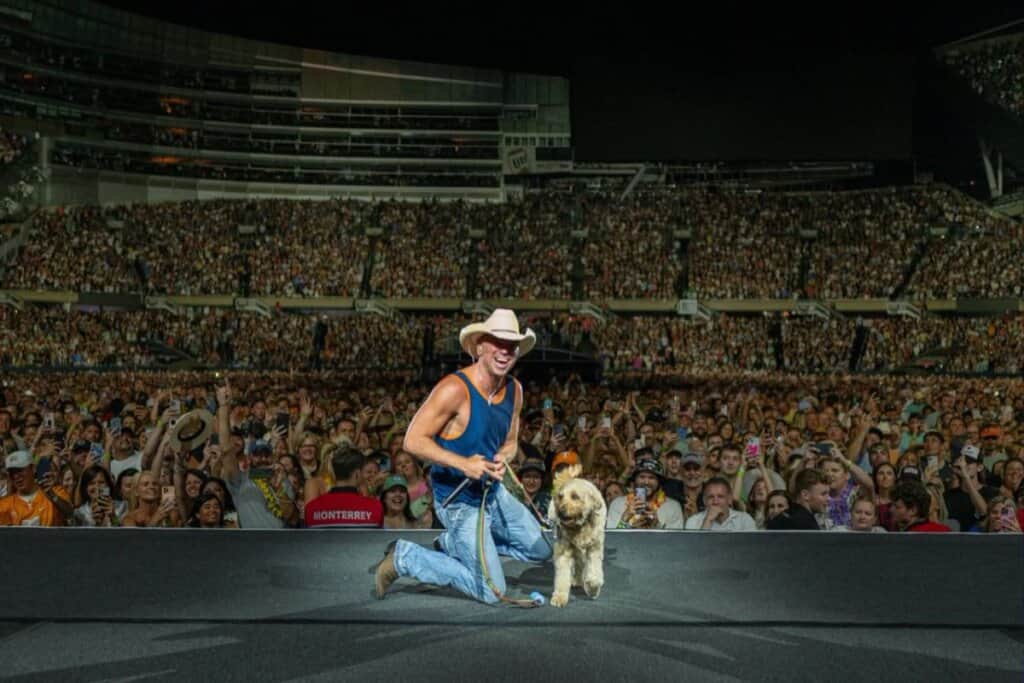
The “Carry On” singer also recalled one of his proudest moments with Poncho, when the pup made his way onto the stage at Chicago’s Soldier Field in 2024. Chesney initially worried the massive crowd, bright lights and loud sounds would overwhelm his dog, but Poncho proved to be more like him than he realized.
“…He loved feeling the energy of the crowd and refused to leave the stage. Instead of being timid, he was a show off a lot like me. That was a favorite moment in 15 years of favorite moments.”
Photo Courtesy of Kenny Chesney
Even though Poncho has now passed on, Kenny Chesney admits his heart is “broken but yet so full” because of the many years of love and good memories that they shared.
“We went down a lot of roads, lived a lot of life, and saw a lot of sunsets together. Poncho, my friend was right. I needed you and I thank you. Our connection and our bond will live forever and I’m gonna miss you. Say hello to DaRubaGirl for us. Goodbye Poncho. You were one heaven of a dog,” he said concluding his heartfelt tribute.
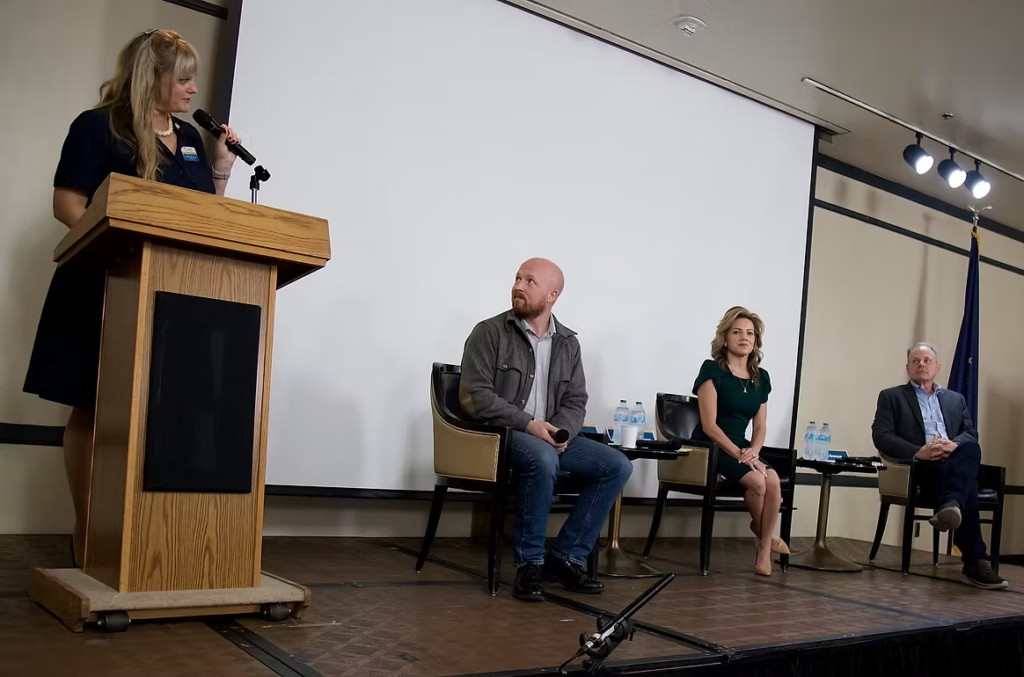
Laura McDonnell, left, moderates a gubernatorial candidate forum between, from left to right, Jonathan Kreiss-Tomkins, Bernadette Wilson and Dave Bronson at the Baranof Hotel on Oct. 7, 2026. (Mark Sabbatini / Juneau Independent)
Three former Alaska governors — Democrat Tony Knowles, Republican Frank Murkowski and independent Bill Walker — are endorsing Democrat Jonathan Kreiss-Tomkins in his race against three Republicans in the Nov. 3 general election.
U.S. Sen. Lisa Murkowski, R-Alaska, also announced Tuesday she…
As the Alaska Department of Natural Resources is deliberating on a controversial no-cost state land transfer in the Matanuska-Susitna Borough, legal questions remain around whether the transfer of public lands for private development qualifies as public or charitable use.
The state could transfer 20,000 acres near Houston to its economic development agency, the Alaska Industrial Development and Export Authority, for a proposed multi-use industrial and energy development district — a proposal that has sparked controversy because it could include data center development.
Under a rare legislative subpoena, DNR Commissioner John Crowther appeared before the Senate Resources Committee on Monday to answer questions about the department’s recent slew of proposed state land transfers to several state agencies at no cost under a “public and charitable use” statute, including the Mat-Su proposal.
Advertisement
The committee subpoenaed Crowther after he declined to appear at another hearing earlier this month. Department officials said at the time he did not have permission from Gov. Mike Dunleavy to appear.
Senate Majority Leader Cathy Giessel, R-Anchorage, listens to a presentation about natural gas during a March 12, 2025, hearing of the Senate Resources Committee, which she chairs. (Photo by Yereth Rosen/Alaska Beacon)
Sen. Cathy Giessel, R-Anchorage, who chairs the Senate Resources Committee, questioned the uptick in no-cost state land transfers over the last year by DNR to a variety of state agencies and local municipalities, where they could potentially be leased instead for millions of dollars each year.
“It feels like an appropriation,” Giessel said. “An appropriation of a very, very valuable asset, and that is Alaska land, Alaska public land. So that authority rests with the Legislature, and that raises questions.”
Senators pressed Crowther on whether a final decision from DNR is expected on the 20,000 acre Mat-Su proposal before a new governor is set to take office on Dec. 7, to which Crowther responded, “it’s certainly possible.”
However, Crowther said a final decision could be challenged by an administrative appeal or lawsuit. “It’s of course subject to judicial review,” he said. “So we anticipate moving through our process as expeditiously as possible. And some of those processes, we don’t have control over the timeline.”
A lawsuit filed Oct. 22 in state Superior Court is challenging the Mat-Su proposal as unconstitutional. The suit was filed by former University of Alaska Regent Eric Forrer and former Republican state Rep. David Eastman, and is intended to tie up the transfer and prevent DNR from pushing it through before Gov. Mike Dunleavy leaves office, Forrer told the Mat-Su Sentinel.
DNR issued a preliminary decision in July for the proposed transfer of the 20,000 acres near Houston to AIDEA. The proposal sparked public outcry, particularly as AIDEA’s list of potential development projects included data centers.
DNR is now reviewing more than 2,100 public comments before issuing a final decision. The comments include opposition from nearby communities, the Mat-Su Borough Assembly and some members of the Senate Resources Committee who wrote letters criticizing AIDEA’s proposal as too vague and raising legal concerns around whether it serves a sufficient public purpose.
DNR and AIDEA officials have maintained that AIDEA’s status as a state-owned economic development agency allows for the state land transfers under a “public and charitable use” statute. AIDEA officials have maintained that it is unlikely that data centers would be part of the development in the Mat-Su, due to a lack of a reliable energy source. No projects or contracts have been confirmed, AIDEA officials said.
On Monday, Crowther said that state land transfers for private development is a priority of the Dunleavy administration.
“I think it is very fair to say that using our land for development has been a governor’s priority, and consequently, the department’s been working on that in several different respects,” he said.
Crowther said it’s a priority of the Dunleavy administration “to maximize use and development of state lands, and to look at how we can partner with these state agencies that have public purposes and public missions to make land that is in theory eligible for private use and development, but hasn’t seen that.”
Officials with Dunleavy’s office did not respond to questions about the legality of the state land transfer, or local opposition to the Mat-Su land transfer proposal on Tuesday.
Senators question regulation change for definition of ‘public purpose’
DNR recently changed state regulations to expand the definition of “public purpose” for state land transfers to include private development.
Anchorage Democrat Sen. Forrest Dunbar wanted to know if the proposed transfers would have been legal before the regulation change. Crowther said the updated regulatory language clarifies existing state law and DNR’s authority.
In March, DNR adopted changes in its regulations after a public comment period. Those changes included an expansion of the definition of “public purpose” to include supporting “private commerce or industry that contributes to the economic development of the state” and “is otherwise determined by the commissioner to be in the best interest of the state.”
At the same time, Giessel noted that the governor introduced a similar bill that included allowing state land transfers for commercial development parks, but it failed to advance in the Legislature.
Crowther said DNR’s mission to promote development of state lands and resources has been ongoing, “for several years in several different avenues, and that regulation change was part of that.”
He said that has included projects including renewable energy, housing, gravel mining and other development.
“That theme runs throughout of: we need to use our lands and our resources in ways to address these, you know, in some ways very consistent, but in some ways very different cost access challenges that are stymying public interest across the spectrum,” he said.
“Other states are trying to tackle these same challenges and are doing so through adaptive land offerings and land management approaches,” he continued. “And so that was a motivation both for that regulation change and some of these other initiatives.”
Giessel said she began to take notice of the number of state land conveyances over the summer, particularly the large Mat-Su parcel and another 885 acres at Port MacKenzie slated for transfer to AIDEA. The Port MacKenzie proposal includes developing a rail-support and cargo logistics area to serve a future railroad link between the port and the railroad’s mainline near Houston.
Giessel questioned why DNR did not consider leases for agricultural use at the Port MacKenzie site.
“This land is still productive, could be productive for farming, and yet you’re conveying it to AIDEA for apparently industrial uses,” she said.
Christy Collis, director of the Division of Mining, Land and Water, appeared at the hearing with Crowther and said the proposed use of the parcel is tied to obligations with the Mat-Su Borough but the department will evaluate farmers’ concerns in their review of the public comments. A decision on that parcel is also expected in the coming months, but there is no set timeline.
Senators raise concerns with AIDEA, public input and oversight
Crowther told senators that officials with AIDEA approached DNR about the no-cost state land transfers before submitting proposals for the Mat-Su and Port MacKenzie parcels.
AIDEA has drawn public scrutiny as it directs some of the most polarizing development projects in the state — from Arctic oil exploration to the proposed Ambler Road project. AIDEA is run by a seven-member board appointed by the governor, but does not report directly to the executive branch and manages investments independently.
Dunbar asked Crowther how DNR weighs the benefits to the public of land transfers specifically for private development.
Crowther said AIDEA is a state-owned agency that has a broad mission to promote economic growth and generate revenue for the state.
“As long as their application (was) identifying a suite of activities consistent with that mission, and not identifying that they plan to abrogate that mission, I think we would interpret that as being cognizably appropriate under the conveyance,” he said.
Anchorage Democrat Bill Wielechowski pressed Crowther on why DNR did not keep a reversionary interest in the Mat-Su proposal with AIDEA, which would allow land not suitable for development to be automatically transferred back to state ownership.
Crowther said historically it’s been the state’s policy to maintain a reversionary interest, but it can also create challenges for developers to get financing for their projects.
“We wanted to provide flexibility for AIDEA as they develop options and plans, but it’s obviously been identified as a significant matter of legal concern and public concern,” Crowther said. “So we’re looking closely at it.”
Later in the hearing, Wielechowski criticized what he said was a lack of transparency and oversight of DNR’s no-cost land transfer to AIDEA for private development.
“It’s a huge loophole that is being created here,” he said, pointing to how DNR’s land use proposals are subject to greater public oversight than AIDEA’s.
“We’ve got a constitutional obligation to manage our resources, including our lands, and if you’re giving the lands away for nothing with no reversionary interest, very little protection for the public, to a board that’s not confirmed by the Legislature, has basically zero public oversight—it seems like it creates this giant loophole, for which AIDEA then has the ability to just go out and do whatever they want with the land, in a way that DNR would not have the ability, and that seems like, that’s what’s causing, I think, a lot of consternation and a lot of concern among the public and legislators.”