(The Center Square) – Alaska’s Republican governor ordered for an investigation into Mary Peltola’s U.S. Senate campaign, following allegations of its role in recruiting candidates to dilute votes from the Republican incumbent.
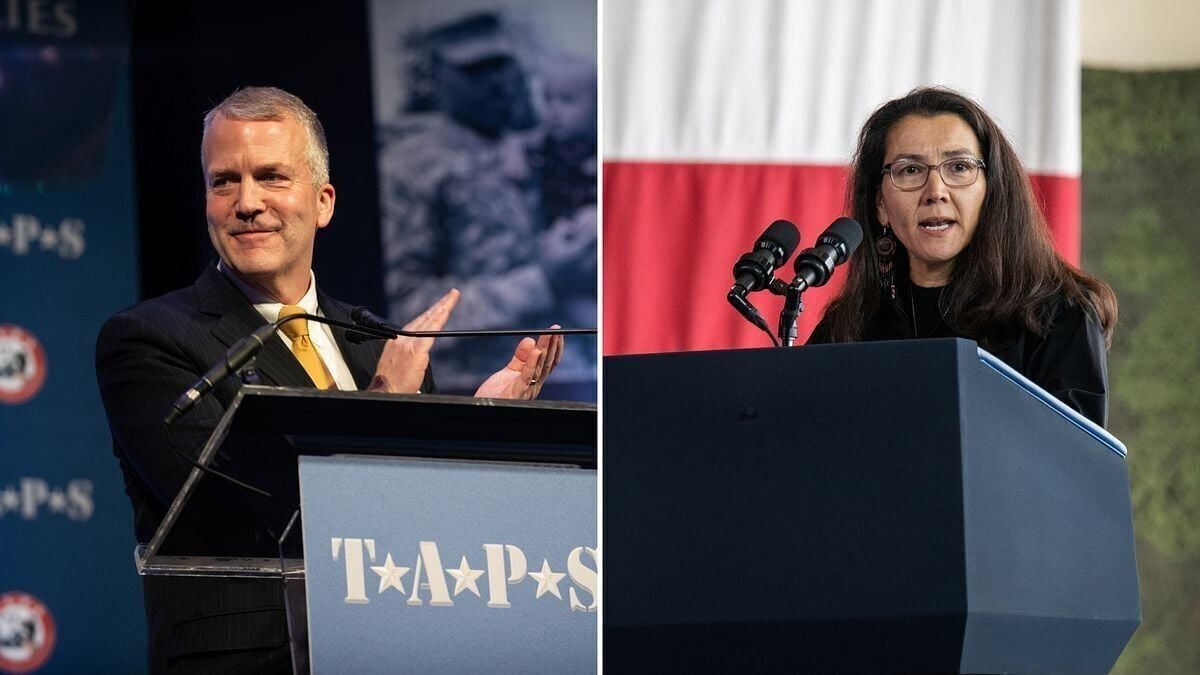









(The Center Square) – Alaska’s Republican governor ordered for an investigation into Mary Peltola’s U.S. Senate campaign, following allegations of its role in recruiting candidates to dilute votes from the Republican incumbent.
Reading Time: 3 minutes
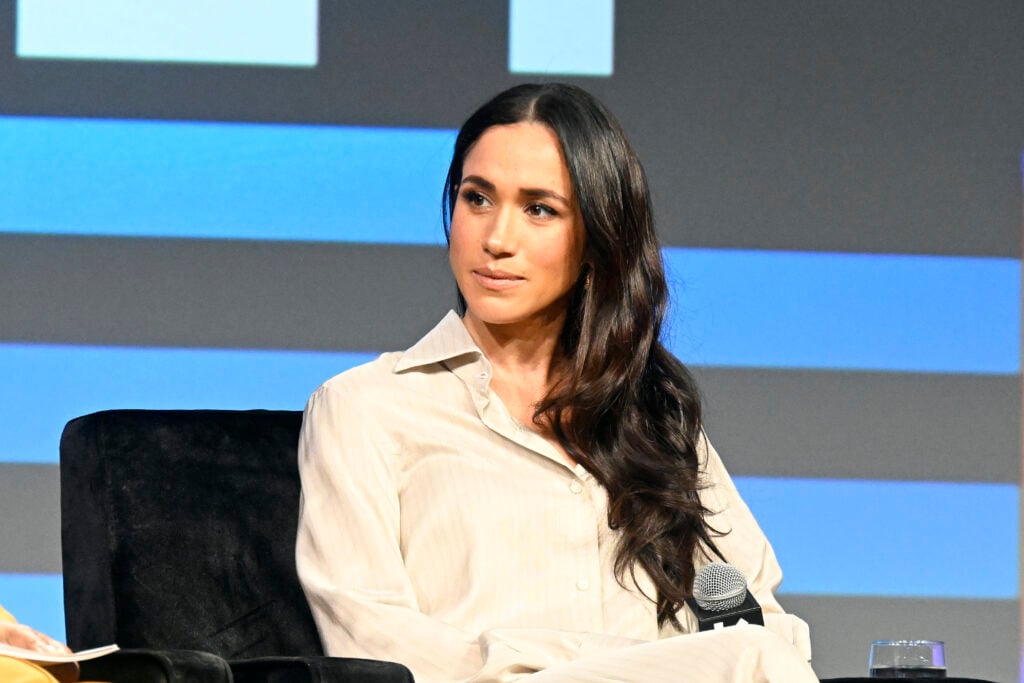
Meghan Markle is taking heat for promoting her lifestyle brand, As Ever, while disturbing allegations against her estranged father, Thomas Markle Sr., continue to dominate headlines.
According to Radar Online, critics slammed the Duchess of Sussex for going back to pushing As Ever products so soon after her father’s scandal broke.
One insider summed up the complaint in four words: “It’s a bad look.”
The latest As Ever promotion has drawn brutal criticism online, with media scrutiny of her dad only intensifying in the meantime.
The allegations against Thomas Sr. are serious. Philippine authorities are reportedly investigating claims that he possessed child sexual abuse material, per Reality Tea.
Thomas Sr. has denied the accusations, but he may soon face criminal charges.
Meghan’s half-brother, Thomas Markle Jr., reportedly discovered the material at their father’s residence and alerted authorities. That claim has been at the center of the coverage since the story first surfaced.
For Meghan’s critics, the As Ever push fits a pattern. As we reported earlier this week, her upcoming role on Junior MasterChef Australia drew a similar wave of backlash.
Meghan confirmed that she’ll appear on the 2027 season of the kids’ cooking competition, saying the decision to sign on “was an easy yes.”
Reports differ on the size of the gig. Some outlets describe her as a special guest, while others say she’ll co-host the series, which is returning to Australia after six years away.
She’s no stranger to the franchise. Earlier this year, Meghan served as a guest judge on the flagship MasterChef Australia, an episode that went over well with the contestants and producers but split viewers at home.
The Junior MasterChef announcement landed just days after the allegations against her father became public. Reality Tea boiled down the critics’ reaction to that news in three words: “Read the room.”
Now the same crowd is making the same argument about As Ever, saying Meghan is carrying on with business as usual while her family drama plays out in the press.
Her father’s scandal has also made her a punch line. A recent “Weekend Update” segment on Saturday Night Live UK, featuring comedians Paddy Young and Ania Magliano, used the allegations to deliver jokes about Meghan and her relationship with the royal family.
Radar Online reported that Meghan was particularly hurt by the bit, with a source claiming she has long regarded the American version of SNL as a television institution.
“Meghan understands that public figures are fair game for comedians, but this is an extraordinarily sensitive subject,” the insider told the outlet.
The same source pointed out that Meghan and her dad have not been close in a very long time.
“She has been estranged from her father for years, yet she’s once again being dragged into a controversy she has absolutely no control over,” the insider added.
That estrangement is at the heart of the debate. Meghan’s defenders argue she shouldn’t have to put her career on hold over the alleged actions of a parent she has been estranged from for years.
Her critics see it differently, and the backlash over the As Ever promotion shows they aren’t letting up.
Meanwhile, the Philippine investigation into Thomas Sr. is reportedly ongoing, and Meghan’s Junior MasterChef Australia appearance is still on track for 2027.
Meghan Markle Slammed for Plugging As Ever Product Amid Dad’s Scandal: ‘It’s a Bad Look’ was originally published on The Hollywood Gossip.
The Hollywood Gossip

 Christina Aguilera fans are certainly feeling this moment.
The Grammy winner dropped jaws in a recent social media post, stripping all the way down in her bathtub with only ghost emojis covering…
E! Online (US) – Top Stories
Jerry Mathers, who played Theodore “Beaver” Cleaver on the beloved ’50s sitcom “Leave It to Beaver,” had to endure and overcome some real-life health struggles.
Health Digest – Health News, Wellness, Expert Insights

Research on political polarization points to how people’s preferred news outlets and social media use create information silos, environments in which people primarily encounter views consistent with their own, further cementing those views.
But this research often omits an important source of political information: popular culture, from influencers and podcasts to comedy, television and movies.
Politics are intertwined with popular entertainment media. The current president is a former reality television star who was reelected in 2024 with the help of comedy podcasters like Joe Rogan. Blockbuster films such as “The Odyssey” spark controversy and turn into political footballs, while late-night talk show hosts must skirt the Trump administration’s regulatory ire with their politically oriented humor.
While we know a lot about the news-consumption habits of Republicans and Democrats, there is less data about the other places that people encounter political ideas. This is particularly true for younger people, who are increasingly likely to get political content from social media influencers and popular culture sources.
Political consultant Sarah Longwell of The Bulwark recently told The New York Times’ Ezra Klein that many people in her focus groups get political information from an “algorithm-driven information environment” populated by influencers, comedians and sports personalities. She noted that the “overlap between politics and culture” creates a “vibe” that shapes many people’s political decision-making.
As co-founders and research affiliates of Colorado State University’s Center for Democracy, Art, and Popular Culture, we conducted a survey that documents the pop culture preferences of Americans ages 18-49.
We wanted to know whether the siloing that has been observed in Americans’ news environments is replicated when younger Americans are consuming entertainment media that often contains political content.
It isn’t.
That matters, because popular influencers and entertainers who cross partisan boundaries have an increased ability to shape the political “vibe” discussed by Longwell. And an important finding from our survey is that many of the favorite creators and outlets ranked in the survey feature men and promote masculinity.
Pop culture is the diverse collection of cultural productions consumed by members of a society: films, television series, video games, art, music, comedy and the like.
We asked 741 Americans to name their top influencers, podcasts, comedians, musicians, video games, films and television series. We examined results by age and political party.
Respondents first identified which pop culture outlets they engaged with and then shared their favorites in each content category. The answers were diffuse, but trends are evident in the top three listed by people across political affiliations.
Both the Democratic and Republican parties have turned to influencers to reach voters – particularly young voters – who “don’t consume traditional political news.”
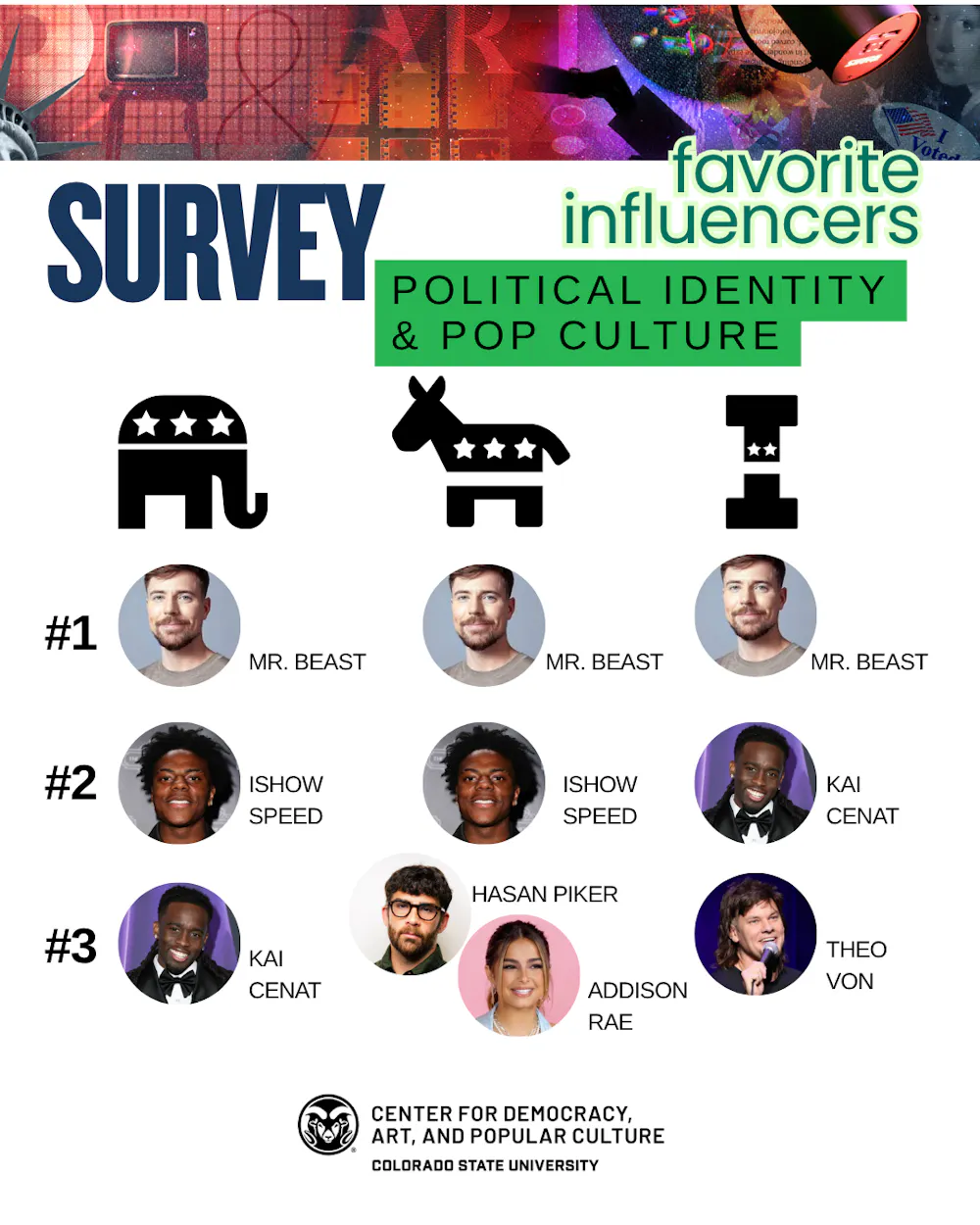
In our survey’s lists of favorite influencers, three creators who rose to fame staging viral stunts, interviewing celebrities and playing video games on YouTube and the live streaming platform Twitch dominated the list: MrBeast was No. 1 for Democrats, Republicans and independents. Republicans and independents ranked Kai Cenat in their top three, while IShowSpeed was No. 2 for Democrats and Republicans.
A similar pattern of the same names populating each list is evident in people’s favorite podcasts. “The Joe Rogan Experience” and “Call Her Daddy” were in all groups’ top three, while Republicans and independents also ranked the “Tucker Carlson Show” and “This Past Weekend with Theo Von.”
Joe Rogan and Theo Von are comedians turned podcasters, whereas Tucker Carlson rose to fame as a right-wing pundit. “Call Her Daddy” is an outlier on our list insofar as it is hosted by a woman, Alex Cooper, and is known for frank discussions of sex and relationships.

The website Campaigns & Elections reported that in 2024 half of all registered voters surveyed who listened to at least one podcast per month said that podcasts had some influence on their vote. The site reported that in the 2024 presidential election, those podcast listeners favored conservatives.
Our survey helps to explain why. Rogan, popular with all three groups, has long voiced libertarian ideas and platformed right-wing politicians. Von occupies a similar space, and Carlson is conservative. Both are favorites not just of Republicans but also independents.
Political scientists and media scholars have demonstrated how comedy can influence politics. Our survey found considerable overlap among political partisans’ favorite comedians.
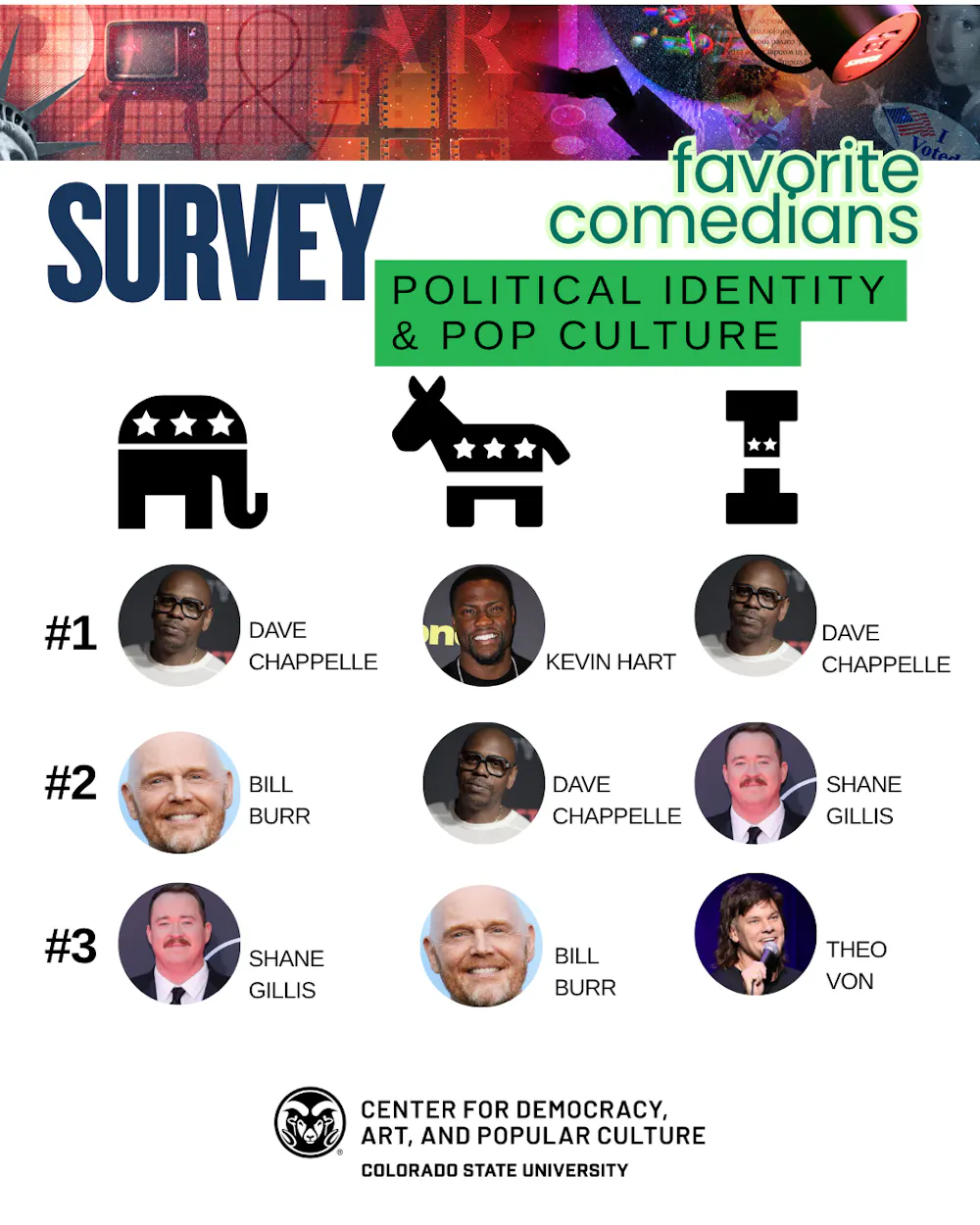
Dave Chappelle, creator of the boundary-breaking Comedy Central series “Chappelle’s Show,” topped the list for Democrats and Republicans and was the second favorite of independents. Bill Burr, known for comedy that is both cocky and aggrieved, was in the top three for Republicans and Democrats, while Shane Gillis, whose comedy The New York Times says “fits into the evolving meaning of conservatism,” was second and third for independents and Republicans.
Video games are another shared pop culture venue where Americans of different political affiliations are encountering one another as they play, via discussions with other players on Twitch and by participating in the comments sections of gameplay livestreams.
Researchers have demonstrated that young people, in particular, are exposed to diverse political views when engaging with one another in “online participatory activities that are non-political in nature.”
For example, one study examined how a viral trend of “building Trump’s wall” while playing Fortnite spurred political discussions both inside the game and in comments on gameplay videos and social media posts.
U.S. Rep. Alexandria Ocasio-Cortez demonstrated the political power of the medium in 2020 when she livestreamed herself playing the game Among Us, an online, multiplayer deduction game similar to the popular party games Mafia and Werewolf. Ocasio-Cortez playing the game with U.S. Rep. Ilhan Omar and prominent gamers was billed as a get-out-the-vote effort and earned 4.5 million views.
In our survey of video games favored by people of different political affiliations, Call of Duty, Fortnite and Sims appeared on all three lists.

Our data suggests that these pop culture spaces are thus not partisan silos. But that doesn’t mean they are free of particular ideologies.
Some of the most popular creators – Rogan, Von, Carlson and Gillis – appeal to, or helped construct, the manosphere, a loose collection of online communities that promote masculinity and often reflect misogynistic attitudes.
Burr’s comedy is not politically conservative. But The New York Times said that it “gives voice to the aggrieved confusion of the white heterosexual guy adrift.”
Chappelle is known for his satirical critiques of racism. But in his more recent Netflix stand-up specials, he voiced anti-trans sentiments that Mother Jones called “indistinguishable from, and grist for, the material of conservative streamers and right-wing edgelords.”
Our survey did not ask respondents why they preferred these influencers, podcasts, comedians and video games. Academic research has shown that pop culture audiences don’t passively accept every message a creator delivers. Nevertheless, the dominance of male creators and the prevalence of misogyny and transphobia in their humor and commentary is significant.
Whether convened online or in person, the groups that gather via popular culture do not fit into the partisan silos that have formed around news and social media outlets. That makes the gendered nature of these lists even more significant, because the manosphere vibes are not relegated to one side of the political spectrum.

The authors do not work for, consult, own shares in or receive funding from any company or organization that would benefit from this article, and have disclosed no relevant affiliations beyond their academic appointment.
Politics + Society – The Conversation

In a 2025 investigation, The New York Times reported that officials in President Joe Biden’s administration, in the wake of Biden’s 2020 election win, had viewed rising immigration as “a distraction” best ignored so that the administration could concentrate political resources on more important economic matters.
Scott Shuchart, a Biden appointee who joined the Immigration and Customs Enforcement agency in 2022, told the newspaper that the White House was “wishing the problem would go away so that they could focus on the things they cared about.”
But two years after Donald Trump leveraged voter dissatisfaction with the Biden administration’s management of the U.S. southern border to win the 2024 election and enforce his immigration crackdown, the issue has suddenly become a secondary matter.
Amid the rising U.S. cost of living, a destabilizing war in Iran and a disrupted system of global commerce, the now-quiet border has relieved Democrats of their thorniest issue just in time for midterm elections.
For the past three decades, the Democratic Party and its candidates have struggled to develop and pass new immigration policies and communicate related political messages.
Bipartisan attempts at comprehensive immigration reform died on Capitol Hill in 2006, 2007 and 2013. Since then, a majority of Americans has trusted Republicans more with governing the issue. That has given the GOP an advantage when the salience of immigration policy has risen due to border crises and related high-profile events, even if that edge has recently narrowed.
In a February 2024 poll, 28% of U.S. respondents told Gallup that immigration was the country’s most important problem – matching the largest share since tracking began in 1981. By May 2026, that figure was 8%, a staggering drop in such a short period.
In a different poll by The Economist/YouGov, the share of U.S. registered voters who identified immigration as the country’s most important issue fell from 14% in October 2024 to 5% in September 2026.
Erik Iverson, a Republican Senate campaign pollster, recently told Axios that declining border crossings have reduced the urgency of immigration, depriving Republicans of an issue that previously energized voters and offered conservatives an advantage.
“You become a victim of your own success,” he said.
But this success is dubious. President Trump’s approval ratings on immigration are underwater.
In the RealClear Polling average from September to October 2026, his net approval was at negative 10.8%. In a recent Fox News poll, most Americans believe the Trump administration has “gone too far” in enforcing immigration laws, including 60% of independents.
Despite Republicans’ insistence that the mass removal of undocumented immigrants and a halt to new migrants would raise wages and make housing more accessible, Americans are experiencing high inflation rates, slow gross domestic product growth and sour consumer sentiment.

Ominously for the White House, Trump’s negative 10.8% net approval score on immigration is actually among his best. On inflation, the economy and foreign policy, his net approval rating is at negative 42.8%, negative 31.7% and negative 27.8%, respectively.
These dynamics bode well for Democrats’ midterm election prospects.
Republicans are now less concerned about immigration – what has been their greatest source of political energy and the left’s greatest political liability – as both parties’ voters are focused on other matters.
Despite the White House’s aggressive and frequently violent pursuit of undocumented immigrants, its proposal to end birthright citizenship, and its near closure of U.S. borders, even Democrats are no more likely to identify immigration as the country’s top issue today than they were previously.
According to The Economist/YouGov polling cited earlier, 1% of Democrats named immigration as their top issue in September 2026. In October 2024, 3% said the same.
Remarkably, without Democrats’ endorsement of a single new immigration policy idea, independents now express greater trust in Democrats than Republicans on immigration, 41% to 27%, according to a September 2026 Marist survey.
Democrats’ sudden edge arises after a decade of trialing different approaches to counter the nativism and popular discomfort that Trump has harnessed.
Before Trump’s 2016 election victory and immediately thereafter, Democratic leaders sought to ameliorate the image of foreigners in the U.S., by highlighting that immigrants start more businesses, file more patents and commit fewer crimes than native-born U.S. citizens on average.

During this period, Democrats commonly cited immigrants’ acute vulnerability and their willingness and ability to fill critical low-skilled and high-skilled labor gaps. But the praise and pity produced resentment among many Americans who did not want an admissions system that elevated foreigners to a higher pedestal.
Toward the end of the first Trump administration, Democrats
began citing the immense macroeconomic and fiscal benefits driven by immigrants’ long-term settlement in the U.S.
Economists attribute to immigrants the bulk of U.S. population growth from 1990 to 2015. And economists have shown that continued immigration mitigates inflation and extends the solvency of Social Security and Medicare funds. Immigration also provides workers for industries like construction, agriculture, food production and healthcare.
However, the benefits of these relationships for average voters tend to be diffuse and realized in the medium-to-long run. That makes them hard to recognize.
After the global pandemic halted most human mobility in 2020, the Biden administration sought to avoid the immigration issue altogether. It’s a strategy that Democrats have now carried over while the dynamics of being out of power still permit doing so.
Should Democrats win majorities in the Senate and House of Representatives in 2026, the issue of immigration is highly unlikely to be resolved. As a matter of constitutional oversight, Democrats plan to commence investigations into the Trump administration’s abusive immigration enforcement tactics, questionable case adjudication and alleged corruption.
It will be almost impossible to pass meaningful immigration legislation in such an environment.
The Biden-era approach was a pivotal electoral liability in 2024. And the Obama administration’s series of immigration executive actions instigated a tennis match of such orders between subsequent administrations ever since.
Democrats will soon feel some pressure to develop bipartisan approaches to immigration governance that ensure order at U.S. borders and a strategy for immigrant selection and integration that is designed with the national interest in mind.
Anything less, and the dysfunctional system – with its massive political risks – will return.

Justin Gest is affiliated with The Niskanen Center, The Aspen Institute España, America’s Competitive Edge (ACE) Initiative, and the Migrant Rights Initiative at Cornell Law School.
Politics + Society – The Conversation
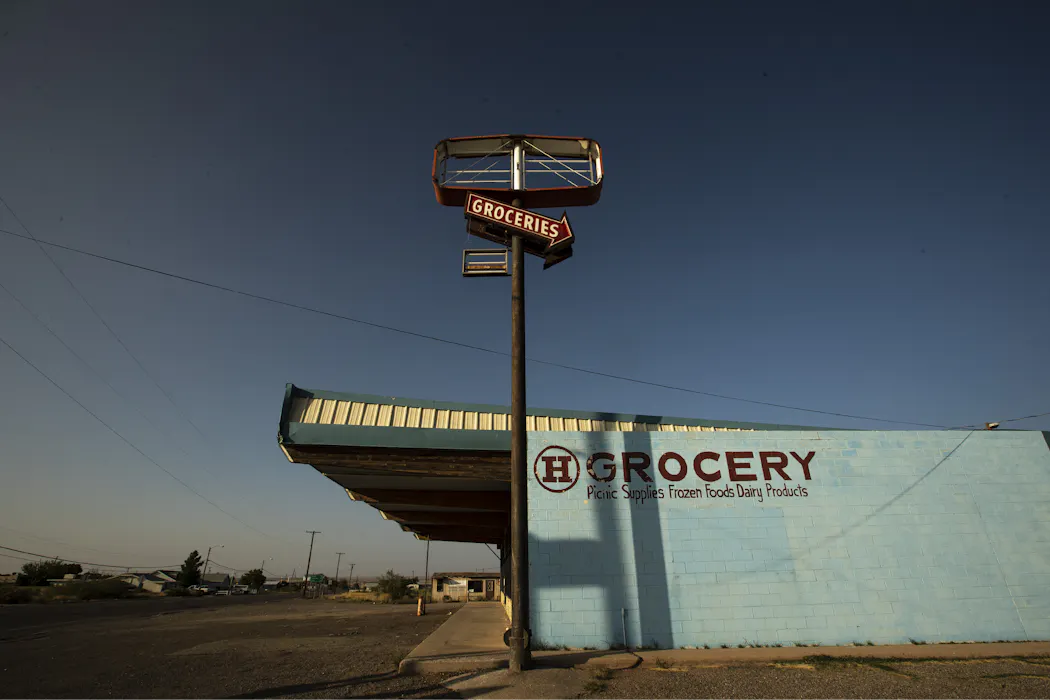
When picking up groceries requires a two-hour round trip, fresh produce can become a luxury. As a food systems researcher, I see this tension firsthand: People need fresh food to be healthy, but rural regions increasingly lack access to it.
Food insecurity among rural households increased from 12% in 2019 to nearly 16% in 2024, according to the U.S. Department of Agriculture. Low income plays a part, but so too do supply chain logistics. Delivering groceries to rural areas costs distributors more, leading to higher prices and less access for rural consumers.
Perishable foods – produce, meat and dairy – travel in refrigerated trucks, making them among the most expensive products to distribute. Rural routes add further costs. Small stores order less and rarely fill a truck on their own, meaning distributors either run long, multi-stop routes, or they send trucks out and back partly empty. Either way, delivery costs increase.
Because of this, many national supply chains don’t prioritize rural communities. But this wasn’t always the case. Since the 1970s, deregulation, supply chain privatization and resulting concentration have skewed food distribution and left rural America behind.
Today, as grocery chains grow larger, rural access to produce, meat, dairy and prepared foods is decreasing. My colleagues and I analyzed the delivery of perishable foods and found that national distributors are underserving seven states when it comes to refrigerated meat, dairy and other prepared foods.
In 1935, the Motor Carrier Act required licensed trucking companies to serve specific regions, so carriers served rural and urban routes alike, ensuring that publicly financed roads were serving public needs. In exchange for a regional operating license, companies offset unprofitable rural service with the high margins they made on profitable city-to-city routes, integrating rural communities into their supply chains.
The following year, the Robinson-Patman Act prohibited wholesale suppliers from favoring large grocers with better prices, advertising or other exclusive deals, discouraging retailers from getting bigger to get better deals.
Together, the two laws strengthened regional economies and held national distribution in check. This protected rural grocers from big grocery chains and split distribution costs between urban and rural communities. As a result, a small-town grocer in 1950 had access to much the same products as a city grocer in the same region.
Though Robinson-Patman is still on the books, enforcement waned in the 1970s as the growing influence of Chicago School economists led a shift toward deregulation. Grocery companies accelerated consolidation, gaining control of supply chains by accumulating massive buying power.
In 1980, President Jimmy Carter signed a new Motor Carrier Act, removing the requirement that trucking companies serve specific regions. Once carriers could choose their routes, service to rural regions declined, as companies began to prioritize more profitable urban routes.
Over time, the dismantling and neglect of these regulatory fail-safes jacked up rural food distribution costs and allowed big grocers to get even bigger. Chains gained access to wholesale discounts that independents didn’t have, affecting smaller grocers and generations of rural Americans.

These two policy shifts were amplified in the 1990s as chain stores started to use point-of-sale data like checkout and loyalty-program records. Large companies had the resources to collect data on purchasing preferences over whole geographic regions, while local businesses did not. Chains began to use early forms of artificial intelligence to find patterns in big datasets, giving bigger companies yet another competitive advantage over small ones.
As AI-powered data became more sophisticated, businesses with the means adopted new technology to improve trucking logistics that optimize for high-density, high-margin urban corridors. This has pushed independent grocers further to the margins.
My colleagues and I use USDA and Department of Transportation databases and AI models to explore rural food access. We found that national distributors are underserving West Virginia, Arizona, Texas, Michigan, North Dakota, South Dakota and Montana when it comes to refrigerated meat, dairy and other prepared foods.
To trace produce in particular, we focused on Wisconsin, using proprietary data from Transearch, a tool that transportation planners use to track interstate commerce. In most Wisconsin counties, national distributors delivered less than 9.2 pounds (4.2 kilograms) of leafy greens per person annually, or less than a third of the 30 to 35 pounds (14 to 16 kilograms) of leafy greens a typical American eats in a year. By contrast, urban counties around Milwaukee and Madison received 19 to 37 pounds (9 to 17 kilograms) per person annually.
Interviews with grocers, distributors and food pantry volunteers across 13 northern Wisconsin counties helped illustrate why.
Federal safety rules cap truckers at 11 hours behind the wheel, so a distant delivery might fit in a shift only if the truck has one stop to make. “But to be profitable, we need multiple stops on the truck,” one distributor said. “That’s why a lot of those really far-out stores, we’re not really interested in.”
Working to fill this gap, independent retailers operate more than half of rural grocery stores, providing 38% of food sales. To alleviate the supply chain cost burden, some rural grocers have joined or formed distribution co-ops they own and govern.
But co-ops alone won’t fix the underlying problem.
One grocer told our team that two cooperative distributors – which had served smaller, independent grocers – merged and were bought out by a private equity firm. Eventually, Kroger – one of the country’s largest integrated grocery chains – bought the distribution network and stopped supplying independent stores, serving only those it owned. It also focused on more profitable urban locations, opening new stores in high-growth markets.
This reduced competition in rural food distribution.
During the Biden administration, the Federal Trade Commission revived enforcement of the long-dormant 1936 Robinson-Patman Act and other antitrust laws meant to protect independent businesses from a few big companies controlling the market.
The FTC sued to block a merger between Kroger and Albertsons, two of the country’s largest grocery chains. It also sued distributor Southern Glazer’s for allegedly giving deep discounts to national chain stores, including Kroger, and PepsiCo for allegedly giving a large retailer deals that smaller ones didn’t get.
In May 2025, under the Trump administration, the FTC dropped the PepsiCo case, citing partisanship. But in October 2026, it settled its case against Southern Glazer’s in a deal the agency said would make it easier for small businesses to compete with large chains.
In my assessment, enforcing Robinson-Patman and other laws would discourage discriminatory pricing that gives chains an advantage over smaller rural stores.
Taking a fresh look at food distribution policies – like the Motor Carrier Act and public utility policies – could also level the playing field. For example, including rural delivery as a licensing requirement again could improve rural food access.
In 2025, the Trump administration announced that it would no longer collect food security data, without which food systems researchers will struggle to know whether conditions in rural America improved or worsened in 2026. Meanwhile, public funding to monitor food systems continues its decline.
Though rural distribution remains a challenge globally, other countries are making inroads: In June 2026, Canada announced a 10-year food security strategy worth 3.2 billion Canadian dollars, including aid to independent grocers, refrigerated warehouses and open wholesale marketplaces where farmers can sell their produce.
Large regions of the U.S. would benefit from the same.

Michelle Miller receives funding from the United States Department of Agriculture, and the State of Wisconsin. She is affiliated with Wisconsin Farmers Union and Warehouses 4 Good.
Politics + Society – The Conversation
Reading Time: 2 minutes
From 2012 until his death, she was the wife of one of the past century’s most infamous figures.
Hugh Hefner’s widow has accused the Playboy founder of forced incest and described scenarios of rape and coercion in their marriage.
Crystal Harris is also pointing the finger at a famous comedian who she says was the Mansion’s “number one customer.”
We’ll say this much: at least he isn’t the worst guy to do a Subway ad.
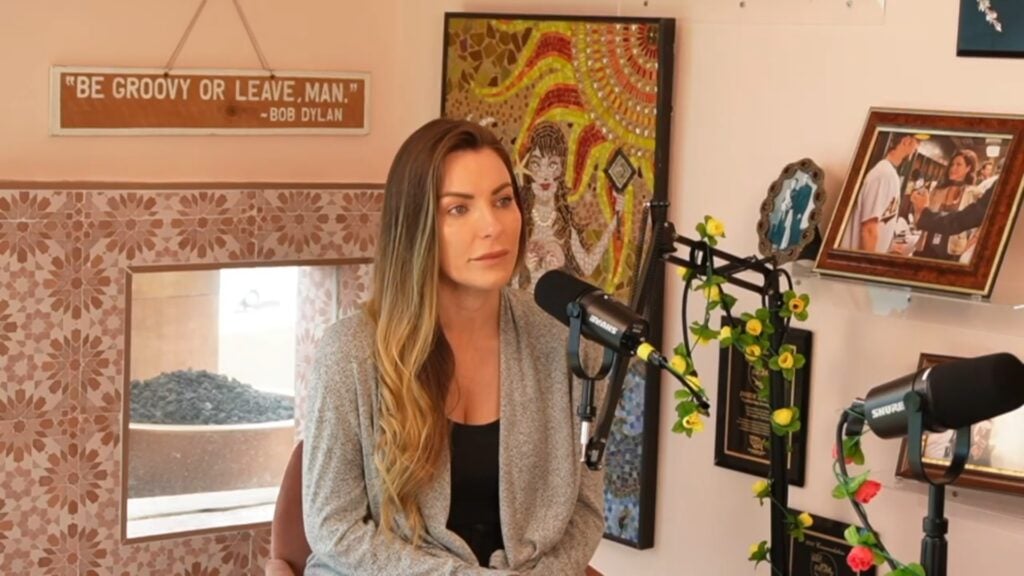
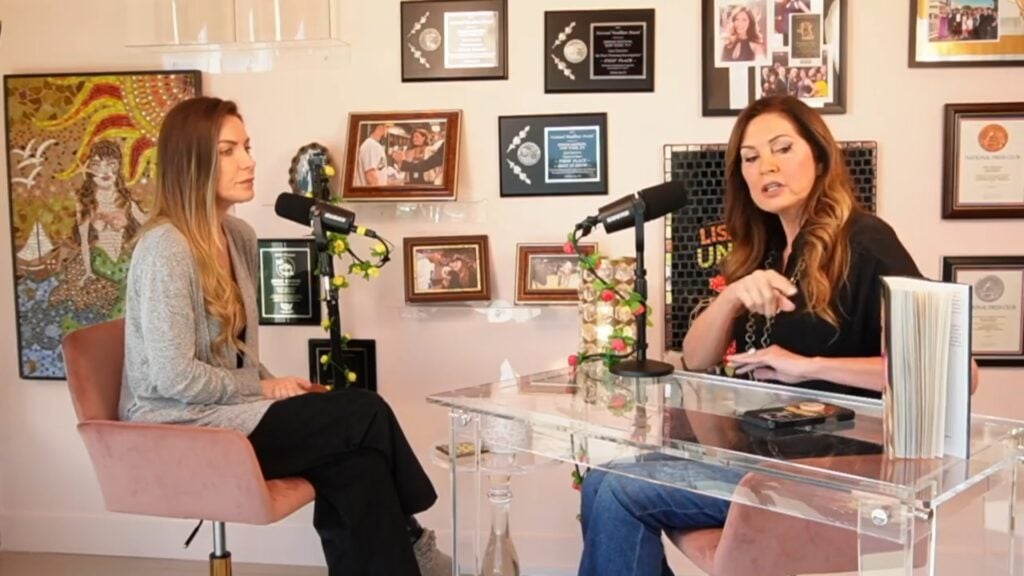
On the Tuesday, October 27 episode of Lisa Guerrero’s Unleashed podcast, Crystal Harris spoke about her late husband — and people who rubbed elbows with him, no matter his reputation.
“Jon Lovitz, you were Playboy Mansion’s number one customer,” Crystal accused during the episode.
“You were, like, one of the biggest pervs there,” she characterized.
Many people use “perv” and “pervert” as terms of endearment, in part to reclaim terms often leveled at women and LGBTQ+ folks online.
It does not sound like Crystal intends this as a compliment towards the famous comedian.
(As before, we apologize for the AI slop thumbnail. YouTubers need to be better than this.)
Crystal went on to alleged that Lovitz was “up there” at the infamous Playboy Mansion “all the time.”
It seems that, at best, he came across as lecherous.
“And his eyes would go front to back, all the women that walked through the door,” Crystal recalled.
“And at the parties, he’d be the lurker,” she described. “And I remember him every time, every party.”
Mere hours after the podcast episode aired, Jon Lovitz had a chance to respond.
On Tuesday evening, the comedian was out in Los Angeles, where he either took Crystal’s comments in stride — or earnestly misunderstood them.
“Anytime someone tells me I’m number one, it’s a compliment,” Lovitz announced, according to Page Six.
That’s … an interesting way of looking at that. Perhaps he just wanted to say something witty to dismiss it.
As for the characterization that he was a lurker, he simply shrugged it off.
Again, we want to emphasize that Lovitz is not accused of crimes or wrongdoings, just of giving Crystal the ick. Being a Subway spokesperson is not a crime, despite some unfortunate associations.
What else did Lovitz have to say?
“Hugh Hefner was one of the nicest, most generous people I’ve ever met,” he raved.
“And,” Lovitz continued, “all of his friends know it. That’s all I have to say about that.”
Once again, it seems that powerful men are best remembered by other men for how kind they were to them — but not how they treated others.
Crystal Hefner Says Famous Comedian Was ‘Biggest Perv’ at Playboy Mansion was originally published on The Hollywood Gossip.
The Hollywood Gossip

 She’s just a niece, standing in front of an aunt, telling her how much she loves her.
Emma Roberts couldn’t let her aunt Julia Roberts’ 59th year go unrecognized, penning a festive tribute to her…
E! Online (US) – Top Stories
Heat seekers ventured beyond the iconic orange chicken at Panda Express with this fiery collaboration. Here’s what folks thought about the seriously spicy dish.
Mashed – Fast Food, Celebrity Chefs, Grocery, Reviews