We have tragic news to report out of Hollywood today.
Michael Kearns, the groundbreaking actor, director, and LGBTQ+ activist who challenged the industry’s treatment of gay performers and people living with HIV, has died.
He was 76.
Actor Michael Kearns attends GLAAD Celebrates 25 Years Of LGBT Images In The Media Show on December 3, 2010 in Los Angeles, California. (Photo by Valerie Macon/Getty Images)
Kearns passed away on October 5, according to longtime friend Karen Ocamb, who shared the news with the Los Angeles Blade. A cause of death has not been publicly disclosed.
While Kearns appeared in popular television shows including Cheers and Beverly Hills, 90210, his legacy extends far beyond his acting credits.
He was among the entertainment industry’s earliest openly gay performers and spent decades fighting for LGBTQ+ visibility.
Kearns came out publicly in the 1970s, when being open about one’s sexuality could seriously damage an actor’s career. He made another courageous decision in 1991 when he revealed that he was HIV-positive, helping challenge the stigma surrounding the virus.
At a time when many people feared the professional and personal consequences of disclosing an HIV diagnosis, Kearns chose to speak publicly about his experience. His advocacy became a defining part of his career.
And he wasn’t content to make a difference in Hollywood alone.
In 1986, Kearns directed the world premiere of Robert Chesley’s Jerker at Los Angeles’ Celebration Theatre.
The play follows two gay men who form a connection through a phone-sex line. Its sexually explicit content sparked controversy after excerpts were broadcast on the radio, igniting a debate over censorship and LGBTQ+ representation.
Kearns also performed in solo productions inspired by the AIDS epidemic, including Intimacies and More Intimacies. Through his theater work, he helped tell stories about people whose experiences were frequently ignored by mainstream entertainment.
His activism included co-founding Artists Confronting AIDS and establishing QueerWise, a spoken-word collective. He also authored books about acting and theater.
Kearns’ personal life included profound heartbreak. He married Philip Juwig in 1992, but Juwig died later that year. Three years later, Kearns adopted a daughter, Katherine, becoming a single father at a time when gay men living with HIV faced considerable prejudice.
The actor’s willingness to live openly, both personally and professionally, made him an important figure in LGBTQ+ history.
Kearns was scheduled to return to Celebration Theatre on October 11 for an event celebrating LGBTQ+ theater history. He had planned to perform selections from Jerker alongside longtime collaborator Joe Gill.
Instead, the theater community is remembering a performer whose contributions extended well beyond the stage.
Kearns spent decades challenging discrimination, confronting HIV stigma, and creating space for LGBTQ+ stories. His death marks the loss of a trailblazer whose influence reached far beyond Hollywood.
Our thoughts go out to Michael Kearns’ loved ones during this enormously difficult time.
“West Hollywood is not safe anymore,” Allen warned in his Instagram caption.
“Robbed at gunpoint and knifepoint by two young men,” he described, “that threatened to KILL me over my watch and would have!”
Framing his survival in a religious context, Allen declared: “God said no tonight.”
He marveled grimly: “My life for a watch.” Dreadful to contemplate.
“Will update more soon,” Allen promised.
In his Instagram caption, Allen warned about his robbery and noted that surveillance does not prevent crime. (Image Credit: Instagram)
‘My life for a watch’
Allen concluded his caption by taking a verbal shot at city and state politicians who have helped install a dystopian panopticon.
“Let’s hope all these flock cameras that @karenbassla @gavinnewsom and everyone thinks will stop crime can find these very dangerous criminals,” he wrote. “God bless.”
Actual policies to reduce this kind of crime center upon improving economic stability, from jobs to healthcare to housing and beyond.
It is only natural that, in this time of economic crisis, robberies are becoming more bold, more violent, and more desperate. Though there is only so much that (hopefully) future Mayor Nithya Raman can do on the local level, we have already seen how much crime has gone down in New York City over a matter of months under Mayor Mamdani. Policies can improve lives and heal communities.
TMZreports that the two men who approached and robbed Allen were wearing all black. One pointed a handgun at the actor’s face while the other menaced him with a knife.
They demanded his watch and bracelet before fleeing with his Rolex.
The gunman struck Allen in the face, resulting in the nasty bloody gash. These two malefactors then fled in a vehicle.
Allen contacted police. Paramedics treated him for the laceration, but reportedly did not transport him to the hospital.
This sounds horrifying. We hope that the perpetrators are caught. Returning his watch will not undo the crime, but it would be a nice start.
The region may become less of a target for groups seeking to pressure the United States. But the Kurds also have less security support now, should they need it.
Research shows that having the support of friends can be invaluable when you’re dealing with cancer, and these celebrities say their experiences back that up.
Health Digest – Health News, Wellness, Expert Insights
Wandering down this road that we call life can bring some uninvited speed bumps.
And Boy Meets World’s Will Friedle definitely did not want to spend a recent Saturday in the hospital.
“I woke up… E! Online (US) – Top Stories
These 15 vintage recipes bring back skillet suppers, Southern staples, old-fashioned bakes, cured meats, and family-style dishes that still make sense for today’s table, from breakfast through dessert.The post My grandpa said this tasted just like his mother’s — 15…
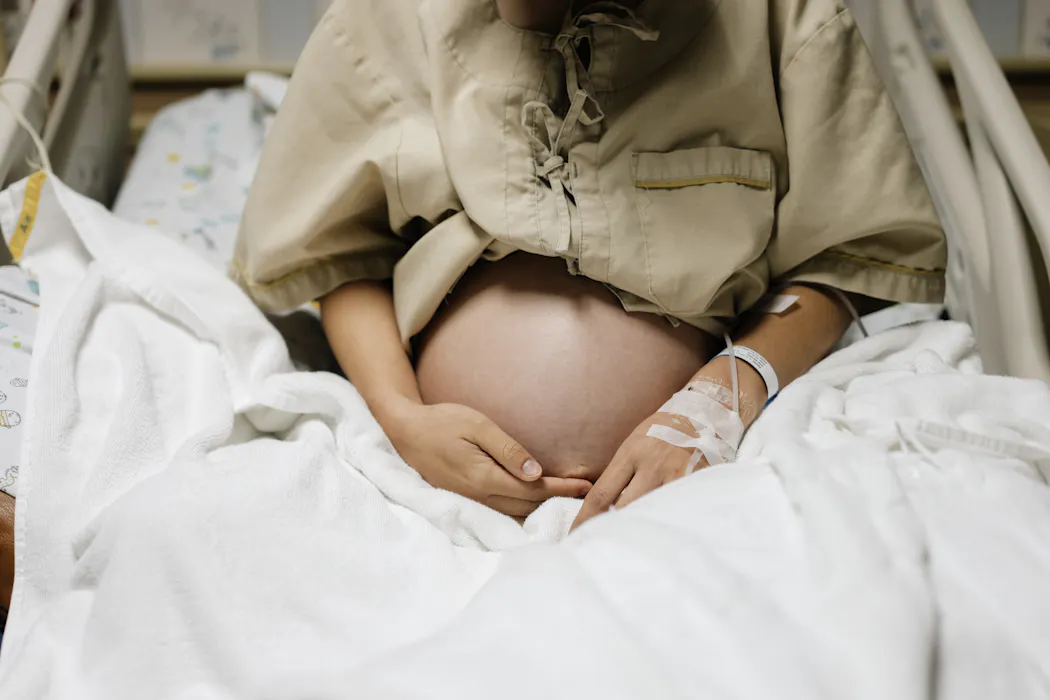
Who controls a pregnancy is one question surrogacy contracts struggle to answer.skaman306/Moment via Getty
Surrogacy arrangements – agreements for someone to carry a pregnancy for the intended parents – have existed for millennia, and modern surrogacy contracts for half a century.
In a 2026 case, surrogate McKenna West refused the intended parents’ request for an abortion after the fetus was diagnosed with a serious heart condition. The case raises an uncomfortable question: What happens when the surrogate’s bodily autonomy collides with the intended parents’ wishes?
As scholars of reproductive justice and family law, we see this case as an example of how rapidly changing abortion laws, reproductive technology and family law can create conflicts that surrogacy contracts cannot necessarily anticipate.
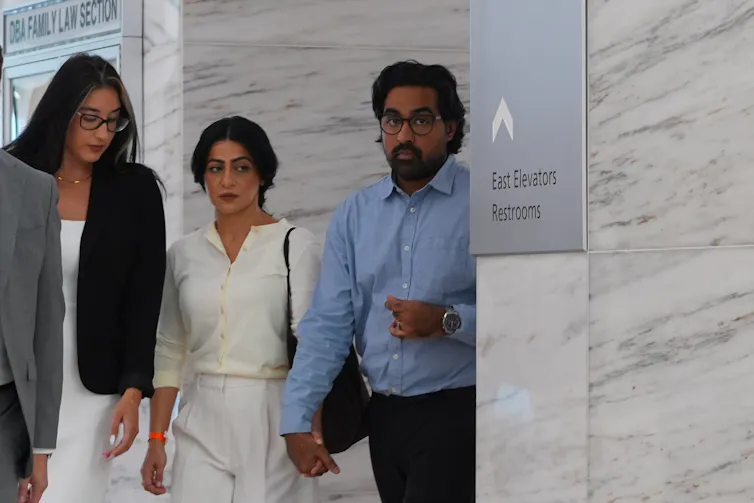
Omar Ahmed, right, and his wife, Nausheen Gilkar, center, arrive for a court hearing in Dallas on Aug. 25, 2026, in their fight with their surrogate, McKenna West. AP Photo/LM Otero
The West case
West’s contract stated that “there shall be a termination of the pregnancy for a fetal abnormality … if the Intended Parents request” it. She later wrote that “their lawyer and my own former lawyer sent me letters threatening six-figure penalties if I didn’t comply with their demand to terminate.”
Instead, West moved from Alaska to Texas, where she had family support and believed the baby, when born, could get needed care. Moreover, she knew that Texas bans abortion in almost all circumstances. Meanwhile, the intended parents, who lived in California, obtained a court order before the birth stating they would become the legal parents once the baby was born.
McKenna West, center, walks in a hallway before a court hearing in Dallas on Aug. 25, 2026. AP Photo/LM Otero
Previous conflicts
In a similar 2012 case, surrogate Crystal Kelley signed a contract allowing the intended parents to call for an abortion in case of a severe fetal abnormality. When the fetus was diagnosed with a heart defect and other serious anomalies, the parents asked Kelley to terminate the pregnancy. She refused and left Connecticut, where she would not have had parental rights, for Michigan, which at the time would treat her as the legal mother. Kelley placed the baby for adoption, and the girl’s adoptive parents raised her until her death at 8.
In the 1988 Baby M case, a surrogate who was also the genetic mother insisted she should be the mother despite signing a contract to relinquish parental rights. The New Jersey Supreme Court voided that contract because it held that she could not give up her parental rights before birth. As a result, it recognized the surrogate as the legal mother but awarded custody to the father. She later received visitation rights.
West’s journey, for example, involved three states – Alaska, Texas and the intended parents’ state of California. They are deemed surrogacy-friendly, meaning contracts are relatively easy to enforce there, though the states diverge sharply on abortion.
Surrogacy agreements may require the surrogate to restrict travel, eat nutritiously and cooperate with healthcare providers. As in the West and Kelley cases, agreements may also specify when the surrogate could be asked to abort or, if pregnant with multiple fetuses, selectively terminate.
These abortion provisions have rarely been tested in court, and West’s case hasn’t resolved whether they are enforceable. Rather, they raise the question: Can anyone be forced to have an abortion?
After the Supreme Court’s 2022 Dobbs decision, which held there is no fundamental right to abortion, states have determined their own abortion laws. In states like Texas, abortion provisions in surrogacy contracts are unenforceable. But even where abortion is legal, a court would likely refuse to compel an abortion, given the surrogate’s bodily autonomy.
A surrogate’s control over her body may be more limited, however, when intended parents seek to enforce provisions meant to protect the fetus.
If a physician recommends a C-section for the fetus’s well-being and the surrogate refuses, for example, a court might enforce a contract clause requiring her “to cooperate with her medical providers.”
Even before 2022, when abortion was still a federal constitutional right, courts in some – but not all – jurisdictions ordered C-sections against the pregnant person’s wishes.
In other words, bodily autonomy has never been absolute for pregnant people.
A post-Dobbs world
Since Dobbs, surrogacy and abortion have become increasingly intertwined.
In 2025, a Florida judge questioned the constitutionality of surrogacy on fetal-personhood grounds – the legal theory that an unborn fetus or embryo has the same legal rights as a born human – even as he granted the intended parents parental rights.
In his view, there can be no “contractual ownership interest over the unborn baby.” Florida’s attorney general took the argument further, declaring that the couple’s contract with the surrogate violated the 13th Amendment’s ban on slavery. A spokesperson said he was concerned “about any case where a surrogacy company profits off the sale of children.”
Some conservative legislators and advocacy groups have also been challenging the legitimacy of surrogacy, a few with plans to limit or even ban it. Consequently, in states that take fetal and embryo personhood seriously, surrogacy contracts and even IVF could become unavailable.
West’s case has surfaced starkly different views of what is at stake. For some, surrogacy is a form of baby selling that should not be allowed. For others, it is a way for intended parents to create families and for surrogates to support them.
Surrogacy asks the law to recognize both the interests of people who intend to become parents and the autonomy of the person who is pregnant. Dobbs has made that balance harder to maintain by inviting fetal-personhood principles into areas of law that had not previously treated fetuses or embryos as persons.
The authors do not work for, consult, own shares in or receive funding from any company or organization that would benefit from this article, and have disclosed no relevant affiliations beyond their academic appointment.
In 1859, Edwin Drake struck oil along Oil Creek near Titusville, Pennsylvania. His well was funded by investors from New Bedford, Massachusetts, who were looking for a replacement for whale oil, which was expensive and challenging to acquire.
The first oil deals were struck on the streets of Oil City, about 90 miles north of Pittsburgh, while traders were still working out basic questions about “rock oil,” as crude was then called: What was it good for, and how much should it cost?
To create a more formal system, the oil traders developed a railroad car designed to be a rolling oil exchange on the Oil Creek Railway. It made 13 stops daily between Titusville and Oil City, and trading was conducted on the honor system, with no written certificates of purchase or sale.
Traders pushed for a building of their own, arguing that a growing industry needed a more formal market. By 1874, Pennsylvania’s Oil Valley was producing roughly 30,000 barrels of crude oil a day, which sold for an average of about $1.15 a barrel.
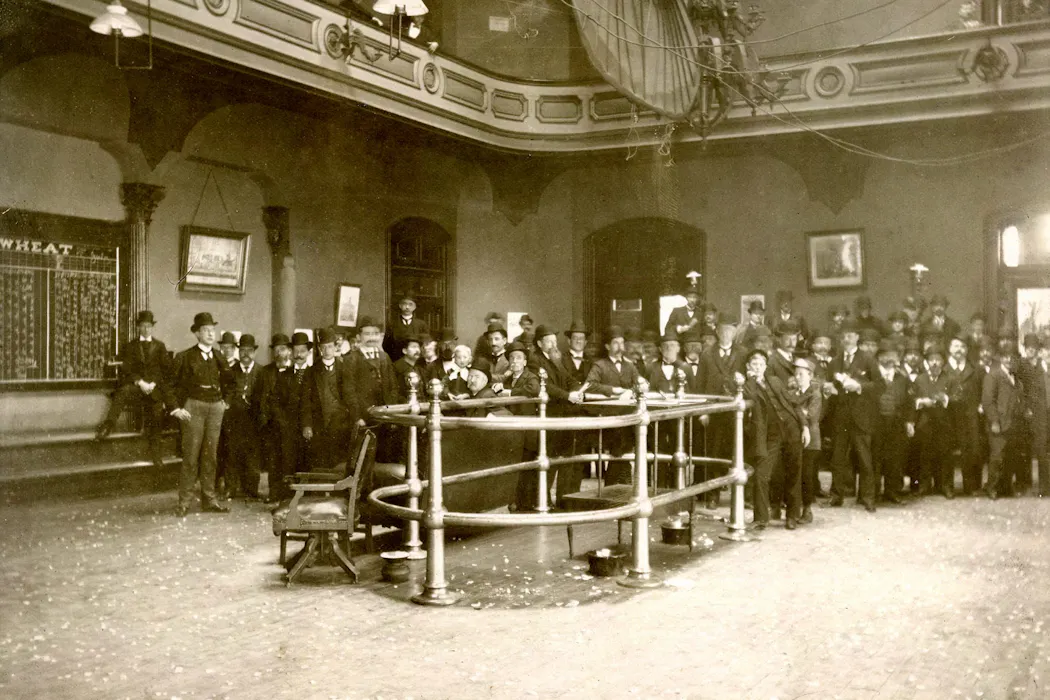
Rather than physically moving barrels around, trading had moved from handshakes to paper. Pipelines issued certificates representing the oil in their lines. Traders bought and sold the paper certificates representing oil, often trading the same barrels many times in a single day. As a result, the volume of oil changing hands could reach 10 million to 14 million barrels a day, hundreds of times more than the wells actually produced.
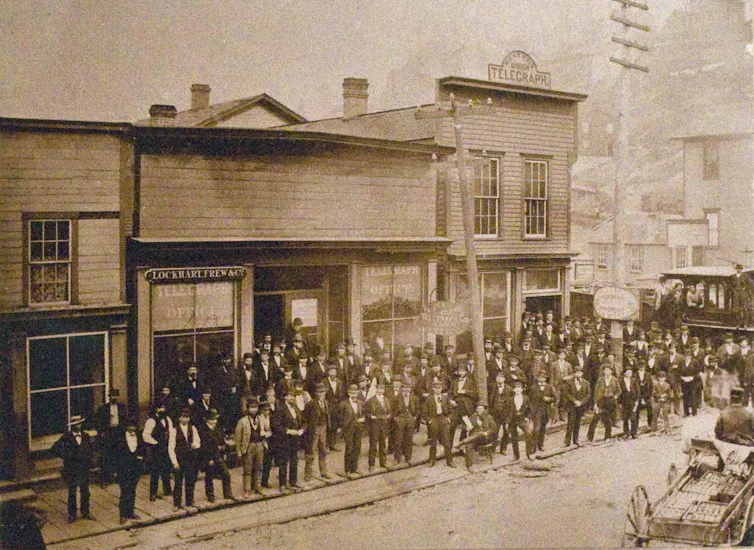
As the industry quickly grew, an oil exchange office was set up at the Arlington Hotel in Oil City. Oil Region Library Association
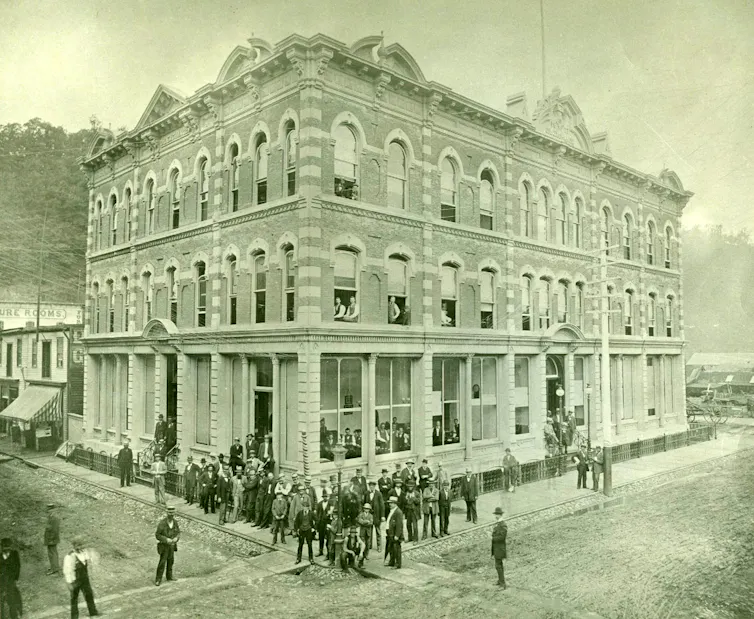
In April 1874, a group of Oil City oil men received a state charter to form the Oil City Oil Exchange. Construction started in July 1877 at the corner of Center and Seneca streets.
When the Oil Exchange opened in April 1878, the local newspaper called it “the largest and most elaborate structure ever erected in the Oil Region.” The building, the paper said, reflected how big the speculative side of the oil trade had become. Standard Oil, the nation’s largest oil company at the time, owned by John D. Rockefeller, kept offices in the building.
The Oil City Oil Exchange heavily influenced early crude oil pricing. Brokers there collected 10 cents a barrel from buyers and 5 cents from sellers.
While the Oil City Oil Exchange was the center of the oil industry for nearly two decades, by 1895 Standard Oil had effectively cornered the market. Its chief buyer, Titusville resident Joseph Seep, began paying producers cash directly, at a price Standard set itself. That control lasted until 1911, when the U.S. Supreme Court ruled in a landmark antitrust case that the trust had to be broken into 34 separate companies.
After that, no single company controlled the price of crude oil.
Who sets the price of oil now
Predicting oil prices became a much bigger concern after the oil crises of the 1970s, when sudden price hikes rattled economies around the world.
Today, the price of crude oil is set largely by traders on two exchanges: the New York Mercantile Exchange and the Intercontinental Exchange. Prices there shift from second to second, and gas prices at the pump follow them, usually within days or weeks.
Much of that trading involves futures contracts, which are agreements to buy oil at a set price on a future date. In the U.S., the benchmark contract is for oil delivered to Cushing, Oklahoma, a storage hub where many of the country’s pipelines meet.
A sign at a gas station in New York shows prices on Sept. 15, 2026, as the war with Iran keeps fuel costs high. Xinhua News Agency via Getty Images
The latest shock to that system began this year. War began on Feb. 28, 2026, when the U.S. and Israel launched airstrikes on Iranian military targets that killed Iran’s supreme leader, Ayatollah Ali Khamenei. Iran struck back with missiles and drones and began attacking commercial ships in the waters around the Strait of Hormuz, the narrow channel between Iran and the Arabian Peninsula that connects the Persian Gulf to the open ocean.
Within days, the attacks and a wave of canceled shipping insurance brought tanker traffic nearly to a halt.
On March 2, a Revolutionary Guard commander made the closure official in a statement carried by Iran’s state media: “The Strait of Hormuz is closed. If anyone tries to pass, the heroes of the Revolutionary Guards and the regular navy will set those ships ablaze.”
Oil and gas prices kept climbing as peace talks failed. By May 2026, the average price of a gallon of regular gas in the U.S. was 50% higher than before the war began. Since then, Gulf oil producers have found ways around the blockade, sending oil through pipelines to ports outside the strait and through a U.S.-guarded shipping route near Oman. By late September, those work-arounds had restored about half of the oil that normally passes through the strait, helping keep crude prices around $100 a barrel instead of the much higher levels many analysts had feared.
Oil City’s exchange building is long gone. It was torn down in 1926 to make way for a bank. But the market its traders built, where paper claims on oil change hands far faster than the oil itself moves, still sets what drivers pay at the pump in Oil City and everywhere else.
Brian C. Black does not work for, consult, own shares in or receive funding from any company or organization that would benefit from this article, and has disclosed no relevant affiliations beyond their academic appointment.
Sometimes, when you know, you know. And Bella Hadid was well aware from an early age that she had an innate sense of style.
Even before the model—celebrating her milestone 30th birthday Oct…. E! Online (US) – Top Stories
















 Wandering down this road that we call life can bring some uninvited speed bumps.





 Sometimes, when you know, you know. And Bella Hadid was well aware from an early age that she had an innate sense of style.