Categories
Uncategorized

In newly independent US, Americans debated whether public executions taught a lesson or just showed off the state’s power to destroy

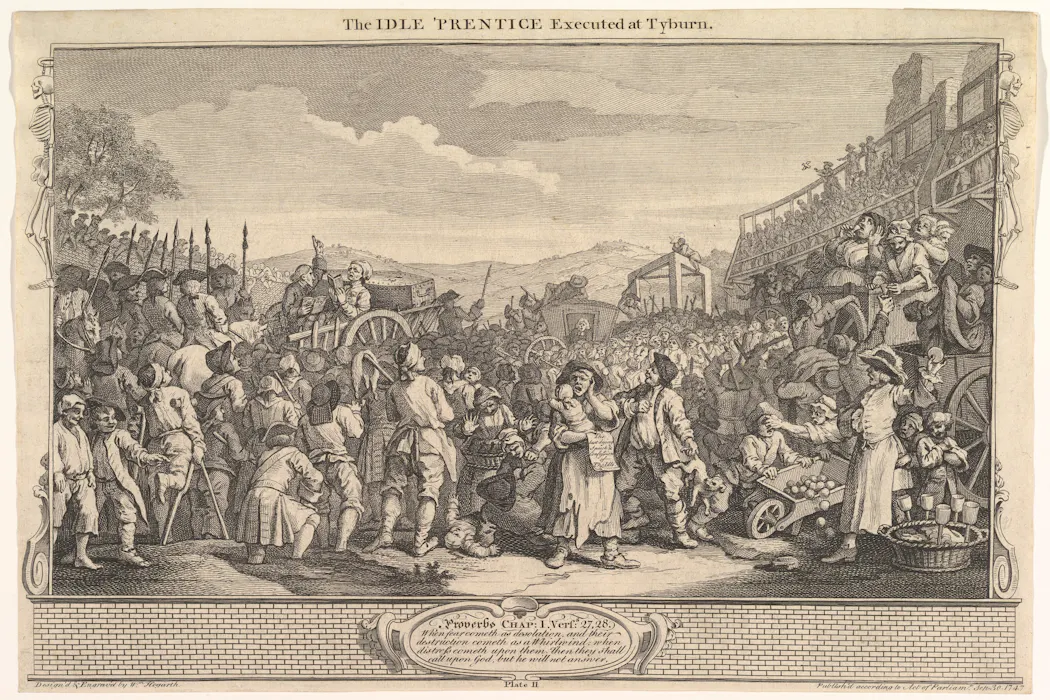
A 1747 print of a public execution at the so-called Tyburn Tree, a gallows in London that served for hundreds of years as a site of hangings. William Hogarth

The proposed livestream of Nidal Hasan’s execution by a U.S. military firing squad gives an old question a new audience. Hasan, an Army psychiatrist convicted by a military court of killing 13 people at Fort Hood in Texas in 2009, is scheduled to be executed on Dec. 3, 2026.

Explaining the plan to make his death public, Defense Secretary Pete Hegseth said that “people need to understand … there’s serious consequences for these types of things.”

Whether the broadcast will proceed remains uncertain. But as a historian of the early American republic, I recognize a familiar expectation behind it: that watching someone die will teach a useful lesson. Americans at the republic’s founding debated that premise — and doubted what the lesson might be.

Defense Secretary Pete Hegseth said the execution of Nidal Hasan will be a public event when the sentence is carried out later this year.

The power of government

On Aug. 17, 1797, New Yorkers gathered to watch John Young hang.

An English musician and music publisher struggling with debt, Young had shot and killed Robert Barwick, a deputy sheriff taking him into custody. Barwick left a widow and nine children.

Young’s conviction by a jury brought him to a scaffold surrounded by soldiers, before an immense crowd.

Governor John Jay, a leading Federalist who placed greater faith in firm government than in popular judgment, had authorized the military presence after the sheriff reported fears of a rescue. But Jay also wanted the execution to impress its witnesses with the power of the government carrying it out.

Writing to James Kent, New York City’s chief municipal legal officer, two days before the hanging, Jay stressed that the authority of law should prevail visibly. The occasion should be “particularly solemn and impressive,” he said. The “authority of the law should be seen to bear down (on) all opposition.”

Solemnity, however, proved difficult to arrange. The military escort played lively music as the procession made its way to the scaffold. One newspaper critic thought an uninformed passerby might mistake the spectacle for “the celebration of some Festival.”

Soldiers formed a square around the gallows. The crowd remained orderly. Young addressed a few words to the minister, sang a psalm “and with great composure pulled his cap over his face,” reported one newspaper. Then, before the assembled witnesses, he was hanged.

Loss of government’s dignity

Whatever the crowd’s reaction that day, the public execution had already become an argument about the nature of government.

The display did not impress everyone as evidence of governmental strength. Writing in the “Greenleaf’s New York Journal” two weeks after the hanging, “A CITIZEN” accused Jay of “letting down the dignity of civil authority.” Calling out troops for the execution suggested, among other things, “a wantonness on the part of the Executive.”

To this critic, the military presence advertised executive excess. The spectacle could undermine the very authority it was meant to affirm.

That point mattered in a republic still deciding how its authority should differ from that of the European monarchies that Americans portrayed as corrupt.

In the 1780s and 1790s, American reformers took particular aim at England’s “sanguinary laws” – statutes prescribing death for offenses ranging from murder to relatively minor theft.

By 1776, nearly 200 offenses carried a possible death sentence in England. These laws had accumulated piecemeal over generations, but American critics portrayed them as a single system with bloodshed at its center.

England’s punishments became a measure of what republican justice must overcome. Independence required Americans to reconsider how readily, and under what circumstances, their own governments could take a life.

The contrast was partly an exercise in national self-definition. Americans cast English severity as evidence of an old, corrupt political order and imagined their own laws as rational, proportionate and suited to free citizens.

In practice, the distinction was harder to sustain.

Nevertheless, the aspiration entered constitutional language. New Hampshire’s 1784 Constitution declared a multitude of sanguinary laws “both impolitic and unjust.” Punishment’s proper object was “to reform, not to exterminate mankind.”

Reform did not necessarily mean abolition. In 1796, New York reduced the number of crimes punishable by death but retained capital punishment for murder.

Young went to the gallows the following year. Even if Jay favored milder criminal laws, he was able to see a carefully staged execution as a necessary assertion of public authority.

No guarantee of lesson learned

Other Americans pressed further.

Benjamin Rush, the Philadelphia physician and signer of the Declaration of Independence, opposed executing even murderers. His argument went to the heart of the relationship between government and the governed.

“Capital punishments are the natural offspring of monarchical governments,” Rush wrote in 1792. “Kings consider their subjects as their property.”

For Rush, a republic that put citizens to death still acted like a monarchy, treating citizens’ lives as its own to dispose of. Calling the killing a lawful punishment did not make it less an act of revenge.

A related debate concerned the audience. Even Americans who accepted capital punishment could doubt the wisdom of making it public.

In 1787, Rush had already questioned what spectators actually learned from watching others suffer. Sympathy for the condemned could turn them against the government: “We secretly condemn the law which inflicts the punishment – hence arises a want of respect for laws in general,” he wrote in a pamphlet titled “An Enquiry into the Effects of Public Punishments upon Criminals and upon Society.”

Alternatively, repeated exposure to cruelty could harden spectators, encouraging the very violence that punishment was supposed to deter. “How often,” Rush asked, “do we find pockets picked under a gallows, and highway-robberies committed within sight of a gibbet?”

The crowd could pity the condemned, admire his composure or simply enjoy an outing. Gathering witnesses did not guarantee that they absorbed the intended lesson. The complaint about festive music at Young’s execution exposed that uncertainty: Officials could stage the spectacle, but they could not control its meaning.

A title page from an 18th-century publication, 'An Enquiry into the Effects of Public Punishments upon Criminals and upon Society.'
In this publication, Benjamin Rush asked whether ‘we secretly condemn the law which inflicts the punishment.’
NIH

What harm does this prevent?

Young’s execution gives the proposed broadcast of Hasan’s death a particular resonance. The crimes, jurisdictions and audiences differ, yet the ambition remains recognizable: to make one person’s punishment teach everyone else a lesson – and demonstrate the government’s strength.

Cruelty concerns more than the pain inflicted. It also lies in treating a person as fodder for exposure, humiliation and public instruction. The condemned person’s body becomes a public demonstration of whom the state protects – and whom it has the power to destroy.

But spectators may come for the theater of death itself, drawn by fascination with what human beings can do to one another. What officials present as instruction can become the marketing of guilty pleasures.

Cesare Beccaria, an Italian criminologist and economist whose 1764 essay “On Crimes and Punishments” helped shape American reform debates, argued that punishment could not undo a crime, only prevent future harm. Suffering beyond that purpose was unnecessary cruelty.

For Beccaria, an execution’s fleeting spectacle deterred less effectively than lifelong penal servitude. Beccaria’s alternative was harsh, but his principle constrained the state: The power to inflict suffering did not establish its necessity.

At Young’s scaffold, the state could end his life without controlling the meaning of his death. A broadcast would vastly enlarge the audience, but reach is no proof of usefulness, and curiosity supplies no justification.

Beccaria’s question thus remains: What future harm does this additional spectacle prevent? If it prevents none, what justifies it – and what does it reveal about the government that stages it?

The Conversation

Maurizio Valsania does not work for, consult, own shares in or receive funding from any company or organization that would benefit from this article, and has disclosed no relevant affiliations beyond their academic appointment.

​Politics + Society – The Conversation

Categories
Uncategorized

How Trump’s disaster aid delays and FEMA cuts could galvanize the ‘movable middle’ in the 2026 elections

After a deadly tornado hit communities in rural southwest Michigan in March 2026, the state’s request for federal disaster aid was denied. Bill Pugliano/Getty Images

When Hurricane Isaias hit the Florida Panhandle on Oct. 9, 2026, it was just the latest weather disaster for Americans in a year that continues to break records.

The hottest U.S. summer on record left millions of Americans facing life-threatening heat waves. Extreme heat and drought set the stage for wildfires. Flooding from powerful storms and days of heavy rainfall inundated communities in several states. And now a “Super El Niño,” on top of already rising temperatures and sea levels, is expected to make extreme events worse, at least into spring 2027.

In the past, states relied heavily on federal aid and expertise to respond quickly to disasters. But in communities across the U.S., people recovering from floods, storms and wildfires in 2025 and 2026 have been left waiting much longer for federal aid – if it arrives at all.

A woman stands our side a home torn up by a hurricane. Belongings are on the porch.
Hurricane Isaias hit the Florida Panhandle on Oct. 7, 2026, amid a quiet Atlantic hurricane season. Active hurricane seasons can push nationwide disaster costs well over $100 billion.
Jen Golbeck/SOPA Images/LightRocket via Getty Image

Will there be political consequences in the midterm elections for the slow aid and lack of government assistance?

The answer to that question runs through the ways the Trump administration has changed disaster response and federal disaster aid. As a professor who has written for years about civic engagement and climate policy, I have reason to believe that voters’ frustration with slow disaster aid may show up at the polls.

Cuts to FEMA hobbled federal disaster help

Even though the United States is experiencing more disasters as the climate changes, the federal programs meant to help Americans recover are being diminished.

The Federal Emergency Management Agency has faced significant cuts to funding and staff since the Trump administration took office in January 2025. The administration initially talked about abolishing the agency, arguing that states and communities could deal with disasters on their own. It created a plan to cut FEMA’s staffing by 50%, but in September 2026, a judge found that plan to be unlawful.

FEMA lost over 17% of its trained staff members in 2025 alone, including hundreds of people who were on call to respond to disasters. Homeland Security Secretary Markwayne Mullin continues to defend the administration’s goal of a leaner workforce at the agency.

The Trump administration also withheld billions of dollars meant to help states reduce their disaster risk and protect homes, hospitals and other structures from storm damage. Lawsuits forced the administration to restore some of the funds, but many communities are still struggling on their own.

These changes have tangible effects on how well states are able to recover from disasters and how well they can prepare for the disaster risks ahead as the climate changes.

Slower aid, if it arrives at all

The Trump administration is also taking longer to approve emergency funding after disasters than past administrations did and denying more of those requests.

In 2025 it denied 26% of requests for major disaster declarations, which unlock immediate federal aid. That was up from an average of 15% over the previous two decades.

An independent analysis of FEMA data exposes some clear patterns in funding delays under the Trump administration. The review found that major disaster declarations have taken an average of nearly 10 weeks to be issued during the current Trump administration, up from an average of three weeks or less over the previous two decades.

The administration says it is simply conducting more thorough reviews when governors make these aid requests. But people caught in disasters don’t have time to wait. Major disaster aid includes individual assistance, such as temporary housing, loans and repair grants, that disaster survivors need quickly to recover.

The review also found that about 85% of the requests for federal assistance from states that went for Donald Trump in the 2024 election were eventually approved, while only about half of requests have been approved in states that voted for his Democratic opponent, Kamala Harris.

A separate Associated Press report in July 2026 noted that no other president had such a sharp partisan divide in approving disaster declaration requests between Republican and Democratic governors since at least 1989, when a federal law set rules for disaster determinations.

Disaster failures can mobilize political moderates

A handful of studies, including mine, have found that people who have experienced a disaster often have higher levels of civic engagement.

In my study, civic engagement included contacting elected officials, signing petitions, attending public meetings, participating in boycotts or joining protests, among other actions. We didn’t look at the connection to voting patterns, but I believe there is good reason to expect our findings to extend to voting as well.

The relationship between experiencing a disaster and level of civic engagement was strongest for political moderates who are sometimes referred to as the “movable middle” – they could swing in either political direction if they have reason to do so.

Given the disasters America has seen in recent years and the sharp drop in federal assistance, I expect that political moderates who become more civically engaged will play a significant role in the midterm elections this year.

How FEMA cuts play out in a crisis

Several recent disasters have shown what happens when the federal government isn’t prepared to respond quickly.

After the devastating July 4 floods that swept through Texas Hill Country in 2025, the Department of Homeland Security, which oversees FEMA, waited three days before approving funding to send federal search-and-rescue teams, a Congressional report confirmed. Other funding approvals took an average of 12 days, leaving local and state programs to fill critical gaps in disaster systems.

In summer 2026, Texas was hit with floods again. The president approved assistance for some of the counties after a seven-week delay. Other requests for assistance were still waiting months later.

Flood debris has been pushed to the side of a road with two buildings off kilter at the end.
Flash flooding swept through Texas Hill Country again in 2026. Some FEMA aid was eventually approved but took seven weeks.
Brandon Bell/Getty Images

FEMA denied individual and statewide assistance to Michigan after severe storms and tornadoes tore up homes across several rural communities in March 2026.

With highly contested Senate races looming in both states, these actions by the Trump administration could color voters’ views or contribute to a lack of enthusiasm for the party in power and even increase support for the opposition.

A survey conducted by Pew Research Center in May 2025 found that the majority of Americans believe that it is a good idea for the federal government to provide financial assistance to help people rebuild after disasters in place at high risk of extreme weather.

These findings are relatively consistent across political parties: 60% of those who identified as Republican or leaning Republican said they believed it was a good idea, as did 68% of those who identified as Democrat or leaning Democrat.

Too little, too late?

Trump recently started announcing disaster aid approvals in states consequential to the control of Congress in the midterm elections, including in Wisconsin and Ohio. In some cases, he coupled his candidate endorsements with disaster funding announcements.

I don’t believe those late announcements will move the needle in his party’s favor at this late date.

The Conversation

Dana R. Fisher does not work for, consult, own shares in or receive funding from any company or organization that would benefit from this article, and has disclosed no relevant affiliations beyond their academic appointment.

​Politics + Society – The Conversation

Categories
Entertainment

Whatever It Takes, You’ll Want to See Where Degrassi’s Stars Are Now

Degrassi: Next GenerationDegrassi has officially entered the next generation.
Now celebrating its 25th anniversary, Degrassi: The Next Generation premiered on CTV Oct. 14, 2001.
For 14 seasons, viewers followed the lives…
​E! Online (US) – Top Stories

Categories
Music

Megan Moroney Says ‘No Girl Best Friend’ If You Want To Date Her

Megan Moroney just laid out her dating rules, and she’s pretty specific about what she won’t tolerate in a relationship. Continue reading…​Country Music News – Taste of Country

Categories
Music

Megan Moroney Says ‘No Girl Best Friend’ If You Want To Date Her

Megan Moroney just laid out her dating rules, and she’s pretty specific about what she won’t tolerate in a relationship. Continue reading…​The Boot – Country Music News, Music Videos and Songs

Categories
Entertainment

Burger King Breakfast Sandwiches, Ranked Worst To Best

There are plenty of fast food chains that offer menu items to help wake you up first thing in the morning. Among the most prolific is Burger King.

​Mashed – Fast Food, Celebrity Chefs, Grocery, Reviews

Categories
Alaska News

At Alaska rally, Trump endorses Wilson and seeks to boost Sullivan and Begich

President Donald Trump speaks at a rally Tuesday, Oct. 13, 2026, at the Menard Center in Wasilla. (James Brooks photo/Alaska Beacon)

President Donald Trump speaks at a rally Tuesday, Oct. 13, 2026, at the Menard Center in Wasilla. (James Brooks photo/Alaska Beacon)

In a surprise announcement Tuesday, President Donald Trump said he is endorsing Republican Alaska gubernatorial candidate Bernadette Wilson in the four-way race to replace term-limited Republican Gov. Mike Dunleavy.

Polls indicate Wilson and two other Republicans — Dave Bronson and Treg Taylor — are trailing the lone Democratic candidate, Jonathan Kreiss-Tomkins.

In a rally at Wasilla’s Curtis D. Menard Memorial Sports Center, Trump offered his support for Wilson, urged Alaskans to vote for a ballot measure repealing Alaska’s current elections system and encouraged votes for incumbent Republicans U.S. Sen. Dan Sullivan and U.S. Rep. Nick Begich III.

Tuesday’s rally made Trump just the third American president to visit the Matanuska-Susitna region and was part of a nationwide campaign by the President, who was in Ohio on Monday. He’s expected to be in Nevada and Arizona on Wednesday, with other stops in Montana and Georgia this week. 

In 90 minutes of rambling remarks, the President made his goal clear: He wants to motivate Republicans to turn out at the midterms and vote.

“Pretend that I’m on the ballot because here’s what happens. Every time I’ve been on the ballot, we win,” he said.

Attendees of President Donald Trump's rally on Tuesday, Oct. 16, 2026, fill the stands of the Menard Center in Wasilla. (James Brooks photo/Alaska Beacon)
Attendees of President Donald Trump’s rally on Tuesday, Oct. 16, 2026, fill the stands of the Menard Center in Wasilla. (James Brooks photo/Alaska Beacon)

Nationally, polling indicates that Republicans are trailing in key elections that may determine whether Republicans or Democrats control the U.S. House and U.S. Senate. 

Polls indicate Begich is ahead of Democratic Party-backed independent Bill Hill in a four-way race that also includes imprisoned Democrat Eric Hafner and Libertarian Jim McDermott.

Sullivan, meanwhile, is in a tight race against Democratic challenger Mary Peltola in a four-way election that also includes Dan J. Sullivan of Petersburg and Republican candidate Gerald Heikes. Polling indicates Peltola holds a small lead.

It isn’t clear how much Trump’s visit will affect those races. 

In a representative statewide survey of registered voters conducted Oct. 1-3, Alaska Survey Research found 58% of respondents had a negative view of Trump.

“We’ve asked this exact question maybe 50 times on surveys dating back to 2015. This is the worst rating we’ve ever recorded,” said company director Ivan Moore on social media. “58% is an all-time high negative.”

But among voters in the Matanuska-Susitna Borough, the site of Tuesday’s rally, Trump had a positive rating, with 44% of voters approving and 43% disapproving. 

“You are here in the heart of Republican Alaska,” Sullivan told the President. 

Trump landed at Joint Base Elmendorf-Richardson Tuesday afternoon before taking a helicopter to Wasilla’s airport and a car to the nearby Menard Center. He was met by a cheering crowd that filled the Menard Center’s seats before returning to his helicopter and an eventual flight to Las Vegas. 

The Menard Center has a capacity of about 3,500 people, and the Mat-Su Sentinel reported that some potential attendees were turned away at the door for lack of space.

Trump was interrupted about 10 minutes into his remarks by a protester who was rapidly rushed out of the rally by security.

Away from the Menard Center, Trump opponents held protests and Democrats organized counterprogramming away from the Republican-focused event inside. Other events took place Tuesday morning in Anchorage.

Alaska Republican governor candidate Treg Taylor talks with reporters on Tuesday, Oct. 13, 2026, at the Menard Center in Wasilla. (James Brooks photo/Alaska Beacon)

Trump backs Wilson in crowded gubernatorial race

Of Alaska’s four candidates for governor, three were present in Wasilla on Tuesday. 

Democratic candidate Jonathan Kreiss-Tomkins was in Fairbanks, attending a forum hosted by the local chamber of commerce. 

Before the rally, Republican gubernatorial candidates Dave Bronson and Treg Taylor each said they didn’t expect Trump to make an endorsement.

But about one hour before he took the stage, Trump took to social media and endorsed the leading Republican in the primary election, Bernadette Wilson.

Trump called Bronson and Taylor “lesser candidates” and said Bronson begged Trump for an endorsement. 

“I wouldn’t do it because he didn’t win the Primary and, therefore, wasn’t deserving of it. I then asked him to get out of the Race, and he agreed! … He agreed to get out, but three days later, without notification, quickly jumped back in, along with a third ‘Republican’ Candidate, who I never heard of, named Treg Taylor,” Trump wrote in a post on Truth Social.

Afterward, Bronson said, “My recollection is different than the president’s of that meeting.”

Bronson said that when he spoke to Trump, he agreed to leave the governor race if Treg Taylor did so but warned Trump that if both left the race, they would simply be replaced by other Republicans.

Taylor never withdrew, “so there was no deal,” Bronson said.

[Voter Guide: 2026 General Election Voter Guide: The candidates, the ballot measures, and the tools you need to cast your vote.]

On stage in Wasilla, Trump said that “now is the time for all Republicans to unite behind Bernadette” and wished her luck.

“It ain’t gonna be easy, Bernadette,” he said. 

Trump’s endorsement came hours after the Cook Political Report, one of the nation’s top election prognosticators, said Alaska’s race for governor now leans Democratic, in large part because the Republican vote is being split among three candidates.

Alaska uses ranked choice voting in general elections, which could eliminate vote-splitting, but election results since 2022 have shown that Republican voters are much less likely to rank multiple candidates than independents and Democrats are.

Incumbent Gov. Mike Dunleavy, a Republican who is term-limited and cannot run again this year, spoke at the rally about three hours before Trump took the stage.

“The only way we’re going to win is if we all vote for the Republican candidates for governor, and that’s very important,” Dunleavy said. 

Bronson and Taylor have urged Republicans to rank all three candidates, but Trump spoke against that appeal, calling ranked choice voting a “scam.”

In a text message, Kreiss-Tomkins’ campaign said the President is in Alaska “because national Republicans know that we’re neck-and-neck in this race, and electing a Democratic governor for the first time in a generation would send shockwaves across the country.”

Alaska hasn’t elected a Democratic governor since Tony Knowles, in 1994 and 1998.

As she left the Menard Center, Wilson said she was thrilled by the endorsement. 

“I think it signals, you know, a lot of excitement on our side, a lot of momentum on our side. You’re seeing everyone come together. They’re unifying behind us. We could not be more excited,” she said.

U.S. Sen. Dan Sullivan talks with reporters on Tuesday, Oct. 13, 2026, at the Menard Center in Wasilla. (James Brooks photo/Alaska Beacon)

Trump offers warnings about a Democratic Congress

Speaking in support of Sullivan and Begich, Trump insulted their leading opponents and the Democratic Party, and he predicted dire consequences for Alaska if Democrats win control of the U.S. House and U.S. Senate.

“Alaska is a special place to be, a very important place to be. And nobody’s done more for Alaska than Donald J. Trump,” he said. “With your support, just 21 days from now, Alaska is going to defeat the radical left Democrats.”

Later in his remarks, Trump said, “If the Democrats win, we will have a 1929-style economic depression. And I don’t like saying it, but they don’t know what the hell they’re doing.”

A relative handful of the seats in the U.S. House and Senate are considered competitive, and Alaska’s two federal races fall into that category, even though Republican presidents have won Alaska each election since 1964. 

Senate Minority Leader Chuck Schumer, D-New York, recruited Peltola to run against Sullivan and has said that her victory would be a step toward becoming Majority Leader and thus in control of the Senate agenda.

At Tuesday’s rally, Sullivan said he thinks that would be a disaster for the state because a Democratic Senate would seek to block oil and gas drilling.

“This would be horrible for Alaska,” Sullivan said of Schumer becoming Majority Leader. “The D.C. Democrats don’t have a positive agenda for Alaska. They have a target on Alaska. But this would also be horrible for the country we love, for the great United States of America. So, ladies and gentlemen, especially here in the Mat-Su Valley, you need to understand Alaska is the firewall for freedom for the entire country.”

An attendee of President Donald Trump’s rally on Tuesday, Oct. 13, 2026, in Wasilla, holds up a sign urging a yes vote on Ballot Measure 2. (James Brooks photo/Alaska Beacon)

President urges Alaska to repeal top-four primary, ranked choice general

In addition to boosting Republican candidates, Trump urged attendees of the rally to vote yes on this year’s Ballot Measure 2 and eliminate the state’s top-four primary election system and ranked choice general election.

That system was installed in a 2020 ballot measure and retained after a 2022 repeal effort narrowly failed.

Trump has repeatedly called ranked choice voting a “scam” and has urged states to not adopt it.

Under Alaska’s system, all candidates for an office run together, and the top four vote-getters, regardless of party, advance to the general election.

In the general election, voters rank the four remaining candidates in order of preference. If one candidate gets the majority of the first-choice votes, they win.

If no candidate has a majority, the candidate with the fewest first choices is eliminated and that candidate’s votes are redistributed to the voters’ second choice candidates. 

The process continues until only two candidates are left, and the person with the most votes wins.

“Vote against the ranked choice. Vote yes for the elimination of ranked choice,” Trump said.

Pardons signed for two diesel mechanics

During the rally, Trump signed presidential pardons for two local diesel mechanics who pleaded guilty to Clean Air Act violations during the Biden administration. 

Zachary Czubak and Patrick Fleming were convicted in 2022 of removing anti-pollution equipment from dozens of vehicles.

Sullivan had championed the pardons, saying the removals were justified because the anti-pollution equipment can cause poor performance at low temperatures.

Trump previously pardoned Mackenzie Spurlock, co-owner of Matanuska Diesel, in a related case.

Trump repeats ‘$5,000 dividend’ promise, but with new conditions

Speaking in Wasilla, Trump repeated a pledge he first made in September in Texas — a $5,000 payment to every adult American citizen if Republicans win the House and Senate during the midterms.

“The Trump dividend that you get, you’ll get it very quickly after the election,” he said.

That payment would cost $1.2 trillion, significantly increase the national debt and likely would increase the national rate of inflation, an independent analysis concluded last month.

At the Menard Center, Trump said he would restrict the dividend so that it could only be spent in the United States. He did not say how he would track Americans’ use of the money.

“I don’t want you to go to Japan. I don’t want you to go to China. You’ve got to spend it in the United States of America,” he said.

Visit makes local history

Trump became just the third President to visit the Matanuska-Susitna region. The first, Warren Harding, died on his return home after ceremonially opening the Alaska Railroad in 1923. The second was Jimmy Carter, who restricted his visit to a remote mountain lake for fishing.

Trump has repeatedly visited Alaska aboard Air Force One, which frequently stops in Anchorage to refuel during trans-Pacific flights.

His last notable venture away from Air Force One was one year ago, when he met Russian President Vladimir Putin briefly at JBER. 

Trump visited Alaska for a campaign rally in 2022 to endorse Dunleavy, U.S. Senate candidate Kelly Tshibaka and U.S. House candidate Sarah Palin. Of the three candidates, only Dunleavy won that year’s election.

President Donald Trump speaks at a rally Tuesday, Oct. 13, 2026, at the Menard Center in Wasilla. (James Brooks photo/Alaska Beacon)

SUPPORT: YOU MAKE OUR WORK POSSIBLE

Categories
Entertainment

Raise a Gold Goblet to These Still Strong Love Is Blind Romances

Lauren Speed, Cameron Hamilton, Love Is BlindLove may be blind, but the crop of contestants signed on for season 11 of the Netflix hit are entering the Love Is Blind pods with eyes wide open. 

Because while the addictive season has produced…
​E! Online (US) – Top Stories

Categories
Entertainment

5 Major Grocery Chains That Use Dynamic Pricing

Grocery chains love to advertise low prices, even if many of the most popular supermarkets engage in dynamic pricing, but what exactly does that mean?

​Mashed – Fast Food, Celebrity Chefs, Grocery, Reviews

Categories
Entertainment

The Wallet-Friendly Whiskey Brand Experts Recommend For Sipping And Cocktails

Raise the subject of the best budget whiskey in a room of connoisseurs, and opinions will diverge. Several experts we spoke to gave this brand a shout-out.

​Mashed – Fast Food, Celebrity Chefs, Grocery, Reviews