Categories
Uncategorized

How candidates are (quietly) talking about climate change – 3 election strategies you’ll see across the US

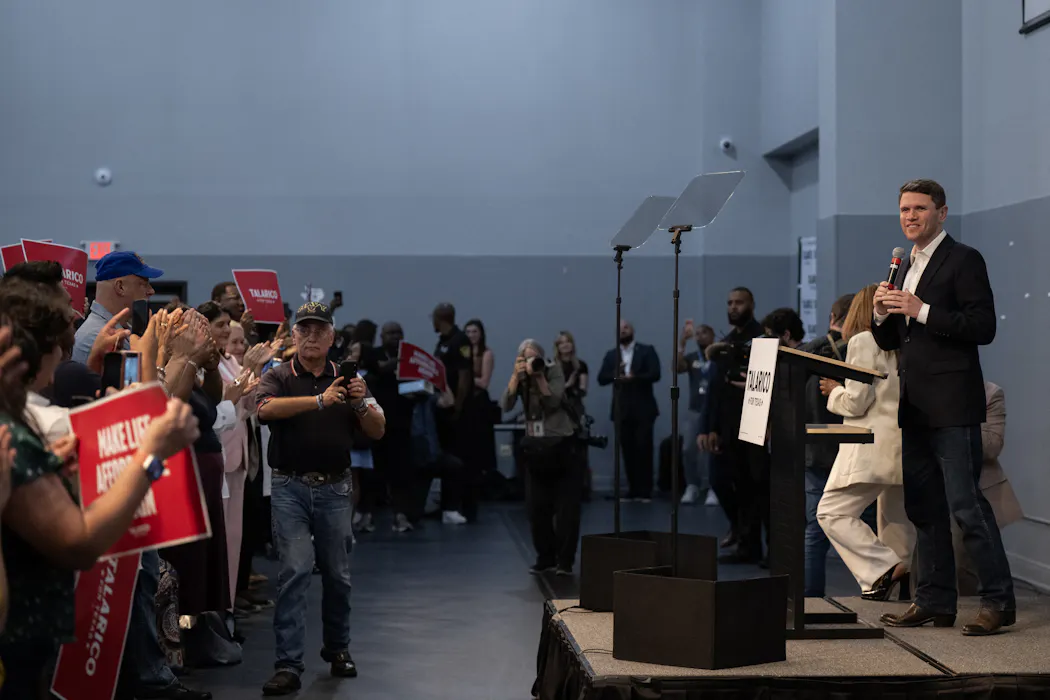
Supporters hold signs reading ‘Make life affordable’ at a James Talarico Senate campaign stop in Houston. Ronaldo Schemidt/AFP via Getty Images

Amid wars, inflation, emerging risks from artificial intelligence and threats to democracy, Americans have a lot to be worried about these days. But polls show the majority of voters in 2026 are also concerned about climate change as temperatures and disaster risks rise.

So why are fewer candidates talking openly about climate change in their midterm election campaigns than just a few years ago?

At the University of Michigan’s School for Environment and Sustainability, we study climate communication and are following how Democratic candidates are discussing climate change in their campaigns.

Democratic candidates seem to agree on one strategy: campaign centrally on affordability, emphasizing how ordinary people are struggling to afford to fill up their cars, pay their electric bills and insure their homes against hurricanes and wildfires. It’s part of a concerted effort to make the election a referendum on Republicans’ support for the Trump administration’s contributions to inflation, such as tariffs and the Iran war.

An arial view of a neighborhood inundated with floodwater and the river behind where the levee breached.
Days of heavy rain broke levees in the Seattle area, engulfing this neighborhood in floodwater on Dec. 16, 2025. More Americans are experiencing extreme weather firsthand and connecting it to climate change.
Brandon Bell/Getty Images

Fossil fuel industry interests have long sought to polarize the public over the phrase “climate change.” As one of us, Geoffrey Henderson, discusses in his new book, “Getting to Work on Climate Policy: The Strategy of Labor-Environmental Coalitions,” campaigns pitting economic concerns against environmental ones have made it harder to build support for policies meant to slow climate change.

When it comes to talking about climate change today, three distinct camps of Democratic candidates and officeholders reveal three different strategies.

The energy populists

The energy populists talk a lot about lowering energy prices for consumers but very little about either climate change or fossil fuels.

Many have been painting data centers, rather than fossil fuel producers, as villains. Candidates often use messages focused on how utilities and data centers are raising voters’ electric rates. They propose measures to lower these costs, like requiring data centers to bring their own energy sources onto the grid.

In North Carolina, former governor Roy Cooper, now running for U.S. Senate, emphasizes lowering energy and utility costs. Sherrod Brown of Ohio, campaigning to return to the Senate, argues that his opponent’s votes in favor of data centers have led to “higher electric rates.”

Roy Cooper meets with residents and his staff.
Roy Cooper, center, saw firsthand how disasters can ravage a state, including Hurricane Helene’s flooding that tore through mountain communities of North Carolina in 2024, killing more than 100 people.
North Carolina Department of Public Service

Discussing energy affordability, without directly calling out the risks to the climate from burning fossil fuels or advocating for more renewable energy, aligns with the argument that climate change messages can alienate swing voters, who prioritize affordability.

If energy populists are elected, they could become silent backers of climate policies to reduce greenhouse gas emissions – both Brown and Cooper have a record of supporting renewable energy – or obstacles to climate policies.

The climate champions

Not all Democrats, even in battleground states, think climate change should fade into the background this election. However, few are as outspoken today as they were in the past.

In Massachusetts, Sen. Ed Markey’s website pledges that he will champion “bold action to invest in clean energy” if reelected in November. In Maine, Senate candidate Troy Jackson asserts that politicians should not pit working-class people against renewable energy, casting the climate-versus-affordability debate as a false choice.

Sen. Sheldon Whitehouse from Rhode Island talks about candidates talking about climate change. Climate One.

Rhode Island’s Sheldon Whitehouse, one of the Senate’s most outspoken supporters of pro-climate policies, contends that candidates should link higher costs to climate change, such as increased home insurance costs due to hurricane risk. He also points to President Donald Trump’s blockade of the cheapest energy sources – namely, solar and wind power – which he attributes to fossil fuel industry influence.

If elected, these candidates’ messages suggest they will pursue policies that help reduce U.S. contributions to climate change. However, they may need to convince independent voters that their focus on climate change will not overshadow their attention to other challenges.

The all-of-the-above proponents

Another group of candidates wants to have it both ways. They call for actions that can respond to climate change and rapidly build out renewable energy, while also promising cheaper gasoline and more fossil fuel jobs. Scientists warn that more fossil fuel use cuts against global climate goals.

Unlike the other camps, this group does not identify villains in their narrative. These candidates are following the script from the Obama administration, whose “all of the above” energy strategy espoused continued fossil fuel use alongside policies to reduce planet-warming emissions.

Josh Turek, running for U.S. Senate from Iowa, talks with voters about high fuel costs. WHO13.

In Iowa, U.S. Senate candidate Josh Turek hosted a roundtable in April 2026 on how climate-fueled extreme weather is raising insurance costs. But he has also focused on lowering the cost of gasoline and diesel. James Talarico, campaigning for the Senate in Texas, has similarly promised to fight climate change by boosting renewable energy while lowering costs by promoting all energy sources.

These candidates may be trying to signal their potential to support climate policies while respecting their states’ cultural connections to fossil fuels. Turek and Talarico are both running in states with abundant wind power.

Where are the voters on this issue?

Studies from the U.S. and Germany find that politicians usually underestimate public support for efforts to address climate change.

So how well do candidates’ platforms represent today’s voters?

Yale’s spring 2026 survey found that 49% of voters believe global warming should be a high priority for Congress and the president. But 70% of moderate or conservative Democrats share this view, alongside 84% of liberal Democrats. Even 1 in 3 liberal-to-moderate Republicans considers the climate a high priority.

Yet polling also suggests that other issues, such as the increasing cost of living, are even more important to many voters. This data suggests that pro-climate messages could appeal to swing voters most strongly if climate policies are seen as complementary to affordability.

Still, a recent survey shows that voters open to Democratic candidates are more likely to support a candidate who prioritizes climate change. Climate messaging may especially resonate with young voters. Over a third of those ages 18 to 29 in a recent Harvard Youth Poll considered climate change an urgent national crisis. Young Republicans are more supportive of addressing climate change than their older counterparts.

While many shifts in the way candidates talk about climate policy have little impact on people’s willingness to participate in collective efforts to address it, messages emphasizing cost savings durably increase support for renewable energy across party lines. Voters’ current concerns about inflation could make climate messages involving affordability especially effective in 2026, though the impact of these messages may vary from state to state.

Retail politics and the way forward

These different approaches reflect the Democratic Party’s efforts to build a “big tent” that can attract voters with a wide range of views and priorities. Yet Democrats are generally coalescing around a message designed to appeal to working-class voters: that Trump and the Republicans are raising your cost of living.

November’s midterm elections will offer some insight into whether Democrats’ energy affordability message will resonate in the 2028 presidential election.

The Conversation

Geoffrey Henderson has worked on a project that received funding from the National Science Foundation.

Nathaniel Geiger has received funding from the National Science Foundation.

​Politics + Society – The Conversation

Categories
Uncategorized

Maine Sen. Collins’ success bringing home federal funds is a perfect example of the thin line between political favoritism and effective representation

Through her multiple reelection campaigns, Republican Sen. Susan Collins has focused on the money she brings to Maine. Spencer Platt/Getty Images

Give politicians the power to decide who gets a government contract, and people will naturally want to get on their good side. After all, the power to hand out something valuable is itself something valuable.

Consider the recent ProPublica investigation involving Sen. Susan Collins of Maine. Martin Kao, the former head of a Hawaii defense contractor called Navatek, told the FBI that his donations to the Republican senator’s campaign and an allied super PAC were part of a deal for help winning federal funding and contracts for his company.

That money padded Navatek’s bottom line, but it was also pitched as an investment in Maine: well-paying jobs from Navy contracts, university research and a new facility on Portland’s harbor.

Trading campaign contributions for official acts, or concealing illegal donations through relatives and shell companies, violate existing law – and it is part of why Kao now sits behind bars. Whether Collins or her official staff knew of an alleged bargain remains a legitimate question the public deserves answered.

But as a scholar of American politics, I argue that the question of criminal corruption obscures a larger problem: The line between political favoritism and effective representation is remarkably thin.

Instead, I wonder why a Hawaii defense contractor concluded that the surest route to federal money ran through a senator from Maine – and why his bet paid off.

Why is access to public money so dependent on the political influence of individual legislators?

A woman with dark hair in a red dress and white sweater, standing in a large room with posters behind her.
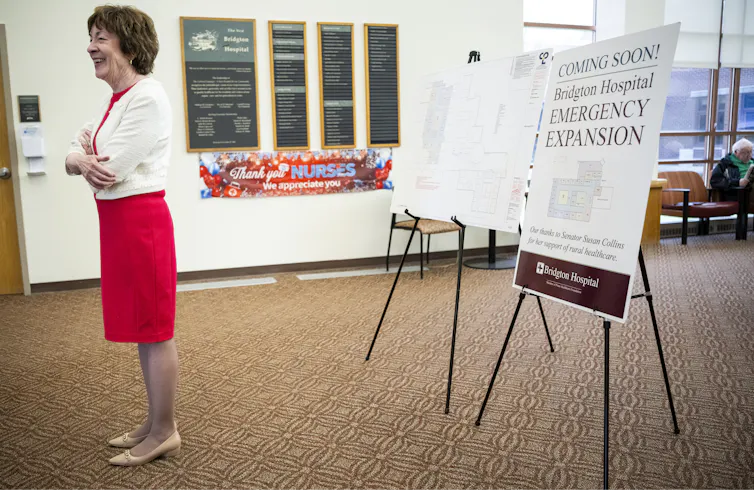
On May 5, 2026, Sen. Susan Collins stands in front of posters announcing expansion plans for Bridgton Hospital, for which she helped get federal funding.
Graeme Sloan/Getty Images

The power of appropriators

Earmarks – spending directed by a lawmaker to a specific local project – account for only about 1% of discretionary federal spending, but they offer an unusually clear window into a much larger competition for public money.

Congress revived the practice in 2021, allowing lawmakers to request funding for particular projects in their states and districts. Navatek’s funding came through the Pentagon budget in 2019, when earmarks were banned. But legislative disclosures make it possible to see who asks for money, who gets it and which politicians are best at delivering.

According to Senate Appropriations Committee disclosures, senators submitted 8,071 requests worth US$26.9 billion for fiscal year 2022. By 2026, that grew to 13,997 requests totaling $50.4 billion.

As these requests have grown, however, the share receiving such funding has fallen.

I matched nearly 55,000 Senate requests from fiscal years 2022 through 2026 against the projects Congress ultimately funded. For every senator, I calculated how many projects they requested independently and how many received funding.

Two things stand out.

The first is the seat: About 30 senators serve on the Appropriations Committee, which writes the bills funding federal agencies. They requested about one-third of the money but secured nearly half of the dollars approved and allocated. A dollar requested by an appropriator was almost twice as likely to become law.

The advantage isn’t partisan: Near the top of the chart, alongside Collins, sit a Vermont Democrat, Patrick Leahy, and a Kansas Republican, Jerry Moran. Leahy retired in 2023, while Moran is still on the panel.

The second is skill: Volume usually costs success – the more a senator asks for, the less of it lands. The median senator won 41% of the money they requested. But Collins is the exception. She requested 496 projects on her own over those five years and won 92% of them – the highest sustained rate in the Senate.

When Republicans regained the Senate majority in 2024, the rate only improved. In fiscal year 2026, her first year as chair, Congress funded 95% of her solo requests, while the median senator’s rate fell to 35%.

When Collins calls her chairmanship a “once in a century” opportunity, she has the evidence. The last Mainer to lead the appropriations committee was GOP Sen. Frederick Hale, who held the chair for four months in the 1930s.

Collins’ chairmanship explains her most recent advantage, but not her entire record. Even before taking the gavel, she secured funding at nearly twice the Senate median. Even in Washington, 30 years of showing up and working across the aisle still gets results.

Forms of political exchange

Now, put yourself in the position of a hospital, a business or a town seeking those dollars. Whose political career would you want to support?

In that respect, Collins is doing what senators are elected to do, and she’s doing it exceptionally well. When access to public resources depends on political influence, those who benefit have reasons to support the politicians most capable of delivering.

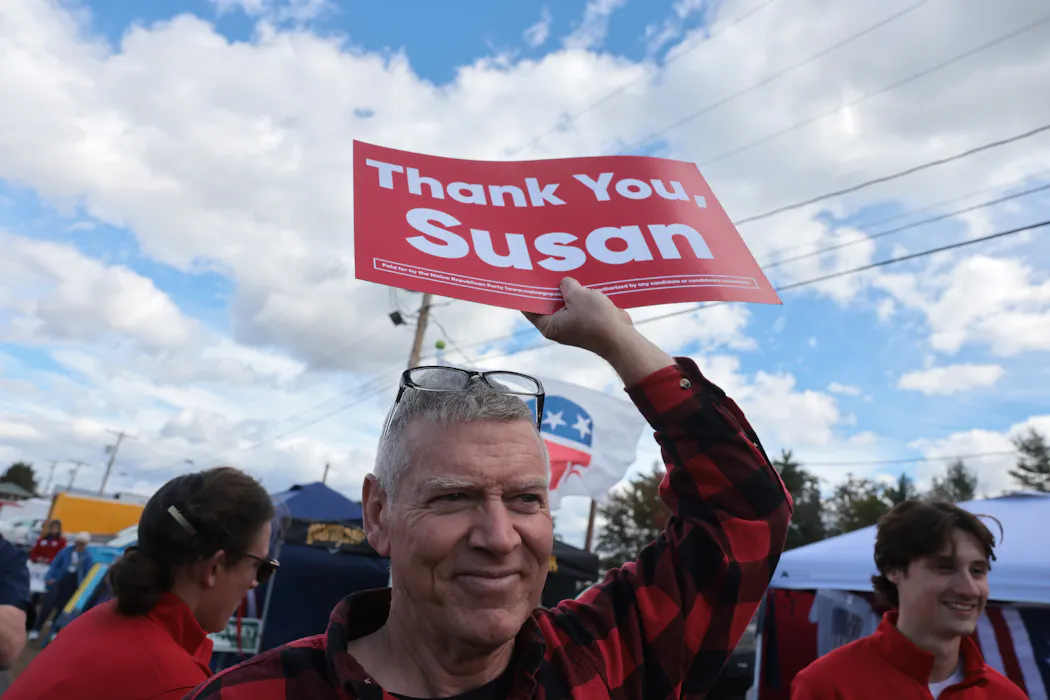
Voters call it delivering for Maine. It is why it is a core message of her reelection campaign. You cannot turn on a television in Maine without hearing about some project “Susan” delivered. It has helped get her reelected four times, because people support candidates who promise results; candidates then run on having delivered on that promise.

The same kind of political exchange happens when businesses contribute to super PACs supporting politicians who deliver. It happens when unions organize turnout for candidates promising favorable policies or when nonprofits support politicians who might fund their programs. These are all different forms of political exchange.

Political scientists call this “rent-seeking”: getting ahead by winning government favors rather than creating something of value. And the more government decides who gets what, the harder it becomes to distinguish representation from favoritism.

Systemic problem

The Supreme Court confronted this problem in McCormick v. United States, a 1991 case involving campaign contributions and extortion. To violate the law, the court said, payment had to be made in return for explicit, official action.

Otherwise, the court recognized, ordinary campaign finance would become nearly impossible to distinguish from criminal conduct.

The same relationships that make effective representation possible also make political favoritism difficult to distinguish from legitimate government. A company wins a contract after supporting a senator. A nonprofit receives a grant after helping elect an ally.

The problem is systemic.

Even if every senator were ethical, conscientious and committed to the public good, the incentives would remain the same. A senator who refused to compete wouldn’t make their state’s sewers less leaky. They would leave them unfunded while other states secured the money. The problem doesn’t require bad people.

Nor can it be resolved by declaring one set of political interests more virtuous than another.

A dark-haired man in a blue shirt greets a person in a wheelchair holding a dog on a leash.
Maine Democratic Senate candidate Troy Jackson greets supporters at a town hall on Sept. 13, 2026, in Biddeford, Maine.
Joseph Prezioso/Getty Images

Clients and patrons

Collins’ Democratic challenger, Troy Jackson, for example, says he isn’t backed by corporate PACs or billionaire donors but by working people. Such a claim implies a distinction between self-interested corporate influence and supposedly public-spirited political support that motivates his donor base – even if that donor base includes a multimillion-dollar “dark money” super PAC.

But when a union invests substantial resources to elect politicians who promise favorable labor legislation, or if a nonprofit mobilizes its members to elect someone who promises to expand grants for its programs, the same client-patron relationship persists.

Corporate entities have particular interests; so do noncorporate entities. Both can expect benefits from government. Patronage exists even when the profits don’t go to shareholders.

To call one form of influence corrupt and the other well intentioned is to paper over the business model of reelection: Have they delivered? Will they continue to deliver? Changing the source of campaign support doesn’t change the powers the winner will exercise.

Restricting earmarks didn’t eliminate the underlying incentives. Nor can campaign finance laws, however necessary, eliminate the value of having a powerful political friend.

If Americans want less rent-seeking, it requires reducing how much government spending depends on discretionary political decisions in the first place. General funding rules, established in advance and responsive to differing local needs, offer one alternative. Such rules wouldn’t remove politics from public spending. But they could shift the political contest away from who gets a particular favor and toward the rules under which everyone receives funding.

Until then, voters face a choice between two kinds of political patrons. Each is asking to hold the pen and write checks. Neither is offering to put it down.

The Conversation

Nicholas Jacobs does not work for, consult, own shares in or receive funding from any company or organization that would benefit from this article, and has disclosed no relevant affiliations beyond their academic appointment.

​Politics + Society – The Conversation

Categories
Entertainment

Donna Kelce Denies Travis’ Resurfaced Misogyny in Wake of Shane Gillis Controversy

Reading Time: 3 minutes

In the wake of Shane Gillis’ misogynistic rant on the SNL stage, who still supports him?

Travis Kelce signaled his support for the controversial comedian, inviting scrutiny into his own character.

As fans and critics alike went digging, they came up with tweets that do not paint him in a positive like?

Are they real? Mom Donna Kelce says that they’re phony.

Travis Kelce and Donna Kelce in 2023.
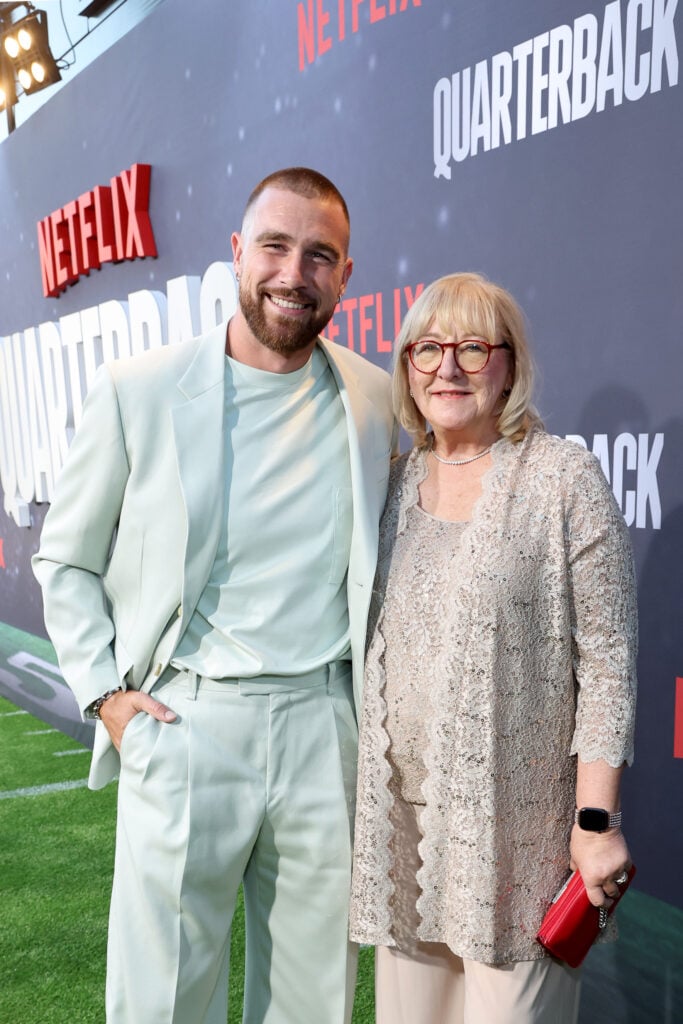
Travis and Donna attend the Netflix Premiere of “Quarterback” on July 11, 2023. (Photo Credit: Randy Shropshire/Getty Images for Netflix)

Did he really say these things?

In 2013, Travis began his career as a professional football player.

Tweets attributed to him dating back to earlier dates — between 2009 and 2011 — are now resurfacing.

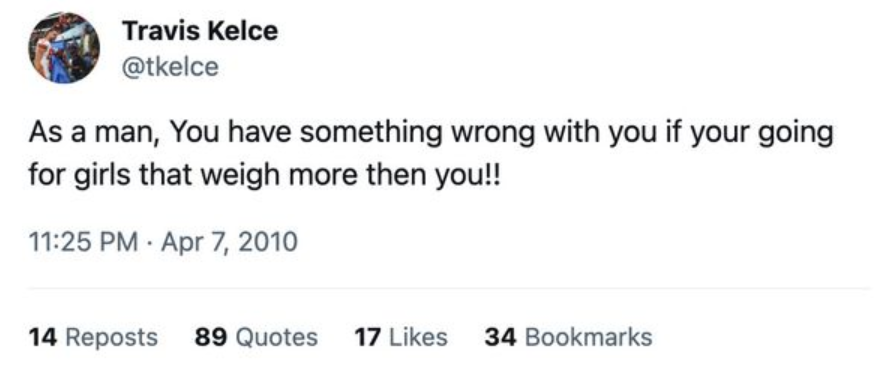
One reads: “As a man, You have something wrong with you if your going for girls that weigh more then you.”

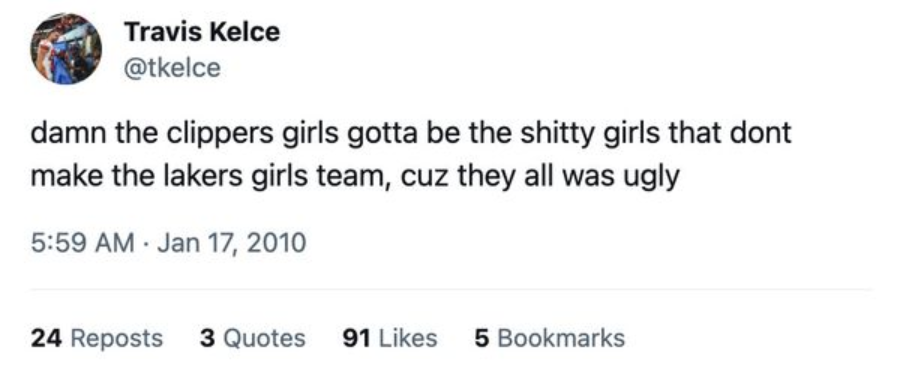
Another reads: “Damn the clippers girls gotta be the s–tty girls that dont make the lakers girls team, cuz they all was ugly.”

Even if one were to ignore the clumsy grammatical errors, these tweets are filled with body-shaming and misogyny. They are not the only tweets about “ugly girls” from this one account.

A dark mode tweet by Donna Kelce.
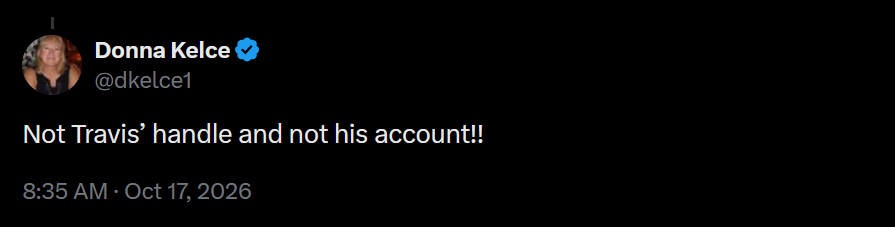
Donna says that her son never wrote these things. (Image Credit: Twitter)

On Saturday, October 17, a now-suspended account tweeted about these to Donna, Travis’ 74-year-old mother.

“Not Travis’ handle,” she replied in a tweet, “and not his account!!”

However, the “@tkelce” account does appear to be Travis’ — and there are even old replies in which Donna sent her love and well wishes while tagging that user handle.

Multiple outlets, including The New York Times and Snopes, have reported on these old tweets.

Many are seeing Travis in a new light. Is he not as good of a person as many (especially Taylor Swift fans) had come to believe?

An old body-shaming tweet by Travis Kelce.
These tweets were common and often insincere in 2010, but are still worth a “yikes” or two. (Image Credit: Twitter)

Is he a better person today than he was in 2010?

These old tweets are abhorrent. That is indisputable. But discussing them requires a level of nuance that many may find to be a struggle.

In 2009 and 2010, social media was full of “ironically” bad takes. Especially in the early days of Twitter — many hoped to be provocateurs, and things like fake bigotry were seen as humorous.

Also, this was 15 years ago. Travis would have been in his early 20s.

Today, someone in their early 20s posting misogynistic vileness would be inexcusable. In a time when this form of humor was prevalent, however, we might view things differently.

Finally, of course, people learn and grow and improve all of the time — especially over a decade and a half. Has Travis?

An old misogynistic tweet by Travis Kelce.
These old tweets appear to show a preoccupation with “ugly girls” in various walks of life. (Image Credit: Twitter)

Unfortunately, though many people may change and grow into better people over time, this is not universal or guaranteed.

Travis, in 2026, appears to be showing support for Shane Gillis. We do not believe in guilt by association, but it speaks about his character that he would associate with someone so vile.

Also in 2026, Travis and Taylor invited Brad Pitt to their wedding. Again, we do not believe in guilt by association, but yikes.

Travis clearly has more learning and growing to do as a person. We hope that he works on that, but won’t hold our breath.

Suffice it to say that, with the exception of rare extremes, we are not too concerned about tweets dating back to President Obama’s first term.

Travis’ more recent errors in judgment are much more relevant to his character today.

Donna Kelce Denies Travis’ Resurfaced Misogyny in Wake of Shane Gillis Controversy was originally published on The Hollywood Gossip.

​The Hollywood Gossip

Categories
Entertainment

This Costco Bakery Find Is A Game-Changer For Breakfast Sandwiches

Breakfast sandwiches get an immediate upgrade with a Kirkland Signature bread option from Costco. Not only does it add more flavor; it’s also quite affordable.

​Mashed – Fast Food, Celebrity Chefs, Grocery, Reviews

Categories
Sports Fox

Monday Morning NFL Top 10 Rankings: Fantastic QB Play Elevates Bears, Packers, Patriots

The top three have become difficult to dethrone in the NFL, but that happens when you’re undefeated. It’s the rest of my top 10 that has seen a lot of movement in recent weeks. Nos. 4 and 5 have been a back-and-forth between the Jaguars and Bills, who swapped places this week. Just behind those teams are a couple of teams that are finding their rhythm behind stellar quarterback play with the Bo Nix-led Broncos in between. Here’s where things stand entering Commanders vs. 49ers on Monday night to close NFL Week 6. Super Bowl odds: +1800 Quarterback Caleb Williams’ return helped the offense find its spark in Week 6. The former No. 1 overall pick completed his first 12 passes and looked like the superstar QB that head coach Ben Johnson needs to make his X’s and O’s come to life in the Windy City. As a squad that can light up scoreboards via the run or passes, the Bears have the potential to vault into top-five consideration by the end of the season. Who Stood Out: According to Next Gen Stats, Williams completed all 24 passes from a clean pocket for 248 yards in the Bears’ Week 6 win. His 24 attempts were the most without an incompletion from a clean pocket in a game since at least 2018. Super Bowl odds: +20000 Winning ugly has become the standard in Cleveland under Todd Monken. The scrappy Browns can overcome long stretches of offensive ineptitude to string together drives in the clutch. Quarterback Deshaun Watson is becoming one of the league’s best closers with four game-winning drives this season and a reel of late-game heroics that have skeptics and supporters alike singing his praises. With a pair of division wins and a share of the division lead coming out of Week 6, the Browns’ rebuild is ahead of schedule under Monken. What Stood Out: Despite the 4-2 record, Watson has been sacked an NFL-leading 24 times this season. Super Bowl odds: +3000 After notching their third straight win, and with running back Josh Jacobs’ return on the horizon, the Packers are rounding into form as a playoff contender. Quarterback Jordan Love has found his rhythm with wide receivers Christian Watson and Matthew Golden, giving the offense a big-play dimension that could make the unit unstoppable when the former NFL rushing champion returns to action. If the defense continues to suffocate opponents as defensive coordinator Jonathan Gannon tailors the scheme to his stars’ talents, the Packers will continue to climb the charts as a legitimate contender in the NFC. Who Stood Out: Watson (538 yards) and Golden (501 yards) lead all teammate duos with 1,039 combined receiving yards. Super Bowl odds: +2000 Although head coach Sean Payton hasn’t sparked the offensive revival expected when he took over playcalling duties, the Broncos are scratching out wins while he figures out how to get quarterback Bo Nix & Co. back on track. With an ultra-aggressive defense keeping opponents in check, the Broncos could be scary good when the offense catches fire. Who Stood Out: Nix is averaging just 5.55 yards per pass attempt, ranking last among the 28 NFL quarterbacks with at least 100 attempts this season. Super Bowl odds: +1800 Don’t look now, but the Patriots are back in business as a dark-horse contender. Drake Maye has worked his way out of an early-season slump with his third straight game with at least three touchdown passes. Although Maye must continue to work on his chemistry with wide receiver A.J. Brown, who returned from an ankle sprain after missing four weeks, the Patriots are starting to look like a championship-caliber squad with their QB rediscovering his mojo as a playmaker. Who Stood Out: Maye became the first Patriots quarterback with at least three touchdown passes in three straight games since Tom Brady in 2017. Super Bowl odds: +1400 A tough loss to a bitter division rival overshadowed Travis Hunter’s breakout game as a two-way star. The spectacular playmaker snatched a pivotal red-zone interception, while also flashing big-play potential as a pass-catcher from various alignments in the Jaguars’ spread formations. The WR-CB might be the X-factor for a team that needs to clean up its self-inflicted miscues on offense and defense during the bye week. Who Stood Out: Hunter became the third player since 1970 with a receiving touchdown and an interception in the same game, joining Brian Dawkins (Week 4, 2002) and Roy Green (Week 3, 1981). Super Bowl odds: +720 Josh Allen is the MVP frontrunner after another dazzling performance that featured several jaw-dropping plays. The 6-foot-5, 237-pound improvisational wizard continues to tease and torment defenders with his impromptu runs and scramble tosses on the perimeter. Although the Bills’ leaky defense is a major concern, No. 17’s heroics can mask the deficiencies during a Super Bowl run. Who Stood Out: Allen has rushed for eight touchdowns, tied for the most by a quarterback through the first six games of a season in NFL history. Super Bowl odds: +1800 Given a bye week to spend more time concocting exotic pressures and mind-boggling pre-snap disguises, defensive coordinator Brian Flores could make the league’s most disruptive unit even scarier down the stretch. If head coach Kevin O’Connell gets the offense going with QB Kyler Murray at the helm, the Vikings could emerge as the team to beat in the NFC. Who Stands Out: Linebacker Dallas Turner’s 5.5 sacks through five games are tied with Doug Martin (1982) for the most by a second-year player through the Vikings’ first five games of a season. Super Bowl odds: +850 Kenneth Walker III has added a dimension to the Chiefs’ offense as a dynamic runner with big-play potential. The NFL’s rushing leader topped the 100-yard mark for the fourth time in five games, exhibiting the explosiveness out of the backfield that’s been missing since the Jamaal Charles era. With a more balanced offense, head coach Andy Reid has the Chiefs leaning into a complementary football approach that makes them a more formidable playoff foe. Who Stood Out: Patrick Mahomes earned his 100th career win in his 131st start, tying Tom Brady as the fastest quarterback to reach 100 wins in NFL history. Super Bowl odds: +580 The 49ers enter their Monday-night matchup against the Commanders sitting pretty at the top of my rankings. Staying healthy will be key for San Francisco, with Deebo Samuel out multiple weeks and fellow receiver Mike Evans already dealing with nagging injuries. Who Stands Out: Purdy enters the game against Washington leading all NFL quarterbacks with at least 100 pass attempts in passer rating (119.3), adjusted net yards per attempt (9.32), adjusted yards per attempt (9.62) and touchdown percentage (9.2%), while posting the lowest sack rate (2.1%).​Latest Sports News from FOX Sports

Categories
Politics

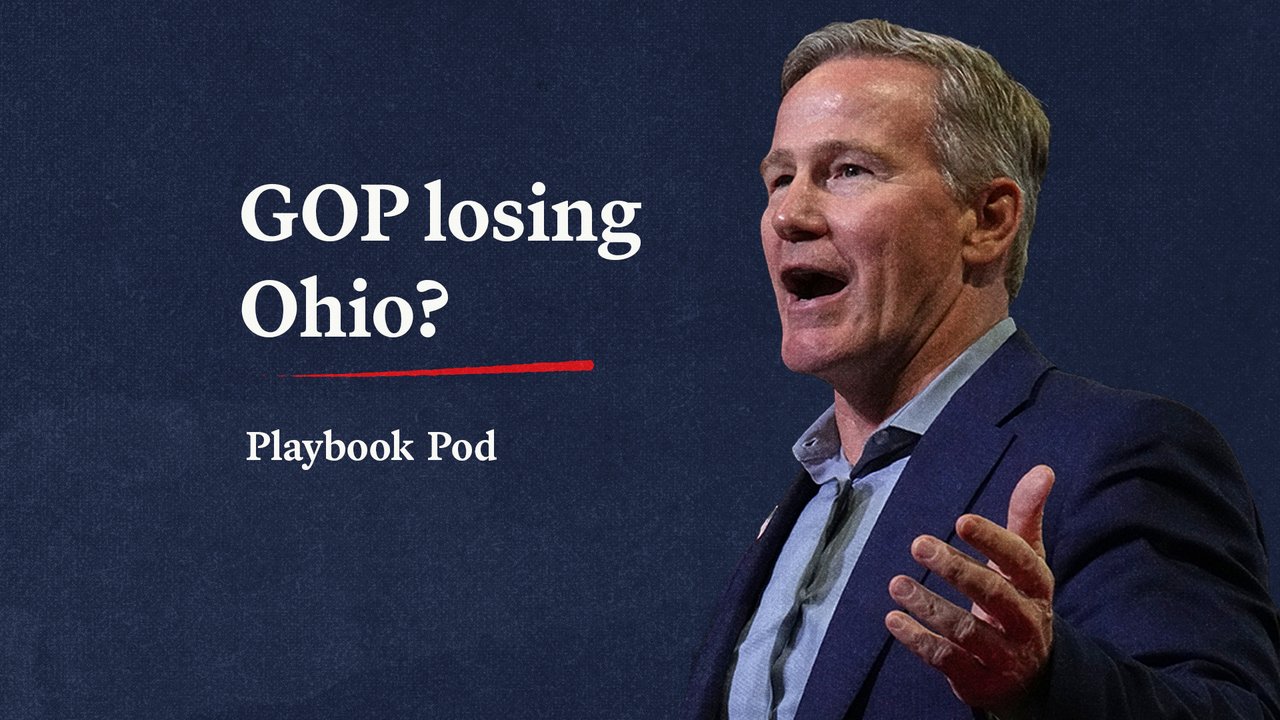
Ohio returns as a bellwether

Ohio returns as a bellwether

lead image

​Politics

Categories
Uncategorized

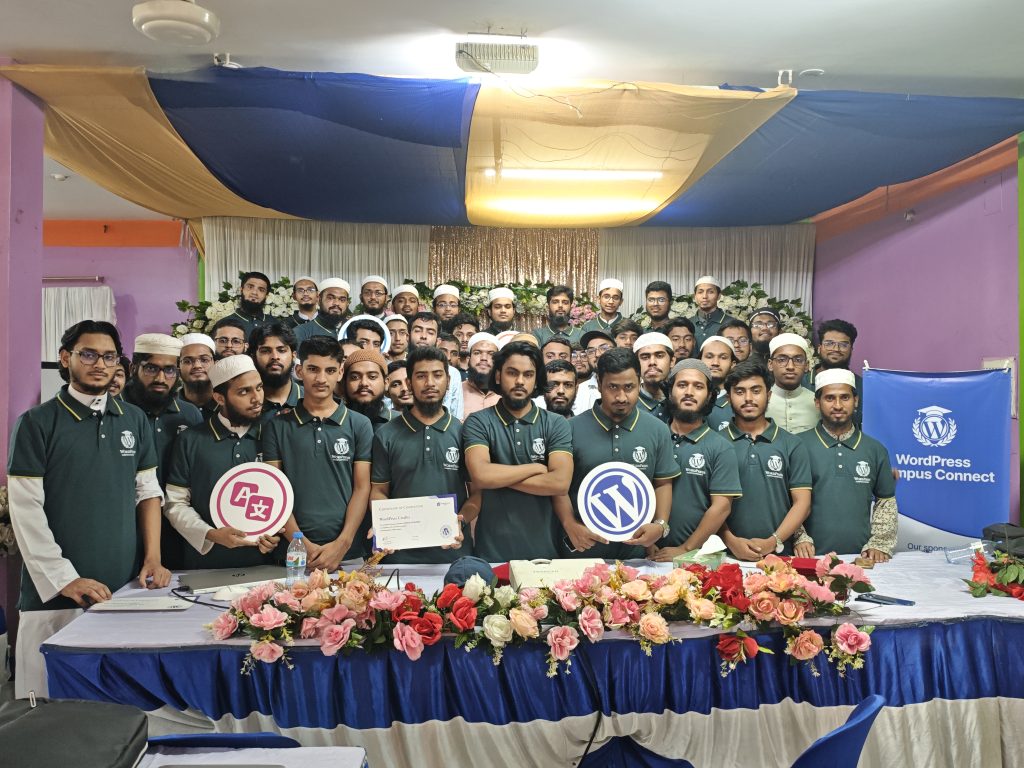
WordCamp Central: WordPress Campus Connect Ahmad Education, Dhaka 2026

Categories
Entertainment

How to Watch Live From the Orange Carpet: WNBA Finals

Live from the Orange Carpet: WNBA Finals 2026, Lilly SinghThis carpet promises to be nothing but net. 

The WNBA Finals will bring the heat as E! presents Live from the Orange Carpet: WNBA Finals Oct. 19, ahead of game two of the championship series…
​E! Online (US) – Top Stories

Categories
Music

Here’s How You Can Win a $500 Target Gift Card

Fund your holiday fun with a $500 Target gift card! Continue reading…​Country Music News – Taste of Country

Categories
Politics

Inside the quiet money pullback — for both parties — in Georgia’s Senate race

The money spigot is sputtering in Georgia’s Senate race amid growing expectations that Democratic Sen. Jon Ossoff will win reelection.

The Senate Leadership Fund, Republicans’ top Senate super PAC, did not spend on broadcast television in the state last week — the first week they were off air in the race, according to tracking firm AdImpact. Neither did Democrats’ Senate Majority PAC.

Senate Majority PAC will also be dark again this week, the Chuck Schumer-aligned group shared first with POLITICO. It was not immediately clear whether SLF would follow suit. The group declined to comment on their future spending plans in the state.

The spending slowdown underscores how dramatically Georgia’s place on the Senate map has shifted, as Ossoff maintains wide margins over Republican Rep. Mike Collins in public polling and fundraising. Georgia was expected to be one of the cycle’s most expensive and preeminent battlegrounds — now some of the biggest outside spenders are pulling back and turning their attention to more competitive races in redder territory.

The two major Senate super PACs have closely mirrored each other’s spending decisions in recent weeks, with neither fully retreating from the state. They still both technically have future ad reservations booked past this week, but those are not binding, leaving both sides with the flexibility to redirect money as they assess the Senate map. And with two weeks until Election Day and early voting already underway in Georgia, it’s unclear whether either will spend any more in the state.

“National Republicans are abandoning Mike Collins as he continues to show Georgians why he’s unelectable and unfit for office. We are committed to seeing Jon Ossoff through to victory as we come to the final days of this campaign,” SMP spokesperson Lauren French said in a statement.

Collins’ campaign, in a statement, said they were “grateful to every group that’s standing with Rep. Collins and welcome their continued support.”

“With early voting underway, he’s working every day to earn the vote of every Georgian, because Jon Ossoff is a radical leftist who wants to raise their taxes and make their families less safe. Rep. Collins will keep making that case until Ossoff is held accountable on Election Day,” Collins spokesperson Meyer Siegfried said in a statement.

Ossoff’s campaign didn’t respond to a request for comment.

SMP had pledged in the spring to spend $20 million on television for the race, but as of Friday had only spent or reserved $11.5 million, per AdImpact. SLF had announced an initial $44 million investment, but has so far only spent or reserved roughly $20 million.

No Going Back PAC, which is affiliated with President Donald Trump’s MAGA Inc. super PAC, has also dramatically scaled back its own spending on the race over the last two weeks, according to AdImpact.

Republican operatives are still monitoring Georgia’s governor’s race, where recent public polling shows GOP nominee Rick Jackson slightly ahead of Democratic nominee Keisha Lance Bottoms. Republicans believe Jackson’s strength could keep the Senate race closer than currently expected.

But they have grown increasingly pessimistic about their prospects of flipping Georgia’s Senate seat, as Collins trails Ossoff in the polls and the overall environment for the GOP continues to grow more difficult. SLF’s decision to go dark last week — so close to the election — raises questions about how much more the group will ultimately invest in the state.

“Every dollar Schumer spends in Georgia is one not spent on offense in red states. Republicans’ financial advantage doesn’t just show up in more ads, it keeps Dems on defense,” a person familiar with SLF’s spending plans told POLITICO.

Ossoff also holds a massive fundraising advantage over Collins, who had just over $1 million cash on hand as of Oct. 1, giving Ossoff a major financial cushion in the final stretch even before the major Senate super PACs pulled back their spending.

The GOP has been triaging races across the map: SLF shifted money out of North Carolina, another perennial battleground, while moving resources toward defending GOP-held seats in states like Kansas and South Carolina, where the Senate contests have become increasingly competitive.

Still, even as the money going into Georgia has continued to slow, Trump appears to be prioritizing the longtime battleground.

At a rally in Dalton on Friday, he urged voters to “pretend” he’s on the ballot, while praising Collins and the state’s GOP governor’s nominee, Rick Jackson.

Meredith Lee Hill and Andrew Howard contributed.

​Politics