“Everybody wanted us to die,” he shared, even before the store’s very diplomatic explanation came out.
He warns about “the place we give celebrities” after this “reprehensible abuse of power.” Is he right?
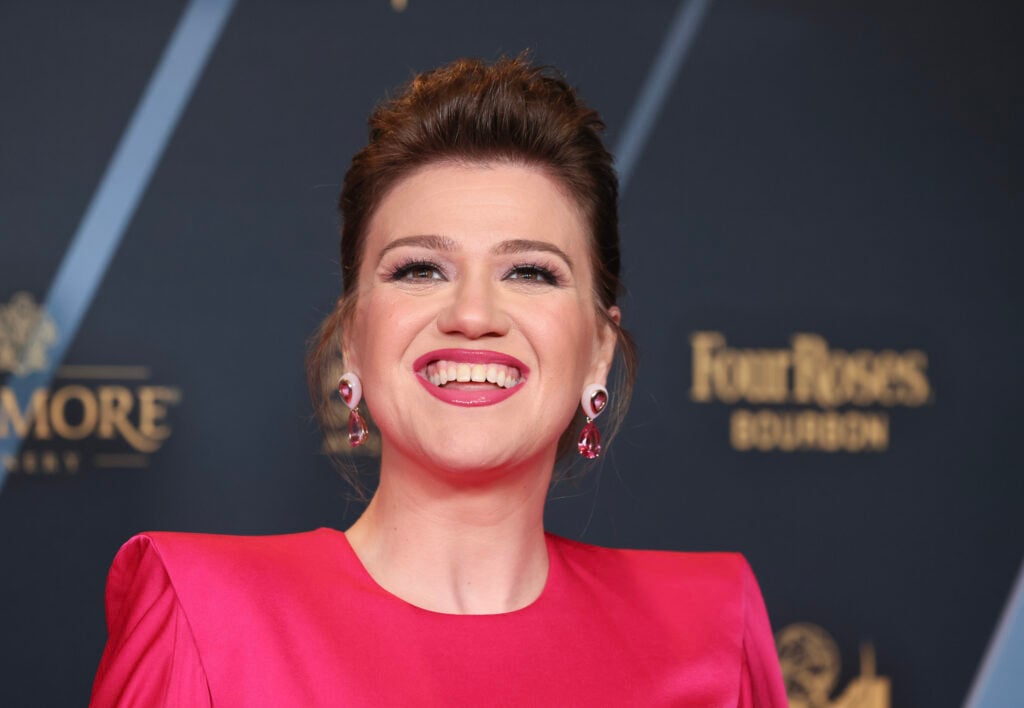
Clarkson attend the 51st annual Daytime Emmys Awards on June 07, 2024. (Photo Credit: Rodin Eckenroth/Getty Images)
Art of Play employees have been bombarded with vitriol
Adam Rubin, co-owner of Art of Play in Brooklyn Heights, spoke to Page Six on Tuesday, October 13 about the barrage of threats and harassment that his store has received in recent days.
“It’s a pop star, a mechanical bird, it’s surreal,” he described. “When this thing first started, everybody wanted us to die.”
Rubin described: “And as the truth has come to light, thinking people realize this is reprehensible abuse of power.”
He urged: “We have to reconsider the place we give celebrities in our society.”
Rubin and staffers, he shared, have received thousands of threatening messages, presumably from Clarkson’s fans, since she declared war on their independent business.
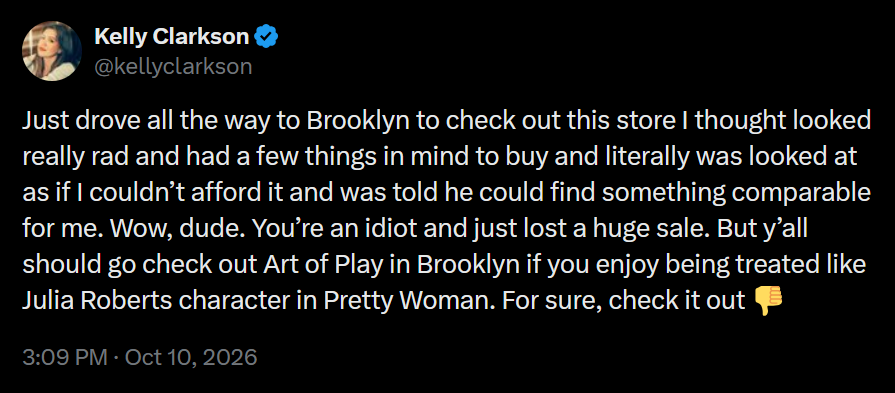
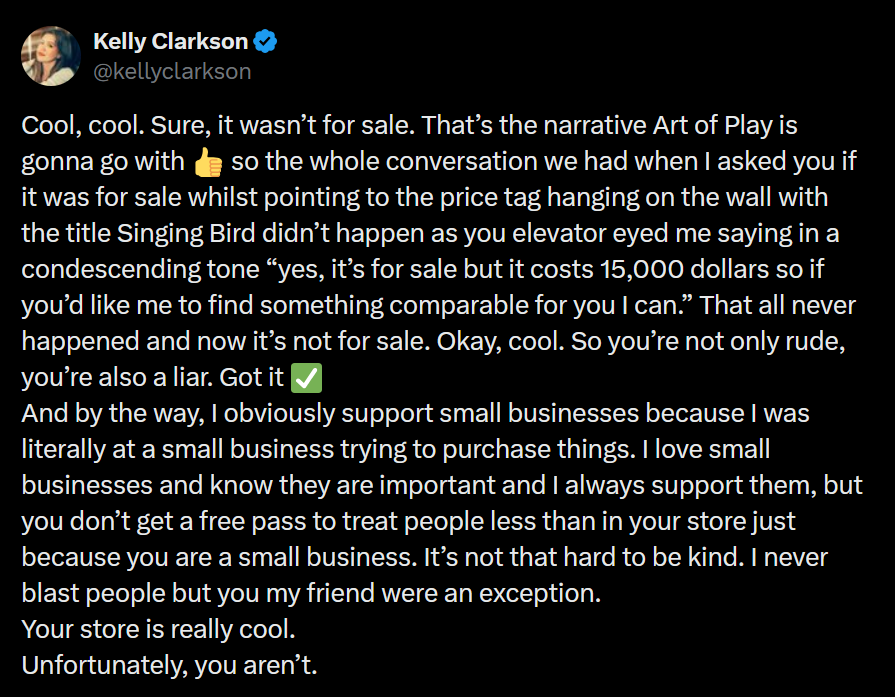
Taking the nuclear option, Clarkson accused a Brooklyn store of snobbishly snubbing her. (Image Credit: Twitter)
“This is not how you can behave as a citizen in the world,” Rubin described. “Like, if you are this famous and powerful and you try to squash someone like a bug, then we’re supposed to blame the trolls for all the damage that’s inflicted.”
After noting that “she lit the fuse,” he said that the bombardment with vitriol over the previous 72 hours felt “totally surreal” to him and his staffers.
“It’s been so intense — thousands of hateful phone calls, thousands of hateful text messages, Kelly Clarkson fans demanding we issue her an apology,” Rubin detailed.
“And it’s just such a perverse distortion of reality,” he lamented, “that anyone could look at the situation and think that we are the ones who owe an apology.”
As painful as having his business and livelihood targeted by weird internet bullies, things have gotten much more personal than that.
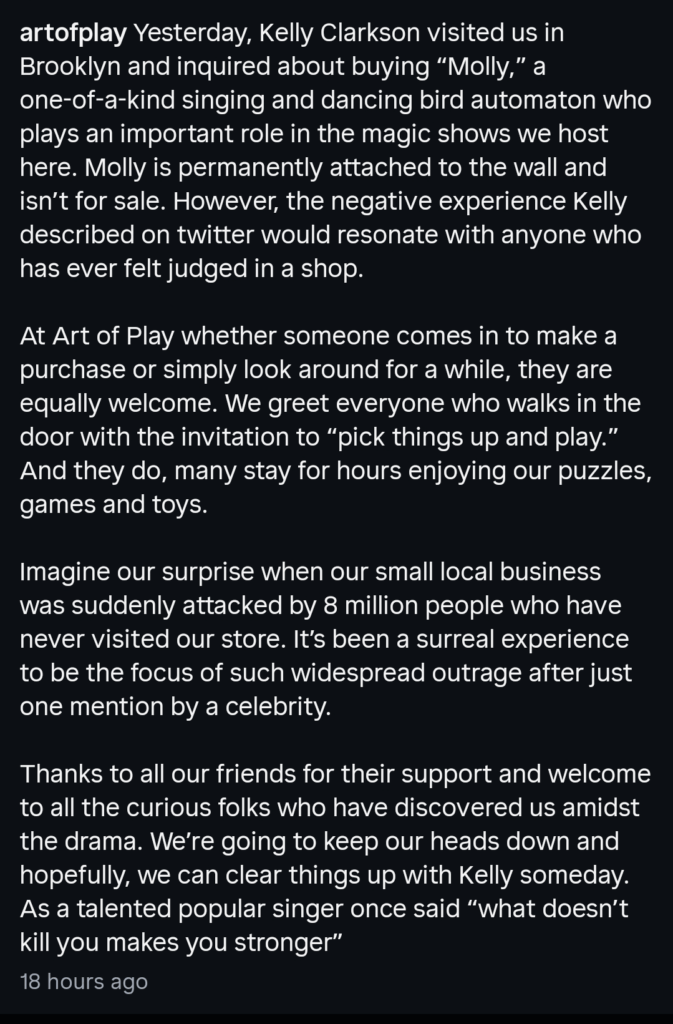
Art of Play shared a lengthy yet diplomatic response, explaining a famous-and-unhappy customer’s experience. (Image Credit: Instagram)
‘She was treated like everybody else who comes in’
According to Rubin, Clarkson’s fans “came out of the woodwork” to track down and harass him and employees all across social media, even targeting friends and neighbors with hate.
That wouldn’t be okay anyway. But it’s especially odd because, he says, Clarkson didn’t receive any special treatment — positive or negative.
“Regardless of what happened in the shop, a misunderstanding in a crowded shop — everybody that comes into the store is treated the same, like a normal person,” he described. “That’s what pissed her off.”
Rubin continued: “She was treated like everybody else who comes in, whether they’re in sweatpants or they’re 9 years old, or they’re a celebrity we don’t recognize.” Some speculate that simply not being recognized was the inciting incident.
Describing her as having symbolically thrown a lit Molotov cocktail into his store, Rubin was quick to note that her obsessed fans “don’t actually know this woman.”
In a retaliatory tweet, Clarkson accused Art of Play of being untruthful. (Image Credit: Twitter)
“This is asymmetrical social warfare,” Rubin described.
He argued that Clarkson knew what effect her scorched earth tweet would have, and “she needs to be held accountable for her actions.”
Rubin did admit: “Listen, I understand objectively, this is hilarious. If it wasn’t happening to me, I would think it was so funny. The memes have been glorious.”
He emphasized: “This is about the power that we acquiesce to celebrity, and how okay we are with it as a society when they abuse it.”
Rubin reiterated: “I’m saying, society is f–ked, and we need to take a look at ourselves in the mirror.”
It was Super Bowl night on Dancing With the Stars, and the remaining couples took to the floor accompanied by music from halftime shows of yore.
Of course, there was plenty of spectacle, and a few unexpected cameos — Joe Buck! Justin Baldoni for some reason! — but there was also heartbreak as another beloved star was sent packing.
This time, it was the season’s most controversial star who went home, and the reaction on social media was decidedly mixed.
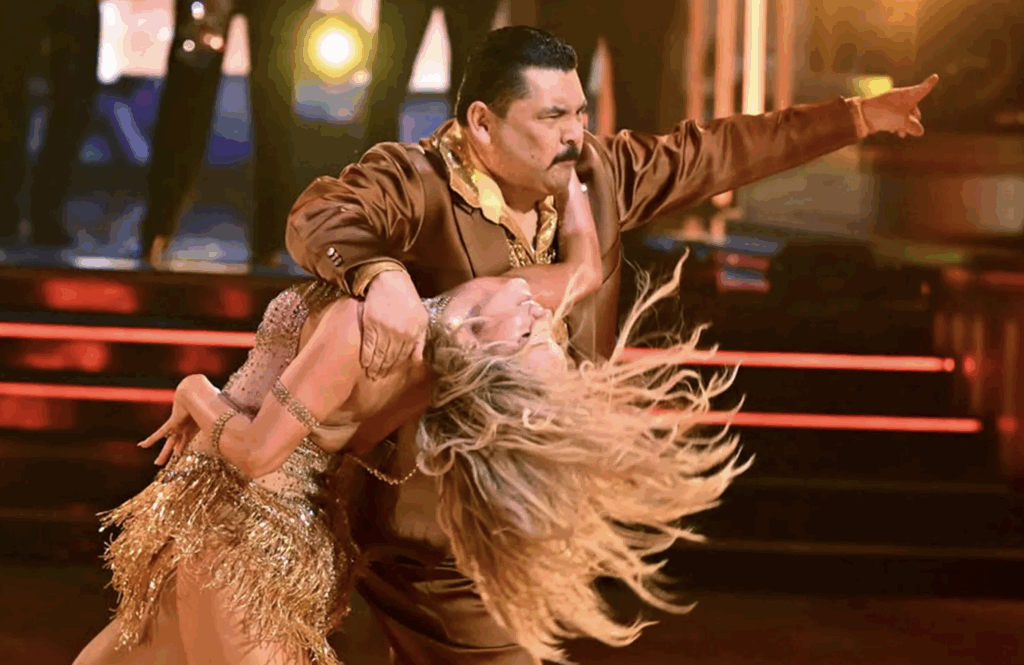
Social media is an uproar following Guillermo’s controversial elimination. (ABC/YouTube)
Yes, Guillermo Rodriguez of Jimmy Kimmel Live fame was eliminated along with his partner, Witney Carson.
Many fans who have been rooting for Guillermo since Week 1 took to X (formerly Twitter) to gripe about the voting and what they viewed as unfair treatment from the judges.
“Wow f–k the judges a 4 for Guillermo is so unnecessarily mean yet they’re handing out 7s to Tyler Cameron who barely moves #dwts,” one user complained.
“Carrie Ann needs to go before Guillermo let’s get to work people #dwts,” another wrote, referring to judge Carrie Ann Inaba.
But while there were quite a few Guillermo defenders, even more viewers were happy to see him go, especially after he outlasted Ciara Miller, who was voted off after delivering her best performance of the season in Week 5.
“I think ABC should shock the nation and do a never-before triple elimination so we don’t have to suffer through another week of Tyler Jackson or Guillermo,” wrote one user.
“The difference between Connor and Guillermo is actually crazy. Like holy I get that he’s kinda the joke contestant but this late into the game.. they need to start talking to him the way they do Connor,” another added.
“Calling Guillermo entertaining when genuinely talented people have gone home instead #dwts,” a third chimed in.
As for the unexpected presence of Baldoni, TMZ reports that he was in the audience as a guest of Julianne Hough.
The two have apparently been friends for more than a decade, dating back to their time on the 2016 documentary series My Last Days, which Justin directed.
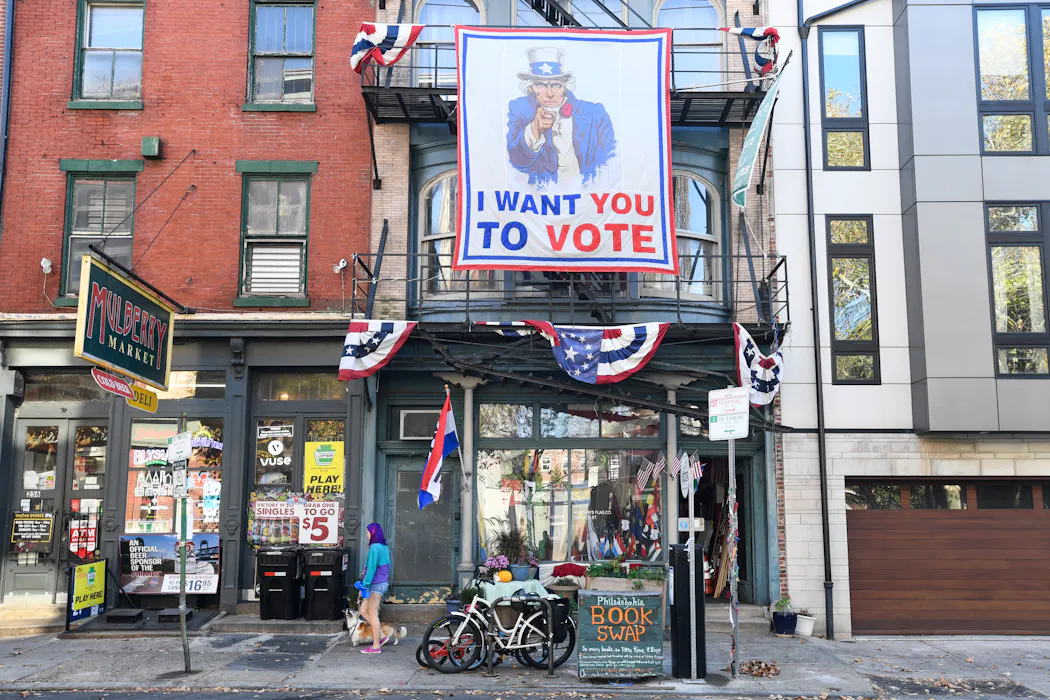
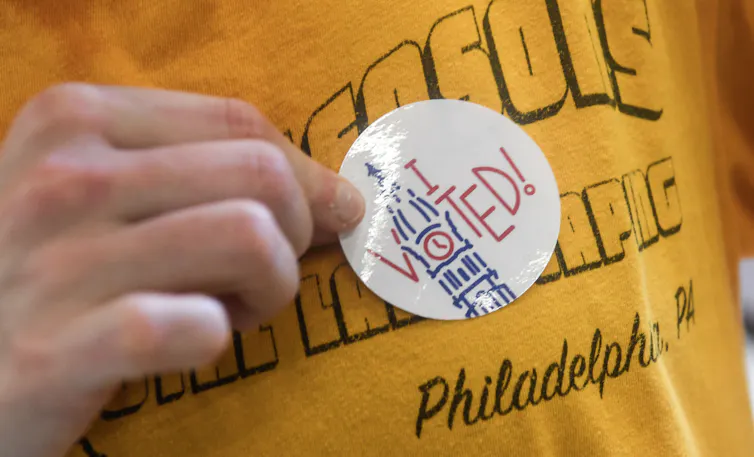
Philadelphia voters will help elect the state’s next governor and lieutenant governor, as well as members of the U.S. House of Representatives and the state Legislature, in the 2026 midterms.Matthew Hatcher/AFP via Getty Images
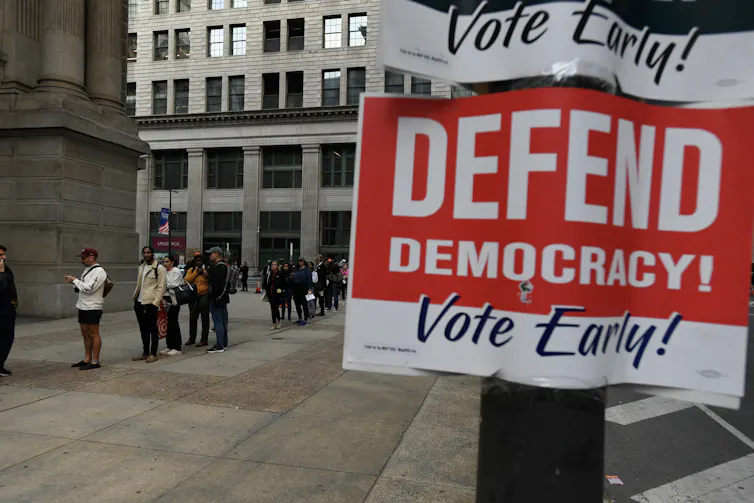
Less than 30 days ahead of the 2026 midterms and almost nobody I talk to in Philadelphia is excited. Not my neighbors. Not my students or colleagues at Temple University, where I research and teach political communication and public opinion. Not even my politically engaged friends.
This mirrors the national mood in recent years: In a Pew Research Center survey, just 4% of Americans said they feel excited about politics; 65% said they feel exhausted.
“There are many factors that go into voter apathy,” explains Temple University political communications professor Bruce Hardy, “barriers to participation, lack of trust, cynicism, sense of disenfranchisement and powerlessness, political fatigue, and so on.”
Voter malaise and campaign fatigue aren’t new, but something feels different to me this time.
Lauren Cristella, president and CEO of the Committee of Seventy, a nonpartisan organization established to improve the voting process and engage Philadelphia citizens in the democratic process, agrees. She points to election integrity fears being hotly debated in the national media as part of the problem.
“We are sitting on the back side of a big decline in voter enthusiasm,” she said, “And yes, we need to start giving voters something to be excited about. However, what we are seeing in the commonwealth is a lot of confusion and fear around election integrity.”
This tension, in my view, is the real story of the 2026 midterms. Voters still care. The stakes are higher than ever. But the question on many voters’ minds is: Will my vote even count?
This is not just a Philadelphia problem. A July 2026 Gallup survey of more than 23,000 adults found that 2 in 3 Americans were concerned about political leaders pressuring election officials to change outcomes. Half worried that their own ballot would not be counted.
Voter confidence is sliding. In a 2026 University of California San Diego survey, 49% of Americans said they expect the midterms to be free and fair, while 51% expect unfair elections or aren’t sure.
A 2026 Pew survey similarly found that barely half of Americans are confident that November’s midterm elections will be conducted fairly and accurately. This represents a 10-point drop in national voter confidence from 61% in the 2024 elections.
Gap between democratic attitudes and voting behavior
Social and behavioral scientists have long understood the tension between one’s beliefs and attitudes about voting: For example, many people say they believe voting is an important democratic behavior, but then don’t actually vote themselves.
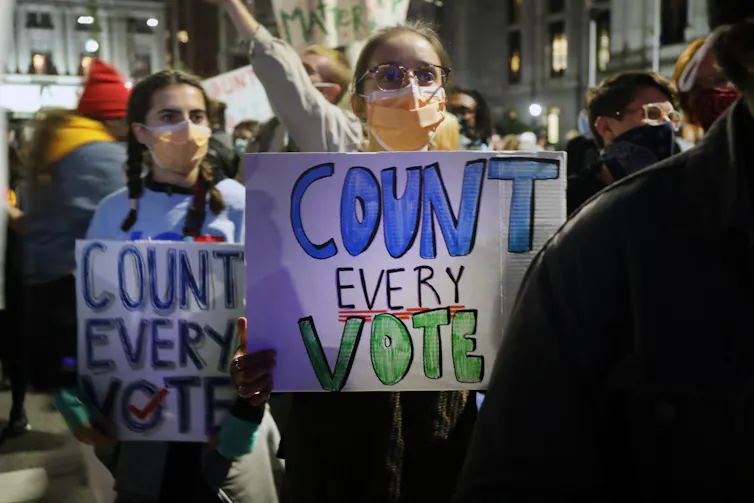
Demonstrators in Philadelphia call for election officials to count all the votes on Nov. 4, 2020, as the election in Pennsylvania remained unresolved. Spencer Platt/Getty Images
Cristella told me that mail-in voting is “the safest and most secure of any time in the commonwealth’s history.” Every ballot can be tracked.
So why are Pennsylvania voters not convinced?
‘What’s the point?’ is a rational response
A 2021 article that cites experts at Tufts University explains how pushing myths like the “election was stolen” or “the election wasn’t fair” – presumably to explain away Donald Trump’s loss in 2020 and create mobilization for his 2024 presidential run – can boomerang and end up lowering confidence in future elections.
If people don’t believe their vote will count, then it becomes completely rational to simultaneously hold the opinion that voting is generally good for democracy, while also lacking any faith that their own vote will even be counted.
Experts say negative national media coverage of politics can leave voters feeling cynical about local elections too. Matthew Hatcher/Getty Images
Framing theory explains how the presentation of information in the media influences the way people process and interpret it.
Hardy attributes much of the current state of voter apathy to the media’s focus on fraud and voter integrity. He says that “much of this comes from political discourse and media focusing on national political conflict, a seemingly endless election cycle, and a constant reinforcement of political in-groups and out-groups.”
Even though our elections are safe and secure in Philadelphia, he explains, “All of this negative national media coverage can overshadow the importance of local elections and leave people feeling disengaged from the politics closest to home.”
Cristella agrees that media framing is a significant part of the problem.
“Issues surrounding election fraud and vote integrity get amplified and muddied,” she said. When isolated issues in other states occur, even if proved untrue, the intense and repeated national media attention on them shakes voter confidence here at home.
What this means for Philly
The 2026 midterms will be an important election for Pennsylvania, as the election will determine the state’s next governor and lieutenant governor, as well as members of the U.S. House of Representatives and the state Legislature.
Philadelphians have a lot on the line.
Economic concerns, in particular, are a major issue this election. A recent Gallup poll indicates that confidence in the economy is at its weakest level since 2022. And the voters are feeling the pinch.
Heather LaMarre does not work for, consult, own shares in or receive funding from any company or organization that would benefit from this article, and has disclosed no relevant affiliations beyond their academic appointment.
This would give President Donald Trump his fourth Supreme Court nomination, helping to ensure conservative dominance on the court for decades.
As a Supreme Court scholar, I know that judicial appointments have real consequences. Look no further than Roe v. Wade: Within two years of securing a 6–3 conservative majority, the high court in 2022 eliminated the constitutional right to abortion that had existed for almost 50 years.
If Democrats take over the Senate and a Republican-appointed justice retires before Jan. 3, this will trigger one of the most explosive confirmation battles in American history.
Here’s how the fight is likely to play out – and why the stakes are so high.
Who is most likely to retire?
Justices Samuel Alito and Clarence Thomas top the list of potential retirees should Democrats win the Senate in November. Alito and Thomas are the court’s oldest justices, at 76 and 78, respectively. Thomas is also the court’s longest-serving justice, appointed by President George H.W. Bush in 1991.
Perhaps more importantly, both justices have deep ties to the conservative legal movement. This is a network of lawyers, judges and politicians who seek to etch conservative principles into law. Overturning Roe v. Wade was at the top of the conservative wish list.
Senate Minority Leader Chuck Schumer made this clear on Oct. 5, 2026, as did Senate Judiciary Committee member Richard Blumenthal, the Democrat from Connecticut. Blumenthal said, “It is slim to none that we would support a nominee from this administration.”
Though Alito has recently indicated he intends to stay on the court through its 2026 term, Thomas has made no recent public statements about retirement. And Alito is free to change his mind at any time.
If Alito or Thomas announced their retirement after the midterms, Republicans would have enough time to confirm a successor. The Senate has four and a half work weeks scheduled between Election Day and Jan. 3. Justice Amy Coney Barrett was confirmed less than a month after her nomination, making the timeline tight but doable.
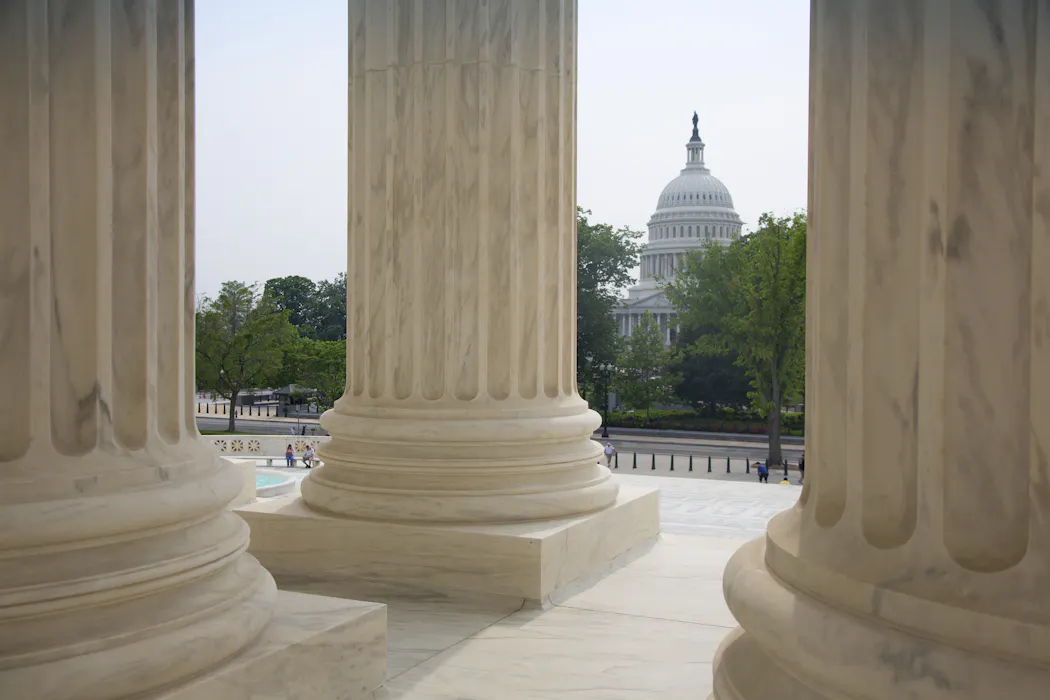
Amy Coney Barrett is sworn in during the Senate Judiciary Committee confirmation hearing for Supreme Court justice on Oct. 12, 2020, in Washington, D.C. Shawn Thew-Pool/Getty Images
Democrats will likely attempt to slow down the process, but they face an uphill battle with few options. Republicans stripped away key delaying tactics in recent years by ending the filibuster in 2017 and ignoring the Judiciary Committee’s quorum rules in 2020. This rule requires nine members be present to transact business, including two members of the minority party.
A potentially historic battle
A Republican effort to confirm a Supreme Court nominee during a lame-duck Senate would spark a historic battle with Democrats.
To justify this, Republicans created the so-called “McConnell Rule,” named after former Senate Majority Leader Mitch McConnell of Kentucky. According to McConnell, the Senate should not fill Supreme Court vacancies “in the middle of a presidential election year.”
Four years later, Senate Republicans abruptly abandoned the rule. This allowed them to push through Coney Barrett’s confirmation just days before the 2020 presidential election.
Democrats did not take kindly to this reversal.
U.S. Sen. Chuck Schumer speaks in front of the U.S. Capitol after a boycott of the Senate Judiciary Committee hearing on the nomination of Judge Amy Coney Barrett to the U.S. Supreme Court on Oct. 22, 2020. Alex Wong/Getty Images
Schumer pulled no punches in a speech the day of Barrett’s confirmation vote. Schumer said the day “will go down as one of the darkest days in the 231-year history of the United States Senate.”
He alleged the Republican majority made “a mockery of its own stated principle – that the American people deserve a voice in the selection of Supreme Court Justices – completing the partisan theft of two seats on the Supreme Court using completely contradictory rationales.”
Democrats were clearly outraged by what they saw as two stolen Supreme Court seats.
However, I believe that pushing through a nominee will trigger an even fiercer fight. Senate Democrats will see such a confirmation as a power grab that sidelines the voice of voters.
Furthermore, if a Republican justice retires should Democrats win the Senate, the move will almost certainly be viewed as purely partisan.
Put simply, in securing a short-term conservative victory, Republicans may end up handing Democrats the exact justification they need to reshape the high court.
Paul M. Collins Jr. does not work for, consult, own shares in or receive funding from any company or organization that would benefit from this article, and has disclosed no relevant affiliations beyond their academic appointment.
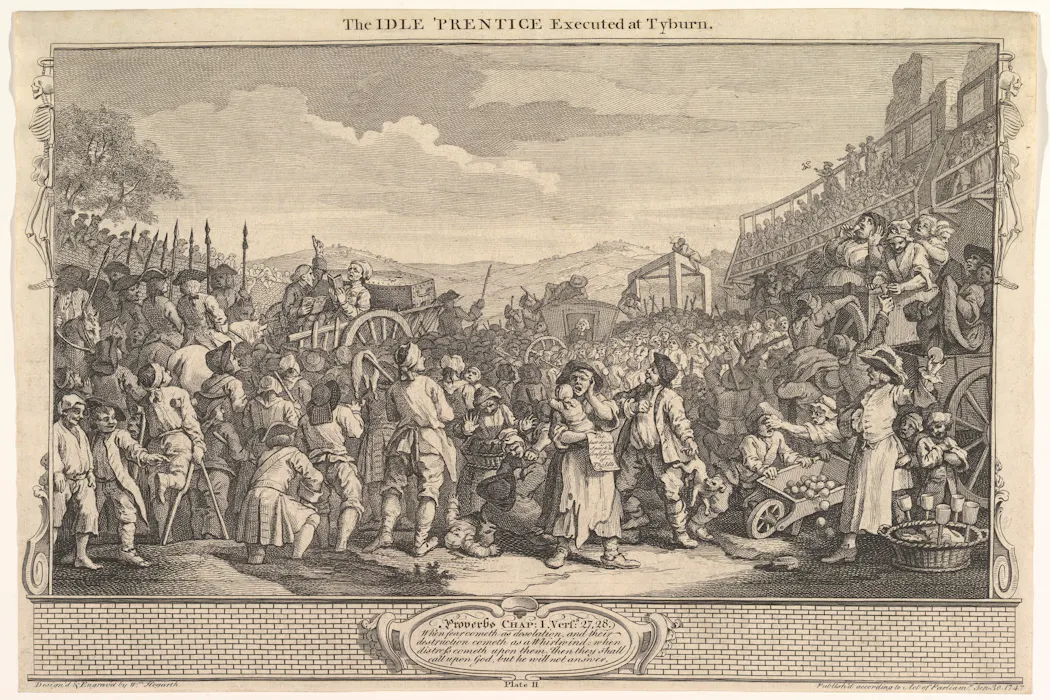
A 1747 print of a public execution at the so-called Tyburn Tree, a gallows in London that served for hundreds of years as a site of hangings.William Hogarth
The proposed livestream of Nidal Hasan’s execution by a U.S. military firing squad gives an old question a new audience. Hasan, an Army psychiatrist convicted by a military court of killing 13 people at Fort Hood in Texas in 2009, is scheduled to be executed on Dec. 3, 2026.
Whether the broadcast will proceed remains uncertain. But as a historian of the early American republic, I recognize a familiar expectation behind it: that watching someone die will teach a useful lesson. Americans at the republic’s founding debated that premise — and doubted what the lesson might be.
Defense Secretary Pete Hegseth said the execution of Nidal Hasan will be a public event when the sentence is carried out later this year.
The power of government
On Aug. 17, 1797, New Yorkers gathered to watch John Young hang.
An English musician and music publisher struggling with debt, Young had shot and killed Robert Barwick, a deputy sheriff taking him into custody. Barwick left a widow and nine children.
Governor John Jay, a leading Federalist who placed greater faith in firm government than in popular judgment, had authorized the military presence after the sheriff reported fears of a rescue. But Jay also wanted the execution to impress its witnesses with the power of the government carrying it out.
Solemnity, however, proved difficult to arrange. The military escort played lively music as the procession made its way to the scaffold. One newspaper critic thought an uninformed passerby might mistake the spectacle for “the celebration of some Festival.”
Soldiers formed a square around the gallows. The crowd remained orderly. Young addressed a few words to the minister, sang a psalm “and with great composure pulled his cap over his face,” reported one newspaper. Then, before the assembled witnesses, he was hanged.
The display did not impress everyone as evidence of governmental strength. Writing in the “Greenleaf’s New York Journal” two weeks after the hanging, “A CITIZEN” accused Jay of “letting down the dignity of civil authority.” Calling out troops for the execution suggested, among other things, “a wantonness on the part of the Executive.”
To this critic, the military presence advertised executive excess. The spectacle could undermine the very authority it was meant to affirm.
That point mattered in a republic still deciding how its authority should differ from that of the European monarchies that Americans portrayed as corrupt.
In the 1780s and 1790s, American reformers took particular aim at England’s “sanguinary laws” – statutes prescribing death for offenses ranging from murder to relatively minor theft.
By 1776, nearly 200 offenses carried a possible death sentence in England. These laws had accumulated piecemeal over generations, but American critics portrayed them as a single system with bloodshed at its center.
England’s punishments became a measure of what republican justice must overcome. Independence required Americans to reconsider how readily, and under what circumstances, their own governments could take a life.
The contrast was partly an exercise in national self-definition. Americans cast English severity as evidence of an old, corrupt political order and imagined their own laws as rational, proportionate and suited to free citizens.
In practice, the distinction was harder to sustain.
Nevertheless, the aspiration entered constitutional language. New Hampshire’s 1784 Constitution declared a multitude of sanguinary laws “both impolitic and unjust.” Punishment’s proper object was “to reform, not to exterminate mankind.”
Reform did not necessarily mean abolition. In 1796, New York reduced the number of crimes punishable by death but retained capital punishment for murder.
Young went to the gallows the following year. Even if Jay favored milder criminal laws, he was able to see a carefully staged execution as a necessary assertion of public authority.
No guarantee of lesson learned
Other Americans pressed further.
Benjamin Rush, the Philadelphia physician and signer of the Declaration of Independence, opposed executing even murderers. His argument went to the heart of the relationship between government and the governed.
“Capital punishments are the natural offspring of monarchical governments,” Rush wrote in 1792. “Kings consider their subjects as their property.”
For Rush, a republic that put citizens to death still acted like a monarchy, treating citizens’ lives as its own to dispose of. Calling the killing a lawful punishment did not make it less an act of revenge.
A related debate concerned the audience. Even Americans who accepted capital punishment could doubt the wisdom of making it public.
In 1787, Rush had already questioned what spectators actually learned from watching others suffer. Sympathy for the condemned could turn them against the government: “We secretly condemn the law which inflicts the punishment – hence arises a want of respect for laws in general,” he wrote in a pamphlet titled “An Enquiry into the Effects of Public Punishments upon Criminals and upon Society.”
Alternatively, repeated exposure to cruelty could harden spectators, encouraging the very violence that punishment was supposed to deter. “How often,” Rush asked, “do we find pockets picked under a gallows, and highway-robberies committed within sight of a gibbet?”
The crowd could pity the condemned, admire his composure or simply enjoy an outing. Gathering witnesses did not guarantee that they absorbed the intended lesson. The complaint about festive music at Young’s execution exposed that uncertainty: Officials could stage the spectacle, but they could not control its meaning.
In this publication, Benjamin Rush asked whether ‘we secretly condemn the law which inflicts the punishment.’ NIH
What harm does this prevent?
Young’s execution gives the proposed broadcast of Hasan’s death a particular resonance. The crimes, jurisdictions and audiences differ, yet the ambition remains recognizable: to make one person’s punishment teach everyone else a lesson – and demonstrate the government’s strength.
Cruelty concerns more than the pain inflicted. It also lies in treating a person as fodder for exposure, humiliation and public instruction. The condemned person’s body becomes a public demonstration of whom the state protects – and whom it has the power to destroy.
But spectators may come for the theater of death itself, drawn by fascination with what human beings can do to one another. What officials present as instruction can become the marketing of guilty pleasures.
Cesare Beccaria, an Italian criminologist and economist whose 1764 essay “On Crimes and Punishments” helped shape American reform debates, argued that punishment could not undo a crime, only prevent future harm. Suffering beyond that purpose was unnecessary cruelty.
For Beccaria, an execution’s fleeting spectacle deterred less effectively than lifelong penal servitude. Beccaria’s alternative was harsh, but his principle constrained the state: The power to inflict suffering did not establish its necessity.
At Young’s scaffold, the state could end his life without controlling the meaning of his death. A broadcast would vastly enlarge the audience, but reach is no proof of usefulness, and curiosity supplies no justification.
Beccaria’s question thus remains: What future harm does this additional spectacle prevent? If it prevents none, what justifies it – and what does it reveal about the government that stages it?
Maurizio Valsania does not work for, consult, own shares in or receive funding from any company or organization that would benefit from this article, and has disclosed no relevant affiliations beyond their academic appointment.
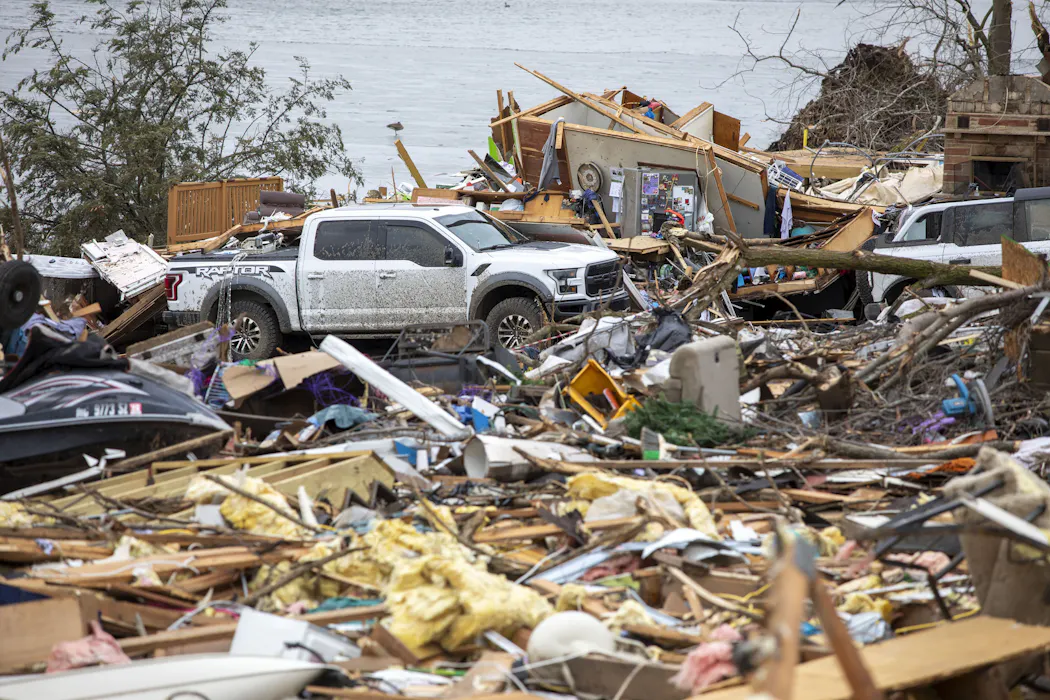
After a deadly tornado hit communities in rural southwest Michigan in March 2026, the state’s request for federal disaster aid was denied.Bill Pugliano/Getty Images
When Hurricane Isaias hit the Florida Panhandle on Oct. 9, 2026, it was just the latest weather disaster for Americans in a year that continues to break records.
In the past, states relied heavily on federal aid and expertise to respond quickly to disasters. But in communities across the U.S., people recovering from floods, storms and wildfires in 2025 and 2026 have been left waiting much longer for federal aid – if it arrives at all.
Hurricane Isaias hit the Florida Panhandle on Oct. 7, 2026, amid a quiet Atlantic hurricane season. Active hurricane seasons can push nationwide disaster costs well over $100 billion. Jen Golbeck/SOPA Images/LightRocket via Getty Image
Will there be political consequences in the midterm elections for the slow aid and lack of government assistance?
The answer to that question runs through the ways the Trump administration has changed disaster response and federal disaster aid. As a professor who has written for years about civic engagement and climate policy, I have reason to believe that voters’ frustration with slow disaster aid may show up at the polls.
Cuts to FEMA hobbled federal disaster help
Even though the United States is experiencing more disasters as the climate changes, the federal programs meant to help Americans recover are being diminished.
FEMA lost over 17% of its trained staff members in 2025 alone, including hundreds of people who were on call to respond to disasters. Homeland Security Secretary Markwayne Mullin continues to defend the administration’s goal of a leaner workforce at the agency.
The Trump administration also withheld billions of dollars meant to help states reduce their disaster risk and protect homes, hospitals and other structures from storm damage. Lawsuits forced the administration to restore some of the funds, but many communities are still struggling on their own.
These changes have tangible effects on how well states are able to recover from disasters and how well they can prepare for the disaster risks ahead as the climate changes.
Slower aid, if it arrives at all
The Trump administration is also taking longer to approve emergency funding after disasters than past administrations did and denying more of those requests.
In 2025 it denied 26% of requests for major disaster declarations, which unlock immediate federal aid. That was up from an average of 15% over the previous two decades.
An independent analysis of FEMA data exposes some clear patterns in funding delays under the Trump administration. The review found that major disaster declarations have taken an average of nearly 10 weeks to be issued during the current Trump administration, up from an average of three weeks or less over the previous two decades.
The administration says it is simply conducting more thorough reviews when governors make these aid requests. But people caught in disasters don’t have time to wait. Major disaster aid includes individual assistance, such as temporary housing, loans and repair grants, that disaster survivors need quickly to recover.
The review also found that about 85% of the requests for federal assistance from states that went for Donald Trump in the 2024 election were eventually approved, while only about half of requests have been approved in states that voted for his Democratic opponent, Kamala Harris.
A separate Associated Press report in July 2026 noted that no other president had such a sharp partisan divide in approving disaster declaration requests between Republican and Democratic governors since at least 1989, when a federal law set rules for disaster determinations.
Disaster failures can mobilize political moderates
A handful of studies, including mine, have found that people who have experienced a disaster often have higher levels of civic engagement.
In my study, civic engagement included contacting elected officials, signing petitions, attending public meetings, participating in boycotts or joining protests, among other actions. We didn’t look at the connection to voting patterns, but I believe there is good reason to expect our findings to extend to voting as well.
The relationship between experiencing a disaster and level of civic engagement was strongest for political moderates who are sometimes referred to as the “movable middle” – they could swing in either political direction if they have reason to do so.
Given the disasters America has seen in recent years and the sharp drop in federal assistance, I expect that political moderates who become more civically engaged will play a significant role in the midterm elections this year.
How FEMA cuts play out in a crisis
Several recent disasters have shown what happens when the federal government isn’t prepared to respond quickly.
After the devastating July 4 floods that swept through Texas Hill Country in 2025, the Department of Homeland Security, which oversees FEMA, waited three days before approving funding to send federal search-and-rescue teams, a Congressional report confirmed. Other funding approvals took an average of 12 days, leaving local and state programs to fill critical gaps in disaster systems.
With highly contested Senate races looming in both states, these actions by the Trump administration could color voters’ views or contribute to a lack of enthusiasm for the party in power and even increase support for the opposition.
A survey conducted by Pew Research Center in May 2025 found that the majority of Americans believe that it is a good idea for the federal government to provide financial assistance to help people rebuild after disasters in place at high risk of extreme weather.
These findings are relatively consistent across political parties: 60% of those who identified as Republican or leaning Republican said they believed it was a good idea, as did 68% of those who identified as Democrat or leaning Democrat.
I don’t believe those late announcements will move the needle in his party’s favor at this late date.
Dana R. Fisher does not work for, consult, own shares in or receive funding from any company or organization that would benefit from this article, and has disclosed no relevant affiliations beyond their academic appointment.
Degrassi has officially entered the next generation.
Now celebrating its 25th anniversary, Degrassi: The Next Generation premiered on CTV Oct. 14, 2001.
For 14 seasons, viewers followed the lives… E! Online (US) – Top Stories
Megan Moroney just laid out her dating rules, and she’s pretty specific about what she won’t tolerate in a relationship. Continue reading…Country Music News – Taste of Country
Megan Moroney just laid out her dating rules, and she’s pretty specific about what she won’t tolerate in a relationship. Continue reading…The Boot – Country Music News, Music Videos and Songs















 Degrassi has officially entered the next generation.