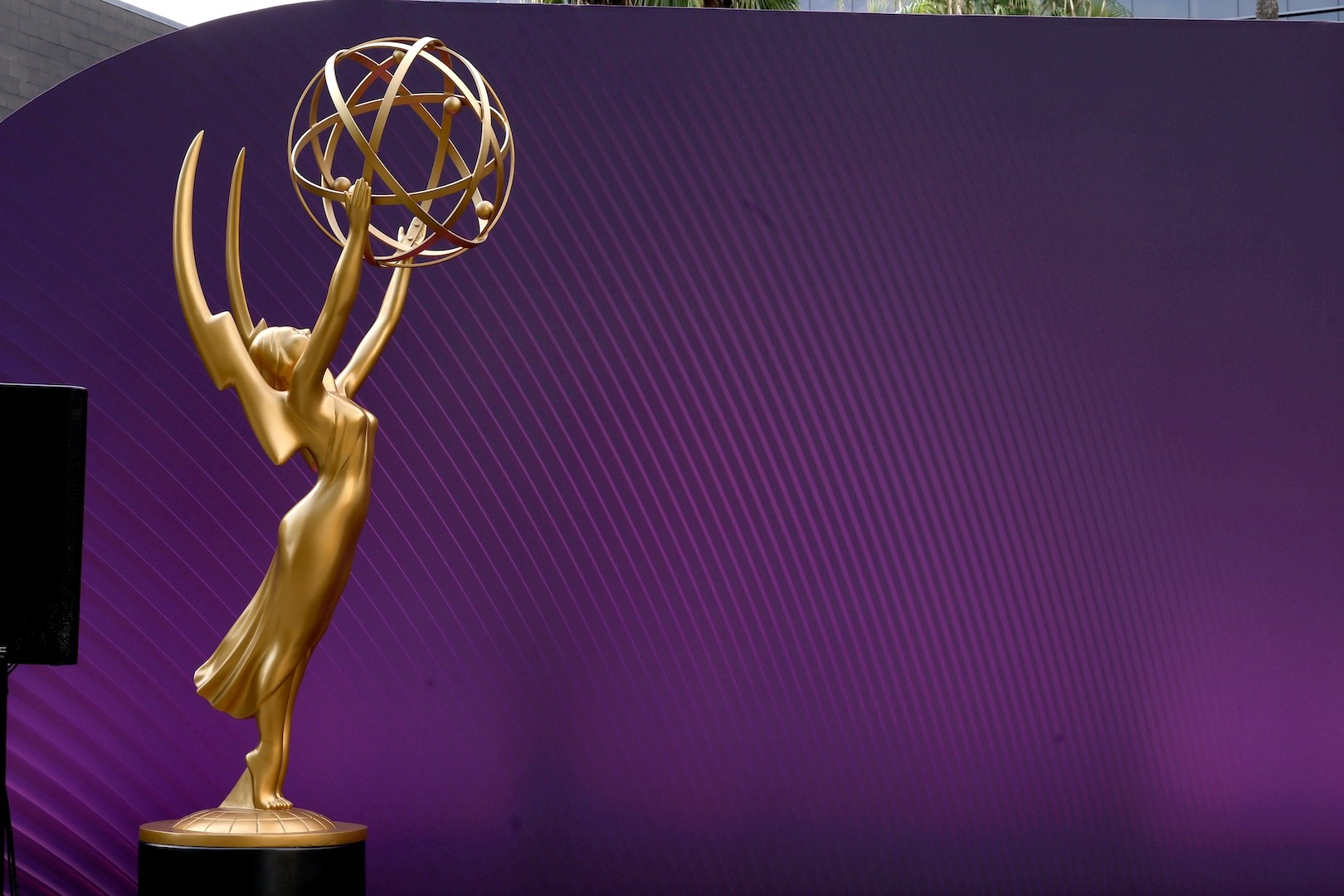
Well, we hate to our own horn, but we did predict that Widow’s Bay would clean up at the Emmys.
And sure enough, the beloved Apple TV+ won big on TV’s biggest night.
In fact, Widow’s Bay and its star Matthew Rhys (who won in TWO lead actor categories, an Emmy’s first!) made history on Monday.
Matthew Rhys accepts the Outstanding Lead Actor in a Limited or Anthology Series or Movie Award for “The Beast In Me” onstage during the 78th Primetime Emmy Awards at Peacock Theater on September 14, 2026 in Los Angeles, California. (Photo by Chloe Kern/WireImage)
Of course, they weren’t the only victors, as Hacks, The Pitt, and a host of other great shows also took home some shiny statuettes.
So without further ado, here are the rest of the big winners at the 78th Emmy Awards:
Outstanding Lead Actress in a Comedy Series
Quinta Brunson – Abbott Elementary Ayo Edebiri – The Bear Elle Fanning – Margo’s Got Money Troubles Lisa Kudrow – The Comeback Jean Smart – Hacks – WINNER
Outstanding Supporting Actor in a Comedy Series
Colman Domingo – The Four Seasons Paul W. Downs – Hacks Harrison Ford – Shrinking Nick Offerman – Margo’s Got Money Troubles Stephen Root – Widow’s Bay – WINNER Michael Urie – Shrinking Tyler James Williams – Abbott Elementary
Outstanding Supporting Actress in a Comedy Series
Dale Dickey – Widow’s Bay Hannah Einbinder – Hacks Janelle James – Abbott Elementary Kate O’Flynn – Widow’s Bay – WINNER Michelle Pfeiffer – Margo’s Got Money Troubles Megan Stalter – Hacks Jessica Williams – Shrinking
Outstanding Supporting Actor in a Comedy Series
Colman Domingo – The Four Seasons Paul W. Downs – Hacks Harrison Ford – Shrinking Nick Offerman – Margo’s Got Money Troubles Stephen Root – Widow’s Bay – WINNER Michael Urie – Shrinking Tyler James Williams – Abbott Elementary
Outstanding Lead Actor in a Drama Series
Sterling K. Brown – Paradise Gary Oldman – Slow Horses Mark Ruffalo – Task Rufus Sewell – The Diplomat Noah Wyle – The Pitt – WINNER
Outstanding Lead Actress in a Drama Series
Carrie Coon – The Gilded Age Chase Infiniti – The Testaments Keri Russell – The Diplomat Rhea Seehorn – Pluribus – WINNER Zendaya – Euphoria
Outstanding Supporting Actor in a Drama Series
Patrick Ball – The Pitt Billy Crudup – The Morning Show Shawn Hatosy – The Pitt Gerran Howell – The Pitt Jack Lowden – Slow Horses Tom Pelphrey – Task – WINNER Carlos-Manuel Vesga – Pluribus
Outstanding Supporting Actress in a Drama Series
Taylor Dearden – The Pitt Fiona Dourif – The Pitt Allison Janney – The Diplomat – WINNER Katherine LaNasa – The Pitt Sepideh Moafi – The Pitt Julianne Nicholson – Paradise Karolina Wydra – Pluribus
Outstanding Lead Actor in a Limited or Anthology Series or Movie
Riz Ahmed – Bait Jason Bateman – Black Rabbit Charlie Hunnam – Monster: The Ed Gein Story Oscar Isaac – Beef Matthew Rhys – The Beast in Me – WINNER
Outstanding Lead Actress in a Limited or Anthology Series or Movie
Claire Danes – The Beast in Me Sally Field – Remarkably Bright Creatures – WINNER Carey Mulligan – Beef Sarah Pidgeon – Love Story: John F. Kennedy Jr. & Carolyn Bessette Sarah Snook – All Her Fault
Outstanding Reality Competition Program
Dancing with the Stars RuPaul’s Drag Race Survivor Top Chef The Traitors – WINNER
Outstanding Variety Series
The Daily Show Jimmy Kimmel Live! Last Week Tonight with John Oliver The Late Show with Stephen Colbert – WINNER Saturday Night Live
Outstanding Limited or Anthology Series
All Her Fault The Beast in Me Beef DTF St. Louis – WINNER Love Story: John F. Kennedy Jr. and Carolyn Bessette
Outstanding Variety Series
The Daily Show Jimmy Kimmel Live! Last Week Tonight with John Oliver The Late Show with Stephen Colbert – WINNER Saturday Night Live
Outstanding Drama Series
The Diplomat The Gilded Age A Knight of the Seven Kingdoms Paradise The Pitt – WINNER Pluribus Slow Horses Your Friends & Neighbors
Outstanding Comedy Series
Abbott Elementary The Bear Hacks Margo’s Got Money Troubles Nobody Wants This Only Murders in the Building Shrinking Widow’s Bay– WINNER
Alaska candidates for the U.S. House race incumbent Republican Nick Begich III (left) and independent challenger Bill Hill (right) squared off at a fisheries debate in Kodiak on Sep. 12, 2026. (Photo by Brian Venua/Alaska Beacon)
Front-runner candidates for Alaska’s sole U.S. House of Representatives seat expressed strong support for the fishing industry and coastal communities at a debate in Kodiak over the weekend.
Incumbent Republican U.S. Rep. Nick Begich III and independent challenger Bill Hill took very similar positions on issues including fisheries bycatch, declining fish stocks and representation in federal fisheries management, but there were some differences.
Begich touted his legislative record in his first two-year term as beneficial to Alaska fisheries, while Hill said his personal history as a lifelong fisherman in Bristol Bay is advantageous for representing Alaska in Congress.
Begich, a technology entrepreneur and business executive, garnered 44.6% of the vote in the primary election, while Hill, a former school superintendent and commercial fisherman, received 32.5% of the vote. Third and fourth place finishers in Alaska’s ranked choice general election include Eric Hafner — a registered Democrat serving a federal prison sentence in New York – with 3.8% of the vote, and Libertarian Jim McDermott of Fairbanks with 1.2%.
The winner of the November election will serve a two-year term as one of the 435 members of the U.S. House of Representatives.
Begich promoted his legislative record as a freshman in the Republican-controlled U.S. House. This spring, six bills he sponsored passed Congress to become law — a tie with another Arizona lawmaker for most bills passed as a freshman — but none of those bills directly address fisheries issues.
“I have passed more legislation than any freshman on record,” Begich said. “And those are good Alaska bills — they are bills that unlock lands for Alaskans, and they are bills that, in many cases, we’ve been working to achieve for decades.”
Hill repeatedly referenced his experience growing up subsistence and commercial fishing in Bristol Bay. “I raised three of my kids on my fishing boat, and understand the importance that state, national and international politics play in what happens on our back decks with our children, what happens in the income that we can take home, what taxation does to us, what tariffs do to us,” he said. “I’ve lived a life of fish.”
Bycatch
Several debate questions focused on bycatch, the accidental harvest of nontargeted fish. Bycatch has raised public concern around Alaska’s industrial trawl fleet, which has many vessels harbored in Kodiak, where the debate took place.
Both candidates said they support broader representation on the North Pacific Fishery Management Council, which oversees fishing policy in federal waters, including bycatch regulations.
Begich said he supports increasing representation for subsistence, sport fishers and small commercial operators, as well as large operators, in council decisions. He pointed to a bill he introduced, the Bycatch Reduction Act, which would require the council to implement gear performance standards to reduce bycatch, to make investments in fishing gear and fisheries research and to increase monitoring and reporting from the industry and the council, among others.
“We need transparency — more transparency for folks who may have conflicts of interest that currently serve on the NPFMC,” Begich said. He also expressed support for a chum bycatch limit established by the council this year for the Bering Sea pollock fishery.
Hill said he supports bycatch limits to protect salmon runs, and additional seats representing subsistence and tribal groups.
“Subsistence is sacred, and the very first thing that needs to happen, and I think you hear it from across the state — this is why there’s such a loud outcry — is because some of our subsistence users have not been able to access their resource, which is more than just protein, for quite a few years now,” he said.
In a question about Congress’ role in reducing bycatch, debate moderators noted all fisheries produce some bycatch harvest and said “a goal of zero bycatch isn’t reasonable.”
But both candidates pushed back on that framing and said that zero bycatch should be the ultimate goal.
The industrial trawl fleet, particularly boats that target pollock, has been the focus of public criticism because it contributes substantially to the state’s bycatch numbers for species including juvenile halibut, cod and salmon returning to spawning grounds throughout Alaska.
Begich said he agreed that every fishery produces some level of bycatch and it’s up to the council to manage each complex fishery. But he said the goal should be “aggressive.”
“I do think the goal should be zero. It’s going to be a long road to get there. But we also have to recognize that in every single fishery, whether it be subsistence, sport, small commercial or large commercial, they have a bycatch responsibility as well,” Begich said.
Hill said the goal should be zero bycatch. “We need to work towards that. We need to work towards a very low-threshold for our trawling industry, especially the out-of-state corporate trawlers,” he said.
And Hill expressed confidence that the trawl industry would be able to meet required limits.
“My perspective is when you set something out for industry to accomplish, they always find a way, and we’ve seen over and over again that our trawl fleet has met the standards that are being set for them. So, can we get to 0%? That would be everybody’s desire, but should we be working towards it? Yes, we should be,” Hill said. “But those who are bad actors, you’ve got to leave the fishery.”
When asked about the primary causes of king and chum salmon run declines, Begich responded it was “largely bycatch related.”
“You look at the Yukon, you look at the Kuskokwim — those runs are way down. We’re seeing some recovery in chums. I think that the cap that we put in with NPFMC is sort of that initial shot saying, ‘Hey, we’re going to be managing these more carefully,’” Begich said. “But I think that historical bycatch is the root cause.”
Hill said he agreed, and added that climate change driven factors are affecting Alaska’s salmon runs. “Climate change is a real thing, and we need to start mitigating for that,” he said. “But yes, we need to end bycatch.”
Processing and protecting Alaska’s fisheries
Both candidates said they would support investments in building the workforce in fishing and processing sectors, as well as more visas for hiring international workers in processing.
In a lightning round of questions, the candidates agreed on every issue. They supported science-based fisheries management, more investment in research and engaging with a wide range of fisheries interest groups prior to introducing new legislation or policies. They also agreed that rural and tribal communities should have more say in decisions affecting fish.
When asked how they would ensure the economic value of federally-managed fisheries would not come at the expense of Alaska communities, Begich said he supports labeling rules for farmed vs. wild-caught fish.
“Alaska seafood is competing with penned fish and farmed fish, and the end consumer doesn’t know it,” Begich said. “And so, when you’re buying an Alaska seafood product, we need to make sure that it’s labeled Alaska. That’s transparent because it gives us the best price for our product and it reduces some of the pressure on our fisheries.”
Hill said he would support more investment in in-state seafood processing to diversify processors to which fishing fleets can sell their harvests. “More processing in our state that’s not a consolidated, vertically integrated type of processing,” he said. “And we need to make sure that we’re legislating to make sure that farmed fishing does not come to our seas and that we keep them off for as long as we possibly can.”
Geopolitics
Both candidates expressed support for tariffs on international seafood to protect Alaska markets.
Hill also condemned the U.S. war in Iran for driving high costs of fuel and affecting fisheries.
“The Iran war is a terrible, terrible thing in terms of how it’s impacted our industry,” he said. “The fuel costs I paid this summer were $2 per gallon more than last year, and they were already high. And then we start talking about things like food and groceries, and the things that allow our crews to do good work for us while we’re fishing hard.”
Begich has expressed support for the Trump administration’s military action against Iran, and voted against a war powers resolution that passed Congress in June calling on President Donald Trump to remove armed forces against Iran, unless authorized by Congress or a declaration of war.
Mail voting in the 2026 midterm elections will go on as usual – now that the Trump administration’s major efforts to disrupt how Americans vote by mail have been blocked by the U.S. Supreme Court.
The U.S. Postal Service had recently implemented new rules placing unprecedented restrictions on the practice of mail voting in federal elections. State officials and voting rights organizations immediately challenged these rules, arguing that the executive agency has no authority under the U.S. Constitution to unilaterally regulate election practices.
On Sept. 14, 2026, the U.S. Supreme Court signaled agreement with these claims, voting 7-2 to uphold a preliminary injunction blocking enforcement of the new rules. The injunction will likely remain in place through the November midterm elections.
The controversy began in March 2026, when President Donald Trump issued an executive order designed to ensure “integrity in federal elections.” The executive order mandates – among other things – that the U.S. Postal Service implement uniform ballot and envelope requirements for mail and absentee ballots used in federal elections.
The order also required states to provide the Postal Service, 60 days prior to Election Day, with lists of all voters eligible to vote by mail or absentee. If a ballot sent via mail didn’t comply with the Postal Service’s requirements, or was sent by somebody not on a state-provided list, the order instructed the USPS to not deliver the ballot, effectively canceling that vote.
Their arguments were straightforward: The president does not possess unilateral authority to alter the methods of voting in federal elections. Rather, the elections clause of the Constitution vests the authority to regulate the “time, place, and manner” of federal elections in the states. Congress also has the authority to regulate federal elections, if it chooses to do so.
Absentee voting instructions for mail-in ballots are seen at the Wake County Board of Elections on Sept. 3, 2026, in Raleigh, N.C. AP Photo/Matt Ramey
Federal judge rules against administration
The two lawsuits were heard by the same U.S. District Court judge in Boston, who ultimately agreed with the plaintiffs and issued injunctions against the federal government. Those injunctions forbade the president and all relevant federal officials and agencies, including the USPS, from carrying out any aspects of the executive order regarding mail and absentee voting.
The lawsuit led by state officials ultimately made its way to the Supreme Court, which on Aug. 24 voted 6-3 along ideological lines in favor of the Trump administration. The court did not decide on the constitutional issues raised in the case but instead found that the states lacked the injury necessary to have standing to bring the case. The court reasoned that because the USPS had yet to implement the executive order, the states were not yet affected by it.
At the same time, the USPS began writing the rules and processes governing how it would carry out the executive order. These steps blatantly violated the remaining injunction in the voting rights organizations’ lawsuit. But the District Court judge ended up dissolving that injunction on Aug. 26 in light of the Supreme Court’s decision in the other case.
That same day, the USPS officially published its new rules for mail ballots.
Widespread confusion
The USPS rules contained three key provisions.
First, states must design their ballot envelopes in accordance with USPS requirements, and the envelopes must be submitted to the USPS for final approval. Second, state and local election officials must input the names of voters qualified to vote by mail or absentee into a USPS-run electronic portal at least 30 days before the date of a federal election. Last, any mailed ballot that does not adhere to the design requirements, or that is sent by somebody not on the Postal Service’s electronic portal, “will not be accepted” by the USPS.
These rules led to widespread confusion among election officials, who remained uncertain about how to apply them to the 2026 midterm elections. For one, the rules laid out no clear deadline for USPS approval of envelope designs. Moreover, the electronic portal’s 30-day deadline conflicted with state voter registration deadlines, with all states allowing individuals to register to vote at some point within 30 days of Election Day, and many far later.
Election officials were also left wondering how to adhere to these rules under such short notice. Some states, such as North Carolina, have already distributed mail ballots to voters. Election officials in Utah, meanwhile, were considering setting up their own distribution centers to bypass the USPS rules.
Justices Samuel Alito, left, and Clarence Thomas dissented on the Sept. 14 Supreme Court opinion and would have allowed the USPS rules to go into effect. Chip Somodevilla/POOL AFP, Getty Images
Following enactment of the USPS rules, the plaintiffs from the original two lawsuits renewed their constitutional challenge, arguing that they now had standing to sue.
On Sept. 4, the U.S. District Court issued a new preliminary injunction pausing the implementation or enforcement of the USPS rules. The court, in short, found that the USPS likely infringed upon Congress’ and the states’ elections clause powers.
On Sept. 6, the federal government petitioned to the U.S. Supreme Court seeking a stay – or pause – on the preliminary injunction.
In its petition, the government contended that the USPS rules do not unduly impede states’ administration of elections but rather “impose reasonable preparation requirements for certain election-related mail.” The petition elicited 20 amicus briefs, largely in opposition to the USPS, including one signed by seven Republican chief election officials detailing the impracticality of the USPS rules.
On Sept. 14, the U.S. Supreme Court ultimately voted to uphold the preliminary injunction, with Justices Clarence Thomas and Samuel Alito dissenting.
In one brief paragraph, the court stated that the federal government “is unlikely to succeed on the merits of its challenge,” suggesting that a supermajority of the court believes the USPS exceeded its constitutional authority. Given that the litigation is still ongoing in District Court, though, the Supreme Court did not issue any final decision on the merits of the parties’ claims.
Practically speaking, this ruling likely settles the question of whether the USPS rules will have any impact on the midterm elections in November.
With less than two months until Election Day, and a preliminary injunction remaining in effect with the Supreme Court’s endorsement, the federal government’s hands are tied until the litigation over the issue fully plays out in the District Court.
By the time that happens, the country may already be looking ahead toward the 2028 presidential election.
John J. Martin does not work for, consult, own shares in or receive funding from any company or organization that would benefit from this article, and has disclosed no relevant affiliations beyond their academic appointment.
The vaunted Rams … What happened?! Drake Maye … What are you doing?! Brian Flores … brings the heat! That Cowboys defense … yikes! The Chiefs are … back? After Week 1 of the 2026 NFL season, I know you have strong reactions from the football you watched — both positive and negative. And it’ll be that way all year long. That’s why I’ll be giving you my best and worst superlatives every week. I’ll drill down into the best and the worst in a number of categories. For Week 1, let’s talk plays, coaching and defense: In the Commanders’ Week 1 loss to the Eagles, special-teamer Tyler Owens produced one of the best gunner reps you’ll ever see. He fought his way through a double team at the snap from Philly’s Jonathan Jones and Darius Cooper. He stiff-armed Jones about five yards downfield. Then he stiff-armed Jones and Cooper simultaneously. He threw Cooper to the ground. He threw Jones down about 10 yards later. And if all that wasn’t enough, he took down Eagles punt returner Britain Covey with a textbook tackle, driving him to the ground. On an individual basis, regardless of the phase of the game, it’s one of the most impressive plays in recent NFL history. The clip will be on a loop for football teams at all levels all week and referenced for years to come as an example of the kind of effort and finish coaches want to see on the field. Each of Maye’s three picks were bad in the Patriots’ 13-10 season-opening loss to the Seahawks, but his final one, which sealed New England’s loss, was particularly puzzling. The Patriots faced a third-and-5 from the Seahawks 16 with 26 seconds left, trailing by three points. That’s where Maye forced a throw to a tightly-covered Mack Hollins in the end zone. Seeing that Hollins wasn’t open, Maye should’ve thrown the ball away, giving New England a chance to tie the game with a field goal. That’s quarterbacking 101. You cannot have a turnover (or take a huge yardage loss on a sack) in that situation. For a quarterback of Maye’s caliber to make a rookie-level mistake like that is baffling. His track record against great defenses isn’t good, so that will be something to watch as his third NFL season unfolds. Flores concocted a brilliant defensive game plan to help the Vikings to a 39-22 season-opening victory over the Packers. The veteran playcaller was relentless in harassing Packers quarterback Jordan Love, who was blitzed on 78.3% of his dropbacks, according to Next Gen Stats. That’s the fourth-highest rate by a defense in any game in at least eight years. Minnesota generated four sacks and an interception on second-half blitzes. Vikings linebacker Black Cashman had seven quick pressures (under 2.5 seconds), which was the most by a player at his position in a single game since at least 2018, per NGS. Third-year edge rusher Dallas Turner registered a career-high 10 pressures. Flores, the former Dolphins head coach, has been in the mix for head coaching openings for years only to be passed over — to the benefit of the Vikings. His complex defense has consistently ranked among the league’s top units since he became Minnesota’s defensive playcaller in 2023. I’m banking on that continuing in 2026. Next week, Flores takes on Ben Johnson and the Bears, the NFL’s highest-scoring offense in Week 1. The Rams’ decision to take a 16-hour flight and arrive in Melbourne, Australia, the day before their opener against the 49ers didn’t seem to make much sense. Sure enough, the Rams looked flat in their 27-7 season-opening loss in what’s being called “The Jet Lag Game.” Even if you chalk that up as an organizational decision based on advice from experts in sleep study, McVay fell short in other ways. His decision to call a goal-line quarterback sneak with 38-year-old Matthew Stafford, who has a history of back issues, was puzzling (Stafford was stuffed). But what stood out the most to me was McVay’s poor handling of star edge rusher Myles Garrett’s knee issue. After the Rams’ loss, a game in which Garrett went without a tackle for the first time since Week 11 of the 2024 season, McVay said the reigning Defensive Player of the Year’s knee was 100 percent to his knowledge. A couple of days later, it was announced that Garrett, who was held out for much of training camp due to his knee, would have arthroscopic surgery and be placed on injured reserve. That means he’ll miss at least four games. The Bengals’ new-look defense lived up to the hype. Cincinnati generated a league-high four turnovers, including on three straight possessions in the first half, to help the team to a 33-27 victory over Tampa Bay. Those four takeaways led to 24 points, including a defensive touchdown by linebacker Demetrius Knight, who registered the team’s first fumble recovery for a TD since 2022. All four of the turnovers forced by the Bengals were fumbles, which came from four different Cincinnati defenders — linebacker Barrett Carter, safety Bryan Cook, defensive ends Myles Murphy and Boye Mafe. That speaks to the depth of the defense, which gave up just 89 rushing yards. After finishing 31st in total defense last season, don’t be surprised to see Cincinnati be top-10 good defensively this year. Yes, the Panthers gave up 59 points. But I think that says more about Ben Johnson, Caleb Williams and the dynamic Bears offense. So my focus here is on the Cowboys, who spent all offseason telling us that this year’s defense wasn’t the same as last year’s only to … look like last year’s. They appeared to be completely overwhelmed and unprepared against the Giants in Week 1. Dallas gave up 165 rushing yards and three drives of at least 12 plays to end the game. New York went 9-of-10 on third down, excluding the game-ending kneel down. Quarterback Jaxson Dart completed 79.3% of his passes. There were coverage lapses everywhere. The Cowboys had a four-man pressure rate of just 10.0%, their lowest in a game in five years, according to Next Gen Stats. I think Christian Parker, the Cowboys’ 34-year-old defensive coordinator, is a good young coach. Defensively, Dallas is better on paper. But Monday’s performance was putrid.Latest Sports News from FOX Sports
Glenfarne’s name is displayed on May. 19, 2026, on the stairs at the Dena’ina Civic and Convention Center, the venue for the three-day Alaska Sustainable Energy Conference. Glenfarne is a major sponsor of the conference. (Photo by Yereth Rosen/Alaska Beacon)
Everyone debating the Alaska LNG project assumes the developer wants what it says it wants: to build an 800-mile natural gas pipeline.
But look at Glenfarne’s deeds instead of its words, and a different possibility emerges. Glenfarne may actually be waiting to see if things work out with the pipeline because it now has an essentially guaranteed moneymaker in the form of a project to import LNG into Cook Inlet for local needs.
Consider the company’s position. Glenfarne paid $10 million and promised to fund the pipeline project’s development in return for 75 percent of the entity that holds the permits, the right-of-way, and a quarter-billion dollars worth of state-funded development work on the only federally-permitted LNG export project on the U.S. Pacific Coast.
In the energy industry, $10 million is sofa-cushion money. It’s not the price of an asset, it’s the price of an option on an asset. And a leaked draft of the state’s own review suggests there’s a highly favorable exit clause for Glenfarne: if Alaska ever wants to get that 75 percent back — to build the project itself or hand it over to a more credible developer — Glenfarne would name the asking price.
Then there’s what Glenfarne has done with its own money — not buying pipe for the gasline, which it promised to order and didn’t, but building an LNG import terminal in Cook Inlet with Enstar, the Southcentral gas utility, locked up as an exclusive customer. Cook Inlet gas is running low and Southcentral will need imported gas soon, pipeline or no pipeline. Imports are the one sure thing in this entire picture. And Glenfarne’s in the catbird seat.
And here’s the rub. The first phase of the pipeline, which Glenfarne now estimates to cost $13 billion to $17 billion, is meant to serve that same Southcentral market before any gas is exported. So Glenfarne is building a relatively cheap, near-term way to supply the Cook Inlet market while asking Alaska to subsidize a $13-billion-plus way to supply the same customers. Once you own a cheap solution to a hungry local market, why rush to build an expensive one and compete with yourself?
The booster answer has been that imports are merely a bridge until the pipeline is ready. But that gets the incentive backwards. A bridge you own, earning money the moment it opens, serving captive customers with no ready alternative, is not a reason to hurry toward a $50-billion megaproject. It’s a reason to relax and see what unfolds.
Now add the politics. To get the Legislature to yes on tax incentives, Glenfarne and the governor promised nearly anything, up to and including a $250 million Fairbanks spur to build political support in the Interior. Yet when the Legislature assembled a bill this year that gave Glenfarne what it said it needed — a big property tax break and an income-tax exemption — the deal collapsed. By several legislators’ accounts, Hilcorp, which controls the North Slope gas the pipeline would carry, leaned on Glenfarne to kill it over the income tax provision in the bill. The governor called that “bullshit.” Either way, the pipeline project is stalled while the LNG import project proceeds.
Put the pieces together and a coherent strategy appears. Build the import terminal, the sure thing, and start making money while Hilcorp and the Legislature duel over income taxes.
Meantime, hold onto your bargain-basement 75 percent stake in the pipeline project like the option it is. If the economics of that project ever come together, either build it yourself or sell out to someone big enough to wrangle Hilcorp and the Legislature into settling their differences. If the pipeline never goes, you’re not exposed, and you make money on LNG imports as far out as the eye can see.
We don’t know Glenfarne’s true intentions, of course. But the incentives all point the same way: the developer’s least risky and most profitable path is not to build the pipeline. It’s to build the LNG import facility, cash the checks, and wait.
That should change how Alaska reads every “almost there” and every new demand for additional concessions: the state may well be negotiating with a company who’s playing a waiting game rather than trying to build a pipeline any time soon. Trying to rush a deal with a counterparty who doesn’t need one is like pushing string.
Glenfarne has arranged its affairs so it can afford to wait. By deferring the pipeline question to next year, a new legislature, and a new governor, the Legislature has responded with precisely the right message: Alaska can wait, too.
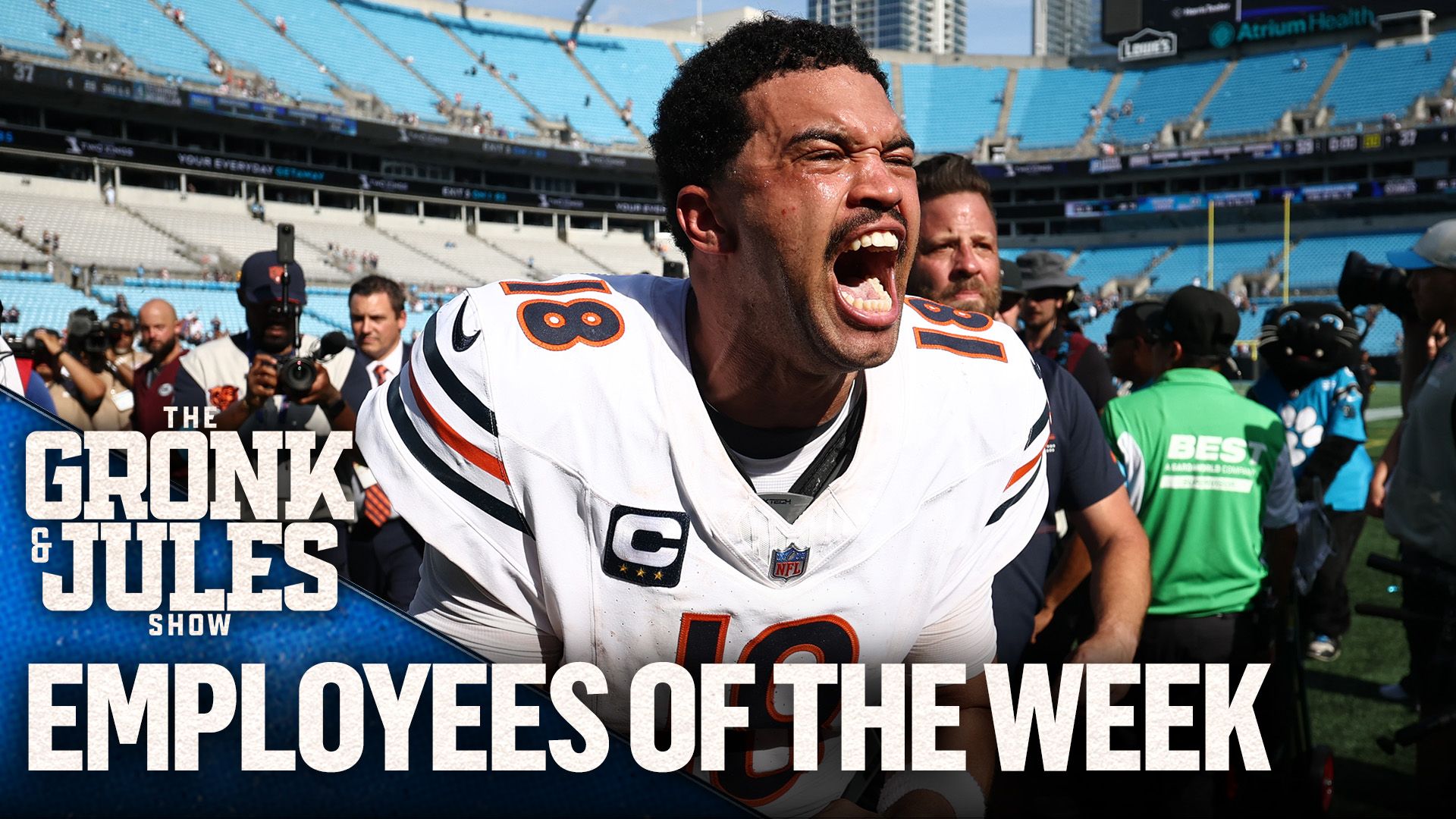
The 2026 NFL season opened with two of the NFC North’s rising stars putting together performances that had the league buzzing, and Julian Edelman and Rob Gronkowski were paying close attention. On the debut episode of FOX Sports’ “Gronk & Jules,” Edelman and Gronkowski handed out their Week 1 “Employees of the Week” honors, and each host picked one star from teams in the NFC North. Edelman went with Chicago Bears quarterback Caleb Williams, while Gronkowski sided with Detroit Lions running back Jahmyr Gibbs. Julian Edelman’s Employee Of The Week Edelman rolled with the guy who quarterbacked the highest-scoring offense on Sunday as his “Employee of the Week.” “Employee of the week for me, Caleb Williams,” Edelman said. “That was a fun game to watch. That’s what you want to see out of your offense. Week 1, 59 points, man. He threw it well. He rushed it well. He looked fast. The whole embracing the Chicago culture — that was a fun, cool win, man. That was big time.” Williams torched the Carolina Panthers in a 59-37 win, completing 21 of 29 passes for 269 yards and two touchdowns while adding 65 rushing yards and two more scores on the ground. His 124.1 passer rating and four total touchdowns made him the first quarterback in Bears history to record at least 200 passing yards, two passing touchdowns, 50 rushing yards and two rushing touchdowns in the same game. Gronkowski agreed, adding that Williams’ style of play is drawing eyeballs to Chicago’s offense. “He’s gonna draw viewers in because of the way he plays the game,” Gronkowski said. “It’s special. It’s entertaining. That’s what people want to see. He’s electric, and when you’re electric, you know that’s a special trait to have. People are going to tune in. The city of Chicago is head over heels in love.” Rob Gronkowski’s Employee Of The Week Gronkowski then turned to his own pick, one that came from the other side of the division. Detroit Lions running back Jahmyr Gibbs authored a milestone of his own in a 31-30 victory over the New Orleans Saints. Gibbs carried 29 times for 156 yards and two touchdowns, adding five catches for 30 yards. His first score of the day was his 50th career touchdown in his 50th game, and he finished the afternoon with 51, making him just the sixth player in NFL history to reach 50 touchdowns within his first 50 games, joining Jim Brown, Marcus Allen, Chuck Foreman, Larry Johnson and Steve Van Buren. “And for my employee of the week … Jahmyr Gibbs, I gotta go with him,” Gronkowski said. “He absolutely balled out. 156 yards, two TDs rushing. He contributed in the pass game as well. Fastest player to 50 touchdowns in history. He has 51 touchdowns currently because he scored two in this game in 50 games. This guy is a special talent, and just like Caleb Williams, he’s electric as well, and he’s fun to watch.” With Williams and Gibbs showing out on Sunday, Edelman and Gronkowski couldn’t hold their excitement for the Lions-Bears matchups later this season. “It’s going to be a helluva game when the Detroit Lions face the Chicago Bears,” Gronkowski said. Williams’ Bears and Gibbs’ Lions meet twice this season, starting with a Thanksgiving Day clash at Ford Field on Nov. 26 before meeting again at Soldier Field in Week 17 on FOX’s “America’s Game of the Week.” That matchup carries extra history for both teams given Bears head coach Ben Johnson’s roots in Detroit. Johnson spent three seasons (2022-24) as the Lions’ offensive coordinator, helping build one of the NFL’s most productive offenses before Chicago hired him as head coach in January 2025. “Another reason why it’s going to be a battle? Ben Johnson came from Detroit,” Gronkowski said. “This rivalry is getting more special as it goes on.”Latest Sports News from FOX Sports
Russell Dickerson took a moment during a recent show to honor two longtime fans who have spent more than a decade supporting his career.
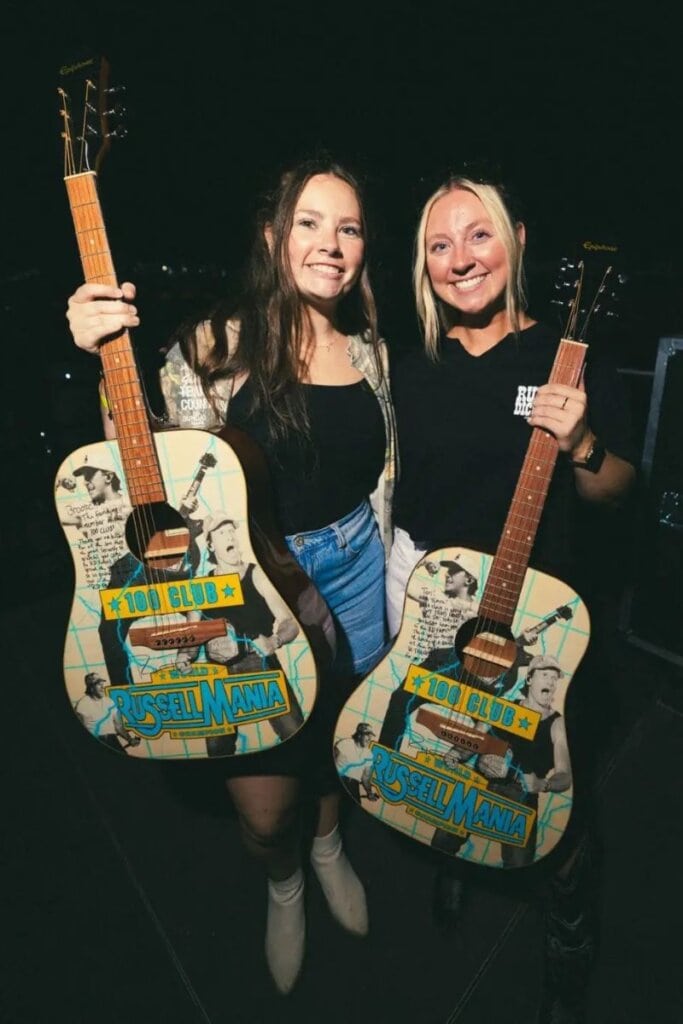
Tori and Brooke, also known under the username TravelingWithT&B, first met because of their shared love for the country music singer. Since then, they have formed a true bond that has taken them to countless concerts together, and this weekend they celebrated a milestone as they attended their 100th Russell Dickerson show.
Russell Dickerson with Tori And Brooke; Photo Provided
Dickerson made sure this moment did not go unnoticed. During a recent show, he paused his performance to invite Brooke and Tori onto the stage to give them a shoutout in front of the entire crowd.
“I would like to bring to the stage my friends, Brooke and Tori, who are both celebrating over 100 Russell Dickerson concerts tonight. They’ve been with us for over 10 years. They’ve seen some bad shows…but they still keep showing up over a hundred times all over America,” he stated in the video.
The Tennessee native explained that fans like Brooke and Tori, who continue to show up, support his music and have the best time doing it together, are what make it all worthwhile.
“I’m a super fan of music. I love going to concerts time after time after time again. And these ladies have been here.”
To commemorate their 100th show, Dickerson noted that him and his team had a special gift for them: their very own, one of a kind “100 club” guitars that featured a handwritten note from the “Happen To Me” singer to show how much their love and support means to him.
After receiving the incredibly kind gifts, they each took a moment to hug Dickerson and told him, “we wouldn’t be friends if it wasn’t for you.”
“They didn’t even know each other before,” he said before prompting the crowd to cheer for the fans as they made their way off stage. “One more time for Brooke and Tori, over a hundred shows.”
Written over the video was a text that found the two fans emphasizing how important it is to show up for the artists who “make their fans feel like more than just a face in the crowd.”
They later told Country Now just how much this gesture meant to them, especially since they have spent years watching his career grow and catching plenty of memorable performances along the way.
“We’ll always support Russell, not just because of his music, but because of who he is as a person. He genuinely cares so much about the people around him, and we feel incredibly blessed to have gotten to know him over the years. So for him to take time out of his show to celebrate us was something we’ll never forget. It truly meant the world to us!”
What began with two strangers showing up for the same artist has now turned into a friendship spanning more than 100 concerts, proving just how powerful live music can be. Their story is the perfect example of how strong the connection between artists and fans can truly be.
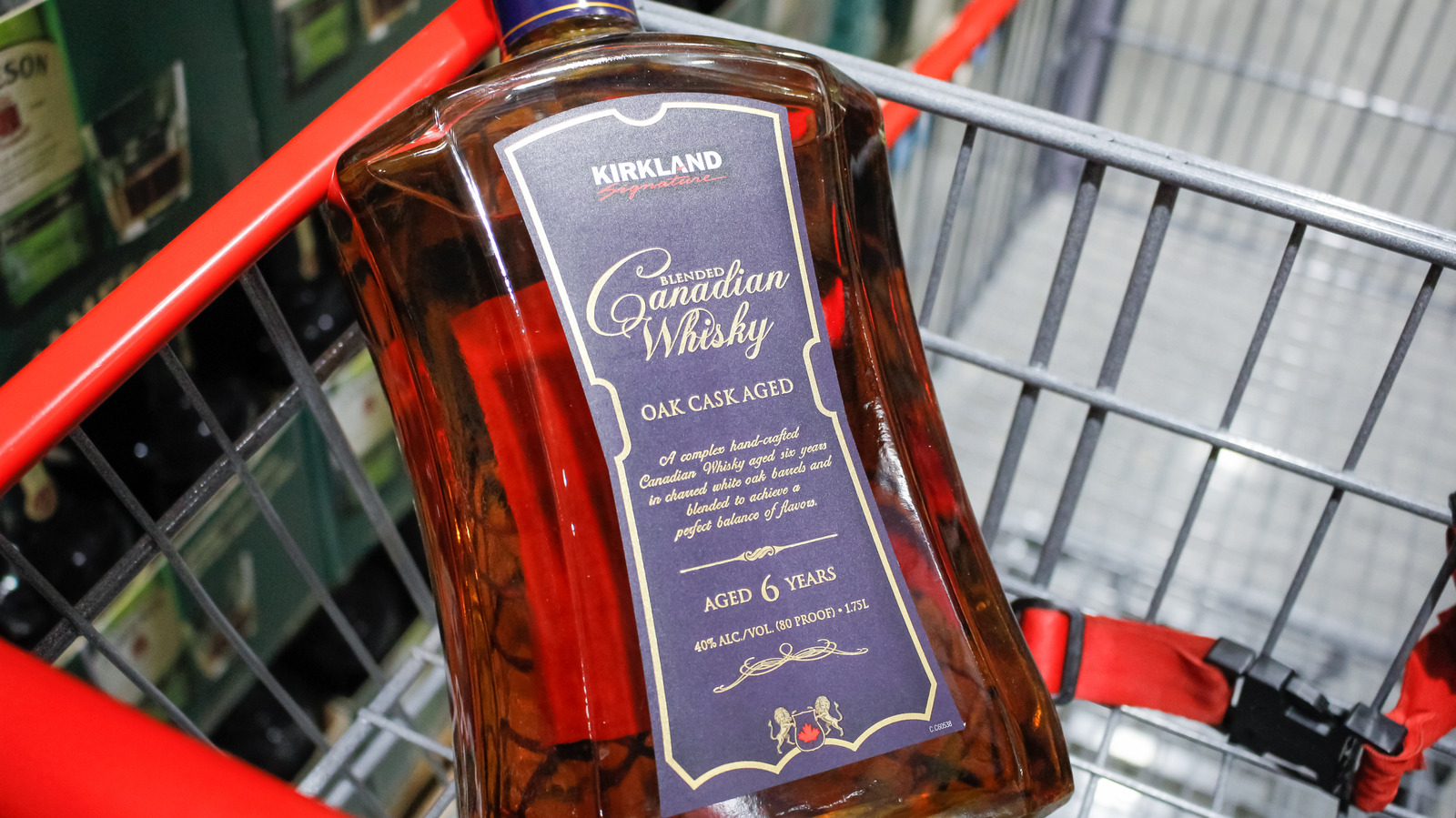
Costco’s Kirkland Signature Canadian Whisky is a standard that is often compared to Crown Royal, and it makes a mean cocktail. Here are five of the best.