BELGRADE, Serbia — The nearly four-year Bosnian war in the 1990s set off a massive wave of displacement, with a third of Bosnia and Herzegovina’s pre-war population permanently leaving the country as refugees.
Team captain Edin Džeko, a 40-year-old striker who left his native Sarajevo soon after the war, has recalled playing soccer in the lulls between the daily barrage of sniper fire that defined the siege of the Bosnian capital and says he could never have imagined becoming a world-class player after watching the football pitches in his neighborhood reduced to “fields of scorched earth.”
Bosnia’s squad reflects that postwar diaspora. Left back Sead Kolašinac was born in Karlsruhe, Germany, in 1993 to a family that left after Bosnia descended into war. Right back Amar Dedić was born in Austria after his parents left northern Bosnia during the war, and midfielder Benjamin Tahirović in Sweden to refugees from besieged Sarajevo.
And then there is the so-called Milwaukee Messi: young forward Esmir Bajraktarević, who was born in a Wisconsin to parents born in the eastern town that gave its name to the Srebrenica genocide.
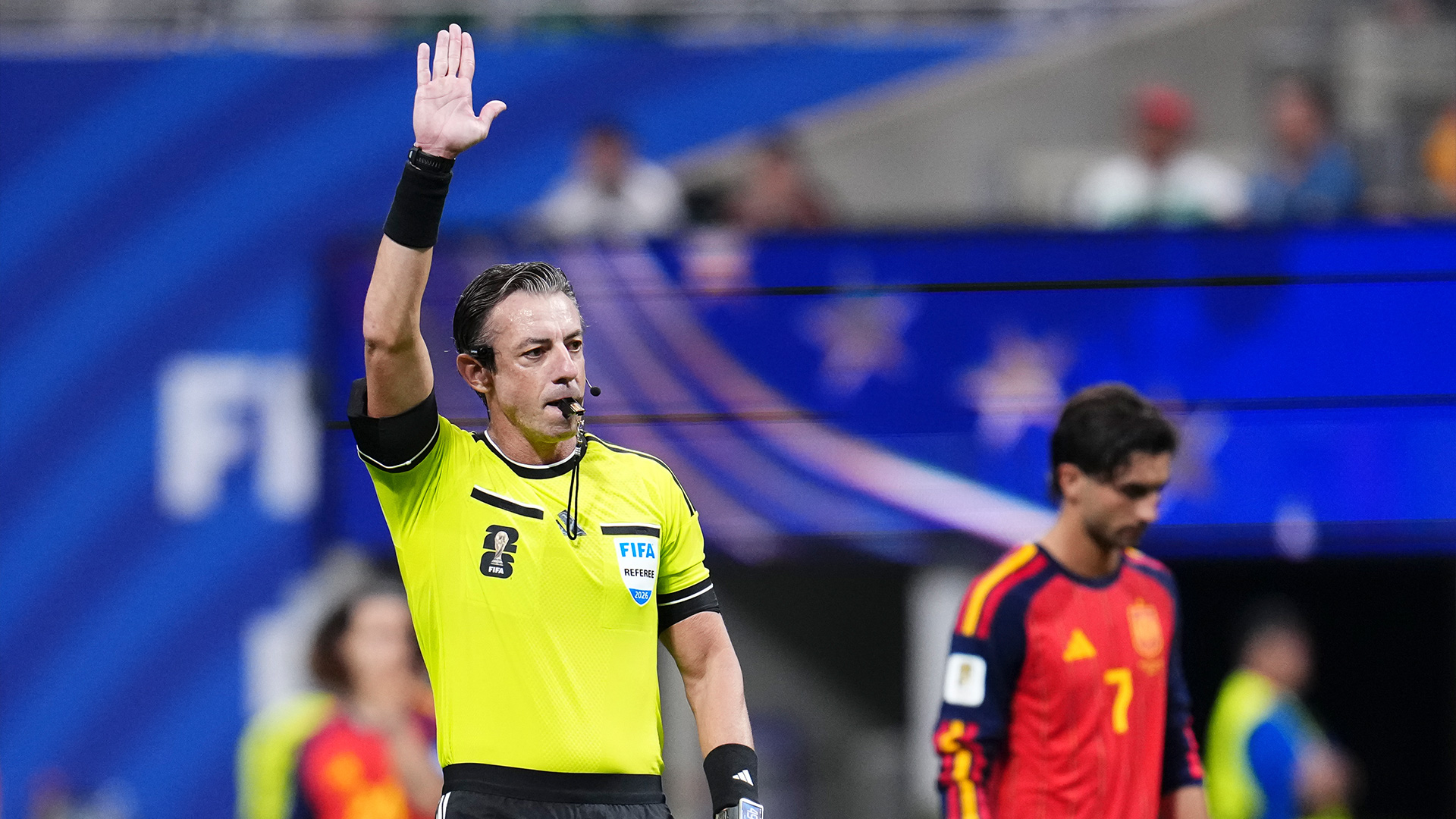
The United States is set to take on Bosnia and Herzegovina at San Francisco Bay Area Stadium in the Round of 32, looking to win only its second knockout-stage game at a men’s FIFA World Cup. The U.S. finished first in Group D and earned the right to play Bosnia and Herzegovina, which finished third in Group B. Bosnia and Herzegovina is playing in its first knockout-stage game in its history at a major tournament. Raphael Claus from Brazil is the referee assigned for this one, alongside his fellow Brazilians Danilo Manis and Rodrigo Figueiredo. Dario Herrera from Argentina will be the fourth official. This will be Claus’ second assignment of the tournament, after he was the head referee for Spain’s 4-0 win over Saudi Arabia on June 21. Claus gave out two yellow cards in that fixture. He also refereed two games at the 2022 World Cup, both group-stage matches, so this will be his first knockout-stage game at a World Cup, despite his experience in CONMEBOL. The VAR room will consist of Venezuela’s Juan Soto, Colombia’s Nicolas Gallo and France’s Jerome Brisard. Here is the full team of referees:Latest Sports News from FOX Sports
BRUSSELS — The Matongé area of Brussels was filled with drums and flags on Wednesday evening as every bar and barber shop showed the DR Congo vs. England game — the biggest Congolese match since 1974, when it won the African Cup of Nations and competed in the World Cup under the name Zaire.
Belgium’s relationship with DR Congo is rooted in its colonial rule, a legacy that continues to shape political, cultural and diplomatic ties today. Up to 50,000 members of the Congolese diaspora live in Brussels, with the vibrant Matongé as the epicenter.
English fans in Matongé were few and far between — and mainly silent — throughout most of the match as their team trailed for a long period before turning the game around.
Despite Congo’s eventual narrow defeat, supporters were stoked by the team’s performance. “At the end of the day Congo was better than England because they overperformed and England underperformed,” said Darshan Pham, whose family hails from DR Congo. “That’s the beauty of the games, it’s a victory for them anyway because they made it so far.”
Sydney Jadot, who worked for five years in DR Congo where his family is from, also admired the team’s fight: “What can I say? I think Congo fought well — they put all their hearts [into it] and England is more thorough.”
Alan Jackson’s final concert was a milestone moment not only for fans and fellow country stars in attendance, but also for his family.
At the historic show, the country icon was joined by his wife, Denise, and their three daughters, Mattie, Ali, and Dani, along with extended family as they gathered to witness a career-defining night.
Following the performance, witnessed by 80,000 fans in Music City, his eldest daughter, Mattie Jackson Smith, shared a heartfelt tribute on social media, reflecting on what she described as one of the most unforgettable moments of her father’s career.
Alan Jackson’s Daughters; Photo via Instagram
Alongside a gallery of photos from the evening, she opened her post by noting just how many of his shows she’s attended over the years, and how this one will always stand apart.
“There’s no telling what number show this was for me in 36 years. But it’s one I’ll never ever forget. We’ve always been so proud of @officialalanjackson, of course. But it’s easy to lose sight of just how remarkable his life and career has been when it’s always been the ‘normal’ backdrop to your life,” she wrote.
She went on to reflect on the impact of his music and the way it has resonated across generations, praising his commitment to authenticity throughout his career.
Alan Jackson Nissan Stadium; Photo by Sam Shapiro Media
“Saturday was anything but normal. His music has transcended generations. His words have both healed and celebrated real people’s lives in their broken and beautiful moments. He’s always sung the truth which is why fans always come back,” she continued.
In closing, Mattie said the night exceeded anything she could have imagined, ultimately solidifying her father’s legacy on one of the biggest stages of his career.
“Not only did he outperform my expectations, it was surreal and humbling and left me in awe to see 80,000 people (and tons more streaming elsewhere) come to celebrate and honor him once last time,” she wrote. “He’s still always first Dado to us, but what a night to forever solidify the icon he is to the world. Couldn’t be more proud!”
Alan Jackson; Photo by John Shearer, Getty Images
Mattie Jackson is the eldest of Alan Jackson’s three daughters and has recently stepped into a new role within his whiskey business. Silverbelly Whiskey, which Jackson launched in the summer of 2022, previously announced that Mattie has joined the brand as Master Blender.
When two teams take to the World Cup pitch, their national histories and politics take the field with them. Seldom is that weight as present as in Wednesday’s knockout stage game between the U.S. and Bosnia and Herzegovina.
The U.S. played a decisive role in ending Bosnia’s nearly four-year war in the 1990s, a conflict that claimed more than 100,000 lives and produced the single worst crime on European soil since World War II — the Srebrenica Genocide, in which more than 8,000 Bosniaks, mostly men and boys, were summarily executed in early July 1995.
“The United States is an indispensable ally,” said Reuf Bajrović, the vice president of the US-Europe Alliance, a nonprofit group that works on mobilizing Americans around key European issues.
Bajrović, as many in Bosnia would, highlights that the existence of an “independent, free and sovereign Bosnia” is the direct result of U.S. involvement in ending the war and brokering a peace deal, widely known as the Dayton Peace Accords — signed in Dayton, Ohio.
Thirty years later, the country faces internal disputes and struggles with a political system that is deeply vulnerable to nationalist manipulation. But reaching this stage and competing against their erstwhile liberator has unleashed a rare moment of collective elation across the Balkan nation.
“A nation which was supposed to be erased from history is competing with the most powerful and influential nation in the world,” Bajrović continued. “The euphoria is absolute,” he continued.
Even the country’s most famous footballing son, former AC Milan star Zlatan Ibrahimović, said he felt “goosebumps” watching Bosnia’s fairytale run to the round of 32. Ibrahimović, who was born in Sweden but embraces his father’s Bosnian heritage, had earlier trolled his fellow Fox Sports co-anchors by playing pop-folk songs by Bosnian singer Lepa Brena as an homage to his roots.
Yet back home, some worry that America’s more recent role in Bosnia’s brittle political order has been anything but benign.
“Until Trump entered the scene, there was bipartisan support for Bosnia … after all, Americans are the founding fathers of the peace deal that became the Bosnian constitution,” said prominent author and political analyst Dragan Bursać, who is based in Banjaluka.
Two Trump administrations have steadily hollowed out that commitment, and some of the most destabilizing figures in Bosnia right now are Trump allies such as Rudy Giuliani and Rod Blagojevich.
Giuliani promotes the same kind of “Christian victimization” narratives as Blagojevich, and also often draws comparisons between Trump and Milorad Dodik, an ultranationalist pro-Putin Bosnian Serb leader, saying they’re victims of the same “lawfare” movement led by liberal or woke judges. Dodik was stripped of the presidency last year after directly violating the Bosnian constitution and encouraging separatist activity.
The “Christian victimization” rhetoric employs the same divisive logic that produced the war itself. In the 1990s, political and military leaders turned a country praised for its diversity against itself, pitting its nominally Orthodox Christian, Catholic and Muslim populations against one another as neighboring Serbia and Croatia backed forces across the border.
Giuliani’s and Blagojevich’s narratives have particular populist purchase with figures like Dodik, who was, until recently, on a U.S. sanctions and travel ban list. Giuliani is thought to have played a key role in getting the sanctions against Dodik lifted last year.
“Dodik is one of those European leaders who wholeheartedly supports Trump’s beliefs and sees himself as a mini-Trump in Bosnia,” Bursać continued.
Bosnia’s political system rests on intense ethnic power-sharing, which has now turned into one of its key weaknesses. In Banjaluka, the administrative seat of the Serb-majority entity of Republika Srpska, pro-Trump chants now ring out at rallies, including during a visit by Donald Trump Jr. in April.
“Now we’re facing a situation where many people would prefer the current U.S. administration ignore Bosnia as much as possible and not get involved, since they fear that there would be no positive effect,” Bursać explained.
Michael Flynn, Trump’s former national security adviser, is a registered foreign agent for Dodik. His brother Joseph, along with Jesse Binnall — a former Trump attorney who worked to overturn the 2020 election — runs a company chasing a $1.8 billion investment in Bosnian airports, gas power plants and a pipeline.
The country that saved Bosnia is now, according to some accounts, actively engaged in undermining it.
“The U.S. policy in the 2020s is not something that Bosnians experienced in the past, and the U.S. never previously openly sided with nationalist Serb and Croats at the expense of the Bosniak-majority of the country,” Bajrović said.
Student backpacks seen on the first day of school at Harborview Elementary School in Juneau on Aug. 15, 2025 (Photo by Corinne Smith/Alaska Beacon)
Content warning: This story contains references to sexual violence and abuse of children.
A new statewide initiative aims to prevent and reduce Alaska’s pervasively high rates of child sexual abuse.
The statewide prevention plan is led by the Alaska Children’s Trust, a non-profit advocacy group focused on supporting children and families and preventing child abuse and neglect.
Trevor Storrs, the president and CEO of the Alaska Children’s Trust, said a coordinated effort among state and community groups, service providers, schools, caregivers and youth is needed to make serious strides in intervening and preventing abuse.
“We should not expect children to fight off these predators. We want them equipped with the tools, but it’s our job, not just as adults, but as a community and society, to make sure kids are safe,” he said.
The plan was developed last year with a variety of statewide groups, including representatives from Child Advocacy Centers, the Alaska Department of Education and Early Development, the Office of Children’s Services, which runs the state’s foster care system, law enforcement, Tribes, health care providers, lived experience experts, faith communities, and the Alaska Network on Domestic Violence and Sexual Assault.
Storrs said the plan focuses on education and raising awareness, as well as preventing harm by developing and strengthening institutions so that questionable behavior is identified and stopped.
“If we don’t keep strong boundaries established, that’s when we start opening the door and predators see their opportunity,” he said. “If we keep those strong and not have those potential openings, it actually prevents the predators from ever accessing, or anybody who’s had even a slight inclination — they’re not being tempted to even try — and that is what our job is.”
The group launched the plan earlier this month and is providing an initial $100,000 in grant funding for prevention work in the three priority areas outlined by the initiative. Nonprofit organizations, tribes, local or state governments, schools and regional attendance areas are invited to apply by July 17.
Alaska has some of the highest rates of sexual violence and rates of child abuse, neglect, and child sexual abuse, in the nation. Many victims delay or never report abuse. AU.S. Department of Health and Human Services’ Child Maltreatment report published this year noted reports of child abuse and neglect have declined somewhat since 2020, but Alaska rates in 2024 were 80% above the nationwide average.
Nationwide, American Indian and Alaska Native children have the highest rates of victimization, and in Alaska national data from the maltreatment report shows rates of abuse among American Indian or Alaska Native children are nearly three times higher than the overall statewide average.
The Alaska Children’s Trust cites a national survey by the U.S. Centers for Disease Control and Prevention from 2013 to 2015 that showed on average one in five Alaska children experience sexual abuse. A 2023 report from the Alaska Children’s Justice Act Task Force showed that an estimated one in seven children will experience an allegation of sexual abuse before their 12th birthday.
“The majority of child abuse and neglect cases that are substantiated are neglect, then it’s physical, and then it’s a small fraction of child sexual abuse,” Storrs said. But sexual abuse can have severe impacts on a child’s development, according to the CDC, with short and long term effects, including chronic health conditions, mental health issues and even post-traumatic stress disorder, or PTSD.
Child sexual abuse is defined as any sexual activity between a child and adult or a child and another child that the child does not fully understand, does not consent to or is not developmentally prepared for and therefore cannot consent to. In Alaska, lawmakers this year changed the law to raise the age of consent to 18 years old.
An estimated 90% of child sexual abuse is perpetrated by someone known to the child or the child’s family, according to the CDC.
Perpetrators can exploit what Storrs calls “natural trust” to get close to a child, including people in positions like a coach, teacher, religious leader or friend of the family, in a pattern of behavior called grooming.
“Grooming is developing that relationship, developing a trust with the family that the child can be left alone with them,” Storrs said. “The trust with the child where their interactions may feel awkward, but are okay. The trust that it’s okay to keep secrets. They really build that trust and build that relationship that then allows them to abuse the child, to do what they do. And you see that in story after story when you talk to a survivor of child sexual abuse, they talk about the relationship.”
Storrs says addressing the stigma to intervene when behavior is inappropriate, also means implementing proper protocols for adults interacting with kids. He said for example, coaches should not text youth individually, but include parents in all communications.
That extends to online safety, he said. Nationally, there are increasing rates of predatory behavior and “sextortion,” a form of blackmail where perpetrators threaten to disclose information or images unless the victims make specific demands. Storrs said caregivers should talk with children and youth about what is and isn’t appropriate, in person and online.
“It’s also making sure that your child understands what the expectations and rules are, as well, of what it’s like to interact with an adult, and what are those boundaries,” he said.
Storrs said in raising awareness of potentially predatory behavior, it’s also important to trust children when they disclose inappropriate behavior.
“A lot of kids don’t disclose that X is happening, what they start disclosing is, ‘I don’t feel comfortable, I don’t want to go. I don’t like hanging out with this person anymore.’ They don’t feel connected,” he said. “That’s a sign.”
The statewide prevention plan likens preventing child sexual abuse to wildfire prevention. That means reducing risks, setting safety codes, educating communities and monitoring high risk situations — to prevent harm.
Three approaches to prevention
The statewide prevention plan has a three-pronged approach: educate and mobilize, cultivate safer environments and act early to prevent harm.
Storrs says all three involve children, families, and community-wide efforts, and the plan calls for local advocacy groups, service providers, schools and governments to gather community input and develop their own child sexual abuse prevention programs and resources best fit around cultural values. The initiative calls for local communities to develop and strengthen systems for children to safely report harm without fear of punishment and family disruption.
The first prong focuses on education: increasing awareness and reducing stigma, and increasing the number of people able to take action proactively. That means training for youth-focused employees like teachers and coaches, and building in protocols for reporting and addressing inappropriate behavior. It also involves providing educational resources for parents and caregivers on healthy boundaries, warning signs, and how to respond to concerns.
The plan calls for education and resources for children and youth on what’s appropriate. Storrs says the plan suggests children receive human development education, not necessarily sex education, so that children develop an understanding of consent, their body anatomy and healthy relationships.
“When you talk to a child about something, it does not give a child permission to engage in something or to act inappropriately,” he said, adding that teaching kids about sex does not give them permission to have it in the same way that teaching kids about car accidents doesn’t give them permission to drive recklessly.
Education is aimed at empowering children to identify when physical boundaries have been violated, Storrs said. “So when a kid needs to talk about any of their private areas or someone is trying to talk about it or touch it, they’re able to know what’s appropriate and what’s not appropriate,” he said.
Similarly, reducing shame and stigma can empower children to talk with an adult or caregiver when they’ve experienced or seen adults behaving inappropriately. Children should know that adults should never ask them to keep secrets, Storrs said, and when inappropriate behavior has occurred they can get help to stop it from continuing.
The second prong, “cultivating safer environments,” calls for state and local governments, Tribes and service organizations to support programs and policies that help families meet essential basic needs to address conditions that put children at risk for sexual abuse.
Storrs noted that children and families with unstable housing, inadequate child care or health care can create circumstances that put children at higher risk.
“Our safety net plays a critical part in keeping kids safe, not just of child sexual abuse, but child abuse in general,” he said. “We know when families have stable housing, food security, all those things, it puts less stress on the family.”
The plan calls for increasing safety of physical and digital spaces where youth spend time, and local community organizations to hold listening sessions in communities to identify risk factors and best prevention strategies.
The third prong aims to prevent harm by increasing access to resources to respond to harmful sexual attitudes or behaviors. That includes addressing people who have harmed or are at risk of harming children.
“I truly believe there’s more gray in our world ever than there is black and white,” Storrs said. “And there are definitely individuals who are 100% predators, and it’s very clear. Then you have individuals that may have some thoughts, but don’t act on it, or it’s controlled internally by themselves and by within the society they are.”
The approach includes responding to harmful and problematic sexual behavior among youth. Storrs said with youth having access to graphic sexual material online, problematic behaviors and attitudes may arise. The plan aims to expand treatment and support services for youth to address harmful behaviors.
“We’re seeing that kids are sexually maturing faster or becoming more hypersexual at a much younger age without the knowledge, skills, supports and resources to then deal with it or understand it,” Storrs said. “And if kids do not have an adult to talk to, or have learned this information, it starts creating hyper sexual experiences, which then can lead to this harmful sexual behavior.”
Alaska has unique challenges with rural and remote communities having less access to services, Storrs said, as well as grappling with legacies of trauma and adversity. He said the initiative aims to push a statewide focus and investment in policies and programs that support children and families that can help prevent harm. The plan is a collaborative effort, he said, and in the first year advocates with the Alaska Children’s Trust will visit communities to discuss the plan, help raise awareness, identify gaps and strengthen protocols and safer environments to prevent abuse.
“What we want to create that’s very clear in our community, in our state, that we as a community are watching and will not stand for any type of inappropriate behavior with our kids,” Storrs said. “And we will say something, we will step in, and you won’t be allowed.”
BRUSSELS — Forty-four members of the European Parliament are urging FIFA President Gianni Infantino to reverse his decision to allow Russian athletes to play at this year’s inaugural U-15 World Cup in Azerbaijan.
They argue that Russia should not be readmitted to FIFA competitions until it enters peace negotiations with Ukraine, ceases fire and agrees to return children kidnapped from Ukrainian territories.
In a letter obtained by POLITICO, the lawmakers criticize global football body FIFA for ignoring what they described as “around 20,000 Ukrainian children … forcibly kidnapped and separated from their families by [Russian President Vladimir] Putin’s regime.”
“We urge FIFA to stand on the side of peace and not appease the aggressor – Russia,” the letter reads.
After Putin launched his invasion of Ukraine in 2022, FIFA banned Russia from participating in all of its football competitions. FIFA lifted the blanket ban for youth competitions in 2023, but Russian teams have not played in its U-17 World Cups since.
FIFA announced last week its first U-15 World Cup, in which boys and girls will compete this October in Azerbaijan. At the time, the organization announced that the competition would be open to “all FIFA member associations,” opening the door to Russia’s participation.
Infantino said in February that FIFA should lift its ban on Russia, saying that bans “create more hatred.”
The European lawmakers argue that allowing Russia to participate could lead other member countries to boycott the competition, a stance they call “very understandable.” They argue that this would “distort FIFA sporting events, where the principle that the best team wins will no longer prevail.” Ukraine’s football federation has previously said it would not participate in competitions with Russia.
In March of 2022, Russia appealed the FIFA ban to the Court of Arbitration for Sport. The body dismissed Russia’s claim. Russia’s gradual return to other sports has triggered outrage in Ukraine and been denounced by the EU.
In the Supreme Court term that began in October 2025, the justices delivered major decisions in cases ranging from voting rights to citizenship to presidential power. The Conversation’s Politics and Legal Affairs Editor, Naomi Schalit, spoke with Dickinson College President John Jones, a former federal judge, about the court’s session.
They focused on two recent decisions: birthright citizenship, which the justices affirmed, and a Mississippi state law that allows mail ballots postmarked by Election Day to be received up to five days later and still be counted, which national and state Republican parties challenged and lost.
Schalit: Two of the court’s conservatives, Chief Justice John Roberts and Amy Coney Barrett, joined the three liberals in saying that the Mississippi mail-in ballots law did not violate federal law and could stand. What do you make of this ruling?
Jones: The majority opinion, written by Justice Amy Coney Barrett, is really emblematic of an emerging pragmatic conservatism that she and the chief justice are showing, which is heartening to see, regardless of whether you agree with their judicial philosophy. Justice Barrett properly cast the question not as one of constitutional import but merely as an interpretation of Congress’ laws that mandate that federal elections be held on the same day. Notably those laws are silent on the issue of when ballots must be received, which has been left to individual states to regulate.
Justice Barrett actually sounded kind of sharp, almost scolding, in the opinion in her criticism of the assertions made by the plaintiffs and some of the justices in the minority. Is that tone typical?
I perceive an increase in what I would characterize as sort of judicial invective among the members of this court. I don’t love that, but sometimes you have to get your elbows up to make a strong point when you’re on an appellate court.
I suspect one of her problems was the sheer illogic of the dissent’s parade of possible horribles if you allow ballots to be counted after Election Day, which really flies in the face of the increasing adoption of mail-in voting. To have the dissenters hearken back to the 19th century and discourse about voting customs then was inapt, and the justice called them on it. She recognized that in the real world today, there are mechanisms that allow for the orderly counting of ballots after Election Day.
Justice Barrett wrote: “Notably plaintiffs admit that they cannot precisely tie this historical practice to the text of the election day statutes. That is a delicately put understatement.”
These types of suits, such as this one brought by the Republican National Committee, plainly intend to promote voter suppression. This traditionally helps Republican candidates. I don’t think the majority was blind to that purpose. Perhaps the justice’s visceral reaction was triggered by that attempted charade.
This lawsuit is really a smaller version of what the president is trying to do with the SAVE Act, which is to cut off mail-in voting, absentee voting and any counting after the election. This is based on a canard – that allowing ballots to be counted after Election Day necessarily triggers rampant fraud.
In effect, the dissenters are parroting what the current administration is saying in support of the SAVE Act, and we know that there is no empirical evidence to support those contentions. Adopting the Republican National Committee’s position would necessarily disenfranchise voters in the military and law-abiding citizens who are permitted to vote absentee or by mail and have their ballots postmarked at or prior to Election Day. That’s simply not consistent with how we view the franchise of voting in a democracy.
Birthright citizenship – the constitutional principle that almost anyone born in the U.S. gets citizenship – has broad support among Americans. The Supreme Court’s ruling strongly affirmed that right, Yet four justices did not vote to affirm birthright citizenship as a right ensured by the 14th Amendment, and some say that was alarming and points to a future of further challenges. What are your thoughts?
It ended up being a closer decision than I would have thought. But I don’t share the alarm. The only path for those who want to restrict birthright citizenship henceforth is a constitutional amendment, which is highly unlikely to pass. So I’m not unduly concerned by the margin. I think the majority, through the chief justice, spoke clearly and appropriately about the 14th Amendment.
President Donald Trump signs an executive order that aimed to end birthright citizenship on Jan. 20, 2025. Jim Watson/AFP via Getty Images
The president has said in response to the ruling, “I’ll just get Congress to change things.”
He’s wrong.
That assumes that Congress can overwrite a constitutional right in the 14th Amendment that’s now clearly established by precedent. They cannot do so. The only way to change the court’s ruling is either to have a subsequent court reverse it or through the amendment process.
Good luck with either. For now, the door is closed.
As a former federal judge, what is it like to deal with such heavily politicized cases? Does it change how judges deal with them? Did you see methods of dealing with politically oriented cases at the court that looked different than how they might deal with cases that were not political in origin?
No, I don’t. In the end the court did its job, agree or not with the decisions.
They’re in a highly polarized environment, and so it’s easy for a jaded public to feel that everything they do is akin to the actions of politicians in black robes. I don’t adhere to that view, even though I may not agree with everything that the court has done.
One of the notions the court debunked is that it’s fully in the tank with the president, and that he just can run the table in these cases at will. That clearly was not the case, even though, of course, several of the opinions tilted in favor of the strong unitary executive theory. That doesn’t mean that I am in accord with everything the court held.
If you go back several years to the immunity case opinion by the chief justice – which gave ex-presidents absolute immunity for official actions they took while president – and then you look at, for example, this term’s Slaughter decision that allowed the president to fire an independent agency commissioner, both of those cases assume that the president is a rational actor. But there’s some inconsistency between those opinions and the Lisa Cook case, where the justices said the president couldn’t simply fire a member of the Federal Reserve Board of Governors.
Clearly, the Lisa Cook result seems in tension with the Slaughter holding. The Cook holding is built on a nod to history, tradition and independence of the Fed, but you could say that about a number of different agencies.
I think, clearly, what Justice Brett Kavanaugh and Chief Justice Roberts feared, and why the Lisa Cook case came down the way it did, unlike the other executive power cases, is that we have a president who just might wreak havoc on the financial system of the United States if he were given the unfettered power to pack the Fed.
So much for the assumption of the rationale actor! But to be sure, for your readers and viewers, those cases are facially hard to reconcile beyond the court engaging in pure pragmatism.
In the end, there remain some really stark philosophical divides on the court. When it convenes in October, we’re likely in for another wild ride.
Anything else you want to say about this session?
The decision in the Mississippi voting case was heartening to me because it truly recognizes the real world, and not the hyperbolic and unfounded speculation in which the dissenters engaged.
In addition, I loved Chief Justice Roberts’ majority opinion in the birthright citizenship case. He nailed it, and it’s one of those decisions that makes you prouder of the country and the traditions that we stand for, including the rule of law. As a former judge who enjoyed turning a phrase, I love great judicial poetry. The chief justice did a terrific job.
John E. Jones III does not work for, consult, own shares in or receive funding from any company or organization that would benefit from this article, and has disclosed no relevant affiliations beyond their academic appointment.
For Ne-Yo, “So Sick” was a life-changing hit. Before the song’s release in late 2005, the artist born Shaffer Smith had already been a successful behind-the-scenes figure in the music industry, most notably as a writer on Mario’s chart-topping “Let Me Love You.” But when “So Sick” also soared up the Hot 100, Ne-Yo secured his own place in the spotlight.
Ne-Yo performs “So Sick” in a new episode of “The One,” an Apple Music video series in which artists present a stripped-down rendition of an especially significant track in their catalog. The video is viewable now on Ne-Yo and Apple Music’s YouTube channels.
Ne-Yo wrote “So Sick” with the Norwegian production duo Stargate after a chance encounter at New York’s Sony Music Studios, where he and Stargate were both working on new music. In John Seabrook’s book The Song Machine, he describes hearing Stargate’s beat for the song for the first time: “When the track started, I teared up.” He channeled his own recent heartbreak into lyrics about a painful breakup, leading to the song that would become his breakthrough hit.
Click to load video
“It’s definitely the one that started it all,” Ne-Yo later told Billboard of the song’s success. “So Sick” became Ne-Yo’s first No. 1 hit as a recording artist, establishing him as a radio fixture for years to come. The song has continued to be hugely popular in the streaming era, racking up enough plays to join Spotify’s Billions Club last year.
“So Sick” was the second single from Ne-Yo’s 2006 debut album In My Own Words, powering it to the top of the Billboard 200 albums chart with more than 300,000 in first-week sales. The album recently turned 20 years old, an anniversary the singer is celebrating with a pair of new vinyl formats, a standard edition 2LP and a limited edition “Enchanted Night” Color 2LP, as well as a new CD edition. The 20th anniversary In My Own Words reissues are due out June 19 and available for pre-order now.