Categories
Entertainment

Customers Are Calling This July 2026 Aldi Find A Great Item For Summer Cocktails

Give your mixer game an Aldi upgrade with these new options that are sure to deliver a zesty punch to many of your favorite summer cocktails.

​Mashed – Fast Food, Celebrity Chefs, Grocery, Reviews

Categories
Alaska News

Many gas pipeline construction jobs will go to non-Alaskans, 2020 study indicates

If built as proposed, the trans-Alaska natural gas pipeline is expected to create thousands of jobs. Many, if not most, will go to people who don’t live in Alaska.

A six-year-old study, commissioned by the Alaska Gasline Development Corp. as part of the project’s environmental statement, says “an estimated 22 to 68 percent of the construction jobs would likely be filled by non-residents, depending on the construction year.”

The high end of that estimate is significantly higher than the state’s norm — last year, 23.4% of all construction jobs in Alaska were held by people who don’t live in the state. 

The difference is likely because specialty jobs needed during construction — pipeline welders, for example — aren’t common in Alaska. Last year, more than 42% of all welding jobs in the state were held by nonresidents, according to figures published by the Alaska Department of Labor and Workforce Development. 

Joelle Hall, president of the Alaska AFL-CIO, said that while new hires might not all be Alaskans, they will have the opportunity to become Alaskans, just as the builders of the trans-Alaska oil pipeline system did.

“There will be, just as it was on TAPS — most of those were not Alaskans, they became Alaskans. That’s one of the opportunities to look at here,” she said.

As the Alaska Legislature debates a multibillion-dollar tax break for the pipeline project, legislators are considering whether to tie that tax break to labor requirements that could require pipeline developers to hire more Alaskans.

Last month, the Alaska Senate voted 16-4 to mandate a certain level of apprentice hiring, something that could increase the number of jobs available to new Alaskans or those starting to learn a trade.

The latest version of the tax-break bill, released last week by legislative negotiators, eliminates that mandate but requires project-labor agreements that maximize opportunities for Alaskans who already have needed qualifications, said Sen. Jesse Kiehl, D-Juneau and author of the apprentice hiring proposal.

Hall said she hopes the apprenticeship mandate returns, but even if it doesn’t, the project would offer young Alaskans a chance to be trained as electricians, plumbers and in other construction-related trades.

They would be able to keep those skills and replace retiring construction workers.

“We are going to have such an opportunity to get these jobs … and then they can go on to full careers,” Hall said. “The graying of the construction workforce is such a big problem, and this is an opportunity to change that graying.” 

Current estimates suggest the project would create a large number of temporary and permanent jobs but significantly fewer than were created by the trans-Alaska oil pipeline in the 1970s.

“I’ve read that during the development stage, there’ll be something like 12,000 jobs attached to this project,” said Speaker of the House Bryce Edgmon, I-Dillingham, in a June 27 hearing.

Adam Prestidge, president of Glenfarne Alaska, jumped in.

“Just to clarify, when we talk about jobs created, it’s approximately 7,000 for the construction of the pipeline, an additional 5,000 for the construction of the LNG facility. When it goes into full operation, you’re looking at a much lower number, around 1,000 permanent, 1,500 permanent operational jobs,” he said.

Tim Fitzpatrick, a spokesman for Glenfarne Alaska, confirmed the figures by email and added: “These are direct jobs and these numbers do not include additional indirect jobs. Glenfarne has not provided an update to the in-state/out-of-state estimates.” 

In 1978, the Alaska Department of Labor concluded that more than 23,000 people were simultaneously employed at the peak of oil pipeline construction.

As currently planned, the gas pipeline project would be built in two phases, with the pipeline first and supporting infrastructure second. That means the 12,000 jobs expected by the project won’t come all at once, and peak employment will be well below what happened during the oil pipeline boom.

In addition, Alaska’s population is much larger than it was during the 1970s, further diluting the impact of construction employment. Last year, the state had 321,500 workers in January and 360,000 in July — the boom created by pipeline employment will be smaller than the one that already occurs each summer with tourism and fishing jobs.

What would be different is the value of each job — lawmakers are planning to mandate agreements that would require workers be paid high wages. 

“There’s going to be a level of rearranging of the workforce that’s going to be pretty dramatic. If you’re a guy working at the Jiffy Lube, you could probably go … and be dispatched to do the same job on the pipeline and make vastly more money,” Hall said.

A successful project would create permanent, high-paid jobs.

“Project operation would require about 980 permanent personnel per year,” AGDC estimated in 2020, predicting that most jobs would be based in Anchorage and would go to in-state residents.

For the moment, those benefits remain hypothetical, and the state’s 1978 study provides an inadvertent cautionary note.

“Construction of the proposed gas pipeline project is planned to begin in 1981 – less than three years from now,” it said. “Alaska citizens and lawmakers are now meeting to lay out guidelines in preparation for pipeline construction in an attempt to maximize stable growth and to minimize the disruption which will result from such a large scale construction project.”

The post Many gas pipeline construction jobs will go to non-Alaskans, 2020 study indicates appeared first on Chilkat Valley News.

Categories
Alaska News

States will shape America’s future as nation confronts a pivotal choice

A quarter millennium after its founding, the United States faces a stark choice that will define its future.

In the years ahead, the country can continue to follow the path blazed by President Donald Trump, who is attempting to bring states under the authority of a more powerful federal government led by him. Or it can move in a different direction, one where states become a heavier counterweight to an aggressive White House and rebalance the relationship between the states and the federal government.

The United States’ foundations are undergoing a significant stress test, experts say, raising questions about whether a radical reconception of the nation lies ahead. The federalism that has helped bind the states — and therefore, the nation — together is fraying, pulled apart by a president who demonstrates little regard for many of the nation’s core principles.

“I wonder if we will come to a breaking point in which the institutions of government no longer serve the society in which we live,” said David Adkins, a former Kansas Republican state lawmaker who’s now the executive director and CEO of the Council of State Governments, a national group that represents all three branches of state government. 

“And again,” he said, “we will be required to balance personal liberty and freedoms against what powers we want the government to exercise.”

While a long line of modern presidents have expanded the powers of their office, Trump has wielded the executive branch as a weapon to punish states and those state leaders he views as enemies. Federal dollars and resources have become a form of leverage he has tried to use to pursue his political aims and deliver the retribution he promised to, if reelected. He is trying to assert an unprecedented level of White House control over state-run elections.

How states — and the people — respond will forever shape the nation.

As explained in this exhibit in Philadelphia, federalism divides political power between the national government and the states. (Photo by Kevin Hardy/Stateline)

As the United States marks the 250th anniversary of the country’s founding, Stateline has been exploring how the Trump era is transforming the relationship between the states and the federal government. This article is the fourth in an occasional series examining the fraught moment and what evolving — and often deteriorating — state-federal ties mean for the country, now and in the future.

As the Trump administration has been aggressively pursuing its agenda on immigration, election restrictions and other issues, Democratic states have been developing playbooks of resistance that could endure even after Trump’s time in office. They have enacted laws aimed at regulating the behavior of federal agents and preventing any attempts to illegally subvert the November midterm elections, for instance.

At least eight states have adopted laws limiting masking by law enforcement, according to Prosecutors Alliance Action, a nonprofit advocacy group that supports the legislation. The mask restrictions are in response to the widespread use of masks by Immigration and Customs Enforcement, Border Patrol and other federal agents, as well as anger over the deployment of agents in places such as Minneapolis and Los Angeles.

Some states have also taken action to thwart any federal attempt to take over elections, which under the U.S. Constitution are run by the states. Administration officials have refused to rule out sending federal agents or troops to the polls, something already prohibited under federal law except in extremely narrow circumstances.

In late May, California Democratic Gov. Gavin Newsom signed into law a bill that prohibits election officials from providing federal agents with access to voter lists or technology absent a court order. And New Mexico lawmakers earlier this year passed a bill to prohibit troops at polling places.

Children interact with a life-size statue of Benjamin Franklin this May inside Signer’s Hall at the National Constitution Center in Philadelphia. The birthplace of the nation, Philadelphia is where the founders signed both the Declaration of Independence and the U.S. Constitution. (Photo by Kevin Hardy/Stateline)

More recently, officials in some states threatened legislation to undercut Trump’s Anti-Weaponization Fund by taxing payments at 100%. Critics argued that the fund would be used to pay off the president’s allies. The U.S. Department of Justice has said it is backing off plans for the fund amid bipartisan opposition in Congress, but leaders have refused to confirm that in writing and a federal judge has said a lawsuit against the fund can proceed.

Collectively, these efforts offer a window into how states are testing ways to push back against the White House. While the Trump administration is challenging some of these measures in court, Democratic state lawmakers have demonstrated that state-level resistance to increasingly aggressive exercises of federal power is possible.

“It is incumbent upon state legislators and state governments to protect their people from this incredible overreach and this display of horrors and egregious behaviors we are seeing from the federal government,” said Pennsylvania state Sen. Amanda Cappelletti, a Democrat who has been pushing restrictions on ICE.

In response to Stateline’s questions for this series, White House spokesperson Davis Ingle said in a statement: “The Trump Administration faithfully upholds our Constitution and the immortalized American principles of federalism, the rule of law, and the separation of powers.”

Rethinking the Constitution

Conservatives have long complained that the federal government has grown too large and too powerful. As Democrats fight Trump, some Republicans see an opportunity to forge a new bipartisan consensus in favor of states’ authority.

Pennsylvania state Sen. Cris Dush, a Republican, said the federal government has been overreaching since at least Woodrow Wilson’s presidency in the early 20th century. He argues that too many powers have been ceded to the executive branch that belong to legislators. 

“And that’s why we have a republic, not a democracy and not a king. It’s not supposed to go with the whims of either the public or whoever the chief executive is, and that’s why you’re now starting to see Democrats get on board with this,” Dush said.

“I’m glad to welcome anybody to this party that wants to come, because it’s all about getting the legislative authority back.”

Dush supports a convention of the states to draft proposed changes to the Constitution that limit federal power. The idea of calling a convention has long percolated in statehouses, especially among Republicans, but support for the idea appears to have grown in recent years.

Article V of the Constitution requires Congress to call a constitutional convention if two-thirds of state legislatures demand one but sets out few details about how such a gathering would operate. Any amendments proposed by a convention would need to be approved by three-fourths of the states.

Several different campaigns are pushing states to demand a convention, including one focused on a balanced budget amendment and another that seeks term limits. Collectively, 28 state legislatures have called for a convention, according to the good government group Common Cause, which opposes a convention. Thirty-six states must call for a convention to trigger one.

Former Utah Republican Gov. Gary Herbert speaks at a March conference on federalism in Orem, Utah. (Photo by Spenser Heaps for Utah News Dispatch)

Former Utah Republican Gov. Gary Herbert has pushed for a balanced budget amendment to rein in federal spending and the ballooning national debt for more than 15 years. He said that states must lead the effort because Congress lacks the courage to confront the issue. 

“The burgeoning debt is just the result of not having appropriate balance between the state and federal government,” he said.

While conservatives and liberals fear a so-called runaway convention that could radically reshape the face of American government, Herbert said those same fears were present 250 years ago as the Founding Fathers met in Philadelphia to reshape the Articles of Confederation into the current Constitution.

“Well, the result was pretty good,” he said. “You know, we got this great Constitution everybody says was really a divinely inspired kind of a thing. … The Founding Fathers were brilliant in putting the Constitution together and said, ‘Here’s a role for the federal government, but here’s a larger role even for the states.’”

Stitt, the Oklahoma governor, said he wants states to have more control of federal spending. Bypassing Washington, D.C.’s bureaucracy would give states more authority and stewardship over federal taxpayer dollars, he said, forcing states to live within their means and end incentives to freely accept federal dollars rather than lose them to another state.

“So we have to change that incentive, and I think that’s a reasonable way to do it,” he said in an interview. “Now, Oklahoma would handle our own roads, bridges, etcetera, and I just think that the incentive would be totally different, and there would truly be 50 laboratories of democracy.”

Oklahoma Republican Gov. Kevin Stitt delivers his final State of the State Address in February at the state Capitol in Oklahoma City. The chair of the bipartisan National Governors Association, Stitt has pushed for a more active role for states rather than the federal government. (Photo by Kyle Phillips for Oklahoma Voice)

Stitt is chair of the bipartisan National Governors Association. He’s criticized Trump’s deployment of the National Guard into blue states. But he said presidents of both parties have wielded the growing might of the federal government to influence policies across the country.

He pointed to Trump’s efforts to kill already-approved offshore wind energy projects, and he highlighted the Keystone Pipeline extension, which was thwarted by Democratic Presidents Barack Obama and Joe Biden but embraced by Trump. He called those sorts of turnabouts “un-American.”

“We’re in a terrible situation if this continues to happen in our country,” he said. “This is like what we’ve made fun of in these Third World countries from dictator to dictator.”

Unlike Stitt, critics of a convention of the states fear it could result in a dramatic overhaul of the Constitution that would endanger core liberties and freedoms. And because the Constitution provides few rules for how a convention would work, they worry the process would be susceptible to influence by wealthy interests.

Adkins, the Council of State Governments CEO, said a convention of the states could become more likely as state-federal tensions increase. He said states should begin having dispassionate conversations about how they would respond if a convention is called, what it would look like, and who would be in charge.

“Those are a lot of questions that we just don’t know about,” Adkins said. “But that’s sort of the ultimate nuclear option for the states in a dysfunctional federal system.”

States are ‘better prepared’

Whether a convention of the states ever takes place, the conversation surrounding the idea underscores the depth of frustration with the current state-federal relationship.

Last year a Gallup survey found that 62% of Americans believe the federal government has too much power, the highest percentage recorded since 2002. It was also the first time since 2007 that Democrats were more likely than Republicans to say the federal government is too powerful.

But what happens once Trump leaves office?Will at least some anger at the federal government dissipate?

Trump is a very unpopular president when compared against the past four executives to hold the White House. His disapproval rating stood at 58% on July 2, according to a New York Times daily average of polling on the president. Just 39% of Americans approve of the job he’s doing, down from nearly 50% in the weeks after his inauguration in January 2025.

Kansas Gov. Laura Kelly, a Democrat, said the way Trump has pushed the envelope could become a new normal “if the wrong people get elected.” But few people who run for president want to bully states, she said.

“They’re not looking to be king. They’re not looking to be a dictator,” Kelly said. “And there is plenty to do just with the responsibilities and the authority that the federal government traditionally has that there’s no need to go that way.”

A group of students stands outside Philadelphia’s Independence Hall, where both the Declaration of Independence and the U.S. Constitution were signed. (Photo by Kevin Hardy/Stateline)

A presidential administration that makes clear it will give states as much leeway as possible as it advances its agenda will go far in rebuilding relationships between the states and the federal government, said former New Jersey Republican Gov. Christine Todd Whitman.

But if not, states have learned from the Trump era.

“The states know what the potential dangers are,” Whitman said, “and they’re getting better prepared.”

In the birthplace of the nation, Philadelphians this spring were gearing up for a raucous Independence Day celebration. But feelings were mixed in this liberal stronghold, said Pennsylvania House Speaker Joanna McClinton, a Democrat who represents parts of Philadelphia.

She said Trump misunderstands the distinct powers of the states and is “trampling the American order” by seeking to upend American federalism. 

She and other Democrats in the closely divided commonwealth are trying to push back on the federal government through words and deeds.

But she said this administration hasn’t soured the excitement and pride in the American experiment. Republican and Democratic lawmakers were eager to participate in special sessions outside of Harrisburg this year in Philadelphia, where the founders signed both the Declaration of Independence and the U.S. Constitution.

“People recognize the challenges of the hour, and they make every effort to engage politically so we can get out of this mess,” she said. “But it doesn’t fully dampen the mood of being grateful for what this country still represents, and the potential that it still has.”

States Newsroom reporter Jonathan Shorman can be reached at jshorman@statesnewsroom.com. Stateline reporter Kevin Hardy can be reached at khardy@stateline.org.

This story was originally produced by Stateline, which is part of States Newsroom, a nonprofit news network which includes Alaska Beacon, and is supported by grants and a coalition of donors as a 501c(3) public charity.

The post States will shape America’s future as nation confronts a pivotal choice appeared first on Chilkat Valley News.

Categories
Music

Ashley Cooke Admits She Stole This From ‘Marshals’ Set

Ashley Cooke made her acting debut on Marshals — and apparently walked off set with a little souvenir the wardrobe department probably wasn’t thrilled about. Continue reading…​Country Music News – Taste of Country

Categories
Music

Ashley Cooke Admits She Stole This From ‘Marshals’ Set

Ashley Cooke made her acting debut on Marshals — and apparently walked off set with a little souvenir the wardrobe department probably wasn’t thrilled about. Continue reading…​The Boot – Country Music News, Music Videos and Songs

Categories
Sports Fox

For U.S. Soccer, hiring Mauricio Pochettino was a coup. Bringing him back would be indefensible.

For landing USA men’s World Cup coach Mauricio Pochettino and his women’s national team counterpart Emma Hayes, the U.S. Soccer Federation’s leadership deserves enduring credit. Both programs were rudderless after respective unprecedented setbacks at the 2024 Copa América and 2023 FIFA Women’s World Cup. Both needed a refresh. In response, USSF president Cindy Parlow Cone and CEO JT Batson lured the best two coaches available against all odds. Former Chelsea manager Emma Hayes was hired to coach the USWNT. Mauricio Pochettino, one of the best-regarded club bosses in Europe following successful stints with Tottenham Hotspur and Paris Saint-Germain, was recruited to lead the men. But while Hayes won the U.S. women their fifth Olympic gold medal in just her 10th match in charge, Pochettino’s once-promising tenure ended in flames on Monday in Seattle, where the Stars and Stripes suffered an incomprehensible 4-1 loss to Belgium that rendered their entire 2026 FIFA World Cup campaign on home soil an abject failure. The U.S. men have never suffered a more lopsided, embarrassing defeat in the knockout stage of any previous World Cup, a disappointment more than 30 million Americans had the misfortune of watching unfold live. The damage it caused to the USMNT’s credibility is incalculable. Yet less than 12 hours later, U.S. Soccer confirmed that it’s still considering bringing Pochettino back for the 2030 World Cup cycle. Yes, you read that correctly. “We have a great deal of respect and gratitude for Mauricio, his staff and everyone part of the program,” the statement read in part, adding that the two camps had agreed to continue discussing a possible extension. “We have shared excitement about our potential and also shared clarity about the amount of work at all levels still required to achieve our ambition.” Since his much-celebrated arrival in September 2024, Pochettino talked up his roots in a place where, per his own words on the eve of Monday’s train wreck, soccer is “more important than religion.”  He said he wanted to mold in his own image a collection of American players that had gotten far too comfortable. “When I was a player with Argentina,” Pochettino said at his introductory news conference in New York City, “Copa América, World Cup or friendly, it was the same: Show that you’re the best, and win the game for your country. “That’s what it means to be competitive,” he added. “We’re going to be focusing on that.” The standard Pochettino holds his players to also applies to him. Had the 54-year-old overseen the sort of capitulation he did on Monday with his national team, at a World Cup hosted in his home country, he would have been fired before leaving the stadium. It would be the same in Brazil or France or Germany or any of the other nations whose success the USA hopes to one day emulate. Pochettino could’ve resigned on the spot, like Portugal’s Roberto Martínez did shortly after losing 1-0 to Spain a few hours before the USA’s debacle against Belgium. Instead, Pochettino blamed his players before pointing the finger at himself. “Maybe the explanation is so easy — it wasn’t our day, in the quality and individual,” he said. “Of course, the principal [person] responsible is myself and, yes, we need to see and to check what we did, because it wasn’t the performance or [the] way that normally we play.” Pochettino is a good coach. The USSF was fortunate to sign someone of his caliber, with experience at the highest level, before the most important moment in its 113-year-history. And until Monday, against mostly inferior foes, everything was great. But when it was all on the line, Pochettino was badly outmaneuvered by his Belgian counterpart, Rudi Garcia. His job was to get the best out of his team in the game he was hired to win. He didn’t come close. Had the U.S. lost in extra time, the way Jürgen Klinsmann and Bob Bradley did at the same stage in 2014 and 2010, maybe a case could be made to give Pochettino an entire four-year cycle. A 4-1 defeat is indefensible. If that Copa América failure cost Gregg Berhalter his job, as it had to, Pochettino shouldn’t survive a collapse many multitudes worse. That’s not to say that Christian Pulisic, Weston McKennie, Tyler Adams and the rest of what was once considered a golden generation of talent shouldn’t shoulder their share of the fallout. And most of the public’s ire has been directed their way. Those players know they’ll never live this down. Squandering the opportunity provided by a home World Cup is a stain that will persist beyond their careers. Every single member of that roster will take it to his grave. For Pochettino, the sting will subside in comparatively short order. He’ll return to the Premier League, or take another national team job four years from now, or four years after that. There might not even be lasting damage to his reputation. The rest of the world will chalk up Monday’s fiasco to the U.S. just not being good enough. But the Americans punched above their weight for decades before Pochettino got here, including a scoreless draw with England four years ago in Qatar. Yet the man billed as a massive upgrade wasn’t able to prevent his team from being humiliated in Seattle by the weakest of the eventual quarterfinalists. Before you say it was just one game, it wasn’t. In Pochettino’s 22 months at the helm, he lost seven of eight matches against European opposition, including a 5-2 drubbing by this same Belgian team in March. The Americans haven’t beaten one elite opponent during his tenure. In a sport where tiny margins decide wins and losses, millions of Americans saw that Pochettino hadn’t adequately prepared his squad for the biggest game in American soccer history. Hiring Pochettino was a coup for U.S. Soccer. Rewarding him with an extension on the heels of such a profound calamity would be an even bigger own goal.​Latest Sports News from FOX Sports

Categories
Music

Bunnie Xo Caught Kissing a Reality Star at Jelly Roll’s Bar

Over Independence Day weekend, Bunnie Xo was spotted locking lips with a reality TV star who’s 22 years her junior. Continue reading…​Country Music News – Taste of Country

Categories
Music

Bunnie Xo Caught Kissing a Reality Star at Jelly Roll’s Bar

Over Independence Day weekend, Bunnie Xo was spotted locking lips with a reality TV star who’s 22 years her junior. Continue reading…​The Boot – Country Music News, Music Videos and Songs

Categories
Food

Cowboys In The Old West Loved This Tried-And-True Classic Drink

Sure, cowboys and drinks like whiskey might go hand in hand, but there’s another (nonalcoholic) drink that they were also famous for drinking.

​Food Republic – Restaurants, Reviews, Recipes, Cooking Tips

Categories
Entertainment

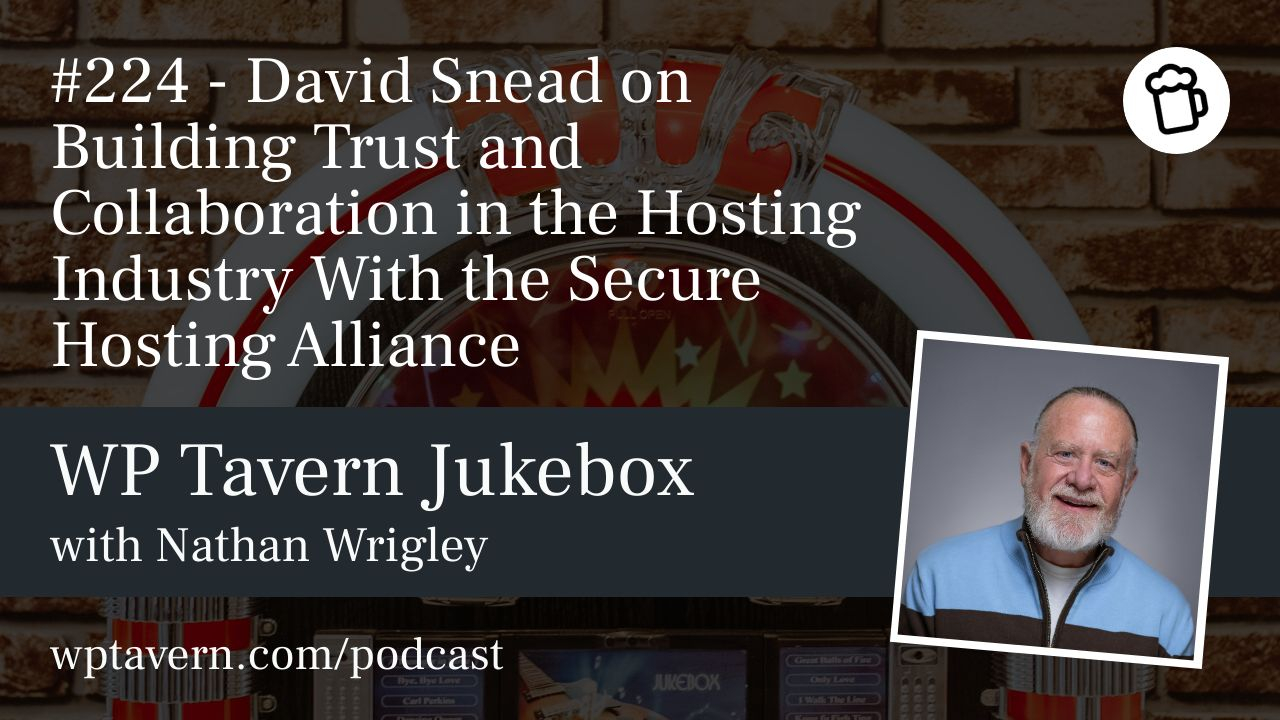
WPTavern: #224 – David Snead on Building Trust and Collaboration in the Hosting Industry With the Secure Hosting Alliance

Transcript

[00:00:19] Nathan Wrigley: Welcome to the Jukebox Podcast from WP Tavern. My name is Nathan Wrigley.

Jukebox is a podcast which is dedicated to all things WordPress. The people, the events, the plugins, the blocks, the themes, and in this case, building trust and collaboration in the hosting industry with the Secure Hosting Alliance.

If you’d like to subscribe to the podcast, you can do that by searching for WP Tavern in your podcast player of choice, or by going to wptavern.com/feed/podcast, and you can copy that URL into most podcast players.

If you have a topic that you’d like us to feature on the podcast, I’m keen to hear from you, and hopefully get you, or your idea, featured on the show. Head to wptavern.com/contact/jukebox, and use the form there.

So on the podcast today, we have David Snead. David has been involved in the hosting industry since 1999, starting out as legal counsel for one of the earliest shared hosting companies, and going on to work with over 50 others. He helped found the i2Coalition, serve as in-house counsel for cPanel and WebPros, and now leads the Secure Hosting Alliance.

If you’re listening to this podcast, I’m sure that many of you will have worked closely with hosting companies. Perhaps you run an agency, or business, that depends on the reliability, ethics, and security of hosting providers. David is here to talk about cross-industry collaboration in the hosting world, specifically around improving security, professionalism, and communication between hosts.

The conversation focused on why, and how, the Internet Infrastructure Forum, or IIF, is building a framework for real-time intelligence sharing and abuse reporting, aiming to help the entire ecosystem detect and prevent attacks faster than adversaries can adapt.

David talks about the challenges hosting companies face, especially smaller ones, in keeping up with security, and how this evolving project hopes to ease this by sharing actionable, non-proprietary abuse information across registrars, hosting providers, DNS services, and more.

He discusses the growth of both the Secure Hosting Alliance and the IIF, the business case for collaboration, and the nuances of legal and technical information sharing across borders.

If you’re in hosting, run a web agency, or just want to know how the backbone of the web is working to stay more secure and connected, this episode is for you.

If you’re interested in finding out more, you can find all of the links in the show notes by heading to wptavern.com/podcast, where you’ll find all the other episodes as well.

And so, without further delay, I bring you David Snead.

I am joined on the podcast by David Snead. Hello David.

[00:03:20] David Snead: Hello.

[00:03:21] Nathan Wrigley: Very nice to have you with us. David’s got a really interesting background, and a really interesting, I’m going to use the word project. I don’t know if that’s the right word. It feels like it’s got more solidity and it’s got a lot more history than that. It’s something which is, I think going, but we’ll find out a little bit more about it. It’s all about the hosting industry and trying to get hosts to, I guess communicate with each other in ways going forwards.

[00:03:44] David Snead: That is a part of it. There are really two goals and one is to level up the ethics and professionalism in the hosting industry. And the second is to facilitate more comradery and interaction among hosts. Something that folks felt occurred in the early 2000s, and with all the consolidation that occurred went away. And so that’s something that we’re also trying to facilitate.

[00:04:16] Nathan Wrigley: Okay. So given that we’re going to be talking about hosting, I guess it’s a good idea to paint your credentials and find out a little bit more about you. So a short opportunity to just tell us a little about you and your background in WordPress and hosting specifically, I suppose.

[00:04:29] David Snead: Sure. So I have been working in the hosting industry since 1999. As I often say, I was working in the hosting industry when hosting was cool. It is not so cool anymore. In fact most people don’t really pay attention to it.

You know, and I started as a lawyer for a hosting company, and I was in-house counsel for a company that actually owned a hosting company and was one of the earliest hosting companies that specialised in shared hosting. And so I was their general counsel. And for some reason it stuck, and I’ve just kind of turned it into a career.

So after that I had a private practise as a lawyer and I worked with probably 50 different hosting companies, mostly writing policies that nobody ever reads, which makes me super fun at parties.

And then from there, my friend Christian Dawson and I formed the i2Coalition as a response to some legislation in the US that would’ve been kind of the death nail for internet providers. So we started the i2Coalition. I then went in-house for cPanel and worked at cPanel and WebPros for 10 years, and then started the Secure Hosting Alliance.

[00:05:52] Nathan Wrigley: Okay. So you’ve got all all the history. That’s pretty good. You know, if we’re going to talk about hosting.

[00:05:57] David Snead: All the hosting history in one person. That’s kind of a very scary idea, no?

[00:06:02] Nathan Wrigley: But that’s excellent. So do you still offer counsel? Is that still, so you haven’t sort of sidestepped and do half of the week on a sort of more technical basis? It’s still the legal side that you’re involved in.

[00:06:13] David Snead: I do. Right now I’m doing mostly M&A work for, it’s weird. So I don’t know if anybody has ever said this to you before, but web hosting is kind of like the Hotel California. It’s like, once you start in the web hosting industry, you never leave. And so I have all these clients from 15 years ago who are now running like little baby hosts, and they’re talking to bigger hosts and they want to get acquired. So I’m doing some of that now. I am not writing any of the policies that nobody ever reads because that was just, I did that for too long.

[00:06:51] Nathan Wrigley: There were too many moments parties.

[00:06:53] David Snead: Yes, exactly. Yeah.

[00:06:55] Nathan Wrigley: Okay, so I’m going to read into the record the title and the blurb that went with the presentation that you are doing or done.

[00:07:02] David Snead: I did it yesterday.

[00:07:03] Nathan Wrigley: Okay, we’ll get into that in a moment. So the title is coordinating the fight, cross industry collaboration, and the blurb goes as follows. WordPress hosting threats cross company lines. When one provider falls victim, the entire ecosystem suffers. This session explores how the Internet Infrastructure Forum, or IFF, enables hosting providers, registrars and registries to coordinate abuse response through real time intelligence sharing. Learn how operational collaboration helps responsible operators detect and stop attacks faster than adversaries can adapt. And why working together produces results no single provider could achieve alone.

When I read that, immediately was, yeah, that’s a really sensible idea. Why are we separately, as hosting companies, I say we, I mean the hosting companies. Why are they all trying to do the same work over and over again, separately? When presumably this aspect of the work, the security bit is something they all have in common.

[00:08:05] David Snead: Right? So that’s the fundamental question, right? So the IIF is a voluntary organisation that is made up of everyone in the infrastructure stack. So from registrars, registries, DNS providers, hosting providers, cloud providers, everyone in the stack. So it is facilitated by the Internet and Jurisdiction Foundation. They’re based in Paris, and they’re the actually the secretariat for it.

And what it’s designed to do is create a common way for everyone who’s in the infrastructure stack to share information about abuse and abuse issues. And it’s one of the fundamental problems that you referred to is everybody is operating in a silo, right? And that’s mostly because that’s the way the internet is architected, right?

So the internet is architected, so it’s distributed, right? Registrars and registries basically do their own thing with domain names. They might have a small hosting component or maybe a cloud component, but by and large, all they do is domain names.

Hosting providers probably resell domain names, but they’re not part of that industry. And so how do they all coordinate? And that’s what the IIF is trying to facilitate, is more information sharing among the participants.

[00:09:39] Nathan Wrigley: Well I imagine some of the hosting companies are probably fairly good. You know, they’ve got a giant customer base. Let’s imagine hosting company X over there, they’ve got millions of customers. They’ve got a huge budget that they can put over to, let’s say, security things. Well that’s all well and good, brilliant. But then there are other companies who are much scrappier. You know, they maybe have only a few thousand customers. And so their budget for the exact same work is going to be reduced.

How will this work? Is it going to be like a subscription service basically? Will you have a membership, which is in some way equal to the number of clients that you’ve got? Will there be some expectation that, okay, we’ll look at your revenue, your membership will be equivalent to a percentage of your revenue? How will that all work?

[00:10:20] David Snead: We don’t know. This is a very early stage project. Right now we are in a prototype phase where we have just figured out what information folks should submit to the secretariat.

So the way it works is, you submit the information that you collect for a particular abuse issue to the secretariat, who then enriches it with all the other information that’s been submitted and sends it to the right person.

So a great example is, let’s say a registrar reported a phishing domain. They turn off the phishing domain and they have maybe a timestamp, an IP address where it was submitted from. They submit that to the secretariat, who then finds the hosting company who is providing the services for the hosting and says, this came in about this particular site. Can you take action on that? So that’s the way it works.

Right now it’s very early stage. It’s in the first phase of a test, and we’re going to look at whether the way we’ve architected it, or the way the group has architected it, actually makes sense.

[00:11:39] Nathan Wrigley: Is this going to be then a sort of slow on ramp whereby you bring a few companies in at the beginning, hopefully. And then one or two more and iron out the wrinkles, and then some more and some more? Because I imagine, if you just threw the switch, everybody’s in, a lot could go wrong at that point. And I’m guessing there’s going to be more of a slow on ramp.

[00:12:00] David Snead: So you’ve pointed out my particular frustration with the IIF, and the reason that the secretariat is moving slowly, right? So fortunately, or unfortunately, based on my cultural background, I’m just sitting here going, this needs to move faster. We need to have everybody involved, we need to have all the hosts involved, we need to have all the registrars and registries. And other folks who are a little bit more skilled in this type of work say, no, we need to figure out what we’re doing and that requires a small number of people.

The phase that we’re in right now is looking for more folks who are interested in sitting at the table and being part of the discussion. Particularly in the hosting industry and in the web design and marketing industry. Those are folks who don’t generally participate in these kind of industry led collaboration exercises. And that’s the reason that I’m at WordCamp, is to talk to web designers, marketing agencies about why they should participate in something like this.

[00:13:13] Nathan Wrigley: So this really isn’t bound in any way to WordPress, is it? It just so happens that WordPress has a significant chunk of the internet, so this is a good place to start. But if you happen to be a, I don’t know, Drupal user, or you’re just into writing PHP code or whatever it may be, this is still applicable. There’s no real WordPress layer to this. This is just a good place for you to come because, well, there’s probably, what, 30 hosts, 100 yards away from us out there.

[00:13:37] David Snead: I know. And I haven’t seen all of them yet.

[00:13:39] Nathan Wrigley: Yeah, there’s work to do. But agnostic to any platform, basically.

[00:13:42] David Snead: It is completely platform agnostic, yeah.

[00:13:43] Nathan Wrigley: Okay. Okay, that’s interesting. But WordPress is a, is certainly a good place to start.

Now, I’m imagining, if I was a hosting company and I was the chief executive, I definitely have some questions for you in terms of, okay, we’re going to share our valuable intel with you, what are you going to do with that? How can we trust you? How do we know that the sharing is going to be done effectively and what have you?

So I guess really what I’m getting to is, what is the assurances or checks and balances that you, in the end, will hope to offer the host? That you can assure them that, look, if you hand us this body of work, you don’t need to think about it again. You can trust us to do it honourably, effectively, collaboratively. You get where going.

[00:14:26] David Snead: Yeah, yeah. And I suspect that you wanted to be a lawyer at some time, because that’s one of the issues that we’re facing. Information that can be shared freely, as an example, in the United States, might not be capable of being shared so freely in the European Union, or in Brazil, or in India or someplace like that.

So one of the things that’s being done, not by me, but by another group, another working group that’s part of this, is analysing the legal issues around information sharing.

The information that’s being shared, to answer the proprietary and confidentiality question, is not proprietary or confidential information. So it’s things like timestamps, domain names, IP addresses for the initial abuse submission. Things like that that really don’t indicate some sort of company confidential information. And it’s further abstracted into xarf, which is a language that’s used for abuse reporting, that we all can share. And so I think that the only thing that would be of concern is whether that information is personal information that’s subject to jurisdictional restrictions around the world.

[00:15:48] Nathan Wrigley: Would the idea be that this organisation would do the remedial work? So is there any notion that, let’s say for example, some sort of security problem was discovered by hosting company A over there, and they share that intel with you. Maybe the question is kind of asking, will you then appoint people to figure out what the patch is for that? Or is your idea just to, oh, red flag, we’ve got this problem, now you all know about it. Is it just information sharing as opposed to fixes?

[00:16:17] David Snead: Yeah, it’s the latter. So the thing that we’re solving for right now, so there’s just one issue that, one abuse issue, that we’re testing out and it’s issues related to fake shops. And so the fake shop issue is the test abuse issue for the project, and where folks are sharing information. It’s a particular problem right now with credentials harvesting. And so that’s what we’re trying to look at.

[00:16:43] Nathan Wrigley: And how has the conversations that you’ve had thus far, how have they gone? Has this been warmly received or are you facing a little bit of pushback?

[00:16:50] David Snead: So, look, I’ll be very direct with you. If something isn’t just an immediate threat to them, it’s very difficult to conceptualise why you should participate. And I am pretty used to answering that question simply based on the political work that I do with the i2Coalition. But once you talk about, so let’s use fake shops as an example. Fake shops, and you’re providing services to fake shops, actually has an impact on your bottom line.

So if you are providing, let’s say, payment processing to an entity that is running a fake shop, it very easily can make your credit card processing charges higher. It ends up eating bandwidth. It will tax your abuse resources.

One of the things that you referred to initially is, you know, larger hosts have a lot of money. I wouldn’t say they have a lot of money, but they have more bandwidth to handle a vast fire hose of abuse issues. Most smaller hosting companies might only get five or six abuse issues in a month. But if you have a fake shop, that’s going to generate a huge amount of abuse, and it’s taking away resources that you can use to actually grow your business. So that argument actually is relatively persuasive in getting folks to pay attention.

I find that the business argument around abuse is a much more compelling discussion than kind of moral persuasion. I don’t think moral persuasion works in the context of a community that is trying very hard just to keep their heads above water.

[00:18:42] Nathan Wrigley: It feels to me from what you’ve just said, and I could be reading too much between the lines, but it feels to me as if a good target audience would be smaller hosts to begin with, simply because they’re probably going to be more receptive because they have less bandwidth themselves. And so would welcome anything that can make the burden of sharing this information easier. So 10 of the small hosts combined is, well, it’s much bigger than each of them individually would be, whereas I suppose you’ll have to get a critical mass of them on board until maybe some of the bigger hosts start to look at you with favourable eyes, let’s say that.

[00:19:15] David Snead: Well, so we have some pretty large hosting companies who are participating. So as an example, both GoDaddy and Newfold are participating. But we also have smaller hosts. But I agree with you, the information that’s being provided, particularly since it is actionable, realistic information that can be adapted for bespoke systems, is invaluable, right?

So if you only get five or six abuse complaints and you get an abuse complaint, and you can go to the secretariat and say, we got a complaint about this domain, and the secretariat says, here’s what the registrar did. Here’s what Cloudflare did. Here’s the information they provided us. And you can use that to make a decision on how to address that problem. It saved you hours and hours and hours of research time.

[00:20:09] Nathan Wrigley: Technically speaking, what would the conduit of information both toward you and away from you look like? So if I’m hosting company X, how are you imagining that I will supply you with that information? But also, if I’m just looking for information from you on a daily, weekly basis, whatever it may be, how do I receive that? Is this like a, I don’t know, a website or an API or?

[00:20:33] David Snead: It’s an API. So it’s a file. It’s just a general file download.

[00:20:37] Nathan Wrigley: Right, okay. So it’s readily available 24/7?

[00:20:40] David Snead: Right. That’s the goal. Right now it’s not, but the goal is to kind of figure out a way to make something like that possible.

[00:20:47] Nathan Wrigley: Yeah, okay. I also suppose that the hosting companies, whilst this is good for their business if they can minimise costs and hand a lot of this work over to you, there’s a part of them which would also probably like to put some sort of badge on their website to say, this is what we’re doing. We’re part of this alliance, for want of a better word. Is that something that you are looking to develop as well, you know, some sort of credentialing system to demonstrate that you’re in this?

[00:21:12] David Snead: So that’s not something that the IIF is working on. It’s something that the Secure Hosting Alliance does. The Secure Hosting Alliance has a trust seal that we give to hosts who fulfil our Trust Seal Certification provisions. But that’s not something that the IIF does.

Talking about like why, other than business reasons, folks should participate in this, one of the things that is going on that I would suggest that most hosts know about, is there’s a little bit of a moral panic going on in the world about what contents you have. And regulation is actually a very real thing for the hosting industry, who has not ever been regulated. This is the time where you can say, hey, this is what we’re doing, right? We’re dealing with issues. This way a trust seal is the same thing, right? It’s something that you can say, we are actually taking steps to make the internet a better place.

[00:22:18] Nathan Wrigley: I think if you are a general agency owner or, I don’t know, just a freelancer, hosting is one of those things that you, once you’ve done it once, you’re in it for the long haul until something goes wrong. But you’re also browsing around for any tiny indication of why is this host slightly different? You know, what is it that they’re doing that, I don’t know, is faster? What is it that they’re doing that’s more secure? So it feels to me if you had a credentialing system and I began to hear about it and see it pop up again and again, it would be one of the metrics which I would weigh up when looking at hosting.

[00:22:51] David Snead: I would think so. One of the things that a trust seal does is it indicates that there’s been some vetting of the host. That someone has determined the things that are important to the hosting industry and are important to the web design industry. The agency industry are also important to the host.

Great example of that is one of the provisions of the Secure Hosting Alliances’ Trust Seal Certification is that a contract is presented to the customer before they sign up, which is super customer friendly.

One of the things as a lawyer that you hear about all the time when people are dissatisfied with their services is, yeah, well, I never saw that contract. Or it was just a hyperlink in an email that I got. That’s one of the differentiators for a Trust Seal certified host is that the contract is actually presented to them, to the customer beforehand.

[00:23:57] Nathan Wrigley: So in terms of the WordPress crowd, is this a thing that you are pitching only to hosts? Like when you step out of here, are you trying to have conversations only with hosts? Or is there some bit of the WordPress community, the freelance, the agency owners? Are you trying to communicate with them just to scope out what they need?

[00:24:15] David Snead: So for both the Secure Hosting Alliance and for the IIF, it is that. I really enjoy talking to agencies and developers about whether this is important to them, or why it might be important to them.

[00:24:31] Nathan Wrigley: In terms of how long this project’s been going, I’ve only heard of it because of your participation here, but I don’t know if you’ve been banging this gong for a decade or, I mean you’ve been in the industry for long enough to have been banging it for decades. Is this a new initiative or is this something which has a long and storied history?

[00:24:49] David Snead: So the Secure Hosting Alliance has only been active for a year, a little bit over a year. I’ve been talking about abuse for a long time, but the Secure Hosting Alliance has only been around for a year.

[00:25:01] Nathan Wrigley: And have you, in that year, got any intuitions that you’ll be here for another year? Is it basically going in the right direction?

[00:25:09] David Snead: It is going in the right direction. So we started out with two or three charter members. We now have 25 hosting members. We have three security vendors who are members as well. We have, I think, 17 Trust Seal Certified members, and we’re launching in 2027 a trust seal for security vendors who provide services to hosting companies.

[00:25:40] Nathan Wrigley: I know that several owners of hosting companies listen to this podcast. They may very well be the people that you’ve spoken to already, but if they are not, and they are people who would like to investigate this further, I suppose the thing that’s going to be in their head is, okay, Nathan and David, you’ve explained what I’ll get out of it, what do I need to put into it? So is this an annual financial commitment? How does it all work from that point of view?

[00:26:02] David Snead: Yeah, so you become a member of the i2Coalition. And so the Secure Hosting Alliance is a working group of the i2Coalition. So you would be a general member and you would participate in the Secure Hosting Alliances’ working groups. You also have the ability to participate in the i2Coalition as a whole, which is a much larger trade association that represents almost everyone in the internet infrastructure vertical. Mostly doing policy work, primarily in the US and the EU. Although there’s, we’re doing some work in India right now as well.

[00:26:40] Nathan Wrigley: And does membership allow you to steer the future of the project? I know that lots of chefs in the kitchen results in terrible food, but that, I fear, is something that could happen. You’ve got 87 members, 260 members. And then the 260 members all start to bicker and, you know, we want this, no. You see how it goes.

[00:26:59] David Snead: I do.

[00:26:59] Nathan Wrigley: What’s the position there? You know, is there sort of gated levels of membership? How are you organising all of that?

[00:27:04] David Snead: There are not. The membership is based on self-reported revenue. The membership is not horrifically expensive from my perspective. And I think that that, most of our members would say that it is, it’s actually relatively affordable, particularly for the small to medium sized hosts. And registrars or design agencies, anyone who’s participating.

The question about, who’s running the show, comes up quite a bit. We haven’t really faced that issue, particularly in the Secure Hosting Alliance. Folks seem to get along. But the organisation runs on the idea of rough consensus. And so decisions end up not being controlled by one member or not. Some of the i2Coalition has some very large companies who everybody knows about, who get along with startups, and folks against whom they compete directly. And policies still get made. The organisation still moves forward.

[00:28:11] Nathan Wrigley: Yeah, I guess you’re in a space where, obviously all of these hosting companies commercially are vying for everybody else’s business. But in this particular situation, that is not the case. Nobody’s vying for their websites to be less secure. They all want the same level of security. So at least in that sense, you would hope that consensus could be maintained even if, commercially, the two companies that are in the room, the 10 companies that are in the room might be commercially at loggerheads with each other. At least on this they could agree. That would be the hope, I suppose, anyway.

[00:28:47] David Snead: It seems to be, not only the hope, but the actual way that things work. You ask about how compromise is reached. What comes to mind is I have a much different concept of privacy than, particularly when I was at WebPros, than other folks in the i2Coalition had. And another company just called me up and we worked through our disagreements about how privacy should be handled within the i2Coalition and were able to move forward.

The industry I’ve found to be hugely collaborative, particularly the hosting industry. Everybody knows what their competitor is doing. But when it comes to addressing an issue like, how are we going to deal with abuse as a community? Folks come together. CEOs of hosting companies while they compete tend to be relatively good friends.

As I said at the very beginning, it really is like the Hotel California, right? You come in as a CEO of a hosting company, you grow it and you sell it to another company. All of a sudden you’re at the bottom again with a server in your grandma’s basement, you know, trying to start again.

[00:30:08] Nathan Wrigley: It’s a really curious effort. I suppose really at the bottom of this entire podcast is your endeavour to be heard and to reach out and get some conversations going. So with that in mind, where do people find the information about this? So maybe there’s a website that we could mention. But also, is there a specific place where you hang out? Is there a place where you would like to be contacted most?

[00:30:33] David Snead: Sure. So our website is hostingsecurity.net. I’m not too afraid of getting too much spam. So folks can email me at snead@i2coalition.com And the two is the numeral two. So it’s snead@i2coalition.com. And I’m happy to answer questions.

In terms of hanging out, I am at most industry conferences in the hosting industry. In the WordPress industry, I’ll be at WordCamp US. We also participate very heavily in ICANN. So there is an i2Coalition member at every single ICANN meeting.

[00:31:12] Nathan Wrigley: So if you go to wptavern.com and you search for the episode with David Snead, S-N-E-A-D, you’ll be able to find those details. I’ll put everything into the show notes. So anything that I missed? Was there a particular focus that we didn’t touch?

[00:31:26] David Snead: No, this is actually one of the most thorough podcasts I’ve been on recently.

[00:31:31] Nathan Wrigley: That’s love to hear it. Well, David Snead, thank you very much for joining me today.

[00:31:35] David Snead: Glad to be here. Thanks for having me.

On the podcast today we have David Snead.

David has been involved in the hosting industry since 1999, starting out as legal counsel for one of the earliest shared hosting companies and going on to work with over 50 others. He helped found the i2Coalition, serve as in-house counsel for cPanel and WebPros, and now leads the Secure Hosting Alliance.

If you’re listening to this podcast, I’m sure that many of you will have worked closely with hosting companies. Perhaps you run an agency or business that depends on the reliability, ethics, and security of hosting providers. David is here to talk about cross-industry collaboration in the hosting world, specifically around improving security, professionalism, and communication between hosts.

The conversation focused on why and how the Internet Infrastructure Forum (IIF) is building a framework for real-time intelligence sharing and abuse reporting, aiming to help the entire ecosystem detect and prevent attacks faster than adversaries can adapt.

David talks about the challenges hosting companies face, especially smaller ones, in keeping up with security, and how this evolving project hopes to ease this by sharing actionable, non-proprietary abuse information across registrars, hosting providers, DNS services, and more. He discusses the growth of both the Secure Hosting Alliance and the IIF, the business case for collaboration, and the nuances of legal and technical information sharing across borders.

If you’re in hosting, run a web agency, or just want to know how the backbone of the web is working to stay more secure and connected, this episode is for you.

Useful links

i2coalition website

Secure Hosting Alliance website

​WordPress Planet