No Italian sub is complete without a generous dusting of this seasoning, which packs the real punch and brings an unmistakable Italian-American deli flair.

Food Republic – Restaurants, Reviews, Recipes, Cooking Tips









No Italian sub is complete without a generous dusting of this seasoning, which packs the real punch and brings an unmistakable Italian-American deli flair.
Food Republic – Restaurants, Reviews, Recipes, Cooking Tips

The song was considered a big risk at the time.
Continue reading…Country Music News – Taste of Country
The song was considered a big risk at the time.
Continue reading…The Boot – Country Music News, Music Videos and Songs
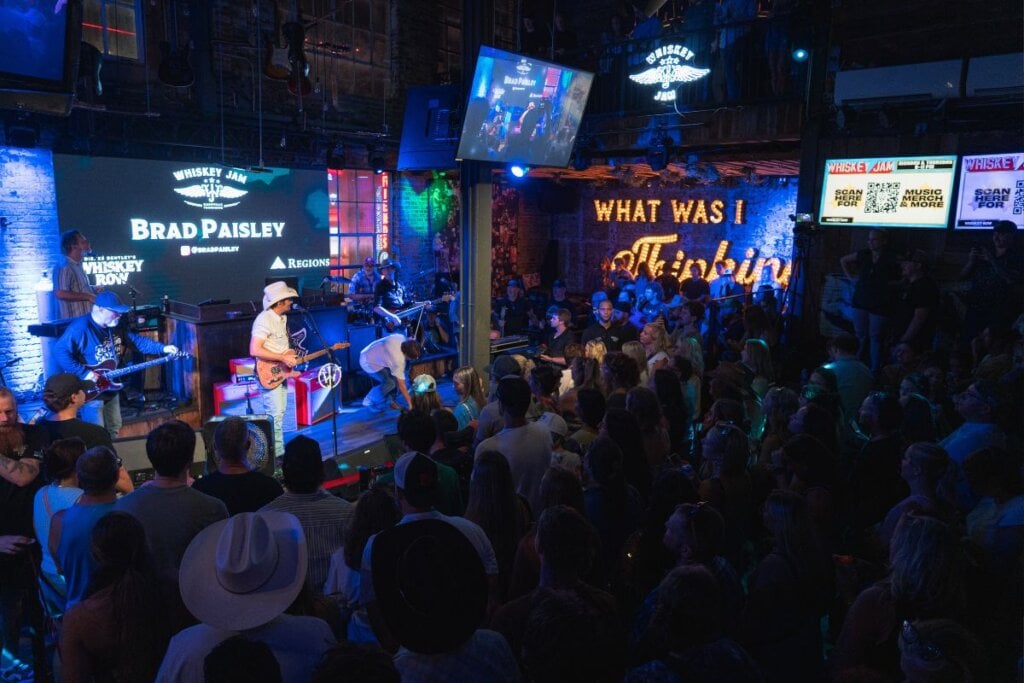
Brad Paisley gave some lucky fans an unexpected treat on Monday night when he made a surprise appearance at the weekly Whiskey Jam event, taking over the stage at Dierks Bentley’s Whiskey Row bar on Nashville’s Broadway with a 45-minute set.
Since 2011, the free concert series has become a popular destination for rising stars to showcase their talent among the Nashville music scene, but every so often a major act like Paisley will unexpectedly pop up on stage.
That’s exactly what happened when Paisley made an appearance and prompted a massive sing-along as he delivered a few fan favorites from his catalog. Additionally, he used the opportunity to celebrate his just-released project, Tacklebox – Disc 1.
One standout moment from the night came when Paisley welcomed songwriter and country artist David Lee Murphy to the stage for a performance of their new collaboration, “Hi Ho Silverado,”which the pair co-wrote with Clint Lagerberg. They kept the energy high by following it up with a performance of Murphy’s 1994 hit, “Dust On The Bottle.”
The surprise set took place just a few days after the release of Paisley’s new 13-track collection, giving him the chance to properly celebrate among fans.
The West Virginia hitmaker has described the project as being “full of hooks, country music hooks,” which ultimately inspired its title. Inside, listeners can expect to find songs stemming from decades of songwriting.
It features a mix of songs dating back to the early years of his career that were never recorded or released until now, as well as newly written tracks inspired by that classic era of country music. Paisley taps into the sounds of acts like Alan Jackson, Brooks and Dunn, and Alabama while also offering 80s-influenced productions reminiscent of those by George Strait, Garth Brooks, and more.
“In this digital age, I have every song I’ve ever written at my fingertips,” said Paisley. “There was such freedom in rediscovering the songs for ‘Tacklebox,’ the new ones we wrote, and the order we released them. They came from or were written about a nostalgic time period, a style of writing, and a sound. We wanted to give listeners that special feeling of playing a vinyl album or CD all the way through, if you listened to it top to bottom.”

Fans first got a taste of the project on May 11, with additional songs arriving over the following two months. Now, Tacklebox – Disc 1 is officially complete, with the final three tracks rounding out the collection: “Who Knew,” “Tell Them Your Life Story” and “It’s Still Goodbye.”
Brad Paisley will soon take the new music on the road when his “Brad Paisley Live” Tour launches on Aug. 27. Joining him throughout the run are special guests Jake Worthington, Charles Worsham, Hannah Harper, Laci Kaye Booth, The Band Loula and Mackenzie Carpenter.
The post Brad Paisley Surprises Fans With Whiskey Jam Performance, Celebrates Release Of ‘Tacklebox – Disc 1’ appeared first on Country Now.
Country Now

Which ’80s candies deserve to be unearthed for a second chance at sweet, sweet life? Pucker up, because these 11 treats of the past are totally mint.

Mashed – Fast Food, Celebrity Chefs, Grocery, Reviews

NEW YORK — Allow me to imagine a scenario for a moment. Indulge me with this fantasy. Months from now. Perhaps years. When the World Cup is long gone. I will be having coffee at my favorite spot in downtown Manhattan, a Puerto Rican establishment right by the historic Stone Street, paved in the late 1700s and one of the oldest streets of the city. I’ll sit down with Erling Haaland, Vozhinha, Jude Bellingham and Rodri and drink Mazapán lattes (look it up). Bad Bunny’s “Nuevayol” plays in the background, and so we listen. Sit. And then reminisce about the summer of 2026 and the World Cup that was. “Fellas,” I’ll say. “Let me ask all of you something.” And they will look up, put down the morning’s brew and listen to the following. Do you remember Gio Reyna’s trivela against Paraguay? How it beautifully swerved from the outside of his foot, thus electrifying the entirety of America? Did Folarin Balogun’s story make you feel proud, not just as a fan of the game, but of what the game represents? Is John Denver’s “Take Me Home, Country Roads” the anthem or should it be Alive, from my hero Eddie Vedder and my all-time favorite band, Pearl Jam? Was Raúl Jiménez’s first World Cup goal months after the death of his father a piece of poetry that made you sink to the ground with emotion? Did Julián Quiñones’s story — a Colombian-born player turned into one of Mexico’s brightest stars – become a blueprint for the fact that identity is more than just a birth certificate? Or Canada’s Stephen Eustáquio, also dealing with the heartache of losing both parents (something I sadly know too well), did his winner against South Africa in the Round of 32 shake you to your very core? Or how about Morocco’s Ayyoub Bouaddi, at 18 years old, how is it possible that he created that level of midfield magic against the Brazilians? Or anyone? Did you feel slightly Congolese when Yoanne Wissa scored the nation’s first ever World Cup goal in that draw against Portugal? Did you hear the Azteca from wherever you were in the continent? Did you feel the intensity of its people as the anthem and “Cielito Lindo” played through millions of Mexican voices? How good is 17-year-old Gilberto Mora? No, really. Aren’t you inspired by his journey and what may come? Could he maybe join you in Madrid one day, Jude? Also, Jude? How did it feel to sing Wonderwall in the altitudes of Mexico City or listen to your country serenade you with a song so iconic such as “Hey Jude,” that it now has two meanings because of your name, do you realize how much you’re loved? Did England’s incredible victory against El Tri become the ultimate display of sacrifice, will and guts? Speaking of love, is there a better word than can describe the Tartan Army’s relationship with their Scottish team? Or Boston? Or Miami? Or anywhere in America? Why can’t I go to sleep without thinking about Amad Diallo’s historic goal for his Ivory Coast or Julián Álvarez’s majestic winner against Switzerland? Why do I not care if Norway’s Andreas Schjelderup meant it or not? Or if I can’t stop analyzing the illustrious creativity of the genius Michael Olise? Is there a better highlight to show young players than Cucho Hernandez’s relentless fight to win the ball from Uzbekistan’s Jakhongir Urozov near the corner flag, recovering it and then placing a pinpoint assist for Jaminton Campaz? Is there a better show of strength and will than the Netherlands’ Brian Brobbey? Can we keep playing on loop the persistence and dynamic ability of the Swiss Johan Manzambi? Do I need to reflect more on Lionel Messi’s emotions after the final, or can I just remember everything else before? Can I save his magic, including Argentina’s first goal of the World Cup, which was against Algeria? And by the end, it became a historic hat-trick? Is Golden Boot winner and all-time leader Kylian Mbappé real or is this a simulation? Which goal can I select that will make me think he perhaps isn’t mortal? His stoppage-time winner against Senegal, which made him France’s all-time scorer? Or the history breaker against England in the third-place playoff? Speaking of that match, Jude – my goodness? Have you recovered? Was your goal so good it took a piece of you? Back to you Erling. Do you realize that your goals, especially the one against Brazil, ignited a nation towards a global Viking row? Is your social media presence tired of generating more and more fans? Do you realize the commotion and excitement that you created for millions of people and turned them into Haaland disciples? Does your partner, Isabel, approve of your “Whiskey Raccoon” holding an empty liquor bottle that you brought back home and will she let you keep it in the house or will she make you put it in the basement? Also, did you know Erling — that in my Peru, nearly 500 Peruvian babies who were born this summer now have your name? Now that’s DEDICATION. That’s impact. When you stop sipping on your latte, Erling, as a striker, can you explain to me how Haiti’s Wilson Isidor was able to produce that kind of power with his goal against Morocco? Or the piece of art that was Cape Verde’s Sidny Lopes Cabral against Argentina? Does anyone realize that the latter essentially broke the internet? It made us all believe in something bigger than ourselves, right? How about those incredible comebacks? From Belgium’s over Senegal or Gabriel Martinelli’s winner against Japan? Did you feel alive with Ecuador’s historic win over Germany? Or Paraguay’s? How about Curaçao’s Eloy Room? Did his 15 saves against the aforementioned Ecuador suddenly create a window for him and his beautiful island to be globally recognized? Wasn’t it just a thing of beauty to see so much resilience? Speaking of resilience. Hey Vozinha? Do you want another coffee? By the way, how is your life now? No, really? Do you understand that your heroics, your insane performances and those of your teammates at this World Cup impacted so many of us? Are you wishing you went back to normalcy? Perhaps, part of you does? Or are you taking it all in? Is it okay for me to tell you that what you did, for me and millions of us, absolutely became a reminder of why we love this game of ours in the first place? Are you okay with the fact that your life will never be the same again? Is it fine for me to tell you that we are so grateful for what you and the Blue Sharks did? Is there a perfect way to express the fact that your national team became the muse, the proverbial star of this World Cup? Do you also remind Rodri, the World Cup champion sitting next you, that he may have won this whole thing but La Roja never went past you? Do you cheekily remind him of that? Speaking of Spain, Rodri, what makes this team so special? Why should the rest of the footballing world admire not just the way you play football but the way you treat others and the game—do you think about your impact? How does it feel to know that you are the ultimate general of an army that wonders us all with possession and intoxicates you with the relentless pursuit of getting it back? Do you contemplate another way, or is this the only way to live? Is this the way we should all see the game? What was Pau Cubarsí born with that makes him such a giant, despite only being 19? Speaking of that generation, is Lamine Yamal okay with the fact that his three-year-old brother Keyne is the actual hero? Can we remember the words you said of Ferran Torres, how he was so unappreciated by so many Spanish fans but in the end, his winner ended up deeply embedded in history? Can we put that in our photo album? Lastly, fellas. Is there a perfect, singular way to describe what we witnessed this summer? Or is it really just a mosaic of reflections? An island of treasures? Or should we just use a Pearl Jam lyric here and simply say, “Hail, Hail the lucky ones, I refer to those in love yeah…” Because quite simply, World Cup moments. I want you to know: we all fell in love with you. Don’t worry, boys. I’ll get the check.Latest Sports News from FOX Sports

Eggs Benedict consists of an English muffin topped with Canadian bacon, a poached egg, and hollandaise. Swap that bacon for something that screams Norway.

Food Republic – Restaurants, Reviews, Recipes, Cooking Tips

NEW YORK NEW JERSEY STADIUM — I’ve often joked that ranking World Cups is like choosing between your children: They’re all different and unique. You don’t love one above another. It just doesn’t work that way. The 2026 FIFA World Cup was the sixth, men’s or women’s, that I’ve had the privilege of covering. The first five took me to Brazil, Canada, France, Qatar, Australia and New Zealand. Each was incredibly special. Years earlier, as a young professional, I hoped to cover one, one day, if I worked my ass off and maybe got a bit lucky. Until this summer, I couldn’t have picked a favorite if my life depended on it. But a home World Cup like this summer’s? That was a new experience for me, just like it was for most of my colleagues. The feeling is hard to describe. We all went into it knowing full well that it’s probably a once-in-a-career thing. Now the biggest, most spectacular World Cup of all time is over. And as I sit here typing in a mostly empty 80,000-seat arena after Spain beat Argentina in Sunday’s final, watching La Roja’s players on the field below me celebrate their well-deserved triumph with their families, I’m filled with gratitude — and maybe a little sadness, too. Part of that is exhaustion, having been on the road and away from my family for almost two full months. That will subside. The memories won’t: The way the United States men’s national team ran out to an early lead against Paraguay in the first World Cup match on U.S. soil in 32 years, then ran away with the match en route to a historic 4-1 victory that captured the imagination of the American public. How the upper deck at Seattle Stadium began vibrating when VAR awarded Alex Freeman’s goal in the USA’s 2-0 win over Australia, the first time the U.S. had ever won two straight World Cup games. I was in Los Angeles to witness Canada, led by American coach Jesse Marsch, win a World Cup knockout game for the first time in that country’s history. A couple of days later, in the San Francisco Bay Area, Mauricio Pochettino’s 10-man U.S. squad not only survived a red card against Bosnia and Herzegovina but actually padded its lead on the way to a 2-0 win — just the second knockout victory in this country’s history, even if it came in the new round of 32. Unfortunately, that was as good as it got for the World Cup co-hosts. By the time you read this, it will have been more than two weeks since Pochettino’s team squandered an incredibly rare opportunity with 50 million in the U.S. watching live, getting embarrassed, 4-1, by Belgium, even after striker Folarin Balogun was controversially allowed to play by FIFA despite the red card he received against the Bosnians. It’s still difficult to understand how the home team, playing in front of another incredible crowd up in Seattle, was so unprepared for that game and so unable to find a way back when things started to go so horribly wrong, despite having the most decorated and handsomely paid coach it’s ever had. It was the largest margin of defeat the U.S. has suffered in a World Cup knockout match since 1934 and will probably remain so for decades. Yet despite the ugly loss, the Americans surely won millions of new fans this summer. For other countries, the World Cup continued. I was fortunate enough to see England and Norway’s hard-fought quarterfinal in Miami, and while the battle between the sport’s two most lethal pure center forwards — Harry Kane and Erling Haaland — didn’t materialize, it was a treat to watch Jude Bellingham steal the show with both of the Three Lions’ goals in a 2-1, extra-time win. That night, writing in a hotel lobby between bites of a Cuban sandwich, I was struck by England’s fans cheering for Switzerland as passionately as they had for their own team hours earlier. They wanted no part of Lionel Messi and Argentina, one confirmed. That fear soon proved justified. For me, the highlight of this World Cup came in England’s next match. Say what you will about Thomas Tuchel’s tactics after his Three Lions took a 1-0 lead over the defending champions, but watching La Albiceleste claw back two goals in the last five minutes, plus stoppage time, with the incomparable Messi setting up both, is not something I’ll ever forget. And not just because an Argentine journalist sitting to my right in the press box — where merely applauding politely is usually forbidden — removed his shirt and began swinging it around his head in celebration. On the streets of Atlanta afterward, one comically inebriated English fan challenged every Argentine he saw to a fistfight. Fortunately for him, all were too drunk on victory to oblige. Which takes us to Sunday’s grand finale. If every World Cup tournament is special, the final is on another level still. While Sunday’s didn’t match the drama of the 2022 decider I saw in Lusail, Qatar on Dec. 18, 2022 (no, I didn’t have to look up the date), there’s always this cosmic energy surrounding the title bout. You know more than a billion people across the globe are tuned in, that history is being written in real time before your very eyes. I can vividly recall where I watched every final since I caught the soccer bug as a kid. Getting to work the last two men’s versions in person is an immense privilege, an aspirational milestone everyone in this business works toward for years or sometimes decades before finally getting there — if they ever do. For someone raised in New York City, Sunday was the ultimate full-circle moment. In my early 20s, I covered MLS games across the parking lot at the old Giants Stadium. A decade before that, on a similarly sunny, sticky summer afternoon in 1994, I saw my first World Cup game in the same building, with my father. Soccer in mainstream America was a curiosity then. As these 39 days have proven, this is a soccer country now. Although I hope to cover more World Cups in the future, this one will be impossible to top. That’s the magic of the World Cup. It’s the memories that make them great.Latest Sports News from FOX Sports

Fast food chains remain at the forefront of trends, often updating menus seasonally or annually. This summer ushers in new and returning items.

Mashed – Fast Food, Celebrity Chefs, Grocery, Reviews

Very few homes in Adak are occupied, yet many, like these in the town’s Sandy Cove neighborhood, are the subject of federal subsidies to provide an internet service that is now outdated. Photographed on June 8, 2026. (Marc Lester / ADN)
This story was originally published by ProPublica and Anchorage Daily News.
On an island in the Bering Sea 1,200 miles from Anchorage, Alaska, sits an abandoned house on an abandoned Navy base. There is no furniture, and the wind blows through broken windows. The last people to live here moved away long ago. Yet a bright orange pipe with a black fiber-optic cable inside runs from the outer wall down into the surrounding soil.
The cable was installed to connect the home to the internet after the base closed. It costs more than $340,000 per year to provide this building and hundreds of others — all but a few of them empty — with internet access no one says they use.
The money being wasted is yours.
It comes from a fee added to nearly every American’s phone bill as part of a Federal Communications Commission subsidy program intended to bring fast, affordable internet to remote towns.
Reporting this year by the Anchorage Daily News and ProPublica has found that the multibillion-dollar Universal Service Fund pays for what often amounts to slow internet access for customers who actually no longer use it.

The FCC keeps the money flowing to telecom companies regardless of their owners’ track records. It kept paying a Fairbanks company to provide internet service while its owner served federal prison time for tax evasion. The government kept paying Alaska’s largest telecom, GCI, even after it signed a settlement for alleged fraud related to the subsidy. (The settlement said it was neither an admission of guilt by GCI nor a concession by the Justice Department that the claims were not well founded.)
Yet few places make the federal government’s failure to safeguard this money more obvious than Adak.
Once home to thousands of sailors and their families, the island emptied after the base closed in 1997. While the state estimated the population to be 77 last year, residents themselves put it at closer to two dozen — meaning the federal internet subsidy to the local telecom amounts to about $14,000 a year per person. And, it turns out, there’s zero indication any of these people are benefiting from it.
We know this because we flew to the island in June and visited every building the company itself told regulators it serves. We knocked on every door. Talked to every person we could find.
Not a single one told us they subscribe to the island’s subsidized internet service.
Residents get online through Starlink, the Elon Musk satellite service that arrived in 2023 without any subsidy from the FCC. People here say it’s up to 40 times faster and costs $90 to $140 per month, compared with the hundreds of dollars a month that Adak Eagle, the local telecom, once collected from customers on top of its subsidy checks. (Adak Eagle’s website currently advertises internet plans for $99 to $550 per month.)
But the subsidies remain.
Like many Alaska telecoms, Adak Eagle was built on public money. It began in the early 2000s with FCC subsidies and federal loans to upgrade old telephone wires for fiber-optic lines that could support both voice and internet service. By 2011, the company was collecting $2.68 million a year from the Universal Service Fund.
A 2013 federal order determined company president Larry Mayes spent telecom subsidy money on a fleet of vehicles and a fishing boat that weren’t necessary for his business, and that the $237,455 salary Mayes paid himself one year was “unreasonable” and “disproportionate” given the size of the company and what’s typical for Anchorage, where he lives.
(The company filed letters with the FCC at the time stating its salaries “should be evaluated in the context of a small company where each employee wears multiple hats” and citing the island’s “remoteness and harsh climate conditions.”)
On top of the $3.6 million his company has received from the federal broadband subsidy since 2016, he also received $3.54 million from the FCC through a program that replaces revenue phone companies once earned connecting long-distance calls. The state kicked in an additional $3.75 million through its own subsidy program, the Alaska Universal Service Fund. (Some Adak residents said they continue to pay the company for landlines that they use as cellphone backup.)
When we first asked Mayes about the federal internet money, he hung up on us. He did not respond to questions emailed in May, a written interview request delivered to his Adak office in June or detailed questions emailed and hand-delivered to his Anchorage office in July. Reached again by phone on July 13, he declined to comment and ended the call.
The one thing Mayes did say before hanging up on the first call: that he is playing by the rules of the FCC’s subsidy program, and if we had questions about it, we should ask the agency.
We did. Repeatedly. About the publicly funded connections to demolished homes on Adak and other uses of internet subsidies in Alaska.
The FCC never responded.
Step outside Adak’s tiny airport terminal, and the scene is straight out of “The Walking Dead.” You can spend hours walking the city streets without seeing another human, the only sounds the dry scrape of tall grass and warbling seabirds. Stiffened copies of People magazine declare George Clooney the 2006 Sexiest Man Alive. A shuttered McDonald’s drive-thru still advertises 99-cent hamburgers.
Subdivisions outside the city core sprawl like any in America, with neatly arranged ranch-style homes, powder-blue roofs, wide driveways and generous garages. After the Navy shipped out, hurricane-force Aleutian winds pried homes apart. The worst of it is in a beachfront neighborhood called “Officer’s Country” on old city maps. Bathroom mirrors and toilets and kitchen tables stand exposed to the rain in homes cleaved in half like dollhouses.

Even in newer neighborhoods, we found rotted exterior walls with holes so wide you could drive a truck inside. Grass grew on living room floors. Bedrooms were filled with bird nests.
In the few homes the FCC paid Adak Eagle to connect that are habitable, the occupants have abandoned Adak Eagle.
Henry Collins, 61, lives in one of those homes. He was partially blinded in a chemical accident years ago while cleaning a boat at the island docks. Now he and his wife spend their days caring for their newborn. Sometimes they FaceTime with his wife’s family in the Philippines and hold the baby up to the screen.
He accidentally cut Adak Eagle’s internet cable with a string trimmer. No matter. He never could afford the subsidized service anyway, and his rooftop Starlink receiver was untouched in the landscaping incident.

One street over, 26-year-old Steven Ivanoff pays close attention to internet speeds because he plays Overwatch and Fortnite competitively online.
Before Starlink, residents said, Ivanoff’s former roommate and fellow gamer was notorious for using up the scant bandwidth Adak Eagle provided every time he went online to play. Neighbors hollered at him to get off the damn computer. Adak Eagle’s subsidized fiber offers download speeds of 1 to 10 megabits per second, according to the FCC National Broadband Map — far short of the FCC’s 100-megabit standard for broadband and, at the low end, barely fast enough to load a modern webpage.
All that has changed. At our request, Ivanoff tested the speed of his Starlink connection using an online service called speedtest.net. He clocked it at a screaming (by Alaska standards) 447 megabits per second.
At another house, four dachshunds stood guard in a fenced yard while inside, an agent with the Transportation Security Administration who moved from Arkansas was playing a reality TV show on her widescreen — Starlink-powered, like everyone else’s internet.
Elizabeth Pryor has leaned into the isolation by starting a mini farm. In her solarium, a cardboard box trembled with teenage chicks, peeping under a heat lamp. No bears on the island, she said. So that’s nice. No foxes either. “But the rats ate my jalapeno peppers down to the stalk! Chomp chomp chomp.”

Her house rises across the street from a pile of rubble, the remains of a house fire.
Both properties — the rubble pile and Pryor’s home, alive with puppies and chickens — are on the list of houses for which Adak Eagle received subsidies to connect to the internet. She doesn’t use it.
Adak was already a ghost town when Mayes’ company started wiring the island.
According to the U.S. Navy’s own Record of Decision on the base closure, published in 2000, “there was no established community on Adak” after the military’s departure. The Navy’s ongoing assessments documented houses being condemned and boarded up.
Andilea Weaver, the company’s former vice president, said Adak Eagle began replacing rat-gnawed copper landline wires to Adak buildings in 2006 — nine years after the base closure.
In 2016, Adak Eagle proposed a 10-year plan to receive new subsidies in exchange for connecting or maintaining lines to 346 locations, nearly every building left standing. The FCC agreed. The agency formally declared the new spending plan to be in the public interest.
The FCC in 2022 reduced the number of locations Adak Eagle was obligated to serve to 306 after the company reported some buildings were unlivable, but the agency left the subsidy amount unchanged.

According to federal data published by the Universal Service Administrative Co., the most locations that Adak Eagle reported having broadband available was 283.
The buildings the FCC says Adak Eagle keeps wired for internet include duplexes, fourplexes and ranches where we found no sign of life. The agency shows connections at places where we found doors yawning open in the wind, hinges screaming with rust — no furniture inside, no appliances, yet in many cases, a single telephone still plugged into a wall.
Whether the abandoned structures Adak Eagle has prepped for low-speed internet can beckon new occupants is an open question.
Adak is so far west of the Alaska mainland that it’s in a different time zone. So far west that it’s almost in the Eastern Hemisphere.
The last vestige of industry departed with the closure of the island’s fish processing plant in 2020. Now the economy consists of a bit of hunting and bird-watching that lures a few hardy tourists aboard the two flights a week that serve the island. (Warning: Pack canned goods. The grocery store and restaurant were closed our entire visit.)
Alaska’s Republican U.S. Sen. Dan Sullivan has argued the U.S. should open a new military base on Adak because of its strategic proximity to waters cruised by the Chinese and Russian navies. With $115 million set aside by Congress last year for “exploration and development of existing Arctic infrastructure,” a Pentagon-led task force is developing recommendations on how to proceed, a Sullivan spokesperson said.
After knocking on hundreds of doors and canvassing every subdivision, we spent our last hours in Adak checking to see if anyone was using the subsidized internet in the old commercial buildings and offices scattered around the center of the city.
At one of the last addresses on the list crouched a cinder block building surrounded by pickup trucks and wide spools of orange piping — the same piping we’d seen leading up to demolished houses the day before. A rotary phone hung on the wall.
This was the local office of the company we’d been examining. Even the people who work there have stopped relying on the internet service that you pay for. Above the front door, above the sign for Adak Eagle Enterprises, stood two Starlink dishes.
