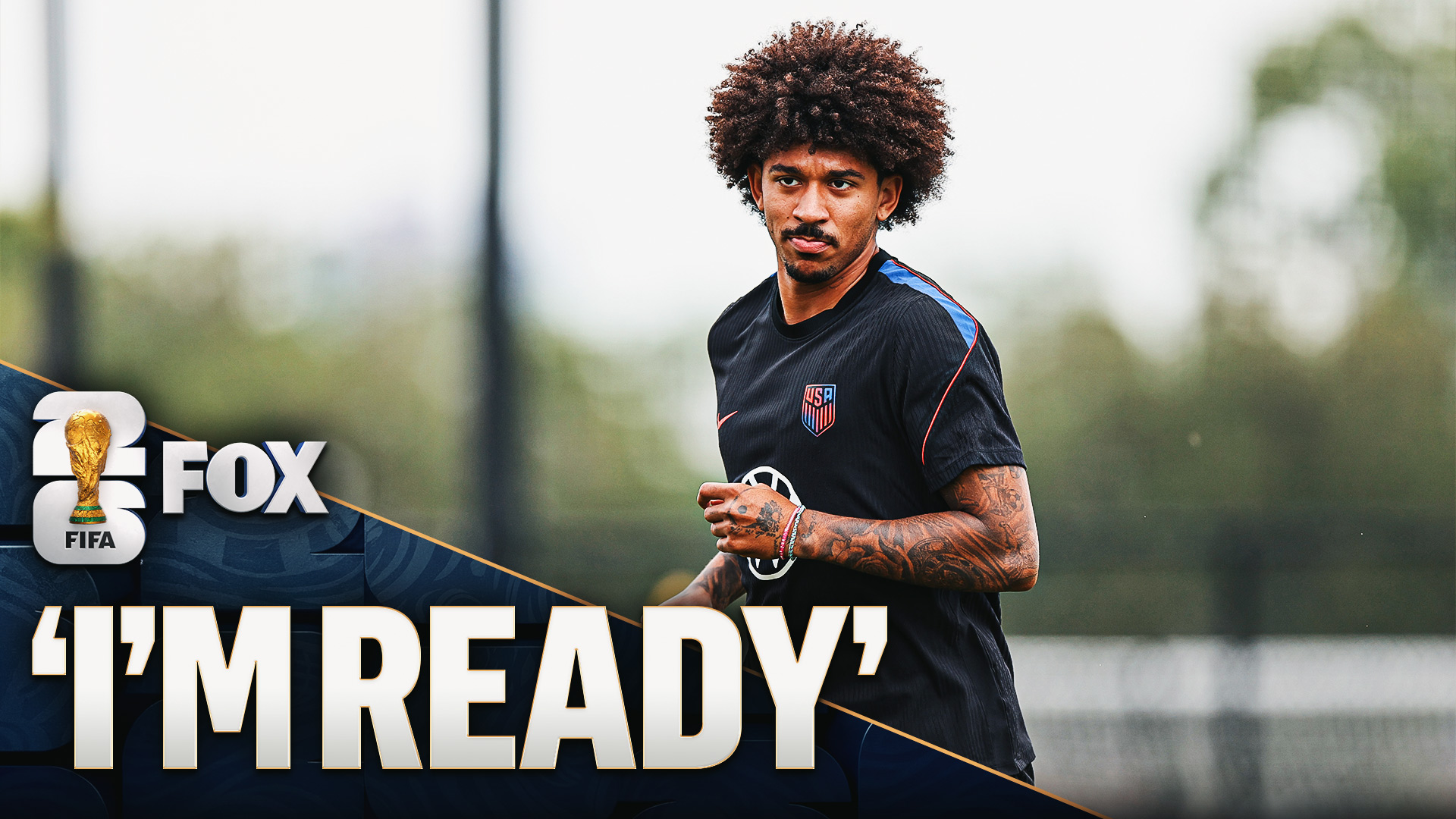
Tim Ream gets wrapped up in a bear hug. Mark McKenzie is dapped up. Tim Weah has a special handshake. Every time U.S. men’s national team players get off the bus — whether it’s arriving at a training or for a game — they’re greeted by their biggest hype man, Harris Patel. “He’s barking, he’s hugging you, he’s dapping you up, he’s picking you up,” McKenzie told me before a recent pre-World Cup training session. “That shock to the nervous system is sometimes necessary. It shows how much he cares about this team.” “And it’s times 10 on game day,” Christian Roldan added. Patel is on staff for his second consecutive World Cup as one of the U.S. squad’s athletic trainers. The USA starts its campaign vs. Paraguay on Friday at Los Angeles Stadium (9 p.m. ET on FOX/FOX One and streaming for free on Tubi). But it would be doing Patel and the team a disservice if he was simply described as one of their physios. “He’s an energy guy,” said Weston McKennie, who sometimes likes to joke with Harris and pretend he doesn’t see him while getting off the bus. “It’s like taking a shot of espresso getting off the bus. Whenever you may feel like you don’t have the energy or the jet lag is kicking in, he’s someone that sparks energy and wakes people up. “I always think that I’m the energy guy of the group. But then he always tops me.” Patel, who U.S. Soccer did not make available for this story, has been with the team since before the 2022 World Cup. He’s also served at five Olympic Games and 10 World Championships with USA Track and Field, and he was one of a select few trainers inside the NBA Bubble during the COVID pandemic. His resume includes stints with the New York Jets and the Indianapolis Colts, as well as the Alabama and Georgia football programs. Most importantly, to his athletes, he’s their guy. “That man is an energizer bunny,” said Ream, who joked that Patel’s hugs are so strong that they give him a good back crack. “He brings such an infectious positive energy. He comes in the morning ready to go, pumping guys up, getting guys really ready to put their best foot forward and put them in a place where they feel comfortable and welcome. And he transfers that energy to each of us every single day.” Added Weah: “He’s like a dad to all of us. We call him Unc. Just the energy that he brings, the vibes daily, keeping us on track. He’s our physio, so he keeps our bodies right. He has blessed hands, and he’s the guy to go to, and we love him so much.” ‘He’s The OG’ Patel grew up about 30 miles northeast of Atlanta in Suwanee and attended the University of Georgia in the late ’90s. As a college freshman, he was part of the first athletic training and sports medicine programs there, which is where he met his mentor, Ron Courson. Courson, now Georgia’s Executive Associate Athletic Director for Health and Performance, spent decades leading the school’s sports medicine efforts after becoming Director of Sports Medicine in 1995. He has also worked at multiple Olympic Games and helped shape health and safety policies throughout the NCAA, SEC and NFL. He knew right away that Patel was special. “One thing about Harris is, he’s all in,” Courson told me by phone. “He really buys a team concept. He’s got a tremendous work ethic, and he’s going to do whatever it takes to help athletes get well. “He has an engaging personality and is really dedicated to learning more and trying to grow in the profession.” Patel was a student trainer at Georgia before getting his masters at Alabama, where he specifically helped out the softball team as a graduate assistant. After two years in Tuscaloosa, he returned to Courson’s staff in Athens. He later went to physician assistant school at Emory University and has crafted a unique business in concierge sports medicine that’s allowed him to work with a variety of prestigious organizations and famous athletes. What makes Patel so endearing, though, is the way he connects with people. He’s the type of guy who says hello in a hotel lobby and then immediately introduces you to the two colleagues he’s meeting for breakfast. He’s the one roaming the U.S. training field with water bottles in hand, shouting encouragement — “Let’s go!” — with a huge smile on his face. He also makes a point of paying it forward. Courson said Patel will return to Georgia this fall to speak with student athletic trainers about careers in Olympic sports medicine. And those relationships don’t end when athletes leave camp. Patel stays in touch with players no matter where they are in the world. When Weah and McKenzie are back with their clubs in France — at Marseille and Toulouse, respectively — Patel regularly checks in, sending texts to see how they’re doing physically and mentally. “HP, he’s the OG,” McKenzie said. “He’s someone special. When you have somebody who truly cares about you, not just from an athletic perspective but also on a personal level, it’s huge. That shows the kind of staff that we have.” ‘Always On The Cutting Edge’ So much of the focus ahead of this summer’s World Cup is about the 26 players on the USA roster. But manager Mauricio Pochettino has expressed his gratitude for staffers behind the scenes like Patel. “You can never find words or money to reward their effort,” Pochettino said during a press conference earlier this month. “I think we have a staff that for sure can compete to win the World Cup. Now we need to translate that energy and everything they provide the players to help the players win.” Aside from his warm demeanor and outgoing personality, Courson says another thing that sets Patel apart is his commitment to learning more about his own profession. For example: A couple weeks ago, he introduced Courson to a pair of innovative “core shorts” he discovered during a trip overseas. The compression style shorts help manage groin and core muscle issues, which is particularly helpful for soccer and football players who are prone to soft tissue injuries. This model had new technology that Patel was eager to try out. “I think Harris is one of those people who is always on the cutting edge,” said Courson, who visited Patel at U.S. Soccer’s new National Training Center before the team left for the World Cup. “Sometimes you get accustomed to doing things one way, and one of the unique things working with the Olympics or the World Cup and having the ability to do international travel is you get exposed to different concepts, you meet different people, and that’s how you get new ideas. “Harris is always finding new ideas and not only using them himself, but sharing them with other people. And that’s how we all get better.” While players love being around Patel, seeing him often means something has gone wrong, whether it’s a minor knock or a more serious injury. It helps that he’s one of the friendliest faces around the team. “I don’t know anybody who ever met Harris and didn’t love him,” Courson said. “Sports medicine is tough because most everybody who comes into the training room comes there because they have a problem. You have a responsibility to take care of them and help them with what they’re dealing with. “And to have somebody who is always positive, who cares about you not just as an athlete but as a person, I think that’s one of the most engaging qualities.”Latest Sports News from FOX Sports
A new album, a new single and a deeply personal message reveal where Wynonna Judd finds herself after years of reflection. Continue reading…The Boot – Country Music News, Music Videos and Songs
A new album, a new single and a deeply personal message reveal where Wynonna Judd finds herself after years of reflection. Continue reading…Country Music News – Taste of Country
Smoke rises from Augustine volcano during its last eruption in 2006. Experts have been studying the volcano to better understand the hazards it poses to Alaskans. (Photo courtesy of U.S. Geological Survey)
In my office hangs an old black-and-white USGS geothermal map of Alaska from the 1980s. Most of the map is nearly blank — white space with just a few major rivers and roads transecting the landscape. The only color delineates Alaska’s known geothermal systems and their relative importance for future development: green for low to moderate importance, orange for high importance.
None of the geothermal sites are labeled, but the patterns are familiar. Small green circles are sprinkled like freckles across a wide swath of the Interior, all of them moderate temperature hot springs located near ancient granite intrusions. These systems are powered by heat slowly released from radioactive elements within the rock over geologic time. One represents Chena Hot Springs, where I helped develop Alaska’s only operating geothermal power plant two decades ago.
More green dots mark known hot springs in Southeast Alaska, each emerging along major fault systems that act like natural plumbing networks, allowing water to circulate deep underground, absorb heat, and rise back toward the surface.
A chain of irregular orange patches follow along the Aleutian Islands from the volcanoes of Cook Inlet, along the Alaska Peninsula, and all the way out to Attu, delineating the tectonic boundary where the Pacific Plate slowly descends beneath the North American Plate. As the slab sinks deeper into the mantle, water released from the subducting crust triggers melting in the overlying rock. Some of that molten rock rises back toward the surface in columns of magma, feeding the iconic stratovolcanoes that delineate the northern boundary of the Pacific Rim of Fire.
But when my eyes drift across the map, none of those features hold my attention for very long. Instead, I find myself drawn to an enormous orange blob just east of Glennallen, its edge lying only a couple dozen miles from the Richardson Highway. I once took out a ruler and measured it. It covers an area roughly the size of Massachusetts and easily dwarfs every other geothermal feature in Alaska.
At that scale, it is not a geothermal prospect. It is more like an entire geothermal province hidden in plain sight. Clearly, the authors of the map believed this place mattered. So why does no one ever talk about it?
Geothermal energy is having a moment
Much of my early professional career revolved around geothermal energy, and back then it was not considered very cool. The excitement was around wind and solar, while geothermal was viewed as a mature technology. Most people assumed we already knew where the major resources were located, and many of the best prospects had already been developed. The field felt a little like it was on cruise control.
Advances in drilling and stimulation technologies pioneered by the oil and gas industry have generated excitement about their potential application to geothermal energy, while improvements in high-temperature materials and subsurface imaging are opening resource frontiers that would have seemed impractical just a decade ago.
As a result, venture capital is pouring into geothermal startups. Former oilfield service companies are reinventing themselves as geothermal developers. Research in the field is booming, with efforts ranging from Enhanced Geothermal Systems, or EGS, to superhot geothermal and a host of other approaches aimed at expanding where and how geothermal energy can be developed. The old assumption that geothermal only works in a handful of special places is being challenged from multiple directions at once.
And plenty of people are catching the geothermal bug. It consistently scores well in public opinion surveys, and readers frequently bring it up in the comments on my energy articles — often as the preferred alternative to whatever technology I happen to be discussing. The appeal is easy to understand. It promises reliable, around-the-clock energy with a small physical footprint and very low emissions.
I get that. I really do. I also love geothermal energy. But one thing I have learned over the years is that not all heat is created equal. More often than not, when people point to a spot on a map and ask, “Why don’t we develop geothermal there?” the answer has very little to do with temperature and everything to do with geology.
The fundamental misunderstanding about geothermal
Everyone knows that the deeper you go into the Earth’s crust, the hotter it gets. But heat alone does not make a usable geothermal system. To put that energy to work, you have to bring it to the surface, and that requires fluid flow.
Essentially, the challenge is finding — or creating — an underground heat exchanger capable of moving large volumes of fluid through hot rock and back to the surface, where that energy can be used to generate electricity or heat homes and businesses.
Heat deep underground is not very useful if you cannot get it to the surface. It is a bit like having a boiler in your house but no plumbing or ductwork to move the warmth where you want it. Sure, the boiler room might be warm, but without circulation the rest of the house stays cold. Geothermal systems need plumbing too.
In the oil and gas industry, the development of fracking technology has been a game changer, dramatically increasing production by creating artificial fracture networks that allow trapped oil and gas to move more easily through the subsurface. That success has generated a lot of interest in applying similar techniques to geothermal through EGS. If engineers can create permeability in oil and gas reservoirs, why not do the same thing in hot rock and harvest the heat instead?
There are three major challenges with this concept.
First, geothermal systems need to move far more fluid to produce meaningful amounts of energy. The amount of energy that can be extracted from a gallon of hot water is much smaller than the chemical energy stored in a gallon of oil. To compensate, geothermal systems require extensive fracture networks and very large volumes of fluid circulating through the subsurface.
Second, those fractures need to stay open. That is where you run into a challenge that oil and gas developers know well: gravity. The deeper you go, the more overlying rock there is pressing down on the formation. That pressure is constantly trying to squeeze those fractures shut. At some point, drilling deeper can begin to produce diminishing returns.
Third, much of the deep crust consists of dense metamorphic and crystalline rocks with very little natural porosity or fluid storage capacity. That is an important distinction from oil and gas reservoirs. Hydrocarbons accumulate and are trapped in porous rocks, so fracking largely works by enhancing pathways that allow those trapped fluids to migrate more efficiently toward a well.
In other words, the heat might be there at depth. The plumbing often is not.
That does not mean EGS will not work. The early results are encouraging, and the potential is huge. But if you were looking for a place to start, you would probably begin where nature has already stacked the deck in your favor — places where high temperatures sit unusually close to the surface.
An old black-and-white USGS geothermal map of Alaska from the 1980s from Gwen Holdmann’s office. (Image courtesy of Gwen Holdmann.)
Superhot geothermal
Iceland is one of those places. The island sits on top of a spreading zone in the Earth’s crust, where North America and Europe are slowly pulling apart. New crust is continually being created, the crust itself is relatively thin, and magma can lurk very close to the surface.
Near the Krafla geothermal power plant in northern Iceland, drillers working on the Iceland Deep Drilling Project unexpectedly struck magma in 2009 at a depth of only about 2 kilometers. While they were looking for high temperatures, they were not expecting to drill directly into molten rock. Despite the challenges, they were able to complete the well and briefly produce steam at temperatures exceeding 450°C.
At very high temperatures and pressures, approaching so-called supercritical conditions, geothermal fluids begin to behave differently and can carry far more energy than ordinary hot water. Under the right conditions, a single well could potentially produce several times the power of a conventional geothermal well. The Krafla experience provided a glimpse of that potential and helped accelerate interest in what is now known as superhot geothermal.
The challenge is that these conditions are brutal on drilling equipment and well materials. Temperatures can exceed the limits of cements, steel alloys, and downhole sensors, while corrosive fluids can attack everything from well casing to valves and surface equipment. Only recently have advances in drilling technology and high-temperature materials made it realistic to pursue geothermal development in such extreme environments.
For geothermal engineers, these ultra-high-temperature systems are something akin to Formula One race cars — technically challenging, expensive, and potentially capable of extraordinary performance.
Iceland has been pioneering this work for decades, but Alaska has one of the field’s most respected experts in John Eichelberger, who has worked alongside Icelandic researchers studying these magma-adjacent systems. When I asked John a few years ago where he would pursue superhot geothermal in Alaska, he answered instantly: Mount Augustine, a volcanic island in lower Cook Inlet.
Recently, at the Alaska Sustainable Energy Conference, I got a better sense of why.
Paul Craig, co-founder of GeoAlaska, and his partner Antony Penino hold the geothermal lease rights to the site. During a break, Paul pulled me aside and showed me an image from a magnetotelluric survey estimating the location and size of the magma body beneath the volcano. The way he carried it around reminded me of a proud first-time parent showing off ultrasound photos.
The image showed the fuzzy but distinct black and white outline of an interpreted magma body beneath the volcano. Based on the survey, it appears to lie less than a mile beneath the surface — potentially even shallower than the magma encountered by the Icelanders at Krafla. It was easy to see why he would be excited.
But a shallow magma body does not automatically make a geothermal project viable. Like the other volcanoes in Cook Inlet, Augustine sits within a compressional tectonic environment where rocks are being squeezed together rather than pulled apart. That is one reason there are surprisingly few hot springs, fumaroles, or other obvious signs of active hydrothermal circulation associated with these systems.
There is also the significant detail that Augustine is an active volcano and a very remote one at that. It would take a very expensive extension cord to get power from the island to the Railbelt grid. In other words, developing a geothermal project at Augustine is not a slam dunk. Still, it’s an enticing prospect.
If Augustine represents a place where very high temperatures may lie close to the surface, that big orange blob in the Copper Basin on my map may represent something equally important: natural permeability.
And in geothermal, the plumbing problem is often the harder one to solve.
The forgotten province
That enormous orange shape east of Glennallen corresponds to one of the stranger and lesser-known geologic systems in Alaska: the Klawasi mud volcanoes and deep crustal fluid systems of the Copper Basin and Wrangell region.
I have started thinking of it as the “Copper Basin geothermal province” because this is clearly not a single geothermal site like Mount Augustine. It is an enormous region that appears to contain many of the hallmarks of a large hydrothermal system. In terms of unexplored geothermal potential, it may be one of the most significant underappreciated geothermal regions in all of North America.
What makes the area especially interesting is its tectonic setting.
While much of southern Alaska, including Augustine, exists within a compressional environment, the Copper Basin and Wrangell region sit within a complicated network of major strike-slip faults where sections of crust are sliding sideways past one another. In certain places, bends and offsets along those faults create localized zones where the crust is also being pulled apart slightly — what geologists call transtensional faulting.
That distinction matters because these kinds of fault systems can create exactly the sort of permeability geothermal systems need. They act as giant crustal plumbing networks, allowing water to move downward through fractures, encounter heat at depth, and then circulate back upward toward the surface.
Historically, many of the world’s most productive geothermal systems formed in precisely these kinds of tectonic environments where heat and permeability intersect.
The geology is only part of what makes the Copper Basin intriguing. The other part is the old real-estate adage: location, location, location. The western edge of the province is adjacent to the corridor proposed for the long-discussed “Roadbelt” transmission concept — a line that could someday provide redundancy to the Railbelt grid by linking the Mat-Su region, Glennallen, Tok, Delta Junction and Fairbanks while also connecting the Copper Valley Electric Association system.
This is a big part of why the area attracted serious attention during the energy crises of the 1970s and early 1980s, around the same time my map was produced. The geologists evaluating Alaska’s geothermal potential were not simply looking for heat. They were looking for resources that could realistically be developed and connected to the people who might use them.
And initial studies on the ground were promising — geologists documented large carbon dioxide emissions, warm mud temperatures, unusual gas chemistry and helium signatures suggesting at least some contribution from deep crustal or magmatic sources. In other words, they found good reason to believe there could be a dynamic and actively circulating deep crustal plumbing system.
Yet despite those intriguing findings, no serious exploration program ever followed. Why?
A province without a program
Part of the answer is that geothermal exploration is both expensive and inherently risky. Before a drill bit ever touches the ground, much of what lies beneath the surface remains an inference — geophysics, fluid chemistry, structural interpretation and educated guesswork. Exploration wells are expensive, and many fail to find an economically viable resource.
As a result, even projects with compelling targets — like Mount Augustine — face major challenges attracting the capital needed for a multimillion-dollar exploration or resource-confirmation drilling program.
But the challenge in the Copper Basin also extends to land ownership, jurisdiction and leadership. Unlike Augustine, where a defined geothermal prospect on state lands has been leased to a private developer, the Copper Basin geothermal area spans a complicated patchwork of federal, state and Native-owned lands. Portions lie within or adjacent to federally protected lands, while others fall within state lands or lands owned by Ahtna, a Glenallen-based Alaska Native Regional Corporation. Any serious effort to evaluate the resource would almost certainly require cooperation among multiple landowners, agencies, researchers, utilities and local stakeholders.
That complexity may help explain why the prospect has never developed a project champion. Large energy projects rarely move forward simply because a resource exists. More often, they move forward because someone believes in the opportunity and is willing to do the hard work of assembling partnerships, pursuing funding, navigating permitting and keeping the idea alive long enough to determine whether it is worth developing.
In other words, the Copper Basin may have the right geology. What it is lacking is an organization or coalition willing to take ownership of the next step.
And yet, the timing may never have been better. Alaska is actively searching for long-term energy options as uncertainty grows around the future of Railbelt gas supply. At the same time, the Department of Energy is investing hundreds of millions of dollars in geothermal exploration and demonstration projects. If there was ever a time to bring together Ahtna, state agencies, utilities, researchers and federal partners to take a fresh look at the Copper Basin using modern tools and techniques, this may be it.
Whether the Copper Basin ultimately proves to be a major geothermal resource or not, the potential upside is significant enough that we owe it to ourselves to find out.
Forty years ago, the geologists who assembled the map hanging in my office looked at the available evidence and colored an enormous swath of the Copper Basin bright orange.
That was a provocative choice. In the years since, relatively little has been done to either confirm or refute that interpretation.
Perhaps it is finally time to find out whether they were right.
MAJOR SHIFT: Last week’s conclusion of Albany’s legislative session left Democratic state lawmakers poised for the biggest shakeup in their ranks since they assumed one-party control in 2019.
Assembly Majority Leader Crystal Peoples-Stokes is retiring at the end of the year, opening up the No. 2 job for only the second time since Carl Heastie became speaker 11 years ago.
State Sen. Mike Gianaris is on his way out too. His departure will leave open the role of Democratic Senate Campaign Committee chair, which he’s held since he was a senator-elect in 2010. It will also pave the way for a new floor leader and Majority Leader Andrea Stewart-Cousins’ deputy.
On top of that, Senate Democrats are about to become the first conference in state history to bump up against term limits.
Rules enacted in 2009 imposed eight-year caps on the majority leader and committee chairs. No party has remained in power long enough to be impacted since then, but the rules will soon apply to Stewart-Cousins and up to a dozen of her members.
“I’d probably have to,” state Sen. Liz Krueger said when asked if she’d vote to scrap the term limits. “Because it would mean Andrea couldn’t remain leader. And I do not actually accept the concept where Andrea doesn’t remain leader.”
Krueger is one of seven impacted chairs surveyed in recent months who unanimously said they want Stewart-Cousins to remain. But Democrats haven’t yet settled on what should happen to other top jobs.
“It’s really a question of ‘do you change all the term limits for everybody while you’re changing them for leadership, or do you allow for some new opportunities at the committee level?’” Investigations and Government Operations Committee Chair James Skoufis said. “I don’t know where I land on that.”
“The level of expertise I’ve developed, it’s not because I’m better or smarter than anyone else, I’ve just been in it longer,” state Sen. Gustavo Rivera said of the “deep and dark and mysterious” realm of policy he oversees as Health Committee Chair. “I would be hard pressed to find somebody in the Senate who would be able to do the job on day one.”
Gianaris’ departure might lead to widespread shuffling, regardless. And while Krueger is running again, she missed the conclusion of this year’s session after an April stroke. It remains to be seen whether she’ll return to the grueling job of being the top Democrat on the Finance Committee as she’s been since 2011 — possibly leading to more musical chairs at the top.
Stewart-Cousins said she’s looking for a deputy “who can bring the same types of talents and skills that Sen. Gianaris has brought.” Names that came up in surveys of legislators and lobbyists include state Sens. Jamaal Bailey, Andrew Gounardes and Shelley Mayer. Still, there isn’t a widespread consensus.
There’s more agreement over who might replace Peoples-Stokes. Upstaters have held the job since 1979, providing some balance to speakers from New York City over the years. The pick will need to be somebody who can work well with Heastie, and conventional wisdom holds they should have a good amount of tenure. Over a dozen insiders mentioned the same three names as fitting each of those criteria: Syracuse’s Pamela Hunter, Rochester’s Harry Bronson and Albany’s John McDonald.
Heastie, however, isn’t making a firm commitment to tradition.
“The requirement that the majority leader comes from upstate, that’s more of a y’all thing,” he told reporters. “I inherited a great majority leader who happened to be upstate in Joe Morelle, one of my closest friends. And then Crystal was somebody I knew even before I was elected, and she’s been amazing. But I don’t know if I feel limited to if it’d have to be somebody from upstate. It could be Long Island, it could be the Hudson Valley — I haven’t even really thought about it.” — Bill Mahoney
From the Capitol
MONSERRATE LEADS PACK: The state’s Public Campaign Finance Board issued $1.96 million in matching funds payments Tuesday, marking the final day such outlays will be issued before the June 23 primary.
The scandal-plagued Hiram Monserrate was the state’s top beneficiary of public funds this week.
He’s running to return to the state Senate against the incumbent state Sen. Jessica Ramos and Assemblymember Jessica Gonzalez-Rojas. Monserrate is the only sitting legislator to be removed by his colleagues in the past century, following his 2009 misdemeanor conviction arising from a domestic violence incident. Since then, this is his ninth comeback bid.
Overall, his haul trails the $348,000 in matching funds that Gonzalez-Rojas has received to date. Ramos has taken in $128,000 in recent months.
BROKEN PROMISES?: Transit advocates are intensifying their pressure on Mayor Zohran Mamdani to set aside more money to lower bus and subway fares. Groups of straphangers, like Riders Alliance, are now portraying the mayor as a promise breaker if he doesn’t support an expansion of the Fair Fares program, which offers discounts to low-income New Yorkers.
“New Yorkers are hurting, especially low-income commuters whose work we all depend on, and this is the mayor’s last chance to lower costs for transit this year, after emphasizing the importance of affordable public transit for his entire career,” Riders Alliance spokesperson Danny Pearlstein said in a text message.
Free buses was one of Mamdani’s three most prominent campaign pledges — alongside child care for all and a rent freeze — but the one he’s seemed to make the least headway on.
Riders Alliance, along with City Council members Tiffany Caban, Shahana Hanif and others, is holding a rally at noon tomorrow outside City Hall to “demand” the mayor “keep his promise to lower costs” — more pointed language than advocates have used publicly in the past.
While Mamdani’s free bus plan is on hold in large part because Albany isn’t on board, the City Council has backed more money for Fair Fares. The mayor, however, is reluctant to take that path because he generally doesn’t support policies where access is based on how much money people make. — Ry Rivard
WORKING THE REFS: Mamdani has a bone to pick about the officiating at Monday’s NBA finals game, which the Knicks lost to the Spurs.
“Crime is going down in New York City, but what we saw the other night did feel criminal,” Mamdani quipped to reporters today. “You just look at the disparity on fouls that were being called. I think many New Yorkers came away from that game with a very clear reflection of the absence of fair refereeing.”
Despite the mayor’s fandom, Madison Square Garden, the home of the Knicks, released a statement Tuesday calling Mamdani and NYPD Commissioner Jessica Tisch “party poopers” for instituting tighter security for a watch party outside the arena tonight.
Asked about it, Mamdani said the level of security planned is “in line with the measures that the NYPD uses for gatherings of this size, whether it be July 4 or New Year’s Eve.”
“This team has brought an extraordinary amount of energy, pride, excitement to every corner of our city,” the mayor said. “We want this to be a memorable night for all the right reasons.”
A watch party scheduled outside MSG for Game 3 on Monday night was moved to Bryant Park thanks to President Trump attending the game.
Asked whether he holds Trump responsible for the Knicks’ loss, Mamdani laughed — but declined to blame the president.
“I’ve made clear my complaints about the refs,” Mamdani said. “I’m hopeful tonight we’re going to see a different game.” — Janaki Chadha
FROM THE CAMPAIGN TRAIL
WHAT TWEETS?: Darializa Avila Chevalier, Mamdani’s pick to unseat Rep. Adriano Espaillat, has come under plenty of fire for her old social media posts.
Mamdani claims he hasn’t seen them.
The posts in question include tweets where Chevalier wrote “F—k Kamala Harris,” criticized black and Arab men for “fetishizing ugly colonizer women,” and described wiping her hand on the American flag. They’re the subject of an Espaillat ad in which a narrator says, “Meet the real Darializa, the one she tried to delete.”
Asked about her social media imprint, Mamdani told reporters, “No, I have not seen those tweets.”
“What I’ve heard from her, and what I know a lot of others in the district have heard from her, is that her views have evolved, and that the campaign that she’s running on is reflective of what she’s going to be fighting for,” Mamdani said.
The mayor has opted against endorsing in other races, including the one for the Manhattan congressional seat being vacated by retiring Rep. Jerry Nadler.
Gracie Mansion is in that district, and while Mamdani said he plans to vote in the Democratic primary, he has not yet decided on who he’ll back. The candidates include Assemblymembers Micah Lasher and Alex Bores, Kennedy scion Jack Schlossberg and Trump critic George Conway.
“I’m one of those classic yet-to-make-a-decision voters that frustrate campaigns so dearly,” the mayor said. — Janaki Chadha
IN OTHER NEWS
— THERE’S NO ‘I’ IN TEAM: Brad Lander says he is not endorsing fellow congressional challenger Darializa Avila Chevalier, despite putting out a joint “Mamdani’s team” ad with her. (Jewish Insider)
— DIY BALLOT LINE: Shut out of major third party endorsements, candidates for NY-21 Republican Anthony Constantino and Democrat Blake Gendebien are battling in court over the validity of their made up ballot line names. (Times Union)
— NO EASY EXIT: Uber is suing New York City to block a new driver protection law, arguing it would force the company to keep dangerous drivers on the road. (Reuters)
Missed this morning’s New York Playbook? We forgive you. Read it here.
It’s quite rare for an artist to hit No. 1 with a debut single, but Clint Black managed it in 1989 with “A Better Man.” Continue reading…Country Music News – Taste of Country
U.S. Men’s National Team Training Base (IRVINE, Calif.) — There was no tape supporting his sore left ankle. There was no ice on it, no limp as he walked toward a microphone in front of several dozen reporters, no indication at all that Chris Richards — the United States World Cup team’s top defender — was anything other than 100 percent ahead of the Americans tournament opener up the coast at Los Angeles Stadium in Inglewood on Friday against Paraguay. OK, maybe not 100 percent. But Richards insisted on Wednesday that he’s healthy and available to start. “I’m feeling good,” the Alabama-born center back said when asked if he’s recovered from the injury he suffered playing for English Premier League club Crystal Palace last month. “Maybe it’s a little swollen, [but] I’m ready.” As if Richards was ever going to miss the World Cup opener. He was expected to anchor the USA’s back line at global soccer’s last quadrennial showpiece four years ago in Qatar, only to be felled by a torn hamstring that forced him to watch the Americans’ run to the knockout stage from his couch. His return is a godsend for a Stars and Stripes squad that has leaked preventable goals in each if its last two matches without him, conceding twice in each of their pre-World Cup games against Senegal and Germany. For the U.S. to have a long stay on home soil — the U.S. is co-hosting this summer’s event with Canada and Mexico — having the steady, hard-tackling Richards on the field will be essential. The fact is the Americans got lucky. When he had to be taken off the field on a stretcher during Palace’s 2-2 tie with Brentford on May 17, both he and U.S. fans were worried that Richards would miss a second consecutive World Cup. “I was pretty devastated,” he said. “I feared the worst.” Once he realized the ailment would only sideline him for weeks rather than months, there was only one question in his mind. “How do I get ready to play against Paraguay?” The answer involved almost around-the-clock rehab. “That’s what I’ve been doing for 24 hours [a day],” he said. “Whatever it takes to be available.” While the ankle still isn’t quite in pre-injury condition, Richards has been involved fully in training over the last three days with no restrictions or problems afterward. “And I think y’all have seen the intensity of our practices” under Argentine coach Mauricio Pochettino, he joked. “Part of playing the sport is you’re gonna have some pain at some point,” he said. “I’m totally OK with that as long as functionally I’m good.” Now that he is, Ricahrds teammates are thrilled to have him back. “He’s looked good,” forward Haji Wright said when I asked him how Richards has been training since the team becan working out here on Monday. “He hasn’t missed a beat.” “Chris is one of the most important players on the team,” added veteran fullback/winger Tim Weah. “Seeing him healthy and playing his best football is everything.” It also gives Pochettino’s squad another experienced, vocal leader in his lineup. “He’s just somebody who brings a lot of energy, whether it’s understanding when somebody needs to be able to step up or wake up, or when somebody needs an arm around their shoulders,” fellow central defender Mark McKenzie said of Richards. “He has a presence on the field.” That presence matters, former U.S. center back and National Soccer Hall of Famer Marcello Balboa told me Wednesday after watching his old squad train. “He’s an organizer,” Balboa said. “He’s good in the air, he’s good on set pieces, he’s a very physical guy, he can get into a tackle. “If you’re going to get out of the group, and you’re going to try to get deep in this tournament, the spine of the team has to be strong,” he continued. When you look at this team with Richards, when he’s healthy, he’s a guy that’ll just make that back line a little bit more solid, a little bit more secure.” After the Paraguay match, Richards will have a full week to rest and be ready for the second group stage contest, in Seattle versus Australia on June 19. He brushed aside any suggestion that playing in Friday’s curtain-raiser could jeopardize his health for the rest of the first round —and hopefully beyond. “If I’m making myself available,” said Richards, “It’s because they can trust me to play at 100 percent.”Latest Sports News from FOX Sports
Carly Pearce is stepping into a new chapter in her career after signing with BBR Music Group/BMG Nashville’s Stoney Creek Records imprint.
The GRAMMY, CMA, and ACM Award-winning artist joins the label following a long run with Big Machine Label Group and, more recently, a brief stint with the newly launched Blue Highway Records.
“Signing with BMG feels less like turning a new page and more like finding the best next chapter. I am incredibly grateful to be surrounded by a team that truly hears my voice and matches my ambition. The horizon looks exactly how it’s supposed to,” Pearce shared in a statement.
(L-R) BMG Publishing’s VP, Head of Creative Chris Oglesby, BMG North America’s SVP A&R Katie Kerkhover, BBR Music Group/BMG Nashville’s General Manager Peter Strickland, Carly Pearce, BBR Music Group/BMG Nashville’s EVP, Recorded Music JoJamie Hahr, Borchetta Entertainment Group’s Scott Borchetta & Mike Blong, and Milom, Crow, Kelly, Beckett, Shihan, PLC’s David Crow, Esq.; Photo by Kevin Grace
“Carly is one of the most authentic and compelling voices in our format, and we’re beyond excited to welcome her to the recorded side of our family, having been cheering her on from our publishing side for years. Her artistry, vision and connection with fans is unparalleled, and we can’t wait to support this next creative chapter,” JoJamie Hahr, EVP, Recorded Music, BBR Music Group/BMG Nashville, added.
Pearce’s manager, Scott Borchetta, Founder and Chairman, Borchetta Entertainment Group, also shared, “When I approached Jon and JoJamie about this opportunity, their excitement and passion for Carly was immediate and unmistakable and they wasted no time in making her feel right at home. For me, to be back in business with Jon and JoJamie is a genuine homecoming. They were both instrumental in the launch and early success of Big Machine’s Valory Music Company and I’ve watched them turn BBR Music Group/BMG Nashville into a powerhouse. We couldn’t be more confident in what’s ahead for Carly.”
Carly Pearce performs at Nissan Stadium on Saturday, June 6, 2026, during CMA Fest presented by SoFi in downtown Nashville; Photo Courtesy CMA
The news comes as Pearce is making waves with her latest single, “If I Don’t Leave I’m Gonna Stay,” and on the heels of a standout week at CMA Fest in Nashville where she was spotlighted as an Artist of the Day, leading a panel on the CMA Close Up Stage and connecting with fans at Carly’s Closet, her fifth annual benefit supporting the CMA Foundation. She also took the stage at Nissan Stadium, Billboard Live at Category 10, SiriusXM’s Music Row Happy Hour, and Spotify House, delivering performances across multiple festival hotspots.
Beyond the music, she spent time giving back by mentoring students at GRAMMY Camp in Nashville, where she offered advice and answered questions for aspiring artists and future music industry professionals.
Backstage at Nissan Stadium, Pearce spoke with Country Now about her new music, sharing that she had been dropping “Easter eggs” for fans throughout the week during her various CMA Fest appearances.
“The album, it’s the most honest music I’ve ever made. It is me celebrating being a woman and being in the best season of my life,” she added.
Carly Pearce is next slated to perform in Woodstock, Georgia on June 13.
Justin Moore was scheduled to hit the road with Riley Green this month. That won’t happen. Continue reading…The Boot – Country Music News, Music Videos and Songs