Companies depend on open source software. Supporting the projects that support your business shouldn’t be treated as charity; it should be part of sustaining the infrastructure, ecosystem, and user trust your products rely on.
If you want to decorate a cake like you really know what you’re doing, but you don’t actually, try this upside-down method for a smooth, impressive surface.
Ariana Grande had to break free from these tour dates.
As the Wicked star continues to hit all the right notes during her Eternal Sunshine Tour, one of her dates in New York City and two in… E! Online (US) – Top Stories
Speaking to TMZ, he alleged that the transfers from one prison to another to another is a “punitive” measure taken by the BoP.
He says that this is retaliation for what he and Josh exposed in a court hearing.
Allegedly, correctional officers violated jailhouse rules by opening Josh’s legal mail at Seagoville.
After Josh brought it up in court — as part of his appeal, as he complained about a filing being rejected for being late — Seagoville staff told him that he would be transferred.
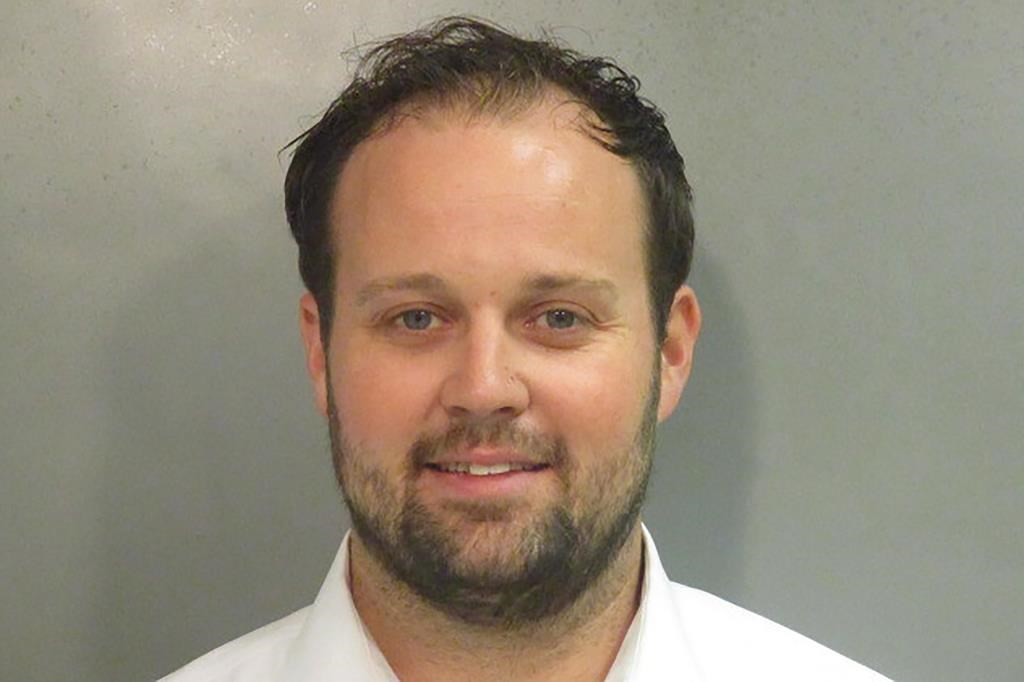
Upon his arrest, Josh Duggar was charged with receiving and possessing CSAM. (Photo Credit: Washington County Jail)
Unjust retaliation can happen to unsympathetic people
Additionally, Brindley alleges that Seagoville officers deleted Josh’s list of approved contacts.
These are people with whom he is permitted to be in regular communication.
Without the list, Josh was no longer allowed to contact them.
Obviously, Josh is a despicable person, even when compared to his most loathsome relatives like Jim Bob and Joseph.
But prison wrongdoings that can and do happen to vile, unsympathetic victims can also happen to good and decent people, including the wrongfully convicted.
It is probably worth noting that FTC Oklahoma City isn’t likely to be Josh’s new long-term residence.
FTC Oklahoma City is a holdover facility. That means that yet another transfer is likely in Josh’s future.
Whether they’ll keep yanking his chain — perhaps literally — by moving Josh from prison to prison until the 2030s remains unclear. It’s similarly unclear how long Brindley will act as his attorney to advocate for him.
Josh doesn’t deserve peace or happiness. But our prison system should conduct itself with honor and dignity instead of petty vindictive weirdness, which appears to be happening here.
Of course, with only Josh’s attorney’s take on what’s happening, we don’t necessarily know the truth yet.
The American Revolution is often told as a heroic story of 13 colonies rising up against a mighty empire and, with some help from France, winning their independence.
But the real story is more complicated. As the United States approaches the 250th anniversary of its independence, it is worth remembering that success on the battlefield depended not only on courage and ideals, but also on trade, credit, shipping and access to military supplies.
The center of that trade was not the 13 Colonies – but south of Loyalist Florida, in the greater Caribbean. Here developed the center of the Atlantic economy due to the insatiable appetite for sugar that had grown across Europe by the late 1700s. The economic output of just Jamaica was the same as the entire 13 Colonies. The Caribbean economies depended on slave labor, trade and supplies from around the world to make sure the sugar flowed freely and tax revenues to European colonial powers were maximized. Much of that support flowed through a small Dutch island in the eastern Caribbean that few Americans know today: St. Eustatius.
Barely 8 square miles (about 21 square kilometers) in size, St. Eustatius – or as residents call it, Statia – sits to the northwest of St. Kitts and Nevis. Without this tiny island, the Continental Army might have found itself without the arms, gunpowder and the supplies it needed to survive.
Statia’s importance began with geography. The island rises steeply from the blue waters of the Atlantic and Caribbean. Its dormant volcano, known as the Quill, dominates the southern part of the island.
Unlike taller Caribbean islands, Statia did not receive enough rainfall to make it especially attractive for large-scale sugar production. That made it less valuable to the great sugar powers of the 18th century, especially Britain and France.
What Statia lacked in plantation potential, it made up for as a port. Oranje Bay, on the western side of the island, offered one of the deepest and safest nearshore anchorages in the Americas. Large merchant ships could come close to shore, unload their cargo and reload quickly.
Along the bay stood a long, busy waterfront, lined with warehouses, shops and trading houses. By the mid-18th century, this narrow strip of shoreline had become one of the most important commercial centers in the Atlantic world.
Imperialism through trade
The Dutch had settled St. Eustatius in the 1630s, around the same time they were developing New Amsterdam, now New York City. Dutch merchants, families and investors moved through a wide Atlantic network that connected Europe, Africa, the Caribbean and North America. These commercial ties created trust, credit and opportunity across long distances.
In the 17th and 18th centuries, European empires tried to control colonial trade through mercantilism. Colonies were expected to enrich the mother country by supplying raw materials and buying finished goods through approved channels. Taxes, tariffs and trade restrictions benefited imperial governments and favored merchants, but they raised costs for ordinary colonists, shopkeepers and planters.
British colonists in North America often resented these restrictions, but Dutch traders were willing to help them get around them. For generations, Dutch vessels carried goods throughout the Atlantic, often selling items at lower prices than British merchants could offer legally.
Archaeological evidence from sites such as Pope’s Creek Plantation in Virginia, the Washington family home, shows the presence of Dutch ceramics, clay pipes and yellow bricks. Even before the Revolution, Dutch trade was woven into colonial life.
‘The emporium of the world’
In 1754, the Dutch West India Company petitioned the Dutch government to make Oranjestad, the capital of St. Eustatius, a free port, and the request was granted. The result was extraordinary: Goods could move through the island with few restrictions and without the heavy taxes common elsewhere. The government profited from leases on land, warehouses and homes rather than from taxing every cargo.
Merchants from across the Atlantic world quickly took advantage. Ships arrived carrying textiles, tools, food, enslaved people, weapons, luxury goods and raw materials. Languages from Europe, Africa and the Americas could be heard in the streets. St. Eustatius became, in the words often associated with the island, “the emporium of the world.” In modern terms, it functioned like an Amazon fulfillment center for the 18th-century Atlantic.
Adam Smith, often called the father of economics or the father of capitalism, noticed. In his 1776 book, “The Wealth of Nations,” Smith helped define economics as a modern field of study. Although he never visited St. Eustatius, Smith discusses the island, as it offered him a living example of what freer trade could produce: prosperity, speed, variety and commercial energy.
The same system that made the island rich also made it dangerous to imperial powers. Britain and France depended on controlled colonial trade, but St. Eustatius showed what could happen when goods moved with fewer restrictions. It also showed how merchants, credit networks and shipping families could challenge empires without firing a shot.
When the American colonies declared independence in 1776, they desperately needed military supplies. The Continental Congress knew that ideals alone would not defeat Britain. The new United States needed muskets, cannons, ammunition, uniforms, cloth, food and credit.
St. Eustatius was perfectly positioned to provide them.
The island’s merchants had long-standing connections with North America, and some of the American founders knew these networks well. Alexander Hamilton, who grew up in the Caribbean, spent his youth in the commercial world of shipping, accounts and credit. His family had ties to the region, and the Caribbean trade helped shape his understanding of finance and power.
St. Eustatius soon became a lifeline for the Revolution. American agents used the island to buy and ship supplies. Cargoes moved from Europe to Statia and then onward to North America. Arms and gunpowder that might have been impossible to obtain through official channels could be purchased through this Dutch free port.
The First Salute
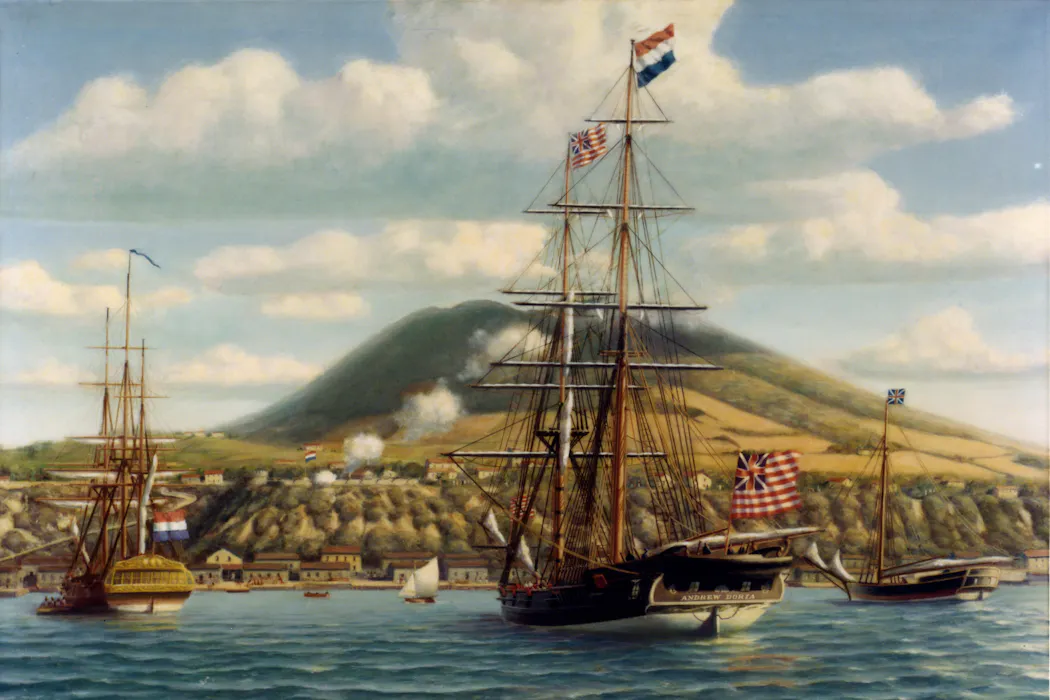
Then, in November 1776, a small but historic event took place in Oranje Bay. The Continental brigantine Andrew Doria arrived carrying a copy of the Declaration of Independence and flying the Continental Colors – the predecessor of the stars and stripes. Following maritime custom, the American vessel fired a salute. Fort Oranje answered with its own guns.
This exchange became known as the First Salute. Many historians regard it as the first formal recognition of American independence by a foreign power. The gesture was brief, but its meaning was enormous. By returning the salute, St. Eustatius publicly acknowledged the flag and authority of the new United States.
Britain understood the significance. The island was not merely a trading post; it was helping sustain rebellion. Over the next several years, much of the gunpowder, shot, cloth and other material that kept the American war effort alive passed through Statia’s warehouses and harbor.
The story of St. Eustatius serves as a reminder that revolutions are not won by ideas alone. The American Revolution depended on farmers, soldiers, diplomats and political thinkers, but it also depended on merchants, sailors, warehouses and credit.
Without St. Eustatius, without Dutch trade and without access to a free port in the Caribbean, the United States might not have survived long enough to celebrate any anniversary at all. The Revolution was a struggle for political independence, but it was also a struggle over who controlled trade. In that struggle, one tiny island helped change the course of world history.
R. Grant Gilmore III does not work for, consult, own shares in or receive funding from any company or organization that would benefit from this article, and has disclosed no relevant affiliations beyond their academic appointment.
Ruby Rose’s summer isn’t starting swimmingly.
The Orange is the New Black alum revealed she had to head to the hospital after accidentally slipping on the ledge of her pool and hitting her side on… E! Online (US) – Top Stories
Police obtained cellphone data for many people who happened to be in this area near the time of a bank robbery.AP Photo/Steve Helber
Law enforcement officials frequently draw virtual fences around areas of interest and require Google to identify every cellphone in the area using cell location history. Dubbed a “geofence search,” officers obtain a warrant that permits a multistep, give-and-take information sharing process between officers and tech employees that winnows down and identifies subjects.
On June 29, 2026, the Supreme Court ruled that whenever police obtain an individual’s cell location data, even from a third-party tech company, it constitutes a search under the Fourth Amendment of the U.S. Constitution. The Fourth Amendment protects people from unreasonable government searches and seizures, and it does so in part by requiring search warrants based on probable cause that describe the particular person or thing to be searched. A geofence warrant that identifies every phone in an area does not align well with those requirements.
In its 6-3 decision in Chatrie v. United States, the court sent the case back to the 4th U.S. Circuit Court of Appeals to determine whether the geofence warrant at issue, including each part of its three-step search process, met the Fourth Amendment’s warrant requirements.
As a privacy, electronic surveillance and tech law attorney, author and legal educator, I have spent years researching, writing, educating and advising about these kinds of privacy and legal issues, and my books on electronic surveillance and evidence are routinely cited and relied upon by courts grappling with these issues.
Google tracks the vast majority of cellphones, collecting your location, usage and device data through installed software and apps. The tracking occurs by various autonomous processes you cannot see or stop, even when you turn off location history, and Google and other companies keep that data for years. Outside of your control, your cellphone continuously creates a durable and revealing digital trail that law enforcement can obtain with a warrant.
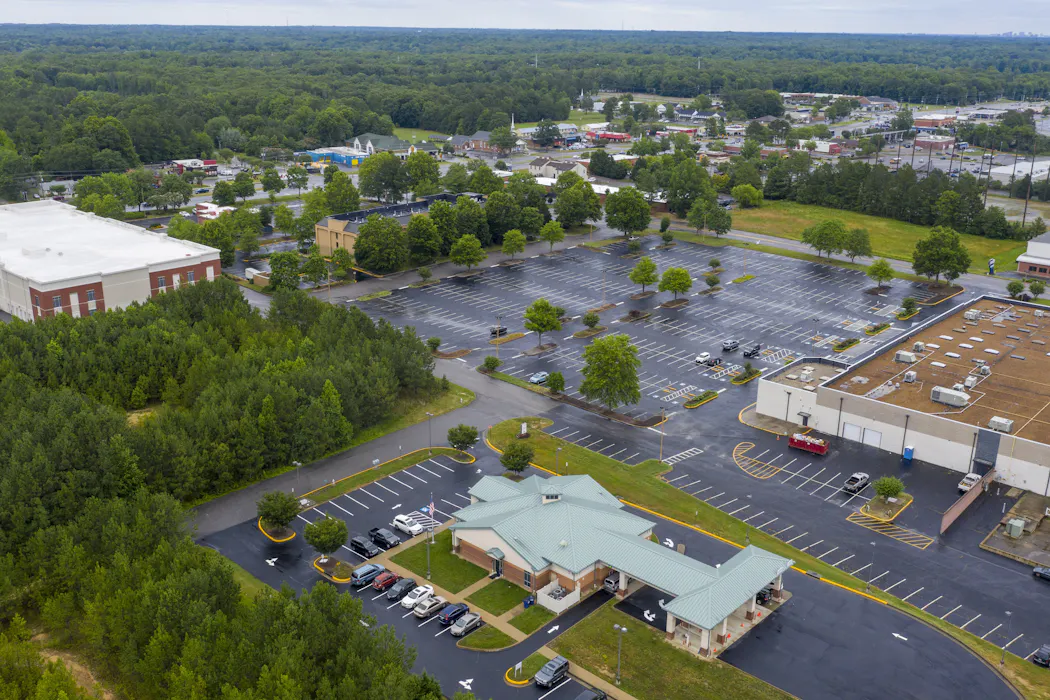
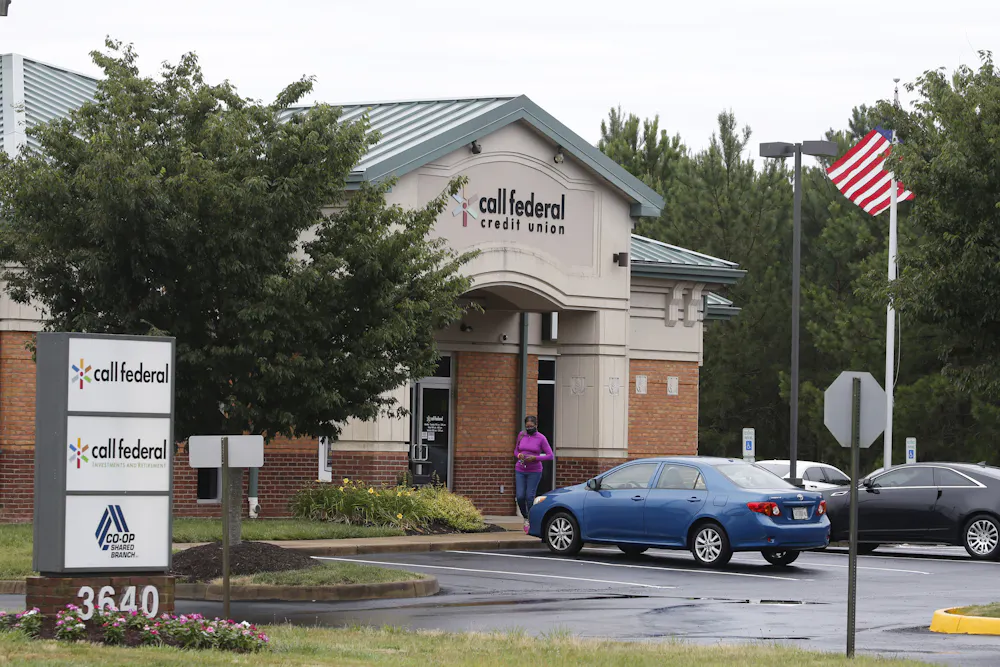
The Chatrie case involves the hunt for a suspect in an armed bank robbery in busy Midlothian, Virginia, in May 2019, and how police settled on a man named Okello Chatrie as the perpetrator.
Detective Joshua Hylton was granted a geofence warrant that compelled Google to search its database and identify every cellphone in a 17½-acre area around the bank, including private residences and a church, for a period of two hours. Working closely with Google, police ultimately narrowed in on Chatrie. When the trial court denied Chatrie’s motion to suppress the geofence-derived evidence, Chatrie appealed.
The government argued both that Chatrie had tacitly agreed to Google collecting the information and that Chatrie had no reasonable expectation of privacy in third-party Google’s records. The Supreme Court disagreed on both fronts. This decision matters because all cellphone-carrying people can end up in tomorrow’s geofence, like all those who were unknowingly grabbed in the Chatrie search. And nearly all users are unaware of these fences. No one specifically consents to be included in them, but people have no choice. What happened in the Chatrie case is a feat otherwise impossible but for advances in location-tracking technology and advanced AI systems.
A customer walks out of a credit union in Virginia where a robbery in 2019 set in motion events that led to a Supreme Court case. AP Photo/Steve Helber
How geofences work
Geofences are part of modern life. By carrying your smartphone and other devices, you generate location and other device activity data. That data is collected, stored, analyzed, and bought and sold by multiple companies. The location history data being collected about you is what makes geofences possible, and it is comprehensive and precise.
Location history relies on a variety of sources of data that can include cell tower location, cellphone connections to Wi-Fi networks and Bluetooth sources, and cellular data sent via cell tower. This means the communications you received and sent and the apps you used can be swept up in a geofence.
Advanced AI technologies analyze that data to discern increasing amounts of personal and behavioral data – insights about people, groups and activities – that can be used for a variety of purposes, including targeted advertising. Your rich location history and device data get snatched up regularly in such fences by private companies; your present and past self travels through them constantly.
A geofence can be in real time, for instance to identify and track who is or was at a protest or, say, a reflecting pool during any period in the past decade or so. It can be dynamically generated, like a circle around a specific location, or it could be a predefined set of boundaries, such as a specific address or area defined by streets or other geographical boundaries. One geofence warrant that Google received covered 2½ square miles of San Francisco for a period of 2½ days.
There has been a significant increase in law enforcement’s use of geofence warrants over the past decade. Google revealed in court that it received a 1,500% increase in geofence requests from 2017 to 2018, a 500% increase from 2018 to 2019, and that by 2020 it had 11,500 geofence warrants in a year. Between 2021 and 2023, geofence warrants made up over 25% of all warrants that Google received from law enforcement agencies in the United States.
If you carry a smartphone around with you, Google and other tech companies keep track of where you are and everywhere you’ve been. Dilara Irem Sancar/Anadolu via Getty Images
Search warrants and the Fourth Amendment
The Fourth Amendment is the foundation on which all U.S. electronic privacy laws rest. When government agents want to search or seize a person, place or thing – absent consent or emergency – the Fourth Amendment requires agents to get a court-approved warrant based on probable cause. Agents must provide a judge with enough evidence to establish probable cause that the person, place or thing to be searched or seized is associated with a crime.
The resulting warrant must also describe with “particularity” the specific person, place or thing to be searched or seized. If these requirements are not met, the search is unreasonable and therefore unlawful, and evidence obtained in that search cannot be used in court, barring a good-faith exception.
The Fourth Amendment’s “particularity” requirement strictly forbids general warrants, historically used by British troops against colonists to engage in overly broad or all-encompassing searches.
Reverse warrants
The only “particularity” that police can specify in applying for a geofence warrant is that a crime occurred at a particular time and place. Hence, geofence warrants are often called reverse warrants because they literally reverse the traditional process of conducting an investigation. Instead of identifying a suspect and then obtaining a warrant to gather information on that person, geofence warrants gather all devices in a time and place. Then, aided by technology and evolving search parameters, police sift through for potential suspects.
Litigation records reveal a collaborative effort between law enforcement and Google that follows a three-step process. First, agents specify in the geofence warrant a time and place to be searched. The data they’re seeking is not merely a list of cellphone devices in the area; it is usually more detailed, such as whether a device sent texts when it was in the area of the geofence.
Next, the company provides the officials with an anonymized list of users or devices matching the warrant’s criteria. At this point, things start to become more fluid, and the officials may seek additional information about specific users outside the originally authorized search parameters.
Third, officials then analyze the information and request that the company “unmask” certain users. In complying, Google may tell police the account holder’s name, their address, their email address, and even whether they were communicating or using certain apps during the relevant time.
This close work between the private entity – usually Google – and law enforcement throughout the geofence warrant process raises significant privacy and civil liberties concerns. It also does not appear that there is any court review or judicial oversight during this give-and-take between law enforcement officers and Google in the geofence warrant process.
Chatrie and the Supreme Court
For decades, the court has grappled with law enforcement’s use of technologies to track the location of people or things. In its 2018 decision in Carpenter v. United States, it ruled that the U.S. Constitution requires law enforcement agents to obtain a warrant to track a person using their cellphone location history data, as it had done previously with GPS data. And in Carpenter, it specifically ruled that cellphone users have a reasonable expectation of privacy in their cell site location history, even though that data is obviously shared with their cell providers.
It was perhaps not surprising that the court firmly rejected the government’s arguments in Chatrie. The justices had already rejected these arguments in 2018 with very similar technologies at issue.
The court’s ruling is unequivocal: “An individual has a legitimate expectation of privacy in his cellphone location data.” The ruling clarifies and strengthens privacy protections in the digital age. What remains to be seen is how the 4th Circuit will answer the question the Supreme Court posed when it sent the case back to them: Did the geofence warrant – and each part of the multistep search – comply with the Fourth Amendment’s requirements?
This is an updated version of an article originally published on April 29, 2026.
Anne Toomey McKenna serves on the Advisory Board to the Institute for Electrical and Electronics Engineers (IEEE)-USA’s Artificial Intelligence Policy Committee (AIPC) and Chairs multiple AIPC subcommittees. The AIPC work involves subject matter and education-related interaction with U.S. Senate and House congressional staffers and the Congressional AI Caucus. McKenna has received funding from the National Security Agency for the development of legal educational materials about cyberlaw (a course which the government still makes available online for the public) and funding from The National Police Foundation together with the U.S. Department of Justice-COPS division for legal analysis regarding the use of drones in domestic policing.












 Ariana Grande had to break free from these tour dates.



 Ruby Rose’s summer isn’t starting swimmingly.