Alan Jackson’s final concert was certainly one to remember, and now fans will be able to relive the magic again and again as the unforgettable night is being released as a live album later this year.
According to an announcement from Jackson’s longtime label, Last Call: One More for the Road – The Finale (Live from Nashville) will arrive later this year. Pre-orders are available now, and according to the official website, the album is expected to ship on December 31, 2026.
Last Call: One More for the Road – The Finale (Live from Nashville)
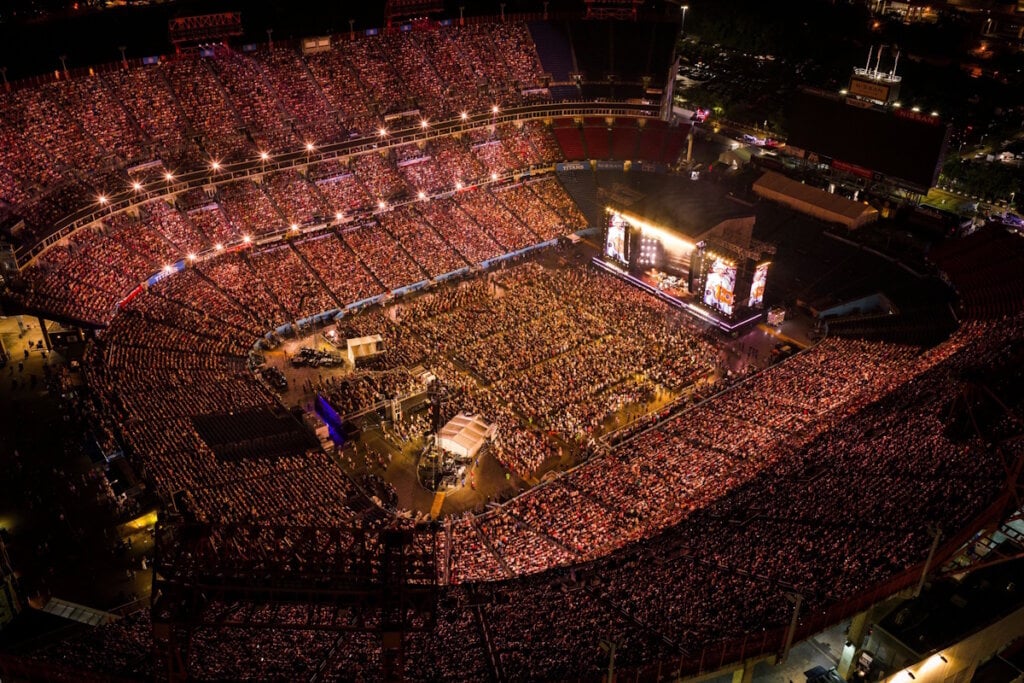
Jackson’s memorable farewell concert was witnessed by more than 80,000 fans across Nashville. The historic night took place live at Nissan Stadium, with additional livestream viewing events held at Belmont University’s Fisher Center and the Country Music Hall of Fame’s CMA Theater. The celebration extended throughout the city, with thousands more watching Jackson’s final performance, along with the all-star lineup of artists who opened the show, from screens set up along Broadway, where fans filled the closed street and gathered on the rooftops of the honky-tonks lining the famous stretch.
Others watched and listened from across the Cumberland River, gathering on the pedestrian bridge connecting Nissan Stadium to downtown Nashville to sing along and celebrate Jackson’s legendary career.
Alan Jackson Nissan Stadium; Photo by Sam Shapiro Media
As previously announced, the show was also filmed for an NBC special, Alan Jackson: The Last Show, which will air in December.
Jackson’s final concert featured the country icon performing many of his biggest hits, with a career-spanning set list highlighting songs from his decades in country music, including many of his 35 No. 1 hits.
The emotional night also featured a special appearance from fellow Country Music Hall of Famer George Strait, who joined Jackson on stage for two songs, including “Designated Drinker” and “Murder on Music Row.”
“This has just been incredible,” Jackson shared during the show. “I don’t even have words – it’s just been completely overwhelming.”
Before Jackson took the stage for his final performance, an all-star lineup of country artists came together to honor his legendary career. Riley Green, Miranda Lambert, Little Big Town, Jake Owen, Jon Pardi, Thomas Rhett, Lee Ann Womack, Luke Bryan, Cody Johnson, Lainey Wilson, Luke Combs, Eric Church, and Carrie Underwood each performed an Alan Jackson song in tribute to the country icon.
The group later reunited for a special all-star performance of “Pop a Top,” which will be featured as part of the upcoming NBC special, Alan Jackson: The Last Show.
Imagine the surprise of a country star facing border patrol after a big show. It’s a wild ride, and the story gets even wilder. Continue reading…Country Music News – Taste of Country
Imagine the surprise of a country star facing border patrol after a big show. It’s a wild ride, and the story gets even wilder. Continue reading…The Boot – Country Music News, Music Videos and Songs
The Supreme Court struck down limits on coordinated spending between candidates and political parties on Tuesday, a win for Republicans that will fundamentally change how tens of millions of dollars are spent in congressional elections.
The decision will have an almost immediate impact on the midterms. Removing the limit on coordinated spending effectively gives candidates direct control over a far greater amount of money being spent on their races. It is also likely to increase the flood of political advertising that hits the airwaves each fall.
The 6-3 decision, which divided the court along its usual ideological lines, held that the limits violate the First Amendment.
The decision is a blow to Democrats, who argued that eliminating the limit on coordination would put more power into the hands of large donors who can cut bigger checks to party committees than to candidates. Republicans tend to get more money from large donors, while Democrats have been more reliant on small-dollar donors.
Justice Brett Kavanaugh, writing for the majority, called the limits a “severe infringement on First Amendment-protected political speech.” He also argued the ruling eliminating the limits could bolster political parties generally.
“To uphold the political-party coordinated-expenditure limits here could therefore help consign political parties to continued second-tier status as compared to outside groups,” Kavanaugh wrote. “Weakened political parties distort the political system.”
President Donald Trump hailed the ruling allowing parties to spend unlimited amounts in coordination with individual campaigns.
“The Supreme Court just took restrictions off political spending!” Trump wrote on Truth Social. “A BIG WIN FOR REPUBLICANS and, more importantly, The First Amendment!”
The National Republican Senatorial Committee brought the case seeking to overturn the limits in 2022 alongside now-Vice President J.D. Vance’s Senate campaign. Trump’s Justice Department declined to defend the law in court, while Democratic groups intervened to oppose the lawsuit.
“By striking down these unconstitutional caps on coordinated spending, the Court has restored core political speech and ensured parties can compete on a level playing field,” NRSC Chair Tim Scott (R-S.C.) and National Republican Congressional Committee Chair Richard Hudson (R-N.C.) said in a joint statement. “We are ready to fully support our candidates and put them in the strongest possible position to win in 2026 and beyond.”
Democrats, who are already staring down substantial disadvantage in party fundraising this midterm cycle and are worried that the ruling will only amplify the impact of that disparity, were quick to deride the decision Tuesday.
“Today’s ruling is a win for billionaire donors and special interests who want more influence over the GOP agenda and an invitation for corruption,” Democratic Senatorial Campaign Committee Chair Kirsten Gillibrand, Democratic Congressional Campaign Committee Chair Suzan DelBene and Democratic National Committee Chair Ken Martin said in a joint statement.
The ruling strengthens the parties themselves, allowing them to directly support their preferred candidates in a way that could empower their roles in the political ecosystem — and potentially weaken the influence of super PACs. Party committees on both sides have been preparing for the possibility for months and the decision is likely to have an immediate impact on campaign spending ahead of the November midterms.
Previously, coordinated spending between candidates and party committees, such as the NRCC or the DCCC, was capped, with the specific amounts depending on the size of the district or state. Those limits no longer apply.
That significantly alters the campaign finance landscape because parties can accept far larger donations than individual candidates — $44,300 per year for national party committees compared with $3,500 per cycle for candidates. Removing the limit on coordinated spending effectively gives candidates the ability to control a far greater sum of money that is being spent on their race.
That could also substantially change the makeup of political advertising on television, because candidates get far lower rates on TV ads than other groups. If their coordinated efforts with campaigns get the similarly low rate, they would have far more cash to tap to flood the airwaves, while super PACs will still have to pay a higher rate. As a result, campaigns might spend more of their budget on TV advertising, while super PACs may be more likely to pick up other campaigning costs, such as mailers and digital advertising.
Democrats have largely had the advantage in candidate fundraising, which has generally given them a leg up in battlegrounds when candidate fundraising was the most important. But NRSC has slightly more cash on hand than the DSCC, according to recent campaign finance reports, while the Republican National Committee has wildly outraised the DNC. Those party funds could now give the GOP the financial advantage in key states.
The court’s decision additionally eliminates the need for parties to mount their own independent expenditure arms, where they have traditionally spent tens of millions of dollars.
The decision is the latest in a series of blows the high court has dealt to campaign finance regulation over the past two decades. The 2010 Citizens United and Speechnow.org decisions enabled the rise of super PACs with no limit on donations. In 2014, the court struck down aggregate limits on individual donations. And in 2022, it struck down limits on candidates using donor funds to repay personal loans they had made to their campaigns.
“Today’s decision follows a string of disastrous campaign finance rulings from the Roberts Court that began with Citizens United,” Michael Beckel, director of money-in-politics reform at Issue One, said in a statement. “By eliminating the limits that have long governed how much money parties can spend in coordination with candidates, the Supreme Court has further empowered wealthy donors and special interests with outsized influence in elections.”
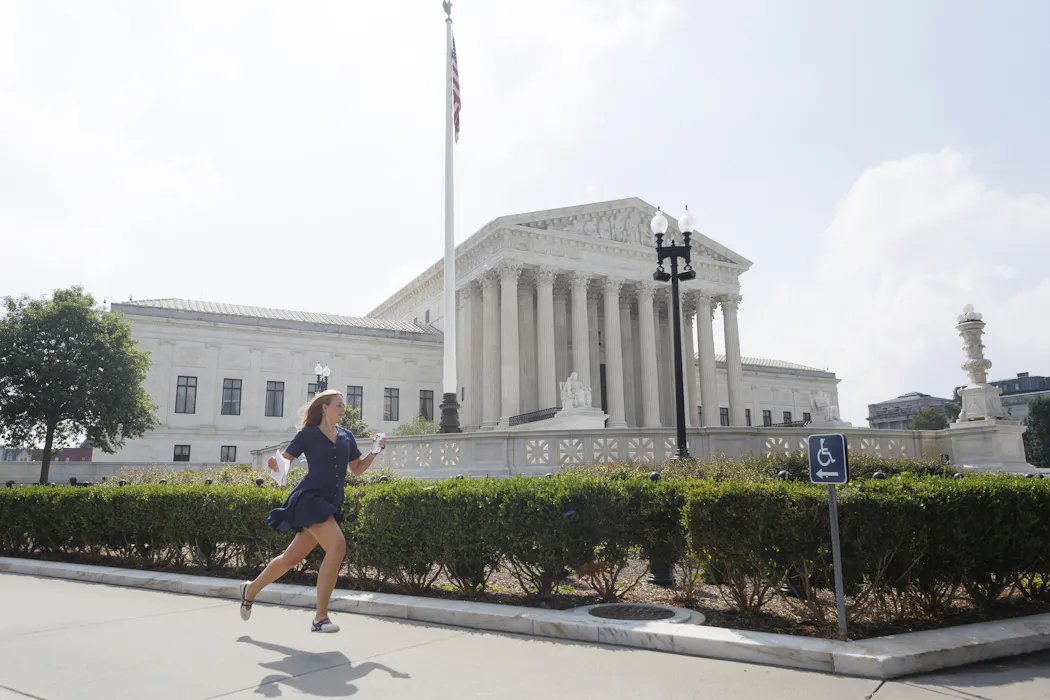
A news reporter carrying printed justice opinion announcements sprints outside U.S. Supreme Court on June 29, 2026, in Washington, DC.Tom Brenner/Getty Images
The U.S. Supreme Court – with its six conservative justices, three of whom were nominated by President Donald Trump – has recently reversed landmark decisions that have long guided American government and society. Over the last few years, the court has stripped federal protection of abortion rights, affirmative action, gun control, and a significant portion of the 1965 Voting Rights Act.
As a political science scholar who studies presidential power, I believe the unitary executive theory is perhaps the most contentious and consequential constitutional theory of the past several decades. And its judicial approval threatens to upend much of American governance.
A prescription for a potent presidency
In 2017, Trump complained that the scope of his power as president was limited: “You know, the saddest thing is that because I’m the president of the United States, I am not supposed to be involved with the Justice Department. I am not supposed to be involved with the FBI, I’m not supposed to be doing the kind of things that I would love to be doing. And I’m very frustrated by it.”
The unitary executive theory suggests that such limits wrongly curtail the powers of the chief executive.
Formed by conservative legal theorists in the 1980s to help President Ronald Reagan roll back liberal policies, the unitary executive theory promises to radically expand presidential power.
There is no widely agreed upon definition of the theory. And even its proponents disagree about what it says and what it might justify. But in its most basic version, the unitary executive theory claims that whatever the federal government does that is executive in nature – from implementing and enforcing laws to managing most of what the federal government does – the president alone should personally control it.
This means the president should have total control over the executive branch, with its dozens of major governmental institutions and millions of employees. Put simply, the theory says the president should be able to issue orders to subordinates and to fire them at will.
President Donald Trump signs executive orders in the Oval Office next to a poster displaying the Trump Gold Card on Sept. 19, 2025. AP Photo/Alex Brandon
The president could boss around the FBI or order the U.S. attorney general to investigate his political opponents, as Trump has done. The president could issue signing statements – a written pronouncement – that reinterpret or ignore parts of the laws, like George W. Bush did in 2006 to circumvent a ban on torture. The president could control independent agencies such as the Securities and Exchange Commission and the Consumer Product Safety Commission. And the president might possess inherent power to wage war as he sees fit without a formal authorization from Congress, as officials argued during Bush’s presidency.
A constitutionally questionable doctrine
A theory is one thing. But if it gains the official endorsement of the Supreme Court, it can become governing orthodoxy. It appears to many observers and scholars that Trump’s actions intentionally invited court cases by which he hoped the judiciary would embrace the theory and thus permit him to do even more. And now the court has effectively granted Trump that wish.
Until recently, the judiciary tended to indirectly address the claims that now appear more formally as the unitary executive theory.
During the country’s first two centuries, courts touched on aspects of the theory in cases such as Kendall v. U.S. in 1838, which limited presidential control of the postmaster general, and Myers v. U.S. in 1926, which held that the president could remove a postmaster in Oregon.
In 1935, in Humphrey’s Executor v. U.S., the high court unanimously held that Congress could limit the president’s ability to fire a commissioner of the Federal Trade Commission. And in Morrison v. Olson the court in 1988 upheld the ability of Congress to limit the president’s ability to fire an independent counsel.
Some of those decisions aligned with some unitary executive claims, but others directly repudiated them.
These decisions clearly suggest that long-standing, anti-unitarian landmark decisions such as Humphrey’s were on thin ice. In fact, in Justice Clarence Thomas’ 2019 concurring opinion in Seila Law LLC v. CFPB, where the court ruled the Consumer Financial Protection Bureau’s leadership structure was unconstitutional, he articulated his desire to “repudiate” the “erroneous precedent” of Humphrey’s.
Several cases from the court’s emergency docket, or shadow docket in 2025 indicated that other justices shared that desire. Such cases do not require full arguments but can indicate where the court is headed.
In Trump v. Wilcox, Trump v. Boyle and Trump v. Slaughter, all from 2025, the court upheld Trump’s firing of officials from the National Labor Relations Board, the Merit Systems Protection Board, the Consumer Product Safety Commission and the Federal Trade Commission.
Previously, these officials had appeared to be protected from political interference.
Remarks by conservative justices in those cases indicated that the court would reassess anti-unitary precedents.
In Trump v. Boyle, Justice Brett Kavanaugh wrote, “whether this Court will narrow or overrule a precedent … there is at least a fair prospect (not certainty, but at least a reasonable prospect) that we will do so.” And Justice Elena Kagan said the conservative majority was “raring” to overturn Humphrey’s and finally officially embrace the unitary executive.
In short, the writing was on the wall. Chief Justice John Roberts authored the majority opinion in Trump v. Slaughter on June 29. It did not explicitly invoke the unitary executive theory, but its fealty to the doctrine was clear.
As for the status of the anti-unitarian precedent of Humphrey’s, the court claimed its logic has “not withstood the test of time” and had been effectively undermined for decades. The majority then declared, “If anything more is left of Humphrey’s, we overrule it.”
As for what judicial endorsement of the unitary executive theory will mean in practice, Trump seems to hope it will mean total control and hence the ability to eradicate the so-called “deep state.” Other conservatives hope it will diminish the government’s regulatory role.
Kagan recently warned it could mean the end of administrative governance – the ways that the federal government provides services, oversees businesses and enforces the law – as we know it:
“Humphrey’s undergirds a significant feature of American governance: bipartisan administrative bodies carrying out expertise-based functions with a measure of independence from presidential control. Congress created them … out of one basic vision. It thought that in certain spheres of government, a group of knowledgeable people from both parties – none of whom a President could remove without cause – would make decisions likely to advance the long-term public good.”
Justice Sonia Sotomayor’s dissent in Slaughter, in which she was joined by the other two liberals, echoed the worry about governance, saying that independent agencies will be “transformed in ways that those who created them never could have expected and actively sought to avoid.”
She also noted that complete presidential control over independent agencies would significantly enhance the power of the president at the expense of Congress, “fundamentally recalibrating the balance of power in this country in the process.”
Graham G. Dodds does not work for, consult, own shares in or receive funding from any company or organization that would benefit from this article, and has disclosed no relevant affiliations beyond their academic appointment.
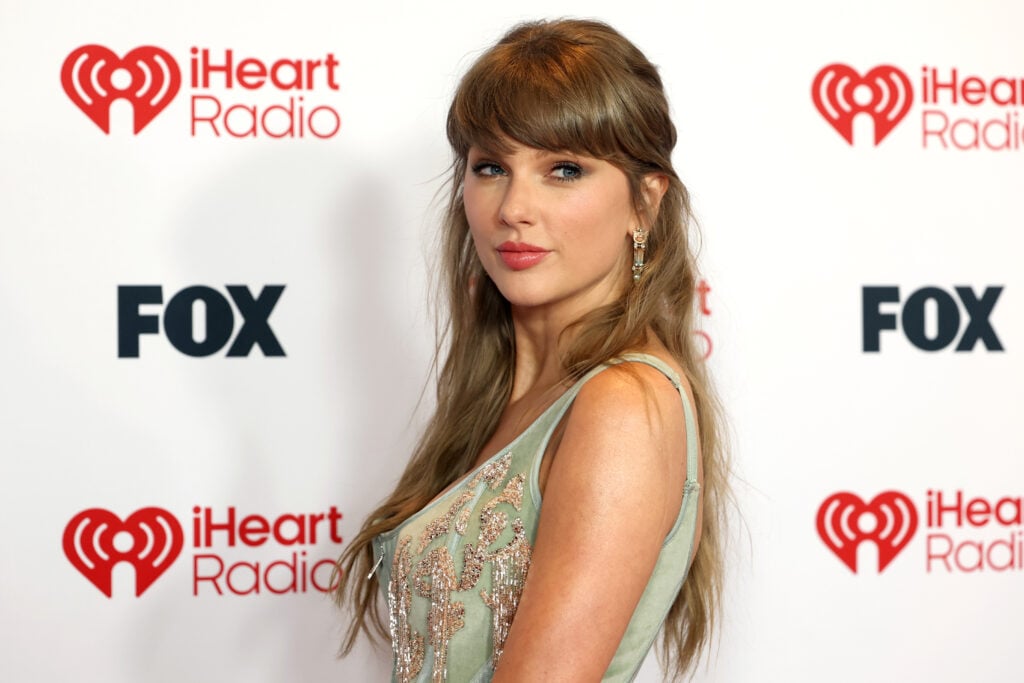
Taylor Swift attends the 2026 iHeartRadio Music Awards at Dolby Theatre on March 26, 2026. (Photo Credit: Frazer Harrison/Getty Images)
Wedding bells are ringing! Metaphorically, for the moment
According to NBC News, Taylor and Travis’ wedding will reportedly include about 1,100 guests.
The festivities should go down at Madison Square Garden on Friday, July 3.
Previous reports had shared that some wedding-related events would take place in New York on Friday. We just didn’t know how much.
It’s hard to keep a large wedding secret when you’re Taylor. Especially when there’s a block-off schedule in a city like New York.
Those with invitations — apparently, over 1,000 individuals — have received electronic nondisclosure agreements. NBC was however unclear on the details of the NDAs.
TMZ reports that the NDA may look intimidating but apparently isn’t quite a Sword of Damocles over guests’ heads.
Yes, the non-disclosure agreements that guests must e-sign forbid them from spilling details to the public.
However, TMZ says that the measure does not include a monetary penalty for blabbers.
In fact, there doesn’t seem to be any other punitive measures attached.
Simply put, it sounds like this is a legal measure to discourage people from blabbing, but not a cudgel with which to ruin their lives if they do.
Will there be some sort of streaming doc for the big day?
There is no film release attached, either.
So guests weren’t asked to sign away their rights to appear on camera.
This makes it sound like there’s probably not going to be a streaming special or a documentary about the wedding.
Or, if there is, select individuals may sign on (or not) during or after the wedding.
This makes sense. Taylor is a world-class celebrity. Travis is arguably fairly famous in the sportsball world. They’re not reality stars, and their wedding can be for them and friends, not for streaming.
Officially, we only know that the invitations listed “New York City” as the venue, and July 3 as the date.
As for MSG, we know the venue because New York City streets surrounding Madison Square Garden will be closed from July 2 through midday on July 4, all for a July 3 event.
People connected the dots. It wasn’t hard.
By the way, the invites were watermarked by Taylor and Travis, sort of like some OnlyFans videos are. That is to say, if someone leaks it, they’ll know who did.
Still, if someone wants to spill the beans, it sounds like they can. They’ll get a really good excuse to not attend a wedding in the process.
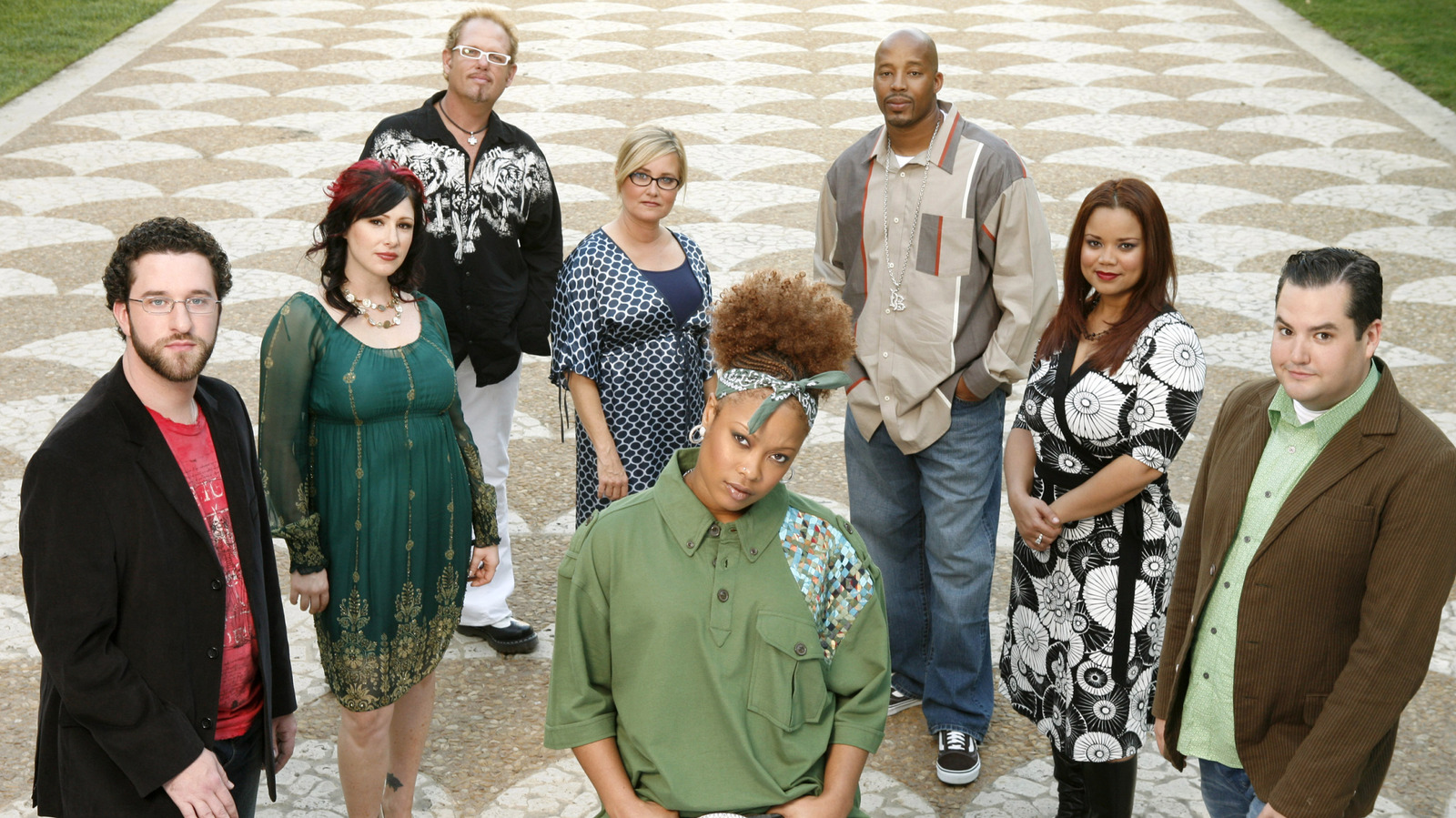
VH1’s “Celebrity Fit Club” featured an interesting mix of personalities united by one goal: to lose weight. Since then, they’ve been busy with their careers.
Health Digest – Health News, Wellness, Expert Insights
Jerry O’Connell revealed his favorite part of Rebecca Romijn’s mystique.
The 52-year-old admitted that he’s a fan of how his wife smells, even though her crystal deodorant doesn’t really… E! Online (US) – Top Stories

















 Jerry O’Connell revealed his favorite part of Rebecca Romijn’s mystique.