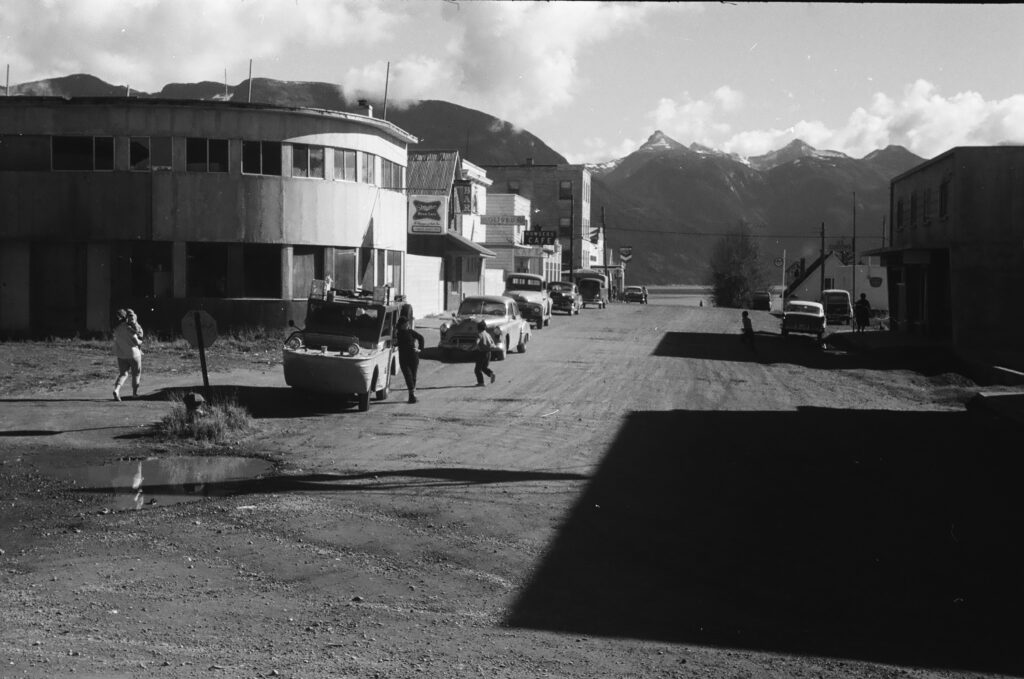
(Courtesy/Christiane Leitinger) “The Ugly Duckling” parked on Main Street in Haines. The Shimanski family from Evergreen, Colorado recently visited Haines to find evidence of Christiane Leitinger’s mother on a journey with The Ugly Duckling through Southeast Alaska.
David Svenson is in town visiting his older brother, John Svenson. David has been visiting Haines since the 1960s — he celebrated his 16th birthday here. This year he brought his 16-year-old son Shion Svenson on the trip from their home in California. David Svenson has been sculpting, carving and making art in the Chilkat Valley with local artists for years and has been inspired by Leo Jacobs Sr. , Nathan Jackson and Ed Kasko. Highlights of this trip included going halibut fishing with Ken Gross. David Svenson and his son both caught their very first halibut together on this trip.
Christiane Leitinger recently visited Haines from Colorado with her family and a stack of pictures from 1961. They set out to match up the photos from her parents’ epic trip that started in Prince Rupert, British Columbia to Haines in 1961, aboard the only vehicle to drive the Lynn Canal. As a boat it averaged four knots. Her parents were Ilse Abshagen and Hans Leitinger; they were traveling in The Ugly Duckling. The Ugly Duckling was a Ford GPA, an amphibious jeep. About 1,200 Ford GPAs were produced during World War II and Abshagen and Leitinger were the first people to drive the Inside Passage in theirs, as documented by plenty of photos. Christiane Leitinger has an amazing collection of pictures from the trip and notes that her parents made on the voyage. She and the family are off to Anchorage next. Leitinger has a solid lead on what could be the current location of the vessel. While the family was in town they compared 1961 photos with areas along Mud Bay road to discover the final landing of the Ugly Duckling before it made the road trip to Anchorage.
Bryce Norton, “Little” Will Tuttle , Lizzy Hahn, Lilly Franck, Katherine Perry, Joseph Rossman and Koa Doddridge went water skiing on the Lynn Canal this week. Norton was the skipper for the adventure in rather chilly waters. Hahn said that 57 degrees was an acceptable temperature. She’s from Nome, maybe that explains things. The chilly waters did not stop Tuttle from skiing in the wake of the Hubbard and a cruise ship, much to the delight of passengers aboard.
Tyler Scovill has been working at The Parts Place for 40 years. His dog, George, has only been on the payroll for a few. His sister, Tomi Scovill, can be credited with inspiring him to move to Haines. He was living in Pentwater, Michigan when she bought the store and pitched the idea to him. His milestone was celebrated with coworkers and friends. Cupcakes and pinwheel appetizers were shared; Scovill enjoyed homemade lasagna and there were several cases of his favorite beverage to enjoy. He said that while working at the Parts Place, the price of oil has changed dramatically, and no people have come in looking for blinker fluid.
A free workshop led by Dan Henry July 7-9 aims at helping residents develop skits for September’s Historic Hysterics Skit Festival.
The festival, Sept. 9-10, celebrates the 90th anniversary of the Chilkat Center and will serve as the annual fundraiser for the Chilkat Center.
The festival aims to feature a series of 10-15 minute skits equivalent to a mini theater festival, with adjudication and awards, said Annette Smith, secretary of Lynn Canal Community Players.
A collaboration between the foundation and the theater troupe, the festival seeks theatrical pieces with a humorous and historical bent, based on an event or item from Haines or Alaska history.
Anyone interested in creating a skit is invited to attend the workshop. “You don’t have to be a writer. You can just be a person who has fun developing something like that,” Smith said.
20 Years Ago
Haines residents are being warned to be on the lookout for phishing attacks that target First National Bank Alaska customers.
The phishing is done by counterfeit E-mails designed to look like official bank correspondence and include urgent requests for personal information.
Banker Dick Flegel, president of the Haines Branch, said “calls started coming in about a week ago. The three of four calls so far have been from local businesses.”
The scam could last a few days up to a month or longer, a bank warning advised residents. “Anyone receiving an E-mail that could be phishing, should not respond to the solicitations nor click on any links within the E-mail,” the announcement said.
30 Years Ago
A cellular telephone was used to summon rescuers to Sullivan River Monday afternoon, after an injury on a three-thinning operation.
A Fairbanks man called Haines police with a report of a man being struck by a tree, said chief Charlie Fannon. The man with the phone apparently was part of a crew working on a Native allotment for Tlingit-Haida, Fannon said.
The dispatcher alerted the U.S. Coast Guard and the Alaska State Troopers in Juneau, and in turn a two-person medical emergency team from Glacier Valley Fire Department was deployed on a Temsco helicopter under a standing arrangement between the department and the company.
The injured man, 24 years old, was struck in the hip by the butt end of a tree as it fell after being cut, said Jeff Newkirk, a supervisor at the fire department.
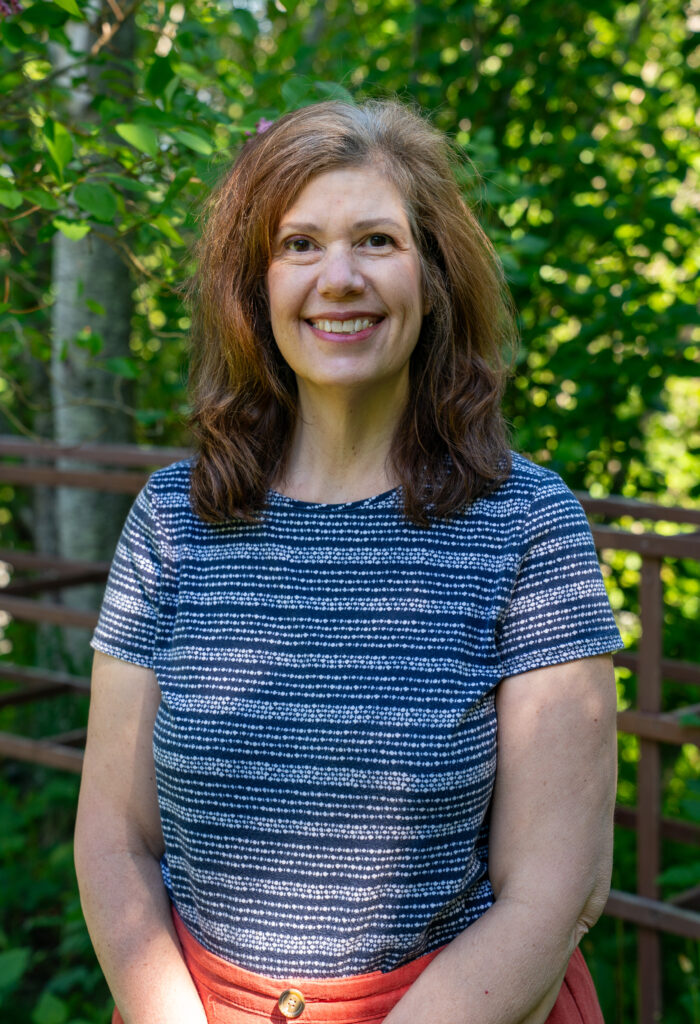
Lisa Andriesen, Haines middle school language arts and social studies teacher, retired in May after being a teacher in Haines for 35 years, seen on June 19, 2026 in Haines, Alaska. (Lizzy Hahn/ Chilkat Valley News)
As teachers closed down their classrooms in preparation for next year, some longtime teachers like Lisa Andriesen packed up their rooms for good.
Andriesen’s route to the Chilkat Valley started with a grandmother who always talked about wanting to come to Alaska. That motivated Andriesen to attend a job fair in Anchorage where she met the Haines Borough School District superintendent at the time, who later reached out and encouraged her to apply.
Andriesen said she didn’t know where Haines was when she applied to be a middle school teacher, but she still got the job and took the ferry up to Haines 35 years ago, fresh out of the University of Michigan in Ann Arbor with her teaching certificates in hand. She was 21 years old. She said she figured she could do anything for one to two years.
Thirty-five years later, most if not all, Haines middle school students had Andriesen as their language arts and social studies teacher.
Andriesen was not only a middle school teacher, but also the homeschool correspondence coordinator for almost 15 years. Andriesen said there were two language arts and social studies teachers in the middle school when she first started. Now, with fewer students, there is only one.
She said one of the reasons she stuck with the job for so long is that the staff she worked with were driven and motivated.
“So many people that they [school district] hired have been so dedicated, wanting to do the best for the kids, and just great, fun people to work with and teach with,” Andriesen said.
Haines Borough School District superintendent Lilly Boron said over the five years that she was the principal, the school lost a lot of core teachers.
“We’ve had about 40% turnover rate,” Boron said. Boron mentioned that because of the current state funding environment in Alaska, teachers are having to do more with less. She said Andriesen is one of the core teachers in the middle school and for the homeschool program that the school depends on for their institutional knowledge.
She also blamed, and thanked, Andriesen for pushing her into leadership positions. Boron said Andriesen recommended that Boron attend a principal program, which ultimately led to her stepping into an administrative role in the district. Not only was Boron a colleague of Andriesen’s, but her twin daughters were also students of Andriesen.
Looking to the future, Andriesen said she thinks artificial intelligence will drive a big change for education.
“We’re just starting to learn how to deal with it, what to incorporate, what to ask from the kids.” Andriesen said.. She encouraged her students to use the Quizlet AI tools, which allowe concepts to be explained in new ways and give new examples.
But, she said, it’s an adjustment for teachers. She gave the example of teaching students for three years in middle school, so she becomes familiar with their writing styles.
A few of her students have tried to use AI for their writing but she could tell it wasn’t their style of writing. Andriesen anticipates that this may become more common.
As the coordinator for the homeschool program, Andriesen oversaw the curriculum, checking work samples and plans that parents would send in. Andriesen said that there are currently around 25 students enrolled in the Haines Borough’s homeschool program, which spans K-12. During the COVID-19 pandemic, the program had 80 students enrolled.
Andriesen said that a challenge in education is the never-ending new techniques. It’s a balancing act of knowing what works for the students and incorporating new methods. Andriesen said she changed a lot in her teaching over 35 years.
Other challenges arose with new administrators who were not familiar with Haines and trying to acclimatize them as well as maintaining programs through reduced staffing. Andriesen said that with staff reductions, teachers took on more responsibilities and got more creative with their schedules to be able to fit in the additional programming.
“I’ve really been proud that we’ve been able to keep our art, music, P.E., … industrial arts and everything.” Andriesen mentioned that it would be easier to move to a smaller schedule, but then the students wouldn’t have access to the vast amount of programs.
“We want them to get everything that they can have,” Andriesen said.
As the social studies and language arts teacher, Andriesen said she would find ways to connect history, civics, novels and readings with public speaking and research. She especially enjoyed working on hands-on projects and simulations to simulate various real-world situations.
Jeanine Ward was a student of Andriesen’s around 21 years ago. She said she still remembers a stock market activity that students participated in. Ward said they learned how to trade stocks and all created something that had never been created before. She created edible glue to put cakes back together. Students recreated the rise of the stock market and eventually saw its fall – something the students never saw coming, according to Andriesen.
Andriesen worked with grades six through eight for two hours a day.
“You get to know them [students] pretty well,” Andriesen said. Sixth graders have a lot of energy and are easier to cause to laugh compared to the more serious eighth graders, who would finish her sentences. Andriesen said that a middle schooler’s mind changes more than a two-year-old’s mind. “Middle schoolers are fun. You never know what to say, they’re super funny.”
The middle schoolers, she said, kept her on her toes. “They’re so silly and goofy… they don’t really care. That’s like their personality, that’s the fun part.”
Although she was teaching in the same position for 35 years, Andriesen said that every year felt different. While she was teaching similar things, the students are what made each year unique, with each class having their own group personality. A few of her students this year were the children of students Andriesen had during her first two years teaching.
When the elementary and middle school moved to join the high school building, Andriesen picked her classroom when it was still cement. She has been the only teacher in that room since it was built. Over the past school year, Andriesen was able to “slowly kind of say goodbye to things.”
Now that she has retired, Andriesen said that she is looking forward to not having to pack a lunch anymore. She will be traveling to go see the location of the Battle of Verdun in France. After teaching about World War I for years, Andriesen said that while it is a sad site, she is looking forward to being part of and near to something that she has taught for so long.
Replacing Andriesen to teach middle school social studies and language arts is Shannon Jeter. Jeter is moving to Haines from Maryland and has experience teaching middle school. Jeter will be one of the two new middle school teachers, in addition to the science teacher. There are still three positions waiting to be filled: two special education instructors and a kindergarten teacher.
“Ultimately, the students that pass through her classroom door were stronger and better for her instruction,” Boron said.
Nearly 300 teams participated in the 30th Kluane Chilkat International Bike Relay on Saturday. They biked the nearly 150 mile race as solo riders, or as part of two-, four- or five-to-eight member teams.
One big change this year was the number of solo riders, which skyrocketed. A record 73 total registered, of which 48 men, 24 women and 1 solo open competitor finished.
Here’s more from racers and teams about their experience went this year:
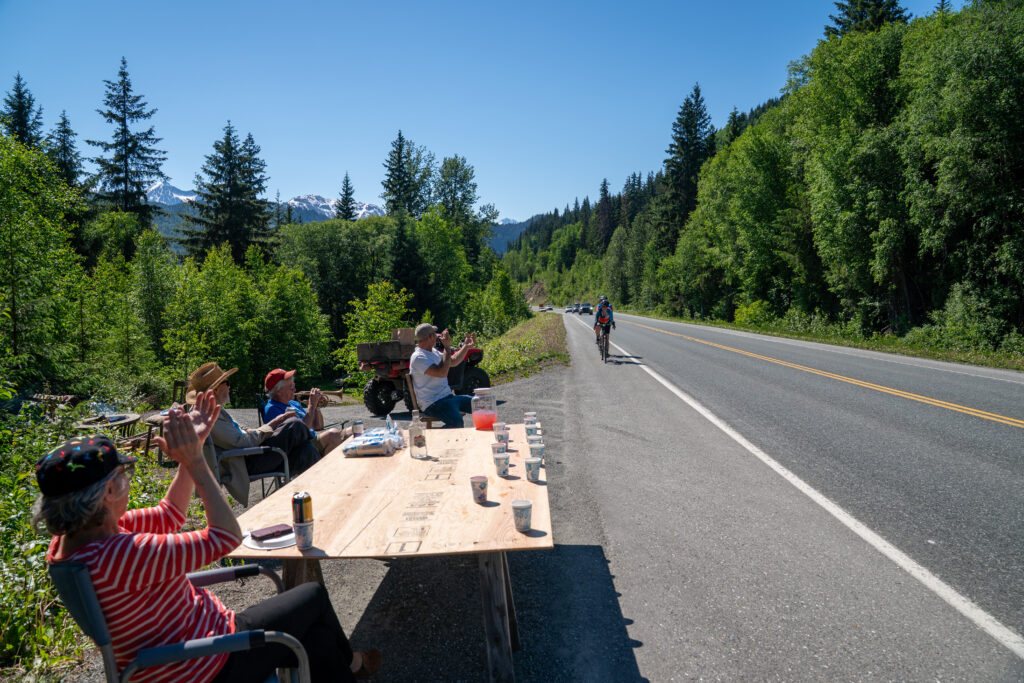
Debra Schnabel, Tom Binder, Tom Morphet and Nicholas Bishop cheer on cyclists at their hydration station during the Kluane Chilkat International Bike Relay on June 20, 2026 in Haines, Alaska. (Lizzy Hahn/ Chilkat Valley News)
Tom Binder’s driveway acted as a lemonade stand for cyclists going by on Saturday. He along with Nicholas Bishop, mayor Tom Morphet and Debra Schnabel got their camping chairs out and sat along the highway with a plywood table filled with paper cups of lemonade. They offered those who stopped canned vodka lemonade. There was also a bottle of vodka sitting on the table next to the lemonade cups, in case riders wanted an added kick to their drink.
Whitehorse local Vincent Menard said that he, his sister, Orlina Menard, and the rest of their family have been doing the race since he was in 2nd grade. The first time they did it, the siblings rode tandem bikes with their parents. They have since moved on to being a part of an eight person team and tested out a four person team this year. “We’re getting older and wanted to try a little harder.” Menard said his parents came along to view the team, named “Dodging Potholes,” but decided to turn around before the border, while the siblings kept going to the finish line in Haines. “We’re just supporting the bike environment and the culture, not the country.”
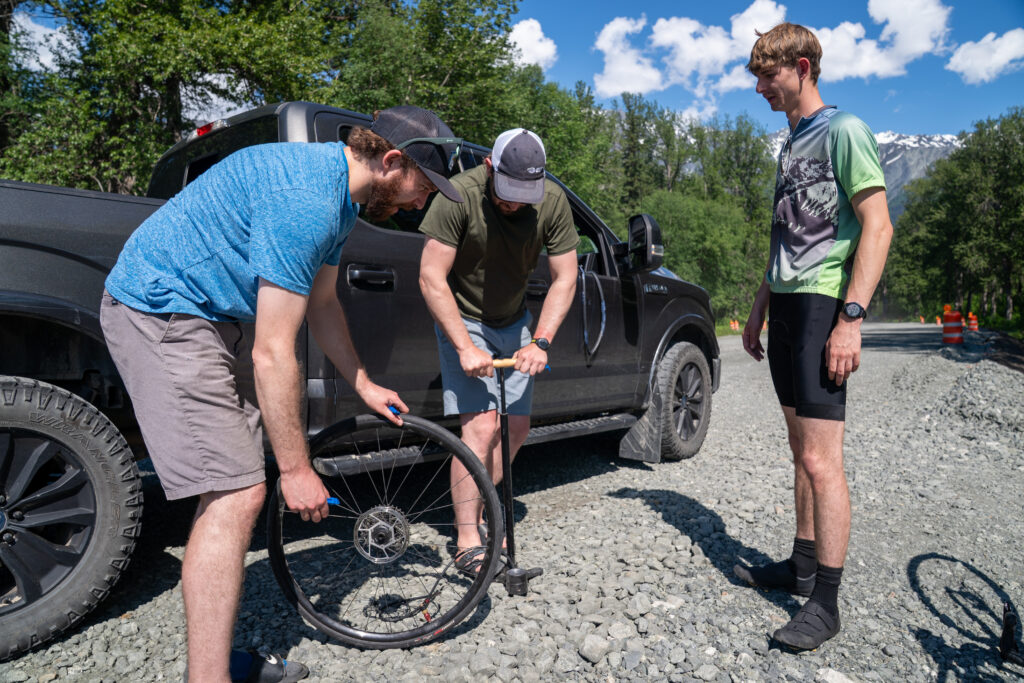
Four person relay members from Whitehorse, Craig Flaherty, left, and Jonathan Lowey help Darin Tingey of Juneau fix his flat during the Kluane Chilkat International Bike Relay on June 20, 2026 in Haines, Alaska. (Lizzy Hahn/ Chilkat Valley News)
Whitehorse cyclists Craig Flaherty and Jonathan Lowey were driving their team’s support car when they came across Juneau cyclist Darin Tingey stuck on the side of the Haines Highway. Tingey got a flat tire about a half a mile after the construction zone started. Road cycling tires are not built to handle the amount of gravel that cyclists faced towards the end of their race. The duo from Whitehorse had a spare tube that they helped put into Tingey’s tire. Tingey was competing in the two person men’s category with his father Brent Tingey.
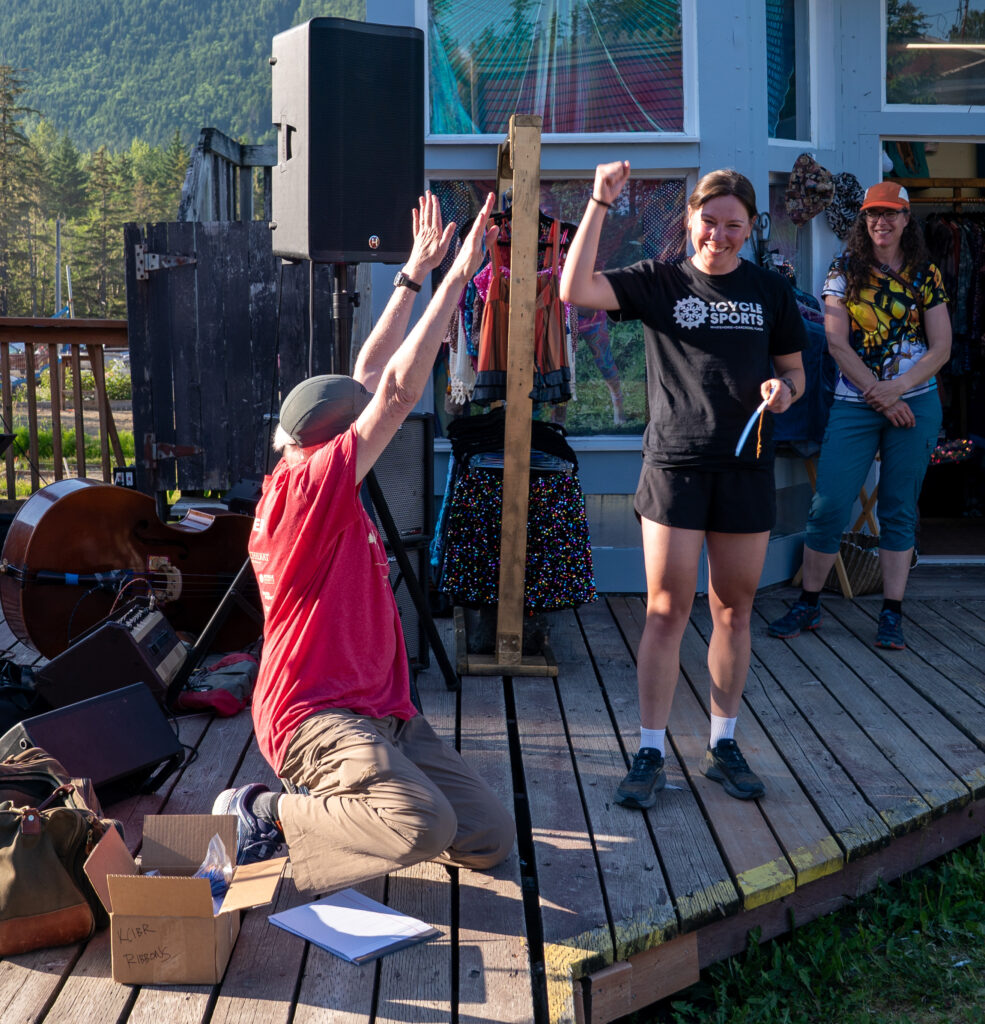
Alisha Falberg and Adam Moser recieve their first place ribbon in the two person mixed cateogry of the Kluane Chilkat International Bike Relay on June 20, 2026 in Haines, Alaska. (Lizzy Hahn/ Chilkat Valley News)
Winners of the two person mixed relay, Alisha Falberg and husband Adam Moser averaged 20.1 miles per hour. The duo from Juneau has completed the race five times. “On a day like today, it [KCIBR] is the place to be. There is no other place in the world we’d rather be,” Moser said. He and Falberg are avid cyclists in Juneau and train rain or shine. Moser rode the first four legs from Haines Junction to Mansfield Creek, with Falberg riding the last four legs from there until Haines. Moser said he did not feel much of a headwind this year, which was an advantage speedwise. The duo received second and third place in this category in years prior but say this race felt a bit easier because of the “impeccable conditions.” Falberg said the conditions one year were so bad that she had two layers on her upper body, a headband, full tights, shoe covers and full finger gloves. Falberg and Moser hope to be back to race again sometime in the near future.
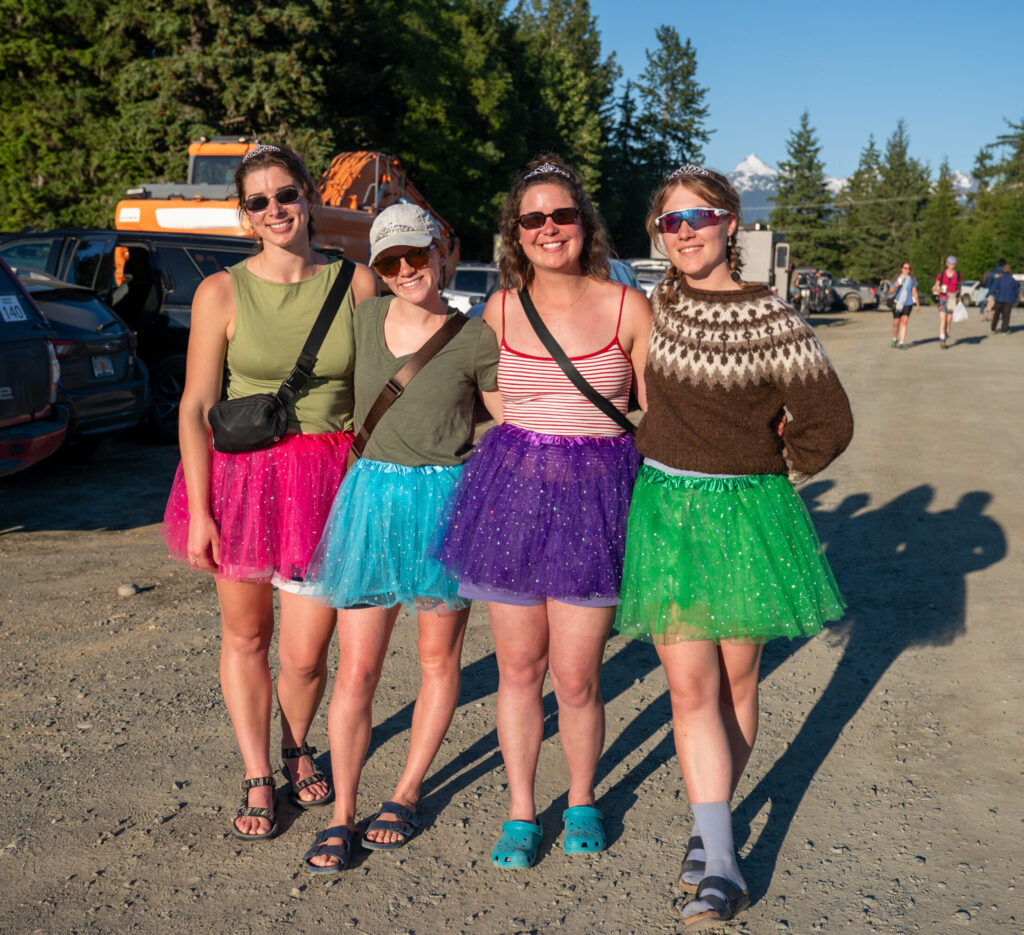
Teammates Lauren Keryluke, Alanna Stobbe, Erica Friesen and Tyra Bretten donned tutus and tiaras for their four person women’s relay team in the Kluane Chilkat International Bike Relay on June 20, 2026 in Haines, Alaska. (Lizzy Hahn/ Chilkat Valley News)
Dressed to the nines in tutus with tiaras on their helmets, the Canadian four person women’s relay team “Islanders” said they hope to make this race a yearly occurrence. Lauren Keryluke, from Whitehorse, organized the group’s costume, allowing each member to be decked out in a sparkly tutu while they rode. Alanna Stobbe, Erica Friesen and Tyra Bretten said they were leisurely racing. Bretten said she hopes to dress up in a tutu in future races. Keryluke rode the leg through the construction on the Haines Highway, an area where she said she “ate a lot of gravel, lot of dust,” but ended up passing a lot of people because she was on a gravel bike. The entire team rode gravel bikes over road bikes because of the road conditions in Canada, where all the members live. Earlier in the race, the team came across a rider with a flat tire and assisted him, “the rescuers with the tutus,” as Friesen explained.
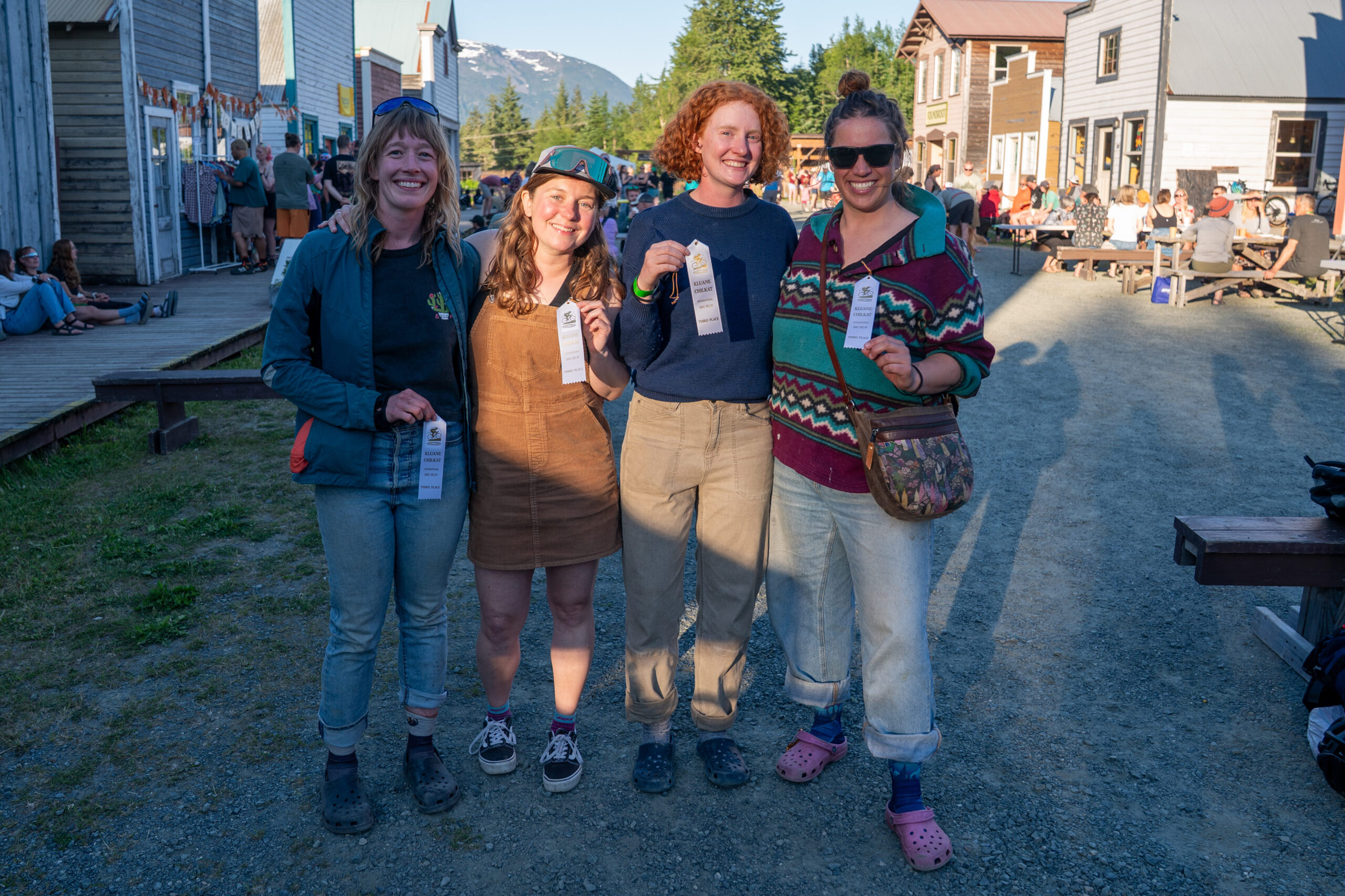
Hilary Lefort, Jennifer Gibson, Harriet Stanford and Aly Miller hold their ribbons after finishing third in the four person women’s relay of the Kluane Chilkat International Bike Relay on June 20, 2026 in Haines, Alaska. (Lizzy Hahn/ Chilkat Valley News)
Team captain Jennifer Gibson gave the team a mission before the race started: have fun. The group said they not only completed their mission but also exceeded expectations. The team, all from Whitehorse, was named “Ghost Riders” and received third place in the four person women’s relay. This was Harriet Stanford and Jennifer Gibson’s second time competing in the race. Hilary Lefort and Aly Miller joined the duo for their first ever KCIBR race. “A lot of training happened today,” said Lefort after completing her longest ride. Miller is new to road biking, having just completed her second month of road biking. Now that the race is over, the group talked about all riding the race solo, but riding together as a group.
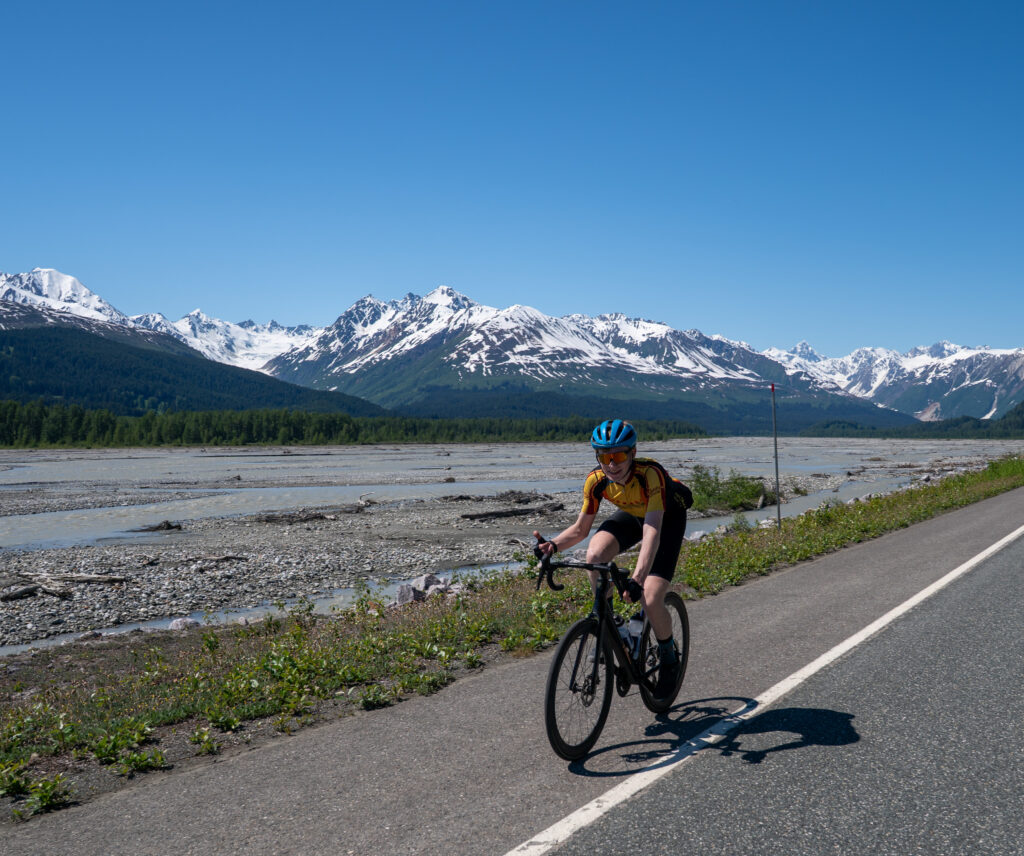
Third place solo finisher Matteo Kuizenga bikes along the Klehini River during the Kluane Chilkat International Bike Relay on June 20, 2026 in Haines, Alaska. (Lizzy Hahn/ Chilkat Valley News)
Third place finisher in the men’s solo category was 21-year-old Matteo Kuizenga. This was the Fairbanks rider’s first time racing the KCIBR as well as his first time being in Canada. Kuizenga first got the race on his radar in April while looking at races to compete in this summer. He learned about the race from fellow Fairbanks biker, Tyson Flaharty, who has won the race multiple times. Fires in the Interior of Alaska impact cyclists ability to train. Kuizenga said that this race is great timing because he was able to train consistently before the fires and smoke start. Kuizenga works 30 hours a week at the Alaska Center for Energy and Power, and tries to bike around 10 to 14 hours a week. While he does not have a coach, he gets advice from fellow cyclists. To train for the race, Kuizenga focused on duration and getting a lot of time in the bike saddle. His longest ride before the KCIBR was a 115 mile ride from Fairbanks to Nenana and back. He said he is still figuring out the best training methods. Kuizenga has done other long races, like the White Mountains 100 and the Triple Dome Classic which consists of 15 hours straight of biking, but this was his longest race distance wise. This was the first road race that Kuizenga has ever done, with most of his experience being in fat bike races. Second place finisher Tyson Flaharty and Kuizenga bike together in Fairbanks and stuck together for most of this year’s race. After Hudson Lucier’s attack at Million Dollar Falls, Kuizenga said he and Flaharty followed cruising down the descent at around 50 miles per hour. The three cyclists split on the Haines Summit descent, which led to what Kuizenga described as “basically what my worst nightmare was going in,” – a two hour solo time trial. For the rest of his race, Kuizenga worked on holding out his lead ahead of Whitehorse racers Simon Connell and Jonah McConnell. He said this was tricky because of the headwind. The duo behind him had the advantage of drafting off of each other. The night after he finished the race, Kuizenga said he spent around two hours going through the Strava data of everyone who he raced with. He wanted to figure out what the gaps were and where he gained or lost time during the race. The physically hardest part of the race for Kuizenga occurred on the Million Dollar Falls climb, but the hardest part mentally came with the last two hours of the race, while he was “leaving it all on the table.” However, he said he still felt strong, seven hours in going up the finish climb.
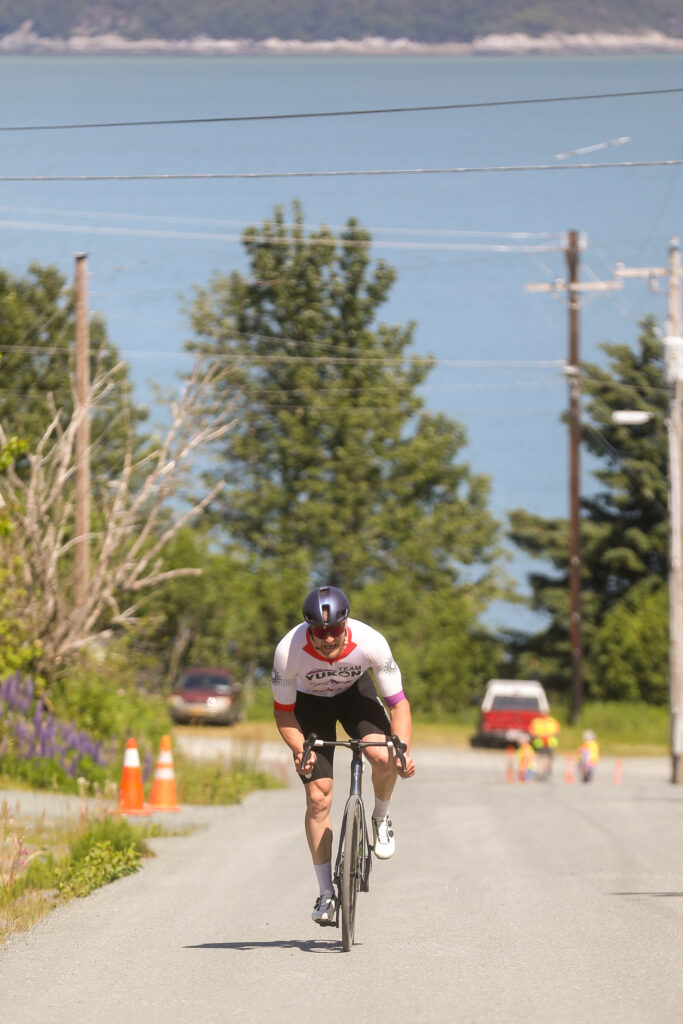
Hudson Lucier, the fastest solo racer in the Kluane Chilkat International Bike Relay makes his way up the final hill toward the finish line on Saturday, June 20, 2026, in Haines, Alaska. Lucier, of Whitehorse, was the first to cross the finish line and completed the nearly 150 mile race in 6 hours 34 minutes and 31 seconds.
In the week leading up to the race, Hudson Lucier was worried that the race would be quite rainy after it was raining every day in Whitehorse. This year’s men’s solo race winner did not see any rain on his ride, however did face some wind around 25 to 20 kilometers from the finish line. Lucier won solo last year, making this his second solo win. Lucier said that his race was faster by about 10 minutes over last year’s race, even with the gravel section that had larger rocks compared to last year’s gravel. “There was some extra body degradation that happened because it’s just so rough,” Lucier said. However, he was able to get through the construction zone without getting a flat. Lucier explained that the race typically plays out the same year after year, with racers starting out hard going up the Haines Junction hill and then sticking together until the Million Dollar Falls climb. On this climb, the peloton broke down into five solo riders and three two person riders. Lucier made his move and attacked on the Guardsmen climb and was able to get a two minute lead to the border. “This year it was all just about building/ maintaining the lead.” He said that this is not his preferred strategy, however with the finish on the climb, he did not want to gamble with coming up to the finish line with other people. Breaking away from Tyson Flaharty and Matteo Kuizenga simplified the finish for Lucier. Lucier is the head coach of the Cycling Association of Yukon. Last year’s Canada summer games led to an uptick in people interested in racing. Lucier said that their program saw an increase in participants with 24 people under 19 signing up for the race program. He said this was more than the Yukon ever had in a cycling program. Lucier’s athletes will be going to Saint George, Quebec after the KCIBR for Canadian Road Championships which goes from June 25 to 28. For many Yukoners like himself, Lucier said that the KCIBR is the goal race for the year. For athletes going to nationals, the race acts as their last big training ride that they do. Coming from the Yukon, Lucier said that they don’t have a ton of practice riding in the heat. This year’s heat impacted his last 40 kilometers, with his feet starting to hurt quite badly. “Ensuring that you’re eating and drinking enough is super key,” Lucier said about biking in the heat. Lucier estimated that around nine of his racers from the under 19 and under 17 categories raced the KCIBR solo. He said it won’t take long until those racers start fighting for the win as well. “Theres been a huge surge in the last two years of people interested in racing their bike,” Lucier said about the Yukon cycling environment.
Winner of the Kluane Chilkat International Bike Relay solo women’s category Heather Clarke celebrates her win on June 20, 2026 in Haines, Alaska. (Lizzy Hahn/ Chilkat Valley News)
Growing up in Whitehorse, Heather Clarke participated in the eight, four and two person race relays. For the past four years, Clarke has won the KCIBR solo women’s race. Clarke was not sure how many times she has completed the KCIBR total over the years. “It’s just one of my favorite events, I love it,” Clarke said after completing her fifth solo race. Clarke said the weather the past few years has been amazing, with “pretty good” winds during this year’s race. She said that the first three legs had a huge group of strong riders. Throughout the ride, Clarke was managing both the heat, swiping salt off her face after the finish, as well as her nutrition. Looking at her strategy over the past few years, Clarke said she tries to stay at the front of the group and hang on as long as she can. This year, her chain dropped right when the first move occurred, which resulted in her being dropped from the first group. With around 40 kilometers to go before the finish, Clarke got into a good group. This was when her dad came up and said that they were on track for the record. “So I looked at her and said, ‘Let’s go.’” Before the race started, Clarke explained how the border crossing worked to another solo women’s rider, Rachel Canning, who was racing the KCIBR for the first time. “People wait [at the border] because there’s always a headwind coming into Haines and you just want people to ride with,” Clarke said. Biking through the construction on the Haines Highway, Clarke said they saw a lot of casualties with some people getting flat tires on their front and rear tires. Clarke, however, made it through with no flat tires, but was waiting for them to go while biking through the five mile section. She explained that this is one of her favorite races, because of the community, amazing scenery and how hard it is. “I love the challenge of it. It is a truly hard race and you’re really out there.”
“I also think there’s a huge uptaking, like the solo women, which I’ve been trying to build and bring people.” She said that when she did the race four years ago, she was fully on her own with the solo men’s racers. This year, she said the turnout for the women’s solo race increased greatly. “It makes me so excited that all these strong women are taking on this really challenging event,” Clarke said. “It takes a village for sure, and everyone lives it.”
Thus far, we think it’s safe to say that the highly anticipated America 250 celebrations have not been the nationwide unifying event that our leaders had promised.
First, a UFC fighter used his moment on the mic to allege that Michelle Obama is secretly a man. Nothing says unity like disparaging a former first lady on a national stage!
Alexis Wilkins attends the Los Angeles Premiere of “Reagan” at TCL Chinese Theatre on August 20, 2024 in Hollywood, California. (Photo by Amy Sussman/Getty Images)
And now we have the situation that played out at the Great American State Fair on Wednesday.
As you may recall, everyone from Martina McBride to Milli Vanilli canceled on the event, leaving organizers to rely on the talents of … Vanilla Ice and Kash Patel’s girlfriend.
It’s hard to crack jokes at a time when everything sounds like a joke, so rest assured that that is not our attempt at humor:
The man who brought us “Ice, Ice Baby” and Alexis Wilkins, who is dating the current FBI director, were indeed tapped to perform.
To be fair, Alexis is a singer by trade. But she has about 5,000 monthly Spotify listeners, so she’s about as popular as your nephew’s screamo band.
For obvious reasons, lots of people jumped to the conclusion that she only landed the State Fair gig because of her connection to Patel.
And Alexis’ performance didn’t do much to dissuade them from that notion.
“She sounds like A DEAD CAT!!!!!” wrote one user (via Radar Online).
“Hello, D.C. police. I’d like to report a murder,” another added.
“Yes, someone has viciously murdered the national anthem,” a third chimed in.
“Wasn’t Milli Vanilli available?” a fourth asked.
Listing any further criticism would feel like overkill at this point, but — eh, what the hell? Here’s a few more burns for good measure”
“I think we’ve discovered the vocal equivalent of a bowl of potato salad with raisins in it,” another person tagged in.
“It’s got the energy of a senior who forced her way into the freshman talent show because she couldn’t get into choir even though she auditioned every year,” yet another added.
“This is the best we can do for America’s 250 birthday kickoff? What an absolute joke,” yet another chimed in.
Hey, she’s no Milli Vanilli, but Alexis clearly did her best. She hasn’t publicly responded to the criticism yet, but you can be sure that Kash is gearing up to do some ranting and raving on her behalf.
The 2026 World Cup has been thrilling, but the national dishes of tournament teams are just as tantalizing. From stews to skewered fish, we listed them all.
LOS ANGELES — Drew Allar might be new to the NFL, but his first professional home provides him with some familiarity. Allar will get to back up Aaron Rodgers, a quarterback he looked up to growing up. But he’s also joining an offensive system that he already knows with the Pittsburgh Steelers, believing the team that selected him in the third round of April’s draft has created a “full circle moment” for him. “The West Coast offense in general was something I studied a lot in the offseasons at Penn State,” Allar told me during a conversation this offseason at the NFLPA Rookie Premiere. “Kind of the newer versions like the [Los Angeles Rams head coach Sean] McVay and [San Francisco 49ers head coach] Mike Shanahan. I was on that trend for the last four years. “But it’s now kind of a full circle moment for me, going back and seeing how everything really started. Why the drops are a certain way and how they match up with the progressions. And where the concepts originated from. It’s really cool to be a part of that. It’s a lot of information, but it’s starting to slow down for me.” And, as Allar mentioned, he will now get to learn from one of the innovators of the West Coast offense: Mike McCarthy. The new Steelers head coach learned from the originators of the scheme during his time as an assistant coach with the Kansas City Chiefs, including Paul Hackett. Hackett cut his teeth in San Francisco, learning from Bill Walsh, the originator of the West Coast offense. McCarthy would go on to coach Joe Montana in Kansas City before coaching Brett Favre and Rodgers with the Green Bay Packers. He also worked under another Walsh protégé, offensive guru Mike Holmgren. McCarthy has been reunited with Rodgers in Pittsburgh, and Allar said he’s privileged to share a quarterback room with the future Hall of Famer. “I’m really excited to learn from him,” Allar told me. “With him being in Coach McCarthy’s system in Green Bay, it’s beneficial because he knows the system inside and out, even though he hasn’t played in it in five or six years at this point. And just everything he’s going through in his career, playing in tens of thousands of snaps, how much experience and knowledge he has — the nuances of playing the position of quarterback, reading coverages, the defensive tendencies — any little thing I can pick up to help me process faster and be more accurate, I’m all in for it.” Allar didn’t always play quarterback. His father, Kevin, was Allar’s youth football coach, and as one of the bigger kids on the team, Allar was relegated to playing tight end, fullback, defensive end and linebacker during his early days of tackle football. But the chance to play quarterback full-time emerged in Allar’s first year in high school. “We didn’t have a quarterback my freshman year, and then I always loved throwing from baseball, so I just wanted to try it out,” Allar told me. Allar blossomed into a five-star college recruit at Medina High School, a half hour south of Cleveland. During his senior season, Allar totaled 4,444 passing yards and 48 passing touchdowns. He also recorded 406 rushing yards and nine rushing touchdowns. Allar helped to lead Medina to a 13-1 record, earning All-State honors. Allar was also named Mr. Football in Ohio. “High school was fun,” Allar told me. “We were five wide and just throwing the ball every time. We were kind of a no-huddle, up-tempo offense. When we got to my senior year, [head coach Larry Laird] was very lenient with me. I probably called like 20 to 30% of the plays at the line of scrimmage my senior year. And that was always in working collaboration with him.” Considered a first-round pick at the start of the year, Allar didn’t perform as expected and his final season at Penn State was cut short because of an ankle injury. At 6-foot-5 and 228 pounds and blessed with good movement skills, Allar showed glimpses of developing into an NFL-caliber quarterback, but remains a work in progress in the pros. It will be up to McCarthy and an experienced offensive coaching staff led by offensive coordinator Brian Angelichio and quarterbacks coach Tom Arth to develop Allar’s unique skill set. “I believe in first impressions,” McCarthy said about Allar in Pittsburgh’s post-draft press conference with reporters. I had a chance to not only watch him play but meet him at the combine. … I like everything about him. I think he’s got room for growth. He’s a young man that can throw the ball with the best of them, and that’s a great starting point to have.” That’s high praise from McCarthy, but an opinion not necessarily shared by an NFL quarterback evaluator I spoke with about Allar. “I think it was a little bit of a surprise pick in the third round, given his production in college,” the NFL talent evaluator told me. “He’s got all the physical tools. He’s kind of like a create-a-player in Madden. He’s 6-5 and 230. He can throw the ball a mile. He’s got a very pretty spiral. He’s a guy that scouts absolutely love, but I think the disconnect is you’ve got to become someone who coaches absolutely love in terms of decision-making, timing and accuracy. “I would say he’s a project. In my opinion, he’s got a long way to go. They’re investing in him as a guy that two years from now could have major upside. He’s got the prettiest deep ball on the planet, but I think most coaches would tell you, ‘Yeah, that’s great, but it’s second-and-10, and you overthrew the guy by five yards.’” For the past year, Allar’s worked with John Beck and 3DQB here in Southern California during the offseason to prepare him for the league. Beck also worked with another former McCarthy quarterback in Dak Prescott. Allar said Beck helped to improve his footwork, getting him in better throwing positions. Currently, Allar is No. 4 on the depth chart behind Rodgers, Mason Rudolph and Will Howard, who the Steelers took in the sixth round of last year’s draft. But he’s willing to be patient, work on his craft and try to live up to lofty expectations, playing behind one of the best to ever do it in Rodgers. “It’s really just taking it a day at a time,” Allar told me. “They do a great job of building it out throughout practice with the quarterback in individual drills. They do a great job of emphasizing things throughout each day, just so I can get that foundation, because the footwork is a little different than what I’m used to. “We were under center a little bit at Penn State, but not in the drop-back game. It was more run game and play-action game. So, just getting cleaner with under-center drops and drop-back footwork. And just really trying to pick up on the nuances of it. Just some different teaching, and it’s really cool to be a part of that. And kind of have another chapter to learn from and grow from. I already feel a lot more comfortable in it, and I know I’ve just got to keep my head down and keep working at it.”Latest Sports News from FOX Sports
The company that owns Opry Entertainment Group — which is behind the Grand Ole Opry, the Ryman and at least two major stars’ bars — is considering selling its majority stake in the company. Continue reading…The Boot – Country Music News, Music Videos and Songs