Categories
Sports Fox

Cristiano Ronaldo Wins First Major Trophy In 5 Years With Saudi Pro League Title

Cristiano Ronaldo’s brace in Al Nassr’s 4-1 victory over Damac on Thursday earned the Portuguese star his first Saudi Pro League title since making the move to the club in January 2023. Ronaldo has now won top-flight domestic league titles in four different countries across two continents: England, Spain, Italy and Saudi Arabia. The triumph marks the eighth league title of his legendary career. Al Nassr Hold Off Al Hilal In Title Race The title did not come easily for Al Nassr, as the race came down to the final day. Rivals Al Hilal finished just two points behind them in second place, but Al Nassr held on to secure their first league title since 2019. The club finished third last season and second the year before. Final-Day Drama Against Damac Al Nassr took the lead in the 34th minute through a Sadio Mané header from a João Félix corner. They doubled their advantage in the 52nd minute through a moment of quality from Kingsley Coman. Damac were handed a penalty in the 58th minute, and Morlaye Sylla converted from the spot to cut the deficit in half. Ronaldo restored Al Nassr’s two-goal lead just five minutes later with a brilliant free kick to make it 3-1. He then doubled his goal tally in the 81st minute, taking advantage of Damac’s failure to clear their lines before smashing the ball into the top corner to seal a 4-1 victory and the title for Al Nassr. World Cup Remains The Final Prize Ronaldo has won almost everything there is to win across multiple countries, but one trophy still continues to evade him: the World Cup. This summer, he will have another chance to chase that final piece of silverware with Portugal.​Latest Sports News from FOX Sports

Categories
Alaska News

Alaska Legislature adjourns regular session with special gasline session set for Thursday

An Alaska Legislature defined by its conflicts with Gov. Mike Dunleavy came to an end at 9:43 p.m. Wednesday night as legislators officially adjourned their second regular session.

Lawmakers will return to work Thursday as they open a special session focused on the planned trans-Alaska natural gas pipeline. As with other topics, the Legislature and the governor appear far apart on the issue. 

“I would say farewell, except I get to see you at 10 a.m.,” said Speaker of the House Bryce Edgmon, I-Dillingham, shortly before final adjournment.

Before adjourning, the 34th Alaska State Legislature passed a large, multi-part crime bill that raises the state’s age of consent and criminalizes the act of using AI to create child sexual abuse material. Lawmakers voted to ban foam food containers, named the giant cabbage the state vegetable, approved a fast lane through airport security and passed dozens of small bills that were priorities for local communities and individuals across Alaska.

Bills that fail to pass before adjournment die and must be reintroduced at the start of the next Legislature. Among this year’s casualties were a proposal to offer paid leave for new parents, a bill to stabilize public school budgets, a right-to-repair bill, and all of the proposed constitutional amendments.  

This fall is an election year and many incumbents are retiring, which means that when lawmakers return next year, the House and Senate will include many new faces. They also will work with a new governor: Because of term limits, Dunleavy may not run for re-election.

The Alaska Legislature is the only one in the United States controlled by multipartisan coalitions in both the House and Senate. 

“The Senate majority and the House majority have worked extremely well together. We’ve been on the same page through this entire two years,” said Senate President Gary Stevens, R-Kodiak.

Senate President Gary Stevens, R-Kodiak, Sens. Cathy Giessel, R-Anchorage, and Bill Wielechowski, D-Anchorage are seen at a news conference after the Senate adjourned on May 20, 2026. (Photo by Corinne Smith/Alaska Beacon)

In their two-year term, the 34th Legislature passed 111 bills, on par with the 33rd Legislature, which passed 101 bills, and the 32nd Legislature, which passed 112.

Of the 111 bills passed by the 34th Legislature, Dunleavy has vetoed 12, including one he vetoed less than three hours before lawmakers adjourned on Wednesday. 

Dunleavy is vetoing bills at a higher rate than any governor since statehood. Though other governors have issued more vetoes, Dunleavy’s represent a higher proportion of the number of bills passed through the Capitol.

At the start of the 34th Legislature, the House and Senate majority coalitions set education funding as their top priority. 

Last year, they voted to permanently increase the core of the state’s public school funding formula, putting themselves at odds with the governor and setting up a historic set of veto override votes with the help of some Republicans from the House and Senate minority caucuses.

This year, the majorities passed a significantly less ambitious package of education policy reforms but also approved $144 million in one-time bonus payments to public schools and millions more in funding for maintenance and construction projects across the state. Some of the bonus payments are contingent on oil prices remaining high through July 1. 

Rep. Andy Josephson, D-Anchorage, thanks his staff and colleagues in remarks on the House floor acknowledging he will retire from the Legislature this year and not seek reelection on May 20, 2026. (Photo by Corinne Smith/Alaska Beacon)

They were less successful with other stated priorities, including pension legislation. Alaska has been without a public pension program since 2006, and the 34th Legislature was the first since then to pass a bill creating a new pension plan.

Dunleavy vetoed that bill on Monday and lawmakers failed to override it on Tuesday.

The governor’s veto came after legislators failed to reach agreement with him on one of their other stated priorities, energy. 

Dunleavy has urged lawmakers to cut the state’s petroleum property tax in order to incentivize  the proposed trans-Alaska natural gas pipeline. Building the pipeline, the governor has said, is critical for lowering energy prices and improving the state’s economy.

Many legislators are skeptical of those claims.

This week, Dunleavy and House Majority Leader Chuck Kopp, R-Anchorage, had negotiated a deal in which the governor would allow the pension bill to become law if legislators approved a gas pipeline bill that aligned with his vision. 

When the pipeline bill failed to materialize on Monday, the governor vetoed the pension bill.

The Senate Majority also prioritized elections reform and passed a bill on the topic earlier this year, but Dunleavy vetoed it. 

Legislators fell two votes short of an override because two Republican supporters flip-flopped and voted to sustain the governor’s choice. They had previously voted in favor of the bill.

“We passed the bills, and that’s all we can really get. It’s out of our hands at that point,” said Senate Majority Leader Bill Wielechowski, D-Anchorage.

The House Majority’s fourth priority was balancing the state’s budget, and while lawmakers successfully did so this year, the budget was balanced on the back of high oil prices caused by the Iran war, not because of a particular legislative action.

“In the beginning, we were worried about just keeping the (Permanent Fund dividend) alive and getting a balanced budget,” said Sen. Bert Stedman, R-Sitka, “and talking about how long our (Constitutional Budget Reserve) is going to last. Then, within a period of a couple of months, things totally changed, and the revenue forecast jumped up.”

When oil prices recede, legislators expect the state will again face major budget deficits.

“Next year will be a very, very difficult session,” Wielechowski said.

In the meantime, the state treasury is reaping wartime rewards, and lawmakers were able to balance the budget without spending from savings. 

They passed a multibillion-dollar state spending plan spread across four budget bills: $2.5 billion in construction and renovation projects$13.9 billion for services$450 million in retroactive budget changes, and a $1,000 Permanent Fund dividend bolstered by a $200 one-time energy relief bonus payment.

“Folks, this is what we accomplished, and we accomplished it on time and under budget,” said Rep. Andy Josephson, D-Anchorage, as he presented the final version of the operating budget bill on the House floor.

Members of the Republican House minority criticized the adopted budget for not spending more wartime oil revenue on the dividend. 

“My primary objection to this budget is that in FY26, the state is absolutely swimming in money,” said Rep. Will Stapp, R-Fairbanks.

“We should have waterfalled that extra money into the Permanent Fund dividend,” he said.

Both the operating budget and the capital budget are subject to the governor’s line-item veto powers. The governor can eliminate or reduce individual items, but he cannot add or increase them.

Kopp gave the majority coalition a “B” for its performance. Senate President Gary Stevens, R-Kodiak, thought the majority coalition there warranted an “A,” while Senate Minority Leader Mike Cronk, R-Tok, thought the Legislature overall merited a “B”. 

The last day of the session saw several lawmakers offer their goodbyes, including some who had not previously announced their retirement. 

“I am not planning on being back here for the 35th Alaska Legislature,” said Rep. Dan Saddler, R-Eagle River. Saddler has served for 12 nonconsecutive years in the House.

Rep. Dan Saddler, R-Eagle River, tears up after an emotional speech announcing his retirement from the Legislature, declining to run for re-election, on the House floor at the conclusion of the 34th Legislature on May 20, 2026. (Photo by Corinne Smith/Alaska Beacon)
Rep. Dan Saddler, R-Eagle River, tears up after an emotional speech announcing his retirement from the Legislature and declining to run for re-election, on the House floor at the conclusion of the 34th Legislature on May 20, 2026. (Photo by Corinne Smith/Alaska Beacon)

Rep. Andy Josephson, D-Anchorage, is retiring after 14 years in the House and received multiple rounds of applause. Rep. Louise Stutes, R-Kodiak, is leaving the House as well, but for a state Senate run rather than retirement.

Speaker of the House Bryce Edgmon, I-Dillingham, has not announced plans to leave the House, but he has been repeatedly named as a possible replacement for Sen. Lyman Hoffman, D-Bethel. Hoffman is retiring as the longest-serving state legislator in Alaska history.

Senate President Gary Stevens, R-Kodiak and the oldest member of the Legislature, is also retiring. The Legislature’s youngest member is also leaving — Rep. David Nelson, R-Anchorage, is getting married this summer. 

After the final gavel fell, staff and legislators cheered and filed out of the chambers. 

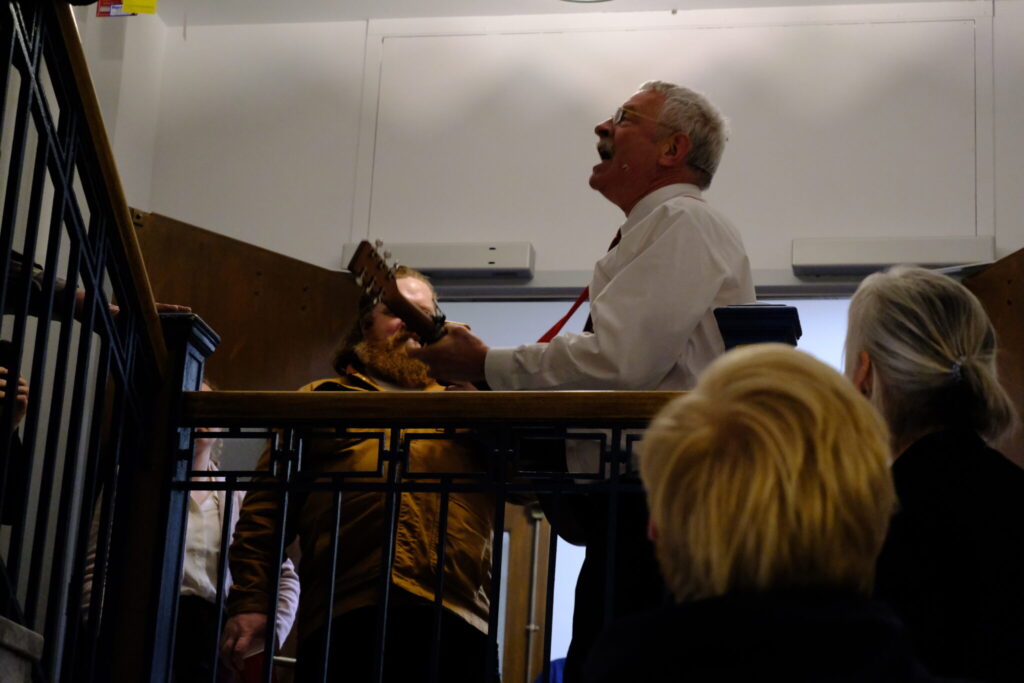
Within an hour, Saddler was leading a group of them in songs that echoed up and down the Capitol’s stairwell.

Corinne Smith contributed reporting from Juneau.

Rep. Dan Saddler, R-Eagle River, serenades legislators and staff in the Capitol stairwell shortly after the 34th Legislature adjourned on May 20, 2026. (Courtesy/Corinne Smith, Alaska Beacon)

The post Alaska Legislature adjourns regular session with special gasline session set for Thursday appeared first on Chilkat Valley News.

Categories
Music

NASCAR Driver Kyle Busch Dead at 41

NASCAR driver Kyle Busch died on Thursday (May 21) after a short hospitalization that followed a severe illness. Continue reading…​The Boot – Country Music News, Music Videos and Songs

Categories
Music

NASCAR Driver Kyle Busch Dead at 41

NASCAR driver Kyle Busch died on Thursday (May 21) after a short hospitalization that followed a severe illness. Continue reading…​Country Music News – Taste of Country

Categories
Entertainment

4 Ordering Tips To Get The Best Whataburger Burger

If you never experiment with Whataburger’s beefy handhelds, then every order becomes a missed opportunity. Here are four tasty ways to seize the day!

​Mashed – Fast Food, Celebrity Chefs, Grocery, Reviews

Categories
Music

Blake Shelton ‘Having a Blast’ in Vegas as He Looks Ahead to First Time Seeing Gwen Stefani with No Doubt at Sphere [Exclusive]

Blake Shelton says he’s “having a blast” during his Live In Las Vegas residency at The Colosseum at Caesars Palace, which is nearing its end with just two shows remaining. Just down the Las Vegas Strip, his wife, Gwen Stefani, is taking the stage at Sphere with No Doubt through June 13.

While chatting with Country Now backstage at the ACM Awards in Las Vegas, Shelton revealed he still hasn’t had the chance to catch No Doubt’s Sphere show,  but that’s about to change.

“I still haven’t gotten to see Gwen’s show. We work on the exact same nights,” he shared.

Gwen Stefani, Blake Shelton; Photo via Instagram

Shelton explained that he’s intentionally avoided seeing anything related to the one-of-a-kind production because he wants the experience to be a complete surprise. That means no rehearsals, no photos, no videos…nothing.

“I’ve not seen a rehearsal. I haven’t seen anything. I’m finally going to get to go see her next weekend. I actually have a day off that they’re working and that’ll be my first chance. I’ve not looked at any social media. I haven’t seen any pictures. I have no clue,” he said. 

The upcoming outing will also mark Shelton’s first-ever visit to the world-famous immersive venue.

Blake Shelton; Photo by Jamie Wendt

“I’ve never even been in the Sphere. I’m really excited about this. So I’m going to take the whole show in and I can’t wait.”

Because their shows happen on the same nights, Shelton and Stefani typically reconnect each night after their respective shows. According to Shelton, Stefani leaves everything on the stage and is completely wiped out by the end of the night.

“I know that every night we’ll meet up after we’re both done performing and we’ll either go to the hotel room or go back home depending on what night of the week it is and she’s just dragging at that point,” he revealed. “I mean, I think the show’s two hours and I don’t know if you’ve ever seen Gwen Stefani in concert, but she’s the opposite of me. It’s like watching paint dry when I perform. She’s like all over the stage climbing stuff. It’s unbelievable how active she is.”

Blake Shelton; Photo by Jamie Wendt

If you’ve ever seen Shelton live, you know he’s the opposite of watching paint dry. His shows are a mix of music and comedy rolled into one, with on-stage antics that are truly unmatched. Now a seasoned Las Vegas performer, Shelton admits he is “having more fun” on his current run of Vegas shows because he feels like he’s “settled in.”

“Vegas was a little bit intimidating at first because when you hear, ‘Okay, I’m going to do a residency in Las Vegas.’ I do shows all the time…And then you land here and you start driving down the strip and it’s like, “Come here tonight to see Shania. Oh, Garth is over here and oh, the Eagles.” And you’re going, ‘Oh my gosh, wait a minute, maybe I’m not ready for this.’ Because you do kind of feel like, ‘Man, I don’t know that I’m to that level of what those guys do. I better step it up.’”

Blake Shelton; Photo by Jamie Wendt

Now, the Oklahoma native says he has a better idea of what fans are wanting from him: interaction from the stage.

“I think because I was on The Voice for so many years and in people’s living rooms two nights a week, every week for 12 years, that they feel like they know me and so that’s what I think they want from my shows is that interaction,” he explained. “So I’ve gotten to the point where probably I interact more with fans in Las Vegas than I do on any of my other concerts because I feel like that’s what they come here wanting and they want to have that one-on-one experience.”

Fans have two remaining opportunities to see Blake Shelton in Las Vegas: tonight, Thursday, May 21 and Sunday, May 24. Tickets are available HERE.

The post Blake Shelton ‘Having a Blast’ in Vegas as He Looks Ahead to First Time Seeing Gwen Stefani with No Doubt at Sphere [Exclusive] appeared first on Country Now.

​Country Now

Categories
Politics

Albany reels in ICE

Gov. Kathy Hochul and state lawmakers passed measures to limit federal immigration enforcement operations in New York.

DAYS THE BUDGET IS LATE: 51

CROWD CONTROL: State Democrats are aligned on reining in ICE — but there’s sharp disagreements over whether the measures will meaningfully impact the NYPD.

Gov. Kathy Hochul and state lawmakers passed a package of measures this afternoon that seek to curtail federal immigration enforcement agents’ operations in New York.

“Tom Homan can shove it,” Brooklyn state Sen. Andrew Gounardes said at a press conference this morning, referring to the Trump administration’s border czar.

The package aims to restrict the ability of police departments like the NYPD to control crowds while federal officers conduct immigration enforcement actions.

“If ICE or DHS ask a local police department to facilitate their operations — lock down the street, clear out traffic, cordon off an area, put up, ‘do not cross signs,’… those types of actions would no longer be allowed,” Gounardes said of the immigration package.

Also in the agreement: banning masks for federal and local law enforcement and creating a list of “sensitive locations” that ICE won’t be able to enter without a judicial warrant.

The slew of anti-ICE measures are just the latest effort by Democrats in blue states like New York to push back against the Trump administration’s aggressive immigration tactics.

But the push to prohibit local police departments from cooperating with federal immigration authorities is likely to prove messy on the ground — as evidenced by a recent fracas in Brooklyn.

A host of elected allies of Zohran Mamdani pointed fingers at the mayor and police commissioner Jessica Tisch earlier this month when the NYPD took steps to control a crowd of anti-ICE protesters who tried to obstruct federal officers that detained an undocumented man and transported him to Wyckoff Heights Medical Center.

The NYPD says officers were doing their job by responding to 911 calls about disorderly protesters — and they also say these new measures wouldn’t have had any effect on how they operated that evening in front of Wykoff. During those efforts, eight people were arrested due to scuffles with cops and attempts to block the federal officers’ exits. Videos depict a chaotic scene, with the NYPD seen throwing a protester to the ground.

But protesters say the NYPD’s efforts to control the crowd made it so the city’s cops, directly or indirectly, were supporting ICE and clearing a path for their movements.

Brooklyn state Sen. Julia Salazar, a key backer of the immigration measures, insists the new language from the state would’ve stopped the NYPD from interfering with anti-ICE protesters outside the Brooklyn hospital that day.

“Someone was quite violently taken into ICE custody by ICE agents,” Salazar said, recounting the incident. “Then they were taken to Wyckoff Heights Medical Center in Bushwick, and the police officers from the NYPD facilitated the entry and exit of those officers — which would be prohibited going forward.”

An NYPD spokesperson told Playbook the “legislation will not impact the NYPD because we do not engage in civil immigration enforcement, period.”

The actual language of the bill would bar any “informal agreement” with federal immigration authorities “under which an officer or employee may engage in or assist immigration enforcement, or otherwise may perform a function of an immigration officer.” The dispute over its actual effect prompts questions about the role of local cops to ensure order in the face of anti-ICE demonstrations, especially after similar protests turned deadly in Minnesota.

Mamdani’s spokesperson Dora Pekec said city policy already prohibits coordination between the NYPD and ICE and that “the Mayor supports this piece of legislation and has made clear that he believes ICE has no role in promoting public safety here in New York City.”

Tomorrow Mamdani will release a report – resulting from a February executive order – examining all city interactions with federal immigration enforcement efforts.

At a May 12 event hosted by the Association for a Better New York, Tisch slammed critics who said the NYPD was colluding with ICE at Wyckoff.

“NYPD officers, in the middle of the night, amid chaos outside of their control, did their job professionally and skillfully and made sure events did not spiral into a calamity,” she said. “The critics of the NYPD’s actions — those who would have us stand aside and call cops doing their jobs collusion – have lost sight of the lives at stake.”

The Wyckoff incident prompted rare public criticism of the Mamdani administration from left-leaning lawmakers who held an emergency press conference and wrote a letter decrying the NYPD’s actions that evening.

“They provided security for ICE,” City Council member Sandy Nurse, who represents the area, said of the incident.

In a statement, Hochul spokesperson Jen Goodman said the new law “would not ban local law enforcement from actions like crowd control in the interest of protecting New Yorkers.” — Jason Beeferman

FROM THE CAMPAIGN TRAIL

A Emerson College poll finds former City Comptroller Brad Lander is leading the Democratic primary against incumbent Rep. Dan Goldman.

POLL-A-PALOOZA: We’ve got the latest snapshots of the city’s most competitive primaries in a trio of surveys from Emerson College Polling for PIX 11 — rare outside polling in these races.

The biggest gap: Former City Comptroller Brad Lander, who’s challenging Rep. Dan Goldman, is leading by a whopping 34 points. The survey has Lander with 57 percent support, compared to the incumbent’s 23 percent. One in five likely Democratic primary voters are undecided.

Goldman’s campaign was quick to dispute the results: “This poll is not remotely close to an accurate read of this race,” campaign manager Simone Kanter wrote on X. “The data we’ve seen shows a dead heat after messaging.”

He went on to argue that the survey oversampled college-educated voters and young people, writing that the poll “is assuming an electorate that looks exactly like the once-in-a-generation turnout Mamdani mobilized when he was on the ballot.” (Mamdani has endorsed Lander in the race, which will be a test of the mayor’s political muscle.)

Emily Minster, a spokesperson for Lander’s campaign, said they are “taking nothing for granted.”

A recent internal poll from a pro-Goldman super PAC found the incumbent trailing Lander by 5 points. Goldman has been up on the air for weeks; Lander began advertising today.

The polls showed far tighter races in the other primaries for NY-07 and NY-12, which are being vacated by retiring Reps. Nydia Velázquez and Jerry Nadler, respectively.

In NY-07, state Assemblymember Claire Valdez has 23 percent support, followed by Brooklyn Borough President Antonio Reynoso with 21 percent. City Council member Julie Won comes in at 13 percent and public defender Vichal Kumar at 1 percent.

Valdez leads among Hispanic voters and is running about even with Won among Asian voters.

An eye-popping 43 percent of respondents are undecided — giving the campaigns a major opportunity to grow their support.

The race for NY-10 is competitive between state Assemblymembers Micah Lasher and Alex Bores, who come in at 22 percent and 20 percent, respectively. Kennedy scion Jack Schlossberg has 11 percent, while anti-Trump commentator George Conway has 10 percent and public health practitioner Nina Schwalbe has 3 percent. Around a third of respondents are undecided.

Recent surveys — nearly all of which have been internal polls — also showed a tight race, with Lasher and Bores toward the front of the pack. Earlier this year, Schlossberg had a slight lead in polls. Heavy outside spending has occurred in recent weeks in favor of Lasher, as well as groups both spending for and against Bores.

Mamdani has a strong approval rating in all three districts: 78 percent approve of him in the 7th, 79 percent in the 10th and 66 percent in the 12th.

The polls were conducted May 16-17 among likely Democratic primary voters. In the 7th, there were 350 respondents and a margin of error of plus-or-minus 5.2 percentage points. In the 10th, there were 450 respondents and a margin of error of plus-or-minus 4.6 percentage points. In the 12th, there were 425 respondents and a margin of error of plus-or-minus 4.8 percentage points. Madison Fernandez

NOT THERE: Democrats are feeling good heading into this year’s midterms. But good enough to not donate to battleground Rep. Laura Gillen?

Oath, a donor platform that measures which Democrats it would be most effective to support, shared new recommendations for which candidates should make the cut, our colleagues in D.C. reported this morning. Among those who fall into the do-not-donate category is Gillen, whose Long Island seat that she narrowly flipped in 2024 is widely considered a crucial 2026 contest for control of the House. In a memo, Oath rationalized that Gillen’s seat is “moving into safe Democratic territory” and “does not have a Republican opponent who even raised $100,000.”

However, it’s unclear how much Hempstead Receiver of Taxes Jeanine Driscoll, local Republicans’ candidate of choice, has raised. She entered the race in April — after the second fundraising quarter began — and has not filed a financial report with the Federal Election Commission. Driscoll’s primary opponent, Air Force veteran Marvin Williams, has raised close to $90,000 — most of which was self-funded.

Also adding uncertainty to upcoming elections is a pending case in the Supreme Court that could open the floodgates to massive political spending from the national parties and benefit Republicans.

“Laura Gillen is running in a fiercely competitive Frontline seat,” Democratic Congressional Campaign Committee spokesperson Riya Vashi said in a statement. “The DCCC is committed to ensuring Laura has the resources and support she needs to win this November.” Madison Fernandez

From the Capitol

New Jersey Transit is creating back up plans for increased traffic expectations during the World Cup games.

THE WHEELS ON THE BUS: The Port Authority of New York and New Jersey has spent months working with other agencies planning for “nightmare scenarios” involving waylaid trains and buses during the World Cup, its executive director said Thursday.

Those plans could come in handy given the history of heat-related problems in the region and a pair of fires that disrupted service in and out of Penn Station in the past week.

New Jersey Transit’s backup plan for waylaid trains is a fleet of buses to carry fans. But those buses also break down in the heat and will need to get through the Port Authority’s tunnels to reach MetLife Stadium where eight World Cup matches will be played. So the Port Authority is working on a backup plan for the backup plan, including freeing up lanes in the Lincoln Tunnel that normally go in one direction to go in another.

“It’s going to be July, it’s going to be hot, on any given day we have bus break downs because the engine gets too hot,” Port Authority head Kathryn Garcia told reporters following a board meeting today. “We need to be able to be very flexible.”

Port Authority Chair Kevin O’Toole said during the hottest day last week he was behind a bus that broke down in the Lincoln Tunnel. Within five minutes a tow truck was there and another bus came to pick up the passengers.

“We are going to anticipate certain breakdowns and hopefully we can do our best to accommodate the public,” he said. — Ry Rivard

FROM CITY HALL

Mayor Zohran Mamdani announced that New York City would offer 1,000 $50 tickets to World Cup matches.

NOTHING IN LIFE IS FREE: Mamdani announced a deal today to provide 1,000 World Cup tickets to New Yorkers at $50 a pop.

The mayor unveiled his discount ticket scheme this morning at a beer garden in Harlem, rattling off teams, players and moments from World Cups of yore before getting to the meat of his announcement.

“We’re so excited, frankly, because we know that there are so many New Yorkers who thought that there was no way they could afford to go to this tournament, and now there is that glimpse of an opportunity,” the mayor said.

But New Jersey Democrats were having none of it. They attacked FIFA – soccer’s global governing body – for the discounted tickets, which are only available to New York residents, even though the matches are being played in the Garden State.

“This publicity stunt does nothing to address the cost of tickets,” New Jersey Democratic Reps. Nellie Pou and Frank Pallone said in a joint statement.

New Jersey Gov. Mikie Sherrill’s spokesperson, Stephen Sigmund, said “FIFA not caring about costs for New Jersey residents isn’t new.”

FIFA said the agreement was between the local host committee and the mayor’s office, and that FIFA was only involved in ensuring the tickets went to fans who genuinely planned to attend rather than sell tickets.

New York and New Jersey officials have repeatedly sparred over how to run the upcoming tournament, despite being co-hosts. Most of that dust up to date has been over dueling bus and train services to get fans to matches. — Ry Rivard and Joe Anuta 

In Other News

SUITED UP: Mamdani’s top lawyer, Ramzi Kaseem, brings a history of suing the NYPD and defending high-profile civil liberties cases to City Hall. (The New York Times)

ICED OUT: A Manhattan parking garage removed federal vehicles after protesters alleged they were being used by immigration enforcement agents. (Gothamist)

SHEIK UP: The Mamdani administration distanced itself from the views of an Islamic leader who has cast doubts on basic facts about the Holocaust. The mayor has met with the controversial figure at least three times since January 2025. (Washington Free Beacon)

Missed this morning’s New York Playbook? We forgive you. Read it here.

​Politics

Categories
Alaska News

Alaska lawmakers approve one-time funding for K-12 schools, plus energy relief

A school bus drives by the Alaska State Capitol on Jan. 21, 2026. (Photo by James Brooks/Alaska Beacon)

A school bus drives by the Alaska State Capitol on Jan. 21, 2026. (Photo by James Brooks/Alaska Beacon)

Alaska lawmakers approved an additional $144 million in one-time funding for K-12 schools next year, plus a batch of education policy changes that garnered bipartisan support particularly aimed at boosting teacher retention and offsetting districts’ energy costs. 

The Alaska Legislature has been divided, and at odds with Gov. Mike Dunleavy, over the level of state funding for public education — even as districts across the state face significant budget deficits and declining enrollment, forcing steep cuts and school closures. 

Rep. Andi Story, D-Juneau and co-chair of the House Education Committee, acknowledged the strife of school districts and said the policy changes and one-time funding are a step in the right direction. 

“It doesn’t meet the need, but it moves the dial in the right way,” she said. 

Last year, lawmakers passed a historic increase to state funding for K-12 schools and added millions in sustained per student funding, known as the base student allocation —   but only after multiple vetoes by Dunleavy, and an equally historic veto override by the Legislature in a special session in August restoring the funding increase.

Alaska Gov. Mike Dunleavy speaks to reporters about school funding and education policy on Thursday, April 17, 2025. (Photo by James Brooks/Alaska Beacon)
Alaska Gov. Mike Dunleavy speaks to reporters on Thursday, April 17, 2025. (Photo by James Brooks/Alaska Beacon)

This year, in the second year of the 34th Legislature, lawmakers seemed to have less appetite for taking on another education funding battle with Dunleavy — particularly amid competing priorities in the Senate and House multipartisan majorities to pass elections reform and revive a state pension system. Both items were vetoed by Dunleavy. The governor has focused on pressing lawmakers to approve a property tax break for a proposed trans-Alaska gas line, and called a special session on that topic beginning on Thursday.

But Alaska schools will see some additional funding next year as the U.S. war on Iran and global oil shock has driven up state revenues from the rise in oil prices. 

In addition to the  $144 million in one-time funding in the operating budget for K-12 schools, including $29 million for offsetting rising energy costs next year, lawmakers also approved a pared-down education package. It establishes a student loan forgiveness program for teachers, an adjustment to state funding for districts in local municipalities and a plan for the state to fund school districts energy costs — beginning in 2028, and subject to future Legislatures funding it.  

“I’m thrilled,” said Story on Wednesday after the vote. She authored the underlying bill establishing the loan forgiveness program for teachers, which is aimed at recruiting and keeping young teachers in Alaska.

Rep. Andi Story, D-Juneau, speaks on the House floor on the last day of the 34th Legislature on May 20, 2026. (Photo by Corinne Smith/Alaska Beacon)

“It’s an incentive to keep continuity, keep your teachers employed, and that’s great for kids —  whenever they can have the same teacher in the building, that always makes a difference,” she said. 

If approved by the governor, the bill would establish a new student loan forgiveness program for teachers of up to $15,000 over three years. It’s focused on teachers specializing in English as a second language, special education, science, technology, engineering and math. The program is expected to serve up to 120 teachers next year.

Senators also included a provision from another bill to cap local municipalities’ contributions to school districts. The provision says the contribution may increase by no more than 4% from the previous year. The cap is intended to provide relief to boroughs with rapidly rising property assessments, which informs how much they contribute to their local schools as part of the complex funding formula with state and federal dollars. 

Sen. Jesse Bjorkman, R-Soldotna spoke in favor of the policy change, as much of the Kenai Peninsula region is seeing rising property values. “Our current law does shift significant cost from the state to local municipalities,” he said. “We accept as local municipalities that we have some skin in the game… we’re okay shifting some cost, but not so much.” 

State plans to cover K-12 schools’ rising energy costs

In addition to the $29 million lawmakers allocated for K-12 schools’ fuel costs next year, they approved a provision in the education package that would initiate the state covering school districts’ fuel costs beginning in 2028 and subject to future lawmakers approving the funding.  

Alaska districts have reported rising fuel costs in recent years to keep schools warm and facilities running, especially in rural and remote areas — estimated at $90 million statewide this year.

If approved by the governor, the state would annually reimburse districts based on the average of the past three-years of fuel costs. Districts are asked to make a reasonable effort to manage fuel use and costs, to not exceed the usage from the previous year and report how much they’re spending on fuel to the Alaska Department of Education and Early Development.

Fuel costs are expected to skyrocket this year with the onset of the U.S. war on Iran, and districts are facing bulk fuel orders in the millions. Officials with the Lower Kuskokwim School District report an 80% expected increase in fuel costs next year for its nearly two dozen village schools in Western Alaska.

Sen. Robert Yundt, R-Wasilla, speaks Tuesday, April 15, 2025, on the Senate floor. (Photo by James Brooks/Alaska Beacon)

On Wednesday, Sen. Rob Yundt, R-Wasilla, said he’s watching three schools close in his district in the Matanuska-Susitna Borough and expressed enthusiasm for the plan on the Senate floor: “I cannot tell you how excited I am. My district last year spent between $6.4 million on natural gas and electricity alone. Those have been rising every year for our community.”

“I do look forward to the day that the state pays for the energy related to all of our schools,” he said.

The bill also includes provisions for homeschooled students to keep textbooks, equipment and other supplies when they leave a school district, to allow regional resource centers to hire former teachers while keeping their defined benefit retirement benefits and to allow school board members to be hired as substitute teachers. 

It also changes the statute so that schools that are closed during school consolidation can be reopened in four years instead of seven years. 

‘Most anti-education governor in history’

This year, members of the House and Senate advanced various education bills that failed to garner bipartisan support. 

They included more targeted and ambitious funding increases with millions for energy costs, transportation, reading instruction and career and technical education programs, as well as policy changes related to tribal compacting for public schools, homeschool programs and math instruction. 

Story authored another bill to help stabilize school districts’ budgeting process by redefining the student counts that passed the House last week, but failed to advance in the Senate. “It costs $113 million and they had already put one time funding in there for districts,” she said, referring to funding in the current operating budget. “And I think there was a fear that the governor would veto that.”

Story said she plans to reintroduce the proposal if re-elected next year.

Senate President Gary Stevens, R-Kodiak, Sens. Cathy Giessel, R-Anchorage, and Bill Wielechowski, D-Anchorage are seen at a news conference after the Senate adjourned on May 20, 2026. (Photo by Corinne Smith/Alaska Beacon)

After adjournment Wednesday night, leaders with the Senate Majority caucus praised the 34th Legislature’s wins for education in a news conference, but acknowledged they were hard fought, and that districts are continuing to struggle amid budget cuts. 

“This has been probably the most anti-education governor in the history of our state,” said Sen. Bill Wielechowski, D-Anchorage, and criticized Dunleavy for repeatedly vetoing funding increases for schools. 

“It’s been an absolute battle,” he said. “So people wonder why schools are closing, because we haven’t kept pace with inflation. But part of its revenue, a huge part of its revenue, we’ve got to figure out (and) we’ve got to stabilize our revenue going forward. It’s going to be tough conversations going forward.”

SUPPORT: YOU MAKE OUR WORK POSSIBLE

Categories
Sports Fox

Crystal Palace Coach Says USA Defender Chris Richards Tears Ankle Ligaments

With just five days until the United States names its 2026 World Cup roster, the United States men’s national team has potentially dealt a massive blow. Star defender Chris Richards has suffered two torn ligaments in his ankle, Crystal Palace manager Oliver Glasner said in a press conference Thursday. Richards sustained the injury during Palace’s draw with Brentford on Sunday. The 26-year-old center back from Birmingham, Alabama, recently captained the U.S. in a friendly against Portugal under coach Mauricio Pochettino. While Glasner ruled Richards out for this weekend’s Premier League finale against Arsenal, the race is on for both club and country. Palace is desperately trying to get him fit for next Wednesday’s UEFA Conference League final against Rayo Vallecano in Leipzig, though Glasner rates his chances as a “50/50” coin flip. “He tore two ligaments in his ankle,” Glasner said. “He is in from sunrise until sunset having treatments… we will give our best and he will give his best—and then let’s see if we can get it done.” The timing could not be worse for the hosts. The Americans kick off their home World Cup campaign against Paraguay on June 12, preceded by crucial tune-ups against Senegal on May 31 and Germany on June 6. Missing Richards—who has 36 international appearances since his 2020 debut—would leave a massive void in Pochettino’s backline. 2026 FIFA World Cup: How To Watch The 2026 FIFA World Cup will run from June 11–July 19, 2026. Spread across three countries, the tournament will culminate with the final on July 19 at New York New Jersey Stadium in East Rutherford, New Jersey. All 104 tournament matches will air live across FOX (70) and FS1 (34) with every match streaming live and on-demand within both the FOX One and the FOX Sports app. A record 40 matches, more than one-third of the tournament, will air in prime time across FOX (21) and FS1 (19). The opening match on June 11 between Mexico and South Africa (3 p.m. ET) will stream for free on Tubi, as well as the USA’s opening match against Paraguay on June 12 (9 p.m. ET).​Latest Sports News from FOX Sports

Categories
Entertainment

Katie Holmes & Her Mom Make Rare Joint Appearance at ABT Gala

Katie HolmesKatie Holmes’ night out with her mom was en pointe. 
Indeed, the Dawson’s Creek alum and her mom Kathleen Holmes stepped out for a rare mother-daughter appearance at the American Ballet Theatre’s…
​E! Online (US) – Top Stories