Ella Langley gets her toughness from how she was raised. Continue reading…Country Music News – Taste of Country










Ella Langley gets her toughness from how she was raised. Continue reading…Country Music News – Taste of Country

New releases at Aldi are always exciting for shoppers, and these products released since the start of 2026 do not disappoint. Find out which are worth buying.

Mashed – Fast Food, Celebrity Chefs, Grocery, Reviews

This French sauce imparts deep savory notes to steamed, boiled, or blanched sides, transforming simple vegetables into something incredibly flavorful.

Food Republic – Restaurants, Reviews, Recipes, Cooking Tips

Texas is known for its stellar barbecue, especially its brisket, but one place in California serves up Texas-style brisket that some say is the best.

Mashed – Fast Food, Celebrity Chefs, Grocery, Reviews

A lot of Democrats are willing to sacrifice Black voting power to beat the GOP.
In the two weeks since the Supreme Court significantly narrowed a key provision of the Voting Rights Act, Republicans have kicked off a fresh round of redistricting across the South. Their aim is to dismantle majority-minority districts, which they’ve long argued are unconstitutional, and to try to keep control of the House.
New results from The POLITICO Poll show many Democrats want their party leaders to fight back hard — even if it means breaking up districts designed to protect the power of Black voters and other minority communities.
In theory, Democrats want to keep those districts intact. When given no context on the recent Supreme Court decision, a 54 percent majority of people who voted for former Vice President Kamala Harris in 2024 say it is more important to protect the voting power of Black voters and other minorities, even if it means Democrats draw fewer seats.
But that number changes significantly when the question is asked in the context of the Supreme Court ruling and Republican gerrymandering — and a 45 percent plurality instead say that Democrats must counter GOP efforts, “even if it means reducing the number of majority-minority districts.”
Taken together, the poll results reveal that Republicans’ aggressive redistricting is testing Democrats’ appetite for a maximalist posture in response — and so far, many appear willing to embrace it to win the House. They’re even willing to throw away traditional liberal principles such as boosting the electoral power of voters of color in an effort to fight fire with fire.
“Do I think you should do all of these carve outs? No. But do I think what we’ve just witnessed should have happened? No. Do I think that the Supreme Court should have come down with Callais? No,” said Rep. Sydney Kamlager-Dove (D-Calif.). “At some point you do have to stop and say, ‘This is madness, and all this is doing is unraveling democracy.’”
But Democrats’ conversations “probably will have to” involve carving up majority-minority districts, said Kamlager-Dove. “It’s existential at this point, and this is a larger battle that we’re fighting for.”
It’s a stunning admission from a Black lawmaker who represents a majority-Hispanic Los Angeles district: Defeating Republicans might be more important than protecting districts like hers.
And it’s a real possibility the party would have to deploy the tactic if it hopes to stand a chance against the most aggressive Republican gerrymandering possible. To draw House seats with the best margins for the party — especially in states like Illinois and New York — district lines would likely need to be altered in a way that packs large numbers of Black voters into red-leaning areas in order to make them bluer.
It’s not just a few Democrats switching their minds. Consider the Harris voters who initially say they would protect majority-minority districts: When asked about countering the GOP, they split roughly evenly, with 46 percent saying it’s more important to draw more blue seats and 41 percent saying the majority-minority districts should be kept together.
The survey, conducted by Public First, sheds new light on an emerging front in the gerrymandering war that has spread across the nation. At least nine states will use new maps this fall, with others still weighing last-minute gerrymandering before the midterms. Many more are debating doing so in the lead up to 2028, as mapmaking rapidly becomes a top priority for both parties.
The poll suggests people of color are more willing to accept the trade-off of having fewer majority-minority districts if it means beating Republicans, though margins of error are higher with the smaller sample sizes for this group.
Pluralities of Black (42 percent), Hispanic (45 percent) and Asian American (48 percent) voters who either identified as Democrats or voted for Harris in 2024 — say it is more important to draw more blue seats, even if it means reducing the number of majority-minority districts. White Democrats and Harris voters appeared slightly less likely to support carving up the districts, with 39 percent supporting such a response, 33 percent opposing it and 28 percent unsure.
Some Democratic leaders reject that drawing politically beneficial maps and preserving majority-minority districts are mutually exclusive.
“As the person that draws the maps and stares at the data, I’m telling you that is not a binary choice,” said John Bisognano, the president of the National Democratic Redistricting Committee.
“The Democratic Party has always basically been able to win elections, ensure that we are able to be in power in different states because of Black voters,” California Assemblymember Mia Bonta, a Democrat who’s also a Black Latina, said during a news conference. As Democrats push for more aggressive gerrymanders, she said, the party must guarantee “we do not forget and do not disregard the importance of making sure that Black voters are at the center of that.”
House Minority Leader Hakeem Jeffries, who is ratcheting up pressure on his colleagues to redraw maps ahead of 2028, told POLITICO that the maps in California and Virginia show a “model for moving forward that won’t result in the dilution of Black representation.”
Meanwhile, Republicans are eager to amplify the Democratic divisions over mapmaking, as the party continues to go all-in on drawing favorable House districts in an effort to shore up the party’s razor-thin House majority.
“Those numbers seem to suggest there’s not a unified position on the path forward for Democrats on this issue,” said Adam Kincaid, president of the National Republican Redistricting Trust. “I think it shows a split in their coalition, and they’re going to need to have everybody on board in order to be successful in repealing or changing these redistricting commissions over the next couple years.”
POLITICO’s Calen Razor and Lindsey Holden contributed to this report.
Politics

In the summer of 1986, brothers D’Wayne Wiggins, Charles Ray Wiggins (professionally known as Raphael Saadiq), and their cousin Timothy Christian Riley joined forces to create one of the most emblematic male R&B troupes of all time. Throughout R&B’s history, there’s been a lineage of successful male groups each era from The Isley Brothers, to The Gap Band, to New Edition and Guy, to Boyz II Men and Jodeci, then Dru Hill and 112. Yet, Tony! Toni! Toné! distinguished themselves by their unique ability to interpolate Oakland’s rugged sonic signatures in an unpredictable way, resulting in timeless music.
Tony! Toni! Toné!’s sound was a culmination of the influences stemming from the Bay Area streets, mixed with a hearty gospel foundation. In spite of the rising dominance of a more hip-hop/rap leaning sound during Tony! Toni! Toné!’s early years, the group combined New Jack Swing, rhythm & blues, and gospel, which led to great success. Unlike their peer groups, the Tonies embraced the duality of current and vintage through musicality, lyrical content, and good old technique – something others strayed away from or failed to execute.
Listen to Tony! Toni! Toné! on Apple Music and Spotify.
What began as a familial hobby turned into a classic story of what happens when opportunity and preparation align. The Wiggins household could easily be compared to the Jackson family’s as a fertile ground for blossoming talent. D’Wayne and Raphael’s father, Charlie, was a blues guitarist, and instruments were scattered all over their home. Unable to read music, the budding musicians taught themselves. “Raphael, Tim, and Carl Wheeler (keyboard) had more of the real Baptist church sound with them. [The streets of Oakland and the church scene is] where we really honed our skills as musicians,” D’Wayne shared in a 2016 interview with Wax Poetics.
In an interview two years later, Saadiq reminisced on falling in love with the bass via Marvin Gaye’s “How Sweet It Is (To Be Loved by You).” He stated, “my favorite toy was the bass. I had a race car set and stuff, and I’d play with them, but for the most part my bass was my G.I. Joe.” D’Wayne started his own band, Alpha Omega, which he labeled “the Earth, Wind & Fire of Oakland,” and Saadiq’s first band was the Gospel Hummingbirds. Timothy and Raphael played drums and bass, respectively, in a separate band. Soon after, D’Wayne joined gospel great Tramaine Hawkins on tour, while Raphael and Timothy joined Sheila E. on the road, opening for Prince. When they’d completed their respective individual treks, the live entertainment version of college, they came together to form Tony! Toni! Tone!.

It was the late 80s, and Ed Eckstine, founder of Wing/Mercury, wanted to sign a band, but bands were going out of fashion. Advances in production changed the style and the cost of making music, so Eckstine held off. At the time, Tony! Toni! Tone! was a rare group that built their sound around elements of live instrumentation, instead of samples. Generally, their structure started with the guitar, then drums, piano, and lyrics. It’s unclear when Eckstine first heard about Tony! Toni! Tone!, but when the hit production team and childhood friends of the band, Denzel Foster and Thomas McElroy, told Eckstine they were going to produce the group, Eckstine, leaning on the team’s proven track record of success, bought in.
Another key factor in them getting signed was that they were, as D’Wayne described to Wax Poetics, “a self-contained band.” He explained, “we had our show together long before we got a record deal. We performed our songs onstage doing cartwheels and splits and everything else. We just brought everything we had to the table and it really worked for us.”

Their 1988 debut single, “Little Walter,” a transformative, updated flip of the spiritual “Wade In The Water” from their thought-provokingly titled album, Who?, was an unconventional choice to introduce themselves. However, taking the road less traveled paid off; it became the group’s first chart-topping hit, spending a week at No. 1 on the R&B charts. By their sophomore effort The Revival, the Tonies had taken their sound and creative direction entirely into their own hands, breaking away from Foster & McElroy to self-produce the LP themselves. The lead single, blues/hip-hop crossover jam “Feels Good,” propelled them to the Top 10 of Billboard’s Hot 100 and set the course for their first platinum plaque.
Critics proclaim The Revival as the first true Tony! Toni! Toné! album. The new jack swing/soul hybrid, plus their more mature follow-up Sons of Soul, firmly cemented the Bay Area natives’ R&B legacy. They drew inspiration from the popular sounds of the late 80s and early 90s – blues, dance-pop, new jack swing, funk, neo-soul – through hits across the two albums: “Feels Good,” 1993’s “If I Had No Loot,” the relatable classic (albeit probably untrue), “It Never Rains (In Southern California),” the widely-sampled (over 18 times) “Whatever You Want,” their seminal Grammy-nominated hit “Anniversary” in 1993, and 1994’s “(Lay Your Head On My) Pillow,” created with a “country-influenced pedal steel guitar after [hearing] a country band used it at Paradise Recording Studio, where they recorded the song.”

The trio didn’t force changes in their sound to follow musical trends. They openly embraced various influences and created music for the sake of the art— not an easy feat when also striving for commercial success. Instead of outsourcing to a collection of songwriters and producers, as had become standard for groups in the early 90s, the Tonies remained autonomous by keeping everything (vocals, writing, instrumentation, and production) in-house. D’Wayne applauded his group for remaining open-minded. In a 2018 interview with The Chicago Tribune, he reflected, “a lot of writers and very seasoned musicians stay stuck in their zone and don’t want to branch out and don’t want to accept when it’s new. I like pulling it into the fold.”
With Who?, they found their professional footing, and then pushed themselves to evolve and improve with The Revival and Sons of Soul. They took risks, experimented, and held to what felt authentic for them as artists. Their final studio album, House of Music, was a masterful journey through their collective sonic influences, ranging from vintage soulful moments like the Al Green-esque “Thinking of You,” to West Coast funk jams like “Let’s Get Down,” to signature Tony love songs like “Lovin’ You.” It was a quintessential Tony! Toni! Toné! album, a fitting close on the group’s chapter as a collective.

Tony! Toni! Toné! should be credited as vanguards of their era for the artistic boldness of refusing to restrict themselves to one style of R&B and ignoring formulas. They referred to themselves as “real soul,” and cultivated their sound in a way that even as their styles changed, their music was still immediately identifiable. Saadiq told Pitchfork, “I’ve always wanted my music to be like great furniture. Something you can go back to and reuse all the time.” Few acts have successfully glided through transitions as easily. Their commitment to the music – instead of the moment – led to a body of work that sounded fresh and relevant as R&B transitioned from New Jack Swing to hip-hop soul to neo-soul and beyond, influencing acts like Donnell Jones, Musiq Soulchild, Angie Stone, D’Angelo, and H.E.R..
There were also a host of acts who’ve used the Tonies’ vast catalog as a foundation for updated spins on oldies-but-goodies, such as “Soul of A Woman” by Kelly Price (1998), “Temptation” by Destiny’s Child (1999), “Tonight” by Teyana Taylor (2015), and “Whatever You Need” by Meek Mill featuring Chris Brown and Ty Dolla $ign (2017). And Raphael Saadiq still actively influences the current music landscape; most recently as co-executive producer of Solange’s critically-acclaimed LP, A Seat At The Table in 2016, and he became one of the first music supervisors for HBO’s hit show Insecure, also in 2016.
Although Tony! Toni! Toné! only recorded four studio albums as a group, the legacy and foundation they created as a chart-topping, critically-acclaimed band are reflected in the timelessness of their greatest hits. They aimed to make music that simply makes people feel, whether it’s the first time or the 50th.
Black Music Reframed is an ongoing editorial series on uDiscover Music that seeks to encourage a different lens, a wider lens, a new lens, when considering Black music; one not defined by genre parameters or labels, but by the creators. Sales and charts and firsts and rarities are important. But artists, music, and moments that shape culture aren’t always best-sellers, chart-toppers, or immediate successes. This series, which centers Black writers writing about Black music, takes a new look at music and moments that have previously either been overlooked or not had their stories told with the proper context. Originally published in 2020, we are republishing this article today in celebration of Raphael Saadiq’s birthday.
Browse the music of Tony! Toni! Toné! on limited edition vinyl and CDs here.
Discover more about the world’s greatest R&B artists | uDiscover Music

A 53-year-old former Haines resident, Brian Kurtzman, was convicted late last month on 11 counts of sexual abuse and sexual assault of a minor.
Kurtzman sexually abused a child he met while he was a raptor handler at Haines’ American Bald Eagle Foundation Raptor Center in 2013 and 2014. His conviction carries a minimum 32.5 and maximum 495 years in prison, according to the Alaska Department of Law. He is scheduled to be sentenced in September in Juneau Superior Court.
The now-adult survivor was interviewed but asked to remain anonymous for this story. She reported the abuse to Juneau police in 2022. During her testimony at the trial, she described years of grooming and abuse by Kurtzman, beginning when she was 12-years-old and continuing on for nearly a decade.
The two first met when the survivor was enrolled in the Bald Eagle Foundation’s junior raptor handler program, and Kurtzman was working at the foundation.
Kurtzman was fired from his position at the Bald Eagle Foundation in 2014, days after private communication between him and the survivor were made public on social media and the survivor’s father filed a police report, then foundation-director Cheryl McRoberts said in court testimony this year.
But Kurtzman and the survivor remained in contact, even after protective orders in 2014 and 2015 prohibited him from contacting the survivor, and Kurtzman moved to Juneau.
According to the survivor’s testimony during the two-week trial, community members saw indications of the abuse during the period of time covered by the convictions. She described “a lot of suspicion” following the social media post, including sports coaches not allowing her to travel to Juneau.
She also said while staying with family in Juneau in 2013, she met up with Kurtzman and Chilkat Bakery owner Miki Atkins, telling family she was only seeing Atkins. She said the three of them were briefly in Atkins’ hotel room together, before Atkins left and she was assaulted by Kurtzman in his hotel room.
The survivor also described frequently meeting with Kurtzman at a trailer on Fourth Avenue that he was renting from Atkins while living in Haines.
In testimony at the trial, Atkins denied ever traveling to Juneau with Kurtzman, and said she “didn’t remember” but “did not think” she ever rented her Fourth Avenue trailer to him. She also testified that she did not have significant knowledge of the extent of Kurtzman’s contact with the survivor, saying she had “heard people in town talking and [telling] me about that, but I didn’t see anything.”
When the Chilkat Valley News contacted Atkins this week she would not comment on Kurtzman or the conviction.
In testimony, McRoberts said she had confronted Kurtzman prior to the social media post, telling him it “wasn’t part of his job to be that close with a junior raptor handler,” but didn’t know the extent of their contact outside of Kurtzman’s work.
McRoberts this week also declined to comment, saying only in a written message that “justice had been served” and “495 years is what (Kurtzman) deserves.”
New Bald Eagle Foundation director Aaron Cleveland, who started the job after previous director Kathy Benner stepped down earlier this spring, said this week the foundation no longer has any youth programming. Cleveland said the foundation now has a policy of doing criminal background checks of new employees, which Benner said was not the case during her tenure. The background checks, along with a new human resources consultant, are part of an effort to “get the foundation to procedures that follow current standards,” Cleveland said.
While he said the changes were not spurred by the Kurtzman trial, he described the new policies as “following standards that are in place to prevent these kinds of things from happening.”
Both Cleveland and Benner said they were told little about Kurtzman’s employment and firing. Benner said she was told informally only midway through her time at the foundation. Cleveland said he was told about the criminal case against Kurtzman by an employee, but said he hadn’t heard about it as director prior to that, or in previous work as a consultant for the foundation.
“No one ever mentioned it when I was being hired,” Cleveland said. “I was pretty shocked when I heard.”
The foundation’s current board president Sue Chasen said she had only learned the details of Kurtzman’s firing this spring. Like Cleveland, she pointed to policy changes in recent months as a positive improvement for the organization.
suddenly has gifts from unknown sources.”
If adults have suspicions, they should immediately report to law enforcement and the state’s Office of Children’s Services, Olson said.
When considering reporting, adults should “listen to their gut instinct, even if they don’t have the facts – even if they just have a suspicion,” she said. Multiple reports from adults can be particularly important because perpetrators frequently make children feel like they’ll be “in trouble,” or that “blame them for what’s occurring,” to prevent the abuse from being reported, Olson said.
One obstacle to reporting is that grooming behavior, like Kurtzman’s, affects community members, not just victims, Olson said.
“It’s important to note that as long as a person is grooming a child, they’re also grooming other adults around the child that might be reporting to try to dissuade them from doing so, and to create a level of distrust of the child,” she said.
“A report is not an accusation, it’s a request for a professional service to be done, for professionals to follow up and figure out what the truth is,” said another advocate, Natalie Watson, violence prevention manager at Juneau-based advocacy organization AWARE.
According to court testimony from former Haines Police Chief Josh Dryden, police reported Kurtzman to the Office of Children’s Services in 2014 after they found the survivor at Kurtzman’s house. But no charges came of the report, and current chief Jimmy Yoakum said he could not make time this week to talk about police records related to the case or current Haines Police Department reporting procedures.
Investigating and prosecuting child sexual abuse cases can be difficult, Olson said, particularly if a child is afraid to speak to investigators. Olson emphasized prevention measures, like early education in schools and by trusted adults about body autonomy and boundaries.
Juneau-based advocacy organizations AWARE and the Juneau Child Advocacy Center, along with STAR Alaska, all offer free, confidential hotlines to assist survivors in seeking resources and reporting. While reports can be made confidentially, advocates are mandatory reporters, meaning they are legally required to report to law enforcement information about abuse of children under 18 years old if given the name of the child.
Advocates may explain options to survivors, offer support in contacting law enforcement, and offer emotional support and counseling resources.
“A lot of it is focusing on making sure a child can really incorporate that it was not their fault (the abuse) occurred, and they cannot hold themselves responsible for the criminal actions of an adult,” Olson said.
Juneau also has a Child Advocacy Center, which in addition to providing resources and information, partners with law enforcement and the Office of Children’s Services to interview children in instances of suspected abuse.
STAR Alaska 24-hour free confidential crisis line: (800) 478-8999
AWARE 24-hour care line: (800) 478-1090
Juneau Child Advocacy Center: 907-463-6100
The post Man convicted in Haines child sexual abuse case appeared first on Chilkat Valley News.

The Haines Borough has been awarded a million dollars in federal money for childcare, but some say spending restrictions may prevent it from addressing the most pressing childcare needs.
The funding has been specifically granted for an “early childhood education building,” according to an April 28 letter to the borough from the United States Department of Housing and Urban Development. The funding was provided through the federal earmark process, where requests are made to members of the congressional delegation — in this case Senator Lisa Murkowski — who then may decide to advocate for the requests in federal budgeting.
The award follows months of discussion about how to address a childcare shortage in the Chilkat Valley.
The original earmark request was made in February 2025, mayor Tom Morphet said, soon after he got the idea from regional childcare expert Blue Shibler. Because the deadline to request funds was only a week after his conversation with Shibler, Morphet said, the request did not go before the borough assembly.
Elected officials, local providers, and experts like Shibler have all described challenging economics of childcare, with revenue unable to keep up with rising costs of staffing and permitting requirements.
In theory, the new million dollars should be a boon: it dwarfs the amount of money the borough currently has to support childcare businesses, with the assembly spending hours this winter discussing a $17,000 injection of cash to local providers.
Mayor Tom Morphet said the million dollar award could fill a need for more space. That’s half of a two-part equation — “more cash and more room,” he said — for increasing total childcare slots.
Morphet’s ideas for the money included refurbishing the current SEARHC clinic as a Haines Borough School District-run childcare facility, or partnering with the Chilkoot Indian Association to refurbish a CIA-owned building on Main Street as a general community childcare center.
There’s disagreement about whether those ideas are possible, and if so, whether they would be effective. On the intergovernmental partnership, Morphet said CIA officials had discussed the idea with borough officials and had “expressed interest,” but didn’t have the money for the project. Those discussions, he said, served as the main impetus for the funding request.
Sheri Loomis, who had been a part of a working group on childcare in the Chilkat Valley, said the partnership idea had been discussed by the working group and the mayor. But it was her understanding that there was confusion over whether the grant, as it had been received, could fund such a partnership. oMorphet this week maintained that the grant could be used for those purposes, and said he believed the grant language “was pretty broadly worded.”
But in a statement Tuesday, CIA tribal administrator Harriet Brouillette wrote that “the grantor does not allow the funds to be ‘passed through’ to another organization.’”
“The mayor may have found a way around that provision,” Brouillette added.
Brouillette also said that CIA has partnered with the borough on a grant to fund childcare planning meetings in June, but “has no formal agreement beyond that.”
Borough staff seem to have less clarity than either Brouillette or Morphet.
At an April assembly meeting, assembly member Eben Sargent asked borough staff about what kinds of limitations were on the funds — whether they were limited only to constructing a new facility or whether they could be used more broadly.
“I’m hopeful that we don’t have to build anything new, and we can use it for at least maintenance on a building. I’d love to use it for childcare services, like funding salaries, because that’s the need,” Sargent said.
Assembly member Alekka Fullerton responded that the limitations on the funds wouldn’t be clear until the borough received a grant agreement.
In an interview this week Fullerton said the borough still needs to officially apply for the funds even though they’ve been awarded, and that the grant agreement wouldn’t come until that application was approved. Fullerton said she did not know the deadline for the application.
As for whether new facilities would be an effective solution to the childcare shortage, Chilkat Valley Preschool executive director Tammy Iund said she had “real frustration when the discovery was made that the million dollars was for a building and not for the logistics of helping create childcare opportunities.”
The current shortage, as it’s been described, has a specific chokepoint. Chilkat Valley Preschool in fact has been suffering from low enrollment, not overenrollment, at the 3-7 year-old age range it currently serves. The preschool has had no more than 9 students enrolled this year, even though it has capacity for up to 18, Iund said.
Rather, many, including both Morphet and Iund, say the shortage lies in care for babies and toddlers, which requires different licensing and facilities than the preschool currently has.
The preschool is currently “pivoting,” Iund said, to providing that care, including acquiring the new licensing and required equipment. Supplementing the costs of those changes, as well as general startup costs for new providers, would be a more effective use of funds, she said.
All the different parties on the issue, including borough officials, CIA officials, and providers like Lund, are set to come together during the June meetings jointly hosted by the two governments.
While there may be disagreement now, there’s hope that those meetings will offer some path forward. Morphet said he sees those meetings as a time to decide how to use the million dollar grant.
“That’s going to be a topic of the meetings in June, seeing if we can get everyone on the same page for how to spend that money,” he said
Iund said something similar. “I do appreciate all the support from the borough,” she said. “Everyone’s working hard on this problem, we just have to figure out some way to come together and get consensus.”
The post Borough receives a million dollars for childcare, hasn’t decided how to spend it. appeared first on Chilkat Valley News.
Haines High School hosted its annual activities awards assembly this week. It celebrated the more than 70 students who participated in activities throughout the year. Graduating senior Maddox Rogers’ Drama, Debate, and Forensics points were big news during the event. Rogers took seventh place on a locally maintained list of all-time top earners with the 698 points he earned. DDF Coach Hannah Bochart, who said the list dates back to the 1990s, said nobody locally has cracked the top ten earners since 2007. In earning 698 points, Rogers actually took Bochart’s spot at seventh on the list. Bochart had 665 points. Fun Chilkat Valley DDF fact, Hannah Bochart’s brother Micah Bochart holds fourth place on that list. The first place all time top earner in Haines remains Iris Holmes, with 1,230 points.
Nolan Woodard is celebrating his 10-year Haines-aversery this week. His mom, Tammy Iund, is also celebrating her arrival in Haines. One year for her. Iund said she disembarked from the ferry a year ago and planned to visit for 10 days. Her plans to move on to Fairbanks were tossed not too long after. She said she is staying.
Dearest parents of school-aged children, please encourage your kids to pay a visit to the lost and found at school. The right hand side of the entry way is a giant display of long lost clothing. You might find the sparkly high tops that have been missing. They are tucked in between the four different styles of Xtra Tuffs, 21 water jugs, multiple lunch boxes, upwards of 75 jackets and sweaters, ducky boots, flip flops, earrings and snow pants. Take a look.

Regi Johanos was in town for a whirlwind visit with Aly Zeiger and visited Mark and Michelle Zeiger at their place across Mud Bay. Johanos is no stranger to Haines. The former resident did not have the time or weather for the traditional Riley and Ripinsky hikes that she and Aly would have preferred. They made up for it with town walks and a Kelgaya Point visit. Johanos enjoyed A Night on the Steinway at the Chilkat Center and the annual plant sales in the Haines that make springtime so special. She also discovered an unknown skill at the card game, Sushi Go.
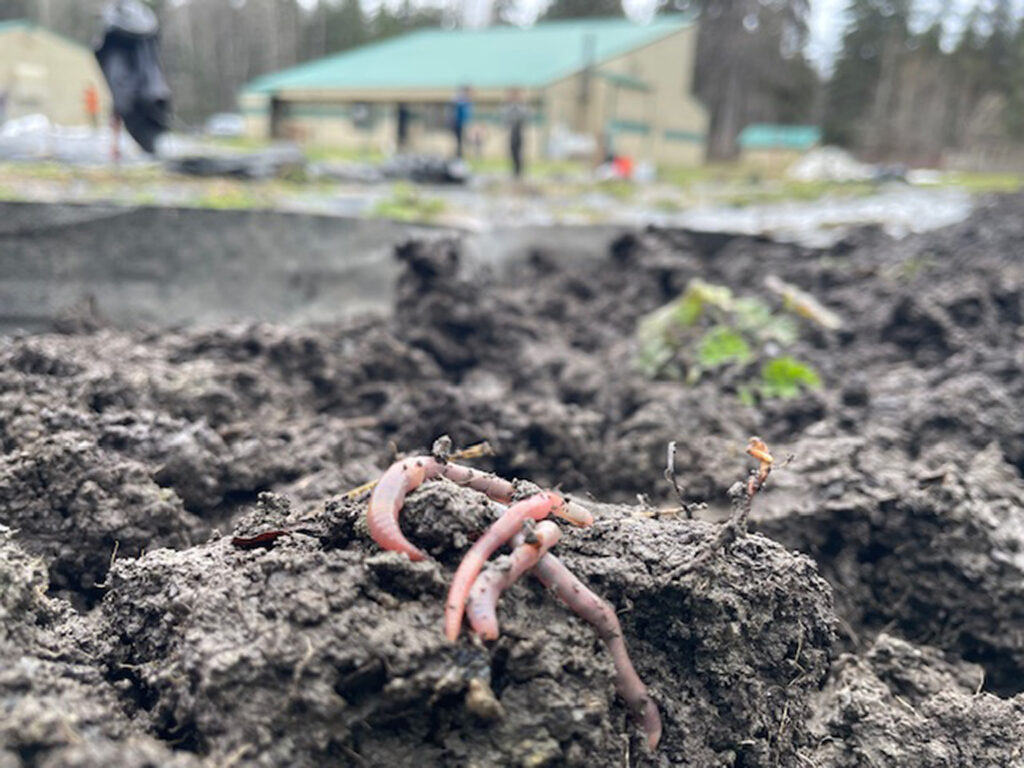
The community garden at Mosquito Lake has finally taken its weekly garden work party outside. Volunteers have been planting since mid-March and this past Sunday, they finally got their hands in the dirt at the 8000 square foot garden. The work crew changes weekly, as different volunteers show up and new projects are created and distributed by garden coordinator Sarah Ammons. This week featured planting onion sets and using the broad fork for soil prep, which uncovered some very healthy earthworms. Vermiculturist Erika Merklin said the worms are feasting on decomposing brassicas stems from last year’s gardening season. Merklin said if you really want to be impressed by some worms, visit the compost pile at the community garden. She is confident that they will knock your socks off.
Kathleen Menke can plan one heck of a ‘clipboard of fun’. Her granddaughter Skyler Menke’s recent visit was an action-packed two weeks that hit all the high points of watching spring unfold in the Chilkat Valley. Skyler was thrilled to see humpbacks, orcas, baby whales, sea lions, and seals. She learned about the Chilkoot eulachon run, got to dip a few herself, and went to Charlie Moody’s laser class and First Friday at the Haines Sheldon Museum. The two enjoyed bird watching and can now spot sparrows, warblers, jays and raptors, feeding her ornithology interests. Skyler also had the opportunity to make Mother’s Day breakfast for her grandmother before wrapping up her visit.
The Clayton family recently visited Cave Creek, Arizona. Piper Carlson celebrated her 12th birthday during the visit and also took horseback riding lessons. Her favorite horse was named Honey. Honey was a little stubborn but spunky, just like her rider. Callahan Clayton skinny-dipped in a neighborhood pool. They went bee hunting nightly. Bee hunting is done with a black light, while looking for scorpions; no bees were harmed. In an exciting turn of events Cal Clayton jumped in a duck pond, while chasing a duck. Ramie Clayton pulled him out by his golden locks. But not before his grandma, Pattie Carlson jumped in after him. The family visited with Kyle Clayton’s brother Troy Wingert, known to frequent Haines every summer. The family also spent time with grandparents Rich and Patti Carlson and found time for a two day trip to Prescott, Arizona.
The Dermott O’Toole Memorial Library in Tenakee Springs got a helping hand from Beau Bradley and The Book Store. The Tenakee Springs library’s book order made it as far as Haines. But its order of children’s nonfiction books was purchased using the Book Hook Fund grant and did not cover the shipping. The books arrived with Bradley’s book order. He had to do a little bit more leg work to get the books to Ruth Underhill, the librarian in Tenakee Springs. Bradley called the ferry terminal and they arranged for a person to escort the precious cargo to the proper ferry in Juneau. The new reading material arrived safely.
Mike Ward announced the winners of the Quick Shop’s grand opening prizes. Shoppers added their name and contact information to their receipts in hopes of winning the $250 digital gift card associated with the rewards program. The winners were Fred Lopez, SJ Durand, Sarah Bishop and Nate Baker.
The post Duly Noted: Visits, anniversaries, record-setters and more appeared first on Chilkat Valley News.

The World Cup final is often a star-studded affair – and now this summer’s edition will have some of the biggest names in music joining the festivities. FIFA announced that the tournament’s final on July 19 will have a halftime show that will feature Shakira, Madonna and BTS with the show curated by Coldplay frontman Chris Martin. Shakira is set to release the official song of the World Cup, “Dai Dai,” later Thursday. The July 19 match will take place at New York New Jersey Stadium in East Rutherford, New Jersey, with the halftime show aiming to raise funds for the FIFA Global Citizen Education Fund, an initiative working to provide access to quality education and football for children worldwide. The 48-team tournament will begin June 11 and will be co-hosted by 16 cities spread across three countries – Canada, Mexico and the United States. Mexico opens up the tournament on June 11 against South Africa in Mexico City, and will have opening ceremony headliners that include Alejandro Fernández, Belinda, Danny Ocean, J Balvin, Lila Downs, Los Ángeles Azules, Maná and Tyla. An opening ceremony in Los Angeles on June 12 ahead of the USA’s opener against Paraguay will feature music acts like Katy Perry, Future, Anitta, LISA, Rema and Tyla. Canada’s opening match against Bosnia and Herzegovina in Toronto on the same day will feature performances by Alanis Morissette, Alessia Cara, Elyanna, Jessie Reyez, Michael Bublé, Nora Fatehi, Sanjoy, Vegedream and William Prince. 2026 FIFA World Cup: How To Watch The World Cup will run from June 11–July 19, 2026. Spread across three countries, the tournament will culminate with the final on July 19 at New York New Jersey Stadium in East Rutherford, New Jersey. All 104 tournament matches will air live across FOX (70) and FS1 (34) with every match streaming live and on-demand within both the FOX One and the FOX Sports app. A record 40 matches, more than one-third of the tournament, will air in prime time across FOX (21) and FS1 (19). The opening match on June 11 between Mexico and South Africa (3 p.m. ET) will stream for free on Tubi, as well as the USA’s opening match against Paraguay on June 12 (9 p.m. ET).Latest Sports News from FOX Sports