Categories
Entertainment

Aubrey Plaza: Reportedly Pregnant With First Child!

Reading Time: 3 minutes

Obviously, Aubrey Plaza had an awful time last year.

That isn’t the kind of grief that goes away overnight.

However, she has found love again.

And now, she and her partner are reportedly expecting their first child.

Aubrey Plaza on Colbert.
In this interview with Colbert, Aubrey Plaza discussed her first time playing a mom as an actress. (Image Credit: CBS)

Congratulations!

On Tuesday, April 7, People reported that the beloved actress is now pregnant with her first child.

Congratulations are in order to Plaza and to her partner, Chris Abbott.

The baby is reportedly due this autumn, so that’s late September at the absolute earliest, mid-December at the latest.

“It was a beautiful surprise after an emotional year,” an inside source told the outlet.

The insider then added that “they feel very blessed.”

Back in March, Plaza reportedly worked to hide the first signs of her baby bump during Paris Fashion Week.

She did wear an oversized leather jacket and other loose-fitting attire to various events.

(Just a quick point of order: baby bumps don’t usually show until 16-20 weeks into a pregnancy, and pregnancies usually only last 40 weeks. That would suggest that Plaza’s due date could not be later than this summer.)

We don’t know a proper due date or any other personal info.

In other words, we know just enough to be happy for Plaza. And, why not, also happy for Abbott.

Aubrey Plaza on Amy Poehler's YouTube show.
Catching up with Amy Poehler, Aubrey Plaza sits and chats. (Image Credit: YouTube)

This news comes on the heels of last year’s loss

As a young adult, Plaza was in an 18-month relationship with fellow actor Michael Cera after the two filmed Scott Pilgrim vs The World together.

The two even joked about marrying — with the idea of referring to themselves as divorced at age 20 — but ultimately did not go through with it.

In 2011, she met writer and director Jeff Baena and the two hit it off, beginning a lengthy relationship.

The two married in 2021, ten years after they began dating. In September 2024, the two quietly separated.

Just a few months later, tragedy struck. Baena was found to have died by suicide in his home in the first days of 2025.

Since that time, Plaza began dating Chris Abbott, a fellow actor.

Notably, the two have worked together in the past.

In 2020, they both worked on Black Bear.

And they also collaborated on an off-Broadway Danny and the Deep Blue Sea production.

Is it too silly to refer to a pregnancy as a “collaboration?” Probably. Pregnancies are generally pretty one-sided collaborations.

Aubrey Plaza on Conan O'Brien.
During this interview with Conan, Aubrey Plaza admitted to not having contemplated what she’d do in a zombie apocalypse. (Image Credit: TBS)

Hopefully, people will be normal about this news

There was a time — especially about a dozen years ago — when a huge portion of internet men were deeply weird about Plaza.

You know how some people have lost their entire minds about Sydney Sweeney? Like that, but without the really gross political angle.

(Oddly enough, both women have iconic The White Lotus roles. That’s probably just because that show casts extraordinary actors.)

After Baena’s death, some deeply awful people blamed his death on the separation. That’s not true, but it’s also vile to suggest.

Some people will, inevitably, be very weird about Plaza’s pregnancy. Hopefully, we as a society can keep it at a minimum.

Aubrey Plaza: Reportedly Pregnant With First Child! was originally published on The Hollywood Gossip.

​The Hollywood Gossip

Categories
Health

Photos Of Ryan Seacrest From 2002 To Now Put Concerns About His Health Into Context

Fans have pointed out that TV and radio host Ryan Seacrest is looking noticeably thinner, and these photos show just why they’re concerned about his health.

​Health Digest – Health News, Wellness, Expert Insights

Categories
Music

Ty Herndon Gets Real About Addiction, Coming Out & Healing In New Memoir, ‘What Mattered Most’

Country artist Ty Herndon is sharing his personal story in a newly released memoir, What Mattered Most, offering an inside look at his struggles with addiction, mental health, and identity.

The book details Herndon’s journey as one of country music’s first openly gay male artists, along with the challenges he faced behind the scenes of his decades-long career. It combines personal reflection with moments of humor, warmth, and insight.

“Writing ‘What Mattered Most’ has been one of the most vulnerable and rewarding experiences of my life,” Herndon said. “This book is my truth — the highs, the heartbreaks, the lessons and the love that have shaped me as a man, an artist and a survivor.”

Ty Herndon; Photo Provided

Herndon first gained recognition as a member of The Tennessee River Boys, who later became known as Diamond Rio. After signing with Epic Records, he became a well-known name in 1995 with his chart-topping debut single “What Mattered Most,” the first of 17 Billboard hits. He went on to chart 17 singles throughout his career, including three No. 1 hits.

All the success for Herndon came with a heavy cost. Behind the spotlight, he wrestled with the pressure to conceal his identity in a traditionally conservative music world. In 2015, everything changed when he became one of the first major male country artists to come out as gay publicly. 

Along the way experienced legal troubles, got married, found himself in secret relationships, and unfortunately relapsed in 2020. On New Year’s Day 2021, the Dove Award–winning artist hit a point that nearly ended his life, forcing him into intensive rehabilitation and to come face-to-face with the trauma he had carried for years.

Out of that struggle, a new clarity emerged. It first surfaced in the vulnerability of his song “God or the Gun” and now unfolds fully in What Mattered Most. The memoir chronicles Herndon’s personal battles along with celebrating his resilience, recovery, and the strength found in embracing one’s true self. 

“For thirty years, I’ve told pieces of my story through my music – but this book has given me the chance to tell the whole truth,” Herndon added. “It’s about the journey, the struggles, the faith, and the people who shaped my life. I hope readers walk away knowing that no matter where you’ve been, you can still write a new chapter.”

Through all the trials and tribulations this chapter brought for him, he remained his most authentic self and now uses his story to advocate for others through his Foundation for Love & Acceptance.

“This book is my heart on the page,” he shared. “It’s about the boy I was, the man I became, and the grace that carried me through it all. If this story inspires even one person to keep going, then I’ve done my job.”

Ty Herndon’s memoir is on sale now from Dey Street Books and can be purchased HERE

The post Ty Herndon Gets Real About Addiction, Coming Out & Healing In New Memoir, ‘What Mattered Most’ appeared first on Country Now.

​Country Now

Categories
Uncategorized

Philadelphia’s 40-year history of protecting undocumented immigrants began with churches hiding refugees from El Salvador

Supporters visit Javier Flores, right, while he lived in sanctuary at Arch Street United Methodist Church in downtown Philadelphia in 2017. Bastiaan Slabbers/NurPhoto via Getty Images

In the midst of a civil war, married couple Ernesto and Linda Fuentes fled their home country of El Salvador and headed for Philadelphia, via Mexico, in November 1983.

Ernesto was an activist who dispensed food and medicine in Salvadoran refugee camps. Linda was a union organizer for banks and clothing factories.

The Salvadoran government viewed activists, especially suspected guerrilla fighters and union leaders, as threats to its regime. It placed activists’ names on “death squad hit lists.” The couple decided to leave after receiving threatening letters and phone calls.

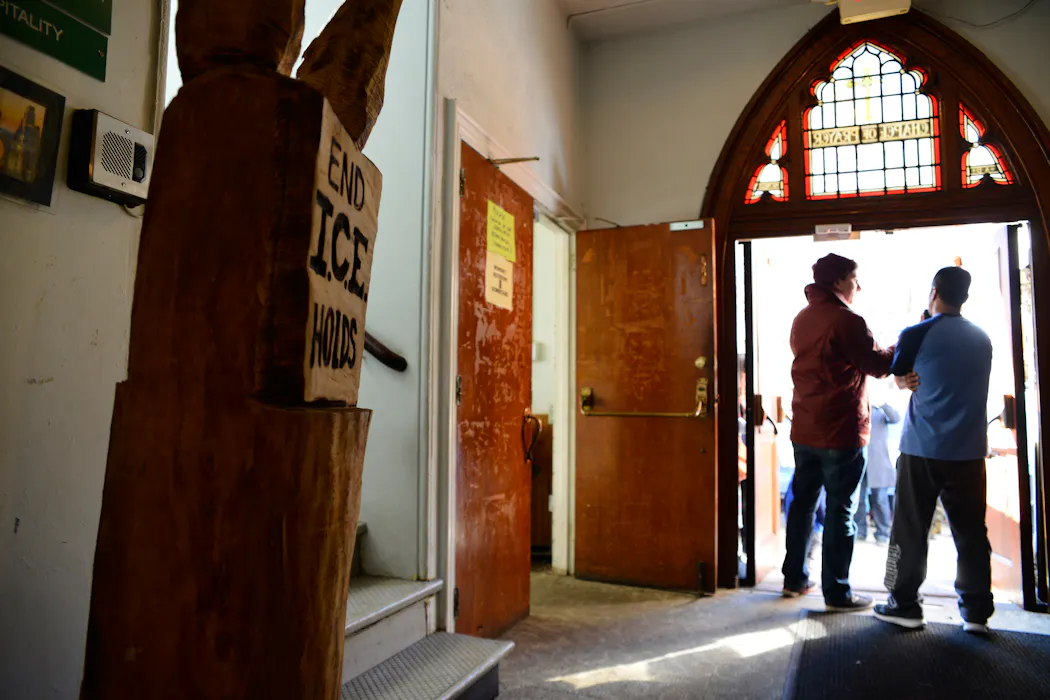
With false documents and the help of a humanitarian church group, they arrived at the Tabernacle United Church in West Philadelphia on May 12, 1984. The congregation declared itself a public sanctuary for undocumented refugees from El Salvador and Guatemala. An estimated 500,000 undocumented Salvadorans lived in the U.S. around that time.

The Fuenteses used the pastor’s office as their bedroom. Church members were instructed to keep the doors locked and not admit strangers, including the Immigration and Naturalization Service.

As a historian of race and policing in Philadelphia after the Civil Rights Movement, and the daughter of an immigrant, I’ve been exploring Philly’s history of sanctuary and how religious congregations, activists and city officials have supported local refugees over the past 40 years.

Four children of various ages stand together, two of them wiping face with hand or arm
Accompanied by elected officials, clergy and community activists, the four undocumented children of Carmela Apolonio Hernández step out of sanctuary at the Church of the Advocate in North Philadelphia in 2018.
Bastiaan Slabbers/NurPhoto via Getty Images

A ‘welcoming city’ for immigrants

Philadelphia Mayor Cherelle Parker has emphasized since May 2025 that Philadelphia is a certified “welcoming city.” She notably does not call Philadelphia a “sanctuary city.”

Welcoming cities have immigrant-friendly initiatives that make education, housing, workers’ rights, legal aid and language services accessible to immigrants and refugees without using the term “sanctuary city” in their laws and policies.

The presumed goal of this phrasing is to keep Philadelphia off the Trump administration’s radar and protect its US$2.2 billion in federal funding for health and human services.

However, Philly was, at various points, an official sanctuary city.

In 2014, then-Mayor Michael Nutter signed an executive order detailing that local police were not required to assist Immigration and Customs Enforcement unless the case involved a warrant or violent felon.

Nutter later rescinded Philadelphia’s sanctuary city status in an effort to dissuade congressional Republicans from passing a House bill that would deny sanctuary cities federal money earmarked for law enforcement and recidivism reduction. However, the next mayor, Jim Kenney, reinstated the order on Jan. 4, 2016.

Throughout 2017, President Donald Trump and Attorney General Jeff Sessions used executive orders, speeches and the immigration raid Operation Safe City to force Philadelphia officials to assist ICE or lose federal grants.

In 2018, Philadelphia won a lawsuit against the Trump administration that denied ICE access to police databases to find undocumented immigrants and prohibited city employees from assisting ICE.

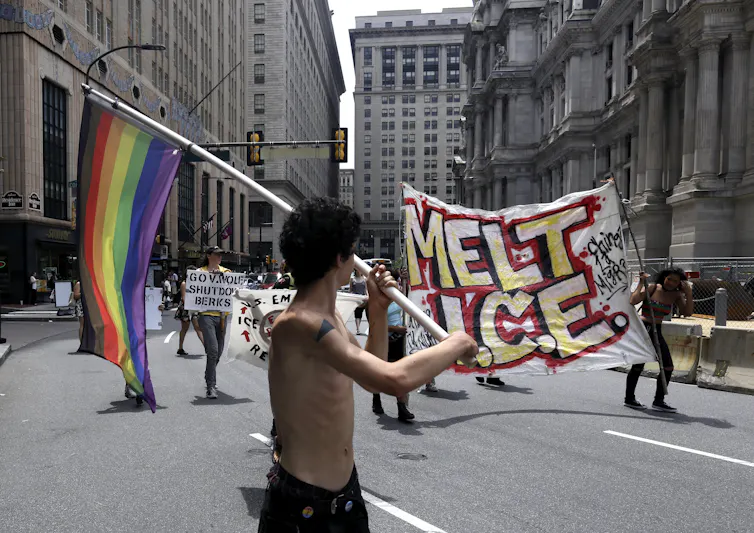
Young shirtless man holds rainbow flag while protesters behind him carry banner that says 'Melt ICE'
Protesters camped outside Philadelphia City Hall march in July 2018 after Mayor Jim Kenney announced that Philadelphia would stop giving ICE access to a real-time arrest database. Kenney accused the agency of misusing the information to target people who were in the country illegally but were otherwise not accused of any crimes.
AP Photo/Jacqueline Larma

Roots of sanctuary cities

The sanctuary movement started back in the 1960s. But it wasn’t immigrants who were seeking sanctuary. It was Americans.

Around 1968, drafted resisters who were opposed to fighting in the Vietnam War sought refuge in churches in the U.S. Northeast. One of the earliest cases involved Robert Talmanson, who received sanctuary in Boston’s Arlington Street Unitarian Church. He was later arrested by U.S. marshals and local police and incarcerated in Virginia for three years.

In November 1971, Berkeley, California, became the first sanctuary city in the country when 12 local churches inspired the City Council to pass a resolution offering sanctuary to draft resisters. It also banned city employees from “assisting in the investigation or arrest of any sanctuary seeker.”

In the two decades that followed, several Quaker, Presbyterian, Catholic and Jewish congregations across America and Canada used their houses of worship as sanctuaries for Central American refugees who were fleeing civil war, government repression and genocide.

Philly joins national movement

Frustration and outcry over the United States’ low acceptance rates of Central American asylum-seekers sparked Philadelphia’s sanctuary movement.

In January 1984, members of Tabernacle United Church, where the Fuentes couple would soon take refuge, voted to join the national sanctuary network. As the Rev. James MacDonald explained at the time, the congregation chose to “violate a human law in order to respond in obedience to God’s law.”

By May, the First United Methodist Church of Germantown also became a sanctuary church. A few months later, the church sheltered a young Guatemalan couple, Joel and Gabriela, and their 3-year-old daughter, Lucy. Joel, an activist who worked with unions and student groups, had been tortured by Guatemala City police.

On Jan. 14, 1985, INS staged nationwide raids of sanctuaries and arrested 60 undocumented immigrants and 16 sanctuary workers – including pastors, nuns and priests – for violating immigration laws. Joel and his family were among those seized. They were released when church members bailed them out as they awaited deportation hearings.

A new pathway to citizenship

By the mid-’80s, 42,000 people from 2,000 religious institutions in 60 cities nationwide had joined the sanctuary movement.

On Nov. 6, 1986, President Ronald Reagan signed into law the Immigration Reform and Control Act. It granted undocumented immigrants who arrived in the U.S. before 1982 one year to apply for amnesty. If eligible, they would begin a five-year pathway to citizenship.

Approximately 3 million people successfully became naturalized citizens through the amnesty program.

In the Philadelphia area, at least 5,000 to 7,000 people were undocumented in 1986. Advocates at the nonprofit Nationalities Service Center and American Friends Service Committee noted that many immigrants wanted to apply for amnesty but feared the program was a trick.

A decade later, immigration enforcement got tougher.

Local police assist ICE

In 1996, Congress passed Section 287(g) of the Immigration and Nationality Act. This granted local police the right to assist immigration officials in arresting and detaining unauthorized immigrants.

As of April 2026, over 1,600 law enforcement agencies in 39 states and two U.S. territories have a 287(g) agreement with ICE. The program offers local police free training in ICE procedures along with funding for equipment, vehicles and overtime pay.

While the Philadelphia Police Department has never signed a Section 287(g) agreement, about 68 Pennsylvania agencies have, including in neighboring Delaware County.

But these agreements aren’t always long-lasting. Between January and March 2026, two departments in Bucks and Chester counties rescinded their agreements with ICE to make residents feel safe after American-born protesters Renée Good and Alex Pretti were killed during ICE operations in Minneapolis.

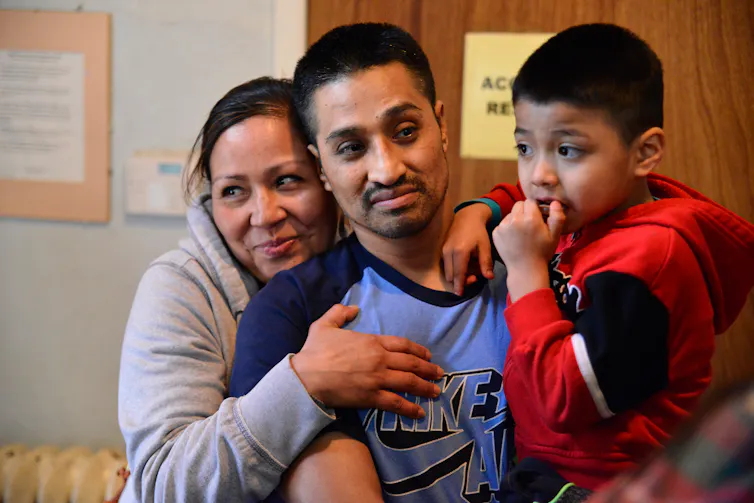
Man in blue shirt holds a child as woman hugs him from behind
After a 16-month detention, Javier Flores, a father of three, went into sanctuary at Arch Street United Methodist Church in Philadelphia in 2016. He spent nearly a year in sanctuary before his visa request was approved and ICE waived his previous removal orders.
Bastiaan Slabbers/NurPhoto via Getty Images

Community activism continues

According to Pew Charitable Trusts, nearly 16% of Philadelphia’s 1.6 million residents are immigrants, largely from Asia and the Caribbean.

The exact number of undocumented immigrants in Philadelphia is unknown. However, the Migration Policy Institute estimates that 250,000 immigrants in Pennsylvania – 1.5% of the state’s total population – are undocumented.

Since January 2025, ICE crackdowns in sanctuary cities such as Los Angeles, Portland, Chicago and New York have resulted in the number of people held in ICE detention jumping from 40,000 to 73,000 people in January 2026.

Citizens and advocacy groups have stepped up to protect immigrants from ICE. The Party for Socialism and Liberation and the AR-12-toting members of the Black Lion Party for International Solidarity participated in protests in Philadelphia. Public school students from Northeast and Edison high schools have led anti-ICE walkouts.

On Jan. 29, 2026, City Council members Kendra Brooks and Rue Landau introduced an “ICE Out” package. The bills aim to codify the right of police to not share immigration, citizenship and personal data with ICE, or detain and hand over arrested individuals to the federal agency.

The legislation also proposes a ban on ICE agents who wear masks or hide their badges, use unmarked cars and city vehicles, or use municipal spaces as staging areas for enforcement and raids. And it would prohibit city employees from giving ICE access to libraries, shelters, health centers and recreation centers without a judicial warrant.

Community activists have long used civil disobedience and humanitarian aid to protect undocumented immigrants who are searching for a fresh start in the U.S.

An interfaith network inspired Philadelphia to become a sanctuary city. Today, churches such as Center City’s Arch Street United Methodist Church and North Philly’s Church of the Advocate, along with other congregations, uphold this tradition while a multicultural community across the city continues that fight.

Read more of our stories about Philadelphia and Pennsylvania, or sign up for our Philadelphia newsletter on Substack.

The Conversation

Menika Dirkson does not work for, consult, own shares in or receive funding from any company or organization that would benefit from this article, and has disclosed no relevant affiliations beyond their academic appointment.

​Politics + Society – The Conversation

Categories
Music

Why Most WWE Fans Are Heated About Pat McAfee’s Heel Turn

In a jaw-dropping moment, a beloved WWEs personality takes a dark turn. Buckle up! Continue reading…​The Boot – Country Music News, Music Videos and Songs

Categories
Entertainment

The Connection Between Food Network’s Chopped And Buc-Ee’s Famous Brisket

A Buc-ee’s brisket counter may seem like a far cry from Food Network competition shows like “Chopped,” but one barbecue champion connects them.

​Mashed – Fast Food, Celebrity Chefs, Grocery, Reviews

Categories
Entertainment

13 Famous Restaurants The Rolling Stones Enjoyed On Tour

The Rolling Stones have been spotted at Italian spots in Las Vegas, Peruvian eateries in Lima, and Indian restaurants in Australia over the years.

​Mashed – Fast Food, Celebrity Chefs, Grocery, Reviews

Categories
Food

I’ve Lived In The UK For Years But I Still Crave This British Pub Food Just Outside LA

As someone who has lived in the UK for years, I know good pub food when I come across it. This British pub just outside of LA will make you cancel your flight.

​Food Republic – Restaurants, Reviews, Recipes, Cooking Tips

Categories
Entertainment

Can You Reuse Aluminum Foil?

Whether you’re trying to save money or simply hate to waste a good sheet of metal, you may have wondered if it’s safe to reuse aluminum foil.

​Mashed – Fast Food, Celebrity Chefs, Grocery, Reviews

Categories
Alaska News

Ferry system may avert summer crisis

Reopening of a federal grant program could reduce, but not eliminate, a cash squeeze at the Alaska Marine Highway System this summer.

The months-long delay in the program jeopardized the ferry system’s operating budget for this summer. But, even with the reopening of the grant applications, the Marine Highway will need state funds  to cover for the missing federal funds until the anticipated grant comes through.

Fear of a shutdown arose earlier this year after Alaska Department of Transportation officials said the ferry system was $77.9 million short of its budgeted needs for 2026 because of the delayed federal funds, which represented nearly half the Marine Highway’s annual operating budget. 

Based on prior years, applications for 2026 federal ferry grants were expected to open mid-2025. But 2025 came and went, and no application period ever opened. 

That left the ferry system with only enough money to operate through July, Department of Transportation budget manager Dom Pannone told state lawmakers this spring. 

Though the state had not yet applied for the funding when the budget was written last year, it had an expectation of receiving funds based on the structure of the federal grant program and the fact that it had received the aid the previous three years. 

Marine Highway reliance on federal funding has been the norm since the 2021 Infrastructure Investment and Jobs Act created a billion-dollar pot of rural ferry funding — widely credited to Sen. Lisa Murkowski. When the bill was passed, Congress appropriated money to fund the grant program through the 2026 fiscal year. 

The vast majority of the millions released so far have gone to Alaska ferries, including roughly $150 million in operating funds, day-to-day costs like paying staff and keeping ferries fueled. 

With no way to apply for the funds, and no public explanation from the federal government on why the application process had stopped, state transportation officials seemed to have few ideas for how to cope. 

At a March legislative hearing, state senator Löki Tobin asked if the department had done any contingency planning. Pannone said the ferry system could offload the out-of-service M/V Matanuska, but otherwise offered few specifics: the department would “continue to work with the legislature on resolving (the funding gap),” he said, adding that they would pursue those discussions “before we’d consider reducing the schedule or canceling any sailings.”

At that hearing, Pannone also delivered hopeful news, saying federal officials at the Federal Transit Administration had “committed” to beginning the grant application process by the end of March. 

Funding was then expected to be awarded in August or September, Pannone said. 

As of this week, the federal government delivered on the first half of that commitment. On Monday, the Federal Transportation Administration announced backdated funding for the 2025 fiscal year and funding for the current 2026 fiscal year. The state will still have to apply for the funds, and until then won’t know how large its share will be. But the size of the total funding pot is comparable to, even slightly larger, than past years. 

Even with the good news for the ferry system, issues still remain. 

For one, the backdated funding, arriving nearly a year later than expected, isn’t expected to be delivered in time for the summer season. The ferry system expects to exhaust existing operating funds in July, and Pannone said last month he expects the federal infusion of cash to only come in August or September. 

That would likely require the state to cover an increased share of expenses until then, after which federal funds could essentially pay the state back. 

In her annual address to the state Legislature last week, Murkowski criticized the Dunleavy administration, calling the use of the funds on operating costs, rather than long-term investments, a “bad idea.”

“Federal funding is a lifeline, not an entitlement,” Murkowski said. 

According to data from the Marine Highway, in the seven years before the Biden-era federal funding infusion, essentially all of the ferry system’s operating funds came from ticket revenue and state funds.  

But as federal funding has increased, the governor has cut the state’s share, vetoing over $40 million in state funding to the Marine Highway since 2019. 

Now, absent a new stream of federal assistance, the state will have to either increasing spending  or make cuts.

Senate Finance Committee chair Bert Stedman told transportation officials in February that tight state budgets were “reducing the flexibility (the Senate Finance Committee) has to backfill some of these holes.” 

There’s also a political challenge beyond just the total dollar figure. 

Whereas the federal grants can only be spent on ferries, pulling in state general funds would come at the expense of some other program, potentially with a broader geographic reach. 

“Beauty is in the eye of the beholder,” Stedman said. “If you use the Marine Highway it’s pretty sensitive, and if you’re an area that doesn’t use it, you’d rather have more potholes fixed.” 

Potential new Lynn Canal ferry funded 

Monday’s notice of available federal funds also included a large chunk of money that could build a new Lynn Canal ferry, contrary to the expectations of borough decision-makers. 

The ferry system’s long-range plan includes two diesel-electric shuttle ferries, which would run frequent, short routes. One of those possible routes is between Haines and Skagway. 

If the ferry is indeed constructed and assigned to the Lynn Canal, it would allow larger ferries to run directly between Auke Bay and either Haines or Skagway — likely alternating between the two. Stopping just once in the upper Lynn Canal would cut down on costs and increase sailing frequency, the Marine Highway’s long-range plan says. 

Borough decision-makers in recent months have been pessimistic about the project, citing the Trump Administration’s slashing of renewable energy projects. 

Assembly members Eben Sargent and Gabe Thomas said at an assembly meeting this winter that they thought funding for the hybrid ferry would be a casualty of those cuts. 

“Electric stuff is not going anywhere right now,” Thomas said at a meeting in January. 

In the Legislature, at least one lawmaker raised a similar concern at one of the Marine Highway hearings: Senate Finance member James Kaufman, an Anchorage Republican, asked Department of Transportation officials if the hybrid boats were linked to an “environmental agenda” that could cause “unstable funding” going forward. 

The answer was largely no, from DOT Deputy Commissioner Katherine Keith, who said the new propulsion system had benefits outside of emissions reductions, including “significant operational savings.” 

Keith also said that diesel-propulsion ferries were “outdated internationally.”

Despite concerns from assembly members and state lawmakers, Monday’s announcement continues Biden-era funding for the program. The program is expected to make $98 million available nationwide for low and no-emission ferry programs over two years. 

That could help complete funding for the project, which received a $46 million grant from the program in 2022. The Marine Highway currently estimates the shuttle ferries to cost $59 million each. 

Design of the hybrid ferries is nearing completion, and construction on one is planned to go out to bid at the end of the year, Marine Highway director Craig Tornga said last month. Construction of the boat is estimated to take another two and a half years, according to the Marine Highway long-range plan. 

The post Ferry system may avert summer crisis appeared first on Chilkat Valley News.