Adam Sanders spent part of the money he got for winning ‘The Road’ on the right person. Continue reading…Country Music News – Taste of Country










Adam Sanders spent part of the money he got for winning ‘The Road’ on the right person. Continue reading…Country Music News – Taste of Country

Another country artist is heading to CBS’ new Yellowstone spinoff, Marshals. Fresh off his big win on The Road, Adam Sanders is set to appear on the TV series this Sunday, April 12.
Fans first got to know Sanders throughout his time on the show’s inaugural season, which followed twelve aspiring artists as they experienced the realities of life of a touring musician. Blake Shelton and Keith Urban teamed up with Taylor Sheridan to search for the next country star in the docu-series-style competition.
After 10 weeks on the road, the competition finally came to a close at the historic Ryman Auditorium, where live audience votes determined Sanders the winner. As his country music career continues to gain momentum, viewers will see his talent emerge in a whole new way.
During an interview with Taste of Country Nights host Evan Paul, the Lake City, FL native discussed the brand-new song that he’s set to perform on the show. The tune, penned by Sanders with Jordan Walker, Adam Craig and Zach Crowell, is one that the singer has been keeping in his pocket for years, waiting for the perfect time to share it with the world.
Tapping into his love for “late ’90s, early 2000s country music,” the track channels that beloved era of the genre while still feeling uniquely his. He offers a mid-tempo sound with carries an authentic country twang that comes through in full force, pairing perfectly with a story rooted in the kind of reckless, all-in love that you know probably won’t end well, but you dive into anyway.
“That is my bread and butter,” he tells the outlet of that era of country. “I’ve always had ’90s country as sort of the roots of my music, but I wanted to find a way — how do I make this branches of my music? So this song is a product of that.”
He adds, “It reminds me of an old Brooks & Dunn song. Like a ‘She Used To Be Mine’ or ‘She Ain’t the Cheatin’ Kind.’”
Sanders goes on to say that during his time on set of Marshals, he had the chance to get to know with the show’s star, Luke Grimes, who portrays the role of Kayce Dutton in the series. Through their conversation, they found common ground in the style of music they are drawn to.
“It was really cool to … find out what makes his ticker tick,” Sanders explained. “His type of music is a little different than mine. He likes that old-school stuff that’s kind of like ’80s and ’70s, and I’m kind of right in the middle of ’90s country.”
The Road contestant isn’t the only country act making an appearance throughout the season. Ashley Cooke performed in a previous episode and Riley Green is set to make his long-awaited acting debut as Garrett, a former Navy SEAL, on Sunday, April 19.
Green’s character shows up at the ranch unexpectedly, looking to reconnect with Kayce Dutton and Cal (Logan Marshall-Green) in an attempt to move forward from his past. He won’t just make a quick cameo, he is expected to be a part of several episodes.
Following his performance on Marshals, Adam Sanders will head to Indio, CA on Sunday, April 26 to make his debut at Stagecoach. In addition to the $250,000 cash prize and recording contract from winning The Road, taking the Mane Stage at Stagecoach is also included in the winner’s prize package.
The post Country Singer Adam Sanders Heads to CBS’ ‘Yellowstone’ Spinoff ‘Marshals’ After ‘The Road’ Win appeared first on Country Now.
Country Now

Tequila production is a time-honored process that involves growing and harvesting agave, but how much liquor can one plant provide? We’ve got answers.

Mashed – Fast Food, Celebrity Chefs, Grocery, Reviews

After the Democratic National Committee punted on two resolutions in August that highlighted the party’s deep divide on Israel, DNC Chair Ken Martin convened a task force “to have the conversation” and “bring solutions back to our party.”
Seven months later, the Middle East working group — meeting today in-person for the second time — still has work to do.
The group, composed of eight DNC members with backgrounds in Jewish and Palestinian advocacy, has struggled to meet consistently or coalesce around shared objectives. Part of that is due to the difficulties of coordinating across schedules and time zones, with at least one member actively running for office. But atop those hurdles come the challenges of productive discourse about one of the party’s most contentious debates among a cohort with sharp ideological divides.
“People aren’t comfortable with being uncomfortable,” Steph Newton, a DNC member from Oregon who’s part of the working group, told POLITICO. “These uncomfortable discussions are how we’re going to be able to move the party forward and find a solution.”
The working group met for the first time in December at the DNC’s winter meeting in Los Angeles, and convened virtually two more times, on March 1 and March 18. Those meetings mostly centered on figuring out what the group should be working on in the first place. “Most of the time, what we’ve talked about is, ‘What are we supposed to be doing?’” said James Zogby, another member from D.C.
The working group comes as divides over support for Israel remain a persistent liability for Democrats, and as AIPAC’s involvement in midterm primaries presents a new purity test for candidates. “No one gets anywhere by trying to shout the other side of the room — as a matter of fact, I think that would be harmful politics,” Andrew Lachman, another working group member from California, said.
A DNC spokesperson emphasized the group’s goal is to figure out how to talk to voters about the Middle East in a way that ultimately helps the party build coalitions and win elections.
The group’s inaction so far came into sharper focus yesterday at the DNC’s spring meeting in New Orleans, when the party’s resolutions committee considered one brought by Joe Salas, another member of the working group from California, to recognize Palestinian statehood.
“It is necessary for the Democratic National Committee to address the ongoing heinous and illegal acts against the Palestinian people. Some here may say that there is a working group. To that, I say that we are in a midterm year and they are yet to produce any results in a moment where anger has only grown amongst the American people,” said Cameron Landon, VP of the College Democrats of America, who spoke on behalf of Salas.
Salas, who wasn’t at the meeting, submitted the resolution without discussing it with the other members of the Middle East working group, according to Zogby and Newton, who said she was “surprised” to see it in the resolutions packet.
“I would assume that if we’re on a work group together discussing these issues, you say, ‘Hey, work group members, teammates, I want to submit a resolution on X, Y and Z. I know we’re working toward something like this together. Is this something that we can discuss?’” Newton said.
Deborah Cunningham-Skurnik, another member of the group from California, told the resolutions panel yesterday that there were “some parts of it I would like to go bit by bit over with” Salas.
Salas said in an interview ahead of the vote he wouldn’t attend the New Orleans meeting because “I’m just gonna let them have those words and reject them, accept them, modify them, whatever they want to do.” He didn’t respond to further requests for comment about why he didn’t tell the working group he submitted the resolution.
The panel ultimately referred those resolutions back to the working group — with a warning. “As a body, we recommend this going back to the task force,” said Ron Harris, the resolutions committee co-chair. “But then we can put some — I don’t want to say ‘constraints,’ but expectations that we hear back.”
John Verdejo, a DNC member from North Carolina, was more direct. “It can’t just be we have a task force and then the next time we have a DNC meeting, it just comes up again. No, we want to see your progress. You want to have a task force? You want to make the hard changes, have the hard discussions? Then do it,” he said.
Allison Minnerly, another working group member from Florida, said after the snafu that “so long as the party does not prioritize this conversation, you will see what happened today, which is that DNC resolutions committee members have many questions on the inaction and the results of the working group. It’s really clear that this issue will keep coming up at every subsequent DNC meeting until there’s a clear direction, solution, talking points.”
Now that the party has referred the resolutions to the working group, it finally has a clear, near-term objective for its meeting today.
“I actually am pleased that we will now have a very specific charge that we must accomplish in a defined period of time,” Zogby said. “We have not had a defined agenda, and it’s been difficult to get people together. Now we have to get this done, and there’s just no way we can duck it at this point.”
Like this content? Consider signing up for POLITICO’s Playbook PM newsletter.
Politics

Pope Leo XIV on Friday issued a sweeping condemnation of war, continuing to reject the idea that military action can bring about peace or freedom as the Trump administration and other leaders use religion to justify the U.S.-Israel war in Iran.
“God does not bless any conflict,” Leo wrote on X. “Anyone who is a disciple of Christ, the Prince of Peace, is never on the side of those who once wielded the sword and today drop bombs.”
Military force, he added, will not result in peace or freedom — that “comes only from the patient promotion of coexistence and dialogue among peoples.” He did not mention President Donald Trump or other leaders by name in the post on X.
Trump, who describes himself as a Christian, but not Catholic, has invoked faith several times throughout his term as a means to justify his actions.
Trump on Monday told reporters at a White House press briefing that he believes God supports the Iran war “because God is good” and wants to “see people taken care of.”
Leo had previously condemned Trump’s threat from earlier this week to destroy Iranian civilization.
He called the threat “truly unacceptable” and urged that the conflict in the Middle East “is only provoking more hatred.”
At a Palm Sunday mass, Leo insisted that no one could use God to justify war, telling the tens of thousands of people gathered before him that God “does not listen to the prayers of those who wage war, but rejects them.”
Defense Secretary Pete Hegseth has framed the Iran war, which reached a temporary ceasefire Tuesday after six weeks of fighting, as divinely sanctioned — often turning to prayer and belief that God is on the side of the U.S. military.
At a Pentagon church service held weeks after the Iran war began, Hegseth, who is also a Christian, but not Catholic, read a prayer that called for violence against military enemies.
“Let every round find its mark against the enemies of righteousness and our great nation,” he prayed during the livestreamed service. “Give them wisdom in every decision, endurance for the trial ahead, unbreakable unity, and overwhelming violence of action against those who deserve no mercy.”
Politics

Costco has more than just food and drinks in its aisles. From whole refrigerators to charcuterie boards, these kitchen finds from Costco are customer approved.

Food Republic – Restaurants, Reviews, Recipes, Cooking Tips
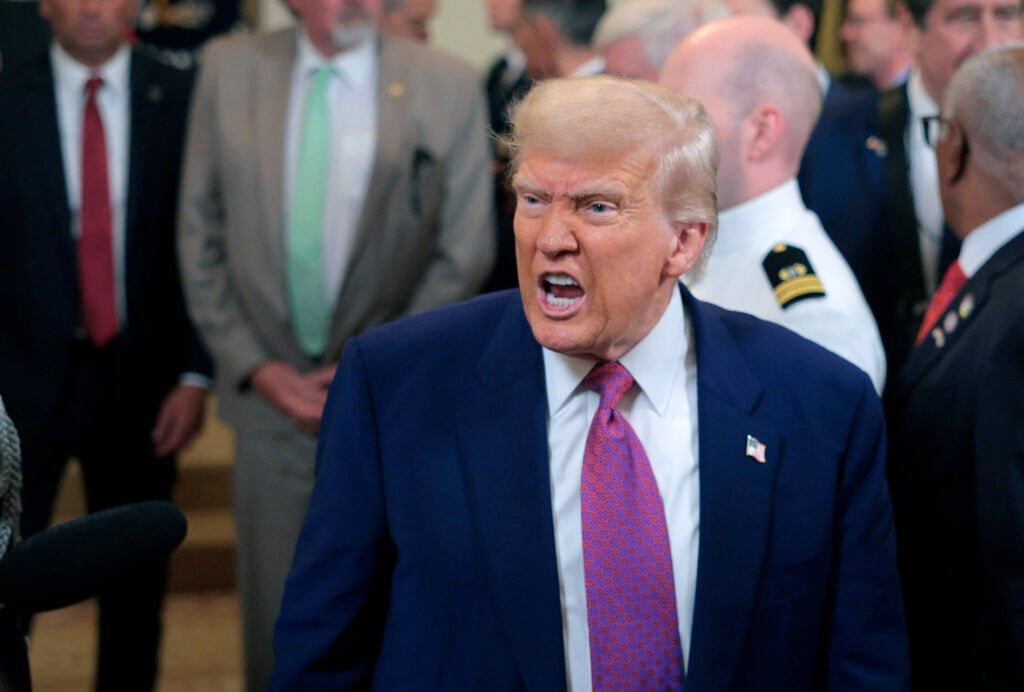
Reading Time: 2 minutes
Earlier today, we reported that Hunter Biden had challenged Donald Trump Jr. and Eric Trump to a cage fight.
And if you thought that would be the wildest political story of the day, then you’re clearly a newcomer to life in 2026.
Donald Trump’s Truth Social has been a hotbed of insanity this week, and his latest post contains uncensored video of a brutal murder.
“An Illegal Alien Criminal from Haiti, who was released into our Country by the WORST President in History, Crooked Joe Biden, and the Radical Democrats in Congress, just beat an innocent woman to death with a hammer at a gas station in Florida,” Trump wrote in his post, adding:
“The video of her brutal slaying is one of the most vicious things you will ever see.
“The Biden Administration granted him, and all Haitians, ‘Temporary Protective Status,’ a massively abused and fraudulent program which my Administration is working to terminate.”
The post comes just one day after Trump blasted Tucker Carlson, Megyn Kelly, and other conservative pundits in a lengthy tirade.
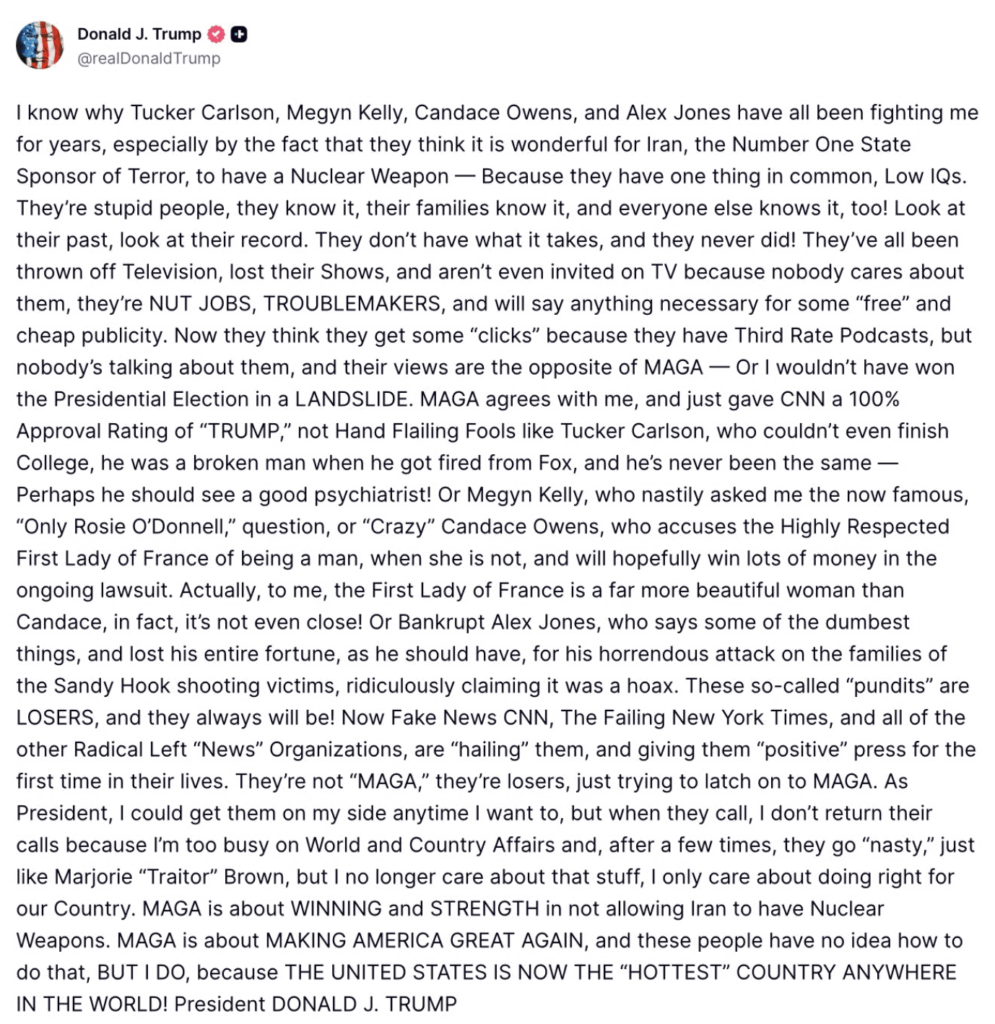
Many believe that Trump is attempting to distract from recent policy failures like the war in Iran and his administration’s handling of the Epstein files by reminding his base about his hardline stance on immigration.
“This one killing should be enough for these Radical Judges to STOP impeding my Administration’s Immigration Policies, and allow us to END THIS SCAM ONCE AND FOR ALL,” Trump continued, adding:
“Please say a prayer for this innocent woman’s family. We will ensure quick and severe JUSTICE is served in this case!”
Ironically, Trump concluded by warning his followers not to watch the footage:
“I don’t recommend you watch this tape, because it is so terrible, but felt I had an obligation to put it up so that people can see what Democrats are protecting, and wanting to come into our Country, even now, after all we’ve been through,” he wrote, adding:
“Again, viewer discretion advised — Not for children!”
Very little is known about the case, aside from what Trump said in his post.
We will have further updates on this developing story as new information becomes available.
Donald Trump Shares Graphic Murder Video on Social Media, Continues to Concern Supporters … was originally published on The Hollywood Gossip.
The Hollywood Gossip
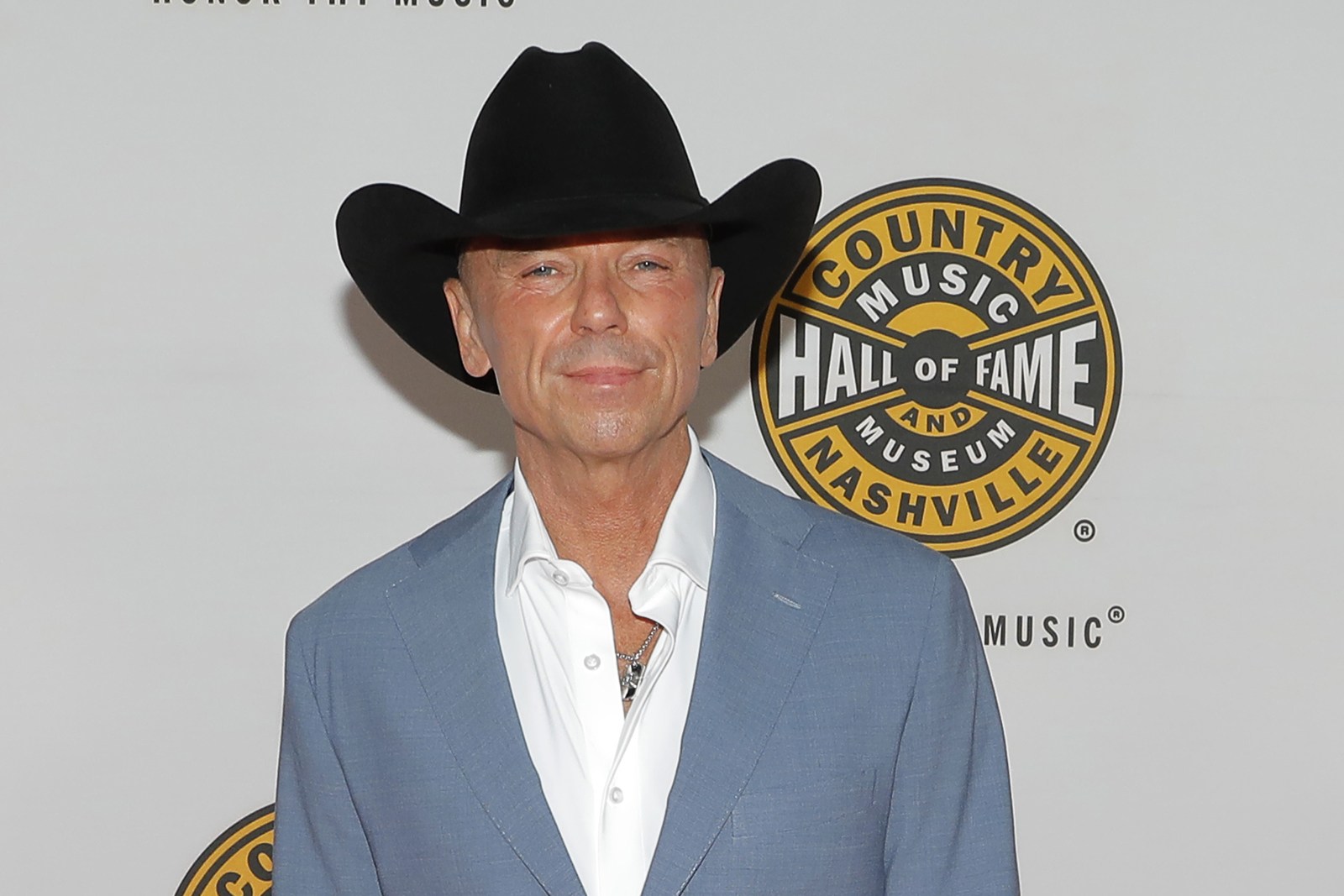
There are now just nine chances to see Kenny Chesney at the Sphere in Las Vegas in 2026. Continue reading…The Boot – Country Music News, Music Videos and Songs
There are now just nine chances to see Kenny Chesney at the Sphere in Las Vegas in 2026. Continue reading…Country Music News – Taste of Country
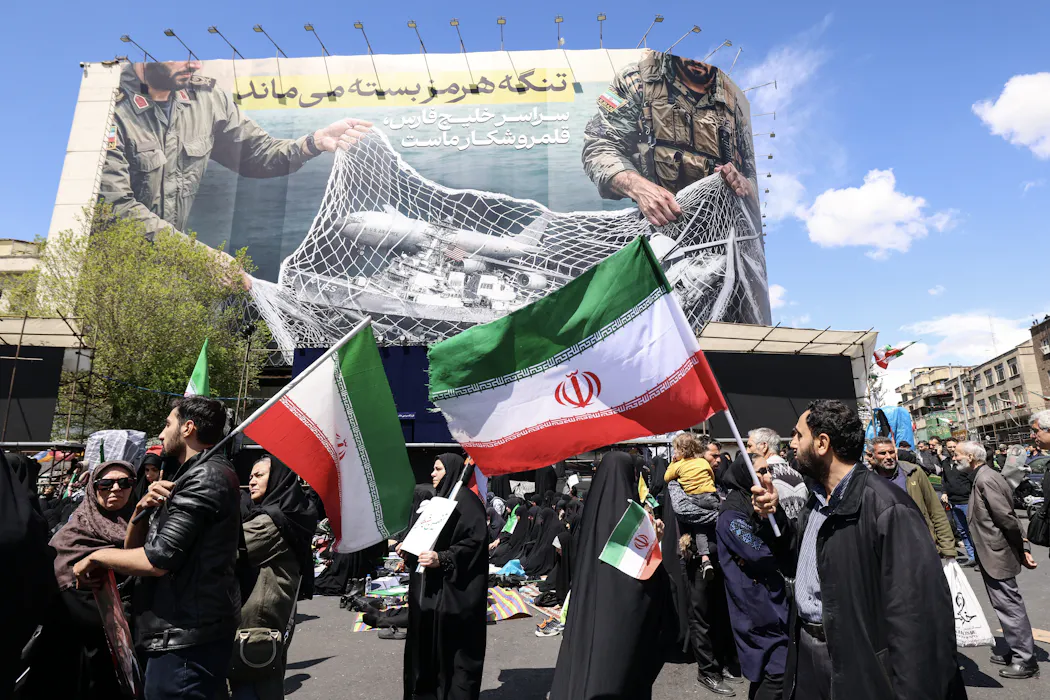
President Donald Trump on April 7, 2026, announced a ceasefire between the United States and Iran, after more than a month of war marked by U.S. and Israeli strikes against Iranian military leadership, Iranian retaliation against regional oil infrastructure and a global energy crisis.
As a former U.S. diplomat, I have found there are three ways that warring parties arrive at a ceasefire.
The first scenario happens when one party tires of war and asks for peace, as Hamas, the militant Palestinian organization, did when it pushed for a ceasefire with Israel in late 2023 and early 2024. But this strategy reveals weakness to the other side and thus seldom works. Israel ignored Hamas and continued the war in Gaza until October 2025.
Warring nations also reach ceasefires when a powerful third country insists the two parties stop fighting due to risks to world peace and regional stability. In the modern era, the U.S. has done this several times in the Mideast when it has leveraged influence over key players, such as Israel and Egypt. But with the Iran war, there is no country in a good position to do this.
The current U.S.-Iran ceasefire is a good example of the third way that agreements to stop fighting can happen. Both countries were tired of the costs and the ongoing risks of the war, and they sent signals to that effect.
Pakistan, which deserves praise for stepping in, picked up on this and offered to serve as an intermediary. For at least two weeks, assuming the ceasefire holds, the U.S., Iran and Israel can lick their wounds and consider their next moves, as they work out whether the conflict between Israel and Hezbollah is covered by the ceasefire.
Why were the United States and Iran ready for a ceasefire?
For the U.S. and Israel, the war didn’t go as planned. There was no true regime change in Iran and no uprising of its people.
Iran closed the Strait of Hormuz, a key maritime channel between the Persian Gulf and the Gulf of Oman, and maintained its ability to shoot down warplanes and attack its neighbors, including Israel, Saudi Arabia, the United Arab Emirates and Kuwait.
For Iran, the war has cost the lives of thousands of its citizens and dozens of its leaders. It has also ruined key infrastructure, and it had the potential to get much worse.

That’s how we got here. Now, where could the war go next?
One possibility is that the ceasefire lasts only two weeks, is shaky throughout – as seen with Israel’s bombing of Lebanon after the ceasefire was declared – and war resumes.
The world already knows what that looks like, with its impact on the global economy and the soaring financial costs to the U.S. military.
Another scenario is that the ceasefire is extended, either clearly or just de facto, with zero to minimal U.S. attacks or Iranian missile or drone launches. This is quite possible.
The third and best outcome would be if the two parties are able to use these two weeks, plus some extensions, to hammer out the key points of a peace deal.
What could this involve?
The two key U.S.-Israel demands are that Iran give up its nuclear weapons development and stop backing Hamas and Hezbollah, the Shiite militia with extensive influence in Lebanon.
At this point, I believe the Iranians should realize that nuclear weapons are not their best deterrence, and that their attempts to obtain them have led only to their isolation. Their true deterrence is their ability to close the Strait of Hormuz and choke off 20% of the world’s energy supply. For that, they need only drones and small speed boats.
Iran’s support of Hezbollah, which has contributed to the ruin of a once prosperous and democratic Lebanon since it launched military operations inside the country in 1982, is a liability to them as well.

Iran’s missile attacks during this war have made it clear that they would be able to deliver nuclear weapons if they had them. And their drone and missile strikes on their Muslim neighbors, including Qatar and Saudi Arabia, are only creating new enemies.
But what would the Iranians want in return?
First and foremost, an end to attacks by other countries attempting to topple their regime. Second, and just as important, a permanent lifting of sanctions so long as they end their support for terrorist groups and surrender their uranium. Unfortunately, such an agreement would do nothing for pro-human rights groups in Iran.
All parties would need to be committed to working out the many details for a ceasefire to last. Pakistan would need to stay the course as an honest broker and not get discouraged. The governments involved would need to be able to persuade their people that such a deal is acceptable.
Sound impossible? It’s been done many times in history. Think of how intractable the conflicts in Northern Ireland or between Israel and Egypt once seemed. The key element is for both sides to fear a resumption of war more than they do the consequences of a compromise peace.
A major problem is the lack of trust on both sides. The U.S. has seen Iran go back on promises before. Israel was traumatized by Hamas attacks in 2023. And Iran can’t keep up with Trump’s constantly changing signals and his bombing Iran while negotiating with the government there.
But if the ceasefire holds and negotiations are successful, the world could see an Iran that, at least, is no longer a menace to its neighbors. And Iran would see itself being readmitted to the world economy, which it desperately needs.
If it doesn’t work, and we go back to how things were before the ceasefire, we’ll be back to the U.S. and Israel raining down hard-to-replace munitions on Iran, and Iran lashing out with drones and missile attacks against a dozen countries, with the world economy taking a beating.

Donald Heflin does not work for, consult, own shares in or receive funding from any company or organization that would benefit from this article, and has disclosed no relevant affiliations beyond their academic appointment.
Politics + Society – The Conversation