 Parke is known for having some iconic collaborations, but this one is definitely their biggest and best yet.
Parke x Target just launched on April 25, and it’s full of styles that every it girl on…
E! Online (US) – Top Stories









Parke is known for having some iconic collaborations, but this one is definitely their biggest and best yet.
Parke x Target just launched on April 25, and it’s full of styles that every it girl on…
E! Online (US) – Top Stories
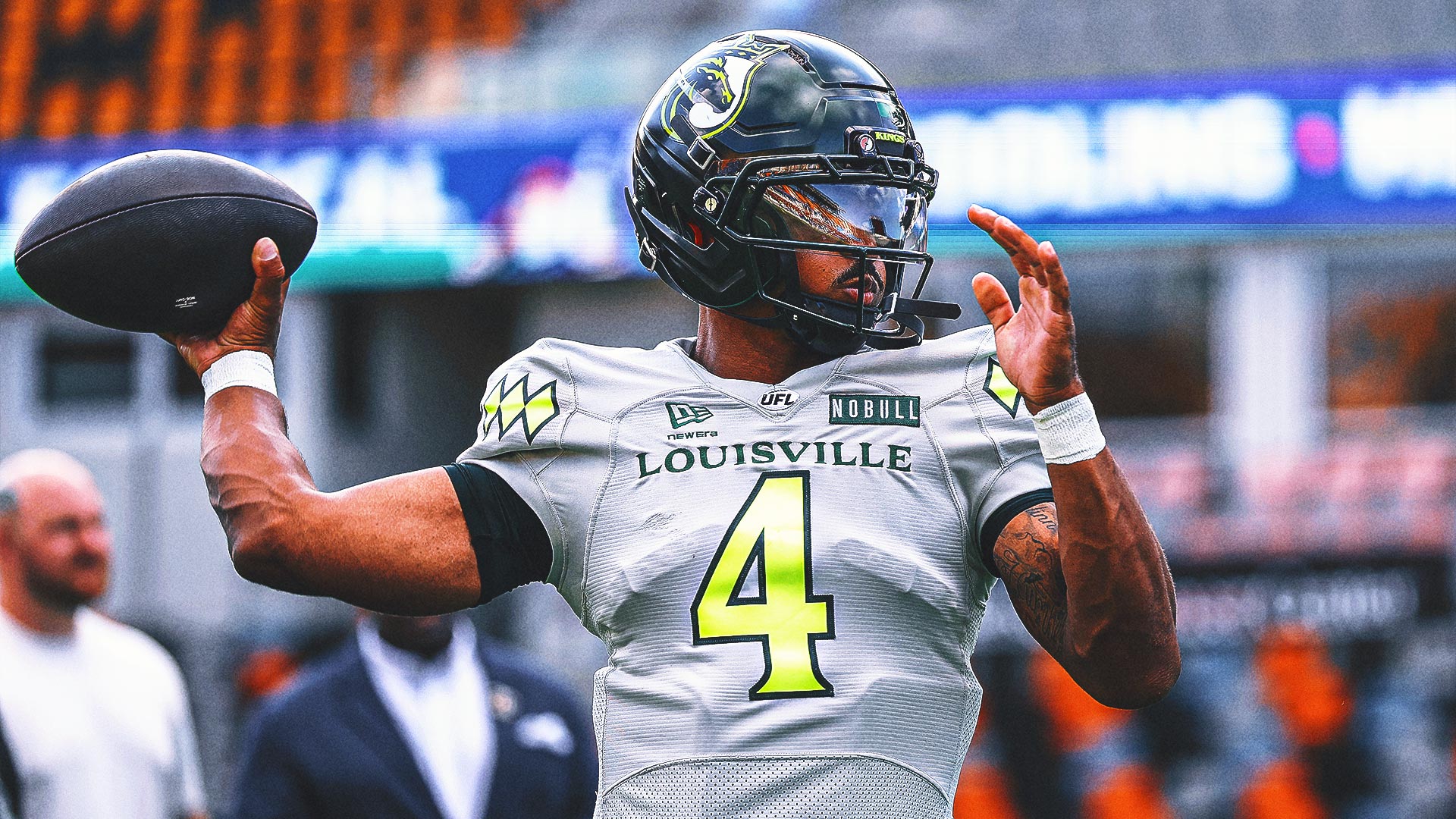
Week 5 of the 2026 UFL season started off with a bang, as the DC Defenders (4-1) went on the road and crushed the Birmingham Stallions (1-4) by double digits at Protective Stadium in Alabama on FOX UFL Friday. It was the first game for both teams after the league announced a pair of massive trades involving four organizations last weekend. On Saturday, the St. Louis Battlehawks (3-2) stunned the previously undefeated Orlando Storm (4-1) at Inter&Co Stadium in Florida. Things wrapped Sunday with a doubleheader. First, the Houston Gamblers (2-3) narrowly outlasted the Columbus Aviators (1-4) at home at Shell Energy Stadium in Houston. Nearby, the Louisville Kings (2-3) went on the road and demolished the Dallas Renegades (3-2) by 20-plus points at Toyota Stadium in Frisco, Texas. Here are the results from Week 5: DC Defenders 45, Birmingham Stallions 28 Key players: Defenders QB Jordan Ta’amu (15-for-22 for 275 yards, four touchdowns), WR Ty Scott (3-for-4 for 84 yards, two touchdowns), WR Erik Ezukanma (2-for-2 for 77 yards), RB Xazavian Valladay (eight carries for 50 yards, two touchdowns); Stallions QB Dorian Thompson-Robinson (28-for-43 for 313 yards, two touchdowns), WR Justyn Ross (9-for-11 for 107 yards), WR Deon Cain (5-for-10 for 57 yards, one touchdown). Game recap: The Defenders hit pay dirt on the opening drive of the game, taking just six plays to find the end zone after a monster 60-plus-yard kickoff return set DC up for success early. The Stallions, on the other hand, didn’t get off to a smooth start. Newly minted Birmingham quarterback Dorian Thompson-Robinson was picked off in the red zone on the team’s first drive, but he bounced back on the Stallions’ second possession to get them on the board, 7-6. DC extended its lead with a rushing score midway through the second quarter, and a costly fumble by Birmingham gave the ball right back to the Defenders. Quarterback Jordan Ta’amu capitalized on the newfound possession, throwing up a dazzling 45-yard touchdown to make it a 15-point game, 21-6. Thompson-Robinson was able to use his legs to get the Stallions into the end zone before halftime, closing the gap slightly to 21-13. Things were looking up for the Stallions early in the second half. They came out on the break swinging, cashing in for a touchdown to open the third quarter and pull within two points, 21-19. That momentum was short-lived though. Turnovers were Birmingham’s kryptonite. After the Defenders scored again to make it 28-19 midway through the frame, the Stallions threw a pick and had a turnover on downs. DC, on the other hand, rattled off a field goal and a touchdown to close out the third quarter. Birmingham opened the fourth quarter with another turnover on downs, and DC made the most of the opportunity — firing back with another touchdown to take a 20-plus-point lead, 45-19. The Stallions were able to score one more time before the end of the frame, but it was too little too late for the home team. Though the Defenders got the win, kicker Matt McCrane had an uncharacteristically poor showing, going 1-for-3 and missing from 36 yards and 62 yards. Up next: In Week 6, the Defenders are playing host to the Renegades on Saturday afternoon, and the Stallions are on the road to battle the Storm on Sunday night on FOX. St. Louis Battlehawks 25, Orlando Storm 17 Key players: Battlehawks QB Harrison Frost (20-for-31 for 185 yards, one touchdown), WR Steven McBride (4-for-5 for 53 yards), RB Jarveon Howard (12 carries for 59 yards), S Jordan Mosley (eight tackles, one pass defended); Storm QB Jack Plummer (22-for-44 for 143 yards, one touchdown), WR Elijhah Badger (4-for-7 for 37 yards, one touchdown). Game recap: The Battlehawks jumped out to an early 7-0 lead, going 62 yards in just eight plays on their opening drive to set the tone early. The Storm, on the other hand, turned the ball over on downs on their first drive. Orlando appeared to catch a break on St. Louis’ next drive after Battlehawks quarterback Harrison Frost was picked off near midfield, giving the Storm the ball back with just over four minutes left in the first quarter and all the momentum. However, Orlando turned the ball over on downs yet again. The Battlehawks opened the second quarter with another touchdown drive, jumping out to a 12-0 lead with ease. They followed that up with a field goal to make it a 15-0 game headed into halftime. Orlando punted twice and fumbled in the second quarter, failing to get on the board. The Storm started the second half with another turnover on downs, while the Battlehawks padded their lead with another touchdown drive. Things picked up for Orlando after that, though, with the Storm rattling off back-to-back scores to end the shutout and keep things competitive. The first came after a lengthy 82-yard, 10-play drive, and the second came after a clutch blocked punt that put the Storm back on the 1-yard line. St. Louis stumbled again later in the quarter, turning the ball over on downs late in the third. The Storm missed a field goal early in the fourth quater and were never able to find a rhythm despite pulling within eight after being down by as many as 25. Up next: In Week 6, the Battlehawks are on the road to face the Kings on Thursday night on FS1, and the Storm are playing host to the Stallions on Sunday night on FOX. Houston Gamblers 17, Columbus Aviators 13 Key players: Gamblers QB Nolan Henderson (13-for-25 for 146 yards), WR Lawrence Keys III (3-for-4 for 43 yards), WR Jontre Kirklin (3-fpr-6 for 32 yards), LB Marvin Moody (11 tackles, one tackle for loss), DE Malik Fisher (six tackles, 1.o sacks, one tackle for loss); Aviators QB Jalan McClendon (15-for-22 for 160 yards), WR Tay Martin (3-for-4 for 40 yards), TE Alize Mack (3-for-4 for 42 yards), LB Tony Fields (13 tackles), LB Fred Thompkins (eight tackles, two tackles for loss). Game recap: The Gamblers came out of the gate with a statement-making opening drive. Houston went 85 yards in 13 plays, eating up over seven minutes off the clock to take an early 7-0 lead. The Aviators, on the other hand, went three-and-out on their first drive of the game. Just like that, things were already into the second quarter, where the Gamblers cashed in for another touchdown to make it a 14-0 game. This is where the tide changed for Columbus, which rattled off back-to-back scores to make it a one-point game headed into halftime, 14-13. It would have been a tie game if not for a missed extra point on their second score. Both teams struggled to find a rhythm early in the second half. Both sides went three-and-out to open the third quarter and then followed that up with both teams turning the ball over on downs on their next possessions. The Aviators had one more turnover before the end of the third, while the Gamblers kicked a short field goal first thing in the fourth quarter to pad their lead, 17-13. Columbus went for a field goal as well on its next drive but missed from 29 yards out. The Gamblers punted on their next drive, giving the Aviators the ball back with just over six minutes to play. Instead of capitalizing here, Columbus fumbled just outside the red zone. Houston punted once again late in the frame, giving the road team the ball back with less than a minute remaining. The Aviators fumbled once again in the game’s final seconds, and things ended there. Up next: In Week 6, these two teams are back at it again, this time with the Aviators hosting Friday night on FOX. Louisville Kings 47, Dallas Renegades 25 Key players: Kings QB Chandler Rogers (13-for-18 for 150 yards), RB Ian Wheeler (13 carries for 62 yards, four touchdowns), WR Tarik Black (5-for-5 for 59 yards); Renegades QB Austin Reed (14-for-28 for 195 yards, one touchdown), RB Ellis Merriweather (18 carries for 55 yards, two touchdowns), TE Curtis Hodges (2-for-3 for 88 yards, one touchdown). Game recap: Both teams got off to slow starts. The Renegades turned the ball over on downs on back-to-back drives, while the Kings notched a field goal before turning the ball over on downs themselves to finish out the first quarter. It was a 3-0 game headed into the second quarter, and that’s when things went awry for Dallas. First, quarterback Austin Reed was picked off inside the red zone, and the interception was taken all the way to the house to put Louisville in front by 10. On the next play from scrimmage, Reed was picked off yet again, this time getting the Kings up on the Renegades’ 40-yard line. Louisville capitalized on the two consecutive turnovers, cashing in for a rushing score on the ensuing drive to put the road team up 16-0. Dallas finally got on the board with a touchdown of its own late in the frame, stretching out a 14-play drive to hopefully run out the clock. The Kings had the last word of the first half, however, punching in a short field goal in the final few seconds to make it a 19-7 game at the break. The Renegades opened the second half with a big touchdown drive that allowed them to pull within six, 19-13. The Kings, of course, had a few more tricks up their sleeves and wasted no time answering with a touchdown of their own. With that, Louisville led 26-13 late in the third quarter. Dallas ended the frame with Reed throwing his third interception of the game, which set up the Kings nicely to start the fourth quarter. Louisville made the most of the newfound possession, hitting pay dirt right away to make it a 20-point game, 33-13. Disaster struck for the Renegades when Reed was picked off for the fourth time and for the Kings’ second pick-six of the day. That ultimately sealed Dallas’ fate. Down 40-13, the Renegades scored again late in the fourth, but it was too little too late. The Kings fired back with another easy score to make it 47-19. Dallas added a touchdown for good measure before things ended. Up next: In Week 6, the Kings are playing host to the Battlehawks on Thursday night on FS1, and the Renegades are on the road to take on the Defenders on Saturday afternoon.Latest Sports News from FOX Sports
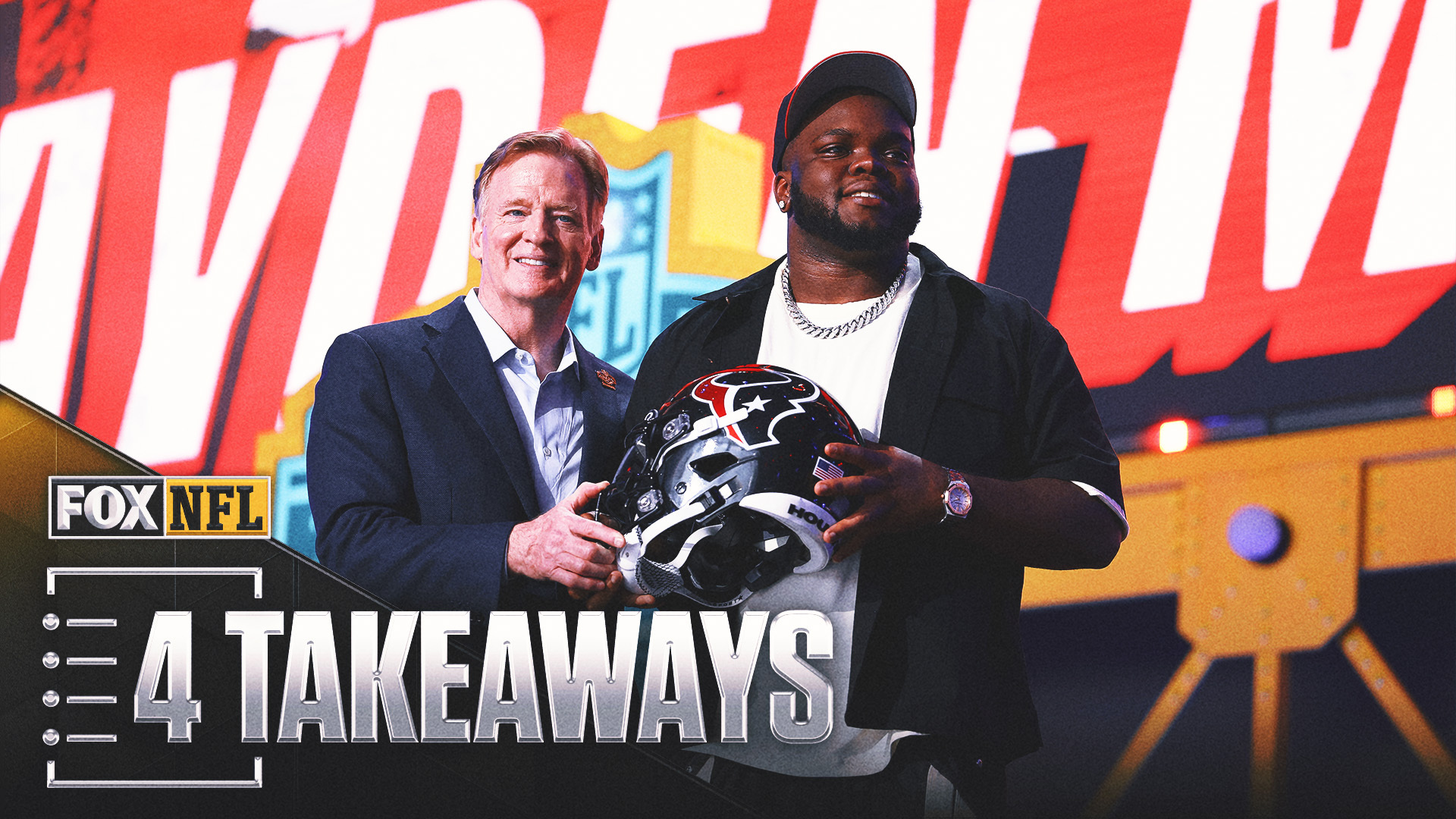
Night 2 of the 2026 NFL Draft put some prominent trends on display on both sides of the ball. Defensively, we saw an early run on defensive tackles, indicating a priority for coordinators around the NFL. On the other side of the ball, the tight ends selected show how offenses around the league are emphasizing the position to create mismatches. Here are my takeaways from the second and third rounds of the draft: 1. Carson Beck and Drew Allar prove that traits still matter in scouting rooms Despite the skeptics dismissing the importance of size and tools in the evaluation process, the selections of Beck (by the Cardinals at No. 65) and Allar (by the Steelers at No. 76) show that coaches and scouts are still chasing prototypes at the quarterback position. Measuring 6-foot-4, 233 pounds, Beck is a throwback with a classic drop-back playing style that would have worked well in the 1990s. He flashes the ability to make every throw from the pocket with touch, timing and anticipation. While he had some untimely turnovers that clouded his evaluation, scouts were enamored with his experience (43 college starts) and management skills as the leader of two championship-caliber programs at Georgia and Miami. Allar measures in at 6-foot-5, 228 pounds with elite arm talent, but he has struggled with accuracy and ball placement. Despite his issues, the former five-star recruit logged 35 college starts, during which he flashed enough skills as a pro-style passer to warrant some consideration as a developmental prospect with starting potential. Yes, the Penn State product’s inconsistencies made it hard for some evaluators to view him as a legitimate QB1 consideration. But new Steelers coach Mike McCarthy’s skill as a quarterback developer (SEE: Aaron Brooks, Aaron Rodgers, Dak Prescott) gives Allar a shot to defy the odds as a potential starter. With teams looking for quarterbacks with starting potential, the size and traits continue to weigh heavily in the evaluation. As a result, I am not surprised that Beck and Allar — highly-touted quarterbacks viewed as QB1s of their respective classes at various stages of their collegiate careers — came off the board in the third round as developmental prospects. 2. Run-stoppers rule Night 2 The top of the second round featured a run on run-stopping defensive tackles, which was a direct reaction to the NFL’s renewed emphasis on the ground game. Kayden McDonald, Christian Miller and Lee Hunter were selected in the first 17 picks of Day 2. Defensive coordinators have leaned on general managers and scouts in this draft to add more big bodies to help them snuff out runs directed between the tackles. With more teams favoring two-high or split-safety looks to eliminate big plays, defensive playcallers need more big bodies on the frontline with “two-gap” potential to win with fewer defenders in the box. McDonald, Miller and Hunter excel at handling double teams, while also flashing enough quickness to win with finesse maneuvers (like the swim move). As the league returns to some of its rugged roots, with the running game back in prominence, the early run on defensive tackles is not a surprise. 3. New York Jets focus on changing the culture After a disappointing debut season, in which the New York locker room seemingly fell apart amid a mix of believers and non-believers feuding over the squad’s direction, Aaron Glenn & Co. have made a concerted effort to populate the roster with “winners” from championship-caliber programs. With their first four picks, the Jets took College Football Playoff participants from this past season: Texas Tech EDGE David Bailey (Round 1), Oregon TE Kenyon Sadiq (Round 1), Indiana WR Omar Cooper Jr. (Round 1) and Indiana CB D’Angelo Ponds (Round 2). While it’s rarely discussed in pre-draft coverage, teams covet players with winning pedigrees because they understand the standards and expectations of a championship program. The Jets are not close to title contention, but the team is laying the foundation for a playoff run by adding a handful of rookies with championship swagger to a revised roster that added quarterback Geno Smith, safety Minkah Fitzpatrick and linebacker Demario Davis in the offseason. 4. Offensive coordinators are stockpiling tight ends to create more mismatches The Los Angeles Rams opened up a can of worms with their clever utilization of “13” personnel (one running back, three tight ends and one wide receiver) to create mismatches all over the field. Teams have started to manipulate the numbers at the line of scrimmage, with multiple tight ends lined up close to each other to create extra gaps for off-tackle runs. The illusion of a run play with more tight ends can also produce big plays through play-action. Teams are also featuring more “YOZ” (tight ends lining up wider than wide receivers) formations, with the tight end’s wide alignment forcing linebackers and safeties out of their comfort zone. Regardless of how they’re looking to find an edge, offensive playcallers have found a cheat code utilizing ultra-athletic tight ends on the perimeter. The 2026 draft saw nine tight ends come off the board during the first three rounds, with a mix of “Y” (traditional tight end) and “FLEX” (H-back) playmakers selected on Day 2. The teams looking for throwback tight ends opted for Texas A&M’s Nate Boerkircher (Jacksonville Jaguars), Michigan’s Marlin Klein (Houston Texans) and Stanford’s Sam Roush (Chicago Bears). Meanwhile, playcallers intent on finding mismatch creators snagged Vanderbilt’s Eli Stowers (Philadelphia Eagles), Ohio State’s Max Klare (Los Angeles Rams) and Georgia’s Oscar Delp (New Orleans Saints). With the game evolving to feature more multi-TE sets, the run on tight ends in the first two days of the draft reflects the league’s changing landscape.Latest Sports News from FOX Sports

“Here we go,” is what borough manager Alekka Fullerton told assembly members at a meeting Tuesday, marking the start of budget deliberations.
The manager’s budget released at the start of this month, proposes holding the borough’s spending plan roughly in line with last year, with a decrease to property tax rates largely made-up for by a projected increase in sales tax revenue from the new seasonal sales tax rate.
War in Iran, however far away from the realm of municipal government, could throw a wrench in the works: the town is bracing for skyrocketing fuel prices and higher shipping costs for goods across the board, and over 500 residents have signed a petition asking the borough to cut taxes in response to the cost-of-living increase.
That discussion will play out at a town-hall Wednesday, scheduled for just after press time this week, and at the next few assembly meetings.
Simultaneously, the borough assembly is starting their process of editing the manager’s plan, including looking for potential spending cuts, many assembly members have said.
Early deliberation is broken down by different sections of the budget, like Tuesday’s meeting, which covered the areawide general fund.
What does it mean for the budget to be broken down into funds?
Borough services are largely split up and paid for by the populations they serve. The general fund encompasses services that are meant to benefit everyone living within the borough’s boundaries — services like the school, which any student in the borough may attend.
With the broadest benefits, the general fund is paid into by broad funding sources that don’t come from just one specific area in the borough. For instance, roughly 43% of the general fund is expected to be paid for by property tax this year. That’s specifically the portion of the property tax paid equally by all borough land-owners — 5.74 mills in the manager’s proposed budget, or 0.574% of a home’s value.
It’s slightly confusing, given that residents in the townsite do pay a higher property total property tax rate, proposed by the manager at 10.09 mills for the upcoming year. That extra chunk of property tax, however, pays into the townsite service area — meant to encompass services specifically benefitting townsite residents.
Those services include the police department. If there’s an emergency — “basically if there’s a life threatening situation,” Fullerton said this week — the police may operate out Lutak, Mud Bay, or out the highway north of the Airport. Those out-of-townsite residents do contribute to police costs when they pay sales-tax on purchases in-town. Sales-tax revenue is split between multiple funds. But otherwise, the police department’s main duties are in town, funded by taxpayers in town.
Other services in the townsite service area fund include townsite road-maintenance and borough public works.
In terms of specific changes to these funds this year, Tuesday’s meeting outlined a picture of persistently creeping costs across the board. For instance, the borough server software, VMWare, has become a subscription service, adding an additional $11,000 to borough technology costs for the upcoming year.
The assembly will hold a committee-of-the-whole meeting to discuss the townsite service area on Tuesday.
The post Budget Nuggets: A budget primer on different funds and creeping costs appeared first on Chilkat Valley News.
The Haines School will host the Region V Art Festival this weekend, welcoming in roughly 70 students from across Southeast.
Students will attend two instructional workshops a day from Friday through Monday. The sessions will be taught by art teachers from the visiting Region V schools, as well as local artists Tassja Letchworth, Kelleen Adams, John Svenson and Skweit Jessie Morgan.
The annual art festival began in 1998, first in Wrangell by teacher Kirk Garbisch with the help of a Kake art instructor and carver Rick Mills.
Its purpose for the last 30 years has been to encourage the exchange of art and instruction among high school students. It rotates among Southeast communities.
This year’s festival offers a range of workshops, including glassblowing, creating a formline longboard, beading, photography, halibut-hook carving and still-life painting. Each student chooses two options and spends an average of 15 hours in each workshop over four days.
The art fest will conclude with an awards show and exhibition of student work open to the public Monday, 6:30 – 7:30, in the Haines High School Gym.
Sue Bahelda of the Wrangell Sentinel contributed reporting to this story.
The post Haines to host Region V art fest this weekend appeared first on Chilkat Valley News.

 Content warning: This story discusses suicide.
Darrell Sheets was in a dark place before his death.
The Storage Wars star—who died in an apparent suicide on April 22 at age 67—had been vocal about…
E! Online (US) – Top Stories

 Paul “Pauly D” DelVecchio won’t be saying “yeah, buddy!” if his daughter Amabella wants to watch Jersey Shore.
Indeed, the reality star admitted that he’d have some hesitations about letting his…
E! Online (US) – Top Stories
A proposed new gold mine north of Juneau expects to create 277 jobs and a pre-tax net present value of nearly $1 billion during an initial seven-year production cycle, a representative of the company developing the project told Juneau business leaders Thursday.
The New Amalga Gold Project, located near Herbert Glacier about 20 miles north of downtown Juneau, is intended to be a low-impact site where employees will commute to work daily from Juneau and ore will be shipped elsewhere for processing, said Graham Neale, director of corporate and external communications at Grande Portage Resources Ltd., during a presentation to the Greater Juneau Chamber of Commerce.
The tentative plan is to drive truckloads of ore to a terminal at Cascade Point, about 10 miles further north, about once an hour, with a ship picking up and transporting stockpiles weekly, he said. Plans for the mine, which doesn’t yet have an opening target date, have been in the works for more than a decade.
“They’ve really been exploring it for the last 12 years or so, intentionally keeping a low profile, just because that’s what you do in exploration,” Neale said. “You want to make sure that you have something to talk about before you start talking about it.”
Attention to the mine — and controversy about it — have grown during the past year due to the Dunleavy administration’s strong advocacy for putting a state ferry terminal at Cascade Point that has been strongly opposed by travelers and regional officials. The administration has already approved contracts spending nearly $30 million for infrastructure, including a road the mine could also use, prompting critics to assert that aiding the company is a primary purpose of the state’s involvement.
Neale acknowledged the questions raised about the mine’s role at Cascade Point. He said the ferry terminal and ore shipping facilities are separate projects, although his company does need a road to the site regardless of the state’s plans. State officials announced last month the first stage of work, which was scheduled this summer, is being postponed beyond this year due to permitting issues raised by the U.S. Army Corps of Engineers.
“Ultimately, if the Department of Transportation and Public Facilities doesn’t build a road, Grande Portage would look at doing it themselves,” he said.
Access to a site for shipping ore is key to what Grande Portage’s website calls “a low-footprint, low-initial-capital scenario” for the Amalga mine.
“When you look at the actual footprint of what would be required on surface or would be needed to support this it’s roughly 50% of what you would see at a conventional underground mine site like you would see at Kensington, Greens Creek or somewhere down in Nevada,” Neale said. “That’s simply because there’s not going to be any processing facilities, there not going to be a need for tailings storage, the need for waste rock storage. We don’t plan on building a camp. So everybody’s that’s going to work at this mine, we’re going to get them home at the end of every shift. That’s the plan right now.”
A preliminary economic assessment published April 15 by Grande Portage states containers of ore will be “loaded onto barges for transport to deepwater port facilities in British Columbia, where the containers would be emptied and the material loaded onto trans-oceanic bulk vessels for overseas processing. Empty containers would be returned to the minesite on the back-haul for reuse.”
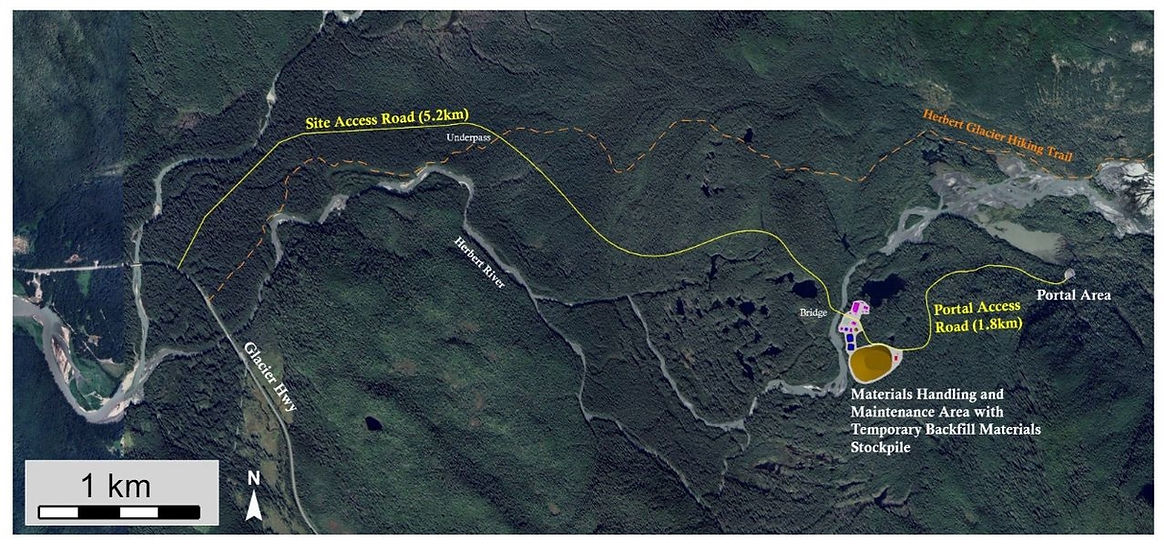
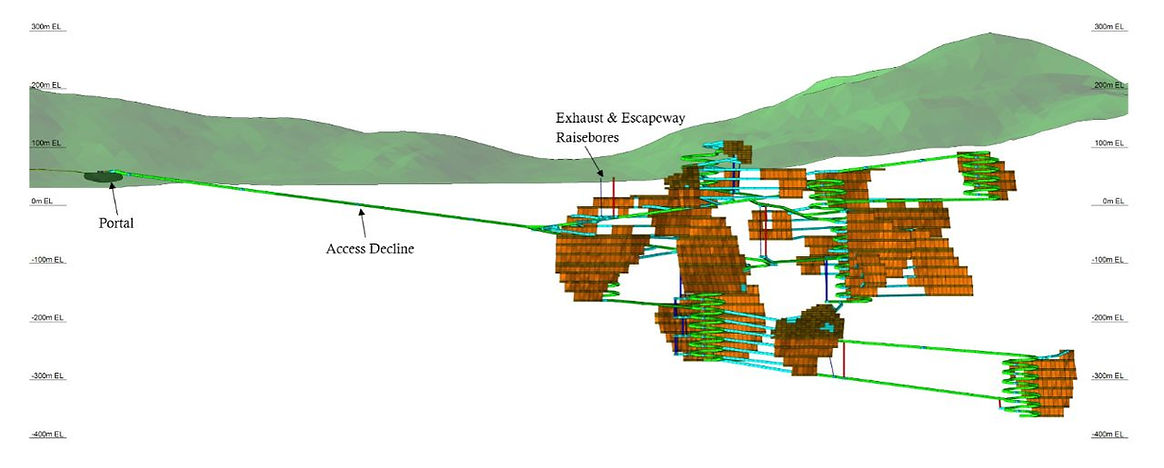
A map presented Thursday shows the company is planning for a 3.25-mile access road from Glacier Highway to a maintenance and materials storage area, with another road extending about a mile to the portal area accessing the underground mine. The mine as currently designed features a network of extraction areas and tunnels extending up to 1,200 feet beneath the surface.
Among Grande Portage’s plans for this year, according to a press release issued Tuesday:
• About 4,300 meters of diamond drilling from up to 14 drillholes to conduct surface mapping and trench sampling, which “will characterize the geotechnical and hydrogeological aspects of the deposit rock mass in order (to) gather data necessary for the environmental review and permitting process as well as to inform mine development plans.”
• Construction of environmental monitoring infrastructure, including meteorological stations and stream monitoring equipment.
• Preparations for initial work on a site access road, pending state approval.
• Conducting baseline studies necessary for the environmental review and permitting process, “including wildlife and avian surveys, wetlands surveys, ongoing surface water sampling, cultural and archeological surveys, geochemical studies, socioeconomic studies, and more.”
As of now the Amalga mine appears comparable in size and mineral grade to the Kensington mine about 20 miles further north that began production in 2010, Neale said. The Kensington mine surpassed 1 million ounces of gold produced in 2019 and in 2025 produced more than 106,000 ounces, according to owner Coeur Alaska Inc.
Grande Portage’s preliminary economic assessment projects shipping 1.05 million ounces of gold during the initial seven-year production cycle. The company’s webpage for the project, citing a mineral resource estimate from June of 2024, states there is an “indicated resource” of about 2 million ounces of gold and nearly 1.4 million ounces of silver.
The company expects to spend more than $500 million for capital projects, including $254.8 million prior to beginning production, and to make a profit quickly by recovering its capital costs slightly more than a year after operations begin, according to Neale’s presentation.
Other mines in the area are seeing their operational years extended, with Coeur Alaska last year announcing a five-year extension until 2029 and the Hecla Greens Creek Mine getting approval in 2024 for an expansion that could extend its life 18 years. Neale said that is a possibility with the Amalga project, but it’s not known how likely or how long an extension might be.
“Greens Creek started in 1989 with a nine-year mine life and Kensington started in 2011 with a 10-year mine life, and they’re both still going,” he said. “So that’s just the type of deposits that these are. It’s like driving in the dark. You just keep going until the resources tell you you can’t.”
Grande Portage projects it will pay about $340 million in federal, state and local taxes, plus $134 million in royalties during the initial seven-year operating window, according to Neale’s presentation.
The company also expects a $979 million pre-tax net present value ($721 million post-tax) on a base gold price of $3,200 an ounce, but those predictions based on production and price have a significant degree of uncertainty. The pre-tax value could exceed $2.1 billion at the recent average spot price of $5,000 an ounce, and have a negative value at $1,600 an ounce.
Among the questions Neale was asked during his presentation to the chamber is the impact the mine road and surface infrastructure will have on recreational use of the area. Much of a planned mine access road follows a roughly parallel path to the Herbert Glacier Trail, for instance, and questions about the mine’s presence were raised when the U.S. Forest Service announced earlier this year a recreational cabin planned in the area is being put on hold.
He said the design of the mine site, which as of now is at about a 50% level of confidence, attempts to use natural features to shield much of the infrastructure from areas where recreational users will be such as the trail.
“That location has been initially assessed for the amount of flat land that is available, minimizing wetlands disturbance, and also the greatest viewshed that we can get from the Herbert river trail, and the viewpoint and the glacier itself,” he said. “So again, this is a preliminary assessment. This may not be the final, may not even be close to the final, but this is where if you look at the project right now from a 50% level this is what makes the most sense.”
This story was originally published by the Juneau Independent.
The post Amalga mine seeks to lower cost, impact by shipping gold from Cascade Point elsewhere for processing appeared first on Chilkat Valley News.

 Helena Bonham Carter is checking out of The White Lotus early.
Nine days after production began in France for the fourth season of the Mike White-created series, HBO confirmed that the Harry…
E! Online (US) – Top Stories

 Nearly 17 years after Michael Jackson’s death, his beloved chimpanzee Bubbles is still aping around.
That’s right, the primate—now 43 years old—is alive and well, living at the Center for Great…
E! Online (US) – Top Stories