Treaty Oak Revival will no longer perform at the 2026 Gulf Coast Jam, according to a statement shared by the band. Festival organizers later confirmed that Jessie Murph has been added to the lineup in their place.
Treaty Oak Revival broke the news to fans via Instagram Stories, explaining that their team was unable to come to an agreement with the festival.
Treaty Oak Revival; Photo by Paige Williams
“Unfortunately, Treaty Oak Revival will no longer be performing at this year’s Gulf Coast Jam presented by Jim Beam. Despite good faith efforts on both sides, neither the festival nor the artist’s teams were able to come to mutually agreeable terms in time for the event.”
Treaty Oak Revival Instagram Story
Following the announcement, Gulf Coast Jam revealed that Jessie Murph will take the stage on Thursday, May 28, performing ahead of headliner Keith Urban.
“Jessie is a truly unique artist who has exploded over the past couple of years, and we’re excited to see her next month,” executive producer Rendy Lovelady shared.
“Jessie Murph is absolutely on fire right now, and we can’t wait to have her hit our stage,” COO Mark Sheldon added.
Gulf Coast Jam 2026
In response to the change, several fans took to social media to share their disappointment over Treaty Oak Revival’s removal from the lineup.
“I love Jessie but I bought vip for Treaty and Koe to wake up to this is so sad,” one user wrote, while another added, “I bought these tickets for Treaty Oak.”
The 14th annual Gulf Coast Jam presented by Jim Beam is set to take place in Panama City Beach from May 28 through May 31, 2026. The festival will also feature headlining performances from Post Malone, Chris Stapleton, and Riley Green, along with more than 20 additional artists.
We have tragic news to report from the world of reality television today.
Storage Wars star Darrell Sheets has passed away at the age of 67.
News of Sheets’ death comes courtesy of a report from the Lake Havasu City Police Department in Arizona.
Darrell Sheets attends A&E Networks 2013 Upfront at Lincoln Center on May 8, 2013 in New York City. (Photo by Laura Cavanaugh/Getty Images)
A spokesperson says police responded to a call about “a reported deceased individual.”
“Upon arrival, officers located a male subject who suffered from what appeared to be a self-inflicted gunshot wound to the head,” read the press release.
“The male was pronounced deceased on scene, and the Lake Havasu City Police Department’s Criminal Investigations Unit was notified and responded to the scene to assume the investigation,” the spokesperson continued, adding:
“The body was ultimately turned over to the Mohave County Medical Examiner’s office for further investigation. The male subject has been identified as Darrell Sheets, a 67-year-old resident of Lake Havasu City, and Darrell’s family has been notified.”
No official cause of death has been revealed, but People and other outlets are reporting that Sheets appears to have died of a self-inflicted gunshot wound.
A beloved figure among Storage Wars fans, Sheets’ bold approach to auctions earned him the nickname “the Gambler.”
He stepped away from the show in 2023 to focus on running his consignment shop, Show Us Your Junk, in Havasu City.
In a statement, issued to People, the show’s producers mourned Sheets loss.
“We are saddened by the passing of a beloved member of our Storage Wars family, Darrell “The Gambler” Sheets. Our thoughts are with his family and loved ones during this difficult time,” they said.
Always candid with fans, Sheets opened up about a heart attack he had suffered in 2019:
“Well here we go I wasn’t going to say anything, but you all have been the greatest friends and fans. I’ve been very sick for 3 months and two nights ago I had a mild heart attack, found out I have congestive heart failure and a severe issue going on with my lung,” he wrote at the time.
“All your prayers would be deeply appreciated thank you for being there for me it’s been a great ride #storagewars # Romney has been by my side through all of this she is a good women and I love her,” he added of his then-fiancé Romney Snyder.
Sheets is survived by his two children, son Brandon and daughter Tiffany. We will have further updates on this developing story as new information becomes available.
Alabama quarterback Ty Simpson has a strong chance of knowing where he’ll end up in the NFL on Thursday night, the Philadelphia Eagles continue to ask teams to pay a premium price for A.J. Brown and the New York Giants are in love with a top wide receiver prosect in the 2026 NFL Draft. Those are just a few of the things FOX Sports NFL insider Jay Glazer is hearing on the eve of draft night. Appearing on FS1’s “Wake Up Barstool” on Wednesday, Glazer shared a few pieces of intel on what to expect on Thursday night and potentially in the coming weeks. Here’s a bit more on what Glazer’s hearing from around the NFL. Ty Simpson will be a first-round pick Not only have there been questions about how early Simpson could be selected on Thursday night, but there may now be some clarity. Glazer is confident that Simpson will come off the board in the first round. Some potential landing spots for Simpson in the first round include the New York Jets at No. 16, the Pittsburgh Steelers at No. 21, or a team looking to trade back into the late first round. One team Glazer specifically mentioned as a possibility is the Arizona Cardinals. The Cardinals are unlikely to select Simpson with the No. 3 overall pick, but a trade up from No. 34 is a more realistic scenario. Moving into the back end of the round would also allow them to secure a fifth-year option, which often motivates teams to trade up on draft night. Simpson is coming off just one season as a starter at Alabama after spending two years behind Jalen Milroe in Tuscaloosa. He put together a strong junior season, completing 64.5% of his passes for 3,567 yards, 28 touchdowns, and five interceptions. All signs point to Simpson being one of the more intriguing quarterback selections on draft night as teams weigh his upside against his limited starting experience. Eagles holding firm on high asking price for A.J. Brown trade The A.J. Brown saga has been one of the defining offseason storylines, and while a post-June 1 trade to the New England Patriots has been expected, questions remain about the return. Glazer still believes the Eagles are holding firm on their demand for a first-round pick in any deal. “The Eagles are still looking for a first-round pick,” Glazer said. “I know the Patriots aren’t there yet.” Brown, 28, is under contract through the 2029 season and is coming off his least productive year since 2021 with the Tennessee Titans. He finished the season with 78 receptions for 1,003 yards and seven touchdowns, including seven games in which he was held under 50 yards. The Los Angeles Rams and Patriots have been the two teams most closely linked to Brown, but all signs point toward him ultimately being dealt to New England, potentially as early as this summer. As talks continue, the final price tag and timing of any deal will likely depend on whether New England is willing to meet Philadelphia’s steep asking price. Both sides appear positioned for a standoff that could stretch deeper into the offseason as the draft approaches. What will Giants do with their two top-10 picks? The New York Giants have been heavily connected to Ohio State safety Caleb Downs in recent days, but Glazer is not sold on him going No. 5 overall. The player he continues to hear is high on the Giants board is Arizona State wide receiver, Jordyn Tyson. “I don’t know if I’m sold on that one as everyone else,” Glazer said on Downs going No. 5 overall. “I think you’re looking at the offensive line or wide receiver and I do know they kind of haven’t hidden their love of the wide receiver from Arizona State.” After trading defensive lineman Dexter Lawrence for the No. 10 overall pick, the Giants now own two selections inside the top 10. That gives them added flexibility to address multiple roster needs on both sides of the ball, if they choose to. “I don’t know if five is too high, maybe 10,” Glazer said of Tyson. “People love him, but he’s just been hurt a lot. But they think he is so dynamic.” Tyson finally found his footing with the Sun Devils after transferring from Colorado, but injury concerns have followed him throughout the draft process. He’s battled multiple injuries during his college career, but has performed well when available. Last season with the Sun Devils, Tyson played in nine games, finishing with 61 receptions for 711 yards and eight touchdowns. With two picks inside the top 10, the Giants are positioned to be one of the most active and unpredictable teams early in the draft.Latest Sports News from FOX Sports
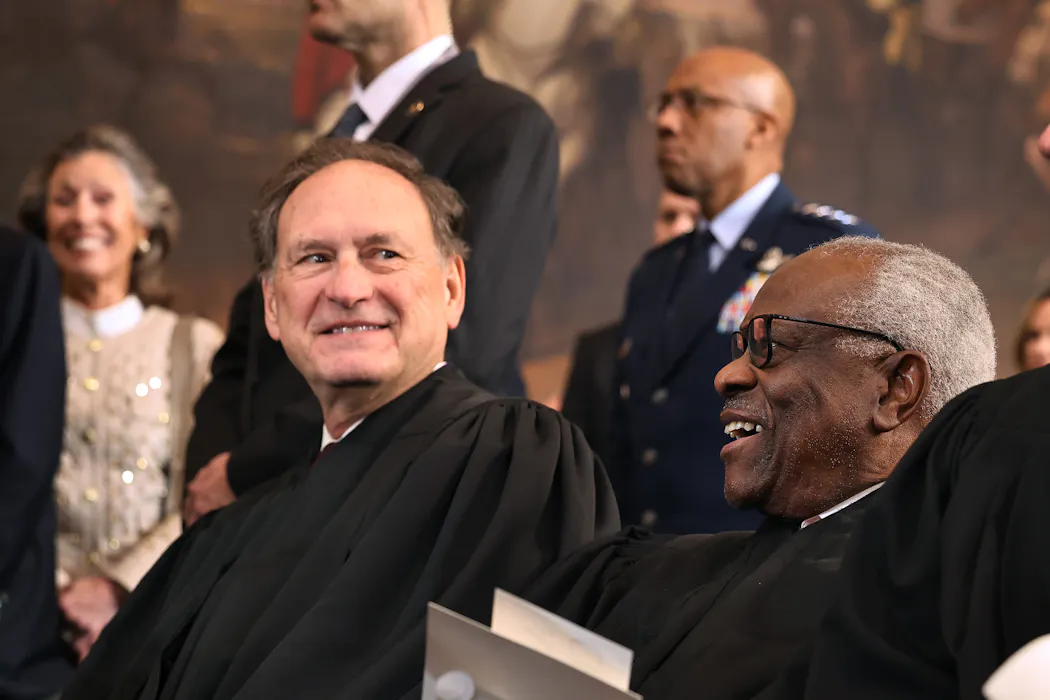
Trump praised Alito as “a great justice” and said that he is prepared to appoint a replacement, should Alito retire.
Trump added, “In theory, it’s two – you just read the statistics – it could be two, could be three, could be one.”
Trump didn’t say who the other potential retiring justices are. Speculation from pundits is that he is referring to Justice Clarence Thomas, 77, another solidconservative vote. Thomas, appointed by George H.W. Bush in 1991, is the court’s oldest justice and longest-serving member.
If Democrats were to take over the Senate following the midterms, it is very unlikely they would confirm a Trump-appointed Supreme Court nominee. Instead, they would probably follow the precedent set by Republicans in 2020 and block a Trump pick.
The clock is ticking on November’s midterm elections, and Democrats’ chances of taking back the Senate are improving. Assuming a current Supreme Court justice retires, here’s what has to happen for Trump and Senate Republicans to successfully confirm a successor.
The Supreme Court confirmation process
The Constitution says that the Senate provides “advice and consent” on presidential appointments to the Supreme Court. Over the course of the nation’s history, this has developed into a complex process.
Once the Senate receives a nomination from the president, it goes to the Judiciary Committee.
This is where the most public part of the confirmation process takes place: confirmation hearings. These typically last three to four days and feature a high stakes question-and-answer session with the nominee.
Prior to the hearings, senators and the nominee engage in a substantial amount of preparation.
Senators, with their staffs, do extensive background research on the nominee, which helps inform their questioning. Some of this is accomplished through the Senate Judiciary Committee questionnaire, to which nominees provide written answers. Supreme Court Justice Ketanji Brown Jackson’s 2022 questionnaire was 149 pages long. It included questions about organizational memberships, public speeches and judicial opinions authored.
Supreme Court nominee Ketanji Brown Jackson listens to U.S. Senate Judiciary Committee members on Capitol Hill on March 21, 2022. AP Photo/J. Scott Applewhite, Pool
Meanwhile, the nominee makes courtesy calls to senators to build support for confirmation.
At roughly the same time, the nominee takes part in hearing preparation, known as “murder boards.” Here, the nominee’s allies play the roles of members of the Judiciary Committee, anticipating the type of tough questions the nominee will face from skeptical senators from the opposition party of the appointing president.
During Jackson’s murder boards, for instance, the focus was on expected Republican attacks that Jackson was soft on crime.
Within a few days of the end of the confirmation hearings, the Judiciary Committee votes on its recommendation to the full Senate. Then the nomination goes back to the full Senate for more discussion and a final confirmation vote. A simple majority is needed to confirm a Supreme Court nominee.
For the nine members of the court, it has taken an average of 70 days between presidential appointment and Senate confirmation, according to data from The U.S. Supreme Court Database. But this number has decreased recently, with Barrett and Jackson taking 30 and 41 days, respectively, to be confirmed.
So, as long as there is roughly a month before the November midterms, it is likely that there is enough time for the Republican Senate to confirm a Trump nominee.
Democrats have limited options
In 2017, Senate Republicans ended the filibuster for Supreme Court nominees. It was a move to secure the confirmation of Neil Gorsuch.
This reduced the threshold for confirmation from 60 votes to 51 votes. Perhaps most importantly, it also severely limited the options available to the minority party to block a Supreme Court confirmation.
With a 53-47 Republican majority in the Senate, so long as Republicans stick together, it will be very difficult for Senate Democrats to block a Trump nominee.
There are some delay tactics available to Democrats – they can perhaps even grind the entire Senate to a halt – but they may pay a political price for these tactics. Republicans, for instance, may try to paint Democrats as obstructionist, potentially motivating a voter backlash against the Democratic Party in the midterm elections.
Paul M. Collins Jr. does not work for, consult, own shares in or receive funding from any company or organization that would benefit from this article, and has disclosed no relevant affiliations beyond their academic appointment.
U.S. Senator Lisa Murkowski sits on a panel at the Arctic Encounter Summit in Anchorage, Friday, April 17, 2026. (Photo by Jenni Monet/Alaska Beacon)
On Friday afternoon in downtown Anchorage, Sen. Lisa Murkowski, R-Alaska, arrived at the Arctic Encounter Summit at the Dena’ina Convention Center, an annual gathering of policymakers, business leaders and international officials focused on Arctic strategy.
A day after welcoming news that two additional U.S. Coast Guard icebreakers would be homeported in the state — a development she has sought for decades – Murkowski struck a tempered tone.
“We got what we wanted,” she told an audience at a luncheon. “But not in the way that we wanted it.”
From this ballroom, not far from where polar ice melt is outpacing earlier scientific expectations, Alaska’s senior senator rattled off a litany of concerns — from repeated Russian incursions in the U.S. airspace to President Donald Trump’s musing about leaving NATO. Murkowski also pointed to tensions over Greenland, which have strained relations between the U.S. and its Arctic allies, troubling a region long recognized as a “zone of peace.”
Attendees at the Arctic Encounter Summer held at the Dena’ina Convention Center, Friday, April 17, 2026, in downtown Anchorage. (Photo by Jenni Monet/Alaska Beacon)
Since taking office, President Trump has pushed for the United States to take control of the semi-autonomous Inuit island under the Kingdom of Denmark, at times suggesting it could be acquired by force, despite repeated rejections from Greenlandic and Danish officials. Last week, Greenland Prime Minister Jens-Frederik Nielsen told NBC News that many Greenlanders “don’t feel safe” amid Trump’s repeated rhetoric to claim the territory.
As these tensions test alliances, new questions were raised at the conference about U.S. strategy in the Far North. Senator Murkowski, arguably the leading congressional voice for establishing U.S. Arctic power, has cast a steady light on the Greenland crisis alongside what she sees as the Trump Administration’s imbalanced Arctic strategy. Despite the administration’s historic investments that are closing the gap on U.S. Arctic engagement — mostly in the form of military and Coast Guard spending — Murkowski expressed concern. “We’re all in on defense,” she said, “But we haven’t prioritized what we need to do with the diplomacy side of things, or the science and research side.”
In January, Murkowski led a bipartisan congressional delegation to Denmark with Sen. Angus King, an independent from Maine, followed by a visit to Greenland the next month. The effort to ease rising Arctic tensions would typically fall to the U.S. Ambassador-at-Large for Arctic Affairs. But for more than a year, the position has remained vacant.
Meanwhile, changes within the U.S. Arctic Research Commission, including the recent appointment of Alaska Gov. Mike Dunleavy, reflect a broader shift in federal priorities as the agency pivots from its longtime focus on environmental science toward greater emphasis on military and commerce. This shift is one of many now testing the concept of “Arctic exceptionalism,” the region’s long-standing norm of peaceful cooperation, which some speakers at the Anchorage summit say may already be unraveling.
For 13 years, former Murkowski staffers have organized the Arctic Encounter Summit, branded as “North America’s premier Arctic policy and business convening.” Drawing on a network of high-profile colleagues — Sen. Joe Manchin, D-West Virginia, attended in 2022 — Murkowski has used the annual gathering to advance U.S. Arctic policy, share the stage with international leaders and offer updates from Congress. She has even taken attendees to Utqiaġvik, the nation’s northernmost community and hub for Arctic research and strategy. More broadly, the summit reflects a policy legacy she has carried forward from Alaska’s past — building on the work of previous Alaska Republican Senators like her father, former Sen. Frank Murkowski, and the late Sen. Ted Stevens. Both helped elevate U.S. Arctic interests through science, research and maritime policy.
U.S. Senator James Welch speaking at the Arctic Encounter Summit in Anchorage, Friday, April 17, 2026. (Photo by Jenni Monet/Alaska Beacon)
This year, Senator Peter Welch, a Democrat from Vermont who traveled to Denmark with Murkowski, joined an international group of Arctic parliamentarians. Together they huddled with the Alaska senator for an afternoon of panel discussions on the last day of the Arctic Encounter.
For months, Murkowski has worked mostly with congressional Democrats like Welch to push back on the president’s Greenland bid in an effort to preserve stability in the Arctic. As a founding member and co-chair of the Senate Arctic Caucus formed in 2015, she has also noted that neither the White House nor the State Department has sought the group’s input on the issue.
“I think that is a disadvantage to them because we do have a level of connection through the Arctic Caucus,” she said at the luncheon. “I think we should be viewed as a valued asset.”
Welch is a member of the Arctic Caucus and also the Senate Finance Committee. Recently, he pushed back on Trump administration tariffs, including those threatened against NATO allies that sent troops to Greenland in a symbolic show of support for its sovereignty, last January. After his trip to Denmark, he introduced a resolution to block the tariffs targeting the eight Arctic nations. The effort, while not formally passed, helped prompt the administration to back down.
“What’s so disturbing to me is that even many of our NATO allies are internalizing that they can’t count on the United States, and that’s upsetting to me, because we have been so benefited by that level of cooperation,” said Sen. Welch at the conference. “What Russia is doing now in Ukraine is just so violent and vicious and terrible that we can’t afford to be having any friction that is self-made amongst allies who have a shared interest in standing up for the independence of a sovereign nation.”
At the same time, Welch is co-sponsoring the Arctic Refuge Protection Act of 2025 which directly challenges Sen. Murkowski’s long-game ambitions to open the Alaska National Wildlife Refuge’s Coastal Plain to oil drilling. To her, the effort represents the “Holy Grail of Alaska politics.” But supporters of the bill describe the extraction plan as a “fictional financial windfall,” citing weak lease sales in 2021 and 2025.
Despite those differences, the two senators united at the summit in their support for maintaining Arctic cooperation and strengthening alliances — a bipartisan approach Murkowski is known for. Days later, they appeared again in Fairbanks for talks hosted by the Conference of Parliamentarians of the Arctic Region, a biennial forum of eight Arctic nations. Murkowski serves as vice chair of its standing committee, while Welch attended as part of the U.S. congressional delegation.
In Fairbanks, Murkowski stopped short of declaring an end to Arctic exceptionalism, instead broadening the definition of security in a changing North — even as she promotes recent military investments for Alaska, like the future commissioning of the U.S.S.Ted Stevens, a missile destroyer. “Security isn’t just military,” she said, pointing to what she described as other forms of security critical to the Arctic: food, family, education and environmental and energy stability.
Native dancers perform at Inuit Night, hosted by Inuit Circumpolar Council, as part of the Arctic Encounter Summit in Anchorage, Thursday, April 16, 2026. (Photo by Jenni Monet/Alaska Beacon)
A key voice for Welch in that discussion was the Inuit Circumpolar Council, an international organization representing about 180,000 Inuit across Alaska, Canada, Greenland and Chukotka, Russia. At the summit, its Alaska branch released an Arctic Strategy outlining priorities for Indigenous self-determination and governance in the region. Murkowski also invited ICC Alaska delegates to take part in the high-level talks in Fairbanks.
“Their whole culture couldn’t survive without a basic consensus‑oriented and cooperative approach,” Welch said, arguing that Indigenous perspectives must remain central to Arctic governance. And he warned against any agenda that sidelines the Inuit. “There’s an immense amount of anxiety about the new interest in the Arctic where the interests and the values of the Indigenous peoples and everyday Alaskans can be imperiled.”
Murkowski echoed that view, aligning with Welch on the importance of Indigenous leadership in shaping the Arctic’s future.
“Right now, we’re not talking to Russia,” said Murkowski, explaining the impasse as a symptom of the ongoing assault on Ukraine. But she drew attention to how the ICC is still able to maintain dialogue with Chukotka, the Russian region home to the Inuit diaspora there. “They are the only entity that is able to keep a connection with people in Russia – Indigenous people at that level. This is noteworthy,” she said.
Though Murkowski often draws criticism for her middle-way approach in balancing environmental priorities with support for military spending and resource development – a contrast reflected by the League of Conservation Voters, which gives Welch a lifetime score of 95% against Murkowski’s 20% – the senator, nonetheless, described his colleague as an important bridge between Alaska’s old Arctic power brokers and a new generation of leaders. “Your father, Ted Stevens — there’s a real through line,” Welch said.
Across their conversations, the lawmakers seemed to imply that a more assertive congressional role — through funding, diplomatic appointments and Arctic engagement — will be key to restoring stability in the Arctic after the Greenland crisis and shaping whether the region will be governed by cooperation or coercion. That includes the Ambassador-at-large for Arctic Affairs, a position Murkowski codified in the 2026 National Defense Authorization Act, elevating it to a permanent diplomatic post.
“The role of Congress has to be much more aggressive, assertive and independent,” said Sen. Welch. “What we need is more Lisa Murkowskis who are pushing actively through the appropriations process to do something.”
“Why not us?” That’s the mantra that United States men’s national team coach Mauricio Pocchetino has used to motivate his team ahead of the 2026 FIFA World Cup, which will be co-hosted on home soil (along with Canada and Mexico) this summer. But how realistic is that objective for the U.S. with less than two months before the World Cup starts? It’s a question put forth to three former USA coaches in the first of FOX Sports’ special roundtable series previewing the tournament’s highly anticipated return to North America this summer. “Obviously, if you set out the highest bar, there’s nothing wrong with this,” former United States men’s national team coach Jürgen Klinsmann said. “But in order to win a World Cup, it takes such a high capability of suffering and going through difficult times in specific moments, to play every three or four days once you get into the knockout phase.” Klinsmann’s U.S. side was knocked out in the Round of 16 at the 2014 World Cup in Brazil after finishing as the runner-up in the “Group of Death” with Germany, Ghana and Portugal. He previously led Germany to a third-place finish as its coach in 2006 and was named German Football Manager of the Year for his efforts with the national team. He also won a World Cup title as a Germany player in 1990. “When you think you go through the Round of 16 or the quarterfinals, you think, ‘Oh, now we’re really there,'” Klinsmann said. “Then comes an even more difficult game with extra time and maybe a penalty shootout. The thing is: Is our team ready to really, extremely suffer? Are we ready to go through the extreme of going one game at a time? “You see a lot of top soccer nations in the world are just not capable [of going] past the fifth game, like Mexico and ‘quinto partido.’ They don’t have the belief to go past the fifth game or go into the fifth game — and now you have one more game because of this tournament.” The United States men’s national team hasn’t won a knockout stage match at the World Cup since 2002, and it has only advanced to the semifinals once, at the inaugural FIFA World Cup in 1930. At the 2022 World Cup in Qatar, the USA lost, 3-1, to Netherlands in the Round of 16, with a roster that had the second-lowest average age (25.2) at the tournament. While USA’s roster is expected to feature many of the same key players this summer, the expectations will be much higher. “After Qatar, we liked that team,” said Bob Bradley, who coached the U.S. at the 2010 World Cup. “Those guys were really likable. Now, in this next period, we’re expecting more, and there’s been some ups and downs. Of course, Mauricio comes in without a full cycle, they don’t get as many opportunities to play against big teams, but I still think we believe in this group. The optimism that they can come together at the right time and do something that is special — I think we all believe in that.” Some of that optimism stems from the number of Americans playing club soccer in Europe’s top-flight leagues and competing in the UEFA Champions League. When Bradley coached the United States at the 2010 World Cup, there were only three Americans playing in the Champions League; this year there were eight, with one — Atlético Madrid midfielder Johnny Cardoso — still competing in the semifinals. “We look around now, and we see that Christian [Pulisic] is doing so well in Europe [at AC Milan]; Weston [McKennie] is having an incredible year [at Juventus]; we see guys like Johnny Cardoso and what he does at Atlético; that’s a reason that people get excited,” Bradley said. “The more guys you have playing in the Champions League, the better.” Playing in the Champions League also gives the stars of the U.S. men’s national team a valuable perspective that they wouldn’t have otherwise. “I think the players know now more than ever before what it will take to go all the way until the end; to book your hotel, as we Germans do, all the way to the final, and if you have to cancel the hotels or the flights, we cancel them because we’re flying home after the quarterfinal,” Klinsmann said. “It’s a cultural element that I see the U.S. growing into more and more and more. “Twenty or 30 years ago, [American players] were also in Europe. … But now they’re in the Champions League and the Champions League is different. Now, we have five to seven players there, and that gives me the feeling that, if they really build exceptional chemistry, if they get along, if they help each other when things get nasty and dirty — and it will get nasty and dirty — then maybe they can really surprise one game at a time.” The United States will have two warm-up matches against Senegal and Germany, two teams that are higher in the FIFA world rankings, ahead of its World Cup opener against Paraguay on June 12 at Los Angeles Stadium. Pochettino’s side will be hoping to use those matches as an opportunity to snap their three-match losing streak and build some positive momentum going into the tournament, but form is fallacy at the World Cup, according to former USA coach Steve Sampson. “I truly believe that when the moment comes that they’re playing against Paraguay, that’s when it all has to come together,” said Sampson, who coached the U.S. at the 1998 World Cup and was an assistant for the 1994 tournament in the U.S. “The leadership of this team has to pull the team together and say, ‘Look, forget about what’s happened before.'” For Klinsmann, that short-term memory is “the art” behind success at the World Cup: “You have to forget about what you just did right away.” And if they do that? “I don’t think there’s an easy path, but as long as they get some momentum in those first games, I think they can do something special,” Sampson said. 2026 FIFA World Cup: How To Watch The World Cup will run from June 11–July 19, 2026. Spread across three countries, the tournament will culminate with the final on July 19 at New York New Jersey Stadium in East Rutherford, New Jersey. All 104 tournament matches will air live across FOX (70) and FS1 (34) with every match streaming live and on-demand within both the FOX One and the FOX Sports apps. A record 40 matches, more than one-third of the tournament, will air in prime time across FOX (21) and FS1 (19).Latest Sports News from FOX Sports
In a furious press conference, Patel lashed out at the publication and alleged that he was being unlawfully defamed.
Now, Democrats are pushing back and demanding that Patel come clean about his drinking under penalty of perjury.
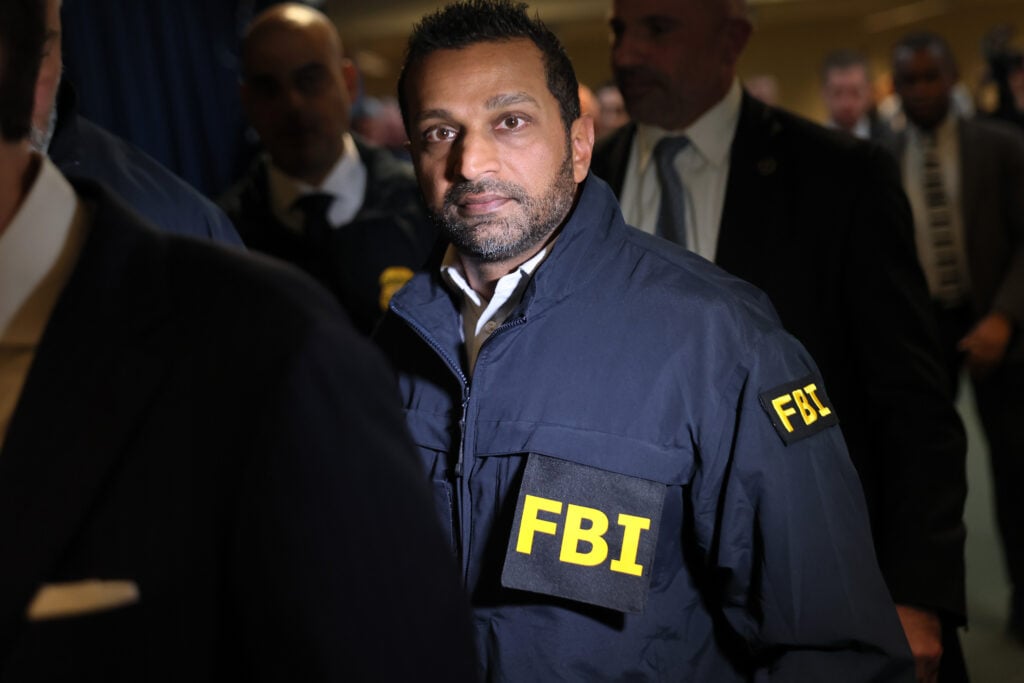
FBI Director Kash Patel leaves after a press conference on October 23, 2025 in New York City. (Photo by Michael M. Santiago/Getty Images)
Rep. Jamie Raskin (D, Md) and House Judiciary Democrats have requested that Patel complete a 10-question test designed to identify “hazardous drinking behaviors.”
Obviously, it would be easy for Patel to simply answer the questions untruthfully, so Raskin has also requested that Patel be sworn in and answer under the penalty of perjury.
“These glimpses of your relationship to alcohol would be alarming to see in an FBI agent; for us to see them in the FBI Director himself is shocking and indicative of a public emergency,” reads a letter that Raskin and his colleagues wrote to Patel earlier this week (Via Fox News).
The Atlantic report alleged that sources who have worked with Patel have strong concerns about his alcohol intake and his related job performance issues.
“Patel, according to multiple current officials, as well as former officials who have stayed close to him, is deeply concerned that his job is in jeopardy. He has good reasons to think so — including some having to do with what witnesses described to me as bouts of excessive drinking,” Atlantic staff writer Sarah Fitzpatrick alleged at one point.
“Print it, all false, I’ll see you in court — bring your checkbook,” Patel said in a statement published by The Atlantic.
“I can say unequivocally that I never listen to the fake news mafia, and as when they get louder, it just means I’m doing my job,” he added, during a joint press conference with Acting Attorney General Todd Blanche.
Raskin’s demand for transparency is unlikely to receive any sort of substantive response, as Republican House Judiciary Committee Chairman Jim Jordan has already dismissed arguments that Patel should be made to testify under oath.
“Crime is down to record-low levels. Criminals are behind bars, and America is safer thanks to the leadership of President Trump and Director Patel,” a spokesperson for the committee Republicans told Fox News this week.
“This is just another unserious effort from anonymous sources and partisan actors to attack the President and his Administration.”
“Defendants are of course free to criticize the leadership of the FBI, but they crossed the legal line by publishing an article replete with false and obviously fabricated allegations designed to destroy Director Patel’s reputation and drive him from office,” reads the lawsuit filed this week by Patel.
We will have further updates on this developing story as new information becomes available.