Bunnie Xo explains why Jelly Roll may not want to read her new book. Continue reading…The Boot – Country Music News, Music Videos and Songs









Bunnie Xo explains why Jelly Roll may not want to read her new book. Continue reading…The Boot – Country Music News, Music Videos and Songs
Bunnie Xo explains why Jelly Roll may not want to read her new book. Continue reading…Country Music News – Taste of Country

In a speech to the Alaska Legislature this week, Alaska Rep. Nick Begich III urged state lawmakers to boost the development of a proposed trans-Alaska natural gas pipeline.
“The federal path is largely cleared, but investors also need state level clarity, fiscal predictability and simplicity,” Begich said. “Scrutinize it carefully, model it thoroughly. But my request to you is not to become a roadblock.”
But legislators who are dealing with the pipeline on a daily basis say they don’t have answers to basic questions, including how much the pipeline will cost and whether the gas it carries will be affordable to Alaskans.
“I have not seen any figures,” said Sen. Cathy Giessel, R-Anchorage and chair of the Senate Resources Committee.
Senate President Gary Stevens, R-Kodiak, said legislators are not going to be a roadblock.
“We’re not going to throw sand in the works. Everybody wants a pipeline. We all hope that it comes about, but it’s got to be done properly and make sure that we know what’s going on.”
Sen. Bill Wielechowski, D-Anchorage, said he has heard “from very credible sources” that the price of gas through the pipeline could be $50 per million cubic feet by 2046.
The current cost of gas from Cook Inlet for Southcentral Alaska is about $10 per MCF.
“Just imagine if you have utilities locked into 30-year contracts for gas at $50 an MCF. That would be catastrophic,” Wielechowski said. “That’s the sort of thing that we’re trying to protect Alaskan consumers all up and down the Railbelt from — an absolute catastrophe to our economic system.”
As currently proposed, the pipeline project consists of two phases. The first phase includes an 807-mile pipeline from the North Slope to the west side of Cook Inlet, with a tie-in to existing natural gas infrastructure around Anchorage.
The second phase would extend the pipeline to the Kenai Peninsula, where an export terminal would be built. The second phase would also include a processing plant on the North Slope.
One year ago, the state-owned Alaska Gasline Development Corporation sold 75% of the trans-Alaska natural gas pipeline project to Glenfarne, an international developer.
Since the acquisition, Glenfarne has signed a number of nonbinding agreements with potential gas purchasers and gas sellers, but it has not disclosed estimates for the project’s cost, and it hasn’t disclosed what it expects the cost of gas to be.
Last year, company officials said they expected to make an investment decision by the end of 2025. In a subsequent filing with the Federal Energy Regulatory Commission, they said they would make the decision in February. A new timeline hasn’t been made public.
The lack of data is particularly problematic because legislators are considering whether to offer a property tax break to pipeline developers.
Those taxes are significant. Because Alaska does not have a statewide income tax or sales tax, its state budget suffers when people move into the state. More people means more demand for things like schools, parks and roads, but no increased revenue to pay for those things.
Economists have called that the “Alaska disconnect.”
Alaska has a 2% property tax on oil and gas infrastructure. Most of that money is passed on to municipalities, which use it for local needs.
In December, Alaska Gov. Mike Dunleavy said he was considering a proposal to cap that property tax at 0.2% for the natural gas pipeline, creating a payment in lieu of taxes system.
“That bill should be next week,” Dunleavy said during a Thursday news conference with U.S. Interior Secretary Doug Burgum, confirming the 0.2% rate will be part of the new legislation.
“Last couple weeks, we’ve been working with municipalities, getting their input as to what this should look like before (we) put the bill out,” he said. “So look forward to probably next week on that PILT bill, so that we can look at the economics of this line and also ways to ensure that municipalities benefit from this directly.”
This week, Begich expressed some support for a lower property tax rate, saying it could encourage people to invest in the pipeline.
“The classic 2% tax burden that would apply, say, to a $50 billion asset, would be a billion dollars in cash flow early in the project’s life cycle,” Begich said. “If that cash flow coming out of the project lowers the rate of return for investors, they’re not going to show up and invest. And so we need to make sure that our tax policy is A, doing what’s right for Alaskans. B, is not impeding the ability for the project to move forward. And I think we can do both of those things with some creative thinking and conversations with the industry.”
While a lower tax rate would benefit pipeline developers, it has the potential to harm residents who live near the pipeline.
If pipeline construction and operation mean more people moving to Alaska and municipalities are unable to raise revenue to meet the resulting demand for services, local governments could be forced to raise taxes or cut basic services in order to pay for the pipeline subsidy.
Last week, the Senate Resources Committee introduced Senate Bill 275, which imposes some transparency requirements on the pipeline project, eliminates a tax exemption relevant to the project, and imposes a new surcharge on gas processing plants.
That bill was introduced just days before Begich urged lawmakers not to be a “roadblock.”
Giessel, who chairs the resources committee, said she didn’t think Begich’s comments were directed at her or her committee’s bill.
“We’re not being a roadblock. We’re doing exactly what we’re supposed to do according to our constitution,” she said.
Asked whether he was thinking of Giessel’s bill during his speech, Begich said, “It was not my direct intention. No, I think it’s always worth having the conversation about the tax structure, about the incentive structure, though that’s an ongoing discussion that happens at the state legislature in Alaska. I think it’s important that when we have those conversations, they’re done in a way that is going to encourage, rather than discourage, industry from coming in and saying, ‘Yes, this is a good place for us to invest in.’”
Speaking to reporters after his speech, Begich said the state would benefit by getting more information from Glenfarne.
“I welcome more information,” Begich said. “I recognize that they’ve got certain restraints on what they can share. But look, I’d like to see more information shared. I’d like to see more of the economics of the project shared so we can understand what the full potential is and what’s on the table. I believe that’s going to come with time, but more information is better.”
The post Alaska legislators have few firm facts as they consider a proposed trans-Alaska natural gas pipeline appeared first on Chilkat Valley News.

She’s got a lot to say. Continue reading…The Boot – Country Music News, Music Videos and Songs
She’s got a lot to say. Continue reading…Country Music News – Taste of Country

A monumental moment for state leaders is expected Friday with the release of an official forecast of how much extra revenue Alaska’s government may get due to the Iran war.
Oil prices have skyrocketed since the United States and Israel attacked Iran on Feb. 28, which had legislators on Thursday commenting on the grim reality the conflict may mean hundreds of millions of extra dollars for Alaska.
“I understand that we’re all feeling awkward about the unfortunate reason for the optimism, which is that mankind can’t stop itself from fighting,” said Andy Josephson, D-Anchorage, who co-chairs the House Finance Committee.
The day also saw lawmakers pull a $373.5 million supplemental budget off the House floor due to a bitter disagreement about tapping into a reserve fund to pay for it. Dissenters, all members of the Republican minority caucuses, said that decision should be made after the updated revenue forecast.
“I find it really interesting that we’re taking up this item the day before we actually know how much money we have and what the size of our deficit is,” Rep. Will Stapp, R-Fairbanks, said during floor debate. He said after talking to executive and legislative financial staff “I’m pretty confident that the vast majority of items in this are probably going to be able to be funded in this specific bill through the current (year) surplus.”
Members of the bipartisan House majority accused the minority caucus of playing Russian roulette with critical budget items such as transportation projects scheduled this year. The supplemental budget includes $70.2 million needed to secure about $630 million in federal funds for such projects — and public and private transportation leaders have been imploring lawmakers to move quickly on those funds so the window for this year’s work season isn’t missed.
“We’re saying, ‘Eh, we like to build, but we want to see what the revenues are later on,’” said Rep. Calvin Schrage, I-Anchorage, another House Finance Committee co-chair. “We’re going to continue to wait. We’re going to continue to leave people hanging. We’re at the verge of being too late. I’m getting texts as of this morning from industry leaders that if we don’t deploy this money now we’re jeopardizing hundreds of millions of dollars that would hit the road this summer. What are we doing?”
The transportation funds are needed because Gov. Mike Dunleavy vetoed them last year as part of a political fight involving the Cascade Point Ferry Terminal, which his administration favors and allocated tens of millions of dollars toward. Legislators voted to divert $37 million in so-called Juneau access funds to other projects — and questioned his support of the terminal since a state study says it will have negligible benefits for travlers, but benefit a planned gold mine in the area. Dunleavy subsequently issued his veto.
Other significant items in the supplemental budget are $98.7 million for wildfire response and up to $75 million for disaster relief.
Also included is about $130 million to replenish the Alaska Higher Education Investment Fund, which provides scholarships, after lawmakers tapped it last year to cover a deficit in the current year’s budget when the House minority blocked an effort to tap the state’s $3 billion Constitutional Budget Reserve, which is typically used for shortfalls.
The lack of minority support was again key during Thursday’s supplemental budget vote.
The House passed the supplemental budget by a unanimous 40-0 vote, following the Senate’s unanimous passage of it Wednesday. But a House vote to fund the budget by tapping the CBR fell short by a 22-18 vote since a three-fourths majority is necessary to access the fund. Rep. Mia Costello, R-Anchorage, was the lone minority crossover to the bipartisan majority coalition vote.
That resulted in the House majority voting to rescind passage of the supplemental budget and pull it from the floor, returning it to the Rules Committee. The House then adjourned until Monday — and House Speaker Bryce Edgmon, I-Dillingham, said it is not a certainty the bill will be brought back to the floor then even if the revenue forecast is known, since there also needs to be assurance the budget can be funded.
Alaska lawmakers last spring passed a budget that balanced if North Slope oil prices average $64 a barrel for the fiscal year ending June 30. The official revenue forecast at the time was prices would average $68. But a grim revenue forecast in December stated this year’s prices would be $65.48 and next year’s about $62.
Oil was $92 a barrel on Tuesday.
House majority lawmakers said Thursday that if oil prices were to average $90 a barrel between now and June 30 it would mean about $300 million in extra revenue. That means the supplemental budget would still need additional funds — and presumes the war in Iran will last that long and cause sufficient disruption to oil markets in the process.
However, some analysts say oil could go above $100 a barrel. Oil prices at that level for a full year would generate an extra $1.5 billion more for the state compared to the most recent revenue forecast.
This story was originally published by the Juneau Independent.
The post Legislators hold breath, budget with war-influenced state revenue update expected Friday appeared first on Chilkat Valley News.

Ten Southeast Alaska radio stations that have been in receivership since February 2025, including KINY and TAKU 105 in Juneau, are in the final stages of being purchased by Cliff Dumas as part of the Alaska First Media company he formed last summer.
For people listening to the six stations in Juneau, and two apiece in Sitka and Ketchikan, the agreement isn’t likely to mean any noticeable changes in the short term, Dumas said in an interview Thursday. But for people familiar with seeing the radio outlet’s offices on Channel Drive, he noted operations are moving to a new site in the Mendenhall Mall as early as next month.
“The construction is underway right now,” he said. “We’ve got the studios built and they’re being wired. Equipment has been ordered. Our engineer’s here for the next month and a half to facilitate it. So I might be ambitious, but I’m hoping that we’re in there in mid-April.”
The station purchase deal, which Dumas said is now in escrow, comes after extensive financial and operational turmoil involving the similarly named Local First Media Group, which owned six radio stations in Texas and 10 in Alaska until filing for Chapter 15 bankruptcy in May 2025. That filing occurred after the company was placed into receivership when it defaulted on a loan of nearly $8.2 million to a Canadian financial company.
Where it may get confusing for some people is this is the second time Dumas has purchased the stations in the past four years.
Dumas is paying about $1.3 million to reacquire the Alaska stations, which includes about $381,000 for the stations and $900,000 for property associated with them, according to a U.S. Bankruptcy Court filing. He previously purchased the stations in Alaska and Texas in a $1.3 million deal in 2022 as the majority owner (80%) of BTC USA Holdings Management. The other 20% was owned by Local First Media Group, headed by Bryan Woodruff.
What happened after that is subject to a lot of dispute and accusations involving Dumas, Woodruff and other stakeholders. But ultimately Local First Media and six affiliates ended up in last year’s bankruptcy proceedings, with Dumas asserting his affiliate groups were not part of the defaulted loan by Local First Media.
Dumas formed Alaska First Media Inc. last July and is its sole owner, according to the State of Alaska’s business license database. He said extensive staff turnover that occurred in recent years has stabalized during the past year, including his daughter Grace as a newscaster, and his wife Lisa as the company’s vice president and an afternoon show host.
“We’re a family of broadcasters and it’s a joy to be able to do that in one place that we call home,” he said.
The stations involved in the purchase, as listed by radioinsight.com are:
Dumas’ company also operates Rock 99.9 KFMJ in Ketchikan, according to the website.
This story was originally published by the Juneau Independent.
The post Cliff Dumas reacquiring 10 SE radio stations, including KINY and TAKU 105, after bankruptcy proceedings appeared first on Chilkat Valley News.

Reading Time: 3 minutes
Former Arizona senator Kyrsten Sinema is finally addressing the rumor that she had an affair with her bodyguard.
And just like the adulterous congressman Tony Gonzales before her, she’s admitting that it really happened.
But she insists that she shouldn’t be sued over her sexcapades — and she might win on a technicality. Here’s what happened:
In case you missed it, Heather Ammel, the ex-wife of Matthew Ammel, has filed a suit against Synema, accusing her of ruining her marriage.
(North Carolina’s “homewrecker law” allows third parties who slept with married people to be sued in connection with alienation of affection allegations.)
Now, Sinema has filed a motion to dismiss, in which she admits that she did, in fact, have a sexual relationship with Ammel (per TMZ).
She acknowledges that she and Ammel became “romantic and intimate” in late May 2024 — five months before he separated from his wife.
She says their first encounter took place on May 27 in Sonoma, California, and they proceeded to bang in several other locations, including New York City, Washington, D.C., Aspen, and Phoenix.

Yes, the relationship wasn’t exactly confined to one ZIP code.
And if you’re wondering why Sinema is suddenly offering what amounts to a travel itinerary of romantic rendezvous, there’s a legal reason for that.
Heather Ammel filed her lawsuit in North Carolina, one of very few states that still allows “alienation of affection” suits — meaning a spouse can sue someone they believe interfered in their marriage.
But Sinema says the case should be thrown out because none of the alleged hookups actually took place in North Carolina.
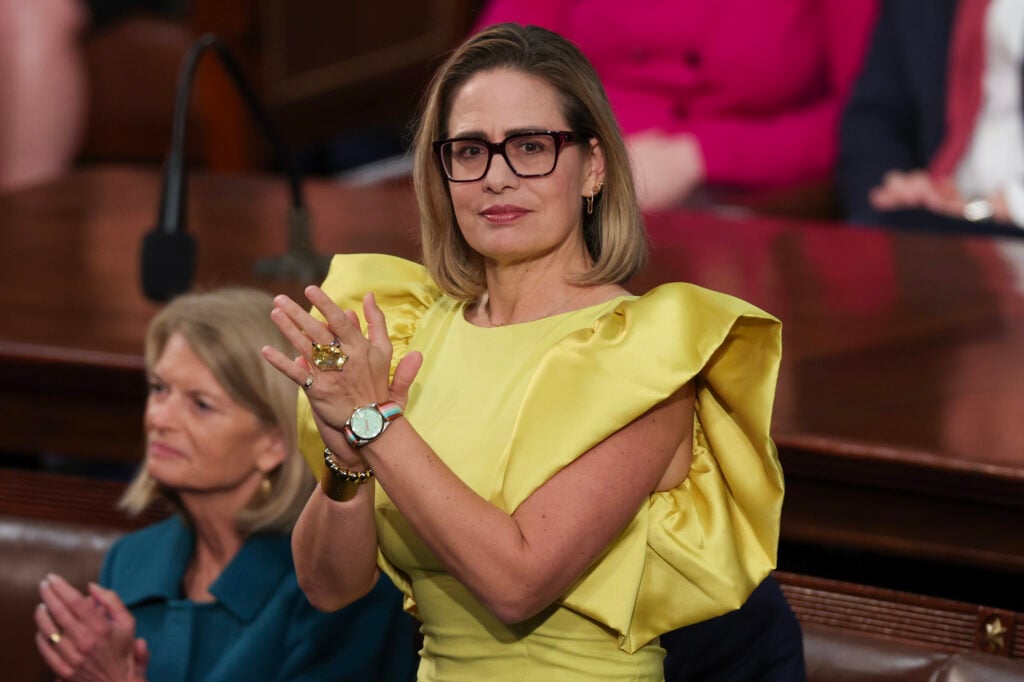
Ammel also claims Sinema sent romantic messages to her husband while he was in North Carolina, including a photo of the senator wrapped in nothing but a towel.
Sinema disputes that allegation and says even if such a message existed, she had no idea he was in the state at the time.
So yes, Sinema is acknowledging the relationship.
But she’s also making it clear that admitting the affair doesn’t mean she’s accepting legal responsibility for the breakup of a marriage, especially in a state where she claims the alleged relationship never actually happened.
In other words: the former senator isn’t denying the scandal.
She’s just arguing it happened in the wrong jurisdiction. The judge has yet to rule this loophole.
In other Kyrsten news, the former Democrat has taken another step toward the right by joining conservative media outlet the Washington Reporter. To paraphrase the meme: Pure Synema!
Kyrsten Sinema: Yes, I Banged My Married Bodyguard But Never In North Carolina! was originally published on The Hollywood Gossip.
The Hollywood Gossip

Picnics are one of the best ways to kick back, enjoy the weather, and have a bite with friends. But these mistakes will ruin your perfect picnic.

Food Republic – Restaurants, Reviews, Recipes, Cooking Tips

Following a month-long community fundraising effort last year to cover $1.15 million in hospital and regulatory fees, 4-year-old Cade Jobsis was selected for a phase 3 clinical trial underway in Dallas.
“When we had heard that it was getting up and running, they were getting through the final phases, we just wanted to be available and give them every opportunity to say, ‘You know, we would love for Cade to be selected,’” said his mother, Emma Jobsis.
Cade was diagnosed with hereditary spastic paraplegia, SPG50, two years ago. It’s a rare neurodegenerative disorder that can lead to loss of cognitive and motor function, and eventually more serious complications like epilepsy. Since the disease is rare, Jobsis has said research and funding can be hard to come by.
The therapy, Melpida, was originally pursued by Terry Pirovolakis, whose son Michael was diagnosed with SPG50 at 15 months old. It’s meant to help express a functional copy of a gene. The third round of trials focuses on efficacy, and will follow Cade for five years post-treatment. It’s also the final round before applying for clinical approval from the Food and Drug Administration.
Jobsis brought Cade down to Texas for the trials about a month ago, returning to Juneau to spend time with family after a delay and returning to sign official consent forms in early March. Since then, they’ve been doing a lot of medical prep work.
“We’ve been doing the panels to make sure that he’s healthy and eligible,” Jobsis said. “We’ve done blood tests, where they’re looking at everything, COVID tests. We did an EKG and echocardiogram, and an EEG.”
While Cade is currently scheduled to receive the treatment on April 1, shortly before his fifth birthday, it’s still a waiting game for the family.
“When we were signing the documents, I thought that this weight would be lifted, like, ‘We’re here, we’re doing it,’ and it hasn’t happened yet,” she said. “I think because we’ve had so many delays, and so many battles, so many hurdles, that I feel like my nervous system is just ready for the ground to be pulled out from under us again. And I think I will feel that relief once he is out of anesthesia on the treatment day. Once he’s woken up from anesthesia and he has received the gene therapy, I think that weight is going to be lifted.”
To prevent Cade from getting sick, they’ve stayed somewhat isolated within the medical district. Jobsis said they’ve been coping by FaceTiming family, trying new foods and getting outside to enjoy some clearer weather.
“He likes to go outside and kick the soccer ball around. It has been a fun, new thing that we’ve been doing, because in Juneau we use the field house a lot, but it’s hard to find outdoor space that has a forgiving ground,” she said.
Now, Jobsis is trying to figure out how to continue sharing their story online through Cure for Cade.
“There’s so many people that are invested in this story,” Jobsis said. “I joked with my husband the other day that I feel like so many people have donated and especially that I feel like people have paid for a subscription to our life, almost. I want so badly to give everybody the rest of the story, to know that what our town did, what they sacrificed and contributed, was so powerful. And I’m still trying to figure out how to keep telling that story, because I just want our town to know how important they are, because there’s a lot of places that you can live that would not show up the way that Juneau did.”
This story was originally published by the Juneau Independent.
The post Cade Jobsis, 4, scheduled to receive novel gene therapy next month appeared first on Chilkat Valley News.