Categories
Alaska News

In Alaska House, a protest against ICE was the result of a split-second decision

Rep. Zack Fields, D-Anchorage, speaks Friday, April 26, 2024, on the floor of the Alaska House of Representatives. (Photo by James Brooks/Alaska Beacon)

Rep. Zack Fields, D-Anchorage, speaks Friday, April 26, 2024, on the floor of the Alaska House of Representatives. (Photo by James Brooks/Alaska Beacon)

Anchorage Democratic Rep. Zack Fields was listening to a speech by Republican U.S. Rep. Nick Begich III when he got fed up.

Fields scribbled a note on a nearby sheet of paper: “ICE out of Alaska” and held it up on the House floor for a few minutes while Begich spoke to lawmakers. 

That simple act riled Republicans, who sought to officially reprimand Fields and kicked off a sequence of events that roiled the state House this week and snarled legislative business for a day.

“That was probably not the best or most effective way to, you know, bear witness to the horror that ICE is inflicting on America,” Fields said in an interview Wednesday, the day after Begich’s speech. “But, you know, thinking about my kids, that was the one thing that I could do at that moment that didn’t interrupt the speech or get more dramatic.”

Begich, Alaska’s lone member of the U.S. House of Representatives, has been generally supportive of President Donald Trump’s administration, including the use of federal agents to aggressively imprison people and remove them from the country.

Some federal agents have acted violently, shooting 14 people in Minnesota, and killing two. Agents in other states have also killed unarmed American citizens and noncitizens.

Begich did not mention those shootings during his speech, instead repeating the Trump administration’s stated justification for the immigration crackdown — that it is intended to address drug trafficking.

“Nick Begich was going on about fentanyl and ICE, and it’s just not right,” Fields said. “That just completely outraged me, because ICE is arresting random children and adults who have been here for years, following the law, founding local businesses. I just thought it was grossly misrepresentative, outrageous, and I got angry about it because my kid, my kids, go to school with a bunch of families who are worried they’re going to be kidnapped or separated from their children.”

Fields’ sign was not visible to the Gavel Alaska cameras in the chamber and does not appear in a recording of Begich’s speech.

Neither Senate President Gary Stevens, R-Kodiak, nor Speaker of the House Bryce Edgmon, I-Dillingham, saw the sign. Both were seated behind Begich as he spoke.

Hours after Fields held up his sign, members of the House’s all-Republican minority issued a statement denouncing his action, saying that it violated legislative rules and decorum.

“Sitting on the House floor during our Congressman’s annual keynote address is not the place for disruption and waving protest signs. This behavior reflects a lack of professional maturity and a blatant disregard for the rules of this body,” said House Minority Leader DeLena Johnson, R-Palmer, in the statement.

The following day, Johnson proposed that the House “issue a formal reprimand” against Fields. 

House Rules Chair Louise Stutes, R-Kodiak and a member of the House majority, spoke against the idea, saying she spoke to Fields about it, and “further transgressions … will not be tolerated in the chamber.”

Fields spoke in his defense, noting in part that “federal agents murdered multiple American citizens, including shooting a nurse in the back,” a reference to the killing of Alex Pretti by federal agents in Minnesota

Fields’ description drew immediate objections from Republican members of the House minority.

“It’s an insult to every member here,” said Rep. Dan Saddler, R-Eagle River. “Maybe it was hidden from the cameras or not but that’s an insult. If a member here has an opinion, they can express it in public speech, they can put it on social media, they can shout it on a street corner on the soap box, they can take part in marches, they could even do it as we see in special orders as long as it’s done without objection.”

During a break in formal debate, Rep. Jamie Allard, R-Eagle River, called Fields’ description “bullshit,” a comment loud enough to be heard across the House chamber.

“I yelled bullshit because Zack Fields called ICE a bunch of murderers,” she said after the House adjourned for the day.

The vote to reprimand Fields arrived on the same day that lawmakers took up a contentious vote to extend a state declaration of disaster that began when ex-Typhoon Halong devastated Western Alaska last year.

The House majority also attempted to force a vote on the state’s fast-track supplemental budget bill, something opposed by the minority and another factor in the day’s tensions.

At one point in debates, Speaker of the House Bryce Edgmon, I-Dillingham, called a halt to proceedings in order to verbally dress down Saddler.

The day ended with the resolution against Fields still tabled and unlikely to come up again.  

“And looking back, you know, probably there was a better way to do it,” Fields said afterward about his actions during Begich’s speech. “Obviously it was not in accordance with the procedure. But it’s like, what do we do when there are these outrageous acts and some people don’t even want to acknowledge them? … I think that’s a challenge every citizen of conscience faces every day.”

As for the sign? Fields said it’s already been recycled.

SUBSCRIBE: GET THE MORNING HEADLINES DELIVERED TO YOUR INBOX

Categories
Entertainment

Why Sydney Sweeney Never Felt Confident About Her Boobs Until Euphoria

Sydney Sweeney, 2025Sydney Sweeney had a euphoric revelation. 
As the Euphoria star admitted it wasn’t until getting cast on the acclaimed HBO series that she finally felt comfortable in her own skin.
“I grew up with…
​E! Online (US) – Top Stories

Categories
Entertainment

The Delicious Aldi Dessert You Can Snag For Cheap

One of the best ways to get a bigger bang for your buck is to spend about a dollar on something delicious. Aldi has a customizable dessert that fits the bill.

​Mashed – Fast Food, Celebrity Chefs, Grocery, Reviews

Categories
Alaska News

Trump administration mulling investment in controversial Alaska mining road

U.S. Interior Secretary Doug Burgum, with Gov. Mike Dunleavy, speaks at a March 12, 2026, news conference at the Ted Stevens Anchorage Internatinal Airport. Burgum was with a delegation of Trump administration officials making a trip to Japan for an energy conference. Behind Burgum and Dunleavy is a stuffed polar bear on display at the airport's north terminal. (Photo by Yereth Rosen/Alaska Beacon)

U.S. Interior Secretary Doug Burgum, with Gov. Mike Dunleavy, speaks at a March 12, 2026 news conference at the Ted Stevens Anchorage International Airport. Among the subjects he discussed was the Ambler Road, in which the Trump administration might invest. Burgum was with a delegation of Trump administration officials making a trip to Japan for an energy conference. Behind Burgum and Dunleavy is a stuffed polar bear on display at the airport’s north terminal. (Photo by Yereth Rosen/Alaska Beacon)

The Trump administration has already put money into a huge and controversial mining project by investing in a company that would benefit from the development.

Now the administration is considering putting federal money into another aspect of the project: the proposed Ambler Access Project that would put a 211-mile industrial road through the currently undisturbed lands in the foothills of the Brooks Range mountains.

Interior Secretary Doug Burgum discussed the idea of federal investment in the Ambler Road during a brief news conference in Anchorage on Thursday.

“I’d say the discussions are ongoing, but there’s a sense of urgency around this,” he said at the news conference, held at the Ted Stevens Anchorage International Airport during a stopover in a trip by administration officials to an energy conference in Japan. Gov. Mike Dunleavy met with Burgum and other officials during the stopover but was not part of Japan trip.

The Ambler Access Project is sponsored by an Alaska state economic agency, the Alaska Industrial Development and Export Authority. It would link the existing road system with the remote Ambler mining district in Northwest Alaska. That region holds large amounts of copper, and that has been much of the focus of exploration to date, though there are other minerals as well in the region.

Trilogy Metals Inc., based in Canada, is the main company operating the Ambler mining district and the company in which the Trump administration has invested $36.5 million. Trilogy has partnered with South32, an Australian mining company, to promote Ambler development.

Burgum said the lack of road access that has stymied commercial development in the remote region is due to change, now that President Donald Trump approved the Ambler Access Project, reversing a Biden administration decision.

Because of Trump’s go-ahead decision, “we think that the financing for the road is actually not going to be that difficult. There’s multiple parties that want to participate,” Burgum said at the news conference.

The Ambler Access Project is planned as an industrial-only road, with no public access, he noted. The plan is for industrial users to repay the government for road construction, and the nation needs the minerals that are in the Ambler region, he said. For those reasons, federal investment in the road makes sense, he said.

“The U.S. is actively considering whether to participate in financing or maybe even be one of the equity partners in that road itself,” he said. Getting enough financial support for the road will not be a problem, he said. “Because the resource there is so rich, I think the road financing will come together,” he said.

In October, when Trump announced his approval of the Ambler project, he also announced the investment in Trilogy Metals, which gained the federal government a 10% stake in the company.

The Ambler Access Project has drawn widespread criticism from environmentalists, tribal governments and others.

Critics of the mining road project have mostly cited environmental factors in their opposition, notably risks to the Western Arctic Caribou Herd and to salmon, both of which are important subsistence resources to hunters and fishers in Indigenous communities in the region.

But critics also object to the idea of public funding for a road to be used only by private industry. Although the project plan calls for the industrial users to repay the state for construction and maintenance, opponents of the Ambler Road argue that the project puts the state at too much financial risk.

On Monday, Ambler Road opponents released a study that found the project would cost the state $2 billion for construction, maintenance and financing.

That estimate is much higher than the cost estimates previously presented by the U.S. Bureau of Land Management, which is coordinating studies and permitting of the project. A 2024 supplemental environmental impact statement put the cost at $765.2 million.

The new cost report, compiled by engineer Lois Epstein for the organization Defend the Brooks Range, does not consider the type of federal funding proposed by Burgum.

Ambler Road critics said it underscores some of the project’s risks, nonetheless.

“This report tells us what we already knew – this road is a bad deal for Alaskans,” Maddie Halloran, state director at the Alaska Wilderness League, said in a statement released Monday. “After widespread opposition from Alaskans during the environmental impact statement process, it’s adding insult to injury to have this project pushed through to benefit foreign mining companies. This isn’t economic growth for our state, it’s a giveaway that puts corporate profit ahead of Alaska’s communities and our environment.”

SUBSCRIBE: GET THE MORNING HEADLINES DELIVERED TO YOUR INBOX

Categories
Sports Fox

Big 12 Ditches Slippery Glass Tournament Floor After Christian Anderson Injury

The Big 12 Conference is ditching its slippery new glass floor for a hardwood court for the final two days of the tournament. “After consultation with the coaches of our four semifinal teams, I have decided that in order to provide our student-athletes with the greatest level of comfort on a huge stage this weekend, we will transition to a hardwood court for the remainder of the tournament,” Big 12 Commissioner Brett Yormark said in a statement Thursday night. “We look forward to a great semifinals and championship game.” Numerous players have slipped when trying to plant. On Thursday, Texas Tech guard Christian Anderson strained a muscle slipping in the No. 16 Red Raiders’ 75-63 loss to No. 7 Iowa State. “Obviously, the floor is a bit slippery,” Anderson said. “I think I just kind of misstepped or did a movement that caused me to slip,” The Big 12 announced last month that it would play the men’s and women’s tournaments on the ASB GlassFloor-made court that has been used at the NBA All-Star Game and in Europe but never before during an official U.S. competition. “I personally didn’t have any involvement (in the decision to go to hardwood),” Kansas coach Bill Self after the No. 14 Jayhawks beat TCU 78-73 on Thursday night in the last game played on the glass floor. “If the other coaches are doing it, (they) have juice and they got more than I got. Because I didn’t have any any involvement with that at all.” Then he added, “I think it’s the right thing to do.” The glass floor has an aluminum and steel spring-action design that is supposed to mimic the flexibility of hardwood. The LED panels, which display everything from data-driven graphics to advertising, have ceramic coating and little dots etched into the glass that are supposed to create grip that is consistent with traditional surfaces. The ball seems to bounce like usual, though with a different “thudding” sound. There are a whole lot more squeaks from sneakers than usual. But the biggest difference has been the traction. Reporting by The Associated Press.​Latest Sports News from FOX Sports

Categories
Food

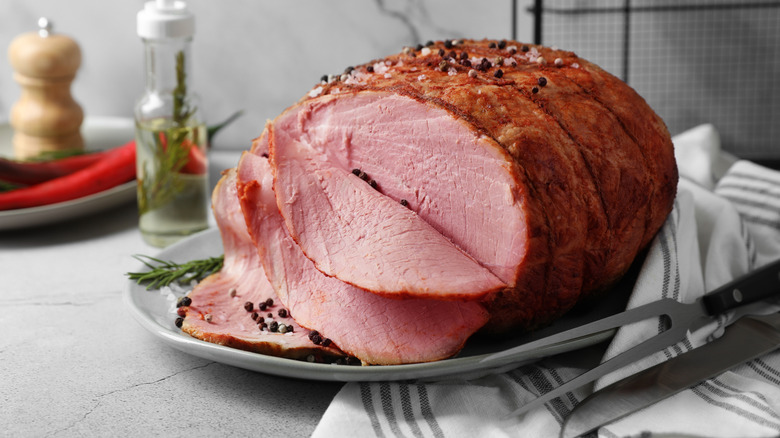
Boneless Vs Bone-In Vs Spiral Ham: How Do The Cooking Processes Differ?

There are three main types of ham you can buy: boneless, bone-in, and spiral cut. Each is different, and so they all need to be cooked differently.

​Food Republic – Restaurants, Reviews, Recipes, Cooking Tips

Categories
Alaska News

Alaska House postpones final vote on gap-filling state budget bill

Members of the Alaska House of Representatives watch the voting board in the House on Thursday, March 12, 2026, as legislators vote on whether or not to spend from savings on a fast-track supplemental budget bill. (James Brooks photo/Alaska Beacon)

Members of the Alaska House of Representatives watch the voting board in the House on Thursday, March 12, 2026, as legislators vote on whether or not to spend from savings on a fast-track supplemental budget bill. (James Brooks photo/Alaska Beacon)

The Alaska House of Representatives on Thursday postponed its final vote on a fast-track supplemental budget bill that would use the state’s largest savings account to cover some shortfalls in the current state budget.

Members of the House voted 21-19 to pull the bill from the House floor after it became clear that there were not enough votes to fund the bill from savings. 

Thirty votes are needed to spend from the Constitutional Budget Reserve; a vote to spend from the reserve failed 22-18 before legislators reversed course, rescinded their rejection and sent the bill back to the House Rules Committee. 

All members of the House’s multipartisan coalition majority voted in favor of the postponement; all members of the Republican House minority voted against it. 

Rep. Mia Costello, R-Anchorage, was the only member of the minority to vote in favor of spending from the reserve. All legislators voted in favor of the underlying bill, even if they disagreed on how to pay for it.

A new vote on spending from the reserve could take place as early as Monday, but it might not be needed: On Friday, the Alaska Department of Revenue is expected to release a revised state budget forecast, and members of the House minority indicated they may be willing to bet that oil revenue from the Iran war will fill the gap.

“We have been blessed in this state. We have been blessed right now with the ability to look a little bit into the future … and notice that we have an additional amount of revenue that we have to spend. How incredible is that?” said Rep. Justin Ruffridge, R-Soldotna. 

Rep. Andy Josephson, D-Anchorage and co-chair of the House Finance Committee, said he does not believe oil prices will rise high enough and stay high enough to pay for the supplemental budget bill without savings.

If Alaska North Slope oil prices were to average $90 per barrel between March 10 and June 30, that would raise an additional $300 million in state revenue — not enough to meet the need, Josephson said. Prices would have to average more than $105 per barrel for that period to avoid a withdrawal from savings, he said.

The bill in front of the House on Thursday would have spent $373.5 million from savings to unlock federal transportation grants, cover last year’s wildfire response spending, and pay for part of the cost of dealing with the disaster caused by ex-Typhoon Halong in Western Alaska. 

All those items are additions for the current fiscal year, which ends June 30. Lawmakers are simultaneously working on a separate budget for the next fiscal year, which begins July 1.

The bill in front of the House on Thursday was adopted by the Senate on Wednesday after the six-person Senate minority negotiated the removal of $150 million in items in exchange for their votes on the bill and the draw from savings. Those items will still need to be funded later.

The biggest remaining item in the bill is $129.6 million to refill the state’s higher education investment fund, which was drained last year amid a veto-involved dispute between the Legislature and governor. 

The item that has garnered the most attention is smaller — $70.2 million that would be used to match federal grants for highway construction.

The state’s construction industry has been lobbying heavily for the Legislature to approve that money early so companies can make plans for the summer construction season.

“There is no way I would ever vote to gamble the future of our construction and oil and gas industry on months of oil prices in the most volatile market and geopolitical conditions of my lifetime,” said Rep. Zack Fields, D-Anchorage. 

Fields said any delay has a cost: “Even if oil prices come in higher for the rest of the year, the Department of Transportation cannot put out bids based on price forecasts. They have to have a budget bill passed by us.”

Without firm projects, construction companies cannot make hiring decisions, he said.

“This is now a starvation year for the construction industry,” Fields said.

The postponement preserves some political leverage for the 19 Republican members of the House minority. Because 30 votes are needed to spend from the reserve and there are 21 lawmakers in the coalition majority, money can’t be spent from the reserve without at least nine minority members in support.

After the floor vote, House Minority Leader DeLena Johnson, R-Palmer, said the vote was not about leverage, but, but that the minority voted to protect savings ahead of Friday’s forecast. 

She pointed out that as currently written, the bill would have authorized lawmakers to spend hundreds of millions of dollars from the reserve, regardless of how much extra money the state earns from the Iran war. 

“What we were really doing is making sure that we didn’t just give a full, free opportunity to take money from our savings and spend $378 million without any controls whatsoever.”

Republican lawmakers said they had not seen the revenue forecast yet, but expressed confidence in increasing oil prices, despite uncertainty around the Iran war.

“There’s a saying in the infantry, ‘no plan survives first contact with the enemy,’ right? So I don’t know what’s going to happen with the Iran war,” said Rep. Will Stapp, R-Fairbanks and a veteran of the Iraq war.

“I can tell you, there’s been a lot of oil and gas infrastructure that has been blown up, and you generally can’t rebuild that stuff in a day,” he said. “So I don’t expect, personally, oil to be like $150. It is going to be higher than it was three weeks ago, probably for a while.” 

But members of the House majority were clearly frustrated by the delay.

“Volatility is a 10 out of 10 right now,” said Speaker of the House Bryce Edgmon, I-Dillingham. “I’ve never seen a responsible finance committee or responsible leadership in the House make such an effort to gamble on the future in terms of oil prices.” 

Rep. Calvin Schrage, D-Anchorage, serves as co-chair of the House Finance Committee.

He pointed to past forecasts where revenues did not materialize and budgets had to be revised, and called the minority members’ move irresponsible. 

“That’s what they were suggesting today, that we rely on a forecast — unrealized, unpredictable, uncertain money to finance a budget when industry and Alaskans are asking for certainty. I mean, as recently as last year, we saw the folly of that sort of budgeting methodology, and it’s irresponsible.”

SUPPORT: YOU MAKE OUR WORK POSSIBLE

Categories
Entertainment

An Etiquette Expert Detailed The Proper Way To Eat Cereal — And It’s Ridiculous

We didn’t think we needed an etiquette lesson on how to eat cereal, but in the social media age, we got one anyway. What the viral video depicted was priceless.

​Mashed – Fast Food, Celebrity Chefs, Grocery, Reviews

Categories
Alaska News

UAS to award honorary degrees to L’uknax.adí, Kiks.ádi clan leaders

L’eiwtú Éesh Herman Davis of Sitka, clan leader of the L’uknax.adí, from Kayaashka Hít (Platform House) is to receive a honorary doctorate of laws. (Courtesy/University of Alaska Southeast)

Lingít clan leaders L’eiwtú Éesh Herman Davis and Aanyáanáx Ray Wilson will receive honorary doctorates of laws from the University of Alaska Southeast during the May 3 spring commencement ceremony at UAS in Juneau.

UAS announced the awards for Davis and Wilson, as well as other distinguished Southeast Alaskans, on Friday.

Davis, of Sitka, is clan leader of the L’uknax.adí, from Kayaashka Hít (Platform House). He “has demonstrated exceptional leadership and dedication as he has worked to ensure that his knowledge of the Tlingit language, culture, traditions and history is preserved and passed on,” UAS said in its announcement.

“Davis has generously shared his extensive Traditional Ecological Knowledge, identified key historical locations on the landscape and worked with scholars to preserve Tlingit place names,” UAS stated. “As a master-level birth speaker, Davis has taught Tlingit language and dance for 50 years through the Sitka Native Education Program and Noow Tlein Dance Group, integrating storytelling, song, and dance into lessons and helping build an extensive curriculum to share with others. He has collaborated with co-awardee Aanyáanáx Ray Wilson to repatriate significant ceremonial pieces, including a Raven helmet.”

Davis and Wilson worked for decades to repatriate the Raven helmet that Ḵ’alyáan of the Kiks.ádi clan wore during an 1804 battle in Sitka against Russian colonists. 

Aanyáanáx Ray Wilson, clan leader of the Kiks.ádi, from Gagaan Hít (the Sun House) is to receive a honorary doctorate of laws. (Courtesy/University of Alaska Southeast)

The state-run Sheldon Jackson museum announced in December that it would return the helmet to the care of Sitka Tribe of Alaska, and Kiks.ádi clan members, in accordance with the Native American Graves Protection and Repatriation Act.

Wilson, of Juneau, is clan leader of the Kiks.ádi, from G̱agaan Hít (the Sun House).

In Friday’s release, UAS stated that Wilson “has shown remarkable leadership in sharing Tlingit dance, stories, practices, and values, and has shifted the paradigm for how museums work with and represent Indigenous Peoples.” 

“As a Tlingit culture-bearer, Wilson taught dance and culture for 25 years with the All Nations’ Children dance group (Lda Kut Naax Sati Yatx’i), and helped collaboratively develop a tool that teaches children about the Tlingit language and culture through music,” UAS said “Wilson worked with the Smithsonian’s National Museum of Natural History to ensure traditional cultural protocols were followed while restoring a ceremonial sculpin hat, and advised the American Museum of Natural History on integrating Indigenous perspectives into renovations, ensuring that Tlingit culture and traditions were represented as living and dynamic.”

UAS also announced Friday that it will confer an honorary doctorate of laws on Younce Kóo oo Wóo Russell Dick, of Hoonah, from the Kaagwaantaan (Eagle/Wolf) Clan.

Dick “is a catalyst for innovation and economic growth throughout Alaska and beyond,” UAS said. “As president and chief executive officer of Huna Totem Corporation, Dick has been an extraordinary leader in sustainable tourism, cultural stewardship, and workforce development.”

UAS also noted that Dick helped transform Icy Strait Point into a globally recognized destination.

“Throughout his career, Dick has held key leadership roles at Sealaska Corporation, Alaska Dream Cruises, Haa Aani, LLC, and Icy Strait Whale Adventures (Three Wolves Charters), and served as vice chair of the Alaska Industrial Development & Export Authority Board of Directors,” UAS stated. 

The university in recent years has honored several Alaska Native leaders with honorary doctorate awards. In 2024 it conferred an honorary doctorate of education on Gooch Tláa/Kéet Tláa/Anne Johnson, a cultural educator and culture bearer who has contributed to the Sitka Native Education Program for some 50 years. 

In 2021 UAS conferred an honorary doctorate of education on Pauline Duncan, a teacher and culture bearer of Sitka who created many culturally relevant classroom materials for Native children in her decades as a classroom teacher. 

The post UAS to award honorary degrees to L’uknax.adí, Kiks.ádi clan leaders appeared first on Chilkat Valley News.

Categories
Alaska News

Alaska officials stonewall state legislators on justification for handing voter data to feds

The head of the Alaska Division of Elections will not share legal advice that led to the state’s decision to send an extended voter list to the U.S. Department of Justice.

Director Carol Beecher told state senators Wednesday that she will not waive attorney-client privilege as state lawmakers examine last year’s decision to give the Trump administration a detailed list of Alaska voters.

Alaska is one of 12 states that have either turned over their voter lists or have said they plan to comply with a nationwide request, according to records kept by the Brennan Center, a critic of the administration’s request.

Alaska and Texas are also the only states to have signed a memorandum of understanding that would allow the Department of Justice to pick individual voters for eventual removal from state lists of eligible voters.

Neither elections officials nor the Alaska Department of Law have explained why the state voluntarily complied with the request and signed the memo, or how compliance fits within the Alaska Constitution’s right to privacy.

Last week, Idaho became the latest state to reject the Department of Justice’s request for voter information, joining dozens of others.

That state’s Secretary of State said in a letter to federal officials that filings in a lawsuit showed that the department had shared sensitive information, including Social Security numbers, with “unauthorized persons,” and as a result, he could not guarantee that Idahoans’ identities would be safe.

In a pair of legislative hearings this week, Alaska lawmakers were unable to learn why Lt. Gov. Nancy Dahlstrom, Beecher, and the Alaska Department of Law reached a different conclusion.

Sen. Bill Wielechowski, D-Anchorage, grilled Beecher during a Wednesday hearing, pressing her to release the legal advice she received before the Division of Elections turned over its voter list.

“This is an issue of grave concern for hundreds of thousands of Alaskans, and you have the ability to provide us with those documents. You have the ability to waive any potential privilege. Would you be willing to do that?” he asked.

“At this point, I am not willing to waive that privilege,” she said. 

Sen. Elvi Gray-Jackson, D-Anchorage, asked Beecher whether the department made a mistake by sharing the voter data and signing the memo that would allow the federal government to single out individual Alaskans.

“I do not, at this juncture, believe that the division made a mistake in signing the MOU,” she said.

This week’s toughest questions came from Democratic lawmakers. Beecher and Dahlstrom are both Republicans, and Dahlstrom is also a candidate for governor in this fall’s elections.

Republican lawmakers were generally silent in this week’s hearings. 

Rep. Andrew Gray, D-Anchorage and chair of the House Judiciary Committee, said he was “in an awkward position” and reached out to a variety of experts in an attempt to avoid bias in a hearing he held on Monday.

During that hearing, Rep. Kevin McCabe, R-Big Lake, said he sees the state’s compliance as something like following the speed limit.

“When the federal government makes a law, we’re expected to follow it … it’s the federal government’s job, through whomever, to ensure that law is followed, and from what I understand, the federal government was merely attempting to make sure that Alaska followed the National Voter Registration Act,” he said.

The information transmitted to the Department of Justice goes beyond the publicly available voter information purchasable from the Division of Elections for $20. 

It contains personally identifying information, such as birthdates, driver’s license numbers and partial Social Security numbers.

In a legal analysis performed last month, legislative attorneys called the DOJ’s request “unprecedented” and said the division’s handover would be legal only if the federal government requested the information “in compliance with federal law” and used “the information only for governmental purposes authorized under law.”

As of Wednesday, three separate federal judges — in Oregon, California and Michigan — have ruled that the federal government’s request is not in compliance with federal law. 

Of the 48 states and the District of Columbia that have been asked for their voter lists, 29 and DC are fighting the federal government in court. The federal government has won none of those cases to date.

Legislative attorney Andrew Dunmire said he is also unaware of any federal law that allows the federal government to single out individual voters for removal from voter lists, as the MOU states.

On Wednesday, Beecher said the Department of Justice has not yet requested that any voters be removed from Alaska’s list. In addition, Dahlstrom said in December that the state would comply with the MOU only if the federal government’s actions are legal.

But with the Alaska Department of Law and the Division of Elections stonewalling legislators, it isn’t clear what the state considers a legal request. 

In September, the Justice Department told Stateline that it is sharing the voter data with the Department of Homeland Security, and the Trump administration has previously said it intends to input the voter lists into a nationwide registry to look for noncitizens.

The DHS tool for that effort has repeatedly flagged citizens in error, ProPublica reported last month.

Speaking to legislators this week, former Alaska attorney general Bruce Botelho advised lawmakers to continue searching for the legal advice given to elections officials by the Alaska Department of Law.

He also suggested that legislators consider filing a lawsuit to have the agreement with the Department of Justice declared illegal.

The post Alaska officials stonewall state legislators on justification for handing voter data to feds appeared first on Chilkat Valley News.