Categories
Hip Hop

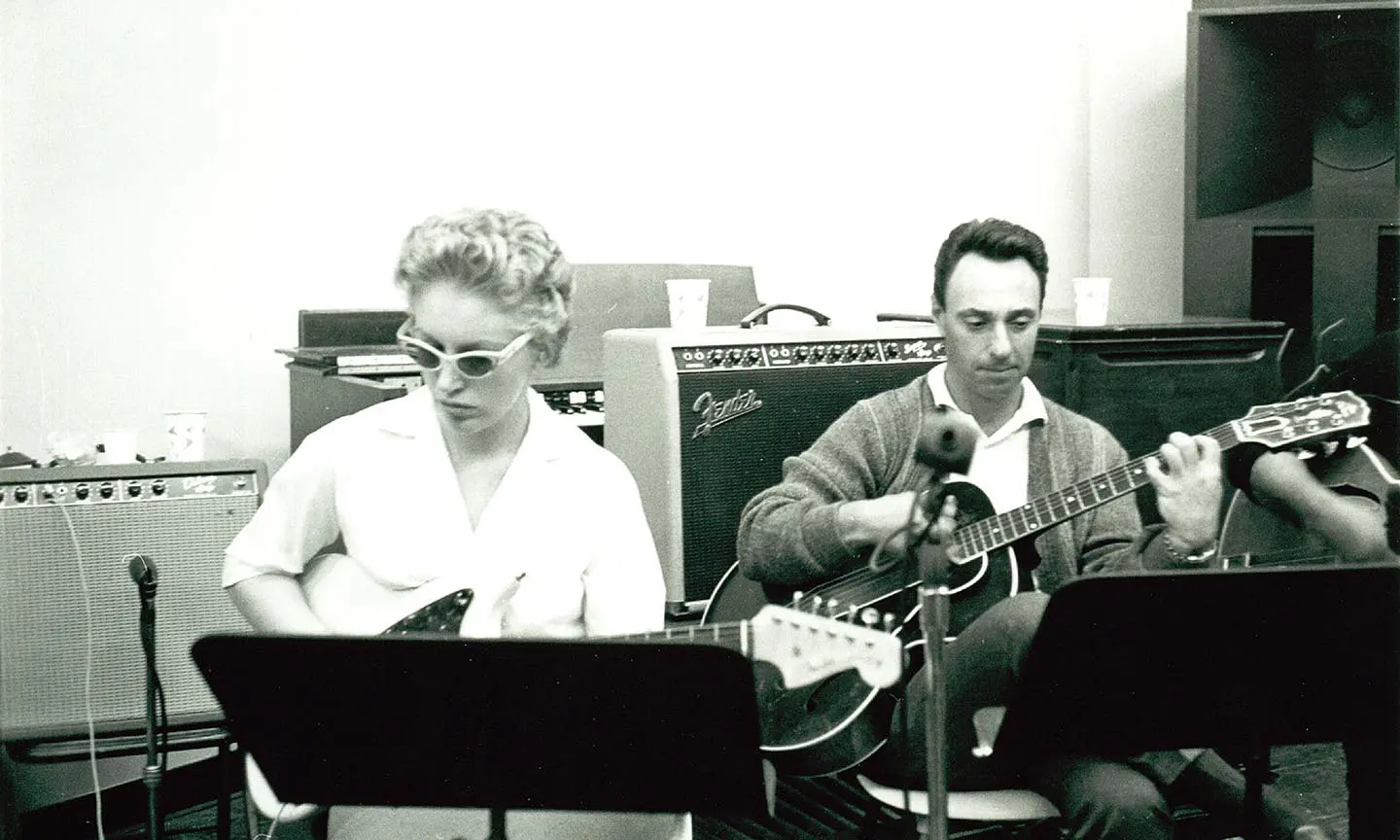
Session Musician Spotlight: Carol Kaye

Carol Kaye

When guitarist/bassist Carol Kaye took her first gig as a session player in 1957 for a Sam Cooke session, she simply saw herself as a working mother who needed to provide for her children. “I knew it looked like money, and I had two kids to pay for,” she once told Far Out.

Kaye was born to working-class, professional musician parents and grew up in a housing project during World War II. At the age of nine, her parents divorced, and she began working to help make ends meet, paying for her own guitar lessons. By the time she was fourteen, she was already a professional – assisting her guitar teacher with lessons and playing jazz gigs in the Long Beach area.

The jazz work led to the Sam Cooke session, and from that sprang a career that encompassed over 10,000 sessions on both rhythm guitar and bass for artists like The Beach Boys, Nancy Sinatra, Herb Alpert, Quincy Jones, Cher, and Joe Cocker as well as scores for film and television.

As one of the few women to find consistent work in the session world, she is viewed today as a trailblazer who broke the glass ceiling for other women musicians like June and Jean Millington, Bobbye Hall, and Sandra Crouch.

Kaye maintains, however, that her focus in those years was less lofty: “I never thought of myself as a woman at all. I knew I was a woman because of the way men looked at me, but not as a guitar player. The guitar was my voice, so I used my guitar to play and make money with. I was born in 1935 and my parents were not extremely poor, but there were times that we didn’t have enough to eat. When you work on that basis, it changes everything.”

Glen Campbell – Wichita Lineman

“‘Wichita Lineman’ is one of my favorite records,” Kaye once said. “I got to improvise most of my bass line on that….We just had a chord chart to work from, and they came up with a lead-in line…so they asked me to ‘start it with a pickup on bass’…and what you hear is what I invented.”

YouTube Video
Click to load video

Brenda Holloway – You’ve Made Me So Very Happy

Kaye played on more than 175 tracks for Motown artists like Diana Ross & The Supremes, the Four Tops, Martha & The Vandellas, Stevie Wonder, and others between 1964 and 1971. Her bassline undergirds this slow burner that hit the top 40 of Billboard’s Hot 100 in 1967. It became an even bigger hit for Blood, Sweat & Tears, peaking at the number 2 position on the same chart, two years later.

YouTube Video
Click to load video

Righteous Brothers – You’ve Lost That Lovin’ Feeling

Produced by Phil Spector, Kaye played rhythm guitar on this recording that hit the number one position on both the American and British charts in February 1965. Kaye recalls of the Spector sessions, “The room would usually hold a crowd of musicians, Sonny Bono would sit in with the percussion section playing tambourine until Phil would call him saying, ‘Telephone, Sonny.’ Then as soon as he was out the door, we’d do the take (to the gratefulness of the percussionists). The booth was constantly crowded with people. What a scene, but fun!”

YouTube Video
Click to load video

Tina Turner – River Deep, Mountain High

This 1966 Phil Spector production was no ordinary session, costing $22,000 to record with over twenty musicians. Kaye provided the song’s memorable bassline. She told Songfacts, “It felt like another thing that was going to be a hit, but to walk in the booth and there’s a ton of people in the booth, and there’s a ton of us out in the studio, it almost felt like a party.”

YouTube Video
Click to load video

Wonder Woman (Theme)

It seems fitting that Kaye would receive the call to play on the theme song for The New Adventures of Wonder Woman, starring Lynda Carter, which aired on CBS from 1976-1979. Kaye’s bass is prominent in the mix alongside session royalty like Emil Richards, Joe Porcaro, and Tommy Tedesco.

Looking for more? Check out our series of articles on the greatest sessions musicians ever.

​Discover more about the world’s greatest R&B artists | uDiscover Music

Categories
Music

‘American Idol’ Standout Julian Kalel Moves Judges and Audience With Emotional Performance of Zach Bryan’s ‘Tourniquet’

Julian Kalel brought a wave of emotion to the American Idol stage in Hawaii with a performance that left both the audience and judges visibly moved. The Texas native took on Zach Bryan’s “Tourniquet,” a song he deeply resonates with as it centers around the importance of lifting others up during their hardest moments.

As he explained to mentors Keke Palmer and Brad Paisley, “Tourniquet” carries a deeply personal meaning for him.

“’Tourniquet’ to me means picking someone else up when they’re hurting and always telling someone, ‘I have your back.’ What always heals my heart is thinking about the people that I have in my life and what motivates me even more is hoping that whoever’s listening gets that feeling that ‘I understand, I see you.’”

Julián Kalel; Photo by Disney/Eric McCandless

Paisley emphasized that Kalel taking on a song so personal to him makes the performance feel ‘very authentic’ and gives listeners a clear sense of who he is as an artist.

“That’s the magic of being this close. It’s really captivating…Your voice is perfect. You’re suited for that song,” Paisley shared.

Palmer added, “Sometimes when you’re in a competition, it’s like you’re thinking about what’s going to do my voice the best, but if you just sing what’s true to you, somehow it’s most perfect.”

Julian Kalel was clear in his mission to make his delivery feel like a hug or like a hand on someone’s back, letting them know they’re not alone.

Keke Palmer, Brad Paisley, Julián Kalel; Photo by Disney/Eric McCandless

“Whenever I listen to a song like this, I think of unconditional love, whether it be for a friend, for someone you love and it just means that you’re never going to leave their side, their worst days and their best days,” he reiterated as he stepped on stage in front of the live audience. “I wanted it to feel like a hand on your back, a hand that you can hold, a hug, just letting you know that you’re never alone, no matter how down you are.”

On the stage, located on the beach of Aulani’s Disney Resort and Spa, Kalel strummed his guitar with steady confidence, never showing a hint of nerves or uncertainty. Instead, he sang from the heart, and it paid off as members of the audience audibly responded, showing that they were moved by his tender, crisp vocals that radiated warmth. Midway through the performance, he turned things up a notch, effortlessly showcasing his impressive vocal range and proving he’s not just a singer, but a true performer who can command the stage.

By the end of his performance, Julian Kalel had achieved his exact goal of connecting with the audience as well as the judges.

Palmer spoke first, noting that even though she hasn’t seen the entirety of his Idol journey up to this point, it has already become abundantly apparent to her how much it means to him being up on stage and sharing his heartfelt messages.

“Your voice is beautiful. I mean, I could listen to you go on and on and on. And then when you look up, you’re talking about ‘Tourniquet.’ This is a deep and intense song, but you’re delivering that hope when you look up during the performance and you flash us that smile. It does feel hopeful. It’s beautiful. I loved it. Great job.”

Carrie Underwood called Kalel not only an artist, but also a poet as she gushed over his ability to make a story feel “believable.”

“It’s just so honest and it’s so you. And it’s a joy to get to listen to you. This is the best job in the world,” she shared.

Lionel Richie added, “To see you at this point in this competition, confident, stepping right on it. It is just really exciting as a judge to see you stand there in the light of your artistry. Strong and powerful. Forget everything else. If we can get you to this point right here, your future is right in front of you.”

Luke Bryan was last to comment, but his opinions were as strong and positive as the rest of his fellow judges. He even went as far as to label the hopeful contestant a “star.”

He proudly stated, “You make us happy to be doing this up here. That was like front runner of the competition kind of stuff. That was like star is born kind of moment. It’s so fun when somebody’s just got it and you just got it.”

Fans who want to help Julian Kalel advance in Season 24 can cast their votes in two ways. First, by commenting “Julian” on the official American Idol voting posts across Facebook, Instagram, and TikTok. Second, by texting “19” to 21523. Voting closes at 6am ET on March 24, 2026. There is a limit of 10 votes protestant per method and it is open to all wireless carriers.

The results of America’s votes will be shared next Monday night (3/30), revealing which singers have made it into the Top 12. Those remaining will take part in the Songs of Faith night.

The post ‘American Idol’ Standout Julian Kalel Moves Judges and Audience With Emotional Performance of Zach Bryan’s ‘Tourniquet’ appeared first on Country Now.

​Country Now

Categories
Entertainment

Channing Tatum Is Writing a Romance Novel

Channing Tatum, 2026Channing Tatum is bringing his magic to the literary world.

The Magic Mike alum will be releasing a romance novel co-authored with Roxane Gay next year. And as the Bad Feminist writer revealed,…
​E! Online (US) – Top Stories

Categories
Alaska News

Alaska legislators advance stopgap spending bill intended to address construction and disasters

Members of the bicameral conference committee charged with writing a compromise supplemental budget sign the final documents on Monday, March 23, 2026, at the Alaska Capitol in Juneau. (James Brooks photo/Alaska Beacon)

Members of the bicameral conference committee charged with writing a compromise supplemental budget sign the final documents on Monday, March 23, 2026, at the Alaska Capitol in Juneau. (James Brooks photo/Alaska Beacon)

The Alaska Legislature is preparing to re-vote on a key spending bill that will cover millions of dollars in disaster response and construction projects in the current fiscal year.

On Monday, a bicameral conference committee voted 5-1 to send an amended version of the bill to final votes in the House and Senate. Those votes may take place Wednesday.

The state’s fast-track supplemental budget contains $449.3 million in spending — expenses accrued since legislators and Gov. Mike Dunleavy adopted the state budget last year.

Legislators are separately working on a budget for the next fiscal year, which begins July 1. A vote on that is expected at the end of the legislative session in May. 

The supplemental budget bill includes $70.2 million to unlock grant-funded construction projects principally paid for by the federal government — a major lobbying priority for the state’s construction industry.

It also includes tens of millions for the state response to last year’s wildfire season and millions more as a down payment for the state’s response to ex-Typhoon Halong, which devastated Western Alaska last fall.

The new spending would largely be paid for with new revenue the state expects because of higher oil prices caused by the Iran war. 

As long as prices remain high through June 30, the end of the fiscal year, legislators expect there will be enough general-purpose money to cover the expenses, plus a smaller package of budget amendments already proposed by Dunleavy. 

Those amendments arrived too late to be added to the supplemental bill. 

If oil prices don’t match expectations, the bill contains language that would allow the state to use the Constitutional Budget Reserve, the state’s principal savings account, to cover the difference plus $20 million in “headroom.” 

That clause may run into problems in the House, where the 19-person House Republican minority caucus has voted several times against spending from the reserve.

It takes 30 votes in the House and 15 in the Senate to spend from the reserve; while the Senate has met that threshold and is expected to do so again this week, it isn’t clear whether the House will do so.

The 21-person, predominantly Democratic coalition that controls the House would need to attract at least nine minority votes, and in earlier votes, it was unable to do so — something that forced the bill into a bicameral conference committee for further negotiations.

Rep. Will Stapp, R-Fairbanks and the minority’s negotiator on the conference committee, was the only lawmaker to vote against the revised bill on Monday, saying he doesn’t believe any kind of spending from the reserve is necessary at this point.

Members of the House majority have argued that allowing reserve spending — if necessary — would provide surety for construction businesses making summer plans. 

They have also argued that time is of the essence: Delaying action on the bill would mean those companies might have to defer purchasing and hiring decisions ahead of the summer construction season.

Members of the House minority argued that as previously written, the bill would have allowed members of the majority to direct the spending of hundreds of millions from the reserve, even if it wasn’t needed to balance the supplemental budget.

That version was cut to less than $375 million in spending, an attempt to attract minority votes, but while that approach worked in the Senate, it did not succeed in the House.

When the House failed to pass the reserve vote, lawmakers there sent the bill to the conference committee for further work.

While that committee was able to finalize a draft compromise, it won’t be clear until later whether that compromise can pass out of the Legislature.

SUPPORT: YOU MAKE OUR WORK POSSIBLE

Categories
Alaska News

This Week in History: Average Haines age, extreme ski contest and border relocation

10 years ago

After a drop of 84 people in 2013 and an increase of 21 in 2014, the population of Haines has reverted to a downward trend, dropping 58 people in the last year to a total of 2,493, according to state statistics.

The town is also continuing to get older, maturing from a median age of 46.6 in 2012, to 48 in 2013, 48.5 in 2014, and 49.3 last year, according to the Department of Labor and Workforce Development.

That means the Haines Borough will retain its position as the oldest borough in Alaska, said state demographer Eddie Hunsinger.

Keeping with the town’s recent trend of no growth through natural increase, births and deaths matched each other last year. In 2014, two more people died than were born here, and in 2013, eight more people died than were born.

According to a news release put out by the Department of Labor and Workforce Development, among the state’s six economic regions, Anchorage/Mat-Su gained the most over the period (343) followed by Northern (277), and Gulf Coast (220). Southwest (-232), Interior (-172) and Southeast (-165) regions each had small losses.

Of Alaska’s 29 boroughs and census areas, 11 grew between 2014 and 2015. The largest population increases were in the Mat-Su Borough (1,801) and Kenai Peninsula Borough (348). The Municipality of Anchorage lost the most people over the period (-1,458).

Hunsinger said the state primarily uses census information and Permanent Fund Dividend applications to make annual population estimates.

24 years ago – March 21, 2002

The season’s centerpiece extreme skiing event begins Friday when two dozen skiers and photographers arrive for the second annual Red Bull Snow Thrill of Alaska.

The eight-day event begins with a downtown open house Friday evening to meet participants, and ends with a day-long competition on a ridge above the Chilkat River that should be visible from town.

Event coordinator Ryan Ernst said the Red Bull Freeskiing World Championship will be held around March 29 on “Telemark Ridge,” above Haska Creek on the west side of the Chilkat.

“It’s so weather dependent. I wish we could have it on a set day. When it looks like we can hold it, we’ll call around and make sure people know so they can get out and watch with binoculars,” Ernst said. A similar event was canceled last year due to poor weather conditions.

Ernst is leading a group of six event organizers who are spending the week scouting locations for the main event — a skiing photography contest to take place on mountain peaks near the Canadian border.

The event pits 12 teams of one skier and one photographer to create the best photos in six categories: best action and feature story sequence, air, fly-on-the-wall, Alaska lifestyles, and powder turns. Each team gets a limited amount of helicopter time to get their shots. Peer judging will be held over the Internet.

Ernst said the event will be based at 33 Mile Haines Highway and will employ three or four helicopters to haul participants and gear. The Telemark Ridge finale will be based at the Haines airport.

It’s the third year logistics coordinator Jim Conway has organized ski days in the upper valley. Conway said Haines has ideal mountains and snow conditions for high-country skiing. 

“It’s the best we’ve found, and I’m from Salt Lake. In coastal mountains, you get wetter snow than in the Interior and there’s way better stability. When it’s clear here, you really get the best of both worlds. It’s a treat to come here.”

But snow conditions aren’t that great this week, according to ski guide Shawn McNamara. McNamara, who’s helping organize the Red Bull event, said high winds during the past two weeks have polished and hardened the snow cover. “It’s been blowing a lot. There are pockets of soft snow, and there’s enough to hold the contest, but it’s not ideal.”

Conway said Outside skiers enjoy Haines’ rural atmosphere. “It’s a great town. People don’t come to Alaska for a five-star hotel. Haines is a nice comfortable town with its own character, and people enjoy that.” Haines local heliski outfitters and guides will be involved in the event, Conway said.

An open house sponsored by the Haines Chamber of Commerce, the Convention and Visitors’ Bureau, and local businesses will allow residents to meet skiers, photographers and guides particıpating in the competition. The reception, which will include a welcome from city mayor Dave Black and a presentation by Ellen Winkler of Mountain Sports International, will begin at 6 p.m. Friday at the Sheldon Museum.

Tourism director Michelle Glass said skiing and snowboarding enthusiasts should be sure to turn out. “They’ll have posters to autograph and we’ll all get to meet each other.” The Pioneer Bar is holding a welcoming party following the open house with music by the Truffles.

53 years ago – March 5, 1973

A petition requesting the relocation of the U.S. Customs and Immigration station from Haines to adjacent to the Canadian border station is making the rounds.

According to Dorothy Fossman of Klukwan, writer of the document, she was able to get “25 signatures in 15 minutes” and is confident of getting a majority of area residents to go along.

The recent waiver of “phone in” privileges for Haines Highway residents returning to Alaska from Canada has gotten several persons mad — namely those that must drive all the way into Haines to check in before driving all the way out to homes along the road. The “no stopping” rule has hurt businesses situated along the highway. The rule effectively bars inbound traffic from stopping to buy gas or eat a meal this side of the border. The owners of businesses along the road are not overjoyed with the setup.

“This may be in violation of the United States Constitution,” Fossman said. “This is an interruption of the free enterprise system.”

The petition, addressed to the Commissioner of Customs in Washington, D.C., requests that “adequate and up-to-standard facilities” be constructed adjacent to the Canadian facilities at the border. Attachments to the petition call attention to past requests along the same line that have had negligible response,” Fossman says.

“Even with a gate (which has been eliminated as a proposal), the basic problem remains,” Fossman said. “Persons would still have to drive clear into town without stopping. The rules simply were not designed to fit a case where such great distances between stations exist.”

Locations in town where petitions will be placed will be announced this week on TV, Fossman said.

The post This Week in History: Average Haines age, extreme ski contest and border relocation appeared first on Chilkat Valley News.

Categories
Alaska News

One dead in an avalanche near Pleasant Camp

One person died Sunday afternoon in an avalanche near the Canadian border in British Columbia.

Atlin Royal Canadian Mounted Police received a Garmin SOS alert from a remote location near the Klehini River and Pleasant Camp, according to a news release. When they got the call, one person was reported unconscious and receiving CPR. Atlin Search and Rescue responded with a helicopter and flew out four people who were uninjured, and a fifth who had died.  

RCMP spokesperson Sgt. Vanessa Munn did not share more details Monday but said the accident happened on the Canadian side of the border.

According to Avalanche Canada, the risk is “considerable” in the Haines Pass and by the border. Haines Avalanche Center director Jeff Moskowitz reaffirmed this saying that human-triggered avalanches are likely.

Moskowitz said recent snowfall created sensitive layers in the upper snowpack with winds redistributing the snow. In addition to winds affecting the snowpack, solar radiation can lead to instability and trigger avalanches or increase the likelihood of human-triggered avalanches.

Moskowitz said that “when we get these really cold temperatures,” weak layers are created in the snowpack that get buried with successive snowfall. Additional risks Moskowitz said to keep an eye out for are cornices, or overhanging shelves of snow, as they can “trigger layers deeper in the snowpack,” leading to an avalanche.

Moskowitz said he has seen shooting cracks — a visible fracture in the top of the snowpack — while out in the backcountry. Shooting cracks occur due to weight from above, often caused by skiers traveling on the surface. He has also gotten reports of human-triggered whumpfing sounds, or collapsing, which occurs when the snowpack drops with weight from above. 

Moskowitz said that the strong-over-weak layering is “fairly widespread.” Such layering occurs when stiff snow, often from snow drifts, sits on top of a layer of sugary snow – or snowflakes that don’t stick together well.

For those traveling into the backcountry, Moskowitz advises to “make conservative terrain choices while the snowpack adjusts, and that could include sticking to slopes less than 30 degrees.” Additionally, he said skiers should assess conditions and layers before committing to steeper slopes.

Since 2012, eight people have died because of avalanches around Haines, in addition to an avalanche partially burying one person.

The post One dead in an avalanche near Pleasant Camp appeared first on Chilkat Valley News.

Categories
Entertainment

This Fast-Casual Mexican Chain Wins Fans With Its Fresh, High-Quality Ingredients

Fast food isn’t known to have the freshest ingredients, but fans and employees say you should choose this Mexican chain over others for its superior options.

​Mashed – Fast Food, Celebrity Chefs, Grocery, Reviews

Categories
Entertainment

Found: Reformation Dress Deals at Nordstrom’s Spring Sale

Ref Dresses Nordstrom Big Spring Sale Thumb.jpgReformation girlies, it’s your last call to save big on spring styles during Nordstrom’s Spring Sale!
Today’s the last day of the sale, which has also brought mega deals to other brands we love…
​E! Online (US) – Top Stories

Categories
Alaska News

Alaska youth and advocates urge support for suicide prevention, state funding for 988 crisis line

Brothers Johnny Nicolai and Jacob Nicolai of Toksook Bay speak at a rally with advocates at the Alaska State Capitol to raise awareness around suicide and urge state support for the 988 crisis line on Mar. 19, 2026. (Photo by Corinne Smith/Alaska Beacon)

Brothers Johnny Nicolai and Jacob Nicolai of Toksook Bay speak at a news conference with advocates at the Alaska State Capitol to raise awareness around suicide and urge state support for the 988 crisis line on Mar. 19, 2026. (Photo by Corinne Smith/Alaska Beacon)

Toksook Bay youth joined advocates at the Alaska State Capitol as survivors of suicide loss to raise awareness for suicide prevention, and urge state support for funding mental health services, including the state’s 988 crisis line.

“I’ve lost a couple people to suicide. It made me feel like my family was broken,” said Jacob Nicolai, a 20-year-old from Toksook Bay in Western Alaska. “Losing a loved one through suicide is hard. It can feel like a part of you is gone too. It takes a long time to forgive and accept.”

A pair of bills now in the Alaska House and Senate, House Bill 138 and Senate Bill 196, would implement a $0.98 surcharge per month on all phone lines in Alaska to go toward a behavioral health crisis services fund. The surcharge is expected to generate $6 to $8 million toward the fund, which would be administered by the Alaska Department of Health and go to support the 988 crisis line, support services, training for at-risk communities and public awareness campaigns around suicide prevention.

Alaska has the highest rates of suicide of any state in the nation — more than double the national rate — a trend that has remained consistent for decades. In 2024, the most recent year of publicly available data, 222 Alaskans died by suicide, with boys and men making up the large majority of suicide deaths at 83% of those deaths. However, more women and girls are hospitalized each year due to suicide attempts.

Alaska youth ages 15 to 24 continue to have the highest rates of any age group, with roughly 48 deaths per 100,000 people in 2024. 

“Suicide prevention is important to me because I believe all of us are here for a reason,” Nicolai said. “We’re here to live and show our loved ones what we are capable of. We are here because we matter. Sometimes people forget how much they matter. So it’s our job, all of us, to check in with our co-workers, family and friends, and ask how they are feeling.”

He was among the youth, advocates and lawmakers that held a news conference on the steps of the Capitol on Thursday to urge passage of legislation in the Alaska House and Senate in part to provide state funding for the 988 Suicide & Crisis Lifeline – a 24/7 free, confidential hotline for not only suicidal ideation, but for anyone in need of resources or support for depression, relationships or mental health issues.

“I’ve lost relatives and friends and seen the after effects of suicide in my community,” said Johnny Nicolai, his younger brother, an 18-year-old junior at Nelson Island School in Toksook Bay. “That’s why it is important for me and my friends to see people happy and supported. I want people to know that they’re not alone.”

Nicole Bick, an Alaska advocate with the national non-profit Inseparable, which focuses on improving mental health, said one life is lost to suicide every two days in Alaska. “One life lost to suicide is one too many,” she said. “Each loss sends shock waves through families, communities and classrooms.”

Jennifer Johnson-Sahaba, site administrator for Nelson Island School in Toksook Bay, spoke about the shock and grief of losing her seventh grade student to suicide last year.

Jennifer Johnson-Sahaba, site administrator for Nelson Island School in Toksook Bay, speaks at a news conference on suicide prevention at the Alaska State Capitol on Mar. 19, 2026. (Photo by Corinne Smith/Alaska Beacon)

“Thirteen years old, a life with so many unwritten chapters, so many possibilities, so many moments that will never come to pass. His laughter, his future, the person he might have become, all gone far too soon. His loss is something that I carry with me every single day,” she said.

Johnson-Sahaba said she feels a renewed sense of responsibility to listen and care for her students, to ensure that no one feels so alone.  

“I never want another child to feel that kind of loneliness, despair and darkness that leads them to believe that their life does not matter. I never want another student to feel so unseen, so unheard and so overwhelmed that they believe there’s no way forward. Our children deserve more than that. They deserve to feel safe. They deserve to feel loved,” she said.

Rep. Genevieve Mina, D-Anchorage, is sponsoring the legislation in the House and spoke about losing her father to suicide.

Rep. Genevieve Mina, D-Anchorage speaks at a news conference on suicide prevention at the Alaska State Capitol on Mar. 19, 2026. (Photo by Corinne Smith/Alaska Beacon)
Rep. Genevieve Mina, D-Anchorage speaks at a news conference with youth, advocates and lawmakers on suicide prevention at the Alaska State Capitol on Mar. 19, 2026. (Photo by Corinne Smith/Alaska Beacon)

“Although my family was aware that he was struggling, he never asked for help. He was ashamed to talk about his struggles, and maybe it was guilt or shame from culture or stigma, but he never talked about it,” she said. She said she didn’t talk about it much either, until many years later.

Mina said the state should be doing more to provide support, but stable funding for the crisis line is a start. 

“When we don’t treat mental health conditions, they worsen in our emergency rooms. They also impact our families… There are far too many Alaskans that are experiencing this isolation and that are dealing with these struggles. We need a better and more stable support network,” she said.

In 2022, the Biden administration established the national 988 crisis line following legislation passed by the U.S. Congress. In Alaska, the crisis line is based in Fairbanks, and has seen a growing number of calls in the years since. Last year, the state crisis line received nearly 44,000 calls from Alaskans. 

Alaska Native residents experience the highest rates of suicide in the state. Rural communities have seen much higher suicide rates per capita, according to state data, with the highest rates in the Yukon-Kuskokwim Delta region. The lowest suicide rates in 2024 were seen in the Kenai Peninsula region. 

The Nicolai brothers said they have been volunteering with suicide prevention efforts with the American Foundation of Suicide Prevention Alaska chapter in their community for the last several years, which holds events focused on Alaska Native community and culture to raise awareness and promote healing for those who’ve experienced suicide loss.

“Open healing is a week long event in our community where we remember those we’ve lost to suicides,” said Johnny Nicolai. “We start off with our traditional blessing song, then we listen to elders talk about life lessons and stories. After that, we separate classes into groups and they do cultural activities. Hope and healing brings people together and reminds us that our culture and community can help us.”

SUBSCRIBE: GET THE MORNING HEADLINES DELIVERED TO YOUR INBOX

Categories
Alaska News

Rough draft of revised Tongass plan envisioning more resource development released for public comment

An early look at Tongass National Forest management plan revisions intended to suit the Trump administration shows, as pledged, a focus on expanding timber and other natural resource development.

A 117-page document referred to as “Preliminary Draft Plan Content” was released Monday by the U.S. Forest Service. Among its extensive recommendations are expanding second-growth timber harvesting activity, allowing “a projected timber sale quantity increasing to 72 million board feet per year in the next decade, due to more young growth reaching harvestable age.”

“The volume of young growth as part of the yearly offer increases annually until young growth is the dominant portion of what is offered,” the draft adds.

The official plan last updated in 2016 calls for an average harvest of 46 million board feet annually. The draft released Monday notes the Forest Service is conducting a new long-term timber demand analysis as part of the revised management plan.

Another major recommendation in the draft is reducing the number of management areas and “simplifying” regulations in those areas.

The document released Monday “is not a complete Draft Forest Plan,” the U.S. Forest Service noted at its website.

“It is a starting point meant to elicit feedback, and will likely change by the time this goes out as a complete Draft Forest Plan,” the website states.

The release also marks the beginning of a public comment period scheduled through May 6, with online and in-person meetings scheduled throughout Southeast starting this week. Those include an online town hall from 5:30-6:30 p.m. Wednesday when “an overview of the recently released preliminary draft plan materials” will be presented and an in-person meeting in Juneau from 5-7 p.m. April 15 at the Juneau Ranger District office.

“This feedback period is meant to focus primarily on the preliminary content,” the Forest Service website notes. “At this time, public feedback will be used to refine a proposed action, help develop alternatives, and determine which substantive issues will be analyzed in detail in the Environmental Impact Statement. Your feedback on plan content would be most helpful if it focused on these goals.”

Areas where an “overarching need to change” exists, according to the draft:

• “Update and modernize the plan consistent with the 2012 Planning Rule by simplifying, clarifying, reorganizing, and reducing the number of management areas for concise, easy to follow direction.”

• “Prioritize local and regional prosperity of Southeast Alaska by contributing to timber, minerals, tourism, recreation, and other important economic drivers.”

• “Incorporate strategies to address significant changes in recreation and tourism, including the increase in cruise ship visitation.”

• “Include plan content that encourages collaboration and shared stewardship with a variety of partners in pursuit of common objectives. These partners can include local, state, and tribal governments; Alaska Native Corporations; industry stakeholders; and other non-governmental organizations.”

• “Consider needs for subsistence uses such as hunting, fishing and gathering when developing the revised plan.”

• “Consider indigenous knowledge related to land stewardship, cultural issues, and culturally significant sites.”

The Forest Service just completed another comment period on the revised plan Friday. Nearly 600 comments were submitted between Feb. 17 and March 20. The agency prior to that comment period made it clear President Donald Trump’s goal of expanding natural resource industries in Alaska would be a goal of the revision.

A press release issued by the Forest Service at that time spells out the past and new parameters that will be considered in the revised draft.

“Public comments will help identify changes that are needed to the current plan, adopted in 1997, to align with best available science, as well as laws and regulations, including President Trump’s Executive Order 14225 – Immediate Expansion of American Timber Production to support American economies and improve forest health and Executive Order 14153 Unleash Alaska’s Extraordinary Resource Potential, benefitting the Nation and the American citizens who call Alaska home,” the Forest Service announcement in February stated.

Notably, the draft does include recommendations to mitigate impacts caused by climate change, which Trump has called a hoax and sought to eliminate as a factor from a wide range of federal policymaking. Among the references in the Tongass report published Monday are ensuring “winter trails and trailheads” and “watersheds and associated aquatic ecosystems” are resilient to climate change, along with factoring climate into timber-related reforestation efforts.

The Forest Service’s timeline, as of Monday, calls for a draft Environmental Impact Statement by August of this year, a final EIS by May of 2027, a decision by October of 2027 and implementation of the revised plan by November of 2027.

This story was originally published by the Juneau Independent.

The post Rough draft of revised Tongass plan envisioning more resource development released for public comment appeared first on Chilkat Valley News.