Categories
Uncategorized

50 years ago, the Supreme Court broke campaign finance regulation

Most other democratic countries spend only a fraction of what the U.S. does on elections. Greggory DiSalvo, iStock/Getty Images Plus

In 2024, spending on federal elections totaled almost US$15 billion in the United States. The United Kingdom, in contrast, spent approximately $129 million on its 2024 parliamentary elections – less than 1% of 2024 U.S. spending – despite having a population one-fifth the size of the U.S.

Indeed, most other democratic countries spend only a fraction of what the U.S. does on their respective elections.

Why do U.S. elections cost so much?

Many people may attribute the blame to Citizens United v. FEC, the 2010 U.S. Supreme Court case that struck down corporate spending limits in elections.

Yet the source runs much deeper, to a case that marked its 50th anniversary in early 2026: Buckley v. Valeo, a landmark case that established the modern framework for U.S. campaign finance regulation.

Big money’s political influence

For most of U.S. history, political spending was an unregulated practice. In turn, big-moneyed interests wielded major influence over elections without any legal impediments.

In the early 20th century, however, Congress began implementing small measures to rein in unfettered campaign finance. In 1907, for instance, Congress passed the Tillman Act, which banned corporations from donating directly to candidates. By 1971, Congress had implemented the modern Federal Election Campaign Act, or FECA, which initially just included disclosure and disclaimer requirements for candidates.

Nevertheless, following the Watergate scandal – which included bags of cash and campaign dirty tricks – Congress enacted the more comprehensive 1974 FECA Amendments to more effectively restrain big money in American politics.

The FECA Amendments instituted, among other things, dollar limits on the amount of money individuals and political committees could contribute to federal candidates. Similarly, it limited the amount of money individuals could independently expend to support the election or defeat of a federal candidate.

Almost immediately, a number of politicians and other parties filed suit – including U.S. Sen. James Buckley, a New York conservative; former U.S. senator and 1968 presidential candidate Eugene McCarthy, a Minnesota Democrat; and the New York Civil Liberties Union – to challenge the amendments’ constitutionality.

They argued that the new laws restricted First Amendment freedoms of political speech and expression. Their argument was straightforward: If I can’t spend as much as I want to support a candidate, I am unable to fully express my political views. The lawsuit ultimately ended up before the U.S. Supreme Court.

On Jan. 30, 1976, the Supreme Court issued its opinion. One of the lengthiest in U.S. history – 294 pages in total – the opinion took an axe to the FECA and effectively reduced federal campaign finance law to a patchwork of laws and rules resembling regulatory Swiss cheese.

In doing so, the court laid the groundwork for the development of the modern campaign finance system in the U.S.

Money is speech

What did Buckley v. Valeo do?

For one, the court declared that limits on political contributions and expenditures, in fact, affect First Amendment interests. The court found limits on contributions to indirectly impact donors’ right of expression, the idea being that a contribution to a candidate acts as an expression of support for them.

Contribution limits can furthermore directly infringe on candidates’ speech rights if they are so low as to prevent the candidate from effectively campaigning, the court decided.

The court, meanwhile, found limits on political expenditures, such as spending money on a TV ad, to impose an even more direct constraint on speech rights. In the court’s words, such limits reduce “the quantity of expression by restricting the number of issues discussed, the depth of their exploration, and the size of the audience reached.” With this, the court embraced what its critics have dubbed the “money is speech” principle.

So whenever a law constrains political speech, the government must justify it via a “compelling” state interest. Thus came the court’s second major move via the Buckley decision: narrowly defining the government’s interest in regulating money in politics.

Specifically, the court recognized only one compelling state interest in restricting political spending: preventing quid pro quo corruption – the exchange of money for political favors. With this, the court outright rejected that the government had a serious, broader interest in promoting political equality, one of the driving forces behind the passage of the 1974 FECA Amendments.

Applying this framework, the court upheld federal limits on contributions to candidates because directly giving money to politicians carries a risk of quid pro quo.

In contrast, the court invalidated FECA’s limits on independently made political expenditures – expenditures made on a candidate’s behalf but not in coordination with the candidate. In the court’s view, if somebody spends money to support a candidate without coordinating with that candidate, no corruption concern exists – an assumption that remains widely disputed. Thus, Congress had no compelling interest to limit political advocacy via expenditures.

A man in a sports jacket and tie, gives thumbs up as he stands behind a lectern featuring microphones.
Conservative James L. Buckley, whose name is on the crucial Supreme Court case Buckley v. Valeo, claims victory in the 1970 race for Senate from New York.
Bettman/Getty Images

Unlimited sums

While a product of 1970s lawmaking, the Buckley decision has played a major role in shaping modern U.S. politics. Its impact on how lawmakers can – and cannot – regulate money in politics endures today.

The most pronounced effect of Buckley has been the proliferation of spending by outside groups making those independent expenditures.

Buckley’s invalidation of independent-expenditure limits applied only to limits on individuals. But the Supreme Court has since extended Buckley’s logic to spending by organizations. In Citizens United in 2010, the court held that the government had no compelling interest in limiting independent expenditures made by entities such as corporations, unions or political action committees – PACs – that do not coordinate with candidates, known today as super PACs.

Shortly following the Citizens United decision, a federal appellate court applied Citizens United to strike down limits on contributions to super PACs, the idea being they could not engage in corruption if they were not coordinating with candidates.

Donors were now free to give unlimited sums of money to super PACs, which were free to spend unlimited sums of money to influence elections. Each passing election since then has seen untold super PAC spending, peaking at over $2.6 billion in 2024.

Enter dark money

Super PACs are only one part of the modern political landscape, though.

Following Citizens United, donors realized that if they were to donate money to a super PAC, federal law would mandate the disclosure of that donation. Yet, federal law contained a loophole: shell companies – companies formed purely to preserve the anonymity of their makers – and 501(c)(4) nonprofits could donate money to super PACs without having to disclose who their money came from. Collectively, these became known as “dark money” groups.

Wealthy donors thus started giving money to these dark money groups as a vehicle to fund super PACs without detection. These groups have become a major force in election spending, accounting for an estimated $1.9 billion in 2024.

The Buckley decision has also led to the proliferation of self-funded candidates. The Supreme Court held that the government cannot limit self-funding because the risk of quid pro quo is nonexistent – again, a disputed assumption.

U.S. campaigns now feature multimillionaires and billionaires propelling themselves into electoral contention each election cycle simply by virtue of having a well-funded bank account. In 2024, 65 federal candidates spent at least $1 million of their own dollars on their campaign.

Small limits, big spending

One area that still remains open to regulation post-Buckley is contributions to candidates, political parties or PACs.

Thus, contribution limits exist federally and in most states in some form.

Still, the government’s authority to cap contributions is not infinite. The Supreme Court has occasionally struck down certain states’ limits when they are deemed “too low.”

The court, moreover, invalidated in 2014 an aggregate limit on the amount a donor could contribute overall to candidates per election, reasoning that Buckley’s anti-corruption rationale could apply only to direct, one-to-one exchanges. Wealthy donors were thus free to donate to hundreds of candidates in an election cycle.

In 2025, the court heard a challenge to a federal law limiting how much political parties can spend in coordination with their nominees. Intended to prevent individuals from using parties as a means of circumventing individual-to-candidate contribution limits, the law has been on shaky ground for decades.

The court will issue a ruling on that challenge in the coming months. Whether the law is upheld or struck down, Buckley is guaranteed to play a major role in the decision.

The Conversation

John J. Martin does not work for, consult, own shares in or receive funding from any company or organization that would benefit from this article, and has disclosed no relevant affiliations beyond their academic appointment.

​Politics + Society – The Conversation
Categories
Uncategorized

When civil rights protesters are killed, some deaths – generally those of white people – resonate more

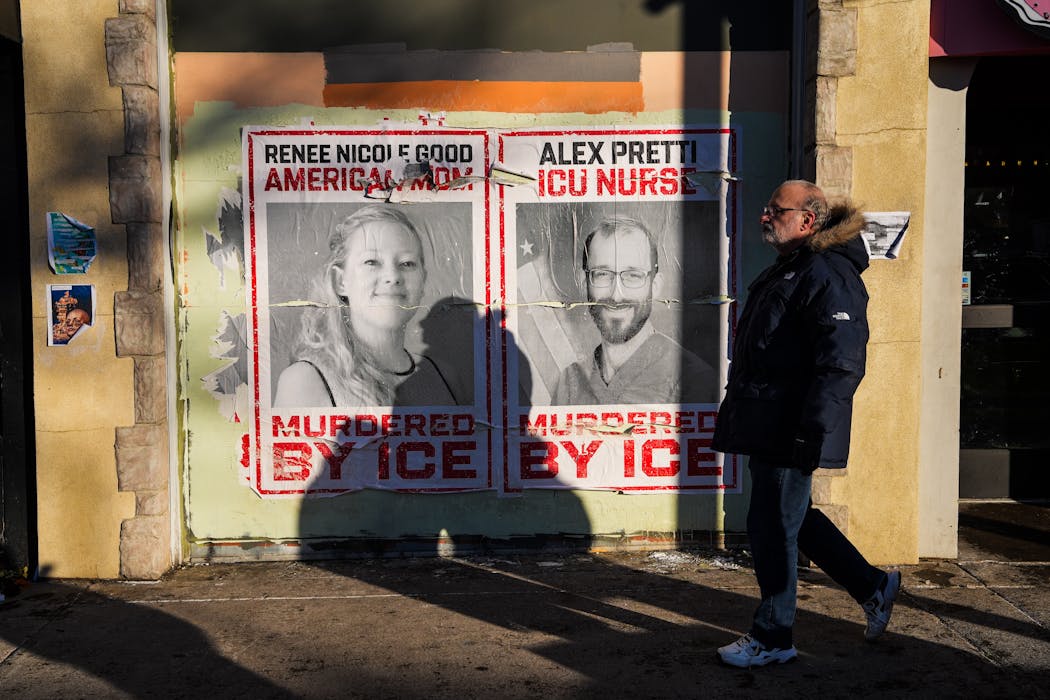
Posters memorialize Renee Good and Alex Pretti, two white Minneapolis residents killed by federal agents. AP Photo/Ryan Murphy

Renee Good and Alex Pretti, two white Minneapolis residents killed in January 2026 by federal agents while protesting the Trump administration’s immigration policy, have become household names. National media outlets continue to focus on their deaths and the circumstances around them.

Neither of them was the first person to be shot and killed by immigration enforcement officials over the past year. There have been numerous shootings and some deaths.

In September 2025, Silverio Villegas González was killed in Chicago under circumstances similar to Good’s death. Ruben Ray Martinez was shot multiple times by Immigration and Customs Enforcement agents in Texas in March 2025, but their involvement was not revealed until nearly a year later. Neither Martinez nor Villegas González has become a household name, and their deadly encounters with federal agents have not drawn nearly the same level of media attention as Good’s or Pretti’s.

As a media historian, I’ve been struck by the similarities between the media’s coverage of Minneapolis and its coverage of Selma, Alabama, in 1965, when voting rights protests led to violence that left three people dead, including two white victims.

I’ve written about the Selma campaign, as well as the media’s treatment of white female activists killed during racial justice protests, in my books “Equal Time: Television and the Civil Rights Movement” and “Making #Charlottesville: Media from Civil Rights to Unite the Right.”

These two events reveal that the deaths of white activists often draw and sustain far more attention than the deaths of Black or Latino people in similar contexts. But the Selma and Minneapolis events also show that male and female white activist victims aren’t necessarily treated the same way.

Remembering Selma

Video footage of law enforcement beating and gassing marchers on Selma’s Edmund Pettus Bridge remains an iconic visual document of the Civil Rights Movement. John Lewis, who later became a congressman, was an activist at the head of the march on March 7, 1965, and was beaten in the head at the base of the bridge by Alabama state troopers. But he was not a household name in 1965, and media coverage at the time did not identify him.

Reporters also didn’t pay much attention to what had motivated the march: the killing of Black voting rights activist Jimmie Lee Jackson by an Alabama state trooper during a nighttime march a week earlier.

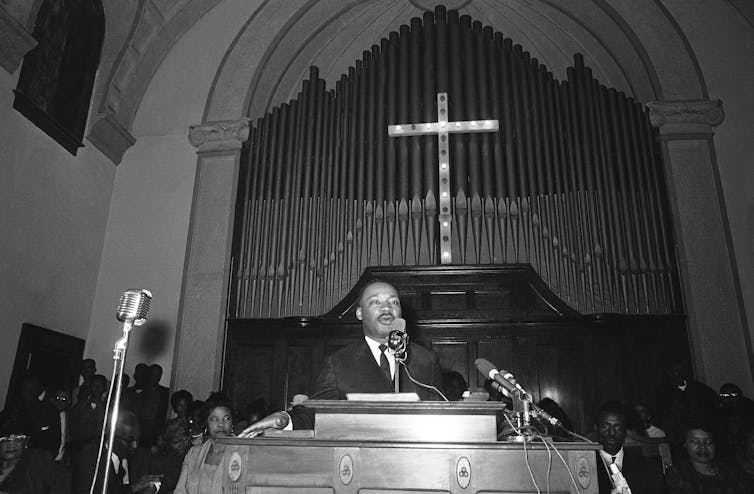
Martin Luther King stands at the pulpit of a church in front of a large crucifix.
Martin Luther King Jr. delivers a eulogy in Selma, Ala., for James Reeb, a fellow minister who was beaten to death.
AP Photo

Still, the prime-time television broadcast of footage from “Bloody Sunday” at the Pettus Bridge shocked Americans, just as footage from Minneapolis has similarly distressed and disturbed many people today.

In 1965, a small number of white Americans from around the country, including numerous members of the clergy, descended on Selma to stand with the brutalized voting rights activists. They included James Reeb, a Unitarian minister from Massachusetts, and Viola Liuzzo, a wife and mother of five from Michigan.

Reeb, following a second aborted march across the Pettus Bridge two days after Bloody Sunday, was viciously beaten by a group of white racists and left lying on the ground, mortally wounded. His beating and subsequent death received plentiful media attention.

President Lyndon B. Johnson contacted Reeb’s widow. She gave media interviews about her husband. Johnson also extolled Reeb at the beginning of his joint address to Congress calling for robust voting rights legislation, four days after Reeb’s death. Johnson never mentioned Jackson’s death.

Liuzzo was ferrying people back to Selma from Montgomery on March 25 after the conclusion of the final, successful march to the state capital when a carload of Ku Klux Klansmen, one an FBI informant, chased her down and shot her through her car window. Her death received even more coverage than Reeb’s, keeping Selma in the news.

The Voting Rights Act passed five months later.

Smearing the victim

So how does coverage of Reeb and Liuzzo echo the portrayals of Pretti and Good? And why does it matter?

Initial media treatment of Liuzzo focused on her status as a wife and mother. She was characterized as brave, putting the rights of others above her own. “Mrs. Liuzzo ‘Felt She Had to Help,’” was the headline of a New York Times profile.

Good’s status as a devoted mother and wife also characterized initial media reporting following her death. This kind of framing can often shield “nice white ladies,” as scholar Jessie Daniels has termed them, from the derogatory treatment that women of color have often endured in the public arena.

But in both cases, although separated by six decades, condemnation, disparagement and misogyny soon followed. Government officials, commentators and far-right forces framed these women and their activism in darker terms. Liuzzo was smeared by a KKK grand wizard who blamed her for her own death, saying, “If this woman was at home with her children where she belonged she wouldn’t have been in any jeopardy.” Liuzzo was falsely accused of having sexual relations with a Black man, thereby being characterized as a traitor to the white race.

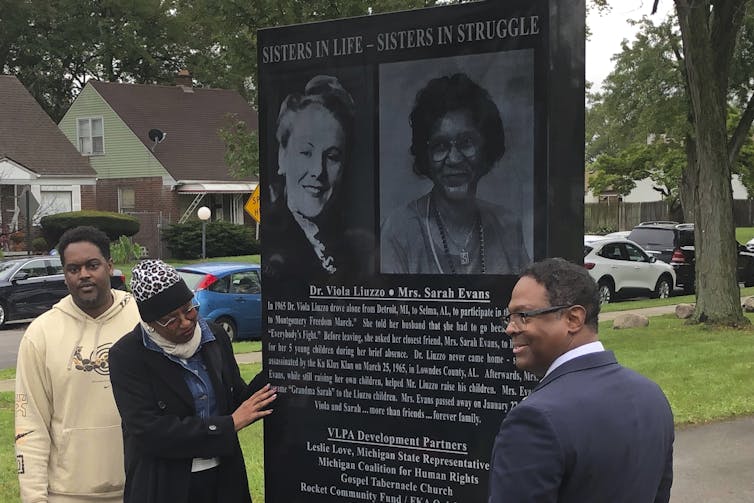
Three people pose for pictures on either side of a black, granite memorial.
In 2023, a Detroit monument honoring Viola Liuzzo, who was killed by the Klan, and Sarah Evans, who raised Liuzzo’s children, was unveiled.
AP Photo/Corey Williams

This kind of racist vitriol might have stayed on the fringes, but FBI Director J. Edgar Hoover amplified the stories, while a Detroit police officer’s file on Liuzzo, which included highly personal information and speculation about her mental health, was shared with segregationist Sheriff Jim Clark of Selma.

The material ended up in The New York Times, and Liuzzo’s posthumous reputation was marred. When Ladies’ Home Journal polled its readers about Liuzzo, 55% responded that she should have stayed home with her children.

Echoes of the past

Official government and law enforcement responses to Good’s death echo the Liuzzo case; in fact, the responses have arguably been magnified. Vice President JD Vance blamed Good for her own death, claiming it was a “tragedy of her own making.” President Donald Trump characterized her as “disorderly” and vicious. Homeland Security Secretary Kristi Noem and other administration officials labeled Good a domestic terrorist.

This attempt to influence the media’s framing of Renee Good clearly had an impact, since much of the early media coverage focused on questions about her actions and motives, with the New York Post derisively labeling her an “‘ICE Watch’ ‘warrior’ who trained to resist feds before shooting,” before attention shifted to Pretti’s killing.

Good, like Liuzzo, was also derided as a race traitor, somehow betraying white Americans by supporting nonwhites. Podcaster Matt Walsh disparaged her for giving her life “to protect 68 IQ Somali scammers,” a smear that made its way into mainstream media, including its appearance in an opinion piece by The New York Times’ columnist David French that criticized inflammatory MAGA rhetoric.

Walsh and other right-wing commentators, along with comedian Ben Bankas, underscored Good’s sexuality to further demean her.

It’s different for men

Men have been treated differently in both press coverage and political response. Reeb, a father of four, never faced the level of condemnation heaped on Liuzzo. Southern white segregationists certainly questioned the motives of the many clergy members who descended on Selma. Those sentiments, however, did not circulate much outside of segregationist press. Reeb’s status as a minister, along with being a white man, may have shielded his reputation.

Here’s where there are some similarities to the response to Pretti’s death. Initially, Trump administration officials brought out the same playbook they’d used with Good. Noem and Stephen Miller, the White House homeland security adviser, called Pretti a domestic terrorist. Greg Bovino, the leader of Operation Metro Surge in Minneapolis, along with a Homeland Security spokeswoman, claimed Pretti intended to “massacre law enforcement.”

Such charges quickly unraveled as media outlets questioned them. It helped that the video footage of Pretti’s killing was clearer than that of Good’s.

Like Good, Pretti became the target of vitriol in far-right media platforms. But little of that has gotten much purchase in mainstream media, just as the segregationist contempt for activist clergy members in Selma was not amplified.

Pretti’s status as a licensed gun owner who was exercising his Second Amendment right to bear arms, as well as his First Amendment rights to protest, may also have assisted his posthumous reputation. Right-wing critics who condemned a lesbian who was not adhering to a set of standards regarding femininity had a much harder time condemning a man licensed to carry a gun.

Liuzzo, Reeb, Good and Pretti all put their bodies on the line and made the ultimate sacrifice on behalf of vulnerable nonwhite people. Liuzzo and Good suffered significant character assassination that their male partners-in-protest avoided.

Whiteness may help bring massive media attention, but being a dead white woman doesn’t necessarily bring respectful treatment. For some, especially those who put their bodies on the line for nonwhite communities, they are just “AWFL,” the current right-wing acronym for “affluent, white, liberal women” who step out of bounds.

The Conversation

Aniko Bodroghkozy does not work for, consult, own shares in or receive funding from any company or organization that would benefit from this article, and has disclosed no relevant affiliations beyond their academic appointment.

​Politics + Society – The Conversation

Categories
Food

Protein-Maxxing: How Much Protein Is ‘Too Much?’

One of the trendiest food fads around right now (and for the last few years) is something called protein maxing, but how much do you really need?

​Food Republic – Restaurants, Reviews, Recipes, Cooking Tips

Categories
Politics

‘A really really big decision’: The court cases looming over the midterms

The fight over this year’s House map is barreling through the nation’s courtrooms.

High-stakes legal cases that could determine the majority loom in nearly a dozen states, with just months to go until the November election. The wave of court cases follows a 2025 that was marked by fiercely political showdowns, with high-profile walkouts, rare Republican defections from President Donald Trump and a hugely expensive ballot initiative in California.

And in addition to the state-by-state fights, one case before the Supreme Court — Louisiana v. Callais — has the ability to blow up the entire map.

“There was a lot of political action in ’25, and that’s turning to the courthouse now, this year,” said Justin Levitt, a former adviser to President Joe Biden on democracy and voting rights and a law professor at Loyola Marymount University. “It’s not just the Supreme Court. These are fights about individual state practices all over the place.”

In Missouri, for example, there are multiple lawsuits — and a ballot measure effort — to try and halt the GOP-led redraw there. In Florida, Democrats are already trying to get ahead of Gov. Ron DeSantis’ planned April redraw with a lawsuit that argues he lacks the authority to call for it. Cases in Utah, New York and Wisconsin that could shift seats are still playing out even as voters gear up for primaries.

In Maryland, the National Republican Congressional Committee has retained a lawyer to handle any potential redistricting challenges there, according to two people familiar with the hiring granted anonymity to discuss it. In Virginia, the state Supreme Court is expected to decide whether the Democratic remapping effort — which still needs to go before voters — is legal, with state Democratic officials vowing to challenge decisions from lower state courts that freeze the gerrymandering push.

Waiting for the court process to play out means organizations dedicated to redistricting are navigating both political and legal challenges simultaneously — and that voters and election officials have no real idea what district lines they may be asked to use, in some cases, in a manner of weeks.

“That’s something we’re used to at this point,” said John Bisognano, president of the National Democratic Redistricting Committee. “Running full steam on the political side or campaign side while waiting for court rulings or engaging court processes has been an ever-present reality for us.”

That isn’t to say there weren’t any major court decisions in 2025, nor that there will be no political fighting this year. Already, Maryland Gov. Wes Moore and House Minority Leader Hakeem Jeffries have been ramping up pressure on state Senate Leader Bill Ferguson, a fellow Democrat who opposes the effort. Florida lawmakers have squabbled over what timing is best to take up the issue, and Virginia may see an expensive ballot measure fight play out over its map.

By far the biggest legal fight is Louisiana v. Callais, the Supreme Court case which centers around Section 2 of the Voting Rights Act. That case could upend the House map by eliminating a legal interpretation of Section 2 — which broadly outlaws discrimination based on race in elections — that has resulted in states drawing districts where minority voters make up at least half the population.

The end of Section 2 would give red states, especially in the South, the ability to draw out more than a dozen Democratic-held seats, an analysis from liberal groups last year found.

While many legal scholars, including Levitt, expect the decision to come at the end of the term in June — which could prevent any redraws from taking place before the midterms — the Supreme Court could hand down its ruling whenever it wants, and some states are prepared to quickly redraw.

A June decision would likely “radically reshape, not just congressional, but local and state maps for ’27 and ’28,” Levitt said.

“A really really big decision upends every map across the country,” he said, cautioning that he doesn’t expect a ruling to go there. “I think it’s entirely possible that the court here says, ‘you know what, never mind,’ it looks over the edge of the cliff and says, ‘oh, that’s really scary.’”

The court’s next scheduled opinion days are Tuesday and Wednesday of this week.

There are several other major decisions pending in other courts. In Virginia, Republicans have won victories in two cases in front of the same Tazewell County judge, although many in the state expect the state Supreme Court to have the final word on if the voter referendum on April 21 will go ahead.

In Utah, a federal panel ruled on Monday that it would not block the new court-ordered map, which gave one blue-leaning seat to Democrats last year. Republicans may appeal, but the decision — and a recent state Supreme Court ruling rejecting another GOP appeal — could lock the lines in place for 2026. And in New York, two state courts have sided with Democrats hoping to draw one more blue-leaning seat in a surprise win, but Republicans have vowed to appeal to the U.S. Supreme Court.

It’s not uncommon for redistricting to end up before judges, but the unusual mid-cycle battle has added fuel to a fire that was already burning.

“Redistricting cycles have phases. Map drawing, then litigation, then sometimes more mapdrawing. This mid-decade cycle is no different,” said Adam Kincaid, the president of the National Republican Redistricting Trust, who redrew the Texas map last year that was ultimately upheld by the Supreme Court. “There will be several legal fights in the months ahead.”

But with the map still uncertain just months away from November — and as primary season begins — the lengthy legal process complicates how election workers can prepare ballots, and can lead to confusion for voters.

“These things take a real toll on election officials and voters,” David Becker, founder of the Center for Election Innovation and Research, said of mid-decade redistricting. “These things make it very difficult for election officials to manage the workload with less resources than they’ve ever had.”

A version of this article first appeared in POLITICO Pro’s Morning Score. Want to receive the newsletter every weekday? Subscribe to POLITICO Pro. You’ll also receive daily policy news and other intelligence you need to act on the day’s biggest stories.

​Politics