Categories
Politics

Racial profiling by ICE agents mirrors the targeting of Japanese Americans during World War II

A Japanese American family is taken to a relocation center in San Francisco in May 1942. Circa Images/GHI/Universal History Archive/Universal Images Group via Getty Images

The Department of Homeland Security in September 2025 said that 2 million undocumented immigrants had been forced out of the United States since the start of Donald Trump’s second presidency.

Through its use of the Alien Enemies Act, a wartime law from 1798, the Trump administration has bypassed immigration courts and the right to due process to more easily detain and deport immigrants.

The Trump administration has, in part, reached these numbers by arresting immigrants in courthouses and at their workplaces. It has also conducted raids in schools, hospitals and places of worship.

And the Supreme Court in September, in its Noem v. Vasquez Perdomo decision, lifted a federal court order that barred agents with Immigration and Customs Enforcement from racially profiling suspected undocumented immigrants. For now, ICE agents can use race, ethnicity, language and occupation as grounds for stopping and questioning people.

This form of targeting has disproportionately affected Latino communities, which represent 9 in 10 ICE arrests, according to a UCLA study published in October.

Targeting immigrants is a centuries-old American practice. In particular, Asian Americans have drawn parallels between the attacks on Latinos today and the forced relocation and incarceration of Japanese Americans during World War II.

Notably, the passage of the War Brides Act, passed just three months after the end of WWII, in December 1945, broke with the nation’s centuries-long practice of exclusionary immigration policy. The act allowed American servicemen to bring their non-American spouses and children to the United States. The measure seemed to inaugurate a new era of inclusive immigration policy.

As a feminist studies scholar and author, I know the War Brides Act forever altered the nation’s racial demographics, increasing both Asian migration to the U.S. and the birth of biracial children.

On the 80th anniversary of the War Brides Act, I’ve also noticed an alarming contradiction: Although America may be more multiracial than ever before, the U.S. immigration system remains as exclusive as it has ever been.

Exclusionary immigration policy

The racial profiling of Latino people by ICE agents today is not unlike what took place during World War II in the U.S.

Following Japan’s attack on Pearl Harbor in 1941, President Franklin D. Roosevelt issued an executive order authorizing the forced removal of anyone deemed to be a national security threat. Anyone, that is, who was Japanese. From 1942 to 1945, the U.S. government incarcerated approximately 120,000 Japanese Americans in internment camps.

To determine who was a national security threat, the government used overt racial profiling. Similar to today, when the U.S. government often misidentifies Latino Americans as noncitizens, a majority of the Japanese people incarcerated in WWII were U.S. citizens.

Amid the Trump administration’s treatment of immigrants, it’s worth recalling the exclusionary origins of U.S. immigration policy.

The first restrictive immigration law in the U.S., the Page Act of 1875, barred Chinese women from entering the country. The assumption the law was based on was that all Chinese women were immoral and worked in the sex trade.

A soldier holds a rifle on a city street.
Immigration and Customs Enforcement agents conduct operations in a predominantly Mexican American community in Chicago on Nov. 8, 2025.
Jacek Boczarski/Anadolu via Getty Images

The Page Act laid the groundwork for the Chinese Exclusion Act of 1882, which banned all Chinese immigration into the U.S. for 10 years. This was the first federal law to ban an entire ethnic group, launching an era of legalized and targeted exclusion.

With the passage of the Immigration Act of 1924, the U.S. created its first border control service, which enforced new immigration restrictions. It also implemented a quota system, which banned or limited the number of immigrants from specific regions, including Asia and Southern and Eastern Europe.

The act stemmed from nativism – the policy that protects the interests of native-born residents against those of immigrants – and a desire to preserve American homogeneity.

The 1945 War Brides Act largely diverged from these previous measures, helping to dismantle the Asian exclusion made commonplace in the 19th and early 20th centuries. From 1945 until 1948, when the War Brides Act expired, more than 300,000 people entered the country as nonquota immigrants, people from countries not subject to federal immigration restrictions.

Exclusionary tendencies

Decades later, in 1965, the U.S. formally abolished the quota system. America opened its doors to those who President Lyndon B. Johnson deemed most able to contribute to the nation’s growth, particularly skilled professionals.

The Immigration and Nationality Act of 1965 eliminated racial exclusion. As a result, the U.S. population diversified. Immigrants deepened the multiracialism initiated by the War Brides Act.

This trend increased later in the 1960s when the Supreme Court, in Loving v. Virginia, overturned anti-miscegenation laws, which criminalized marriage between people of different races. The justices ruled that laws banning interracial marriage violated the 14th Amendment.

Multiracialism further increased after the Vietnam War. Subsequent legislation such as the 1987 Amerasian Homecoming Act facilitated the entry of biracial children born in Vietnam and fathered by a U.S. citizen.

Japanese-Americans arrive at a train station.
People of Japanese ancestry arrive at the Santa Anita Assembly Center in California before being moved inland to relocation centers, April 5, 1942.
© CORBIS/Corbis via Getty Images

By the 1960s, however, exclusion was taking on a different shape.

After 1965, immigration policy initiated a preference system that prioritized skilled workers and relatives of U.S. citizens. Quotas related to race and national origin were abolished. Nonetheless, preferences for families and professionals excluded people from Latin America.

For the first time, immigration from the Western Hemisphere was limited. This directly affected migrant workers in the farming and agricultural industries, many of whom were Latino.

Recalling the War Brides Act allows Americans to better comprehend the fiction that undergirds the U.S. immigration system: that immigration policy’s preference for certain immigrants is enough to justify the discriminatory policies which deem some families more valuable than others.

The Conversation

Anna Storti has received funding from the Institute for Citizens and Scholars, the Andrew W. Mellon Foundation, and the McNair Scholars Program.

​Politics + Society – The Conversation
Categories
Politics

ICE killing of driver in Minneapolis involved tactics many police departments warn against − but not ICE itself

A protester stands near a makeshift memorial honoring Renee Nicole Good, the victim of a fatal shooting in Minneapolis involving federal law enforcement agents. AP Photo/Tom Baker

Minneapolis is once again the focus of debates about violence involving law enforcement after an Immigration and Customs Enforcement officer shot and killed Renee Nicole Good, a 37-year-old mother, in her car.

The incident quickly prompted dueling narratives. Trump administration officials defended the shooting as justified, while local officials condemned it.

The shooting will also likely prompt renewed scrutiny of training and policy of officers and the question of them shooting at moving vehicles. There has been a recent trend in law enforcement toward policies that prohibit such shootings. It is a policy shift that has shown promise in saving lives.

Decades ago, the New York City Police Department prohibited its officers from shooting at moving vehicles. That led to a drop in police killings without putting officers in greater danger.

Debates over deadly force are often contentious, but as I note in my research on police ethics and policy, for the most part there is consensus on one point: Policing should reflect a commitment to valuing human life and prioritizing its protection. Many use-of-force policies adopted by police departments endorse that principle.

Yet, as in Minneapolis, controversial law enforcement killings continue to occur. Not all agencies have implemented prohibitions on shooting at vehicles. Even in agencies that have, some policies are weak or ambiguous.

In addition, explicit prohibitions on shooting at vehicles are largely absent from the law, which means that officers responsible for fatal shootings of drivers that appear to violate departmental policies still often escape criminal penalties.

In the case of ICE, which is part of the Department of Homeland Security, its policy on shooting at moving vehicles – unlike that of many police agencies – lacks a clear instruction for officers to get out of the way of moving vehicles where feasible. It’s an omission at odds with generally recognized best practices in policing.

ICE’s policy on shooting at moving vehicles

ICE’s current use-of-force policy prohibits its officers from “discharging firearms at the operator of a moving vehicle” unless it is necessary to stop a grave threat. The policy is explicit that deadly force should not be used “solely to prevent the escape of a fleeing suspect.”

That point is relevant for evaluating the fatal shooting in Minneapolis. Videos show one officer trying to open the door of the vehicle that Good was driving, while another officer appears to be in front of the vehicle as she tried to pull away.

Kristi Noem, the Homeland Security secretary, stands behind a podium at a news conference.
Homeland Security Secretary Kristi Noem said that an ICE officer ‘feared for his life’ before shooting a woman in Minneapolis.
AP/Yuki Iwamura

Shooting to prevent the driver simply from getting away would have been in violation of agency policy and obviously inconsistent with prioritizing the protection of life.

ICE’s policy lacks clear instruction, however, for its officers to get out of the way of moving vehicles where feasible. In contrast, the Department of Justice’s use-of-force policy makes it explicit that officers should not shoot at a vehicle if they can protect themselves by “moving out of the path of the vehicle.”

Notably, President Joe Biden issued an executive order in 2022 requiring federal law enforcement agencies – like ICE – to adopt use-of-force policies “that are equivalent to, or exceed, the requirements” of the Department of Justice’s policy.

Despite that order, the provision to step out of the way of moving cars never made it into the use-of-force policy that applies to ICE.

The rationale for not shooting at moving vehicles

Prioritizing the protection of life doesn’t rule out deadly force. Sometimes such force is necessary to protect lives from a grave threat, such as an active shooter. But it does rule out using deadly force when less harmful tactics can stop a threat. In such cases, deadly force is unnecessary – a key consideration in law and ethics that can render force unjustified.

That’s the concern involved with police shooting at moving vehicles. It often is not necessary because officers have a less harmful option to avoid a moving vehicle’s threat: stepping out of the way.

This guidance has the safety of both suspects and police in mind. Obviously, police not shooting lowers the risk of harm to the suspect. But it also lowers the risk to the officer in the vast majority of cases because of the laws of physics. If you shoot the driver of a car barreling toward you, that rarely brings a car to an immediate stop, and the vehicle often continues on its path.

Many police departments have incorporated these insights into their policies. A recent analysis of police department policies in the 100 largest U.S. cities found that close to three-quarters of them have prohibitions against shooting at moving vehicles.

The gap between policy and best practices for protecting life

The shooting in Minneapolis serves as a stark reminder of the stubborn gap that often persists between law and policy on the one hand and best law enforcement practices for protecting life on the other. When steps are taken to close that gap, however, they can have a meaningful impact.

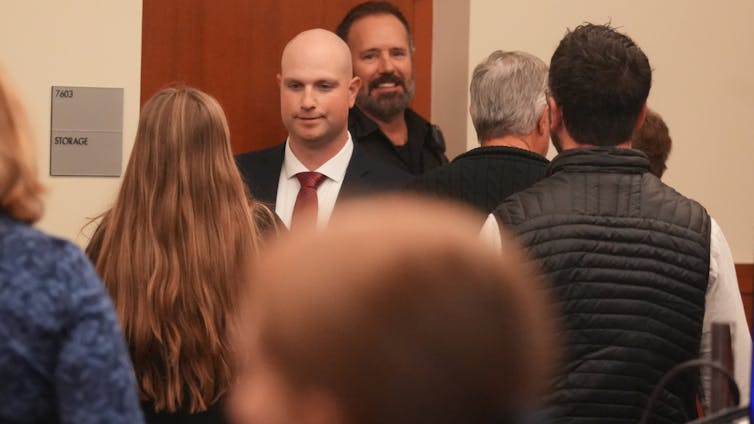
Blendon Township, Ohio, police officer Connor Grubb greets a family member after being found not guilty at a Columbus courthouse.
Connor Grubb, a police officer in Blendon Township, Ohio, was acquitted in November of charges stemming from a killing that involved a pregnant woman fleeing in a car.
Doral Chenoweth/AP

Some of the most compelling examples involve local, state and federal measures that reinforce one another. Consider the “fleeing felon rule,” which used to allow police to shoot a fleeing felony suspect to prevent their escape even when the suspect posed no danger to others.

That rule was at odds with the doctrine of prioritizing the protection of life, leading some departments to revise their use-of-force policies and some states to ban the rule. In 1985, the U.S. Supreme Court ruled that it was unconstitutional for police to shoot a fleeing suspect who was not a danger.

Banning that questionable tactic notably led to a reduction in killings by police.

This history suggests that clear bans in law and policy on questionable tactics have the potential to save lives, while also strengthening the means for holding officers accountable.

The Conversation

Ben Jones does not work for, consult, own shares in or receive funding from any company or organization that would benefit from this article, and has disclosed no relevant affiliations beyond their academic appointment.

​Politics + Society – The Conversation

Categories
Entertainment

Jenny McCarthy Vows ‘Over My Dead Body’ She’ll Return to ‘The …

Reading Time: 3 minutes

Jenny McCarthy doesn’t want to revisit a specific former job.

She’s a former Playboy model. She’s one of the world’s most infamous opponents of vaccination.

And, over a decade ago, she was a panelist on The View.

Would she return as a co-host if they invited her? Not a chance.

Jenny McCarthy on YouTube.
Notorious anti-vaccine influencer and former Playboy model Jenny McCarthy speaks on a white nationalist podcast in January 2026. (Image Credit: YouTube)

In case you blissfully forgot, she was once a co-host on ‘The View’

In 2013 and 2014, for some awful reason, The View producers — clearly in the market for a new primary antagonist — elevated a woman whom many have characterized as a horseman of the apocalypse.

That woman was Jenny McCarthy. She’d be Pestilence specifically, by the way.

Her role on the daytime talk show didn’t last.

Her firing was part of a set of sweeping changes that caught some good people (gosh we love Sherri Shepherd).

Now, McCarthy is vowing that she’d never return.

Jenny McCarthy in January 2020.
Jenny McCarthy attends the FOX Winter TCA All Star Party on January 07, 2020. (Photo Credit: Rich Fury/Getty Images)

This week, McCarthy sat down as a guest on The Katie Miller podcast.

Yes, that Katie Miller. Wife of far-right white nationalist member of the Trump regime, Stephen Miller.

The Katie Miller who was recently rumored to be having some sort of thing going on with Elon Musk. (She sure can pick ’em, huh?)

“The reason why they wanted to bring me on is because they, quote, said it was too polarizing,” McCarthy claimed about her time on The View a dozen years ago. “They thought it was too polarizing back then, you guys!”

McCarthy shared that her initial role on the show was to offer “light, fluffy, and fun” commentary on nonsense topics like reality TV.

After a while, producers asked her to express her unsavory political beliefs

That light, fluffy drive “only lasted a whole week,” McCarthy claimed.

“And back then, I didn’t consider myself to be a political person,” she admitted.

(Just for the record, in 2013, she was already infamous for the alarming and non-scientific anti-vaccine nonsense that came spewing out of her mouth)

“Which is why I thought I was perfect for the job,” McCarthy claimed.

“After a week, when they said they wanted to get political, I was like, ‘Oh my God, what am I going to do?’” she alleged.

Jenny McCarthy in September 2019.
Jenny McCarthy arrives for the 71st Emmy Awards at the Microsoft Theatre in Los Angeles on September 22, 2019. (Photo Credit: VALERIE MACON/AFP via Getty Images)

According to McCarthy, producers suggested that she might “act Republican” in order to face off with her fellow co-hosts. That shouldn’t really be a challenge, given, you know, everything about her.

At the time, she didn’t believe herself to be political. She admits that she is “much more political” now.

McCarthy gushed that “our latest administration has helped so much.”

Members of the Trump regime have canceled cancer research, altered language on limiting alcohol consumption, and are pushing Americans to consume more red meat.

And, of course, they’re ending a slew of vaccine recommendations that have helped millions of Americans live healthy lives for generations.

Dr. Oz and RFK Jr. in January 2026.
Mehmet Oz looks on as Robert F. Kennedy Jr. speaks during the daily briefing on January 7, 2026. (Photo Credit: Mandel NGAN / AFP via Getty Images)

McCarthy isn’t the only person who embodies the ‘Pestilence’ horseman, by the way

“But, back then? Ooh, I would not, I would never even,” McCarthy said.

“They’ve asked me to come back for, like, reunion shows,” she claimed.

McCarthy added: “I was like, over my dead body would I ever step foot in that place.”

Well, that sounds like a plan! (Avoiding places that you don’t like, we mean)

The View does need a primary antagonist in order to thrive. Meghan McCain, Elizabeth Hasselbeck, and Candace Cameron Bure are all examples.

But while obviously none of those women are good people, they arguably managed to play their roles without endangering children or their families with anti-science bunk. Could McCarthy do the same?

Jenny McCarthy Vows ‘Over My Dead Body’ She’ll Return to ‘The … was originally published on The Hollywood Gossip.

​The Hollywood Gossip

Categories
Entertainment

Jonathan Ross Identified as ICE Agent Who Killed Renee Nicole Good

Reading Time: 2 minutes

As you’ve no doubt heard by now, a widowed single mother named Renee Nicole Good was shot to death by an ICE agent in Minneapolis on Wednesday.

Predictably, the situation quickly became a hot-button political issue, with President Trump claiming that Good “viciously ran over” the agent, “who is now recovering in the hospital.”

Trump added that it is “hard to believe [the agent] is alive,” despite the fact that he was not run over by a car and video of the incident shows him walking to his own car and driving away from the scene.

Local media outlets, including Fox 9, have now identified the agent as Jonathan Ross.

An onlooker holds a sign that reads "Shame" as members of law enforcement work the scene following a suspected shooting by an ICE agent during federal law enforcement operations on January 07, 2026 in Minneapolis, Minnesota.
An onlooker holds a sign that reads “Shame” as members of law enforcement work the scene following a suspected shooting by an ICE agent during federal law enforcement operations on January 07, 2026 in Minneapolis, Minnesota. (Photo by Stephen Maturen/Getty Images)

Many details about Ross’ career — including the length of his tenure with ICE and what sort of training he’s received — are still unclear.

However, Newsweek is reporting that Wednesday’s incident was not the first time in recent months that he was involved in a violent incident involving a vehicle.

According to court documents obtained by the outlet, Ross “got his arm stuck in the window of a vehicle” during a June 17 traffic stop in Bloomington, Minnesota.

He was “dragged” 100 feet during the incident, and he fired his Taser during the struggle, striking the driver.

Members of law enforcement work the scene following a suspected shooting by an ICE agent during federal law enforcement operations on January 07, 2026 in Minneapolis, Minnesota.
Members of law enforcement work the scene following a suspected shooting by an ICE agent during federal law enforcement operations on January 07, 2026 in Minneapolis, Minnesota. (Photo by Stephen Maturen/Getty Images)

On that occasion, Ross was involved in the apprehension of a Mexico native who had allegedly entered the country illegally.

Wednesday’s altercation was a different matter entirely, as Good was a US citizen who, by most accounts, was passively observing ICE activity in her neighborhood.

Department of Homeland Security Secretary Kristi Noem alleged that Good was obstructing the officers in their duties, but video from just before the shooting shows her waving her hand out her car window, encouraging federal vehicles to pass her by.

“This is a guy who’s actually done a very, very important job for the United States of America,” Vice President Vance said of Ross. “He’s been assaulted. He’s been attacked. He’s been injured because of it.”

We will have further updates on this developing story as new information becomes available.

Jonathan Ross Identified as ICE Agent Who Killed Renee Nicole Good was originally published on The Hollywood Gossip.

​The Hollywood Gossip

Categories
Entertainment

Stranger Things Creator Respond: Is the Show REALLY Over?!?

Reading Time: 3 minutes

As Netflix fans know well by now, Stranger Things has come to an end.

Except… many of these same fans have been asking themselves a pressing question ever since the alleged series finale of this beloved drama hit the streaming service:

Wait, has it really?!?

Might creators Ross Duffer and Matt Duffer ever put the show back into production and make new episodes of the thriller?

(Netflix)

“I feel like this season really, truly does close the door on this story,” Ross told Entertainment Tonight in an interview published January 2. “On the story of Hawkins, and the story of the Upside Down and the story of these characters.”

Fair enough. Sad, but fair.

Still, the executive producers won’t completely rule revisiting the original characters — including Mike (played by Finn Wolfhard), Will (Noah Schnapp), Max (Sadie Sink), Lucas (Caleb McLaughlin) and Dustin (Gaten Matarazzo) — in some way, form or fashion down the line.

“I guess never say never,” Ross also told ET, not sounding overly confident this will ever transpire.

(Netflix)

“[Maybe] in 20 years, if we’re all broke and need some money [and] we’ve all talked about it,” the director added, noting that the idea is his and Matt’s “safety net.”

Stranger things premiered way back in 2016. It has aired a total of 42 episodes, the last few of which were all feature film length.

Some fans out there have believed a viral conspiracy theory that there is a secret ninth episode of the final season of Netflix series dropping on January 7 at 8 p.m. ET.

According to the Duffers, however?

They have made no official comment on the theory amid ongoing post-series-finale press interviews, but the show’s bios on Netflix’s Instagram, TikTok and X accounts stated as of Wednesday: “ALL EPISODES OF STRANGER THINGS ARE NOW PLAYING.”

Sorry, folks.

(Netflix)

“The show has just grown so massive,” Matt Duffer previously said, speaking generally about the conspiracy-theory-addled segments of the show’s fandom.

“Online, there’s just so much misinformation. Just tons of it. We would be here for hours trying to bat down the stuff that was not true.”

Overall, meanwhile, Stranger Things has comprised a full decade in the lives of those involved in it. Most sound content with it being over.

“If there’s a story when we’re all in very, very different stages of our lives, maybe,” Finn told Entertainment Tonight of coming back for more installment. “But I think that the whole point of the show ending is because it’s run its course.”

It is worth noting, though, that the Stranger Things’ Universe isn’t completely closed.

In addition to a documentary titled One Last Adventure — chronicling the making of season five and set to be released on Netflix on January 12 — the Duffer siblings said before that there are two more related projects in the works… one of which is a live-action spinoff that will explore what exactly happened to Henry Creel in the cave.

“The spinoff is going to delve into that and explain that, and you’re going to understand it,” Matt told Variety in an interview published January 1. “But it’s a completely different mythology.

“It’s very fresh and very new, but yes, it will answer some of the loose threads that are remaining.”

Stranger Things Creator Respond: Is the Show REALLY Over?!? was originally published on The Hollywood Gossip.

​The Hollywood Gossip

Categories
Entertainment

Kate Middleton Opens Up About Cancer Battle Amid ‘Arise, Queen Kate’ …

Reading Time: 3 minutes

It’s been an eventful week for Kate Middleton.

Things got off to a rocky start thanks to an unexpected controversy sparked by a newspaper article.

As you may have heard, The Times of London ruffled with feathers with a headline reading, “Arise, Queen Kate: The princess’ friends and palace insiders on how she will change the royal family.”

Britain's Prince William (L), Prince of Wales, looks on as Catherine (R), Princess of Wales, speaks with healthcare staff during a visit to Charing Cross Hospital in west London on January 8, 2026, to highlight the work of NHS staff and volunteers.
Britain’s Prince William (L), Prince of Wales, looks on as Catherine (R), Princess of Wales, speaks with healthcare staff during a visit to Charing Cross Hospital in west London on January 8, 2026, to highlight the work of NHS staff and volunteers. (Photo by Isabel Infantes / POOL / AFP via Getty Images)

“‘Kate will be a queen who really listens’ — by palace insiders,” read the headline on the online version of the article.

The controversy stems from the fact that Kate is not yet queen consort, and many felt that the article was disrespectful toward King Charles and his wife, Queen Camilla.

After all, Charles is battling cancer, and eagerly imagining a future in which he’ll be out of the picture is arguably in poor taste.

Anyway, Kate and Prince William countered the bad press with good today by making a surprise appearance at Charing Cross Hospital in West London.

Britain's Prince William (R), Prince of Wales and Catherine, Princess of Wales pay a visit to Charing Cross Hospital in west London on January 8, 2026, to highlight the work of NHS staff and volunteers.
Britain’s Prince William (R), Prince of Wales and Catherine, Princess of Wales pay a visit to Charing Cross Hospital in west London on January 8, 2026, to highlight the work of NHS staff and volunteers. (Photo by Isabel Infantes / POOL / AFP via Getty Images)

The goal of the visit was to highlight the work of NHS workers amid a historically difficult flu season.

But as a bonus, the event also shifted the focus away from the “Arise” scandal.

We’re sure it wasn’t her intention, but Kate’s brief comments about her own battle with cancer ensured that the visit would make headlines.

One hospital employee explained that chemotherapy patients and visitors remain in the facility “for hours,” to which Princess Kate replied, “I know. We know” (via People).

Britain's Catherine, Princess of Wales pays a visit to Charing Cross Hospital in west London on January 8, 2026, to highlight the work of NHS staff and volunteers.
Britain’s Catherine, Princess of Wales pays a visit to Charing Cross Hospital in west London on January 8, 2026, to highlight the work of NHS staff and volunteers. (Photo by Isabel Infantes / POOL / AFP via Getty Images)

“Both of us have had different experiences with hospitals. Me working with the air ambulance; Catherine with her recent health journey,” William said during the visit, adding:

“And coming here today and reminding ourselves just how important all the teams are, all the staff, the patients.

“It’s so heartwarming, and it’s so important that we kind of acknowledge and appreciate all that goes on in the NHS and that very strong bond between patient and carer.”

So it might be inappropriate to prematurely imagine Kate as queen — but weeks like this one remind us that she’ll be an expert and handling mini-controversies of this sort by the time she takes the throne.

Kate Middleton Opens Up About Cancer Battle Amid ‘Arise, Queen Kate’ … was originally published on The Hollywood Gossip.

​The Hollywood Gossip

Categories
Politics

‘The party has done an abysmal job’: Israel tensions threaten Dems’ midterm plans

NEW YORK — Just as Democrats are finding their footing by focusing on affordability, their differences on Israel are threatening to tear them apart.

Spurred by polling that shows support for the Jewish state slipping among voters nationally, congressional challengers are lining up across the country to take on stalwart Israel supporters in an attempt to energize left-leaning voters. But the deluge of Democratic primaries being waged in some part over this issue also threatens to exhaust resources, muddy the party’s messaging and bloody candidates ahead of the general election.

Pro-Israel Democrats believe supporters should mobilize with urgency to confront this crop of challengers.

“The main, centrist Democratic Party as a whole is doing a terrible job managing this whole process,” said Mark Botnick, a former advisor to ex-New York City Mayor Michael Bloomberg, who contributed more than $10 million to efforts opposing Zohran Mamdani’s successful mayoral campaign. “That’s not to say the Israeli government has made it easy for them. It’s fine for someone to be against their policies, but it’s very different to be against the existence of the Jewish state, which in my eyes is antisemitism. The party has done an abysmal job of getting up and saying that.”

Next year’s midterms are pivotal: Democrats locked out of power in Washington need only net three House seats and four in the Senate — a tougher task — in order to seize control over either chamber.

Pro-Israel incumbents are facing challenges in New Jersey and New York, while primary battles in Michigan and Illinois are also being prepped by pro-Palestinian candidates. The coming contests have put Democrats on edge. As they try to win back power in the closely divided House, they are desperate to avoid messy primary races.

The American Israel Public Affairs Committee is mobilizing too — months before the first vote is cast — to identify potential incumbents who need shoring up as the primary fields take shape.

“Our 6 million grassroots members understand the stakes in the upcoming midterms, and that is why they are deeply motivated and engaged to help elect pro-Israel candidates and defeat detractors,” said AIPAC spokesperson Marshall Wittmann.

The Democratic Majority For Israel’s political action committee got an early jump on the cycle as well — so far endorsing 26 Democratic House incumbents across the country, an initial slate that includes lawmakers in Illinois, California, Pennsylvania and Ohio. The group’s board chair, Brian Romick, called it a “critical moment for the U.S.-Israel relationship.”

Primary bids fueled by opposition to Israel are complicating Democrats’ path to victory next year, despite signs of increasingly favorable political terrain following wins in Georgia, Virginia and New Jersey. The efforts underscore the yawning chasm facing Democrats over Israel more than two years since the Oct. 7 attacks by Hamas and a devastating war in Gaza that has killed thousands of Palestinians. Jewish Democrats are alarmed by what they consider open antisemitism among far-left candidates encouraged by Mamdani’s success in the New York City mayoral race.

AIPAC-backed Rep. Rob Menendez in New Jersey appears likely to draw a challenge from Mussab Ali, a former local school board president with a strong social media following. Ali, like Mamdani, began criticizing Israel within weeks of the Oct. 7 attacks — early compared to most people with hopes of running for office.

Michigan’s open Democratic Senate primary offers another microcosm of the party’s evolving dynamics on the issue. The three-way brawl pits a sitting representative backed by the pro-Israel lobby against a former booster of the “uncommitted” movement to pressure a Gaza ceasefire and a progressive state lawmaker who’s shifted away from Israel.

The Middle East crisis is also reshaping the contours of at least two House Democratic primaries in Illinois — home to large Jewish, Middle Eastern and Muslim communities. Statewide the tensions are apparent as well in the U.S. Senate contest to replace retiring Democrat Dick Durbin.

And in New York City, home to the nation’s largest Jewish population, left-leaning challengers backed by the Democratic Socialists of America are eager to unseat Israel-supporting incumbent Reps. Dan Goldman, Grace Meng, Ritchie Torres and Adriano Espaillat.

That includes a Mamdani-endorsed challenge to Goldman by former New York City Comptroller Brad Lander — a primary that promises to be a marquee intraparty fight over the issue.

If successful, candidates willing to criticize Israel stand to remake a Democratic Party that has historically backed the Jewish state since its 1948 founding — a path some party officials acknowledge already may be too difficult to alter after the war isolated the country. The challenges by Israel critics, too, highlight growing Muslim populations and commensurate political strength in pockets around the country.

Foreign affairs has divided Democrats before. Opposition to the war in Iraq helped Barack Obama stand out as a state senator in Illinois, while higher-profile pro-war Democrats — like Hillary Clinton — saw their electoral fortunes sink when support for the war became a disqualifying issue among Democrats.

Israel — and increasing hostility from the left toward it — has conjured deep-seated emotions among Democrats watching the situation unfold with disbelief. Taken together, there’s a pervasive worry among Jewish political leaders that shifting political winds in the United States will have long-term consequences for Israel — and Jews — in the decades to come.

“The whole democratic socialist movement has become very anti-Israel, which I don’t understand at all,” said David Weprin, a Queens state lawmaker. “I grew up with Israel being a very progressive country, a democratic country, one that tolerates everyone. It’s definitely something that I find disturbing.”

Democrats’ divisions over Gaza are perhaps nowhere more pronounced than in Michigan, where disparate views of Israel continue to roil state politics and where Democrats are grappling with how to re-engage Arab American voters who shifted toward Trump last year.

In Michigan’s marquee Democratic Senate primary, DMFI PAC endorsed Rep. Haley Stevens, who’s viewed as the establishment pick and who represents a substantial Jewish population. Stevens described herself as a “proud pro-Israel Democrat” in accepting DMFI’s support. She also said she’d fight in the Senate to “support Israel’s security [and] ensure the ceasefire holds in Gaza.” AIPAC’s PAC, which has funneled millions toward Stevens in the past, has yet to issue an endorsement this cycle but features her prominently on its website.

Her opponents have taken far more critical stances toward Israel.

Abdul El-Sayed, a past gubernatorial hopeful who backed the “uncommitted” movement during the 2024 presidential primary but later endorsed Vice President Kamala Harris, has described Gaza as a Rorschach test for Democrats’ values. He has repeatedly criticized Israel’s military actions and the U.S. dollars funding them — and has used those stances to draw contrasts with rivals.

El-Sayed was the first in the race to call the conflict in Gaza a genocide, a stance state Sen. Mallory McMorrow later adopted. McMorrow also joined El-Sayed in rejecting support from AIPAC. And both said they would have voted in favor of resolutions from Sen. Bernie Sanders blocking weapons sales to Israel — legislation Stevens said she would have voted against.

McMorrow, whose husband is Jewish and whose daughter was the target of death threats after the Oct. 7 attacks, has shifted on Israel in a way that reflects the broader transformation occurring within the Democratic Party. She initially declined to call the war a genocide, but changed her stance in October after a September United Nations report claiming Israel had committed one.

El-Sayed has indirectly criticized McMorrow for being a late adopter of his positions as the two progressives compete for the same slice of voters, including younger voters for whom Gaza remains an animating issue.

The primary will also provide an early test of whether Michigan Democrats have been able to reengage Muslim voters, like those in Dearborn who have historically backed Democrats but who split their tickets last year between Trump and Democratic Sen. Elissa Slotkin.

“The politics around Israel-Palestine have changed dramatically over the last few years,” said a Democratic strategist who’s worked on Michigan races and was granted anonymity to speak candidly about the Senate primary’s dynamics. “For 2026 and beyond, it’s less about candidates reacting and more about what they believe on the issue as a matter of core values. Just claiming to support a two-state solution isn’t going to cut it anymore.”

Tensions over Israel are also simmering in a pair of Illinois House races and the U.S. Senate contest.

The House seats are currently held by Rep. Jan Schakowsky, who is retiring, and Rep. Raja Krishnamoorthi, who is running for the U.S. Senate seat now held by Durbin.

State Sen. Laura Fine, one of the top candidates vying for Schakowsky’s seat, has been the beneficiary of a supportive AIPAC email — even though the organization has yet to endorse or donate to her campaign directly. Other high-profile candidates among the 17 in the Democratic primary include the left-leaning suburban Mayor Daniel Biss and social media influencer Kat Abughazaleh. Biss is Jewish, and Abughazaleh is Palestinian-American.

The district spans Chicago and Evanston — home to Northwestern University — and includes suburban communities with significant Jewish, Muslim and Arab populations.

In the district now held by Krishnamoorthi, candidates Junaid Ahmed and Yasmeen Bankole have both made Gaza a campaign priority and are running against former Rep. Melissa Bean, who hasn’t been endorsed by AIPAC but is viewed as a more moderate candidate.

In New Jersey, Menendez is attempting to strike a balance in a district that has significant Arab and Jewish voters. While he supports Israel, he has also called for a two-state solution and has chastised colleagues for Islamophobia, including “vile rhetoric” directed at Mamdani.

“My record of delivering for all of our residents and standing up to the Trump Administration speaks for itself. The same is true for my approach to the Middle East, from advocating for the release of the hostages, to surging humanitarian aid to Gaza, to working towards a lasting and durable peace for the region,” he said in a text message. “I look forward to having that conversation and will forcefully push back on any attempt to misrepresent my record.”

As support for Israel has weakened, Menendez’s likely challenger Ali believes pro-Israel politics can be disqualifying for incumbent Democrats.

“Eventually, politicians who think that they can hide behind talking points will be outed,” Ali said. “You’re seeing that right now with a bunch of people challenging AIPAC’s influence.”

Mamdani’s meteoric rise has fueled far-left challenges to incumbent Democrats across the Big Apple. Several Democrats have expressed interest in running against pro-Israel Democrat Dan Goldman. In the Bronx, former Democratic Committee Vice Chair Michael Blake has predicated his campaign on running against Torres’ stridently pro-Israel views.

The dynamic facing the party is a reversal from the 2024 cycle, when moderate Democrats backed by millions of dollars in support from AIPAC ran to oust anti-Israel lawmakers. The Democratic Majority for Israel PAC spent more than $11 million on races across the country during the 2024 election as well, with 80 percent of its endorsed candidates winning their races.

In New York City’s suburbs, Rep. George Latimer successfully defeated incumbent Democrat Jamaal Bowman after a bitterly fought race featuring plenty of rhetoric about Israel.

Latimer, who was among the incumbents recently endorsed by DMFI, said in an interview he expects another left-flank primary challenge next year, driven in part by opposition to Israel. Prominent Jewish leaders in New York, though, are skeptical the posture makes much sense when most voters are focused on pocketbook concerns — an issue effectively leveraged by Mamdani.

“Everybody in America wants to be Zohran Mamdani, but there’s only one Zohran Mamdani,” said David Greenfield, a former city councilmember and head of The Met Council, a Jewish charity. “The reason he won is not because of Israel, he won because of affordability.”

​Politics

Categories
Politics

The nation’s cartoonists on the week in politics

Every week political cartoonists throughout the country and across the political spectrum apply their ink-stained skills to capture the foibles, memes, hypocrisies and other head-slapping events in the world of politics. The fruits of these labors are hundreds of cartoons that entertain and enrage readers of all political stripes. Here’s an offering of the best of this week’s crop, picked fresh off the Toonosphere. Edited by Matt Wuerker.

​Politics

Categories
Health

Is Bristol Palin’s Face Still Paralyzed? Her Photo Update Leaves More Questions Than Answers

The former reality star recently shared an update on Instagram about the health condition she suffered from nearly a year ago — but people are still worried.

​Health Digest – Health News, Wellness, Expert Insights

Categories
Entertainment

Review: Cracker Barrel Should Have Left ‘New’ Menu Items In The Past

Cracker Barrel brought back two comfort classics and introduced maple syrup with a kick. We visited the Old Country Store to see what this rollout is all about.

​Mashed – Fast Food, Celebrity Chefs, Grocery, Reviews