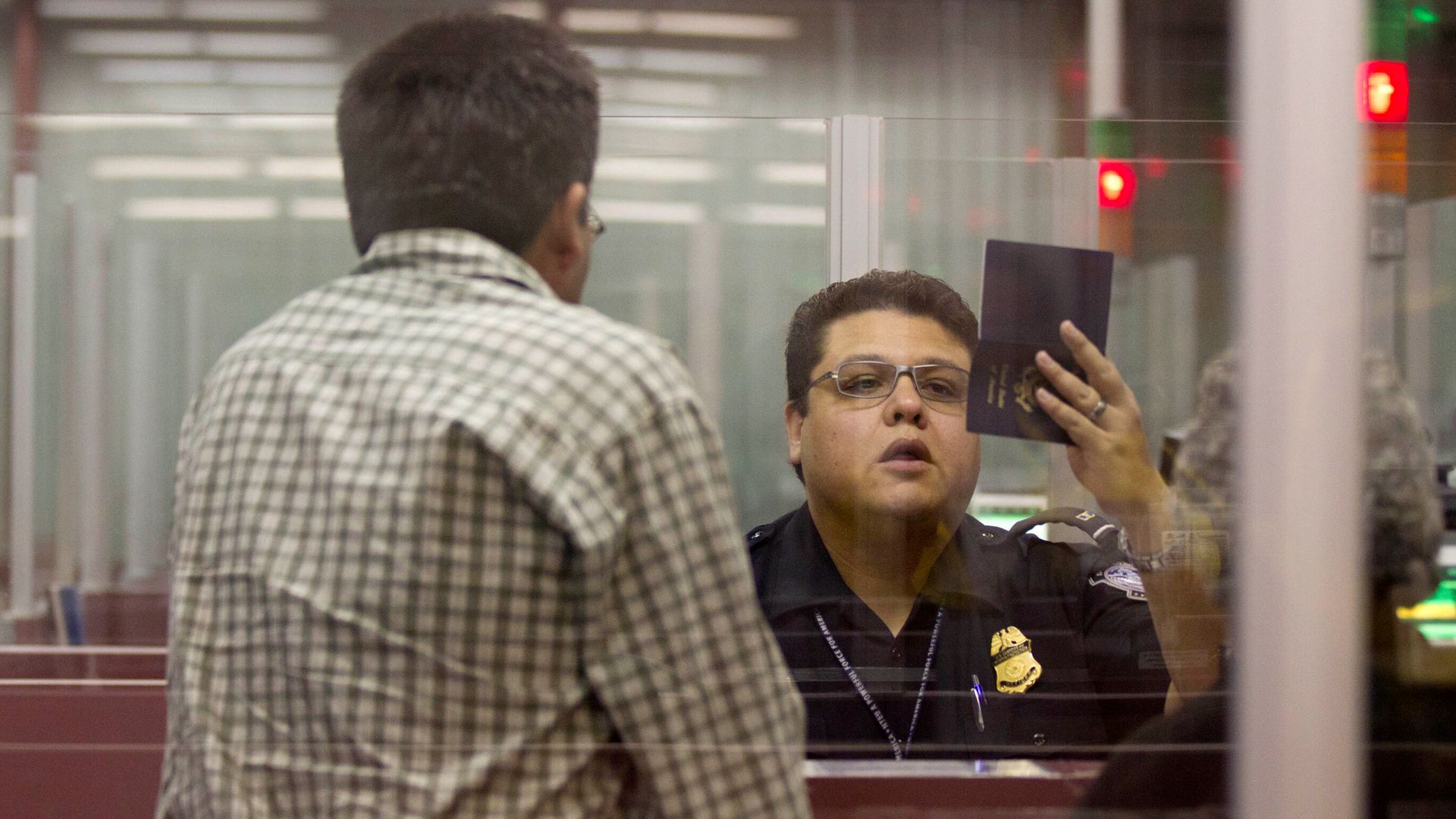
All tourists – including those from Britain – will have to undergo a social media screening before being allowed entry into the US under new plans being considered by the country’s border force.The Latest News from the UK and Around the World | Sky News
“The system is more than broken – it crossed that limit a long time ago,” says Palestinian asylum seeker Ibrahim Altaqatqa.The Latest News from the UK and Around the World | Sky News
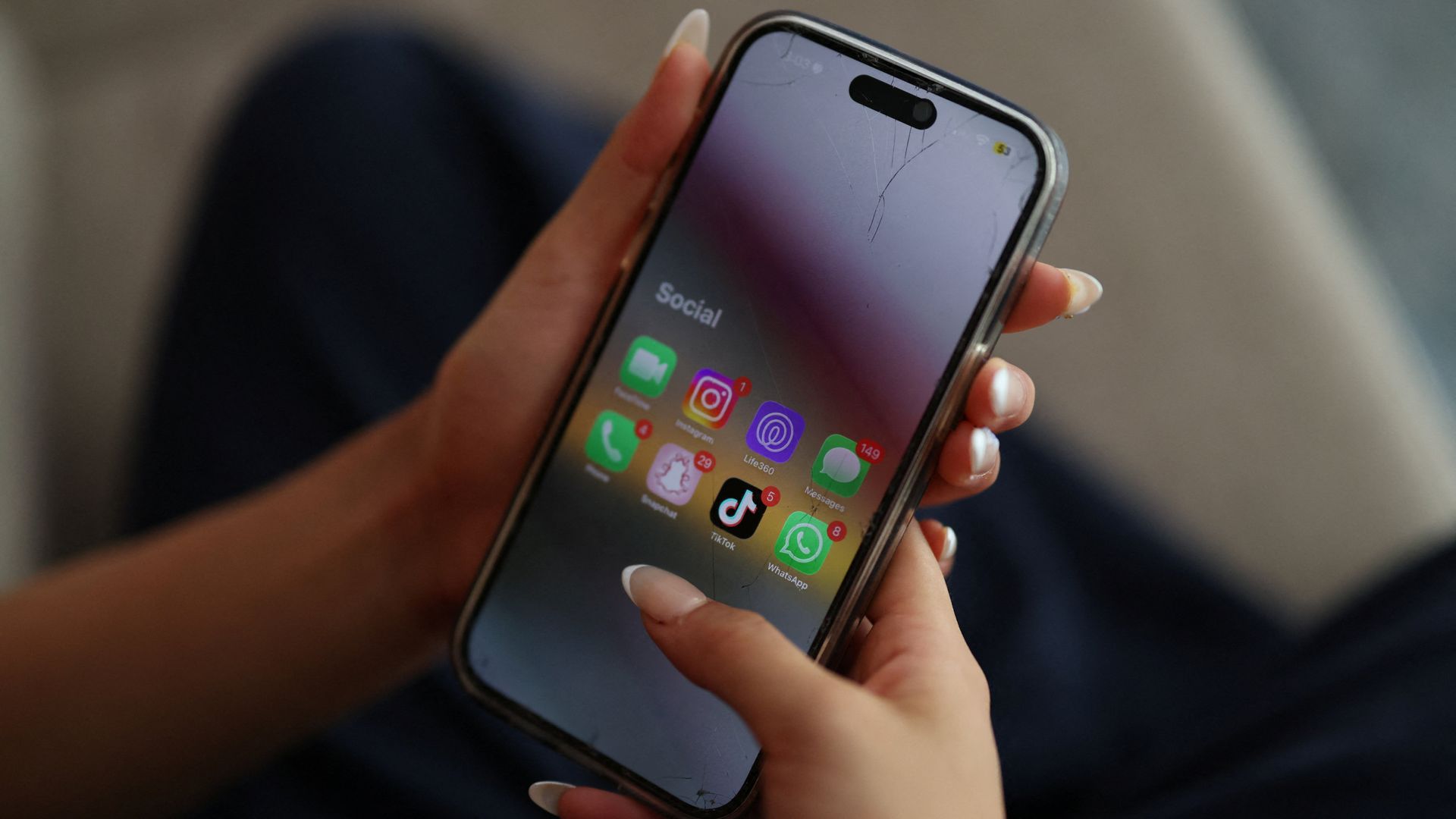
Australia’s prime minister has warned that implementing the country’s new social media ban for children under 16 – which came into force on Wednesday – will be difficult.The Latest News from the UK and Around the World | Sky News
The Alaska Governor’s Mansion is seen on Tuesday, Dec. 14, 2022 during the annual holiday open house. (Photo by James Brooks / Alaska Beacon)
Holiday music, decorations and thousands of cookies are ready at the Governor’s Residence for the annual Holiday Open House today, from 3:00 p.m. to 6:00 p.m.
Students from the Thunder Mountain Middle School Carolers, the Juneau Douglas High School Band, Faith Christian School, and Juneau Alaska Music Matters (JAMM) will perform holiday music, while Alaska’s 15 state commissioners will serve up hot apple cider to all visitors.
Cookies and other holiday treats will be provided 17,050 cookies, 35 pounds of toffee and 90 pounds of fudge and chocolate will be served in the dining room. This year’s Christmas tree was donated by the U.S. Forest Service and was harvested from the Tongass National Forest.
The first open house was held by Territorial Governor Walter Eli Clark and his family on New Year’s Day 1913. The annual tradition has been held every year since, apart from two years during World War II and in 2020 due to COVID-19. Individuals with special accessibility needs can contact Maxine Lucero at (907) 465-3500, to arrange entry from 2:15-2:30 p.m.
Wooden gavel with books in background, News of the North File
The state of Alaska has settled lawsuits against Juul and Altria, two nicotine vapor manufacturers, for a combined $7.8 million, the state Department of Law said on Friday.
The suits were part of a nationwide pattern: Alaska and other U.S. states had alleged that the companies deliberately targeted children with advertising, something that likely contributed to a surge in nicotine use among children and young adults.
Altria settled Alaska’s lawsuit for $2 million last year, and the state announced a $5.8 million consent judgment with Juul on Friday.
Under the settlements, neither Juul nor Altria must admit fault, but both must abide by marketing restrictions. One key point in the settlement: Juul can’t use cartoons to advertise its products.
“This case took five years and a great deal of work from our public health and consumer
protection teams, but it was worth it,” said Alaska Attorney General Stephen Cox, in a prepared statement.
“We now have strong court-enforceable limits on how these companies can operate in
Alaska, and we’ve obtained a per-capita recovery that ranks near the top nationally, with
those dollars going straight into prevention and consumer protection.”
Alaska was one of the last states in the country to settle with Juul, which has already paid more than $1 billion to states across the country.
Some states have since filed additional lawsuits against vape distributors, alleging that they contributed to a surge in nicotine vapor use among children and young adults.
Money from Alaska’s Juul settlement is to be paid over the next five years.
Under the financial terms of the consent judgment, half of the proceeds would be used to fund tobacco control and prevention programs, and the other half would go to the Department of Law’s consumer protection program.
Typically, the spending of money earned in financial judgments must be approved by the Alaska Legislature before becoming official.
“The use of vapes and other nicotine products among youth in Alaska remains a concern,” said Alaska Department of Health Commissioner Heidi Hedberg in a prepared statement. “This funding will help families and communities continue to access education, prevention, and cessation programs.”
Most Americans imagine human trafficking as a violent kidnapping or a “stranger danger” crime – someone abducted from a parking lot or trapped in a shipping container brought in from another country.
In most cases, traffickers spend months or even years building trust and creating emotional and economic bonds with their victims. They use a variety of coercion and control techniques such as emotional abuse, forced criminality, financial abuse, and physical and sexual abuse to entrap their victims.
Meanwhile, the perpetrators are making money off their victims’ unpaid labor, including unwanted sex work. Human trafficking is estimated to be a US$172 billion industry.
The story of Jeffrey Epstein is just one example of how traffickers use a combination of manipulation, economic dependency and coercion – rather than physical captivity – to entrap vulnerable people and slowly erode their autonomy. Many victims don’t even realize they’re being exploited due to the manipulations of their traffickers.
Epstein’s crimes have attracted the national spotlight due to the fame and power of his clientele. His case demonstrates the harsh reality that human trafficking is far more common and complex than most people imagine.
Misconceptions about what trafficking looks like have made it harder to see and harder to measure. The available data on this crime and its victims has long been fragmented, incomplete and inconsistent. Law enforcement, government organizations such as health departments, and nonprofits that provide advocacy and victim services collect information differently. The same case could be counted multiple times by different agencies, while other victims go entirely uncounted, making it nearly impossible to understand the true scope of trafficking and effectively fight it.
Florida steps up
To address this problem, Florida in 2023 passed Senate Bill 7064, a law requiring all state and local government agencies and nongovernmental organizations that receive federal or state funding to send their human trafficking data to the USF TIP lab.
We also conducted a self-report survey in 2024 to learn more about trafficking victims living in Florida. The survey was administered by YouGov using a representative sample of 2,500 Florida residents. And we established BRIGHT – Bridging Resources and Information Gaps in Human Trafficking – which connects survivors directly with services such as housing, mental health counseling, transportation and more, helping them move from crisis to stability. Besides serving as a resource for trafficking victims, BRIGHT allows us to measure and track the availability of victim services relative to the need for them.
Since starting TIPSTR in 2023, we’ve been putting all of the data together to create a picture of the complexities, depth and breadth of trafficking, as well as the resources that address the problem, both statewide and in each of Florida’s 67 counties.
All of these features make Florida economically vibrant – but they also create vulnerabilities. Transient labor markets, seasonal employment and high migration make it easier for traffickers to exploit workers and harder for authorities to detect exploitation. Often, buyers travel into Florida as tourists with the idea that “what happens in Florida stays in Florida,” creating a market for sex trafficking.
What we’ve found so far
2024 was the first full year for which we collected data, and we published our findings in July 2025 in the 2024 TIPSTR Report. The report demonstrates both the scale of the problem and the importance of reliable data.
The report also analyzes Florida counties with populations above 500,000, evaluating each county’s risk, resilience and response capacity on a scale from low to high.
Our self-report survey found that an estimated 500,000 current Florida residents were exploited or trafficked at work, and an estimated 200,000 were trafficked for sex. Minors made up half of those trafficked for sex and a quarter of those exploited at work. Although many of these survivors were exploited outside of Florida, these people need services locally to help get their lives on track.
Of those reporting human trafficking, only 9% to 12% reported this crime to law enforcement, confirming our concerns that it remains largely hidden from view. This is why it’s critical that TIPSTR doesn’t solely rely on law enforcement data.
Our analysis of the available data revealed wide variation across Florida counties in both the level of risk and the robustness of response systems. Some regions show strong resilience due to coordinated task forces and survivor services, while others struggle with underreporting and limited resources.
Translating data into action
At the same time, there are encouraging signs. The TIPSTR data shows prosecutions are increasing, and coordination among law enforcement, service providers and community organizations has strengthened.
Going forward, we hope our analysis of the data collected by TIPSTR will help the reporting agencies find new ways to respond. And tracking trends can allow policymakers to measure the effectiveness of programs run by different groups.
In fact, this is already happening. One sheriff’s office shared with us that when it saw how many illicit massage businesses were in its county, it started investigating them. In another instance, a nonprofit told us it had used the report to show why it needs more funding to expand its programs.
Law enforcement can now use TIPSTR’s cross-agency data to connect cases. Service providers can coordinate care across counties, reducing duplication and ensuring continuity for survivors.
We hope that the report will also be used to develop broader awareness campaigns and better victim identification practices.
The importance of a long-term database
The system we’ve created will allow us to track the data for years to come. From a research perspective, this is critical, because it means our team can assess whether new policies and prevention strategies are making a measurable impact over time.
As criminologists, we believe that what Florida has built through TIPSTR can serve as a model for other states. Data alone cannot end human trafficking, but without it, we are fighting a hidden problem we cannot fully see.
Read more stories from The Conversation about Florida.
Shelly M. Wagers receives funding from National Institute of Justice and Mel Greene Foundation.
Joan A. Reid receives funding from National Institute of Justice and Mel Greene Foundation.
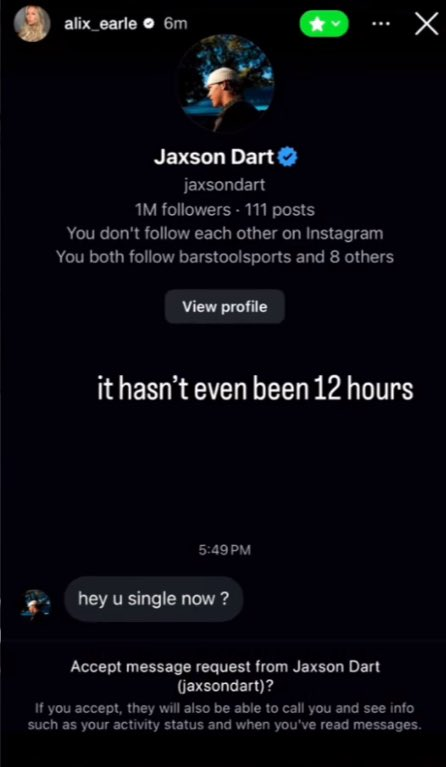
Then, a viral screenshot appeared to show Alix exposing Giants quarterback Jaxson Dart hitting up the TikToker.
Did he slide into her DMs? Did it work?
Alix Earle attends the 2025 GQ Men Of The Year party at Chateau Marmont on November 13, 2025. (Photo Credit: Amy Sussman/Getty Images)
It’s over for Alix Earle and Braxton Berrios … and on for Jaxson Dart?
On Saturday, December 6, news broke that Alix Earle and Braxton Berrios had split.
Almost immediately, a screenshot — seemingly related — spread on social media like wildfire.
As you can see below, the image appears to show a DM from Jaxson Dart to Alix Earle.
“Hey u single now?” the apparent message reads.
Atop the screenshot, Alix seemingly commented: “It hasn’t even been 12 hours.”
A viral screenshot appeared to show Alix Earle exposing Jaxson Dart sliding into her DMs. Is it real? (Image Credit: Twitter)
By all appearances, the screenshot shows Alix herself as having posted this to her Instagram Story.
Presumably, the goal was to “expose” Jaxson for being way too horny — and not waiting a respectful amount of time.
Sure, Alix just broke up with one sportsball player.
But that doesn’t mean that she wants another in her DMs so soon after leaving a very serious relationship. Right?
It turns out that Alix’s wasn’t upset by the DM after all. Why? Because it never happened.
Alix Earle attends ELLE’s 2024 Women in Hollywood celebration presented by Ralph Lauren, Harry Winston and TikTok at Four Seasons Hotel Los Angeles at Beverly Hills on November 19, 2024. (Photo Credit: Phillip Faraone/Getty Images for ELLE)
‘That never happened’
The breakup news broke on Saturday. The screenshot also circulated on Saturday.
On Sunday afternoon, Alix Earle effectively exonerated Jaxson Dart by taking to her TikTok Story.
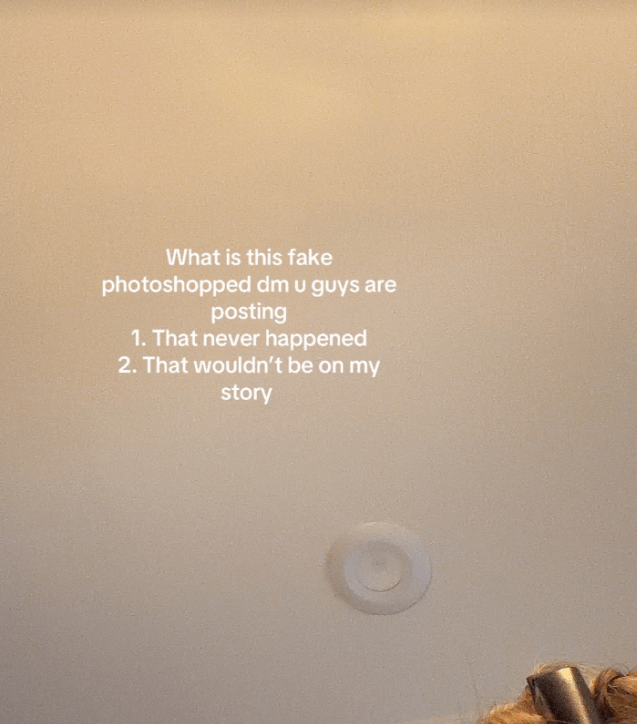
“What is this fake photoshopped DM u guys are posting,” she asked in the post, which consisted of a simple photo containing text.
“1. That never happened,” Alix wrote.
She added: “2. That wouldn’t be on my story.”
Taking to TikTok, Alix Earle debunked a phony screenshot. (Image Credit: TikTok)
That sounds very reasonable.
It would be in extremely poor taste for someone to DM someone after a serious breakup looking for a hookup.
(There are rare exceptions — some friends with compatible senses of humor, for example, or hookup buddies who would find post-split boning to be therapeutic)
One can only assume that whoever manufactured this screenshot was attempting to be funny. People sometimes edit real screenshots to resemble famous people (or fictional characters).
The alternative is that the originator was intentionally trying to misrepresent both Alix and Jaxson. And, gosh, we sure hope not!
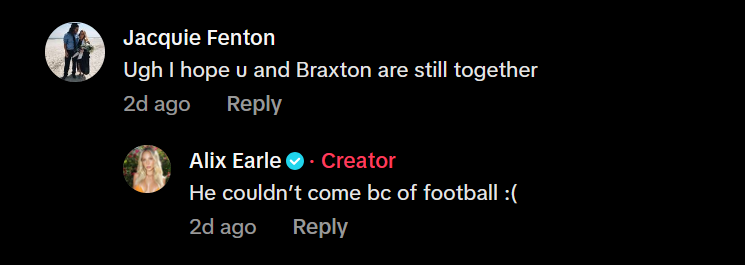
In TikTok comments, Alix Earle explained why hunky boyfriend Braxton Berrios could not attend her ‘DWTS’ Season 34 finale. (Image Credit: TikTok)
Why did she and Braxton break up?
Reports have said that the breakup was the result of their busy schedules. Certainly, public evidence supports this.
Braxton couldn’t make every Dancing With The Stars show — even when she was a finalist on the season finale.
According to Alix Earle herself, this was because he was busy with his football career.
It’s always possible that there’s more to the story. People with busy careers that require travel and odd hours do, however, sometimes find that it’s best to break up.
Either way, it’s good to know that Jaxson Dart was not, in fact, sliding into Alix Earle’s DMs the day that the news broke. That would have been tasteless.
But long before he amassed a devoted fan base through his work on shows like LA Law and Mad Men, Hamlin was a college student at Berkley.
Harry Hamlin and Lisa Rinna attend the 2023 Palm Springs International Film Festival: World Premiere of “80 For Brady” at Palm Springs High School on January 06, 2023 in Palm Springs, California. (Photo by David Crotty/Getty Images)
Like so many college kids of the 1970s, the aspiring thespian dabbled in illicit substances.
And on at least one occasion, his experiments took him down a very dangerous path.
Hamlin opened up about the incident during a recent appearance on Rinna’s “Let’s Not Talk About the Husband” podcast.
Apparently, the show is rather inaccurately titled, because Lisa’s husband talked about himself extensively during a conversation that started with the mention of the controversial drug ketamine.
“I have never had ketamine, but … in jail, I was forced to smoke PCP,” Hamlin remarked.
“[An] upperclassman had given me 25 pills and about a 25th of an ounce of grass, and that was my payment for taking these pills,” the 74-year-old continued, adding:
Actors Harry Hamlin and Lisa Rinna arrive at the 65th Annual Primetime Emmy Awards held at Nokia Theatre L.A. Live on September 22, 2013 in Los Angeles, California. (Photo by Frazer Harrison/Getty Images)
“It was exam season, and I was at Berkley. And my upperclassmen in the fraternity house I was living in came to me before I was going down to LA for Thanksgiving, which is around exam time.
“And he said, ‘Take these pills down to another house at USC. They need these for their exams. So I take them down, and they didn’t want the pills … so I had to take them back.”
“Do you think that was very smart?” Rinna asked, prompting Hamlin to admit, “Obviously not because I ended up in jail.”
Surprisingly, it wasn’t the pills that landed Hamlin in legal trouble but the “tiny quantity of marijuana” he had on his person.
Hamlin was sentenced to 18 days behind bars, but as a college student, he was permitted to serve his sentence on weekends.
Harry Hamlin and Lisa Rinna attend the 26th annual Elton John AIDS Foundation’s Academy Awards Viewing Party at The City of West Hollywood Park on March 4, 2018 in West Hollywood, California. (Photo by Rodin Eckenroth/Getty Images)
It was on his first weekend that Harry saw a group of inmates passing around a cigarette as though it were a joint. Eventually, one of the inmates insisted that he join in.
“He said, ‘Have some of this!’” Hamlin recalled, “So that’s how I was forced to have the PCP.”
“Somebody had brought in a little sack of rolling tobacco, and they had soaked it in PCP … so they were smoking it, and there was no odor. But they were high as kites,” he continued.
“I was so stoned because the guy forced me to take three or four hits of it, right?” Hamli said. “And I was completely messed up after I had that. So that’s my PCP story.”
And what a story it is!
Obviously, aspects of that particular tale are downright horrifying, but our main takeaway here is that Harry Hamlin is one of those guys who has an interesting story on just about any topic.
His own light, that is. Or perhaps is own dark, we should say.
On the December 7 episode of Sister Wives, the reality star embarked on a three-part apology tour… sitting down opposite ex-spouse Janelle in order to make amends for all his past behavior.
“I feel like we’ve needed an olive branch — the entire family,” the dad of 18 said on air, noting that he flew to North Carolina to meet with second wife because she received “the high honor” of “being the person I felt the safest with to start offering that olive branch.”
Kody went on to say he wanted “to apologize for just being so angry and so bitter over the family breakup,” and then explained in his chat with Janelle:
“Nobody deserved to have me be that angry.”
Never previously known for his self-awareness, or for taking responsibility ever for anything, Kody wasn’t done looking deep within himself.
Much to the surprise of Janelle and to viewers around the globe.
(TLC)
“I’ve been a bastard for about three years about this whole breakup, four years,” Kody actually said to Janelle, acknowledging that he was full of it when he claimed to have never loved his exes.
“I think the meanest thing that I did was I said I didn’t love you. That wasn’t true. That was a lie from the perspective of pain.”
Kody emphasized that there were “some mistakes I made in plural marriage specifically,” expounding as follows when it came to his early years:
“I wish I would have seen the need for you and I to protect our special place. If I would have understood that, I think it would have been a lot safer for you. I feel like I put you in harm’s way and then didn’t step up to protect you.”
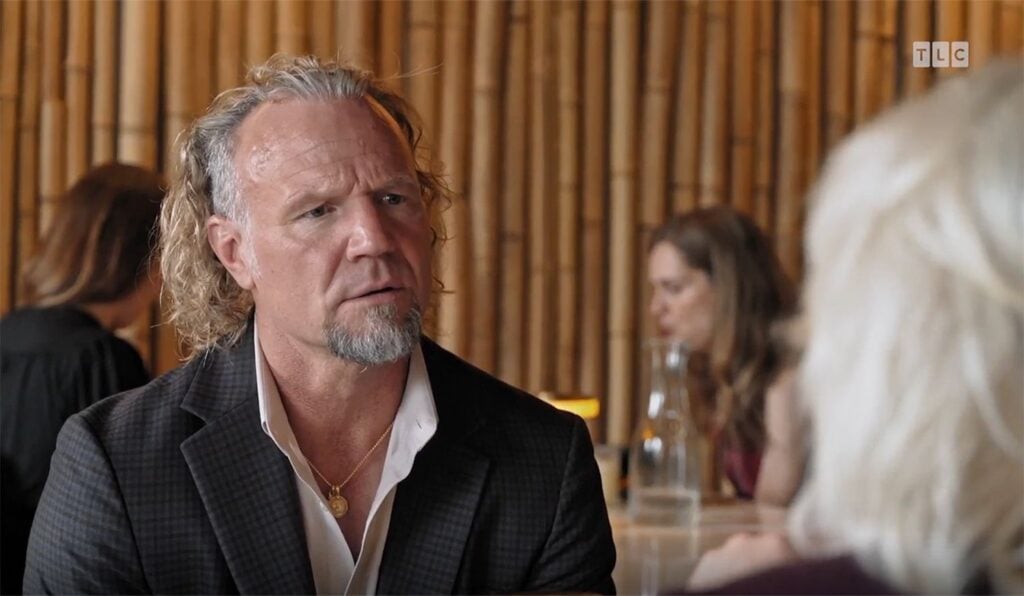
Janelle Brown should be so very happy she’s done with Kody. (TLC)
On Sunday night, Kody and Janelle didn’t untangle their specific issues, but they each referenced how challenging it was to navigate the world of polygamy.
“There were things that happened, especially that first year or two that I kind of wish he would have stood up for me as much as he maybe, by default, sort of took the other position,” Janelle explained, referencing her and Meri’s “very different personalities” and tendency to clash.
“So, add that to the fact that there was a lot of jealousy and insecurity and stuff that we were working through and it just was not good.”
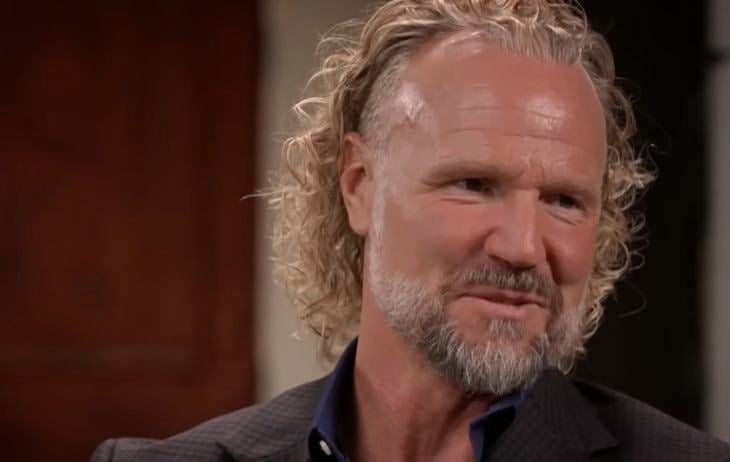
Kody Brown appears to be pondering life in this photo. (TLC)