A close adviser to Prince William has told Sky News William “does care deeply about tradition” but his Earthshot Prize shows he’s not afraid to modernise to make sure his work “makes sense” for the generation he will serve.The Latest News from the UK and Around the World | Sky News
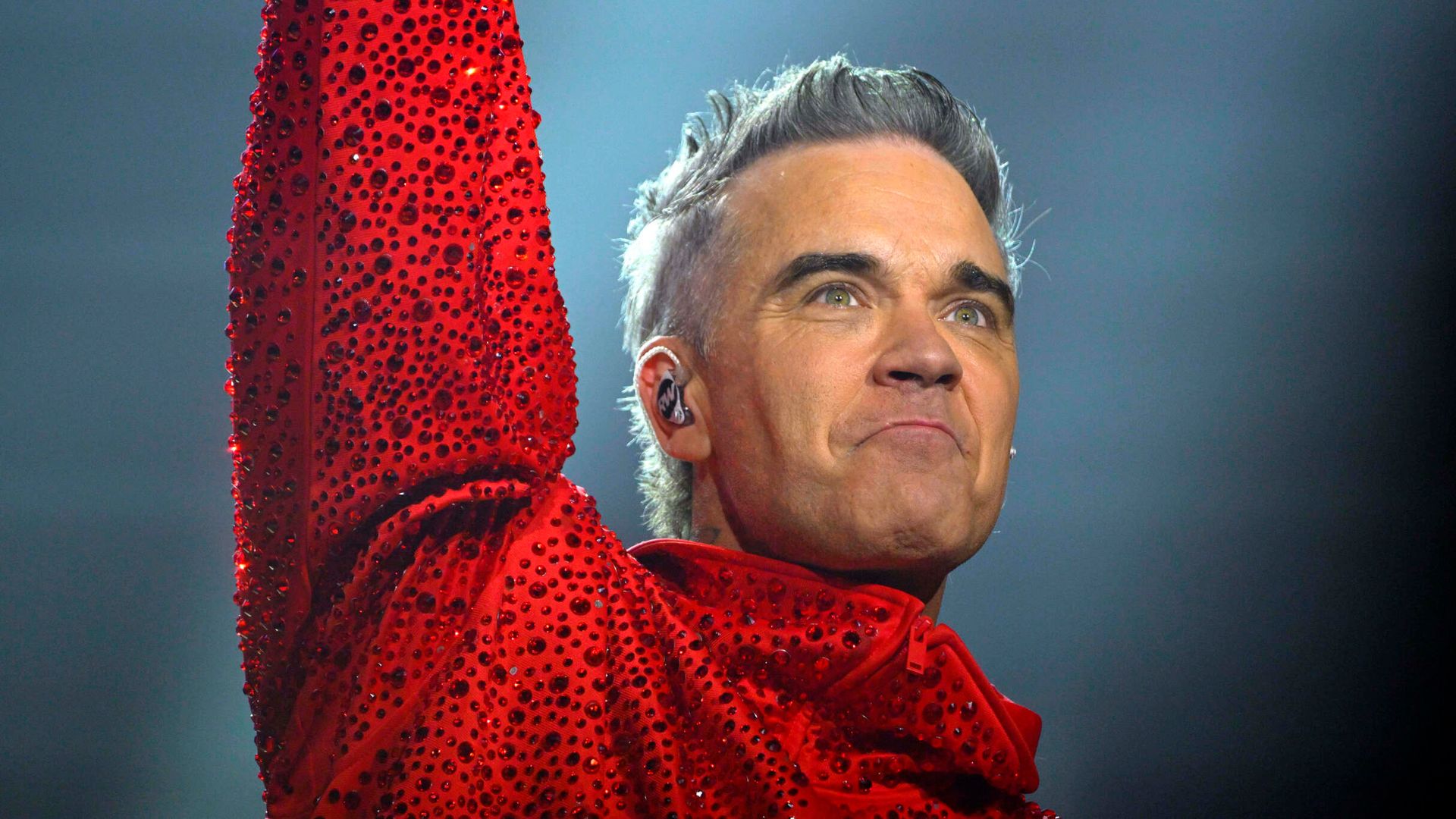
Robbie Williams has said he is “deeply sorry” his concert in the Turkish city of Istanbul has had to be cancelled “in the interests of public safety”.The Latest News from the UK and Around the World | Sky News
Police have been granted extra time to question four people who were arrested in connection with the terrorist attack on a synagogue in Manchester.The Latest News from the UK and Around the World | Sky News
At least five people have been killed in a massive Russian missile and drone attack on Ukraine, Volodymyr Zelenskyy has said.The Latest News from the UK and Around the World | Sky News
Police have launched an investigation after a suspected arson attack at a mosque in East Sussex – as footage shows the moment the fire erupted.The Latest News from the UK and Around the World | Sky News
There is a loud boom, the noise of an explosion, followed by the rat-a-tat of automatic gunfire.The Latest News from the UK and Around the World | Sky News
It is a breathtaking and, at points, pretty perilous journey through the remote mountainous region of eastern Afghanistan.The Latest News from the UK and Around the World | Sky News
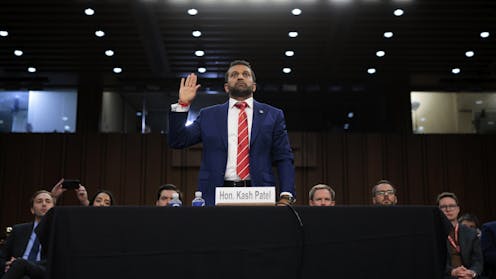
FBI Director Kash Patel is sworn in to testify before the Senate Judiciary Committee on Sept. 16, 2025, in Washington, D.C.Chip Somodevilla/Getty Images
Three converging events in the 1970s – the Watergate scandal, the chaotic U.S. withdrawal from the Vietnam War and revelations that FBI Director J. Edgar Hoover had abused his power to persecute people and organizations he viewed as political enemies – destroyed what formerly had been near-automatic trust in the presidency and the FBI.
In response, Congress enacted reforms designed to ensure that legal actions by the Department of Justice and the FBI, the department’s main investigative arm, would be insulated from politics. These included stronger congressional oversight, a 10-year term limit for FBI directors and investigative guidelines issued by the attorney general.
Some of these measures, however, were tenuous. For example, Justice Department leaders could alter FBI investigative guidelines at any time.
Now, in Trump’s second term, prior guardrails have vanished. The president has installed loyalists at the DOJ and FBI who are dedicated to implementing his political interests.
A lawsuit filed by three former FBI officials fired by the Trump administration asserts that the bureau is being politicized and is supporting Trump’s agenda.
As a historian of the FBI, I recognize the FBI has had only one other overtly political director in the past 50 years: L. Patrick Gray, who served for a year under President Richard Nixon. Gray was held accountable after he tried to help Nixon end the FBI’s Watergate investigation. Whether Trump’s current director, Kash Patel, has more staying power is unclear.
After Hoover
Ever since Hoover’s death in 1972, presidents have typically nominated independent candidates with bipartisan support and law enforcement roots
to run the FBI. Most nominees have been judges, senior prosecutors or former FBI or Justice Department officials.
While Hoover publicly proclaimed his FBI independent of politics, he sometimes did the bidding of presidents, including Nixon. Still, Nixon felt that Hoover had not been compliant enough, so in 1972 he selected Gray, a longtime friend and assistant attorney general, to be Hoover’s successor.
Gray took steps to move the bureau out of Hoover’s shadow. He relaxed strict dress codes for agents, recruited female agents and pointedly hired people from outside the agency – who were not indoctrinated in the Hoover culture – for administrative posts.
Gray asserted his authority with blunt force. FBI agents at field offices and at headquarters who resisted Gray’s power were censured, fired or transferred. Other senior officials opted to leave, including the bureau’s top fraud expert, cryptanalyst and skyjacking expert, and the head of its Crime Information Center.
Attorney L. Patrick Gray meets with reporters at the White House after his selection by President Richard Nixon as FBI acting director on May 3, 1972. Bettman via Getty Images
Gray helps Nixon
In contrast to Hoover, who had rarely left FBI headquarters and publicly avoided politics, Gray openly stumped for Nixon in the 1972 campaign. He was so rarely spotted at FBI headquarters that bureau insiders dubbed him “Two-Day Gray.” At the request of Nixon aide John Ehrlichman, Gray told field offices to help Nixon campaign surrogates by providing local crime information.
Gray cooperated with Nixon to stymie the FBI’s investigation of the 1972 Watergate break-in and the ensuing cover-up. He provided raw FBI investigative documents to the White House and burned documents from Watergate conspirator E. Howard Hunt’s White House safe.
When Nixon had CIA Deputy Director Vernon Walters ask Gray, in the name of national security, to halt the FBI’s investigation, Felt and other agency insiders demanded that Gray get this order in writing. The White House backed down, but Nixon’s directive had been recorded. That tape became the so-called “smoking gun” evidence of a Watergate cover-up.
Felt, in classic Hoover fashion, then leaked information to discredit Gray, hoping to replace him. Gray resigned in disgrace.
While Felt never got the top job, he is now remembered as the prized anonymous source “Deep Throat,” who helped Washington Post reporters Bob Woodward and Carl Bernstein in their Pulitzer Prize-winning Watergate investigation. But it was internal FBI resistance, from Felt and agents at lower levels, that led to Gray’s departure.
After Democratic National Committee headquarters at Washington, D.C.’s Watergate Hotel was burgled in June 1972, the FBI was charged with investigating the break-in – as Director L. Patrick Gray tried to subvert his own agency’s investigation.
Political from the start
Campaigning in 2024, Donald Trump vowed to “root out” his political opponents from government. Realizing he was a target because of his investigation of the attack on the U.S. Capitol on Jan. 6, 2021, FBI director Christopher Wray, whom Trump had nominated in 2017, resigned in December 2024 before Trump could fire him.
In Wray’s place Trump nominated loyalist Kash Patel, a lawyer who worked as a low-level federal prosecutor from 2013 to 2016 and then as a deputy national security appointee during Trump’s first term.
Even before Patel was confirmed on Feb. 20, 2025, in an historically close 51-49 vote, the Justice Department began transferring thousands of agents away from national security matters to immigration duty, which was not a traditional FBI focus.
Hours after taking office, Patel shifted 1,500 agents and staff from FBI headquarters to field offices, claiming that he was streamlining operations.
Patel installed outsider Dan Bongino as deputy director. Bongino, another Trump loyalist, was a former New York City policeman and Secret Service agent who had become a full-time political commentator. He embraced a conspiracy theory positing the FBI was “irredeemably corrupt” and advocated “an absolute housecleaning.”
In February, New York City Special Agent in Charge James Dennehy told FBI staff “to dig in” and oppose expected and unprecedented political intrusions. He was forced out by March.
Patel then used lie-detector tests and carried out a string of high-profile firings of agents who had investigated either Trump or the Jan. 6, 2021, insurrection. Some agents who were fired had been photographed kneeling during a 2020 racial justice protest in Washington, D.C. – an action they said they took to defuse tensions with protesters.
In response, three fired agents are suing Patel for what they call a political retribution campaign. Ex-NFL football player Charles Tillman, who became an FBI agent in 2017, resigned in September 2025 in protest of Trump policies. Once again, there are assertions of a purge.
Will Patel be held accountable?
Patel’s actions as director so far illustrate that he is willing to use his position to implement the president’s political designs. When Gray tried to do this in the 1970s, accountability still held force, and Gray left office in disgrace. Gray participated in a cover-up of illegal behavior that became the subject of an impeachment proceeding. What Patel has done to date, at least what we know about, is not the equivalent – so far.
Today, Patel’s tenure rests solely upon pleasing the president. If formal accountability – a key element of a democracy – is to survive, it will have to come from Congress, whose Republican majority has so far not exercised its power to hold Trump or his administration accountable. Short of that, perhaps internal resistance within the administration or pressure from the public and the media might serve the oversight function that Congress, over the past eight months, has abrogated.
Douglas M. Charles does not work for, consult, own shares in or receive funding from any company or organization that would benefit from this article, and has disclosed no relevant affiliations beyond their academic appointment.
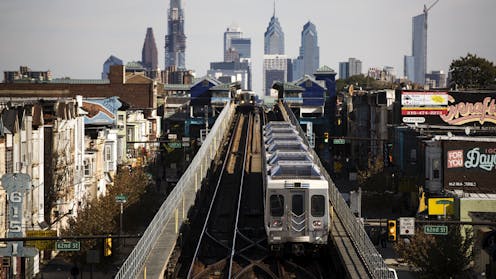
A SEPTA train moves along the Market-Frankford Line in West Philadelphia.AP Photo/Matt Rourke
On April 13, 1967, around 1:30 p.m., Lt. Joseph Larkin of the Philadelphia Police Department’s subway unit visited the Philadelphia High School for Girls to interview the school’s librarian, 61-year-old Miriam S. Axelrod.
Axelrod had written a letter to Mayor James H.J. Tate about poor conditions on Philadelphia’s Broad Street Line subway. In her letter, she stated that the escalators in the subway concourse of the Walnut-Locust station were out of operation for several weeks and requested that they “be put in running order.”
Axelrod also asked that “something be done” about people using the subway stairs “as a latrine.”
As a historian of post-1968 Philadelphia, a proud alumna of Girls’ High and a rider of Philadelphia’s mass transit, Southeastern Pennsylvania Transportation Authority – more commonly known as SEPTA – I was thrilled to find Axelrod’s story among 1960s administrative reports to the police commissioner in the city archives.
Axelrod’s story reminds us that for nearly a century, Philadelphia’s mass transit has been plagued by poor conditions and unstable funding. Commuters’ complaints have often convinced government officials to act. However, no effective plan has ever been implemented to definitively solve the city’s transit crises.
SEPTA’s current turmoil
On Sept. 15, 2025, SEPTA fully restored its service, by court order, after implementing 20% service reductions and a 21.5% fare increase due to a US$213 million budget deficit.
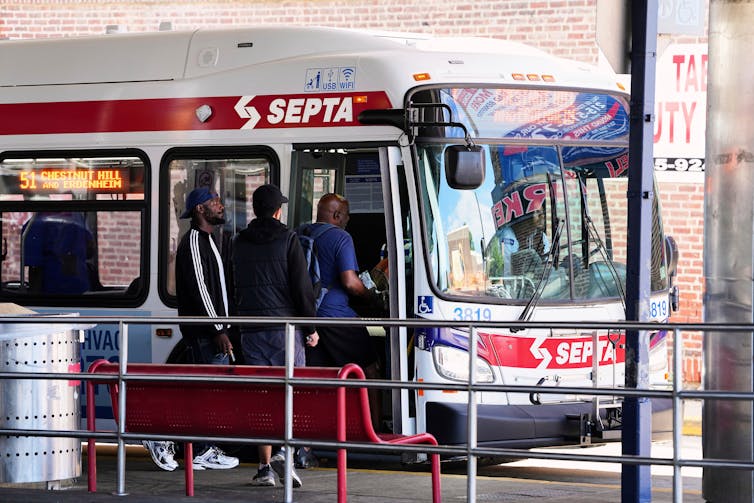
Passengers at Olney Transportation Center in North Philadelphia board a SEPTA bus on Aug. 25, 2025, a day after major service cuts went into effect. AP Photo/Matt Rourke
Some lawmakers have argued that SEPTA is guilty of mismanaging funds, since the agency already received over $1 billion in state subsidies last year for operating assistance and asset improvement.
Public transport in the 1920s
As a longtime Philadelphian who lived in Center City, Miriam Axelrod was familiar with the strengths and shortcomings of public transportation.
At the age of 4, her family emigrated from Russia to Carmel, New Jersey. By 1920, they made Philadelphia their home just as the city’s Russian community became the largest immigrant group due to Jewish people escaping pogroms in Europe. Axelrod grew up living in South and North Philadelphia.
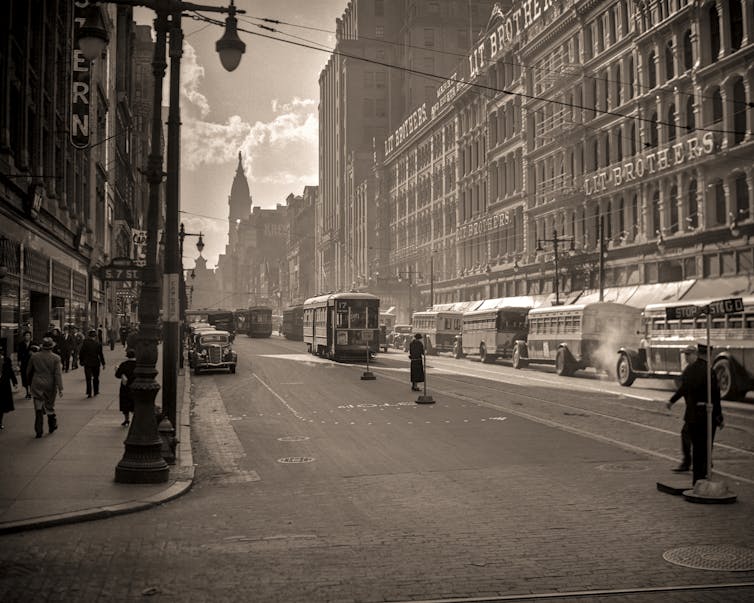
At that time, dozens of private transit companies operated in Philly.
Southern Penn operated city buses. Red Arrow provided suburban trolley service. Pennsylvania and Reading railroads offered high-speed rail lines. The Philadelphia Rapid Transit Co. alone brokered deals with 64 underlying companies to annually rent their services under 999-year leases. Fiscal responsibility for quality transportation was complicated and often dependent on public funding.
During PRT’s early years, it paid the city $15,000 annually for snow removal. In return, the city spent $2 million for street paving and bridge repairs.
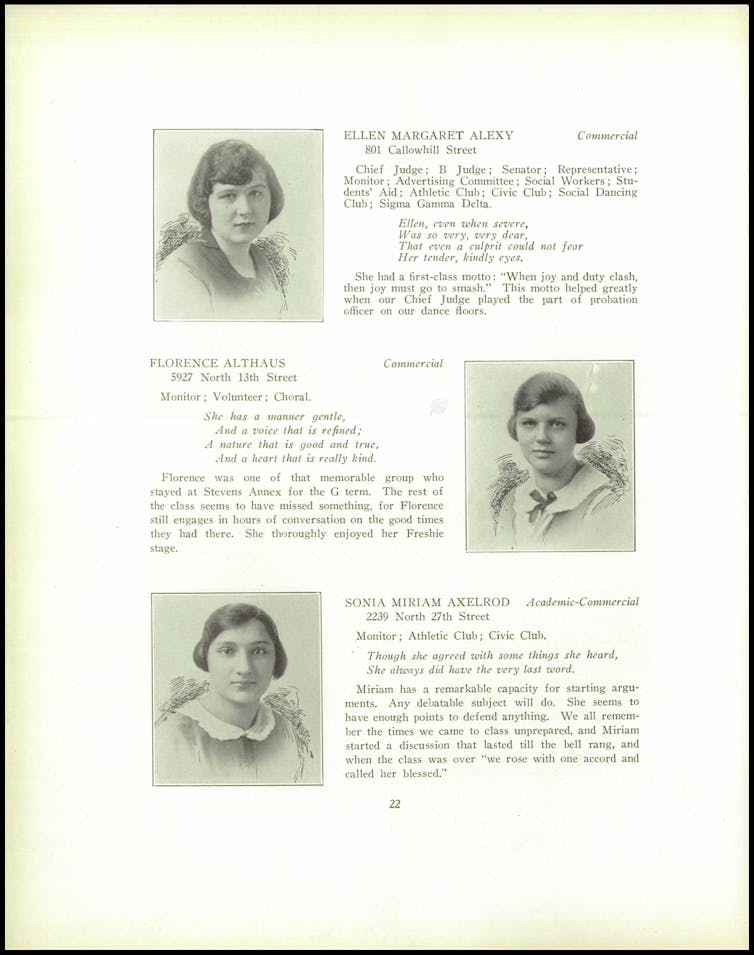
That was the same year Axelrod graduated from William Penn High School for Girls. Her classmates keenly noted in their yearbook that she had a “remarkable capacity for starting arguments” in which “any debatable subject will do.”
Six years later, the first segment of the Broad Street Subway traveling from Olney Station in North Philadelphia to City Hall opened to the public. Unlike the bus, trolley and railways systems, the city owned the El, short for elevated, line and subway. The city leased both systems to PRT and made the transit company responsible for their maintenance.
On Jan. 1, 1940, the Philadelphia Transportation Co., a private company with a 21-member board of directors that included five city representatives including the mayor, Robert E. Lamberton, merged the transit companies and took over PRT’s operations. PTC became responsible for 10,000 employees and providing transportation for 2 million passengers a day.
PTC also acquired extensive financial responsibilities. Payroll expenses cost $327,000 each week. The annual rate for leasing the subway and El was roughly $3 million. PTC had to provide its 25,000 bondholders an annual income of at least $959,207 while also fulfilling its promise to offer modern transit vehicles.
Overcrowding and frequent fare increases
During the 1940s through the 1960s, Axelrod took public transportation to her job as a librarian at Central High School and later Frankford High School.
Meanwhile, PTC made good on its promise to provide better transit service. In its first eight years of operation, PTC spent $22.8 million to purchase 1,506 new streetcars, buses and trackless trolleys while also improving terminal and plant facilities. The company even purchased advertisements in The Philadelphia Inquirer to highlight its achievements. PTC extended 38 existing routes and created 18 new routes that serviced old residential and industrial areas, along with newly developed neighborhoods.
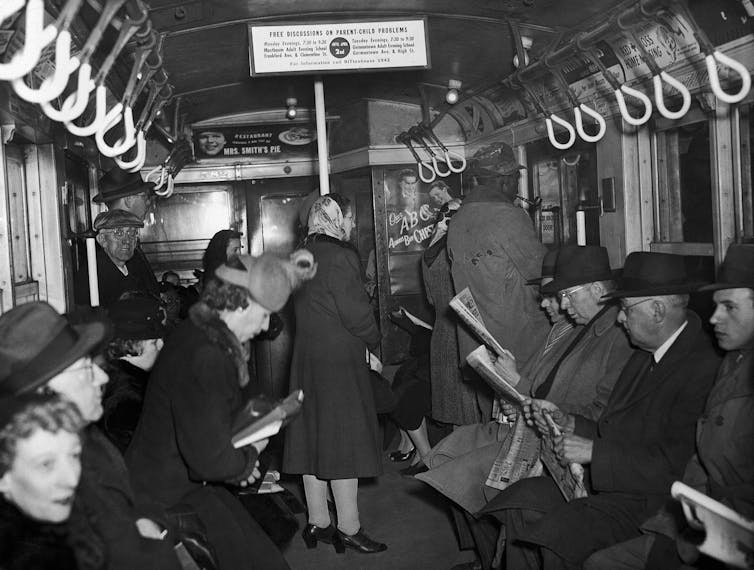
By 1949, however, many of PTC’s 3.2 million daily riders were complaining about overcrowded subways, the end of free exchanges between popular routes and frequent fare increases.
Passengers ride a subway car in Philadelphia on Feb. 15, 1946. AP Photo
Both PTC and the city faced scrutiny for these issues, although each party had distinct transit obligations outlined in their joint contract. PTC had to provide “safe and adequate service” that included spending on maintenance and replacement of transit equipment. The city was responsible for police and fire services on mass transit along with auditing PTC’s records. Both parties had to agree on fare changes under the state Public Utility Commission’s supervision.
Nevertheless, when issues on mass transit occurred, the city could persuade PTC to improve conditions, but the city was only required to offer emergency services to commuters.
When Larkin personally addressed Axelrod’s 1967 complaint about the subway, he informed her that the United Elevator Co. was repairing the escalators. He also assured her that the subway unit arrested 45 to 50 intoxicated people each month because they were at risk of falling onto the subway tracks. In “isolated cases,” Larkin explained, police arrested people for public urination and defecation.
Larkin reassured Axelrod that PTC could keep subway conditions clean and under control. In reality, PTC was underwater in responsibilities and debt.
On Sept. 30, 1968, SEPTA, a state agency formed five years earlier, took over PTC and managed transportation for the city and its surrounding areas. SEPTA bought PTC for approximately $47.9 million, settling the company’s debt, accepting its pension liability and buying out the institution’s roughly 1.7 million shareholders. Now federal and state funding rather than fare revenue largely determined the quality of the city’s public transit.
Five counties in Greater Philadelphia contribute subsidies to SEPTA in exchange for transit service. Philadelphia alone contributes $110 million. State subsidies also help finance SEPTA’s $1.74 billion operating budget, while federal subsidies support SEPTA’s $1 billion capital budget to pay for major repairs and new equipment. State politicians annually vote on funding for SEPTA, but there has not been a concrete solution to the funding crisis.
However, Philadelphians never ceased to demand better transit service. During the 1980s, the Pennsylvania Public Interest Coalition established the Transit Riders Action Campaign, also known as TRAC, which advocated that SEPTA have better safety, funding, accountability, service and stable fares. The Transport Workers Union Local 234 advised TRAC, while several organizations partnered with them: the Action Alliance of Senior Citizens, the Clean Air Council, Disabled in Action and the Delaware Valley Interfaith Coalition.
Even today, local groups such as Save the Train with outspoken commuters – like Axelrod was in her day – have launched campaigns to halt service cutbacks and encourage residents to write and telephone legislators who can vote to fund SEPTA. Residents have consistently united to advocate for quality mass transit. All that remains is an agreement among lawmakers to make it possible.
Menika Dirkson does not work for, consult, own shares in or receive funding from any company or organization that would benefit from this article, and has disclosed no relevant affiliations beyond their academic appointment.
As we know, the two married, and were all set to film The Flip Off together.
When they broke up, she was not the one who booted Josh from the HGTV series. That was her (other) ex-husband.
Christina Haack, Tarek El Moussa, and Heather Rae El Moussa appear on a promo for The Flip Off on HGTV. (Image Credit: HGTV)
Sometimes, it takes an ex-husband to counter an ex-husband
During new interview with People, Christina Haack revealed that ex-husband Tarek El Moussa was instrumental in purging The Flip Off of more recent ex Josh Hall.
Tarek then advised Christina to “leave.” And, from there, she says that he took matters into his own hands.
Addressing the confessional camera on ‘The Flip Off,’ Christina Haack discusses her miscalculations. (Image Credit: HGTV)
The Flip Off had only just begun filming. Josh was, at first, part of the cast — albeit the least interesting of the bunch.
“Tarek told our attorney and told the network for me that Josh would no longer be a part of the show,” Christina shared.
“In all honesty, I didn’t want to film the show with Josh,” she admitted.
“The network knew I didn’t want to,” Christina added. “I had even told Tarek I didn’t want to.”
She recaled: “And he had joked and said — well, I don’t know if he was joking — but said, ‘Whatever. You guys are just going to split up in Episode 2 and then the show will go on and everything will be fine.”
On ‘The Flip Off,’ Christina Haack voices the feeling that her most recent ex is hoping to ‘retire’ off of her after their marriage, which spanned less than three years. (Image Credit: HGTV)
Christina Haack and Josh Hall hadn’t been happy for a while
“[Josh and I] hadn’t been getting along in a long time,” Christina Haack then acknowledged.
“And I’m not talking about weeks,” she specified. “I’m talking years.”
(Many relationships have periods of unhappiness or disagreement — but years of unhappiness in still-recent marriage? That’s not good!)
“There’s a lot of red flags that I ignored, and that could be a whole memoir that I don’t need to get into,” Christina acknowledged.
“But, we were not getting along and there’s a lot of insecurity on his side,” she summarized.
A smiling Christina Haack looks very cozy beside Josh Hall on Christina In The Country Season 2, Episode 1. (Image Credit: HGTV)
“He made filming very uncomfortable for me, very hard. It was not fun,” Christina lamented.
“I think the filming made things worse and [sped] things up that already were going really bad,” she assessed.
Overall, she’s so glad that the show booted Josh so early.
“The show would have been horrible if he had stayed on,” Christina said bluntly.
She described: “It would have been awkward; there wouldn’t have been any funny moments. There wouldn’t have been any of those real scenes.”
On ‘The Flip Off,’ Christina Haack, Tarek El Moussa, and Heather Rae El Moussa enjoy a friendly conversation even though they are supposed to be reality TV rivals. (Image Credit: HGTV)
Insecure dudes should probably not marry successful partners, generally speaking
According to Christina Haack: “I feel like I would have had to dim my personality” in order to soothe Josh’s ego.
She explained that it would have either been that “or I would get home and he would ignore me for three days.”
Folks, the silent treatment is not an appropriate way of communication. It is the opposite of communication.
“I couldn’t be myself, and that’s a really strange feeling to have,” Christina described.
“Especially when you’ve been on TV for 15 years, and it’s your show,” she noted. “And you’re the reason people are watching on your side, and you’re not allowed to be yourself.”
Christina admitted: “It’s a strange lesson to learn, especially as a 40-year-old woman.”