Two British fighter jets have flown their first defence mission over Poland after a Russian drone incursion into the country’s skies.The Latest News from the UK and Around the World | Sky News










Two British fighter jets have flown their first defence mission over Poland after a Russian drone incursion into the country’s skies.The Latest News from the UK and Around the World | Sky News

Today, Sir Keir Starmer will deliver on his pledge to recognise a Palestinian state – after setting out a series of conditions in July which there was little prospect Israel could meet, including agreeing a ceasefire with Hamas. The Latest News from the UK and Around the World | Sky News

The following is an advisory from the City and Borough of Juneau
Residents are advised to be aware of their surroundings and take precautions as heavy rainfall and wind may increase hazard risk in the Juneau area through late Monday night. Read the full National Weather Service (NWS) Flood Watch notice.
City & Borough of Juneau (CBJ) Parks and Recreation teams closed the Auke Lake Trail on Saturday after two landslides were observed. For their safety, residents should to stay clear of the trail and out of the lake until weather conditions improve and staff can clear the debris.
The National Weather Service also issued a Flood Advisory for Montana Creek. Significant rainfall is increasing water levels around Montana Creek, with water observed in low-lying areas and the potential for flooding on Montana Creek Road and Back Loop Road at the Montana Creek Bridge. If you see water on the road, turn around. Do not drive on flooded roadways.
From the National Weather Service Flood Watch for Juneau:
“While the current periods of heavy rainfall will diminish Saturday evening, another band of heavy rain will move through on Sunday. This will result in elevated streams and the potential for minor flooding. This will be followed by a strong system on Monday which will bring with it strong winds and more heavy rain. Rainfall totals of between 3-5 inches are expected during this time, with higher amounts possible in isolated areas and at elevation.”
CBJ will remain in close contact with the NWS and our response partners and provide updates as available. Residents can also stay tuned to weather.gov/Juneau for further developments.

Pennsylvania is due to receive US$2.2 billion dollars from the national opioid settlements, and a new database shows the public where that money is going.
Starting in 2021, a national, bipartisan coalition of attorneys general, including now-Pennsylvania Gov. Josh Shapiro, reached settlements with opioid manufacturers and distributors who had directly contributed to the opioid addiction crisis.
That year, over 5,000 Pennsylvanians died from unintended drug overdoses. That number has since dropped, falling to about 3,300 in 2024.
The opioid settlement payments, which began in 2022 and are slated to continue until 2038, are supposed to fund opioid overdose prevention, treatment, harm reduction, recovery support and other programs. This includes a broad array of interventions in Pennsylvania, from first-responder training for law enforcement to handle people who have overdosed to stigma reduction education and support for medication-assisted treatment, to name just a few.
We are researchers from Penn State University, Temple University and the University of Pittsburgh who helped build a website, which launched in August 2025, that publishes and tracks opioid settlement fund spending data in Pennsylvania.
We are partnering with the Pennsylvania Opioid Misuse and Addiction Abatement Trust, the County Commissioners Association of Pennsylvania and the Pennsylvania Career Development Association. Our team receives funding through the Pennsylvania Opioid Misuse and Addiction Abatement Trust to help the trust with data collection, analysis and web design. However, our website is separate and independent from the trust.
Here are five things we believe Pennsylvania residents ought to know about the spending data, and how it can be used to improve public health:
Out of the 48 states that have received settlements so far, Pennsylvania is one of nine states that have given majority control of settlement spending to local governments.
In Pennsylvania’s case, 70% of the funding goes to counties. Cities and other organizations that were involved in the lawsuits, such as county district attorney offices, get 15%. The remaining 15% goes to the state.
This means that in Pennsylvania, it is mostly up to counties to determine how to best spend the US$2.2 billion. Counties must interact directly with their communities through requests for proposals to distribute funds. They will face critical decisions about how to invest the funds in ways that move beyond pilot programs to sustainable, system-level change.
Requirements from the opioid settlement to spend at least 85% of the money on opioid abatement aim to avoid pitfalls of the 1990s tobacco settlement, when funds were often diverted to general budgets and spent on programs unrelated to getting people to quit smoking.
States that have not given majority control of settlement spending to local governments have created a variety of ways to spend the money. These include a mix of state and local disbursement, as well as special fund-governing bodies charged with deciding how settlement funds are distributed. In some states, the state is the primary decision-maker about how settlement funds are used.
The requirement in Pennsylvania that opioid settlement funds are primarily sent to counties creates an opportunity for local innovation. It will also, eventually, allow experts to evaluate the effectiveness of this local control of funds compared with state control or other structures.
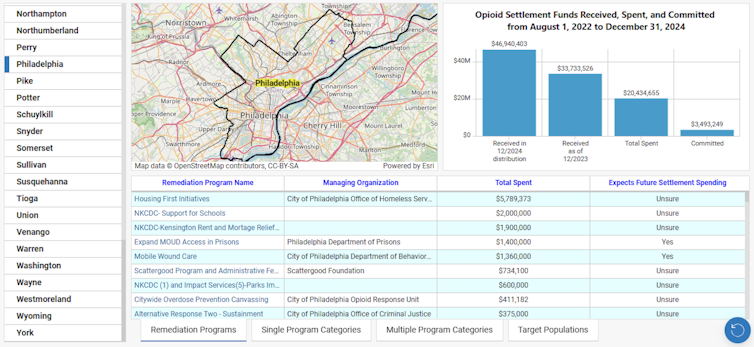
When members of the public can see where the money is going, they can hold systems accountable for using the funds effectively. County leaders, meanwhile, can see what programs are currently being funded in other counties that they may want to replicate or scale up.
Settlement dollars are just beginning to be distributed and spent. According to the tracker, over $80 million had been spent on approved opioid remediation programs as of Dec. 31, 2024. Settlement payments will continue over the next seven to 18 years, varying by company.
This is a marathon and not a sprint, so communities and decision-makers will have to balance spending that produces short- and longer-term objectives.
Additionally, not all counties are receiving the same amount of money, and that affects what they can do with it.

Emerging issues in the opioid crisis will continue to evolve, such as how contaminants like the animal tranquilizers xylazine and medetomidine, or products derived from kratom, a tropical tree, have entered the street drug supply in recent years.
Systematically tracking data will help expand our knowledge base of all programs in Pennsylvania that aim to address the opioid crisis. Some of these programs are based on strong existing evidence, while others will help to build new evidence, especially considering the ever-changing landscape of the crisis.
Opioid settlement funds are an important opportunity to address the opioid crisis, but will not on their own cover all funding gaps needed to address the crisis or the broader public health crises that are its major drivers. These include food and housing insecurity, unemployment, lack of access to mental health care, and so many other related issues.
As the country faces major and rapid federal disinvestment in states and communities, these funding gaps will grow and increase the pressure on local decision-makers to make the most of each dollar while demonstrating evidence of impact.
Read more of our stories about Philadelphia and Pennsylvania, or sign up for our Philadelphia newsletter.

Jonathan Larsen receives funding from the Pennsylvania Opioid Misuse and Addiction Abatement Trust. He is the Chair of the Haverford Township Democratic Committee.
Amy Yeung receives funding from the Pennsylvania Opioid Misuse and Addiction Abatement Trust
Dennis Scanlon receives funding from the Pennsylvania Opioid Misuse and Addiction Abatement Trust.
Renee Cloutier receives funding from the Pennsylvania Opioid Misuse and Addiction Abatement Trust.
Politics + Society – The Conversation
In a classic work on the modern presidency originally published in 1960, political scientist Richard Neustadt wrote that the American public “expects the man in the White House to do something about everything.”
These expectations, Neustadt argued, far exceeded the president’s ability to actually control outcomes.
More recently, political journalist John Dickerson, author of “The Hardest Job in the World,” noted that presidents typically have people demanding that they pay attention to about 250 problems at one time. But, quoting a productivity expert, Dickerson points out that priorities are like arms: “If you have more than two, you’re either crazy or lying.” The implication: Presidents have to shed 248 of those pressing concerns.
I study the American presidency. The research in the field, including my own, suggests that typically the politics of presidential attention is driven by two considerations.
The first comes down to delegation: As Barack Obama was fond of saying, no easy problem gets to the president’s desk. Presidents typically focus on the problems that no one else – not state or local governments, the bureaucracy or Cabinet secretaries – can deal with.
The other consideration is whether the issue is a winning one. Neustadt emphasizes this in his study of presidential power: Presidents enhance their reputations by winning conflicts, not losing them.
There are also plenty of examples of presidents wading into highly conflicted areas and alienating supporters or suffering policy defeats, including George W. Bush’s unsuccessful attempts to tackle the “third rail” of Social Security reform, and Bill Clinton’s failed efforts to enact health care reform.
As a result, presidents are typically expected to be focused on national security, economic management and other key issues that have to be handled at the national level. They are expected to only sparingly wage battles of will with leaders outside government – in the arts, business or education – and with state-level politicians who lie outside the president’s direct control.
Amid the many other ways he’s departed from American political tradition, President Donald Trump has turned these assumptions upside down. That has important implications for how Americans understand the scope and reach of presidential power.
Like most aspects of American politics, the presidency has become more defined by partisan politics over time. Trump has taken this evolution to a new level, rejecting the traditional role of statesman or a spokesperson for the whole nation.
Instead, he has adopted the role of partisan political warrior – and that means he is using the power of his office in areas and in ways previously considered off-limits to the president.

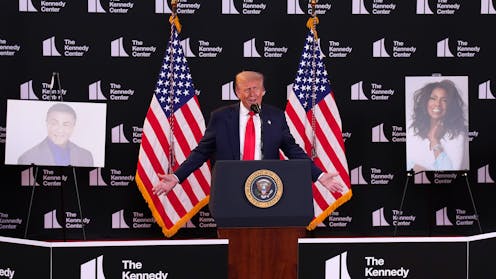
Recently, President Trump reported that he might host the Kennedy Center Honors in December. He also reportedly had a strong hand in choosing the center’s honorees, a task normally undertaken over months and with public input.
He’s also been heavily involved in the redecoration of the White House, waged war on wind turbines and posted online about the controversy over actress Sydney Sweeney’s ad for American Eagle jeans.
His administration has issued detailed demands of numerous universities, wading directly into curriculum, personnel policies and the frequent target of diversity, equity and inclusion programs. While much of this effort has gone through the Department of Education, the president himself has issued executive orders and posted online about specific universities.

Traditionally, presidents have been especially hesitant to dive into areas where education intersected with difficult cultural conflicts. One of the most significant examples is the way that presidents reacted, from the 1950s through the 1970s, to Supreme Court orders mandating school desegregation.
To put it bluntly, presidents did not want to face the political dilemmas associated with enforcing the court’s 1954 Brown v. Board of Education decision.
As I note in my book “Backlash Presidents,” presidents are rarely eager to upend the racial status quo, even when they recognize its injustice.
Dwight Eisenhower, who was president when the Supreme Court issued the Brown decision, felt the decision placed new strain on the federal government to get involved in social relations and local issues. The feeling was bipartisan; Eisenhower’s presidential successor, Democrat John F. Kennedy, didn’t want to take a lead role in enforcing desegregation either.
Both, at different times, did eventually use federal force and power to uphold the law. Eisenhower mobilized the National Guard to protect Black students integrating a Little Rock, Arkansas, high school in 1957, and Kennedy in 1963 took similar action to protect Black students integrating schools in Alabama.
But federalism, which divides powers between national and state government, provided presidents with a strategically useful barrier to any further presidential action, allowing the two presidents to say that they were treading carefully because education was up to the states.
Obviously, this was a different time and context – the Department of Education didn’t exist yet, so there was not a clearly defined federal role in public education. But it represents an example of how presidents have typically looked to use structures such as federalism to leave tough issues to others and avoid political fallout.
Focusing attention on foreign policy and national security is less likely to stoke opposition. Those are areas where presidents have more latitude and can expand their power even more.
Presidents have traditionally not engaged in direct conflict with individual governors, industry leaders or university presidents if they can help it. They’ve engaged in policy battles, but generally not personal ones.
Trump’s approach has been very different.
With Department of Justice investigations and public criticism, his administration has targeted specific law firms and individuals whom Trump dislikes. The president has issued executive orders about the “forced use” of paper straws.
Is Trump’s attention on the personal a problem for the nation?
Presidents have been challenged for being too focused on minor issues and details, including Jimmy Carter, whose attention to things such as the schedule of the White House tennis courts drew scorn from critics.
Some presidents have been criticized as too quick to delegate to others, as was Ronald Reagan, who was seen as inattentive to important details. George W. Bush likewise was knocked for delegating too much, especially in crucial areas of foreign policy and intelligence.
But Trump’s shifting of presidential priorities signals a much deeper political change.
First, some of these actions have also been directly related to cultural conflict – the fights with universities over DEI polices, commenting on the Sydney Sweeney ad.
Trump is hardly the first president to elevate a hot-button cultural issue for political gain – George W. Bush famously promoted a constitutional amendment banning same-sex marriage leading into his 2004 reelection campaign.
But presidents have traditionally seen more costs than benefits associated with campus speech issues or race questions that could be handled elsewhere.
A February 2025 article in The Root, whose motto is “Black News and Black Views with a Whole Lotta Attitude,” points to “five ridiculously petty actions” from the administration. All are related to race or LGBTQ symbols or visuals, such as the removal of references to LGBTQ Americans from government websites and the removal of a Spanish-language version of the White House website.
Another related aspect of the logic behind this shift in presidential attention is that the political constraints that limited past administrations, such as fear of alienating voters or stirring controversy, do not seem to concern this one. It suggests that the president and his team are not worried about the opinions of people who might disagree with their cultural stances.
This change also represents a departure from the more traditional statesmanship version of the presidency. The Trump administration and the president who heads it have chosen to dive deeply into, rather than rise above, politics.

Julia R. Azari has received (in the past) funding from the Truman Library Institute, the Kluge Center at the Library of Congress and the William and Flora Hewlett Foundation.
Politics + Society – The Conversation

It’s been nearly two years since Hamas’ Oct. 7, 2023, attack on Israel and the subsequent start of the Israel-Hamas war – and still, antisemitism shows no sign of abating as one of the thorniest issues at American colleges and universities.
University administrators have responded in various ways to Jewish students’ reports of harassment and discrimination during and after pro-Palestinian protests in 2024 and 2025.
Some schools, such as Columbia and the University of Pennsylvania, have banned student organizations associated with the protests, expelled student protesters and instituted anti-bias training programs on antisemitism.
The Trump administration, meanwhile, launched a task force to combat antisemitism at 10 universities, including Harvard and Columbia. It has also withheld federal funding from a range of universities on the grounds of their alleged inaction over antisemitism.
These efforts have often been as controversial as the problem they’re trying to solve.
Critics have accused university administrators of violating academic freedom and penalizing legitimate political protests.
And federal judges have pushed back against – and in some cases blocked – the Trump administration from withholding federal funding to schools, echoing calls from commentators and many American Jews that concerns about antisemitism are merely a pretext for punishing political opponents.
Since the Oct. 7 attack occurred, my team at the Cohen Center for Modern Jewish Studies at Brandeis University has been trying to understand how antisemitism looks and is changing on campuses.
Our findings show antisemitic ideas are not necessarily widespread among university students or faculty in the U.S. But that doesn’t mean antisemitism is not a serious problem, since just a few students or faculty members with extreme views can shape an entire campus’s climate.

We first surveyed about 2,000 Jewish college students in December 2023 at about 50 schools with large Jewish populations.
We surveyed those same Jewish students again in the spring of 2024, while also conducting in-depth interviews with students and Jewish campus professionals about their experiences with antisemitism on campus.
During this same time period, we also conducted a survey of over 4,000 mostly non-Jewish students at these same schools.
In the spring of 2025, we conducted a survey of over 2,000 faculty members at 146 research-intensive universities, often called R1.
Here are some of our most important findings.
Our December 2023 survey found that the majority of Jewish students said there was a hostile environment toward Jews on their campus. This hostility was much more prevalent at some schools than others.
Students reported personal experiences of antisemitic harassment – especially on social media. But they also said they feel shunned or excluded from campus life. Jewish students at schools with higher reported levels of hostility were also less likely to say that they fully “belong” on their campus.
In our 2024 interviews, Jewish students reported being told by peers that they could no longer be friends due to their – real or perceived – support for Israel. They also said that their non-Jewish peers were actively avoiding them.
As one Jewish student put it, “No one wants to have a conversation with Jews right now.”
The majority of Jewish students who identify as politically liberal were especially likely to feel alienated and isolated. They were also especially likely to feel estranged from other liberals on campus.
Jewish students we interviewed also reported being shunned by friends who were critical of Israel, regardless of their own views on the actions of the Israeli government.
Multiple other studies have found that non-Jewish students reported they would not want to be friends with anyone who supports Israel’s existence as a Jewish state.
Our research also shows that when it comes to debates about what is or is not antisemitic, Jewish students see a clear distinction between criticizing the actions of Israel’s government and denying Israel’s right to exist.
When we spoke to Jewish students in 2023 and 2024, we found the vast majority felt that denying Israel’s right to exist was antisemitic. But there was no similar consensus around other statements, such as accusing Israel of committing genocide.
Our research also found that about 34% of non-Jewish undergraduates, and about 10% of non-Jewish faculty held views about Jews or Israel that most Jewish students find antisemitic.
About half the people in these groups expressed hostile views about Israel, such as denying that it has a right to exist and refusing to be friends with anyone who thinks differently.
The other half were less likely to express these extreme views on Israel but tended to agree with explicitly anti-Jewish statements such as “Jews in America have too much power.”
In contrast, two-thirds of non-Jewish students and about 90% of non-Jewish faculty did not hold views that Jewish students tend to see as antisemitic, even if they expressed deep criticism of Israel’s government.
Despite frequent news headlines about classroom discussions or protests related to the Israeli-Hamas war, 76% of faculty said that in the 2024-25 academic year the issue simply never came up in their class.
Other contentious topics such as climate change or racism in America were much more likely to be taught about or discussed in the classroom.

In our interviews, many Jewish undergraduates said they wanted their campus administrators to do more to address antisemitism. But some said that heavy-handed actions such as banning pro-Palestinian groups sometimes made things worse by further inflaming campus tensions and prompting criticism that Jewish students were receiving special treatment.
Similar concerns have been raised about the federal government’s approach, which, in the name of fighting antisemitism, has been focused on punishing entire schools and researchers in a wide variety of disciplines that have nothing to do with Jews or Israel, by withholding billions in federal funding.
The government has also initiated civil rights investigations and revoked visas for international students at some schools.
This approach, in my opinion, has the potential to alienate potential allies on and off campus, including faculty and students who oppose antisemitism in all its forms but are being harmed all the same by federal actions. Penalizing people in the name of helping Jewish students could also reinforce antisemitic stereotypes about oppressive Jewish power.
I think that healing Jewish students’ feelings of isolation and ostracism requires building, or rebuilding, social connections across ideological and religious lines. If university administrators, or the federal government, really want to help Jewish students, they should focus on bringing students together rather than driving them apart.

Graham Wright works for the Cohen Center for Modern Jewish Studies at Brandeis University
Politics + Society – The Conversation
The assassination of conservative activist Charlie Kirk has sparked a wave of political commentary.
There were the respectful and sincere comments condemning the killing. Former President Barack Obama said, “What happened was a tragedy and … I mourn for him and his family.” And former Vice President Mike Pence said, “I’m heartsick about what happened to him.”
But Kirk’s killing also elicited what many saw as inappropriate comments. MSNBC terminated commentator Matthew Dowd after he said, “Hateful thoughts lead to hateful words, which then lead to hateful actions.” American Airlines grounded pilots accused of celebrating Kirk’s death.
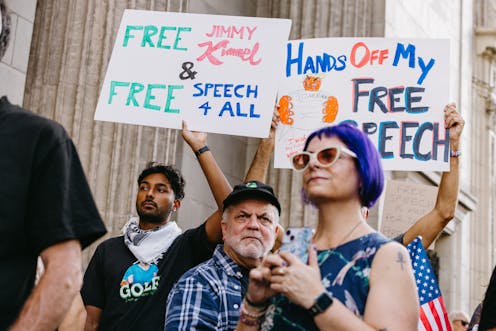
Perhaps the most notable reaction to remarks seen as controversial about the Kirk killing hit ABC comedian Jimmy Kimmel. His network suspended him indefinitely after comments that he made about the alleged shooter in Kirk’s death.
Countless defenders of Kimmel quickly responded to his indefinite suspension as an attack on the First Amendment. MSNBC host Chris Hayes posted the following on X: “This is the most straightforward attack on free speech from state actors I’ve ever seen in my life and it’s not even close.”
But is it?
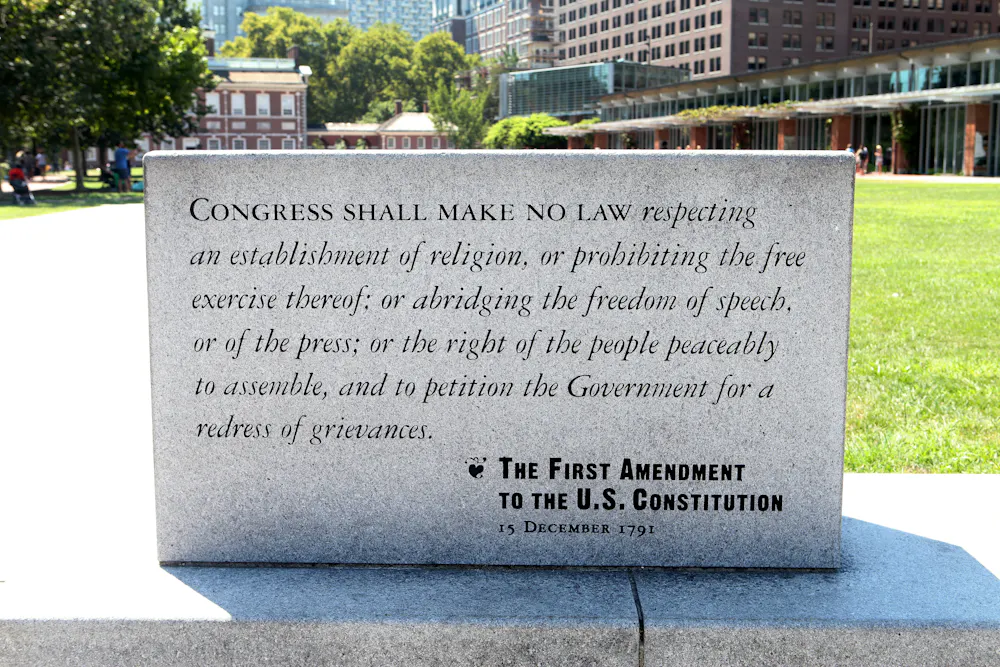
The First Amendment limits government officials from infringing one’s right to free speech and expression.
For example, the government cannot force someone to recite the Pledge of Allegiance or salute the American flag, because the First Amendment, as one Supreme Court justice wrote, “includes both the right to speak freely and the right to refrain from speaking at all.”
And government cannot limit speech that it finds disagreeable while permitting other speech that it favors.
However, the First Amendment does not apply to private employers. With the exception of the 13th Amendment, which generally prohibits slavery, the Constitution applies only to government and those acting on its behalf.
So, as a general rule, employers are free to discipline employees for their speech – even the employees’ speech outside of the workplace. In this way, U.S. Sen. Lindsey Graham correctly said on X, “Free speech doesn’t prevent you from being fired if you’re stupid and have poor judgment.”
This is why Amy Cooper’s employer, an investment firm, was free to terminate her following her 2020 verbal dispute in New York’s Central Park with a bird-watcher over her unleashed dog. She called the police, falsely claiming that the bird-watcher, a Black man, was threatening her life. The incident, captured on video, went viral and Cooper was fired, with her employer saying, “We do not condone racism of any kind.”
This is also why ABC was able to fire Roseanne Barr from the revival of her show, “Roseanne,” after she posted a tweet about Valerie Jarrett, a Black woman who had been a top aide to President Obama, that many viewed as racist.
But as a scholar of constitutional law, I believe Kimmel’s situation is not as straightforward.
Neither Cooper’s employer nor Barr’s employer faced any government pressure to terminate them.
Kimmel’s indefinite suspension followed a vague threat from the chairman of the Federal Communications Commission, Brendan Carr. As complaints about Kimmel’s statement exploded in conservative media, Carr suggested in a podcast interview that Kimmel’s statements could lead to the FCC revoking ABC affiliate stations’ licenses.
“We can do this the easy way or the hard way,” Carr said.
But the Supreme Court has been crystal clear. Government officials cannot attempt to coerce private parties in order to punish or suppress views that the government disfavors.
In a 2024 case, National Rifle Association v. Vullo, a unanimous Supreme Court plainly said that the government’s threat of invoking legal sanctions and other coercion to suppress speech it doesn’t like violates the First Amendment. That principle is so profound and fundamental that it got support from every member of an often bitterly divided court.
A threat to revoke broadcast licenses would almost certainly be seen in a court of law as a government action tantamount to coercion. And Carr’s public comments undoubtedly connect that threat to Kimmel’s disfavored comments.
If the FCC had indeed moved to strip ABC affiliates of their licenses to broadcast because of what Kimmel said, ABC and its parent company, Disney, could have sued the FCC to block the license revocations on First Amendment grounds, citing the NRA v. Vullo case.
But the network seemingly caved to the coercive threat instead of fighting for Kimmel. This is why so many are decrying the Kimmel suspension as an attack on free speech and the First Amendment – even though they might not fully understand the law they’re citing.

Wayne Unger does not work for, consult, own shares in or receive funding from any company or organization that would benefit from this article, and has disclosed no relevant affiliations beyond their academic appointment.
Politics + Society – The Conversation

Reading Time: 3 minutes
Lil Tay had open heart surgery and a lengthy recovery, all before turning 18.
That is a far reach from the viral death hoax that targeted her just a couple of years ago.
The singer, social media star, and self-reported OnlyFans success is alive and well.
However, the brand-new adult is revealing the shocking and unexpected major surgery that she underwent.
In August of 2023, Lil Tay was already an internet sensation with millions of followers.
At that time, her Instagram account stunned those fans with a declaration that she and her brother, Jason, had died.
There were no legal or medical records of any such deaths. No one in her family seemed to have any public comment.
Fortunately, the news was untrue. And, unlike so many public figure death hoaxes, Lil Tay herself was not the culprit.
Lil Tay showcasing her guitar skills with a rendition of Lana Del Rey’s “Florida Kilos.” pic.twitter.com/sG828zUP1h
— Lil Tay Access (@LilTayAccess) October 15, 2023
Speaking to People in a new interview, Lil Tay recalled: “I woke up to my phone being blasted with calls and texts. My mom was being spammed. Everybody was worried. I was like, ‘What the hell’s going on?’”
She expressed: “It was really surreal and weird, and also there was a lot of people posting tributes to me, which is weird in itself.”
Lil Tay said that there was “malicious intent” behind the hoax, and assigned blame to her estranged father.
He denies the accusation.
One year ago, in September of 2024, the singer and (now) OnlyFans star again vanished from the public eye. This time, she explains, it was not a hoax.
Lil Tay shared that she underwent open-heart surgery. Doctors apparently stopped her heart for 70 minutes during the procedure.
“I was getting irregular heartbeats, heart palpitations for a while,” she explained.
“But it really wasn’t that long of a time period that I knew about this.”
“And I definitely did not know that I was going to need heart surgery to remove a f–king tumor,” Lil Tay expressed.
Fortunately, she shared, she is doing much better now.
“I bounced back way quicker because I’m young, active, and healthy,” Lil Tay explained.
“But it was hard because I couldn’t dance for a long time. But I’m still standing, I’m here.”
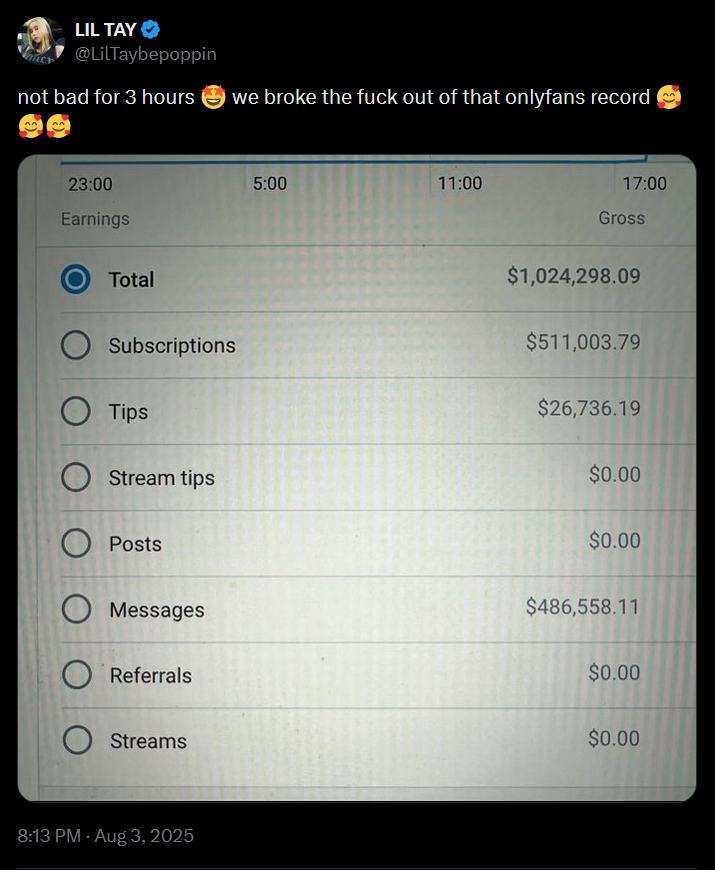
Just a month into her OnlyFans stardom, Lil Tay claims to have raked in millions. She has even used her purported wealth in her feud against Danielle “Bhad Bhabie” Bregoli.
Some have questioned whether or not the numbers that she’s reporting are accurate.
While we’re certainly not accusing the singer of anything, there have been instances of people announcing major subscription numbers to drive up interest. (It often works!)
We hope that Lil Tay continues to be a success. If you didn’t pick up on the subtext of the death hoax and who she’s blaming, there’s a lot of painful backstory. We wish her well.
Lil Tay Reveals Open Heart Surgery that Followed ‘Malicious’ Death Hoax was originally published on The Hollywood Gossip.
The Hollywood Gossip

Reading Time: 3 minutes
Chrissy Teigen is an Ozempic girlie.
At least, she was. She appears to no longer be taking the semaglutide.
The model and cookbook author was not necessarily on people’s radar for this divisive medication. A few body-shaming internet bullies, however, were ahead of the curve.
Teigen’s explaining why she took Ozempic, and even sharing how the weight loss helped her mental health during a time of trauma.
On the Thursday, September 18 episode of Chrissy Teigen’s Self-Conscious podcast, she opened up about using controversial semaglutide Ozempic.
She shared that she took what is normally a diabetes medication “for a year or so” after experiencing a stillbirth.
In September 2020, almost exactly 5 years ago, she and husband John Legend suffered this tragic loss.
According to Teigen, she “noticed no results for three, four months” but was then “finally able to” lose her pregnancy weight.
She shared how the weight loss helped her crawl out of “this deep depression of seeing this pregnant belly with no baby in it.”
Teigen also joked about having “Ozempic blindness.”
Not one of the documented cases of people losing their eyesight while taking semaglutide shots, but of simply having a skewed self-image.

“You end up losing such an incredible amount of weight you don’t realize you’ve lost too much,” Chrissy Teigen described of her Ozempic experience.
That, of course, can be dangerous. Just because your body feels full doesn’t mean that it gets enough nutrients.
Not getting enough nutrients is how these drugs cause you to lose weight.
Teigen admitted that taking the shots felt “frustrating” and “almost torturous.”
“Not being hungry at all, for me, I f–king hate that,” Teigen then expressed. “I love being hungry.”
The cookbook author and social media influencer added:
“I love eating food. I love desiring food.”
Teigen shared that it took a while to find the “right dosage” and for her to “even get feelings of hunger.” That does not sound particularly healthy.

“I would take the shot. It would be three days of forcing myself to eat food. [Then] it would wear off a bit. Day four, day five, more food. Day six, the shot again,” Chrissy Teigen detailed.
“I felt bad about it because it’s not bad to be hungry,” she correctly affirmed.
But she had been on “such a bad path in the way [she] thought about good food” and the shots helped her unlearn some “insane” diet “rules.”
Notably, Teigen did not opt to share when she stopped using Ozempic.
She also did not share why.
Chrissy Teigen Admits to Ozempic Use, Says It Helped Her Out of ‘Deep … was originally published on The Hollywood Gossip.
The Hollywood Gossip
Reading Time: 3 minutes
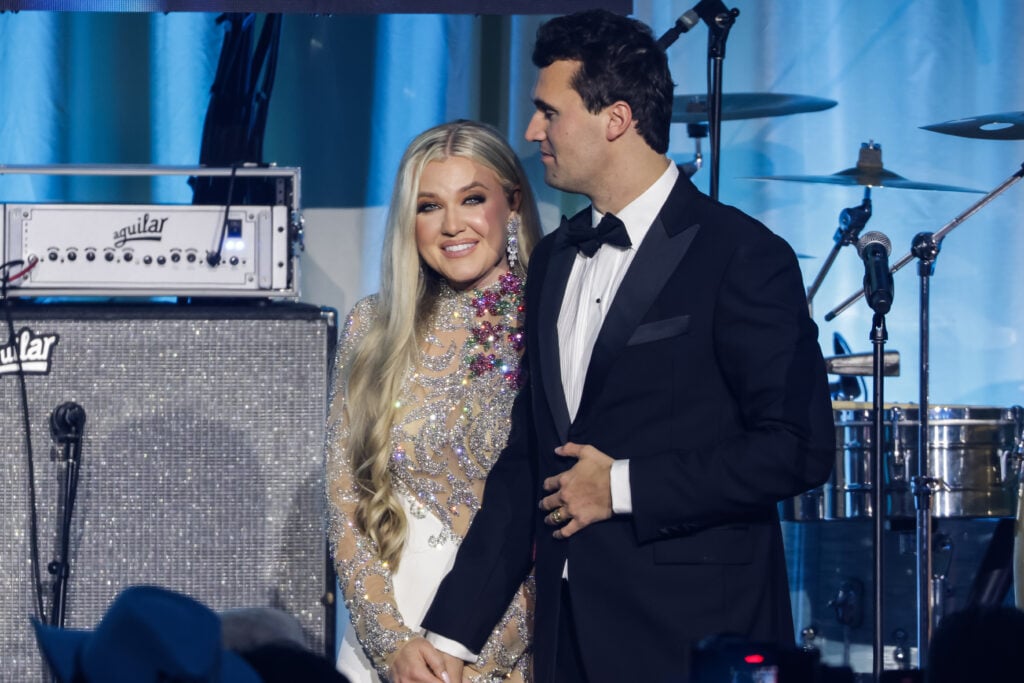
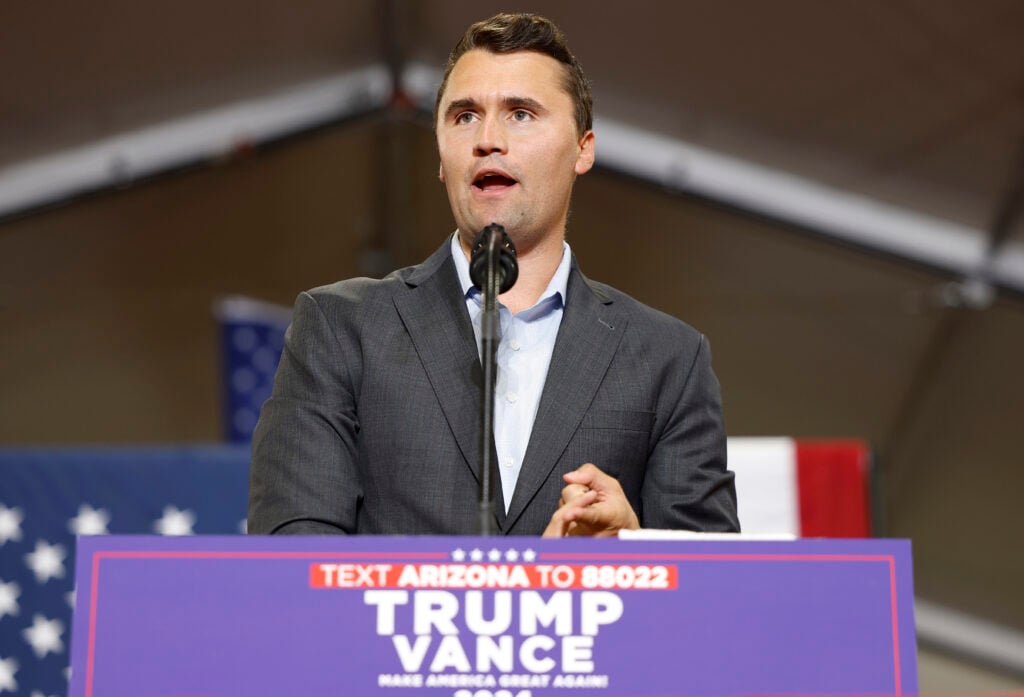
Shortly after Charlie Kirk was shot and killed during a speaking engagement at a Utah university, his widow, Erika Kirk, vowed to carry on his mission.
Now, the mother of two has taken a major step toward that goal by assuming leadership of Kirk’s Turning Point USA organization.
The move comes amid a growing battle over Kirk’s legacy and an increasingly tense debate over the proper way to discuss his controversial views.
“We will not surrender or kneel before evil,” Turning Point board members said in a statement Thursday (via CNN). “We will carry on.”
A former Miss Arizona and college basketball player with a degree in political science, Erika has worked as a podcast host and ministry leader in recent years.
She and Charlie met and got engaged in 2020. They married the following year and welcomed two children.
Erika memorably spoke out last week, just two days after her husband was killed.
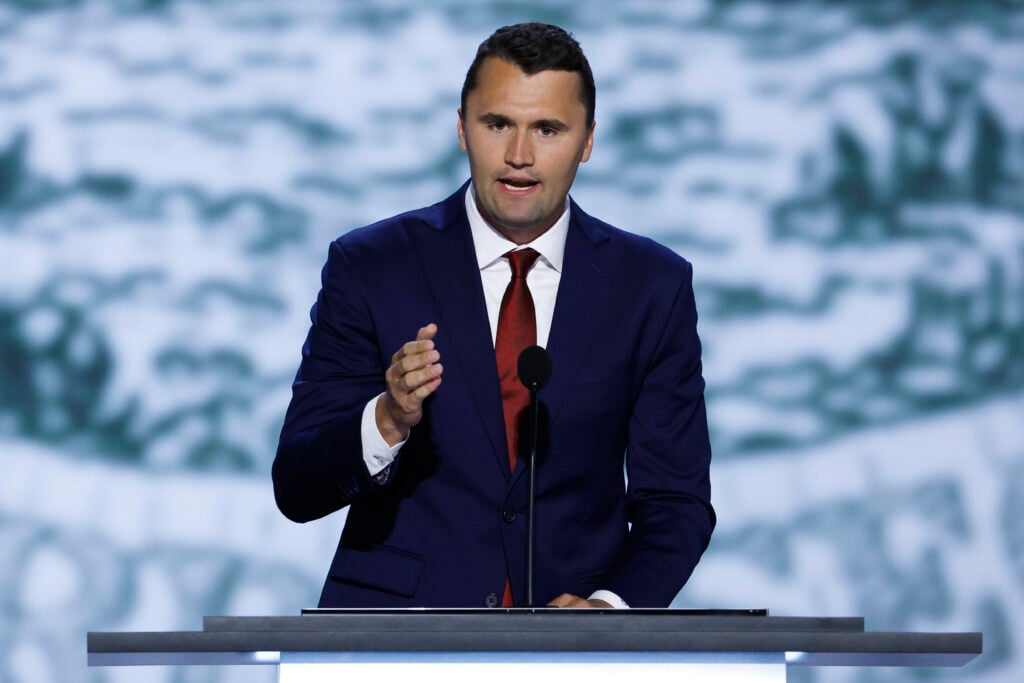
“To everyone listening tonight across America, the movement my husband built will not die,” Kirk said on Sept. 12.
“My husband’s mission will not end, not even for a moment,” she added, before vowing to continue the American Comeback Tour of college campuses.
Erika’s views present a stark contrast to those presented moments ago by Rep. Alezanda Ocasion Cortez.
“His rhetoric and beliefs were ignorant, uneducated, and sought to disenfranchise millions of Americans,” Cortez said on the House floor today while opposing a resolution “honoring the life and legacy” of Charlie Kirk.
News of Erika’s appointment as CEO comes at the end of a tense week in the worlds of media and politics.
On Wednesday, late night host Jimmy Kimmel was suspended by ABC after FCC Chairman Brendan Carr publicly pressured the network and its affiliate owners to muzzle the comedian.
The move has been widely criticized, but thus far, ABC has not announced any intention to bring Kimmel back to the air.
For some, the move is the most glaring example yet of the Trump administration capitalizing on the grief and outrage surrounding Kirk’s death in order to silence critics and amass power.
But supporters of the move maintain that Kimmel’s joke about Trump’s reaction to the shooting amounted to a pernicious lie, and the government acted in the people’s best interest in having the comic taken off the airwaves.
Whatever your stance, the past week confirmed that the cultural tensions of the past ten years will not be resolved anytime soon.
Erika Kirk Named CEO of Charlie Kirk’s Turning Point USA Amid Growing Culture War was originally published on The Hollywood Gossip.
The Hollywood Gossip