Categories
Politics

Commuters have bemoaned Philly’s public transit for decades − in 1967, a librarian got the city to listen

A SEPTA train moves along the Market-Frankford Line in West Philadelphia. AP Photo/Matt Rourke

On April 13, 1967, around 1:30 p.m., Lt. Joseph Larkin of the Philadelphia Police Department’s subway unit visited the Philadelphia High School for Girls to interview the school’s librarian, 61-year-old Miriam S. Axelrod.

Axelrod had written a letter to Mayor James H.J. Tate about poor conditions on Philadelphia’s Broad Street Line subway. In her letter, she stated that the escalators in the subway concourse of the Walnut-Locust station were out of operation for several weeks and requested that they “be put in running order.”

Axelrod also asked that “something be done” about people using the subway stairs “as a latrine.”

As a historian of post-1968 Philadelphia, a proud alumna of Girls’ High and a rider of Philadelphia’s mass transit, Southeastern Pennsylvania Transportation Authority – more commonly known as SEPTA – I was thrilled to find Axelrod’s story among 1960s administrative reports to the police commissioner in the city archives.

Axelrod’s story reminds us that for nearly a century, Philadelphia’s mass transit has been plagued by poor conditions and unstable funding. Commuters’ complaints have often convinced government officials to act. However, no effective plan has ever been implemented to definitively solve the city’s transit crises.

SEPTA’s current turmoil

On Sept. 15, 2025, SEPTA fully restored its service, by court order, after implementing 20% service reductions and a 21.5% fare increase due to a US$213 million budget deficit.

Service cuts began on Aug. 24, just one day before public school students returned to classrooms. This left kids, seniors and people from nonwhite, working-class communities with few alternative routes. Riders faced lengthy travel times or were even stranded on their daily commute.

Passengers board a red, white and blue city bus
Passengers at Olney Transportation Center in North Philadelphia board a SEPTA bus on Aug. 25, 2025, a day after major service cuts went into effect.
AP Photo/Matt Rourke

Over 600,000 people travel on SEPTA’s 172 routes each day. For weeks, state legislators could not agree on how to fund SEPTA within the state budget. City officials, transit executives and tourism experts advocated for a bailout because Pennsylvania will reap tax revenue when Philly hosts millions of tourists in 2026 for America’s 250th birthday, the FIFA World Cup and the Major League Baseball All-Star Game.

Ultimately, Gov. Josh Shapiro authorized the use of the Pennsylvania Department of Transportation’s capital funds to finance SEPTA’s operations through June 2027.

Some lawmakers have argued that SEPTA is guilty of mismanaging funds, since the agency already received over $1 billion in state subsidies last year for operating assistance and asset improvement.

Public transport in the 1920s

As a longtime Philadelphian who lived in Center City, Miriam Axelrod was familiar with the strengths and shortcomings of public transportation.

At the age of 4, her family emigrated from Russia to Carmel, New Jersey. By 1920, they made Philadelphia their home just as the city’s Russian community became the largest immigrant group due to Jewish people escaping pogroms in Europe. Axelrod grew up living in South and North Philadelphia.

At that time, dozens of private transit companies operated in Philly.

Southern Penn operated city buses. Red Arrow provided suburban trolley service. Pennsylvania and Reading railroads offered high-speed rail lines. The Philadelphia Rapid Transit Co. alone brokered deals with 64 underlying companies to annually rent their services under 999-year leases. Fiscal responsibility for quality transportation was complicated and often dependent on public funding.

During PRT’s early years, it paid the city $15,000 annually for snow removal. In return, the city spent $2 million for street paving and bridge repairs.

By 1922, the PRT and the city had built and unified two elevated train routes – with assistance from the Union Traction Co. and the Market Street Elevated Passenger Railway Co. – to create the Market-Frankford Elevated Train Line.

A page from a high school yearbook with photos of three young women
Classmates at William Penn remembered Miriam Axelrod’s ‘remarkable capacity for starting arguments.’
Ancestry.com, U.S. School Yearbooks, 1900-2016

That was the same year Axelrod graduated from William Penn High School for Girls. Her classmates keenly noted in their yearbook that she had a “remarkable capacity for starting arguments” in which “any debatable subject will do.”

Six years later, the first segment of the Broad Street Subway traveling from Olney Station in North Philadelphia to City Hall opened to the public. Unlike the bus, trolley and railways systems, the city owned the El, short for elevated, line and subway. The city leased both systems to PRT and made the transit company responsible for their maintenance.
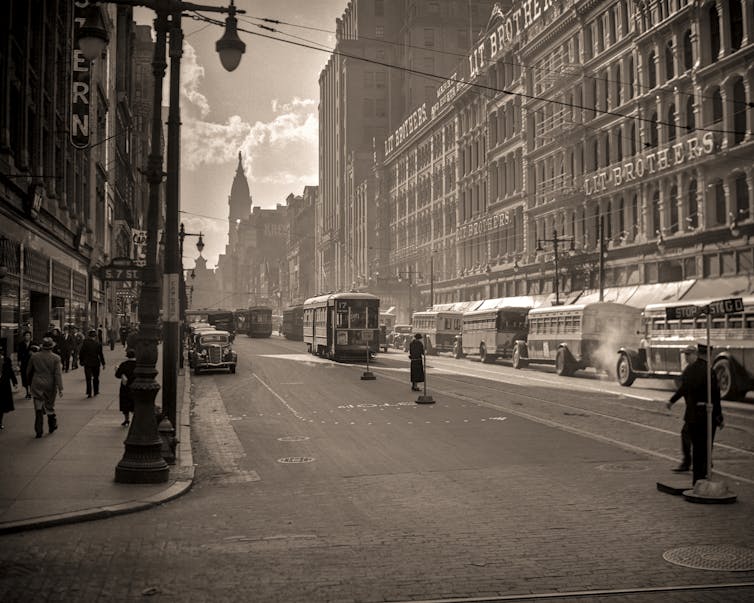
Sepia-toned photo of busy street in a commercial area of a city circa 1930s
Buses and trolley cars drive down Market Street in Philadelphia in the 1930s.
Charles Phelps Cushing/ClassicStock via Getty Images

The Depression years

Philadelphia first witnessed underfunded mass transit during the Great Depression.

In 1934, PRT faced a budget deficit when it was unable to pay the $7.1 million annual rentals to the underliers. PRT later went to court to request a consolidation plan. To make matters worse, PRT had spent approximately $230 million from 1902 through 1939, but that didn’t include spending to modernize old transit equipment.

On Jan. 1, 1940, the Philadelphia Transportation Co., a private company with a 21-member board of directors that included five city representatives including the mayor, Robert E. Lamberton, merged the transit companies and took over PRT’s operations. PTC became responsible for 10,000 employees and providing transportation for 2 million passengers a day.

PTC also acquired extensive financial responsibilities. Payroll expenses cost $327,000 each week. The annual rate for leasing the subway and El was roughly $3 million. PTC had to provide its 25,000 bondholders an annual income of at least $959,207 while also fulfilling its promise to offer modern transit vehicles.

Overcrowding and frequent fare increases

During the 1940s through the 1960s, Axelrod took public transportation to her job as a librarian at Central High School and later Frankford High School.

Meanwhile, PTC made good on its promise to provide better transit service. In its first eight years of operation, PTC spent $22.8 million to purchase 1,506 new streetcars, buses and trackless trolleys while also improving terminal and plant facilities. The company even purchased advertisements in The Philadelphia Inquirer to highlight its achievements. PTC extended 38 existing routes and created 18 new routes that serviced old residential and industrial areas, along with newly developed neighborhoods.

By 1949, however, many of PTC’s 3.2 million daily riders were complaining about overcrowded subways, the end of free exchanges between popular routes and frequent fare increases.
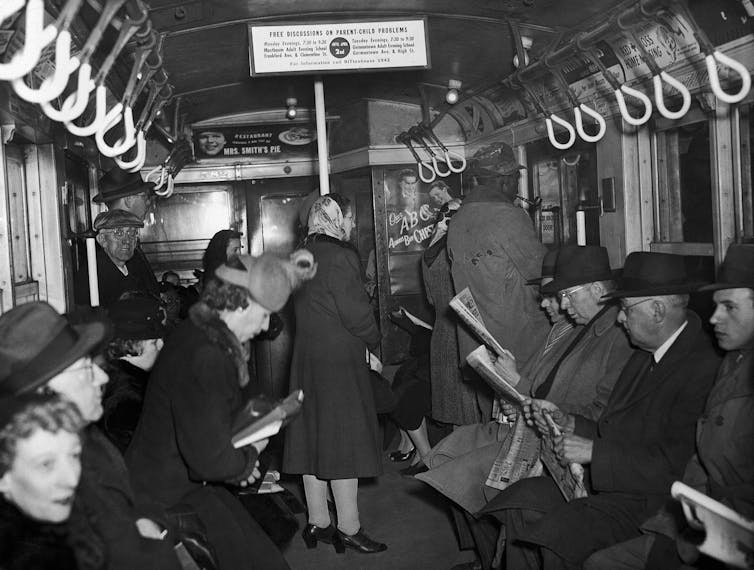
Black and white photo of men and women, some reading newspapers, in a subway car
Passengers ride a subway car in Philadelphia on Feb. 15, 1946.
AP Photo

Both PTC and the city faced scrutiny for these issues, although each party had distinct transit obligations outlined in their joint contract. PTC had to provide “safe and adequate service” that included spending on maintenance and replacement of transit equipment. The city was responsible for police and fire services on mass transit along with auditing PTC’s records. Both parties had to agree on fare changes under the state Public Utility Commission’s supervision.

Nevertheless, when issues on mass transit occurred, the city could persuade PTC to improve conditions, but the city was only required to offer emergency services to commuters.

When Larkin personally addressed Axelrod’s 1967 complaint about the subway, he informed her that the United Elevator Co. was repairing the escalators. He also assured her that the subway unit arrested 45 to 50 intoxicated people each month because they were at risk of falling onto the subway tracks. In “isolated cases,” Larkin explained, police arrested people for public urination and defecation.

Larkin reassured Axelrod that PTC could keep subway conditions clean and under control. In reality, PTC was underwater in responsibilities and debt.

On Sept. 30, 1968, SEPTA, a state agency formed five years earlier, took over PTC and managed transportation for the city and its surrounding areas. SEPTA bought PTC for approximately $47.9 million, settling the company’s debt, accepting its pension liability and buying out the institution’s roughly 1.7 million shareholders. Now federal and state funding rather than fare revenue largely determined the quality of the city’s public transit.

Decades of unpredictable funding

Since the 1960s, annual government funding to SEPTA has been unpredictable. White flight, deindustrialization and job flight have contributed to depopulation, a declining tax base and government defunding of social programs in Philadelphia. These socioeconomic shifts continue to affect Philadelphia’s budget for education, public housing and recreation as well as SEPTA’s $2.743 billion budget as a public transit agency.

Five counties in Greater Philadelphia contribute subsidies to SEPTA in exchange for transit service. Philadelphia alone contributes $110 million. State subsidies also help finance SEPTA’s $1.74 billion operating budget, while federal subsidies support SEPTA’s $1 billion capital budget to pay for major repairs and new equipment. State politicians annually vote on funding for SEPTA, but there has not been a concrete solution to the funding crisis.

For years, politicians have proposed using county sales and gas taxes along with business licensing fees to fund mass transit, without success. Additionally, since 2008 rising rates of car ownership have also led to fewer commuters and reduced fare revenues for SEPTA.

However, Philadelphians never ceased to demand better transit service. During the 1980s, the Pennsylvania Public Interest Coalition established the Transit Riders Action Campaign, also known as TRAC, which advocated that SEPTA have better safety, funding, accountability, service and stable fares. The Transport Workers Union Local 234 advised TRAC, while several organizations partnered with them: the Action Alliance of Senior Citizens, the Clean Air Council, Disabled in Action and the Delaware Valley Interfaith Coalition.

Even today, local groups such as Save the Train with outspoken commuters – like Axelrod was in her day – have launched campaigns to halt service cutbacks and encourage residents to write and telephone legislators who can vote to fund SEPTA. Residents have consistently united to advocate for quality mass transit. All that remains is an agreement among lawmakers to make it possible.

Read more of our stories about Philadelphia and Pennsylvania, or sign up for our Philadelphia newsletter on Substack.

The Conversation

Menika Dirkson does not work for, consult, own shares in or receive funding from any company or organization that would benefit from this article, and has disclosed no relevant affiliations beyond their academic appointment.

​Politics + Society – The Conversation

Categories
Politics

Shutdowns are as American as apple pie − in the UK and elsewhere, they just aren’t baked into the process

The obligatory showing of the red briefcase containing budget details is as exciting as it gets in the U.K. Justin Tallis – WPA Pool/Getty Images

When it comes to shutdowns, the U.S. is very much an exception rather than the rule.

On Oct. 1, 2025, hundreds of thousands of federal employees were furloughed as the business of government ground to a halt. With negotiations in Congress seemingly deadlocked over a funding deal, many political watchers are predicting a lengthy period of government closure.

According to the nonpartisan nonprofit Committee for a Responsible Federal Budget, the latest shutdown represents the 20th such funding gap since 1976.

But it doesn’t have to be like this – and in most countries, it isn’t. Other Western democracies experience polarization and political turmoil, too, yet do not experience this problem. Take for example the U.K., traditionally one of Washington’s closest allies and home to the “mother of parliaments.”

In the British system, government shutdowns just don’t happen – in fact, there has never been one and likely never will be.

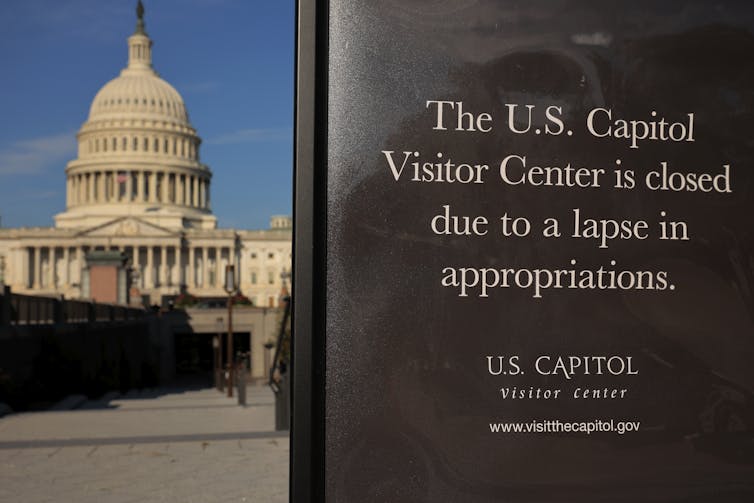
A sign reads 'The US Capitol Visitors Center is closed due to a lapse in appropriations.'
The U.S. Capitol Visitors Center is closed to visitors during the federal government shutdown on Oct. 01, 2025.
Chip Somodevilla/Getty Images

So why do they occur in Washington but not London? Essentially, it comes down to four factors: the relative power of the legislature; how easy it is to pass a budget; the political stakes at play; and distinctive appropriation rules.

1. Legislative power

There are significant differences in how the legislatures of the U.K. and U.S. shape the budgetary process.

In the U.K., only the executive branch – the party or coalition in power – has the authority to propose spending plans. Parliament, which consists of members from all political parties, maintains an oversight and approval role, but it has very limited power over the budgetary timeline or to amend spending plans. This is a stark contrast with the U.S., where Congress – which may be split or controlled by a party different to the executive – plays a far more consequential role.

The U.S. president starts the budget process by laying out the administration’s funding priorities. Yet, the Constitution grants Congress the power of the purse – that is, the power to tax and spend.

Moreover, past legislation has bolstered congressional control. The 1974 Congressional Budget Act helped curtail presidential involvement in the budgeting process, giving Congress more authority over the timeline. That gave Congress more power but also offered it more opportunities to bicker and derail the budgetary process.

2. Thresholds to pass a budget

Congress and the U.K. Parliament also differ when it comes to their voting rules. Passing the U.S. budget is inherently more complicated, as it requires the support of both the Senate and the House of Representatives.

In Parliament, however, the two houses – the elected House of Commons and unelected House of Lords – are not equally involved. The two Parliament Acts of 1911 and 1949 limited the power of the House of Lords, preventing it from amending or blocking laws relating to budgeting.

Additionally, approving the budget in Westminster requires only an absolute majority of votes in the House of Commons. That tends to be quite a straightforward hurdle to overcome in the U.K. The party in power will typically also command a majority of votes in the chamber or be able to muster one up with the support of smaller parties. It is not, however, so easy in Congress. While a simple majority suffices in the House of Representatives, the Senate still has a 60-vote requirement to close debates before proceeding with a majority vote to pass a bill.

3. Political stakes

U.S. and U.K. politicians do not face the same high stakes over budget approval. Members of Congress may eventually pay a political price for how they vote on the budget, but there is no immediate threat to their jobs. That is not so in the U.K.

Indeed, the party or coalition in power in the U.K. must maintain the “confidence” of the House of Commons to stay in office. In other words, they need to command the support of the majority for key votes. U.K. governments can actually fall – be forced to resign or call for new elections – if they lose formal votes of confidence. Since confidence is also implied in other major votes, such as over the annual budget proposals, this raises the stakes for members of Parliament. They have tended to think twice before voting against a budget, for fear of triggering a dissolution of Parliament and new elections.

4. Distinctive appropriation rules

Finally, rules about appropriation also set the U.S. apart. For many decades, federal agencies could still operate despite funding bills not being passed. That, however, changed with a ruling by then-Attorney General Benjamin Civiletti in 1980. He determined that it would be illegal for governments to spend money without congressional approval.

That decision has had the effect of making shutdowns more severe. But it is not a problem that the U.K. experiences because of its distinct rules on appropriation. So-called “votes on account” allow the U.K. government “to obtain an advance on the money they need for the next financial year.”

This is an updated version of an article that was first published by The Conversation U.S. on Sept. 28, 2023.

The Conversation

Garret Martin receives funding from the European Union for the Transatlantic Policy Center, which he co-directs.

​Politics + Society – The Conversation
Categories
Politics

Where George Washington would disagree with Pete Hegseth about fitness for command and what makes a warrior

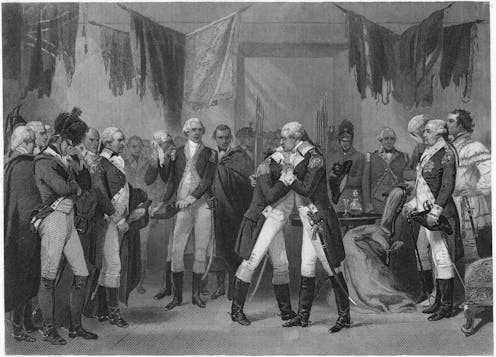
On Dec. 4, 1783, after six years fighting against the British as head of the Continental Army, George Washington said farewell to his officers and returned to civilian life. Engraving by T. Phillibrown from a painting by Alonzo Chappell

As he paced across a stage at a military base in Quantico, Virginia, on Sept. 30, 2025, Secretary of Defense Pete Hegseth told the hundreds of U.S. generals and admirals he had summoned from around the world that he aimed to reshape the military’s culture.

Ten new directives, he said, would strip away what he called “woke garbage” and restore what he termed a “warrior ethos.”

The phrase “warrior ethos” – a mix of combativeness, toughness and dominance – has become central to Hegseth’s political identity. In his 2024 book “The War on Warriors,” he insisted that the inclusion of women in combat roles had drained that ethos, leaving the U.S. military less lethal.

In his address, Hegseth outlined what he sees as the qualities and virtues the American soldier – and especially senior officers – should embody.

On physical fitness and appearance, he was blunt: “It’s completely unacceptable to see fat generals and admirals in the halls of the Pentagon and leading commands around the country and the world.”

He then turned from body shape to grooming: “No more beardos,” Hegseth declared. “The era of rampant and ridiculous shaving profiles is done.”

As a historian of George Washington, I can say that the commander in chief of the Continental Army, the nation’s first military leader, would have agreed with some of Secretary Hegseth’s directives – but only some.

Washington’s overall vision of a military leader could not be further from Hegseth’s vision of the tough warrior.

A man in front of a US flag, looking like he is shouting and holding out his fists.
U.S. Secretary of Defense Pete Hegseth speaks to senior military leaders at Marine Corps Base Quantico on Sept. 30, 2025.
Andrew Harnik/Getty Images

280 pounds – and trusted

For starters, Washington would have found the concern with “fat generals” irrelevant. Some of the most capable officers in the Continental Army were famously overweight.

His trusted chief of artillery, Gen. Henry Knox, weighed around 280 pounds. The French officer Marquis de Chastellux described Knox as “a man of thirty-five, very fat, but very active, and of a gay and amiable character.”

Others were not far behind. Chastellux also described Gen. William Heath as having “a noble and open countenance.” His bald head and “corpulence,” he added, gave him “a striking resemblance to Lord Granby,” the celebrated British hero of the Seven Years’ War. Granby was admired for his courage, generosity and devotion to his men.

Washington never saw girth as disqualifying. He repeatedly entrusted Knox with the most demanding assignments: designing fortifications, commanding artillery and orchestrating the legendary “noble train of artillery” that brought cannon from Fort Ticonderoga to Boston.

When he became president, after the Revolution, Washington appointed Knox the first secretary of war – a sign of enduring confidence in his judgment and integrity.

Beards: Outward appearance reflects inner discipline

As for beards, Washington would have shared Hegseth’s concern – though for very different reasons.

He disliked facial hair on himself and on others, including his soldiers. To Washington, a beard made a man look unkempt and slovenly, masking the higher emotions that civility required.

Beards were not signs of virility but of disorder. In his words, they made a man “unsoldierlike.” Every soldier, he insisted, must appear in public “as decent as his circumstances will permit.” Each was required to have “his beard shaved – hair combed – face washed – and cloaths put on in the best manner in his power.”

For Washington, this was no trivial matter. Outward appearance reflected inner discipline. He believed that a well-ordered body produced a well-ordered mind.

To him, neatness was the visible expression of self-command, the foundation of every other virtue a soldier and leader should possess.

That is why he equated beards and other forms of unkemptness with “indecency.” His lifelong battle was against indecency in all its forms. “Indecency,” he once wrote, was “utterly inconsistent with that delicacy of character, which an officer ought under every circumstance to preserve.”

More statesman than warrior

By “delicacy,” Washington meant modesty, tact and self-awareness – the poise that set genuine leaders apart from individuals governed by passions.

For him, a soldier’s first victory was always over himself.

“A man attentive to his duty,” he wrote, “feels something within him that tells him the first measure is dictated by that prudence which ought to govern all men who commits a trust to another.”

In other words, Washington became a soldier not because he was hotheaded or drawn to the thrill of combat, but because he saw soldiering as the highest exercise of discipline, patience and composure. His “warrior ethos” was moral before it was martial.

Washington’s ideal military leader was more statesman than warrior. He believed that military power must be exercised under moral constraint, within the bounds of public accountability, and always with an eye to preserving liberty rather than winning personal glory.

In his mind, the army was not a caste apart but an instrument of the republic – an arena in which self-command and civic virtue were tested. Later generations would call him the model of the “republican general”: a commander whose authority rested not on bluster or bravado but on composure, prudence and restraint.

That vision was the opposite of the one Pete Hegseth performed at Quantico.

A man on a white horse and in a uniform saluting a long line of soldiers in front of him.
Washington formally taking command of the Continental Army on July 3, 1775, in Cambridge, Mass.
Currier and Ives image, photo by Heritage Art/Heritage Images via Getty Images

Discipline and steadiness, not fury and bravado

The “warrior ethos” Hegseth celebrates – loud, performative – was precisely what Washington believed a soldier must overcome.

In March 1778, after Marquis de Lafayette abandoned an impossible winter expedition to Canada, Washington praised caution over juvenile bravado.

“Every one will applaud your prudence in renouncing a project in which you would vainly have attempted physical impossibilities,” he wrote from the snows of Valley Forge.

For Washington, valor was never the same as recklessness. Success, he believed, depended on foresight, not fury, and certainly not bravado.

The first commander in chief cared little for waistlines or whiskers, in the end; what concerned him was discipline of the mind. What counted was not the cut of a man’s figure but the steadiness of his judgment.

Washington’s own “warrior ethos” was grounded in decency, temperance and the capacity to act with courage without surrendering to rage. That ideal built an army – and in time, a republic.

The Conversation

Maurizio Valsania does not work for, consult, own shares in or receive funding from any company or organization that would benefit from this article, and has disclosed no relevant affiliations beyond their academic appointment.

​Politics + Society – The Conversation

Categories
Politics

Supreme Court to decide if Colorado’s law banning conversion therapy violates free speech

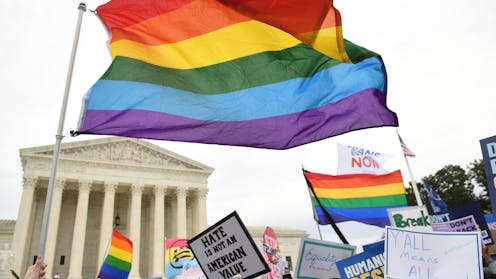
The US Supreme Court will hear oral arguments for yet another case involving the LGBTQ+ community. Saul Loeb/AFP via Getty Images

The constitutionality of a Colorado law that bans so-called “conversion therapy” is scheduled to go before the Supreme Court on Oct. 7, 2025. The question at the center of the case, Chiles v. Salazar, is whether a therapist who uses talk therapy to try to convince minors to change their sexual orientation or gender identity is protected by a First Amendment right to free speech.

Twenty-three other states and the District of Columbia also ban conversion therapy.

People stand behind a table cheering as a white man in a blue suit jacket signs bills into law.
Colorado Gov. Jared Polis is applauded as he signs a law banning the use of conversion therapy on minors.
Aaron Ontiveroz/The Denver Post via Getty Images

I am a legal scholar who has explored aspects of the rights of the LGBTQ+ community, and this case is an important test of the status of the community’s rights and protections at the Supreme Court.

Why it matters

The case has similarities to the court’s 2025 decision in United States v. Skrmetti that upheld state laws banning gender-affirming care for transgender minors, such as the use of puberty-blocking hormones. LGBTQ+ persons viewed those bans as hurting the community, whereas bans like Colorado’s on conversion therapy are viewed as protecting the community.

Technically, the legal issue in Skrmetti was different: The court addressed whether the ban violated the equal protection clause of the 14th Amendment, which prohibits states from discriminating against particular protected classes, such as race or gender, absent a particularly strong state interest. In the Skrmetti decision, the court held there was no discrimination on the basis of sex, which meant the law received no heightened scrutiny.

Instead, the court assessed whether there was a “rational basis” for the law and held that Tennessee had “plausible reasons” for the ban: protecting minors from harms such as sterility and treatments whose long-term effects are unclear. The court upheld the law banning gender-affirming care even though major U.S. medical professional associations oppose such bans and support such care.

The facts of Chiles

In Chiles, the issue is freedom of speech, not equal protection. But this time the Colordo ban on conversion therapy aligns with leading medical associations.

Kaley Chiles is a licensed professional counselor who uses talk therapy in her counseling practice. Chiles identifies as Christian and often works with Christian clients. Chiles “does not try to help minors change their attractions, behavior, or identity, when her minor clients tell her they are not seeking such change.” She would like to use talk therapy with clients “who have same-sex attractions or gender identity confusion and who also prioritize their faith above their feelings” and who “are seeking to live a life consistent with their faith,” according to court filings.

Chiles sued Colorado to invalidate the statute as unconstitutional for violating her freedom of speech and religion under the First Amendment of the U.S. Constitution. Both the federal district court in Colorado and the U.S. Court of Appeals for the 10th Circuit denied her request for a preliminary injunction, rejecting both arguments.

The Supreme Court agreed only to hear her free speech claim, leaving the 10th Circuit’s rejection of her religious liberty claim in place.

Is ‘talk therapy’ speech or conduct?

The Supreme Court first will need to address whether talk therapy is protected speech under the First Amendment. This decision likely will determine the case’s outcome.

Chiles contends that talk therapy is protected speech and that Colorado is impermissibly regulating the content of her potential speech. The law permits her to help minor clients embrace their sexual orientation or gender identity through talk therapy but not to change it. If this therapy is speech, it would be regulating the content of her speech because the law determines what can and cannot be said. Affirming talk therapy is allowed, but conversion therapy is prohibited.

Colorado, however, insists that the statute regulates medical conduct, which is not protected by the First Amendment, even if there is an incidental burden on speech.

A state undisputably can regulate medical activity, such as the prescription of a medicine. If the therapy involved the use of medicines, there would be no dispute because no speech would be involved. The Colorado conversion therapy ban is part of a broader statute, the Mental Health Practice Act, which prohibits acts that could harm patients. Thus, talk therapy, according to Colorado, is treatment – like providing medicine – that the state is free to regulate.

Conversion therapy is also deemed ineffective and harmful to children by leading medical associations, such as the American Psychiatric Association and the American Medical Association. The 10th Circuit noted that the Colorado ban regulates treatment, not expression, because Chiles is free to share her views on conversion therapy, even with minors. She simply cannot engage in actual therapy under the law.

People with protest and support signs stand outside of the U.S. Supreme Court building.
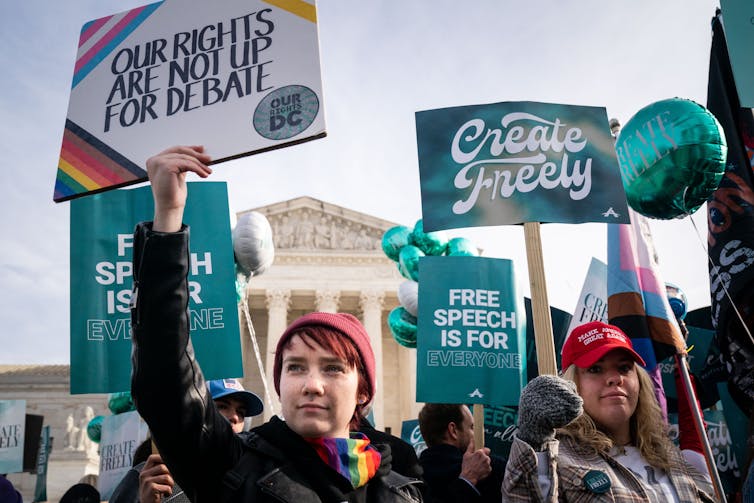
Members of both sides of the debate stand in front of the U.S. Supreme Court on Dec. 5, 2022. The high court heard oral arguments in a case involving the owner of a website design company in Colorado who refused to create websites for same-sex weddings despite a state antidiscrimination law.
Kent Nishimura/Getty Images

The Supreme Court will need to decide whether talk therapy is speech or conduct. The court often takes a broad view of what constitutes speech, particularly in the area of LGBTQ+ rights. In 303 Creative LLC v. Elenis, another case out of Colorado, the court held that creating a wedding webpage was deemed protected speech. This 2023 decision permitted the webpage designer to deny services to same-sex couples requesting webpages for their weddings, in violation of Colorado’s law prohibiting sexual orientation discrimination.

If the court concludes that conversion therapy is conduct, then the Colorado law is subject to the same standard used in Skrmetti – rational basis – and likely will survive. In light of 303 Creative, however, the court may deem it speech.

If talk therapy is speech, can Colorado ban it?

Simply because an act constitutes speech protected by the First Amendment does not mean the state cannot regulate it. For example, the state can rightly regulate defamatory statements or obscene material.

Courts, however, apply an exacting standard of review, known as strict scrutiny, and rarely does a law survive such analysis. Colorado must show that its ban on conversion therapy is narrowly tailored to achieve a compelling state interest. Colorado contends that ensuring minors receive safe and effective mental health care is a compelling interest, and the law is narrowly tailored because “(i)t prohibits only specific harmful treatment while leaving therapists free to engage in any other appropriate therapy.”

Chiles’ strongest argument is that the law is not narrowly tailored for a number of reasons. Chiles contends the law is too broad because it bans more speech than necessary to protect against any harms to LGBTQ+ minors, including any therapy to change behavior, expression, identity or feeling.

For example, she argues she could not counsel a gay client toward celibacy. It is also not properly tailored, Chiles argues, because it exposes minors to the harms of conversion therapy by its omissions: It applies only to licensed mental health professionals and not others, such as life coaches, and it applies only to minors. If conversion therapy is as harmful as Colorado alleges, these gaps show the lack of proper tailoring, says Chiles.

The court has frequently struck down laws that regulate the content of speech. If the court concludes that talk therapy is protected speech, it is likely the court will find the Colorado ban on conversion therapy unconstitutional.

Such a decision would contrast sharply with Skrmetti. If the court strikes down the Colorado law, then a law meant to protect LGBTQ+ minors will be invalidated while one deemed harmful to trans minors will stand.

The court again will have gone against the predominant view of medical experts in a way detrimental to the LGBTQ+ community, potentially adding to criticism of the Supreme Court as being too political.

Read more of our stories about Colorado.

The Conversation

Timothy R. Holbrook does not work for, consult, own shares in or receive funding from any company or organization that would benefit from this article, and has disclosed no relevant affiliations beyond their academic appointment.

​Politics + Society – The Conversation

Categories
Politics

Moral panics intensify social divisions and can lead to political violence

The day before Charlie Kirk was assassinated, I was teaching a college class on science, religion and magic. Our class was comparing the Salem witch trials of the 1690s with the McCarthy hearings of the early 1950s, when U.S. democratic processes were eclipsed by the Red Scare of purported communist infiltration.

The aim of the class was to better understand the concept of moral panics, which are societal epidemics of disproportionate fear of real or perceived threats. Such outsized fear can often lead to violence or repression against certain socially marginalized groups. Moral panics are recurring themes in my research on the anthropology of fear and discrimination.

Our next class meeting would apply the moral panic concept to a recent example of political violence. Tragically, there were many of these examples to choose from.

Minnesota State Representative Melissa Hortman and her husband were assassinated on June 14, 2025, which happened to be the eighth anniversary of the congressional baseball shootings in which U.S. House Majority Whip Steve Scalise and three other Republicans were wounded. These shootings were among at least 15 high-profile instances of political violence since Rep. Gabby Gifford was severely wounded in a 2011 shooting that killed five and wounded another 13 people.

Seven of these violent incidents occurred within the past 12 months. Kirk’s killing became the eighth.

In most of these cases, we may never fully know the perpetrator’s motives. But the larger pattern of political violence tracks with the increasing polarization of American society. While researching this polarization, I have found recurring themes of segregation and both the dehumanization and disproportionate fear of people with opposing views among liberals and conservatives alike.

Segregation and self-censorship

The first ingredient of a moral panic is the segregation of a society into at least two groups with limited contact between them and an unwillingness to learn from one another.

In 17th century Salem, Massachusetts, the social divisions were long-standing. They were largely based on land disputes between family factions and economic tensions between agriculturally-based village communities and commercially-based town communities.

Within these larger groups, a growing number of widowed women had become socially marginalized for becoming economically independent after their husbands died in colonial wars between New England and New France. And rumors of continuing violence led residents in towns and villages to avoid Native Americans and new settlers in surrounding frontier areas. Salem was divided in many ways.

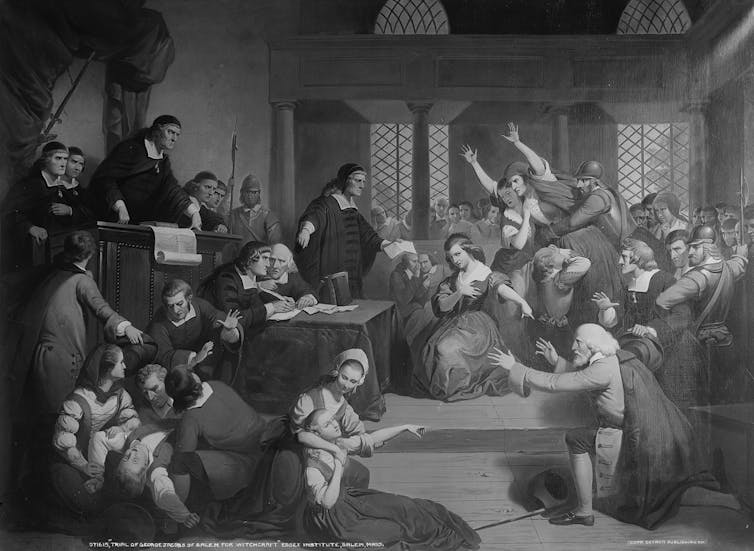
A black-and-white copy of a painting depicts a trial in Salem, Massachusetts, in 1692.
The painting ‘Trial of George Jacobs of Salem for Witchcraft’ by Tompkins Harrison Matteson. Jacobs was one of the few men accused of witchcraft.
Tompkins Harrison Matteson/Library of Congress via AP

Fast forward to the end of World War II. That’s when returning American veterans used their benefits to settle into suburban neighborhoods that would soon be separated by race and class through zoning policies and discriminatory lending practices. This set the stage for what has come to be called The Big Sort, the self-segregation of people into neighborhoods where residents shared the same political and religious ideologies.

It was during the early stages of these sorting processes that the Red Scare and McCarthy hearings emerged.

The Big Sort turned digital in the early 2000s with the rise of online information and social media platforms with algorithms that conform to the particular desires and biases of their user communities.

Consequently, it is now easier than ever for conservatives and liberals to live in separate worlds of their own choosing. Under these conditions, Democrats and Republicans tend to exaggerate the characteristics of the other party based on common stereotypes.

Dehumanization and discrimination

Dehumanization is perhaps the most crucial ingredient of a social panic. This involves labeling people according to categories that deprive them of positive human qualities. This labeling process is often conducted by “moral entrepreneurs” – people invested by their societies with the authority to make such claims in an official, unquestionable and seemingly objective way.

In 1690s Massachusetts, the moral entrepreneurs were religious authorities who labeled people as satanic witches and killed many of them. In 1950s Washington, the moral entrepreneurs were members of Congress and expert witnesses who labeled people Soviet collaborators and ruined many of their lives.

In the 21st century, the moral entrepreneurs include media personalities and social influencers as well as the nonhuman bots and algorithms whose authority is derived by constructing the illusion of broad consensus.

Under these conditions, many U.S. liberals and conservatives regard their counterparts as savage, immature, corrupt or malicious. Not surprisingly, surveys reveal that animosity between conservatives and liberals has been at its highest over the past five years than any other time since the measurements first began in 1978.

Adding to the animosity, dehumanization can also justify discrimination against a rival group. This is shown in social psychology experiments in which conservatives and liberals discriminate against one another to a greater degree than by race when deciding on scholarships and job opportunities. Such discrimination lends credence to further animosity.

Exaggerating fear

There is a fine line between animosity and disproportional fear. The latter can lead to extreme policies and violent actions during a moral panic.

Such fear often takes the form of perceived threats. Rachel Kleinfeld, a scholar who studies polarization and political violence, says that one of the best ways to rally a political base is to make them think they are under attack by the other side. She says that “is why ‘They are out to take your x’ is such a time-honored fundraising and get-out-the-vote message.”

In the past few years, the “x” that could be taken has escalated to core freedoms and personal safety, threats which could easily trigger widespread fear on both sides of the political divide.

But the question remains whether exaggerated fears are sufficient to trigger political violence. Are assassins like Kirk’s killer simply pathological outliers among agitated but otherwise self-restrained populations? Or are they sensitive indicators of a looming social catastrophe?

A black-and-white photo shows two men dressed in suits sitting in front of a desk.
The House Committee on Un-American Activities investigates movie producer Jack Warner, right, in Washington on Oct. 20, 1947.
AP Photo

Countering the panic

We do not have the answers to that question yet. But in the interim, there are efforts in higher education to reduce animosity and encourage constructive interactions and discussion between people with different perspectives.

A nonpartisan coalition of faculty, students and staff – known as the Heterodox Academy – is promoting viewpoint diversity and constructive debates on over 1,800 campuses. The college where I teach has participated in the Congress to Campus program, promoting bipartisan dialogue by having former legislators from different parties engage in constructive debates with one another about timely political issues. These debates serve as models for constructive dialogue.

It was in the spirit of constructive dialogue that my class debated whether the Kirk assassination could be explained as the product of a moral panic. Many agreed that it could, and most agreed it was probably an assault on free speech despite having strong objections to Kirk’s views. The debate was passionate, but everyone was respectful and listened to one another. No witches were to be found in the class that day.

The Conversation

Ron Barrett does not work for, consult, own shares in or receive funding from any company or organization that would benefit from this article, and has disclosed no relevant affiliations beyond their academic appointment.

​Politics + Society – The Conversation

Categories
Politics

Supreme Court opens with cases on voting rights, tariffs, gender identity and campaign finance to test the limits of a constitutional revolution

The U.S. Supreme Court building at dawn in Washington, D.C. Samuel Corum/Bloomberg via Getty Images

The most influential cases before the U.S. Supreme Court this term, which begins on Oct. 6, 2025, reflect the cultural and partisan clashes of American politics.

The major cases in October and November address the role of race in elections, conversion therapy and the Trump tariffs. Later cases include campaign finance and transgender sports.

This year’s controversies focus on three dominant themes. One is the continuing constitutional revolution in how the justices read our basic law. The court has shifted from a living reading of the Constitution, which says the Constitution should adapt to the American people’s evolving values and the needs of contemporary society, to an original reading, which aims to enforce the constitutional principles understood by the Americans who ratified them.

Another clear theme is the deep cultural division among Americans. The core disputes at the court this year reflect controversial factual questions about gender and race: How pervasive and influential is racism in the current day? Are gender transitions a recognized fact, which means that they must be accepted in sports competitions, or can a state assert that trans athletes are not women?

A final theme is the struggle for partisan advantage embedded in several cases.

A portion of the U.S. Constitution, torn into blue and red pieces.
The justices’ constitutional interpretations could have major partisan significance.
Douglas Rissing, iStock/Getty Images Plus

Constitutional revolution

Until just a few years ago, the majority of justices would have agreed that the proper way to read the Constitution was as an evolving document, an approach usually described as living constitutionalism.

The new majority reads the Constitution as an expression of enduring principles, which maintain their historical meaning unless the American people collectively decide to amend the document, an approach known as originalism.

Since 2022, this revolutionary shift has led to dramatic changes in the law on abortion, religion, guns, affirmative action and the power of federal agencies to regulate in areas such as the environment, public health or student debt.

This year, the constitutional revolution – “a historic constitutional course correction.” as legal scholars Gary Jeffrey Jacobsohn and Yaniv Roznai put it – turns to transgender politics.

Little v. Hecox and West Virginia v. B.P.J. ask whether a state can ban transgender athletes from participating in girls or women’s sports. The plaintiffs are middle school and university students who were banned by state laws from participating as a female competitor. They are asking the court to rule that transgender identity is a protected category similar to race and gender under the equal protection clause of the 14th Amendment.

Originalists argue that the meaning of the 14th Amendment is clear and fixed. It establishes the equal status of racial minorities as holders of rights. But originalists do not believe the equal protection clause was meant to apply to sexual identities unless that is explicitly approved through a constitutional amendment by the American public.

Originalists also emphasize the role of federalism as a core constitutional principle. Federalism allocates a great deal of authority to state legislatures to make decisions when a question of rights is uncertain.

For these reasons the court majority is likely to see the regulation of who gets to participate in women’s sports as a state-by-state decision.

Cultural divisions, disputed perceptions

The status of transgender identity also reflects the disputed perceptions of reality that have come to dominate American politics. In essence, the Iowa and West Virginia sports cases ask the court to rule whether a transgender girl – a person assigned male at birth who has transitioned to align with their identity as a girl or woman, as the AP Stylebook phrases it – is a girl or a boy.

The court is likely to leave such questions about what is factually true for state legislatures to determine.

The same need for the court to determine who can decide what is or is not a legitimate fact also applies to this year’s controversy over conversion therapy. Colorado bans the practice – condemned by many professional medical associations – in which counselors attempt to alter sexual orientation or gender identity.

Chiles v. Salazar challenges the Colorado law as a violation of the First Amendment’s protections of free speech and religious liberty.

An original reading of the First Amendment provides strong support for open expression on controversial topics, even by medical professionals. But on the factual question of whether homosexuality or gender identity in young people is indisputably innate or immutable, the court may defer to state legislatures to decide whether licensed professionals must assert only a specific set of accepted facts.

Partisan advantage

Many observers perceive a partisan as well as principled divide on the current court. Decisions in several cases this year potentially give a distinct advantage in future elections to Democrats or Republicans.

The most clear case may be about the regulation of campaign finance. National Republican Senatorial Committee v. FEC – a lawsuit begun in 2022 by then-U.S. Sen. JD Vance – asks the court to overturn a restriction that bars political parties from coordinating unlimited spending on campaign advertising with the official campaign.

Many Democrats believe Republicans will be the larger beneficiaries in the coming years if the court rules that the current limits violate the First Amendment.

Then there’s the challenge to the constitutionality of the Trump tariffs.

Learning Resources v. Trump will determine whether the recent tariffs are authorized by Congress under the International Emergency Powers Act of 1977. The answer hinges on the application of what’s known as the “major questions doctrine,” which limits presidential authority over issues of great economic or policy importance in the absence of direct endorsement from Congress.

The major questions doctrine is an originalist concept, but in the court’s view it may not apply to actions in the foreign policy realm – including tariffs – where the president has greater discretion.

A container ship loaded with hundres of containers, coming into a port.
Will the court strike down Trump’s tariffs on imported goods such as those on this ship in Oakland, Calif.?
Justin Sullivan/Getty Images

Race and elections

The case that represents all three trends at the court is Louisiana v. Callais on the creation of majority-Black congressional districts.

The Voting Rights Act of 1965 outlaws racial discrimination in voting. This landmark legislation from the civil rights era helped raise the rate of Black voter registration and turnout in Southern states from less than half the white rate to exceeding it over the past 60 years.

The question in front of the court is whether the law requires a state to make sure that some congressional districts have a majority of Black voters.

The argument opposing the intentional creation of racial districts is that the equal protection clause of the 14th Amendment demands the same treatment of all citizens regardless of race, banning any distinction even when designed to benefit minorities.

Underlying the differences of opinion are competing perceptions of the prevalence and influence of racism in the current day. This dispute was clear in the court’s 2013 Shelby County decision, which struck down the part of the Voting Rights Act that limited Southern states from passing new elections laws without “pre-clearance” from the Department of Justice. That requirement aimed to ensure that new laws would not discriminate against Black voters, whether intentionally or unintentionally.

In striking down that requirement, Chief Justice John Roberts ruled that “no one can fairly say” that the South “shows anything approaching the ‘pervasive,’ ‘flagrant,’ ‘widespread,’ and ‘rampant’ discrimination that faced Congress in 1965.”

Justice Ruth Bader Ginsburg famously responded that removing the Voting Rights Act’s protections was “like throwing away your umbrella in a rainstorm because you are not getting wet.”

The ultimate number of majority-Black districts in Louisiana is not only a question of constitutional principles applied to prevailing facts. It is also about partisan advantage. Partisans on both sides are well aware that a majority-Black district is also a Democratic district.

So whether the state ends up with two or just one – or potentially even none – of its six congressional districts shaped by race could shift the future partisan balance in a closely divided Congress.

With partisan advantage, clashing perceptions of reality and revolutionary readings of the Constitution all in play, the rulings of the Supreme Court this year will reach far into American politics and culture.

The Conversation

Morgan Marietta does not work for, consult, own shares in or receive funding from any company or organization that would benefit from this article, and has disclosed no relevant affiliations beyond their academic appointment.

​Politics + Society – The Conversation
Categories
Politics

The nation’s cartoonists on the week in politics

Every week political cartoonists throughout the country and across the political spectrum apply their ink-stained skills to capture the foibles, memes, hypocrisies and other head-slapping events in the world of politics. The fruits of these labors are hundreds of cartoons that entertain and enrage readers of all political stripes. Here’s an offering of the best of this week’s crop, picked fresh off the Toonosphere. Edited by Matt Wuerker.

​Politics

Categories
Politics

Why a quick compromise to the first government shutdown in nearly 7 years seems unlikely

The Capitol is seen in Washington, D.C., on Sept. 25, 2025. AP Photo/J. Scott Applewhite

Congress failed to meet an Oct. 1 deadline to adopt a spending measure and keep the federal government open, resulting in the first government shutdown in nearly seven years. With both Democrats and Republicans seemingly prepared for a long fight, Alfonso Serrano, a politics editor at The Conversation, interviewed Charlie Hunt, a congressional expert at Boise State University, about the prospects of a compromise and what’s at stake for both parties.

Both sides appear to be dug in. Do you see a path to a quick compromise?

Not at this point. The Democrats have made clear at least what their stated sticking point is: these health care subsidies that are set to expire at the end of this year that were part of the Obamacare legislation. Politically speaking, this is part of a larger tactic of pushing back broadly and finally having some point of leverage against the Trump administration. The Democrats are going to use this moment to draw attention to what they see as abuses in the administration.

There have been a number of incidents like the spectacle at the Department of Defense (on Sept. 30), the use of the military in cities, and a lot of the other uses or abuses of the Justice Department or the Trump administration. Even though those all are technically separate from the shutdown issue, it’s impossible to talk about the Democrats’ strategy without making reference to those as things that a lot of folks of the left are really upset about. And this is a vehicle by which the Democrats can push back politically and actually use some of their power to stop momentum and draw attention to what the administration is doing.

But on the Republican side of things, they have a pretty simple argument, which is they want to continue funding the government at current levels and the Democrats do not. Until those dynamics change, or until enough Democratic senators get nervous about the optics of what is going on, no, I don’t see a pathway out.

How does the White House’s power over government spending, in the form of impoundment, affect negotiations?

The process of impoundment is basically the executive branch declining to spend money that Congress has appropriated. Technically speaking, that is not legal under the Impoundment Act that was passed following Richard Nixon practicing this method in the 1970s. If you’re the Democrats and you’re trying to negotiate for some kind of spending, for instance on these health care subsidies, and say you win a concession from the Republicans, then the Democrats might rightfully say, “Why would we even agree to this when we think there’s a chance that you’re either going to impound these funds that we’re appropriating for these subsidies, or you’re just going to have another rescissions package and the Republican-led Congress, with a simple majority, is just going to take these funds back? And then we haven’t won any concessions.”

Who are key players and groups of senators and representative who might decide how long this shutdown lasts?

You have people like GOP Sen. Rand Paul who are sort of the Tea Party or Freedom Caucus wing of the party, who want to see less government spending overall, and on principal tend to oppose these continuing resolutions. He was the only Republican who voted against the GOP bill last night. I have the feeling that if Republicans like the Senate Majority Leader John Thune manage to peel off a few more Democrats, and Rand Paul ends up being the deciding vote, they might be able to get him on board to pass this package.

In terms of the Senate, the real sticking points are the Democrats. You’ve got a shrinking number of moderate Democrats who could end up joining the Republicans on future votes to pass their spending bill. (You have) John Fetterman of Pennsylvania, who has been a bit of a wild card for the Democrats ever since he took office in 2023. Then you’ve got other more moderate Democrats from middle-of-the-road states. People like Catherine Cortez Masto in Nevada and others from states like Arizona or Pennsylvania, or maybe Wisconsin. But, for the most part, the Democrats have held the line.

To me, at the end of the day it’s a question of how much leadership in these two parties can hold together their caucus. I think both Chuck Schumer and Hakeem Jeffries, the Democratic leaders in the Senate and House, respectively, have faced a ton of blowback from Democratic voters, who have made it really clear that their strategy last time was not something the left supported. So I think there’s a lot more political pressure on them this time. And (Schumer and Jeffries) are going to sort of use that pressure a lot more with their caucus members than they did last time.

The dome of the U.S. Capitol is seen surrounded by U.S. flags.
The dome of the U.S. Capitol is seen before dawn on Wednesday, Oct. 1, 2025, in Washington.
AP Photo/Mark Schiefelbein

Which party stands to lose more from the political backlash of the shutdown?

It’s perfectly possible that we end up having this fight and there are no winners. A lot of times in these negotiations it ends up being who can save the most face. Who can get away from the fight without having lost the respect of their own supporters.

I have the feeling that most Democratic senators understand that Republicans are not going to suddenly give in on these health care subsidies, or that Donald Trump is going to suddenly say, “You know what, you’re right. We shouldn’t use the military in American cities.” Or that (Director of the Office of Management and Budget) Russell Vought is suddenly going to say, “You’re right. The executive branch should really stop impounding funds and we’re just going to give you what you want.” The Democrats understand that, but they are trying to demonstrate to their voters that they are going to do some kind of fighting and use whatever small leverage they do have.

I think there is more on a policy basis for the Democrats to lose just based on their ideological principles. There are plenty of Republicans that, frankly, are happy to see the government shut down, to demonstrate to the American people that “hey, look, you don’t need this much government, you can get away with less, this is a good opportunity maybe to cut a bunch of government programs, do mass firings of federal workers, as the OMB director has suggested.” Whereas the Democrats favor more robust social safety net programs and more government spending to achieve their goals.

So the longer the government stays shut down, the less funding those programs are going to get. In that sense, the Democrats have more to lose. On the other hand, the Republicans can lose a lot in terms of public relations because of who is leading their party.

I think Donald Trump demonstrated in the last shutdown, back in 2018-2019, that he has a great deal of difficulty not making these fights all about him, at least from a public perspective. That doesn’t tend to go well for him because he’s a pretty unpopular president, because he tends to bite off more than he can chew in fights like these. And that’s something the Democrats can use to their advantage from a public relations or communications perspective, in terms of talking to their voters.

But the question is going to be: How much of that is worth the losses that are going to be incurred if we’re talking about a government that is shut down for weeks or even months? That’s going to be a lot of pain for Americans. Then it just turns to who ends up getting the blame. And I don’t think we know enough yet.

The Conversation

Charlie Hunt does not work for, consult, own shares in or receive funding from any company or organization that would benefit from this article, and has disclosed no relevant affiliations beyond their academic appointment.

​Politics + Society – The Conversation

Categories
Politics

Conventional anti-corruption tools often fail to address root causes – but loss of US leadership could still spell trouble for efforts abroad

President Donald Trump signs a series of executive orders on Feb. 10, 2025, including an order relating to the Foreign Corrupt Practices Act. Andrew Harnik/Getty Images

For nearly half a century, the Foreign Corrupt Practices Act has made it illegal for U.S. citizens and companies to bribe foreign officials. Since 1998, that has been the case for foreign companies listed on U.S. stock exchanges or acting in the U.S., too.

Under the Trump administration, however, expectations are changing. In February 2025, an executive order froze new investigations for 180 days, arguing that the act has been “stretched beyond proper bounds” and “harms American economic competitiveness.” The president ordered a review of enforcement guidelines to ensure they advance U.S. interests and competitiveness.

The Department of Justice’s revised guidelines, issued in June 2025, prioritize cases that are tied to cartels and other transnational criminal organizations, harm U.S. companies or their “fair access to compete,” or involve “infrastructure or assets” important for national security.

Whatever impact the new guidelines will have on anti-corruption prosecutions globally, which is still unclear, the impact on the actual level of corruption will likely be small. Legal rules and sanctions designed to deter, find and punish “bad apples” have had limited success in many parts of the world. Yet the United States’ retreat from leadership could set back momentum for addressing the root causes of corruption.

New anti-corruption norm, but limited change

In 1977, when the Foreign Corrupt Practices Act was signed into law, the U.S. was alone in criminalizing bribery of foreign officials. Since then, and especially since the end of the Cold War, there’s been a paradigm shift.

Today, a global infrastructure of treaties and institutions obligates countries to criminalize corruption, adopt measures to prevent it and cooperate to recover stolen assets. All but a few members of the United Nations have adopted the U.N. Convention Against Corruption. Substantial amounts of international aid have also been allocated to strengthen anti-corruption efforts. In 2021 alone, the Development Assistance Committee of the Organisation for Economic Co-operation and Development invested over US$7.5 billion for reforms related to fighting corruption, from anti-corruption courts to public financial management.

Yet global trends in corruption, widely defined as the “abuse of entrusted power for personal gain,” are not improving. On the 2024 Corruption Perceptions Index, the most widely used global ranking of public sector corruption, two-thirds of countries scored below 50 on a scale where 0 is “very corrupt” and 100 is “very clean.” And while 32 countries had reduced corruption since 2012, 148 had either stayed the same or gotten worse.

Corruption, it turns out, can be stubbornly resistant to “best practices.”

A beige sign with illustrations of one hand holding money reaching out toward another hand signaling 'stop.'
A sign at a Congolese hospital reminds patients that payments directly to staff are not allowed.
BSIP/Universal Images Group Via Getty Images

A few examples illustrate this “whack-a-mole” dynamic. Medical personnel in Ugandan hospitals began to solicit “gifts” and “appreciation” after the government imposed greater oversight and penalties for bribery. A study of World Bank efforts in over 100 developing countries to clean up procurement corruption found that gains in one area were canceled out when government buyers started to use procedures not subject to the new rules. In my own research, my co-authors and I found that civil servants developed innovative ways to avoid enforcing a law requiring public employees convicted of corruption to be fired.

More than ‘bad apples’

I have spent the past 10 years trying to understand this paradox. One key factor we (and many others) found is that most conventional anti-corruption tools are addressing the wrong problem.

The Foreign Corrupt Practices Act and similar measures focus on preventing, detecting and punishing individual acts of corruption. Rules requiring reporting and asset declarations, monitoring and oversight, and criminal penalties for corruption belong to this category. These tools try to limit the power people have over decisions and resources and increase accountability and transparency.

This approach works where corrupt acts are sporadic, opportunistic deviations from the norm by “bad apples” acting to enrich themselves. It also assumes that rule of law and robust institutions exist.

Rows of people sit on the ground and along a cement wall, all facing one way, under a blue sky.
Filipinos protest on Sept. 21, 2025, in Manila after corruption was uncovered in flood control projects that have embroiled officials, engineers, contractors and politicians.
Ezra Acayan/Getty Images

This is not the case in much of the world – especially in fragile and conflict-affected states where corruption is endemic. By “endemic,” I mean not just that corruption is widespread, but that it is embedded in politics and the economy – a “team effort” within broad networks, with informal rules of the game. As an Afghan official reportedly told U.S. Embassy officials in 2010, endemic corruption “is not just a problem for the system of governance … it is the system of governance.”

What makes the conventional anti-corruption tool kit so ineffective in contexts of endemic corruption?

#1. It does not pay to follow the rules. Without trusted leaders and institutions to implement the law, it is difficult for people to behave honestly, as they don’t trust that others will do the same. Corruption, in this sense, is a “collective action” problem. If corruption is the norm, not the exception, the short-term costs of sticking to the rules are too high.

#2. Corruption serves a useful function – even when it undermines the public good. Even when people believe it’s wrong, corruption can solve problems that seem unsolvable in their current system. For example, health workers in Nigeria often ask for bribes because their salaries are low and clinics lack needed supplies. The money helps them fulfill family obligations and make clinics work. Similarly, politicians often practice patronage because it helps them redistribute wealth to retain supporters and stabilize conflict. Unless dysfunction is addressed, incentives to bypass the rules remain.

#3. Informal institutions prevail over formal rules. When a government cannot be relied upon to provide security, services or livelihoods, people rely on their personal networks to survive. As a judge in the Central African Republic told our research team, “If someone [within your social network] asks for a service, you are required to do it, even if it goes against your own ethics. To refuse is to put oneself in opposition [to one’s clan] and this can be dangerous.”

Loss of leadership

This does not mean that conventional anti-corruption approaches are completely ineffective or irrelevant.

But they aren’t enough on their own. They work best hand in hand with interventions that address motivating factors – from low pay to a lack of livelihoods not dependent on corruption, to social norms that motivate people to seek bribes or make them hesitate to enforce the rules.

Over the past few years, momentum has built to develop these new approaches – though it is still early to assess their effectiveness. Some focus on fixing government dysfunction. Others help unite people and groups trying to resist corruption. Some projects support “horizontal” monitoring by peer firms or communities, instead of government regulation, or try to “nudge” behaviors or change social norms.

The limitations of existing anti-corruption approaches suggest that more limited enforcement of the Foreign Corrupt Practices Act is not likely, by itself, to worsen global corruption. But the loss of U.S. leadership may.

The U.S. role in anti-corruption progress cannot be understated – as a leader in “policing” foreign corruption, a model for other countries’ laws and institutions, and a leading donor. It is still unclear whether others – such as the U.K., the most likely and dedicated candidate – can fill the gap.

Equally concerning, in my view, is the danger that the U.S. turn to a more self-serving view of anti-corruption efforts may encourage a corrupt use of anti-corruption enforcement. Many authoritarian governments have weaponized anti-corruption laws to target political opponents through selective prosecutions.

If the Foreign Corrupt Practices Act is used this way, this could not only undermine the legitimacy of global anti-corruption norms but exacerbate conflict and fuel democratic backsliding at home and abroad.

The Conversation

Diana Chigas receives funding for her research from The MacArthur Foundation, Transparency International Canada and the Wellspring Philanthropic Fund through Besa Global, Inc., a social enterprise in Canada dedicated to improving anti-corruption effectiveness in fragile and conflict-affected contexts.

​Politics + Society – The Conversation
Categories
Politics

Blackburn talks natsec amid shutdown standoff: ‘Adversaries do not take a day off’

Blackburn talks natsec amid shutdown standoff: ‘Adversaries do not take a day off’

lead image

​Politics