Before Ella Langley ever played a sold-out show, she was singing to nervous dental patients as a kid, and that origin story is genuinely charming. Continue reading…Country Music News – Taste of Country









Before Ella Langley ever played a sold-out show, she was singing to nervous dental patients as a kid, and that origin story is genuinely charming. Continue reading…Country Music News – Taste of Country
Russell Dickerson covered a Garth Brooks classic, and then Garth Brooks himself showed up in the comments with the kindest words imaginable. Continue reading…The Boot – Country Music News, Music Videos and Songs
Russell Dickerson covered a Garth Brooks classic, and then Garth Brooks himself showed up in the comments with the kindest words imaginable. Continue reading…Country Music News – Taste of Country
Every injury at this time of year carries extra weight, especially for the playoff contenders trying to get their rosters right for the stretch run. So when Dodgers All-Star outfielder Andy Pages fractures his hand on a pitch, Yankees starters Max Fried and Ryan Weathers both go down to injury, Padres starter Casey Mize leaves his start early with an ankle sprain and Diamondbacks second baseman Ketel Marte deals with … well, whatever it is that he’s dealing with, it’s worth paying extra attention. In this week’s rankings, we spotlight the latest injury updates for every team. The absences of All-Star catcher Hunter Goodman (left shoulder strain) and third baseman Kyle Karros (concussion symptoms) have taken some life out of the lineup. A back end of the bullpen featuring Samy Natera Jr. and Ben Joyce was starting to intrigue until Natera, who has 42 strikeouts in 27 innings this year, went to the IL with back spasms. Now the offense has taken a hit, too, with left fielder Wade Meckler (concussion) and first baseman Nolan Schanuel (intercostal strain) out. Losing Matt Chapman and Casey Schmitt for the year and trading away Luis Arraez and Heliot Ramos has taken a lot of the production out of the order. It will be interesting to see if Marcelo Mayer, the 23-year-old infielder acquired from Boston at the deadline, can put things together with a change of scenery, but he has to play for the Giants due to a right foot bone bruise. It’s hard to expect much here with Nick Kurtz, Jacob Wilson, Shea Langeliers, Brent Rookier and Tyler Soderstrom all injured (among many others). Maikel Garcia returned after missing nearly two months with a hand injury, recorded hits in each of his first four games back, then promptly went back on the IL with a hamstring strain. It’s just not going to be the follow-up campaign many were hoping to see from the 2025 All-Star and World Baseball Classic MVP. The Royals are playing much better, though, and a healthy Vinnie Pasquantino is making a difference. Losing Hunter Greene for the rest of this year (and next) is a brutal blow both for the Reds and for Greene, who had his second Tommy John surgery. Remember when the Nationals were two games over .500 on July 28? Well, they’re 6-18 since then. That’s what happens when the lineup is missing All-Star outfielder James Wood — and now All-Star shortstop CJ Abrams. The Mets are still missing a ton of pieces, but don’t tell them that. They’ve been playing much better baseball lately despite being without Juan Soto (calf strain), Devin Williams (shoulder strain) and Mark Vientos (fractured hand). Jorge Polanco’s injury-riddled disaster of a first year in Queens is also officially over after season-ending ankle surgery. If you’re wondering how this year in Seattle is going, Brendan Donovan was just scratched from a game after getting hit in the head by a pitch in the batting cage, and the Mariners have lost Bryce Miller’s past two starts by scores of 22-0 and 19-2. Whatever hope the Tigers have of sneaking into the playoffs after selling at the deadline, it’s getting slimmer by the day. They’ve lost eight of their past nine games, and it doesn’t help that the offense is without Riley Greene (hamstring strain) and Kerry Carpenter (plantar fasciitis), Byron Buxton is back, but he hasn’t looked like himself since returning from his hip issue. It’s hard to envision the Twins contending for a final playoff spot if they don’t get All-Star right-hander Joe Ryan back soon from a glute strain. Shortstop Oneil Cruz’s return is a welcomed sight, but the Pirates’ offense still looks rather lifeless. Losing Ryan O’Hearn to injury last month really hurt. They haven’t had a winning month since May, and it doesn’t look like that’s going to change in August after getting swept at Dodger Stadium over the weekend. Maybe rookie shortstop Konnor Griffin’s expected return from a finger injury in July can provide a late-season spark. Slugger Samuel Basallo is back for an Orioles lineup that could use the extra thump. It will be interesting to see what Felix Bautista, who began a rehab assignment, can provide for the bullpen down the stretch as he works his way back from shoulder surgery. The Astros did nothing to address their rotation at the deadline, a decision they might already regret. Their starters rank 28th in ERA since the start of July, and Houston got outscored 23-7 by the Angels last week before dropping a series to the A’s. That kind of week should probably be automatic grounds for removal from a division race, but this is the AL West we’re talking about. One team will win it despite its best efforts. Keep an eye on starter Mike Burrows, who has looked better on his rehab assignment. (See above.) The Rangers have been basically a .500 team all year … which might be enough to win the division. We’ll see what deadline addition Logan O’Hoppe can provide after his call-up, but the offense could really use the return of third baseman Josh Jung, who’s still out after straining his calf a month ago. Infielders Andres Gimenez and Josh Smith are both dealing with hamstring issues. More importantly, though, Vladimir Guerrero Jr. has returned from his concussion. Can he find his power stroke in time to save the Blue Jays’ season? Losing both Hunter Dobbins and Andre Pallante to arm injuries will be tough for the rotation to withstand. Meanwhile, shortstop Masyn Winn (sore thumb) didn’t start any games this weekend as the Cardinals were swept by the Phillies. The Guardians did what they had to do last week against the Giants and Rockies, and it might be a sign of things to come with a cakewalk of a schedule to end the year. It helps that the roster is relatively healthy, and most of the injured guys (Rhys Hoskins, Slade Cecconi, Shawn Armstrong) should be back at some point down the stretch. The Marlins have compiled the lowest rotation ERA in the National League this month despite being without All-Star Max Meyer (neck strain). It’s still unclear when he might return, but they should be getting outfielder Kyle Stowers (hamstring strain) and reliever Anthony Bender (shin stress reaction) back soon. We still have more questions than answers after Ketel Marte no-showed for a game Monday, was placed on the restricted list, then was shifted to the injured list with knee inflammation. The situation took its latest bizarre turn Friday when Marte was spotted at a casino during Arizona’s game. Not great while your team is fighting for a playoff spot. Meanwhile, Michael Soroka is back on the IL as the D-backs await the potential returns of injured pitchers Corbin Burnes, Ryne Nelson and Zac Gallen in some capacity before season’s end. Chicago’s starters have the worst ERA of any rotation in the American League this month. The White Sox really need Davis Martin to find his early season form when he returns from a blister issue. He was 9-4 with a 3.41 ERA in 18 first-half starts and is 0-2 with an 8.03 ERA in six starts since the break. Meanwhile, Kyle Teel is getting close to a rehab appearance, which should be helpful for a Sox team that has gotten little production from their catchers all year. The offense is about to get some reinforcements. All eyes are on Roman Anthony as he gets closer to his return, which could happen as soon as this week. Infielders Trevor Story and Isiah Kiner-Falefa are also closing in on a return. The Phillies are the hottest team in baseball, riding a nine-game winning streak. The offense is finding its groove — as are depth starters Aaron Nola and Andrew Painter — which made this weekend a bit concerning when Luis Arraez and Derek Hill both departed Saturday’s game early. Then Bryson Stott did the same on Sunday after fouling a ball off his foot. X-rays were negative on Stott, and Arraez felt good enough to replace him in the game. Max Fried is back on the injured list with a recurrence of his elbow bone bruise, Ryan Weathers is now sidelined with a forearm strain, and Giancarlo Stanton is in danger of missing the rest of the season. On the bright side, Cody Bellinger is back, and Aaron Judge is at least swinging a bat again. The Yankees need all the offense they can get right now, but the pitching is still performing despite the absences. Deadline addition Casey Mize left his latest start with an ankle sprain. It might seem like the Padres’ rotation is in a tough place until Nick Pivetta and Joe Musgrove can return, but the starters in place have done their part to keep the vibes strong and the arrow pointing up in San Diego. Reynaldo Lopez has started a rehab assignment as he works his way back from knee inflammation, but it remains to be seen when, if or in what role Spencer Schwellenbach (elbow surgery), Spencer Strider (elbow inflammation) and Hurston Waldrep (arm discomfort) will be able to contribute this year. The depth pieces in the rotation have picked up the slack in the meantime, but the offense has gone cold. If all goes well, injured pitchers Ben Brown, Justin Steele, Edward Cabrera, Hoby Milner and Shelby Miller could all be back helping the staff sometime before season’s end. Meanwhile, utility man Matt Shaw is on a rehab assignment, an important development considering shortstop Dansby Swanson is sidelined with an oblique injury. The Orioles seem to have the Rays’ number, taking series against them both on the road and at home over the past couple of weeks. Griffin Jax (elbow discomfort) and Cole Sulser (back spasms) are both on rehab assignments, so pitching reinforcements should be due back soon in Tampa Bay. The Dodgers have started to right the ship after a couple of lackluster months, and now their rotation is getting close to full strength with Tyler Glasnow and Shohei Ohtani set to return to the mound as soon as this coming week. The outfield, meanwhile, took a big hit with Andy Pages’ hand injury, but catcher Will Smith could be back to assist the lineup by the first week of September. The impending return of right fielder Sal Frelick should provide an extra jolt of energy, but the health of star second baseman Brice Turang is something to watch as he manages his knee pain the rest of the way. He hasn’t hit a home run this month, and the Brewers are going to need him as a presence in the lineup.Latest Sports News from FOX Sports
Reading Time: 3 minutes
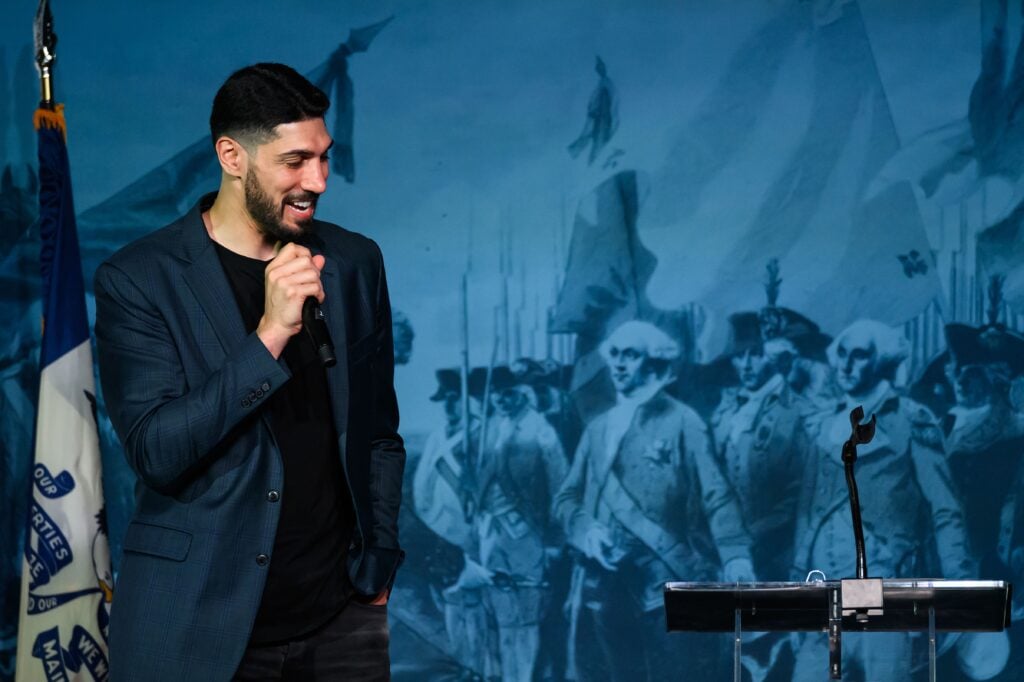
Former NBA player Enes Kanter Freedom has launched a second career in recent weeks.
Perhaps in an attempt to make a name for himself as a conservative pundit, Kanter Freedom has been fighting against the inclusion of trans athletes in professional sports leagues.
Of course, his frequent public stunts have many wondering if he’s more interested in chasing clout than he is in making his point.
Kanter Freedom was ejected from the Chicago Sky’s game against the Indiana Fever after a heated confrontation with Sky guard Natasha Cloud during the third quarter.
With the obvious goal of attracting attention, he was sitting courtside at Wintrust Arena wearing a black T-shirt emblazoned with the message, “WOMAN noun. adult human female.”
The situation escalated with 1:22 remaining in the third quarter, shortly after Cloud scored for Chicago.
According to ESPN, Cloud turned toward Kanter Freedom and began yelling and pointing at him as she approached his courtside seat.
Kanter Freedom stood up, spread his arms, and took a step toward the court before security personnel and several Sky players intervened.
He was subsequently escorted from the arena. And he didn’t exactly go quietly.
As security removed him, Kanter Freedom pumped his fist and appeared to mock Cloud by imitating her talking with his hand. He eventually held out his shirt as he made his way toward the lobby.
The incident comes amid an increasingly heated debate surrounding transgender athletes and women’s sports.
Kanter Freedom, who played 11 seasons in the NBA, recently declared himself eligible for the 2027 WNBA Draft while saying he identifies as a woman. Former NBA player Royce White has also made a similar declaration.
The controversy began after Fever guard Sophie Cunningham made comments about transgender athletes that sparked a national debate.
Kanter Freedom has subsequently used his social media platforms to criticize the WNBA’s policies regarding transgender players. His recent stunts happen to coincide with the release of his new memoir.
The league’s current collective bargaining agreement states that “only players who are women are eligible to play in the WNBA,” but does not further define the term or publicly outline eligibility rules for transgender or intersex athletes.
After his removal Sunday, Kanter Freedom claimed on X that he had been kicked out of the game for supporting women.
Cloud’s version of events was not publicly detailed, but Sky coach Tyler Marsh made it clear that he supported his player.
“I told her she wasn’t,” Marsh said when asked whether Cloud was concerned about becoming a distraction. “I told her that we all embrace her as someone that protects our team and protects people that need to be protected and so Tash is always going to stand on that, and we stand for Tash.”
On the court, Indiana rolled to a 113-90 victory behind 37 points from Caitlin Clark and 30 from Kelsey Mitchell. Clark said she didn’t witness the confrontation because she and her teammates were focused on their huddle at the time.
“I didn’t see it, we were talking about the next play in our huddle,” Clark said. “So I think that’s probably a question for Chicago.”
For Kanter Freedom, however, the game became less about basketball and more about the ongoing culture-war battle that he has inserted himself into.
And judging by Sunday’s spectacle, that battle isn’t going away anytime soon.
Enes Kanter Freedom Ejected From WNBA Game For Transphobic Tirade was originally published on The Hollywood Gossip.
The Hollywood Gossip

Kacey Musgraves began her ‘Middle of Nowhere’ Tour in Chicago last weekend. The setlist and staging stay true to her new album. Continue reading…The Boot – Country Music News, Music Videos and Songs
Kacey Musgraves began her ‘Middle of Nowhere’ Tour in Chicago last weekend. The setlist and staging stay true to her new album. Continue reading…Country Music News – Taste of Country

 The Gardiner family has suffered another devastating loss.
One year after Sam Gardiner’s death in a car accident at age 24, his mother Jo Gardiner—with whom he competed on the BBC’s Race Across…
E! Online (US) – Top Stories

Glenda Douglas of Shungnak, in the Northwest Arctic Borough, shared this photo on social media of a gasoline purchase she made on Friday, Aug. 21, 2026. (Glenda Douglas photo)
It’s not a typo. The price of a gallon of gasoline in the northwest Alaska village of Shungnak was $26.82 on Friday, local residents and regional officials said, likely giving the community the dubious honor of having the most expensive gasoline in the United States.
“It is very much real,” said Glenda Douglas, who manages the store in Shungnak and posted a picture of the price on Facebook.
Across the United States, the average price of a gallon of regular unleaded gasoline was $4.10 on Thursday.
Shungnak is about 280 river miles east of Kotzebue, up the Kobuk River, or 150 miles as the airplane flies. Air travel is the only reliable, year-round form of transportation.
In summer, the river is usually navigable by boat. In winter, residents travel by snowmachine. Last fall and for parts of this summer, water levels on the Kobuk were low enough to interrupt barge traffic, which contributed to the high price of gasoline.
“We sell groceries, diesel and gas,” Douglas said via Facebook message. “We had to get gas flown in twice this summer since (the) barge isn’t able to make it this way because the river water levels (are) too low. Just yesterday, the price was 13.99, but now it is 26.82.”
Shareholders in NANA Regional Corp. are eligible for a discount — they can buy gas for $21.46 per gallon.
Albie Dallemolle is NANA’s vice president of economic development and sustainability.
“Confirmed, Shungnak gasoline price is $26.82 per gallon, which had to be flown into the community,” she said by text message. “This price does reflect the highest cost for gasoline in the region … for now. Unfortunately, prices for gasoline and diesel are expected to increase once communities receive their fall barge deliveries.”
That’s because the current price is based in part on an average of the air-delivered fuel and cheaper barge-delivered fuel. New barge-delivered fuel, bought after the Iran War began, is expected to be more expensive than fuel bought before the war.
Shungnak frequently endures some of the highest fuel prices in Alaska.
In 2007, a gallon of regular unleaded was already $8.11 per gallon, so costly that the Wall Street Journal used the village as an example of what rural Alaska was experiencing that year. By 2022, the price was $14.03 per gallon, according to figures from the Northwest Arctic Borough.
In a message, Douglas said one thing that particularly concerns her is the fact that hunting season has arrived in the region.
Many people in the region practice a subsistence lifestyle, hunting and fishing for food they use to survive.
“(That price) is really going to hurt our hunters that pay for gas to hunt,” she said.

When a hot evening makes a heavy sit-down dinner unappealing, these 17 Mediterranean recipes keep the table flexible with salads, hummus, chilled soup, pasta, vegetables, beans, and chicken for grazing.The post 17 Mediterranean recipes for grazing straight through a hot…