Categories
Politics

A law from the era of Red Scares is supercharging Trump administration’s power over immigrants and noncitizens

The Trump administration detained former Columbia University student and pro-Palestinian protest leader Mahmoud Khalil, center, for more than two months and is seeking to revoke his lawful permanent resident status. Kena Betancur/AFP via Getty Images

Nativism, the idea that government must guard native-born Americans from various threats posed by immigrants, has a long history in the United States.

Today, the Trump administration is citing the Immigration and Nationality Act of 1952, a restrictive measure written by nativist members of Congress decades ago when fears of communism were rampant, to sharply restrict the rights of noncitizens.

Under this law, also known as the McCarran-Walter Act, federal agencies have arrested and detained noncitizens associated with pro-Palestinian protests, reintroduced immigrant registration requirements, and imposed a new travel ban that affects 19 nations.

Since the 1950s, Congress has removed some of this sprawling federal law’s most discriminatory features, such as racist national origins quotas. But other key provisions remain on the books. Now they are the primary legal basis for some of President Donald Trump’s most controversial immigration crackdowns.

Author and reporter Clay Risen discusses parallels between anticommunist fears in the 1950s and the Trump administration’s anti-immigrant policies.

Foreign policy trumps free speech

In March 2025, the White House invoked the McCarran-Walter Act to justify arresting and deporting Mahmoud Khalil, a legal permanent resident who had participated in pro-Palestinian protests at Columbia University. Officials pointed to Section 237(a)(4)(C) of the law, which states that any “alien whose presence or activities in the United States the Secretary of State has reasonable ground to believe would have potentially serious adverse foreign policy consequences for the United States is deportable.”

This has been tried only once before. In 1995, the Clinton administration unsuccessfully sought to use the provision to deport a former Mexican official, Mario Ruiz Massieu, to face charges in his homeland for extortion and obstructing a murder investigation. Ruiz Massieu was later indicted in the U.S. on money laundering charges and died by suicide shortly before his arraignment.

The Trump administration cited the same provision to justify detaining Tufts University doctoral student Rumeysa Ozturk in March. Ozturk came under government scrutiny because she co-authored an op-ed in the Tufts student newspaper criticizing the university’s position on the Israel-Gaza war.

Surveillance footage of a terrified Ozturk being arrested by masked Immigration Customs and Enforcement agents on a street in Somerville, Massachusetts, drew criticism from government officials and civil liberties advocates. In response, Secretary of State Marco Rubio alleged that Ozturk had harmed U.S. interests by supporting “movements that are involved in doing things like vandalizing universities, harassing students, taking over buildings, creating a ruckus.”

Khalil and Ozturk both were released after weeks in detention, pending final resolution of their cases. Their lawyers argue that their clients’ treatment violates free speech protections and that the defendants were punished for expressing their political beliefs.

Monitoring noncitizens

The McCarran-Walter Act also authorizes intrusive registration and tracking requirements for noncitizens who remain in the U.S. for 30 days or longer.

On Jan. 20, 2025, Trump issued an executive order directing the Department of Homeland Security to enforce an “alien registration requirement.” The agency issued a final rule in April requiring all noncitizens over the age of 14 to register and be fingerprinted. Parents or guardians must register noncitizen children under age 14. The rule also requires adult noncitizens to carry “evidence of registration” at all times.

Such policies aren’t new. Noncitizen registration was codified in the Alien Registration Act of 1940, on the eve of U.S. entry into World War II. The law was designed to regulate the foreign-born population and encourage eligible noncitizens to join the U.S. armed forces. Its requirements were written into the McCarran-Walter Act.

After the 9/11 terrorist attacks, the Bush administration created the National Security Entry-Exit Registration System, which targeted noncitizen males age 16 or older from 25 Muslim-majority countries. It required registrants to submit biometric information, check in regularly with immigration authorities and use specific ports of entry for travel.

The Obama administration suspended this system in 2011 and permanently dismantled it in 2016.

Today, Trump administration officials say they are simply enforcing long-standing legal authority. A federal judge agreed, ruling on April 10 that the Homeland Security Department could require noncitizens to register and carry documentation.

The Trump administration says it will strictly enforce a long-standing requirement for immigrants in the country more than 30 days to register with the federal government.

Travel bans redux

On June 2, Trump announced a new travel ban on foreign nationals from 12 countries, mostly in Africa and the Middle East. The ban draws its authority from the McCarran-Walter Act. Two days later, Trump claimed the same legal discretion to exclude Harvard University’s international students from the U.S.

During his first term, Trump invoked these sections of the law to justify a travel ban on seven predominantly Muslim countries. The U.S. Supreme Court ultimately upheld this action in 2018 by a 5-4 vote in Trump v. Hawaii. Writing for the majority, Chief Justice John Roberts stated that the travel ban was well within broad powers over immigration granted to the president under the McCarran-Walter Act. He added that the court had “no view on the soundness of the policy.”

Trump’s new ban is more carefully crafted than earlier versions and more likely to withstand legal challenges. But his efforts to use the McCarren-Walter Act to ban international students from attending Harvard University face stiff legal headwinds.

On May 22, Homeland Security Secretary Kristi Noem notified Harvard officials that the agency was revoking the school’s certification to participate in the Student and Exchange Visitor Program, which grants visas to international students to come to the U.S. In a June 4 proclamation, the White House claimed that foreign students at Harvard had behaved in ways that threatened U.S. national security.

A federal judge in Boston quickly blocked the revocation, holding that it violated core constitutional free speech rights. “The government’s misplaced efforts to control a reputable academic institution and squelch diverse viewpoints seemingly because they are, in some instances, opposed to this administration’s own views, threaten these rights,” wrote Judge Allison D. Burroughs.

The latest step came on July 9, when the Trump administration subpoenaed Harvard for information on its foreign students, including their disciplinary records and involvement in campus protests.

Broad power over noncitizens

Ironically, congressional sponsors of the McCarran-Walter Act were at odds with the White House when the law was enacted in 1952. They overrode a veto by President Harry S. Truman, who thought the law’s nativist ideas were unfitting for a nation of immigrants and global defender of democracy.

However, the expansive executive powers created by this law have endured largely unaltered over time, through waves of immigration reform.

Now they are a boon to the Trump administration’s ambitious immigration crackdown. It’s a telling reminder that repressive old laws can come back to life – even when they don’t reflect the current views of many Americans.

The Conversation

Daniel Tichenor does not work for, consult, own shares in or receive funding from any company or organization that would benefit from this article, and has disclosed no relevant affiliations beyond their academic appointment.

​Politics + Society – The Conversation
Categories
Politics

How universities can keep protests from turning violent: 3 lessons from the 2024 pro-Palestinian encampments

Pro-Palestinian supporters march outside Columbia University in September 2024. AP Photo/Yuki Iwamura

In spring 2024, pro-Palestinian student encampments that began at Columbia and Harvard spread to university campuses throughout the U.S. as Israel invaded Gaza in response to Hamas’ Oct. 7, 2023, surprise attack. At least 100 campuses had encampments for at least a few days during this period.

While some campuses erupted in violence, others remained peaceful and didn’t experience the open conflict that led to congressional hearings, university presidents losing their jobs and repercussions that are continuing to be felt today.

What made the difference?

In spring 2024, Ohio State University’s College Impact Laboratory, where we all work, surveyed universities to learn more about whether their campuses experienced protests, what happened and how they handled them. Part of our goal was to understand how spiritual leaders played a role, if any, in managing the protests. We’ve been analyzing the data ever since. The results from those who responded point to several lessons universities could learn from to avoid violence in future protests.

Campuses are a critical arena for activism

Campus protests have long been a defining feature of social and political change in the U.S. From the civil rights movements of the 1950s and 1960s to the student-led climate strikes of recent years, higher education institutions have served as a critical space for activism.

Often, these protests reflect broader societal tensions, and how universities respond has played a significant role in shaping their outcomes.

Historically, protests have been most likely to escalate when students feel unheard. In contrast, institutions that adopt proactive strategies, such as facilitating conversations or including students in decision-making, often experience better outcomes.

a student holds a green red and white flag on pavement in front of tents on a college campus
A George Washington University student carries a Palestinian flag at a student encampment protesting the Israel-Hamas war in May 2024.
AP Photo/Jose Luis Magana

Snapshot of the pro-Palestinian protests

As our survey data shows, the pro-Palestinian protests illustrate this dynamic.

To gather data, the College Impact Laboratory sent questionnaires to administrators at the 329 universities that participate in our Interfaith Spiritual, Religious and Secular Campus Climate Index, also known as the INSPIRES Index, as well as hundreds of colleges and universities in our recruitment database.

In all, 35 schools responded to our 23-question survey. Of those, we found that most protests were led by students, half lasted less than a week, and the vast majority were nonviolent. Fifteen did not have protests, while the rest did. While the number of institutions that participated in this survey is relatively small, it does give us key insights into what schools were thinking.

Half of the campuses with protests reported law enforcement involvement – either campus police or city officers – with 20% experiencing physical altercations between protesters and police. Other disruptive actions such as academic interruptions, vandalism, physical violence and doxxing were reported with varying frequencies.

Protests at campuses that participated in our survey peaked during April and May 2024, with 70% of them experiencing demonstrations in these months.

Here are three takeaways from the survey, suggesting steps universities can take before and during future protests to avoid escalation:

1. Involve students in guidelines for engagement – early

At every surveyed institution that reported protests, students were at the forefront of organizing and leading these efforts.

Yet, despite this clear student leadership, about one-third of institutions said they didn’t consult with students to establish guidelines for engagement. Those that did invited representatives from student organizations or student government officers into the policymaking process to determine what protocols would be followed to manage protests and keep them peaceful.

On campuses where administrators didn’t engage with student leaders, tensions tended to escalate, and protests disrupted the institutions for weeks, often after police were called in or curfews were imposed.

While many of the protests lasted only one to seven days, we found that institutions that opened lines of communication early between administration and student protest leaders were more likely to deescalate tensions quickly. In contrast, campuses where administrators did not engage early on saw protests lasting weeks or involving greater disruptions.

Also, institutions that engaged early with student leaders were less likely to face stronger demands, such as calls for administrators to be fired, divestment from Israeli companies or calls to defund the campus police.

Our survey results suggest it’s important for administrators to engage with students early to establish clear guidelines to make it less likely future protests spiral into violence.

2. Communicate openly, often and before protests

Discussion of difficult topics, such as the conflict between Israel and Palestinians, shouldn’t wait until protests break out to begin. We found that every school in our survey that proactively supported dialogue between Jews and Muslims – before the war broke out – didn’t see violence result from the protests.

Dialogue isn’t just a strategy for preventing protests from spiraling out of control; it is fundamental to intergroup learning in higher education. These events create safe spaces for students − whether Arab, Jewish, Palestinian or members of different ethnic or religious groups − to engage with classmates with different points of view.

But even once protests begin, dialogue can help. When institutions engaged in dialogue, during or as a result of a protest, the protests were less likely to involve violence. At half of the campuses that participated in our survey and experienced protests, protests were ended peacefully through dialogue.

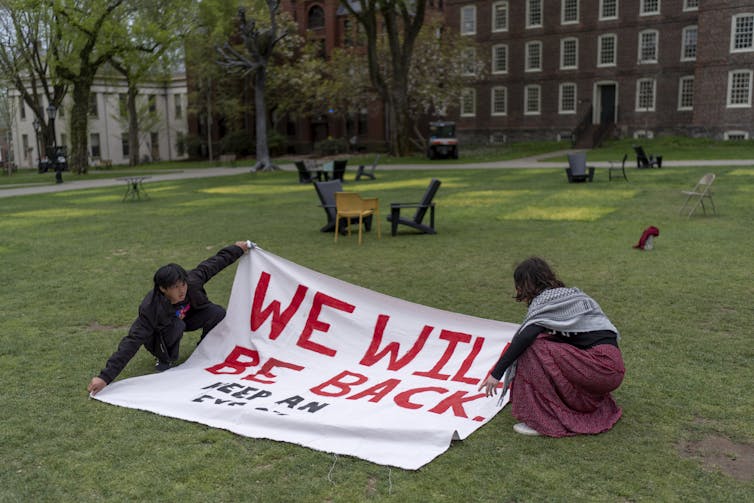
Brown, for example, modeled the power of institutional listening in its response to its April 2024 encampment. Rather than escalating tensions, university leaders engaged directly with student activists, resulting in a peaceful resolution and a commitment to bring the students’ divestment proposal to a formal vote in October. It ultimately failed to pass the board of directors.

two people hold a sign saying we will be back on a mostly empty college lawn
Demonstrators unfurl a banner on a lawn after an encampment protesting the Israel-Hamas war was taken down at Brown University on April 30, 2024, in Providence, R.I.
AP Photo/David Goldman

3. Involve relevant groups in decision-making

Most administrators in our survey, as they considered how to engage with protesters, reached out to relevant student groups such as those that focus on Jewish and Muslim students to better understand their perspectives.

However, only 28% consulted a religious or spiritual life office staff member on campus.

Religious or spiritual life staff are present on both private and public campuses and may include university-employed multifaith chaplains, interfaith coordinators or directors of spiritual life. Unlike student-led religious groups, these professionals often serve as liaisons to the religious and nonreligious communities represented on campus.

The focus of such roles on serving students from all worldviews positions them as key resources for deescalation through community outreach, support and two-way communication. Additionally, these professionals have valuable expertise in religious pluralism and community relationships. This experience helps them to advise administrators on policy and potential courses of action in times of tension.

Consulting with university staff with a focus on religion or spiritual life makes particular sense given the nature of the protests and how religion is intertwined, but our data suggests they may be underutilized more broadly for their expertise in navigating tensions related to competing worldviews.

Proactive engagement with these leaders not only helps campuses navigate an immediate crisis but demonstrates a commitment to inclusivity and respect for different groups’ perspectives.

Leading by example

Put another way, our research suggests institutions can avoid the negative outcomes of protests by embodying the traits commonly associated with universities, such as showing mutual respect, fostering democratic debate and engaging in critical thinking even on divisive issues. Engaging from a mindset of goodwill with student leaders shows administrators value student voices and are willing to work collaboratively toward solutions.

But when campuses ignore peaceful protests or refuse to engage with student leaders, they risk turning manageable situations into prolonged crises.

At a time when divisions run deep, we believe campuses that lead by example by embracing dialogue and engaging student activists before, during and after protests take place are not only likely to see less violence, but are likely to help heal America’s great divides.

The Conversation

Matthew J. Mayhew receives grant funding for various research projects from the National Science Foundation, the ECMC Foundation, the Templeton Religion Trust, the Arthur Vining Davis Foundations, and Pew Charitable Trusts. Currently, Dr. Mayhew leads the College Impact Laboratory at The Ohio State University. He is the Principal Investigator for the INSPIRES Index project and is the current editor of the Digest of Recent Research.

Renee L. Bowling works for the College Impact Lab at The Ohio State University that produces the INSPIRES Index and serves as Chair of NASPA’s Spirituality and Religion in Higher Education Knowledge Community.

Anisha Gill-Morris and Hind Haddad do not work for, consult, own shares in or receive funding from any company or organization that would benefit from this article, and have disclosed no relevant affiliations beyond their academic appointment.

​Politics + Society – The Conversation

Categories
Entertainment

Dan Rivera: Paranormal Investigator Dies In Presence of ‘Haunted’ Annabelle …

Reading Time: 2 minutes

A bizarre story involving a Connecticut-based paranormal investigator is going viral on social media today.

Multiple outlets have now confirmed that Dan Rivera passed away in Gettysburg, Pennsylvania while touring with the infamous “haunted” doll known as Annabelle.

The doll gained notoriety through the Conjuring film franchise, which is based on the real-life work of paranormal investigators Ed and Lorraine Warren.

Paranormal investigator Dan Rivera has passed away at the age of 54.
Paranormal investigator Dan Rivera has passed away at the age of 54. (YouTube)

Rivera was an employee at the Warrens’ Occult Museum in Monroe, Connecticut.

Psychic research center announces death of Dan Rivera

News of his death comes courtesy of a Facebook post from the New England Society for Psychic Research.

“It’s with deep sadness that Tony, Wade, and I share the sudden passing of our close friend and partner, Dan Rivera. We are heartbroken and still processing this loss.

“Dan truly believed in sharing his experiences and educating people on the paranormal. His kindness and passion touched everyone who knew him. Thank you for your support and kind thoughts during this difficult time.”

Paranormal investigator Dan Rivera has passed away at the age of 54.
Paranormal investigator Dan Rivera has passed away at the age of 54. (YouTube)

No cause of death has been revealed.

TMZ reports that “firefighters and medics rushed to his hotel Sunday night” but were unable to revive Rivera.

Presence of ‘dangerous’ doll fuels social media speculation

Naturally, much of the online fascination with this story has to do with the presence of Annabelle.

In a YouTube video, Rivera and another museum employee explained that the doll is a “dangerous” artifact with the ability to inflict “psychic wounds.”

In the clip above, Rivera explains that extreme precaution is exercised when taking Annabelle on tour.

The doll’s case is equipped with multiple crosses and other religious emblems in order to contain its alleged evil.

Before removing Annabelle from the museum, a priest is brought in to say a protective blessing.

According to a Connecticut NBC affiliate, the doll “is rarely moved” due to the dangers thought to be associated with it.

So no matter what the medical examiner’s report reads, you can bet that countless paranormal believers will attribute this death to the doll whose supposed powers have inspired numerous horror films.

Our thoughts go out to Dan Rivera’s loved ones during this devastating time.

We will have further updates on this developing story as new information becomes available.

Dan Rivera: Paranormal Investigator Dies In Presence of ‘Haunted’ Annabelle … was originally published on The Hollywood Gossip.

​The Hollywood Gossip

Categories
Politics

Florida is fronting the $450M cost of Alligator Alcatraz – a legal scholar explains what we still don’t know about the detainees

Florida Gov. Ron DeSantis leads a tour of the new Alligator Alcatraz immigration detention facility for President Donald Trump and U.S. Department of Homeland Security Secretary Kristi Noem. Andrew Cabellero-Reynolds/AFP via Getty Images

The state of Florida has opened a migrant detention center in the Everglades. Its official name is Alligator Alcatraz, a reference to the former maximum security federal penitentiary in San Francisco Bay.

While touring Alligator Alcatraz on July 1, 2025, President Donald Trump said, “This facility will house some of the menacing migrants, some of the most vicious people on the planet.” But new reporting from the Miami Herald/Tampa Bay Times reveals that of more than 700 detainees, only a third have criminal convictions.

To find out more about the state of Florida’s involvement in immigration enforcement and who can be detained at Alligator Alcatraz, The Conversation spoke with Mark Schlakman. Schlakman is a lawyer and senior program director for The Florida State University Center for the Advancement of Human Rights. He also served as special counsel to Florida Gov. Lawton Chiles, working as a liaison of sorts with the federal government during the mid-1990s when tens of thousands of Haitians and Cubans fled their island nations on makeshift boats, hoping to reach safe haven in Florida.

U.S. Department of Homeland Security Secretary Kristi Noem has characterized the migrants being detained in facilities like Alligator Alcatraz as “murderers and rapists and traffickers and drug dealers.” Do we know if the detainees at Alligator Alcatraz have been convicted of these sorts of crimes?

The Times/Herald published a list of 747 current detainees as of Sunday, July 13, 2025. Their reporters found that about a third of the detainees have criminal convictions, including attempted murder, illegal reentry to the U.S., which is a federal crime, and traffic violations. Apparently hundreds more have charges pending, though neither the federal nor state government have made public what those charges are.

There are also more than 250 detainees with no criminal history, just immigration violations.

Is it a crime for someone to be in the U.S. without legal status? In other words, is an immigration violation a crime?

No, not necessarily. It’s well established as a matter of law that physical presence in the U.S. without proper authorization is a civil violation, not a criminal offense.

However, if the federal government previously deported someone, they can be subject to federal criminal prosecution if they attempt to return without permission. That appears to be the case with some of the detainees at Alligator Alcatraz.

What usually happens if a noncitizen commits a crime in the U.S.?

Normally, if a foreign national is accused of committing a crime, they are prosecuted in a state court just like anyone else. If found guilty and sentenced to incarceration, they complete their sentence in a state prison. Once they’ve served their time, state officials can hand them over to U.S. Immigration and Customs Enforcement, or ICE. They are subject to deportation, but a federal immigration judge can hear any grounds for relief.

DHS has clarified that it “has not implemented, authorized, directed or funded” Alligator Alcatraz, but rather the state of Florida is providing startup funds and running this facility. What is Florida’s interest in this? Are these mostly migrants who have been scooped up by ICE in Florida?

It’s still unclear where most of these detainees were apprehended. But based on a list of six detainees released by Florida Attorney General James Uthmeier’s office, it is clear that at least some were apprehended outside of Florida, and others simply may have been transferred to Alligator Alcatraz from federal custody elsewhere.

This calls to mind the time in 2022 when Gov. Ron DeSantis flew approximately 50 migrants from Texas to Martha’s Vineyard in Massachusetts at Florida taxpayer expense. Those migrants also had no discernible presence in Florida.

To establish Alligator Alcatraz, DeSantis leveraged an immigration emergency declaration, which has been ongoing since Jan. 6, 2023. A state of emergency allows a governor to exercise extraordinary executive authority. This is how he avoided requirements such as environmental impact analysis in the Everglades and concerns expressed by tribal governance surrounding that area.

For now, the governor’s declaration remains unchallenged by the Florida Legislature. Environmental advocates have filed a lawsuit over Alligator Alcatraz, and the U.S. Supreme Court upheld a decision by a federal judge temporarily barring Florida from enforcing its new immigration laws, which DeSantis had championed. But no court has yet intervened to contest this prolonged state of emergency.

This presents a stark contrast to Gov. Lawton Chiles’ declaration of an immigration emergency during the mid-1990s. At that time, tens of thousands of Cubans and Haitians attempted to reach Florida shores in virtually anything that would float. Chiles’ actions as governor were informed by his experience as a U.S. senator during the Mariel boatlift in 1980, when 125,000 Cubans made landfall in Florida over the course of just six months.

Chiles sued the Clinton administration for failing to adequately enforce U.S. immigration law. But Chiles also entered into unprecedented agreements with the federal government, such as the 1996 Florida Immigration Initiative with U.S. Attorney General Janet Reno. His intent was to protect Florida taxpayers while enhancing federal enforcement capacity, without dehumanizing people fleeing desperate circumstances.

During my tenure on Chiles’ staff, the governor generally opposed state legislation involving immigration. In the U.S.’s federalist system of government, immigration falls under the purview of the federal government, not the states. Chiles’ primary concern was that Floridians wouldn’t be saddled with what ought to be federal costs and responsibilities.

Chiles was open to state and local officials supporting federal immigration enforcement. But he was mindful this required finesse to avoid undermining community policing, public health priorities and the economic health of key Florida businesses and industries. To this day, the International Association of Chiefs of Police’s position reflects Chiles’ concerns about such cooperation with the federal government.

Florida Gov. Ron DeSantis speaking into a microphone
Gov. Ron DeSantis outlines his plans for Alligator Alcatraz to the media on July 1, 2025.
Andrew Caballero-Reynolds/AFP via Getty Images

Now, in 2025, DeSantis has taken a decidedly different tack by using Florida taxpayer dollars to establish Alligator Alcatraz. The state of Florida has fronted the US$450 million to pay for this facility. DeSantis reportedly intends to seek reimbursement from FEMA’s Shelter and Services Program. Ultimately, congressional action may be necessary to obtain reimbursement. Florida is essentially lending the federal government half a billion dollars and providing other assistance to help support the Trump administration’s immigration enforcement agenda.

Florida is also establishing another migrant detention facility at Camp Blanding Joint Training Center near Jacksonville. A third apparently is being contemplated for the Panhandle.

ICE claims that the ultimate decision of whom to detain at these facilities belongs to the state of Florida, through the Florida Division of Emergency Management. Members of Congress who visited Alligator Alcatraz earlier this week have disputed ICE’s claim that Florida is in charge.

You advised Florida Division of Emergency Management leadership directly for several years during the administrations of Gov. Charlie Crist and Gov. Rick Scott. Does running a detention facility like Alligator Alcatraz fall within its typical mission?

The division is tasked with preparing for and responding to both natural and human-caused disasters. In Florida, that generally means hurricanes. While the division may engage to facilitate shelter, I don’t recall any policies or procedures contemplating anything even remotely similar to Alligator Alcatraz.

DeSantis could conceivably argue that this is consistent with a 287(g) agreement authorizing state and local support for federal immigration enforcement. But such agreements typically require federal supervision of state and local activities, not the other way around.

The Conversation

Mark Schlakman served as special counsel to Florida Gov. Lawton Chiles and as a consultant to Emilio Gonzalez at the U.S. Department of Homeland Security during his tenure as U.S. Citizenship and Immigration Services Director during the George W. Bush administration.

​Politics + Society – The Conversation

Categories
Entertainment

Jennifer Love Hewitt Flaunts 46-Year Old Curves, Fiery Hair on Red Carpet

Reading Time: 3 minutes

When it comes to what Jennifer Love Hewitt has been up to over the last several months, we know what the actress did last winter and spring:

Continue to look amazing!

On Monday night, the 46-year old walked the red carpet for I Know What You Did Last Summer, a remake of the 1997 thriller that also starred Hewitt … along with Sarah Michelle Gellar, Ryan Phillippe, and Freddie Prinze Jr.

Jennifer Love Hewitt attends the premiere of Columbia Pictures’ “I Know What You Did Last Summer” at The United Theater on Broadway on July 14, 2025 in Los Angeles, California. (Photo by Monica Schipper/Getty Images)

The long-time star hasn’t exactly been out of the spotlight since appearing in this hit movie, most notably having starred in 114 episodes to date of the drama 9-1-1.

But Hewitt doesn’t exactly get all dolled up for that role, which may explain why she turned heads in so manu directions in Hollywood yesterday evening.

As you can see above and below, Hewitt wore an ankle-length, form-fitting Rachel Gilbert Embellished dress with 3-D jeweled beading for the occasion, as she dazzled photographers and onlookers.

Her matching black pumps featured textured silver accents.

And her hair? It had far more of a ginger tinge than usual, wouldn’t you say?

Jennifer Love Hewitt has still got it! (Photo by Robyn Beck / AFP) (Photo by ROBYN BECK/AFP via Getty Images)

The new movie picks up after the events of 1998’s I Still Know What You Did Last Summer and the 1997 original installment with the same name.

the return of Hewitt’s good-girl character, Julie James, who can’t seem to escape her troubled past.

According to Sony Pictures, it chronicles five friends who “inadvertently cause a deadly car accident” before “cover[ing] up their involvement and mak[ing] a pact to keep it a secret rather than face the consequences.”

Fast forward a year later and:

“Their past comes back to haunt them and they’re forced to confront a horrifying truth: someone knows what they did last summer…and is hell-bent on revenge. As one by one the friends are stalked by a killer, they discover this has happened before, and they turn to two survivors of the legendary Southport Massacre of 1997 for help.”

Hewitt plays one of these survivors.

(Photo by Robyn Beck / AFP)

At the moment, though, Hewitt is playing the role of Natural Curve Role Model.

A bunch of social media users have jumped online over the past few hours to gush over the actress’ appearance.

“A real woman showing her naturally gorgeous body!” one person wrote in response to the snapshots, for example, while another added:

“Beautiful ❤️ finally someone who is not afraid to show the real person she is with curves and healthy what all woman should be proud of.”

Then there was someone who referred to Hewitt as a “Gorgeous Curvy Girl with STYLE!” and another who praised such positivity across the board as follows:

The comments section gives me hope for the next generation.

For her part, Hewitt once slammed those who sexualized her as a teenager.

Jennifer Love Hewitt on March 17, 2019.
Jennifer Love Hewitt attends the Paley Center For Media’s 2019 PaleyFest LA – “9-1-1” held at the Dolby Theater on March 17, 2019. (Photo Credit: JB Lacroix/Getty Images)

“It was really strange, I think, to become a sex symbol sort of like before I I even knew what that was,” Hewitt explained on a podcast this year, referring to how often folks talked about her breasts in the late 1990s. “Like I didn’t know what being sexy meant.”

She added back then:

“There were grown men talking to me at 16 about my breasts openly on a talk show, and people were laughing about it. It was a culture that was fully accepted, but when you sit, and you look at where we are now versus then, it is really mind-blowing.”

Hewitt felt like people only saw her as a sex symbol back then, lamenting:

“I’m working so hard. I’m growing. I’m trying so hard, like crying from my heart week after week for you. And the only thing that you see is a movie poster with boobs on it.’”

“That was heartbreaking for me.”

Jennifer Love Hewitt Flaunts 46-Year Old Curves, Fiery Hair on Red Carpet was originally published on The Hollywood Gossip.

​The Hollywood Gossip

Categories
Entertainment

Selena Gomez & Benny Blanco Wedding Plans REVEALED! [Report]

Reading Time: 3 minutes

Selena Gomez and Benny Blanco are getting married — and, reportedly, very soon.

Late last year, the two became engaged after about a year and a half of dating.

Speculation about the couple began almost immediately.

Now, we’re learning a lot more about their reported wedding plans, including the date, the location, and how Selena’s A-list peers like Taylor Swift will work as guests.

Selena Gomez and Benny Blanco on March 2, 2025.
Selena Gomez and Benny Blanco attend the 97th annual Oscars at Ovation Hollywood on March 02, 2025. (Photo Credit: Emma McIntyre/Getty Images)

Selena Gomez and Benny Blanco have a wedding date, per a new report

According to a new report by The Daily Mail, Selena Gomez and Benny Blanco will marry late this summer or early this autumn in California.

“Selena and Benny’s wedding is going to be a two-day event in Montecito in September,” a source claimed.

This will not be one of those lavish celebrity weddings with thousands of guests.

Selena Gomez and Benny Blanco on October 24, 2024.
Selena Gomez and Benny Blanco attend the Second Annual Rare Impact Fund Benefit Supporting Youth Mental Health, hosted by Selena Gomez, at Nya Studios on October 24, 2024. (Photo Credit: Amy Sussman/Getty Images)

The ceremony will reportedly be relatively intimate, with close friends and family of the couple being the only invitees.

That will include big-name celebrities, including Taylor Swift and Travis Kelce.

Apparently, wedding invitations have already been mailed to guests.

Selena Gomez and Benny Blanco on January 5, 2025.
Selena Gomez and Benny Blanco attend the 82nd Annual Golden Globe Awards at The Beverly Hilton on January 05, 2025. (Photo Credit: Monica Schipper/Getty Images)

Who will the wedding guests be?

“Everyone invited has been asked to bring overnight bags to stay for the weekend,” the insider detailed.

“Although it’s for friends and family only, many on the friends list are huge celebrities,” the source continued.

The insider said that this is “including Taylor Swift and Travis Kelce, Selena’s co-stars from ‘Only Murders In The Building,’ and music superstars who are Benny’s friends and some he’s also worked with.”

Benny Blanco and Selena Gomez at a sports game in April 2025.
Benny Blanco and Selena Gomez attend the game between the New York Knicks and the Boston Celtics at Madison Square Garden on April 08, 2025. (Photo Credit: Elsa/Getty Images)

This will not be an especially long engagement.

This is, the report details, because Selena and Benny will both have busy professional schedules this autumn and winter.

“Selena loves being engaged but she has been dreaming of being married forever,” shared a second inside source.

“At the end of the year, it gets busy,” the insider explained.

“Not only for them, but also for everyone they want to attend.”

Selena Gomez and Taylor Swift in 2023.
Selena Gomez, Taylor Swift, and Ice Spice attend the 2023 MTV Video Music Awards at Prudential Center on September 12, 2023. (Photo Credit: Theo Wargo/Getty Images for MTV)

How will Taylor Swift factor into the wedding plans?

“Selena is not having her wedding to accommodate Taylor,” a third inside source clarified.

“But,” this final insider affirmed, “she wants her to attend and she would love for her to be able to go with Travis.”

Taylor and Selena have been besties for over a decade.

Their friendship means the world to each other. Hopefully, nothing will ever change that — or keep them from each other’s weddings.

Selena Gomez & Benny Blanco Wedding Plans REVEALED! [Report] was originally published on The Hollywood Gossip.

​The Hollywood Gossip

Categories
Entertainment

Blake Lively Scores (Another) Victory in Justin Baldoni’s Legal War

Reading Time: 3 minutes

Blake Lively just scored another, albeit smaller, victory.

In June, the court dismissed Justin Baldoni’s lawsuit.

There are laws specifically against retaliatory lawsuits of this nature, as Lively’s attorneys had pointed out. The court agreed.

Now, the court has sided with Team Lively in a dispute over a deposition.

Blake Lively on April 27, 2025.
Actress Blake Lively attends the New York special screening of “Another Simple Favor” at the Jazz at Lincoln Center in New York on April 27, 2025. (Photo Credit: CHARLY TRIBALLEAU/AFP via Getty Images)

This Blake Lively deposition was a point of contention

Court battles are about so much more than an eventual verdict, judgment, or settlement. There are countless smaller points of contention along the way. These little decisions can add up — in cost and in consequences.

In this case, Blake Lively has been seeking to have her upcoming deposition take place at her lawyer’s office.

Justin Baldoni has countered, alleging that she is using her “celebrity status” to get her way. Or, at least, that she was trying to.

Justin Baldoni in December 2024.
Actor/filmmaker and VOS Honoree, Justin Baldoni speaks onstage at the Vital Voices 12th Annual Voices of Solidarity Awards at IAC Building on December 09, 2024. (Photo Credit: Bryan Bedder/Getty Images for Vital Voices Global Partnership)

Well, Page Six reports that the court concluded that attorneys can depose Lively at her attorney’s office.

Her team had expressed concerns about the deposition taking place at Baldoni’s lawyer’s office. Among other things, there have been realistic worries of paparazzi and other media outlets ambushing her.

Relatedly, Baldoni’s team must submit a list of people who will attend the deposition.

Blake Lively on April 24, 2025.
Blake Lively attends the 2025 TIME100 Gala at Jazz at Lincoln Center on April 24, 2025. (Photo Credit: Dimitrios Kambouris/Getty Images for TIME)

What did Justin Baldoni’s team want?

Apparently, Justin Baldoni’s team objected to the request to locate the Blake Lively deposition on her home turf.

They reportedly worried that this location will hinder their ability to privately discuss the deposition.

(Just for the record, depositions are a standard part of most court cases. Disagreements over where to hold these formal meetings are also very common)

Justin Baldoni in 2022.
Justin Baldoni attends Nights of the Jack friends and family nights at King Gillette Ranch on October 08, 2022. (Photo Credit: Andrew Toth/Getty Images for Nights Of The Jack)

Team Baldoni had characterized Lively’s attorney’s arguments as a “tantrum” in court.

The argument was essentially that Lively was behaving like a princess and trying to take control of the trial just as she allegedly did with the film, It Ends With Us.

Lively’s team countered that this lawsuit is a serious matter and includes topics like sexual harassment and retaliation. As such, they felt that Baldoni, and not their client, has been creating a “spectacle” at every turn.

Blake Lively on April 15, 2025.
Blake Lively attends the “Another Simple Favour” photocall at the Corinthia Hotel on April 15, 2025. (Photo Credit: Gareth Cattermole/Gareth Cattermole/Getty Images)

This legal war is far from over

Late in the summer of 2024, an obvious smear campaign launched against Blake Lively.

In December of 2024, she filed a lawsuit against Justin Baldoni, accusing him of sexual harassment on set — and of coordinating the smear campaign against her.

Baldoni responded with a nine-figure lawsuit against Lively and her husband, Ryan Reynolds. The dismissal of that lawsuit was a victory for Lively, but the fight isn’t over yet.

Blake Lively Scores (Another) Victory in Justin Baldoni’s Legal War was originally published on The Hollywood Gossip.

​The Hollywood Gossip

Categories
Entertainment

Jessica Ditzel: Joe Rogan’s Rarely Seen Wife Stuns In Bikini During Venice Vacation

Reading Time: 3 minutes

For a guy who makes his living carrying on three to four conversations with his buddies, Joe Rogan does an impressive job of keeping his private life private.

In fact, even the comic’s most diehard fans probably couldn’t tell you much about his wife of 16 years, Jessica Ditzel.

Yes, Joe and Jessica tied the knot way back in 2009, and they’ve welcomed two children together (Jessica has a third kid from a previous relationship).

Jessica Ditzel and Joe Rogan walk in the Paddock prior to the F1 Grand Prix of United States at Circuit of The Americas on October 20, 2024 in Austin, Texas.
Jessica Ditzel and Joe Rogan walk in the Paddock prior to the F1 Grand Prix of United States at Circuit of The Americas on October 20, 2024 in Austin, Texas. (Photo by Mark Sutton/Getty Images)

Rare Jessica Ditzel sighting captivates social media

Jessica is so seldom-seen that new photos of her on vacation with Joe in Venice were enough to make her one of the day’s trending topics.

In photos obtained by Page Six, Ditzel is seen enjoying some time with Joe and their kids aboard a yacht.

Unlike so many other celebs, the couple did not attend Jeff Bezos and Lauren Sanchez’s wedding in Venice just a few weeks prior.

As a one-man media empire with a net worth estimated to be upward of $200 million, Joe certainly would have had no trouble fitting in.

Who is Jessica Ditzel?

A former cocktail waitress, Jessica started dating Joe in 2008, and she became pregnant with their first child shortly thereafter.

Rogan had been critical of the institution of marriage in his standup routines, but he says he had no qualms about proposing to Ditzel.

In an interview with the Palm Beach Post, Joe joked that he “had to; she made a baby.”

“What she had done was way more of a commitment compared to signing a legal contract,” he elaborated.

Rogan doesn’t go out of his way to avoid discussions of his family, but they rarely come up as topics on his wide-ranging podcast episodes, likely due to privacy and security concerns.

Jessica Ditzel and Joe Rogan walk in the Paddock prior to the F1 Grand Prix of United States at Circuit of The Americas on October 20, 2024 in Austin, Texas.
Jessica Ditzel and Joe Rogan walk in the Paddock prior to the F1 Grand Prix of United States at Circuit of The Americas on October 20, 2024 in Austin, Texas. (Photo by Mark Sutton/Getty Images)

During a recent appearance on Lex Fridman’s podcast, Rogan described Ditzel as a “happy,” “kind, “disciplined,” “dedicated,” and “fun” person who is “always smiling.”

During the pandemic, the couple left Los Angeles and relocated to a $14 million home on Lake Austin in Austin, Texas.

“Parenthood is probably the greatest human privilege. Having kids is one of the most powerful things I ever did in life; it changed me on so many levels,” Joe once remarked on his show.

“I think the universe did me a solid by giving me only daughters. If I had a son, I would probably be like, ‘I have to keep this boy out of jail’ because I am passing my genes,” the girl dad added.

Maybe one day, Jessica will decide to join Joe in the studio for one of his signature marathon interviews.

We’re sure she could offer all kinds of new insights into the mind and personality of one of American media’s most divisive figures.

Jessica Ditzel: Joe Rogan’s Rarely Seen Wife Stuns In Bikini During Venice Vacation was originally published on The Hollywood Gossip.

​The Hollywood Gossip

Categories
Politics

Sen. Eric Schmitt praises Pam Bondi, declines to opine on Epstein case | The Conversation

Sen. Eric Schmitt praises Pam Bondi, declines to opine on Epstein case | The Conversation

lead image

​Politics

Categories
Politics

Vote.org promised 8 million voters. Its founder says that was never the goal.

A messy fight between the current and former leadership of Vote.org is escalating.

Debra Cleaver, the nonprofit’s founder, said she has filed complaints with four states’ attorneys general alleging that the high-profile voter registration group has defrauded donors, including by vastly inflating the number of voters it could register in 2024, financial mismanagement and using charitable funds for the personal benefit of its current CEO.

The allegations follow a wrongful termination suit from Cleaver over her firing in 2019 and have prompted a new threat of litigation from the group over what it called a “sustained and vindictive campaign rooted in misinformation.”

Vote.org counsel Vanessa Avery, a partner at McCarter and English, vigorously denied the claims by Cleaver, saying they were “categorically false.”

In the 28-page complaint, shared first with POLITICO, Cleaver alleged there was no serious plan for the group to deliver on its pledge to register 8 million voters for the 2024 cycle, which would have been more than the total number of voters it had registered during its entire 14-year history. Vote.org ended up registering 2.2 million voters in the 2024 cycle.

Cleaver, who now runs a similar group called VoteAmerica, filed the complaint with the attorneys generals of New York, California, Pennsylvania and Georgia. POLITICO independently verified all filings except the one in Georgia. Among her claims: that the group originally set an internal goal to register 6 million voters, but that was increased to 8 million to avoid the “symbolism of 6 million Jews murdered in the Holocaust.”

“The fact that Vote.org ultimately failed to register 8 million voters is inconsequential to the organization, because that was never the true goal,” Cleaver said in the complaint. “The goal was staying afloat, attracting donor attention, and retaining relevance through the illusion of scale.”

The organization is one of the biggest nonpartisan voter registration vehicles in the country, but it has come under scrutiny in recent years over its internal management. The complaint points to the example of Taylor Swift, who previously worked with the group. But last year, when Swift endorsed Kamala Harris, she directed fans to go to Vote.gov to register instead of plugging Vote.org. The complaint alleges a Daily Mail story on internal turmoil at the group helped cause Swift to avoid touting the organization again. (A Swift spokesperson didn’t respond to a request for comment.) Vote.org’s spending and alleged internal dysfunction was also the subject of a Chronicle of Philanthropy investigation last year.

The complaint also alleges that donor money was inappropriately used to pay for Vote.org CEO Andrea Hailey’s personal travel and notes a jump in expenses on Vote.org’s “travel conferences and meetings” totaling more than $275,000 in 2023. It also notes that IRS documents show that Vote.org spent almost $600,000 on legal fees in 2023 versus $89,000 in 2019 as the organization fought wrongful termination lawsuits from Cleaver and another employee.

In the Cleaver case, she sued Vote.org and one of its human resources vendors. The suit between Cleaver and Vote.org was dismissed with prejudice with both parties dropping their claims and no money was exchanged between Vote.org and Cleaver, according to the settlement agreement. The agreement shows the HR vendor paid her $50,000 in a separate deal which said Vote.org would not reimburse the vendor.

The attorneys general complaints also made claims, which POLITICO has not independently verified, that Vote.org has paid for private security for Hailey even though Cleaver says staff haven’t received any threats against Hailey. Vote.org told the Daily Mail that Hailey did receive threats.

“For the past six years, she has organized a sustained and vindictive campaign rooted in misinformation, aimed at discrediting this organization and its leadership,” Avery, the Vote.org counsel, said in a statement.

“Her wrongful termination lawsuit was withdrawn with prejudice, and she is now resorting to even more desperate and baseless tactics. We will be filing a defamation claim in the near future and will vigorously defend against these lies.” She also said that they have emailed the state attorneys generals to rebut her claims.

Avery defended the high voter registration target for 2024, which Vote.org did not meet. “Successful organizations set ambitious goals — no one aims for underperformance,” she said. “We set bold targets because the stakes are high.” She said the group has registered more voters than any other organization in American history; Score could not independently verify this.

When asked why she filed the complaints, Cleaver told Score in a statement: “As the founder, I would like nothing more than Vote.org to succeed. Unfortunately, for five years now Vote.org has been racked by a series of financial, governance, and ethical lapses.”

A spokesperson for the New York attorney general’s office said they’ve “received the complaint and are reviewing.” Spokespeople for the other states’ attorneys generals didn’t respond to a request for comment.

Like this reporting? Subscribe to Morning Score.

​Politics