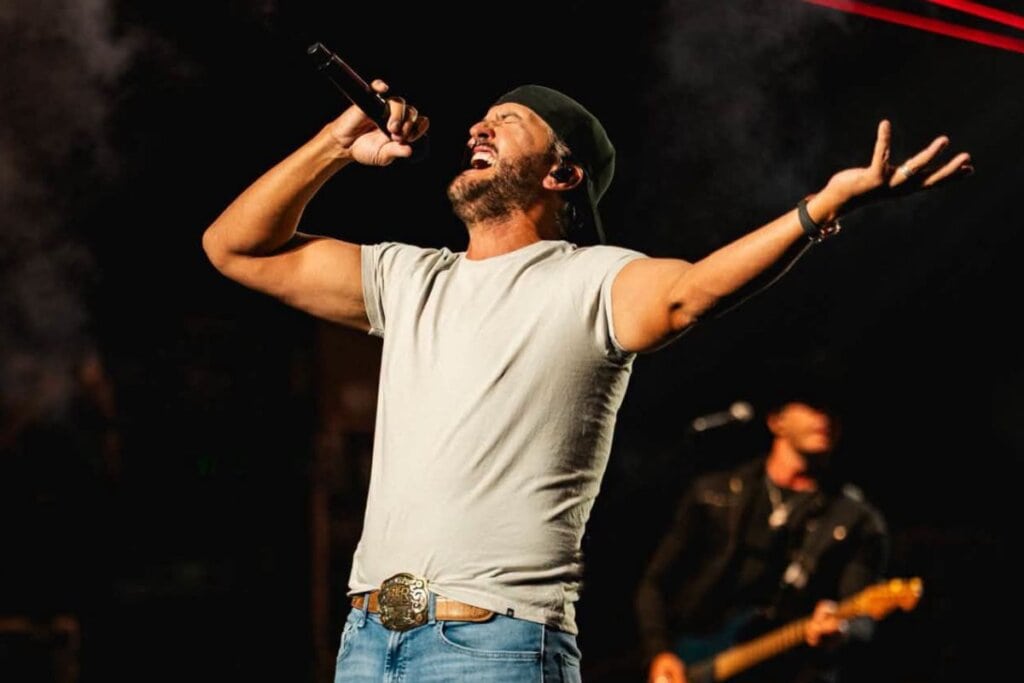
Heavy rain forced Luke Bryan’s Farm Tour stop in Latrobe, Pennsylvania to be postponed last week. Now, organizers say the concert will not return to 1846 Farms.
Bryan’s Farm Tour concert at 1846 Farms in Unity Township was originally scheduled to take place on Thursday, Sept. 17, however the weather resulted in extremely muddy field conditions that made it difficult to safely accommodate the thousands of fans and vehicles expected for the event. The Georgia native apologized for the difficult decision that had to be made and explained to fans that he and his team were working on figuring out next steps.
“I am so sorry. This call was made for everyone’s safety,” he stated.
Photo Courtesy of Luke Bryan
According to a new post from 1846 farms, there will be no rescheduled date for the Farm Tour show. They opened up about exploring “every possible option” to make it work, but were ultimately saddened to share that they were unable to find a time that aligned with Bryan’s schedule.
“This summer brought an extraordinary amount of rain across the region, creating extremely wet and muddy conditions at multiple Farm Tour locations. As working farms, these properties rely heavily on fields for parking and access, and the saturated ground ultimately made safely accommodating thousands of vehicles incredibly difficult,” the post explained.
“We know how disappointing this news is. So many people spent months looking forward to these shows, and countless hours of hard work went into preparing the farms and communities to welcome everyone. We share in that disappointment and are incredibly grateful for the patience, understanding, and support shown throughout this entire experience.”
Fans who had already purchased tickets to attend Luke Bryan’s Farm Tour concert will be refunded. Ticketholders are asked to watch their email associated with the purchase and Luke Bryan’s official Farm Tour webpage for more information.
“From all of us at 1846 Farms, thank you. The support shown to our farm, our team, and our community has meant so much to us.”
This week, the country act returns to Nashville to perform Luke Bryan & Friends at Bridgestone Arena. He has already started teasing his surprise guests by dropping hints on social media that has fans guessing who they think will make an appearance.
Then Bryan will continue with his Word on the Street Tour and perform the final stop on his stadium run with Jason Aldean, The Double Down Tour, which wraps up in Las Vegas on December 11.
A small group of White House officials is exploring whether to cut back President Donald Trump’s decision to increase foreign beef imports, as GOP panic rises ahead of the midterms.
The proposal to reduce the amount of imports is being discussed within the Domestic Policy Council headed by Vince Haley, a longtime Trump speechwriter and former campaign official, and a few other officials at the White House, according to two people with direct knowledge of the conversations, who were granted anonymity to share private details.
Trump officials are unsure if anything will come of the talks. The two people said the Office of the U.S. Trade Representative disagrees with cutting back the imports, since it aims to lower high consumer beef prices in the short term and since USTR helped implement the move.
But their conversations about partly rolling back the beef policy — which Trump instituted in August — is a clear sign the White House is trying to stem the alarm from battleground and farm-state Republicans as high prices and Trump’s tariffs roil their election campaigns. The White House is also preparing a plan on diesel exports, likely with exemptions, amid sky-high prices from the Iran war.
The White House and USTR, in statements after this article published, denied that there was any official action on the table.
“There’s no pending policy change to ‘disagree’ with,” a USTR official said. “The administration is focused on the interest of American ranchers and consumers. All agencies are supporting the President in these goals.”
“The White House is not considering such action. As the President directed in his executive order, the USDA and USTR continue to monitor beef imports to ensure that savings are being passed onto consumers,” White House spokesperson Kush Desai said.
Earlier this week, Iowa Rep. Ashley Hinson, the GOP Senate nominee, took the extraordinary step of publicly breaking with Trump, saying gas prices were too high because of the Iran war and that farmers in her state are suffering. Michigan Senate GOP nominee Mike Rogers and other vulnerable House and Senate Republicans have made similar breaks.
Farm-state lawmakers in Iowa and beyond have publicly called for the White House to provide some relief from the beef import executive action in particular, because of its impact on farmers and ranchers.
Sen. Chuck Grassley, the rest of the Iowa delegation and other senior farm-state lawmakers have all pressed the administration to change course — to no avail.
Trump did sign an executive order of rancher-friendly policies as a way to address the initial backlash. But U.S. Trade Representative Jamieson Greer made clear to a group of House Republicans in a closed-door briefing earlier this month that Trump’s executive action to import 300,000 metric tons of beef without certain tariffs and at discounted prices would go forward as planned, as POLITICO first reported.
Now she’s at the center of yet another scandal — but this time, there’s a baby involved.
When Bonnie announced her pregnancy after taking on hundreds of partners in a single day, many thought — and many hoped — that she was lying for publicity.
An empty baby bed, which has been placed under a window by the photographer. (Photo by Sean Gallup/Getty Images)
But Ms. Blue, whose real name is Tia Billinger, recently welcomed her first child. And she has since faced intense backlash over social media videos featuring the newborn alongside men wearing balaclavas.
The controversy has now escalated beyond angry comments sections.
Joy Morrissey, a Conservative Party spokesperson for equalities in the UK, contacted the National Society for the Prevention of Cruelty to Children (NSPCC) to raise what she described as “serious safeguarding concerns.”
Morrissey argued that children should not be involved in pornography or used to promote adult entertainment.
“Children are not adults,” she said. “They must never be involved in p—-graphy, used to promote adult entertainment, or absorbed into a parent’s sexualized commercial brand.”
“The concern now is that this has moved beyond people simply criticizing Bonnie online. Once safeguarding allegations involving a newborn are formally raised, they can potentially be examined by the relevant authorities,” a source close to the scandal tells Radar Online, adding:
“In the most serious circumstances, social services have powers to rip babies away from mothers or make other interventions.”
The situation has prompted widespread calls online for child-welfare authorities to investigate Bonnie, with a Change.org petition also demanding an investigation. However, there is currently no indication that authorities have determined Bonnie’s baby was harmed or that the child is being removed from her care.
That distinction is important because an NSPCC report is not the same thing as a finding of wrongdoing.
The controversy stems largely from videos in which Bonnie appears to hold her baby while surrounded by masked men.
In one clip, she also discussed having recently undergone a C-section and joked about the so-called six-week rule following childbirth.
The footage itself does not establish that the baby was present during any adult-content production, nor does it prove that a crime or child-protection violation occurred.
Bonnie, unsurprisingly, isn’t exactly accepting the criticism quietly.
“My baby is loved, protected and incredibly well looked after,” she said in response to the backlash.
She also accused Morrissey of using her name to gain attention and insisted that she understands the difference between her career and her responsibilities as a mother.
“Becoming a mum hasn’t changed the fact that I’m Bonnie Blue, but I know exactly where Bonnie ends and being a mum begins,” she said.
Family lawyer Charlotte Proudman has also raised concerns about the child’s privacy, pointing out that the baby cannot consent to having their earliest moments publicly associated with their mother’s adult-content career.
For now, there’s a whole lot of outrage — but no public finding that Bonnie’s baby is in danger or that social services are preparing to take the child away.
The question of whether the videos crossed a safeguarding line is now one for the appropriate authorities to consider, rather than the internet jury that has already rendered its verdict.
SoFi Stadium (Los Angeles) — Dejected, Los Angeles Chargers quarterback Justin Herbert sat next to offensive coordinator Mike McDaniel on the bench toward the end of their disappointing 26-14 loss to the Las Vegas Raiders. The two appeared to be having an uncomfortable conversation about how to put the pieces together. It was supposed to look different, but through two games, the Herbert-McDaniel marriage has been a failure. That newfangled offense, led by the most coveted offensive coordinator in this past offseason’s coaching cycle, has been stuck in neutral. “Fire the OC,” a longtime NFL scout told me when asked how to fix Herbert, firmly placing the blame on McDaniel. “Go back to a scheme that fits him. Starting NFL QBs need coaches to fit their strengths and weaknesses — not fitting the coach’s scheme to the QB.” The numbers aren’t pretty. Herbert is 23rd in passing yards (401), 28th in passer rating (71.6) and tied for third in interceptions (3). The Chargers are 29th in the NFL in scoring (14 points per game) and have generated just three passing plays of 20-plus yards. The Chargers had six fumbles against the Raiders. Pro Bowl right tackle Joe Alt leads the league in penalties with five. In a preseason conversation with McDaniels, he told me the focus during the offseason was on creating an offense that got the ball out quicker so Herbert didn’t get hit as much as he did last season. Herbert took the second-most hits among quarterbacks (74) and was the third-most sacked quarterback in 2025. McDaniel also pushed Herbert to take more risks down the field during training camp, asking him to play with more anticipation and try to fit the ball into tighter windows. One thing that could help Herbert is the return of less pre-snap motion to distort the defense, which has led to more confusion. That included a botched snap on an important third down against the Raiders where the snap hit receiver Tre’ Harris, which caused Herbert to lose his temper. The Chargers have used motion on 79.6% of their plays this season, No. 2 in the league, per Next Gen Stats. In 2025, under offensive coordinator Greg Roman, the Chargers used pre-snap motion on 61% of their plays. Expected to compete for a Super Bowl, the 0-2 Chargers face a stretch of five playoff teams from last year, the 2-0 Kansas City Chiefs and a competitive Baltimore Ravens team over their next seven games, a daunting stretch to prepare for while trying to fix a disjointed offense. However, a longtime NFL front-office executive I spoke with believes head coach Jim Harbaugh will get things right. “Usually, less is more,” the exec told me. “Cut the game plan down. I wish they would let Justin go back to his old footwork and less pistol, but they are probably too far down that road. “The offensive guards are struggling and the fullback is poor. Plus, they never replaced all of Keenan Allen’s production. But Harbaugh is a problem solver. He’ll get more involved with the offense is my bet.” Reading headlines about the San Francisco 49ers this offseason was like watching an episode of “Cops.” WARRANT ISSUED FOR BRANDON AIYUK AFTER VIRAL SPEEDING VIDEO 49ERS HEAD COACH KYLE SHANAHAN INJURED IN CAR CRASH 49ERS OWNER JED YORK ARRESTED IN PROSTITUTION STING MAN POSING AS 49ERS PLAYER CHARGED WITH FRAUD Through it all, San Francisco ignored the noise and rightly showed up in Australia a week early to throttle the late-coming Los Angeles Rams. The following week, San Francisco easily handled the tanking Miami Dolphins. And the center of the team’s success has been quarterback Brock Purdy playing at an MVP level. The reason? After three years of battling through nagging injuries that began with a torn UCL in his right elbow in the NFC Championship Game in his second NFL season, Purdy appears fully healthy. Purdy leads the league in completion percentage (80.4%), is third in passer rating (125.6) and is fifth in passing touchdowns (5). And because he’s healthy, Purdy’s mobility has returned. He’s run for 59 yards and a touchdown through two games. “I just feel like I’ve grown a lot with who I am as a person, as a quarterback, trying to grow my game,” Purdy recently told reporters. “What I knew then compared to now is obviously a night-and-day difference. And understanding still, though, that same love of the game that I had from my first start until now has been the same” San Francisco sitting tied atop the NFC West should not be a surprise because all their key foundational players are healthy. Along with Purdy, Christian McCaffrey, George Kittle, Trent Williams, Deebo Samuel, Nick Bosa and Fred Warner all started the first two games and are healthy heading into the team’s Week 3 contest at home against the Arizona Cardinals. Purdy, McCaffrey and Williams were the only three of those players on the field for the 41-6 NFC divisional playoff loss to the Seahawks last season. Against the Dolphins, Purdy had one of his best games as a pro, finishing 20 of 22 (90.1%) passing for 287 yards, with two touchdowns and barely missing a perfect passer rating at 149.1. The game included 18 straight completions, as San Francisco scored on its first five drives. Still just 26 years old and in his fifth NFL season, Purdy is just starting to come into his own as a pro. “It’s unbelievable to watch,” McCaffrey said about Purdy’s last outing. “How decisive he is. How good he is at throwing on time but also creating when he has to. When he’s at the helm, we feel good.” Few NFL observers expected the Raiders to sit at 2-0 to start the year while No. 1 overall pick Fernando Mendoza still held a clipboard. But the Raiders’ success reminds me of a conversation I had late last year with Seattle Seahawks quarterback Sam Darnold about this team’s new head coach Klint Kubiak, when I asked him to describe his then stoic offensive coordinator’s personality. “We’re very similar,” Darnold told me at the time. “No BS is the best way to describe it. We just kind of go about our business. If something needs to be done, we’re going to get it done. If something needs to be said, we’ll say it. But we like to work, and we love football.” Kubiak’s no-nonsense, lunch-pail approach to building a culture is similar to the approach Mike Macdonald took in leading the Seahawks to a Super Bowl last season. “It’s 17, one-game Super Bowls in a row,” Kubiak said. “That’s how our guys have to treat it if we want to be a successful organization.” So far, Kubiak’s approach has served him well in Las Vegas, according to the team’s best player, defensive end Maxx Crosby. “He’s hard on us during the week, for sure,” Crosby said after the game. “But it’s because he wants us to go play free, have that confidence and we have the confidence in him. We believe in putting us in situations where we’re going to capitalize. And we believe in him and what he’s doing.” There’s no arguing with the results. Second-year pro Ashton Jeanty has come to life, with 210 scrimmage yards and two touchdowns through two games. Kirk Cousins has done a nice job of managing the game and creating explosive plays. Defensively, the Raiders have held teams to 13.5 points per game, No. 5 in the NFL, and forced five takeaways in two games. The son of former NFL head coach Gary Kubiak, the younger Kubiak understands there’s more to do. “This is the NFL,” Kubiak said after his team’s win over the Bolts. “This is the most competitive business in the world. So, our players, our coaches all want to win. And that’s our job, is to win. “We’ve got 15 more games. I’m really proud of today, but the way that you win more is you forget about quick and you back to work on the next one.” 5. Las Vegas Raiders Las Vegas is off to a good start, and their best player, tight end Brock Bowers, has yet to play. 4. Los Angeles Rams Kyren Williams (23 carries, 126 yards) and Blake Corum (22 carries, 133 yards) have pretty much split the carries through two games, providing extra playmaking beyond Davante Adams in their win over the New York Giants on Monday night. 3. Kansas City Chiefs Much has been made about Patrick Mahomes’ return and Kenneth Walker III’s hot start, but don’t sleep on the Chiefs’ defense. The defense is surprisingly holding teams to 252.5 total yards per game, ranking third in the NFL. 2. San Francisco 49ers The San Francisco 49ers have had as good of a start to the season as they could’ve asked for. There are some questions, though, about their depth at receiver. They addressed that on Tuesday, with former Rams WR Brandin Cooks returning to NFC West by joining San Francisco’s practice squad. 1. Seattle Seahawks Starting quarterback Sam Darnold (glute) is slated to return to practice this week, but the Seahawks can take their time bringing him back with Drew Lock leading the league in passer rating (127.3). “Sometimes you win, and sometimes you learn. And sometimes you have a dumb ass coach who makes travel plans that put you in a bad spot.” Rams head coach Sean McVay on his team’s failed travel plans to Australia.Latest Sports News from FOX Sports
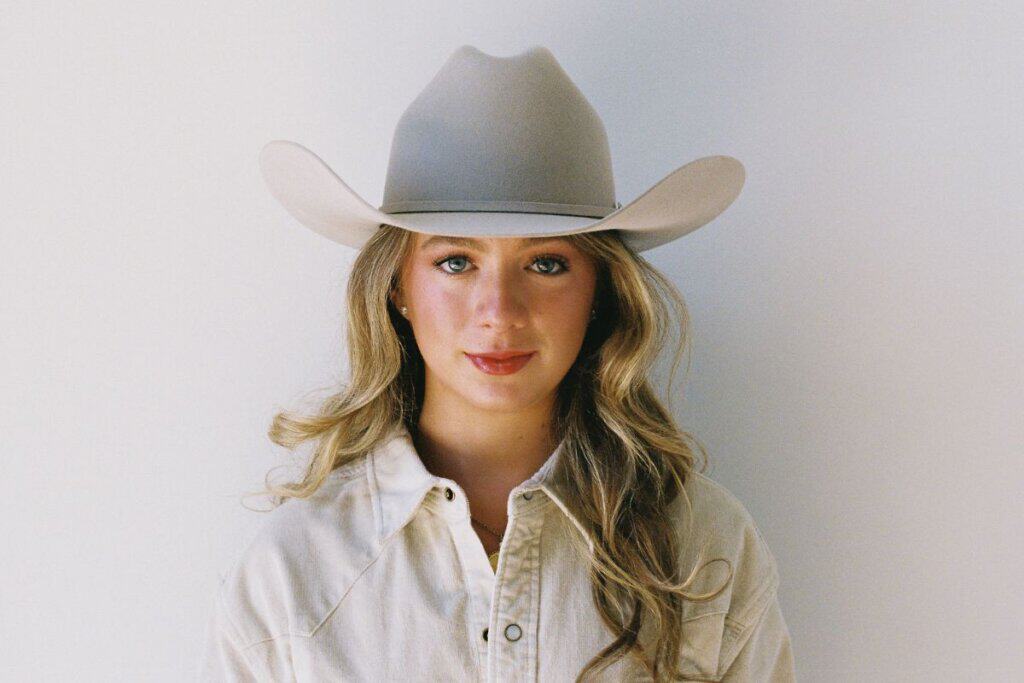
Currently in her third year at Belmont University and set to graduate in May, Carlisle Wright is already making a name for herself while staying true to the traditional country sound she was raised on in Tennessee.
As a fourth-generation singer-songwriter, music has always been a part of Wright’s life, but she’s determined to carve out a path of her own. That drive has already led her to some major stages, including her Grand Ole Opry debut, CMA Fest and Nissan Stadium, where she opened for her great-uncle Alan Jackson at his final concert in Nashville.
Carlisle Wright; Photo Provided
Wright is also giving fans a better look at who she is through her recent single, “Wright Kinda Country,” which serves as is an unapologetic introduction into her roots and unique sound that blends classic country with a modern flair. Written alongside Nicole Witt and Matt McClure, the fiddle-laced track pulls from Wright’s real-life experiences and the people that shaped her love for the genre.
Wright has no plans of slowing down. In fact, as she continues to gain momentum, she remains fully committed to pursuing the career she’s passionate about, with no Plan B in sight. With graduation just around the corner and her next release, “Born In A Dive Bar” on the way there’s plenty more to look forward to from this rising country artist.
Keep reading to learn more about how Carlisle Wright is keeping traditional country music alive, her musical upbringing, the milestones she achieved this summer, and more.
When do you remember your love for music really starting to form?
So I feel like I’ve probably been singing since I could talk as far as just sitting in the back of the car and listening to music and whatever. And in preschool, I went to a Montessori center that’s off Granny White in Nashville, and they make you pick an instrument to learn. So…preschool, so that two to three age range, is when I picked up guitar for the first time and figured it out. I don’t even know how my hand fit around in front, but it’s to some extent. And then just once I got to kindergarten, I started taking piano lessons from my uncle and did that till fourth grade, got bored of piano and switched back to guitar. But fourth grade was the first time I recorded a solo written song. It was a Christmas song I had given to my family. And I feel like that’s the first time I can pinpoint as far as the writing goes, finishing a song.
As a fourth-generation singer/songwriter, was your home full of music all the time?
Yeah, a lot of it was classic country. My dad would make these CDs that we called “Sleepy Time CDs” because he’s a pilot and so he’s gone and has been gone, if you think about it, pretty much half my life, which is crazy to think about. And so my mom grew up on classic rock, so when I was with her so much growing up and I would hear a lot of that influence and my dad’s like, “Nah, she’s got to learn the good stuff too.” So he made those CDs and it was just a thing to put them on my CD player every night before I went to bed. And once I picked up a guitar, that’s the sound that I clung to.
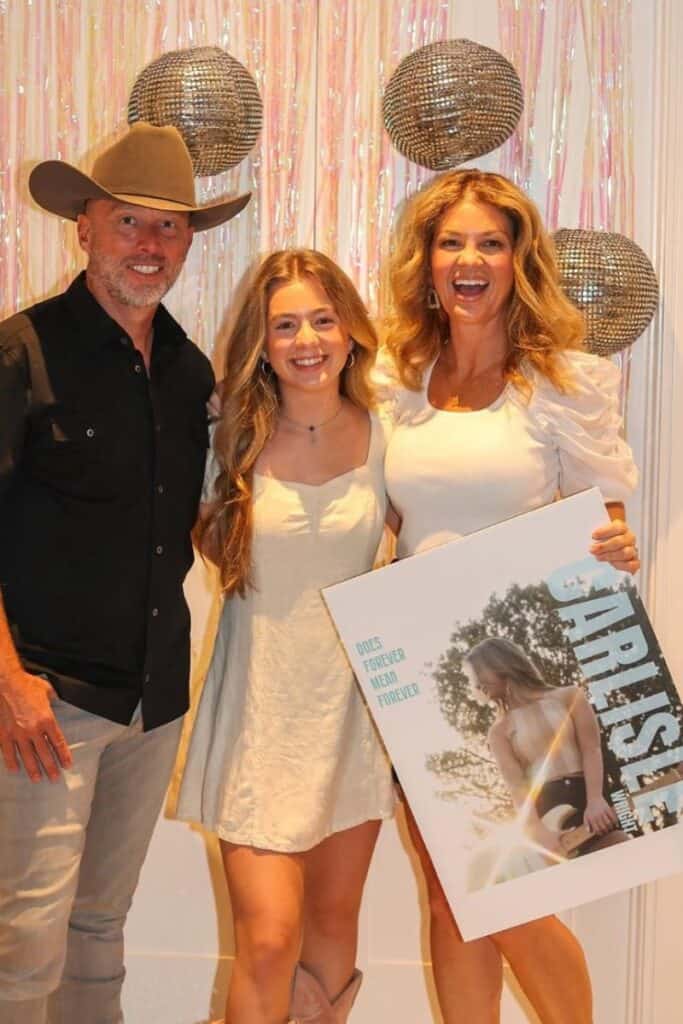
Carlisle Wright and parents; Photo Courtesy of Carlisle Wright
You mentioned that you began songwriting at an early age, but when did you really start performing in front of an audience?
I did every single one of the elementary school talent shows, and I distinctly remember and have seen pictures and videos since. I sang “Mama Tried,” I think first or second grade, and I wore a pearl snap and literally the guitar, there’s this one picture of me walking down the school hallways with a guitar that’s bigger than I was at the time. But I always make a joke of no one my age at the elementary school probably knew what the heck I was singing, but the teachers loved it.
What was your experience transitioning to life at Belmont University and how has that helped continue to establish your career in country music?
Belmont was the only school I applied to, and I knew right away that the songwriting degree was what I wanted. And quickly once I got there, figured out that music business was the minor I wanted to attach to that because I’ve just learned so much in the business side. And once I got to Belmont, quickly realized that there’s very few country writer artists and a small, small, small fraction of that was traditional. There’s really not any of us. And before Belmont, I didn’t co-write a whole lot. It was pretty much all solo writing and adapting to the co-writing culture, coming to Belmont was I think one of the biggest transitions and something that now is incorporated into every single day of my life pretty much. And then the first thing I wanted to do when I got there was form a band because I love playing live and bringing original songs to life as well as playing my favorite ones, covers and such, because my dad has a band that he performs with for fun. And I’m like, I need one of my own age people who love it as much as I do. So started a band, October of my freshman year was the first practice that we had. And then some players have changed, but we’ve had a lot of gigs under our belt already and now it’s two year going on now that a lot of them have been with me.
How did it feel to win the Belmont Showcase Series this past spring?
I went to it my freshman year like, “This is so awesome. I need to do this.” And so we applied as soon as we could apply and they’re the best people because they have my back always and support me always, but it’s also a lot of time and effort that is unpaid because it’s a school thing. And I could not have done that without them because it’s definitely a lot of yourself and your energy to give to something like that. And so we found out that we got a live audition and then we did the live audition and found out that night that we were in the four. So then we got to perform. And I feel like that was a huge moment of all of our practices and all of our, excuse my French, sh***y bar gigs and everything else that we’ve played have put the chemistry on stage to the test and proved itself.
What are your plans after graduating next spring?
It’s a whole lot of doing exactly what I’m doing, just hopefully more of it and not having to study for tests. That’s what I’m looking forward to doing and manifesting that hopefully in the near future there’ll be an on-the-road position. That’s what I’m really hoping for.
What did it mean to you to get to perform at your great uncle, Alan Jackson’s final concert in Nashville this summer?
It was a super bittersweet moment. Labor Day weekend actually was the one-year mark of when he had asked/told me to play this time last year for the show. So it was nine months of anticipation leading up to it, which is a long time. And a lot of that time I couldn’t even tell people about it. So when the day finally came, it was so just exciting, but bittersweet at the same time because I feel like classic country in general just has that nostalgic feeling to it. And I think that’s why so many people enjoy it and can always go back to it, even if that’s not what they listen to on the daily. And for me and my family in particular, we grew up going to Uncle Hat’s shows every time he had a tour, at least one. And so his shows are the soundtrack of growing up and seeing each phase of what each tour looked like and what the venue was and the difference of the venue in five years from then. And so knowing that that was the last show we were going to see, there was definitely tears, that’s for sure.
It’s crazy to think that, yes, I’m only 20, but the 20 years of listening to a person’s concert is a lot of years. I just think there’s no show like his. And so that day was super special, getting to hear his set for the first time and then being a part of it myself was just, that was always a bucket list thing and I didn’t know it was going to happen. So it was really cool.
What has it been like having his support as you’ve pursued your own path in music?
I always love getting to sit down and talk with him and hear his stories. And he’s like, “Well, you got to do this. Don’t do this.” It’s really cool to hear it from somebody like that, but also someone so close to you as well.
Is there one piece of advice he’s given you that has really stuck with you?
Well, minus the keeping it country, of course, I think the main thing would be to be yourself. He told me that and was like, “You don’t need to put on a costume and be like somebody else or write songs that you’re not actually living. If you’re yourself and you are confident in that, it’s going to show and it’s going to attract to people.” I just think that’s so important because in today’s day and age especially, it’s hard to do exactly what you want, even if it’s not what other people are looking for out of you.
Shortly after the milestone Alan Jackson show, you got make your Grand Ole Opry debut. How was that night for you?
It gives you chills. That place is just so historical, and being in the circle for the first time was just a what the heck moment because it’s something I’ve dreamt about for literally my whole life. And being there to walking that backstage and just looking at all the pictures and getting to sign the little book that people sign when they make their debut, it’s so crazy cool to think how far history has come in country music and where it stands now, but also getting to be a part of where it’s going, I think was just full circle.
Digging into new music, you most recently released “Wright Kinda Country.” Talk about writing this one.
I kind of just clung to the idea of my family and I, with the last name that we have, we always make jokes about our way being the “Wright way.” And so I was like, “Oh, I want to write ‘Wright Kinda Country.’” And going along with that, I get asked so many times since I’m younger, “Why do you like classic country?” or, “Really, what does that mean to you?” And I feel like every time I get asked, I have a better way to describe it, but it’s definitely still a hard question to pinpoint an answer on. And so I brought this idea into the room and we started writing it and then we had packed up for the day and the next time we came back to it, pretty much rewrote what we had already written because I’m like, “This is actually what we need to say.” And it was just picking what I felt like were pinpoint moments of the life that I have lived, even though it’s not long, as far as this is when music started, this is the sound and who I got it from. And I don’t know, just as far as even the little lines of “honky-tonkitis,” my dad puts out music for fun and that is one of his song titles. And not many people know that, but that’s kind of why I said it because honky-tonks are a big part of my brand and the places I play, but then things like that that tie back to him. And I don’t know, it was just a getting to pull together my why of classic country.
What other new music do you have in the works that fans should know about?
Yeah, so we do have a new song coming out in a couple weeks. I have not announced yet, but top of October will be another one, and it’s called “Born in a Dive Bar.” It’s another honky-tonk style song, but it kind of talks about, I always tell people when I play it live, I’m like, “Childhood looked a little different as far as my parents were not afraid of taking me to Honky-tonk dive bars.” And so whether it was listening to a family, a friend, a mentor, or playing it, I just felt like I’ve grown up in that scene of music. And no, I wasn’t actually born in a dive bar because I’ve had people ask me that. Just feels like it. Wrote that song with one of my songwriting heroes, Mark Irwin, and I’m very excited about that release. And so as far as that goes, yeah, we have some other songs and I’m getting ready to record some new ones. So definitely working towards a bigger project that will hopefully see the light of day next year.
It’s been a little over four months since Lainey Wilson and Devlin “Duck” Hodges tied the knot and according to the songstress, married life has been everything she could have hoped for.
Wilson opened up about her days as a newlywed while backstage at the 2026 iHeartRadio Music Festival in Las Vegas on Saturday, September 19. During an interview with Entertainment Tonight, she was asked what has surprised her most about being married.
“I hadn’t got rid of him yet,” she joked. “That probably surprises him.”
Photo Courtesy of Lainey Wilson
On a more serious note, Wilson confirmed that it has been “absolutely incredible” doing life with Hodges by her side as husband and wife.
“It just feels good. It feels like we’re just turning the page into this beautiful chapter. I mean, he’s the best thing that’s ever happened to me. I’m telling you, he’s a good man,” she added.
When the Entertainment Tonight described Hodges as a good “copilot,” Wilson quickly agreed.
“He is,” she said.
The Louisiana native and the former NFL player exchanged vows at Ruskin Cave in Dickson, Tennessee back in May. The couple celebrated surrounded by family, friends and several fellow country stars, including Luke Bryan, Ian Munsick, Lauren Alaina, Ella Langley, Miranda Lambert, Wynonna Judd, Ashland Craft, Drew Baldridge and Jelly Roll.
Their wedding came just over a year after Hodges proposed to Wilson in February 2025 on the doorstep of George Jones’ former estate in Franklin, Tennessee.
Now, Wilson is settling into married life while continuing to navigate her busy career. She recently performed at the 2026 iHeartRadio Music Festival at T-Mobile Arena in Las Vegas. During the award show, she paid tribute to the late Dolly Parton with a powerful performance of “WWDD,” a song she wrote for the country music icon that appeared on her 2021 project, Sayin’ What I’m Thinkin’,” as well as Parton’s hit, “9 To 5.”
While on stage, she described Parton as being “my hero,” and “the lady that I looked to for everything.
“They say never meet your heroes, but that did not count with Dolly Parton,” Wilson continued. “She was better than I could have ever imagined. … Let’s celebrate for Dolly Parton, y’all!”
Fans can catch Lainey Wilson at a slew of upcoming festival before she returns to Nashville to host the 60th Annual CMA Awards, airing live from Nashville’s Bridgestone Arena on Wednesday, November 18, at 8/7c on ABC and Disney+.
This will mark her third consecutive year acting as host of the show and her second time taking on the role solo. Wilson previously shared hosting duties with Peyton Manning and Luke Bryan.
Wilson is also heading into the night a three-time nominee in the categories of Entertainer of the Year, Female Vocalist of the Year and Single of the year with “Somewhere Over Laredo.”