Forget the Big Mac and Whopper – McDonald’s and Burger King’s iconic fries usually steal the show. So, how do they stack up against each other?

Food Republic – Restaurants, Reviews, Recipes, Cooking Tips









Forget the Big Mac and Whopper – McDonald’s and Burger King’s iconic fries usually steal the show. So, how do they stack up against each other?
Food Republic – Restaurants, Reviews, Recipes, Cooking Tips

Not everyone thinks there’s an affordability crisis.
While many Americans say the cost of living is the top issue facing the U.S. more than any other, President Donald Trump’s MAGA base does not always agree, according to a new analysis of The POLITICO Poll. Just 28 percent of voters who self-identify as part of the MAGA movement say expenses have become less affordable since Trump took office.
In fact, MAGA voters are more likely to say things have gotten better rather than worse.
That’s a stark break from the rest of the country, including the voters who backed Kamala Harris in 2024 and those who voted for Trump but do not identify as part of the MAGA movement.
The POLITICO Poll results reveal a complicated challenge for Republicans: In an election all about the economy, cost of living concerns are reinforcing partisanship divides — entrenching Democrats’ opposition to Trump — while also driving a wedge among Republicans’ own base. Now, GOP candidates are facing frustrated voters from all sides.
Harris voters are far more likely than Trump voters to say groceries, gas and other expenses have gotten more expensive since the president took office, despite facing similar increases in household costs, according to a POLITICO analysis of cost of living data.
Democrats hope to ride that frustration to victory in November, and have made affordability their top messaging issue this fall. They’re poised to benefit from the backlash to Trump’s economic agenda — from his unpopular tariffs to an Iran war that’s raised gas prices — which politicians and strategists widely agree are helping motivate Democratic voters.
“Those Democrats are definitely going to go vote,” said Michigan-based GOP strategist Jason Roe. “And we’ve got some voters that are a little harder to get to the polls, and when they are mad, frustrated, disappointed, disillusioned, in disagreement, and we don’t have them motivated, that’s going to be a problem.”
Many of those disillusioned Trump voters, The POLITICO Poll suggests, are the ones who don’t identify as part of the MAGA base.
Consider the 52% of non-MAGA Trump voters who say the cost of living in their area is the “worst” it has ever been: Nearly half say they either wouldn’t vote for a Republican in the midterms or are still making up their minds.
But what is a boon to Democrats today could be a problem for them later. Partisanship also shapes how Americans remember the economy in years past, the poll results show.
Harris voters have a more favorable memory toward Democratic presidents and Trump voters have a more favorable memory toward Republican presidents, each saying life was more affordable when their party held the reins.
Democrats and Republicans simply don’t share an understanding of the economic reality — and without a common frame for the past, nor whether things are improving in the present, any party in power stands to lose its grip against an increasingly frustrated opposition when the economy is the key issue.
This year, that will be a major challenge for Republicans.
The POLITICO Poll asked adults across America last month about affordability in their area, including about local prices and their memory of when prices were more affordable in the past.
Across the board, Harris voters outpaced Trump voters in their pessimism about the economy. And among Trump voters, non-MAGA voters outpaced their MAGA counterparts.
For example, 70% of Harris voters and 52% of non-MAGA Trump voters say the cost of living is worse than they can “ever remember it being.” MAGA Trump voters disagreed — a 43% plurality said the cost of living today is bad, but they could “remember times when it was worse.”
The results are a warning sign about the Trump coalition: In question after question, the president’s most loyal base is still sticking with him, but among the non-MAGA voters he convinced to back him in 2024, their frustration more closely resembles how Harris voters feel.
“There will be voters who voted for Donald Trump in 2024 who know he’s made life more expensive and won’t vote for his party this time,” said longtime Democratic strategist Jesse Ferguson. “Some will vote for a Democrat, some won’t vote. But they won’t cast a ballot for a Republican who they blame for the high cost of living.”
Of the non-MAGA Trump voters who say the cost of living is the worst they’ve seen, just 53% say they would vote for a Republican if the midterms were held tomorrow. More than 25% would vote for a Democrat or third-party candidate. The rest say they would stay home or have not yet made up their minds.
Changes to family budgets are similar on average among those that voted for Trump and those who voted for Harris, according to a POLITICO analysis of data from the Living Wage Institute, a nonpartisan public benefit corporation that produces cost of living data. Across the country, family budgets have increased by 2.5 percent on average from early 2025 to early 2026, according to the Living Wage Institute.
But it is the concept of who is to blame that creates division among each voting bloc. Though each group is concerned about affordability — the cost of living is the most common concern for each — only MAGA Trump voters remain sympathetic to the current administration.
Young voters — and young men in particular — have also grown disillusioned with the Trump administration amid cost of living concerns, a warning sign for the GOP. Among those under the age of 25 who say the cost of living is the worst it’s ever been, 56% say they trust Democrats to bring down the costs. Just 20% trust Republicans to do the same.
“Young people feel like the system isn’t working for them,” said Joe Mitchell, a Republican running for Iowa’s open and competitive 2nd District. Mitchell, who is 29, would be the second Gen Z member to join the House if elected. “You see them being attracted to some of these DSA candidates like Zohran Mamdani. And they’re going to be attracted to these candidates if we don’t figure something out for them now.”
Partisanship also colors how Americans see the past, making it difficult for any incumbent party to convince voters of plans for the future.
The POLITICO Poll asked respondents whether it was easier or harder to afford everyday items in years past compared to today in one of two ways: In one, they were asked about a specific calendar year, and in another, the presidential administration in power at the time.
For each question framed around a calendar year, Trump and Harris voters gave similar answers. But when asked to compare how easy or hard it was to afford things during a particular presidential administration compared to today, their answers split along party lines.
For example, just over a third of both Harris and Trump voters said it was “easier” to afford everyday items in 2024 compared to today. But when asked the same question about the “end of [former President] Joe Biden’s term,” 55% of Harris voters said everyday items were easier to afford, compared to 39% of Trump voters.
The results show that Americans lack a common frame of reference on the issue most people care about — the cost of living — creating a massive hurdle for politicians hoping to win over new voters who may not be willing to listen.
The same effect happens among Trump voters looking back on a Democratic administration. When asked about costs in 2010 compared to today, 63% of Trump voters said everyday items were easier to afford then compared to now. But when asked about costs during the “middle” of former President Barack Obama’s first term — or 2010 — only 36% of Trump voters said the same.
It’s only when a political party is attached that Americans’ version of the truth changes.
When POLITICO asked whether it was easier or harder to afford everyday items “just before the Covid-19 pandemic” or in “2019,” majorities from both parties said things were easier to afford then, and in both framings.
The challenge for both parties is that voters don’t know “who has a better plan for the future,” GOP communications strategist Kevin Madden said. “Instead, what you’re seeing is a gap — or a canyon — emerge between the rest of the country and Washington.”
He added: “When you see that gap emerge, watch out if you’re an incumbent.”
Alisa Vasquez and Andrew Howard contributed to this report.
Politics

The opera is over, but the show will go on.
“Ḵutulagaaw: The Tlingit-Russian Battles,” billed as the world’s first Tlingit opera in recorded history, ended its stage debut Sunday after selling out all performances during a two-week run, according to Sealaska Heritage Institute, which co-produced the opera with Perseverance Theatre.
A video crew filmed the opera, which is expected to be shown at free public screenings and available to people at SHI’s archives in…

Pressure cookers, like the Instant Pot, can be useful when you need to cook a big chunk of tough meat fast, but there can be several problems with them.

Food Republic – Restaurants, Reviews, Recipes, Cooking Tips

When Kenny Chesney announced a special Silver Sand Marina album release show at Nashville’s The Pinnacle, you already knew it was going to be a special night.
The superstar is fresh off two back-to-back summers at The Sphere in Las Vegas and is no stranger to selling out stadiums, so the chance to see him play a $10 underplay at The Pinnacle was pretty special.
Those lucky enough to score tickets packed into the venue, ready to see the Country Music Hall of Famer up close. As the lights went down promptly at 7:30 p.m., the energy in the room was palpable.
“We Do,” Chesney’s love letter to his beloved fan base, No Shoes Nation, began blasting through the speakers as the crowd erupted, signaling that Chesney was about to take the stage.
The East Tennessee native entered the venue with a huge smile, greeting fans with waves before launching into 2006’s “Summertime.” And for a song that is now two decades old (how is that even possible?), it still hit just as hard.
He went on to perform fan favorites like “Here and Now,” the carefree “Beer In Mexico” and “Save It For A Rainy Day” before offering up a taste of his new album.
Making his way to the front of the catwalk, Chesney delivered the slow-burning “Burn My Boat,” followed by “Goldfish,” which he described as the only breakup song he’s ever heard that somehow made him feel happy. He then picked up the pace with “Talkin’ Dirt,” a song about small-town gossip spreading like wildfire.
Between setlist staples like “Living In Fast Forward,” “Young” and “Reality,” Chesney also brought back “Ain’t Back Yet” for the first time since 2015. He celebrated his newest No. 1 single, “Carry On,” and revealed that “Remember Me That Way” would be his next single at country radio.
Amid the 95-minute set, Chesney welcomed fellow East Tennessee native and soon-to-be Original Vibe Room tour mate Greylan James to the stage to join him for “Born,” the title track of his 2024 album, Born, which James co-wrote.
Chesney explained the full-circle moment, sharing that his mom used to cut James’ hair when he was a young boy. Now, years later, the two are set to tour together next summer.
The Pinnacle transformed into a giant party for “Out Last Night,” and when we thought the energy had reached its peak, Chesney returned to the stage for a two-song encore featuring “American Kids” and “Don’t Happen Twice.”
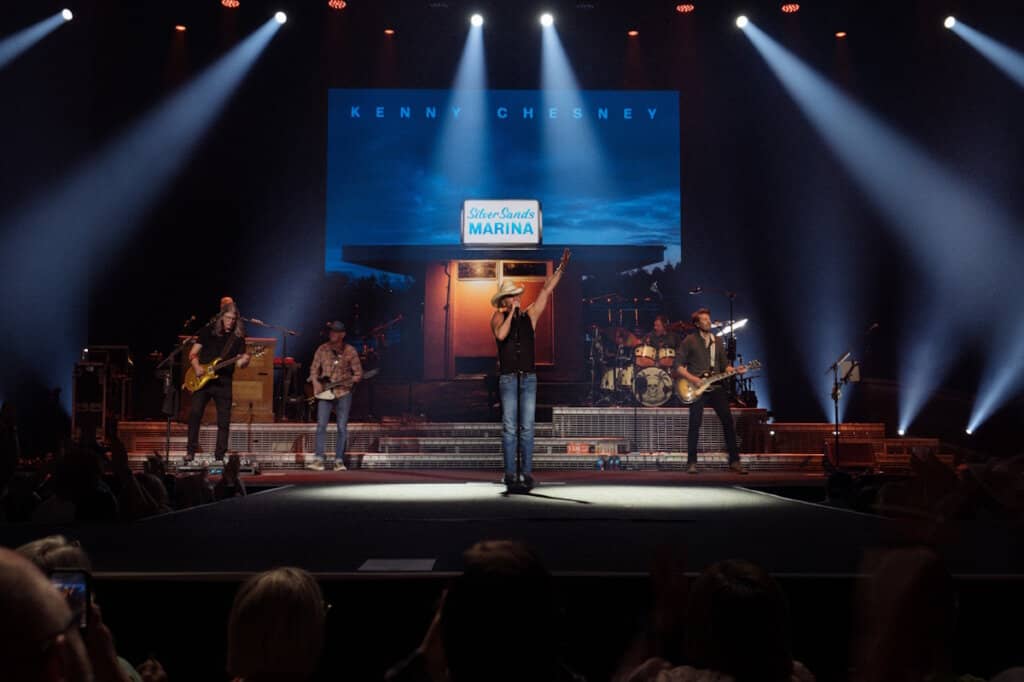
Bringing the same level of energy he brings to an NFL stadium, Chesney was full of life and smiles and interacted with fans throughout the night. Vocally, he sounded better than ever, with each track playing out like the studio versions.
Fans around the world listened in on No Shoes Radio, while those inside The Pinnacle got a preview of the energy Chesney will bring to stadiums next summer. The wait is officially on, with his stadium tour set to kick off April 24 in Tampa, Florida.
Silver Sands Marina is out now.
The post Kenny Chesney Brings Stadium-Sized Energy to $10 Nashville Underplay at The Pinnacle appeared first on Country Now.
Country Now

Howdy,
Before anything else: if you maintain WordPress sites, go update them. WordPress 7.1.2 shipped on September 22 to patch a single critical vulnerability in page template resolution, one that lets an unauthenticated attacker load a chosen PHP file from outside your active theme’s directories.
Now let’s move on to better things. Anne McCarthy is auctioning off her framed WordPress release albums, the ones given to release squad members. All the proceeds go to Stimpunks, a nonprofit started by Ryan Boren, who joined the project in 2003 and wrote the plugin system that nearly every site runs on. She calls the albums “a form of a gold medal to me,” and she built the auction site herself in a week. The starting bid is $500.
We also learned this fortnight that the next default theme will be called Ipsum, which means 16 years of naming themes after the calendar is over. Admittedly, I’ll miss the old Twenty* names a little. But it’s time for something new for a new era.
Two more quick things: WordPress has taken its turn leading the Open Website Alliance, alongside Drupal, Joomla!, and TYPO3, with Mary Hubbard holding the rotating presidency for the WordPress Foundation. And starting with 7.2 in December, release parties move from in-person events to livestreamed webinars, so the whole squad can actually be there.
Enjoy your weekend!
Your friendly neighborhood dev advocate, 
Justin Tadlock
Two security releases in six days. WordPress 7.1.2 is the urgent one, and it’s security-only: an unauthenticated attacker can, under the right conditions, make page template resolution include a readable local PHP file from outside the active theme directories. John Blackbourn led the release, Robert Ressl disclosed it, and the fix was backported to every eligible branch going back to 4.7.
Five days earlier, WordPress 7.1.1 arrived as the regular maintenance release with 11 security fixes, 17 bug fixes on Core, and 19 for the Block Editor. Aaron Jorbin led it, and Anthropic is credited twice in the security list.
Aki Hamano announced what’s new in Gutenberg 24.0. The big feature: post title changes now show up in revisions with a proper diff, so you can stop guessing when a rename happened. The Gallery block gains a Grid variation with column count and “crop images to fit” configurable per breakpoint, and Site Title picks up fit-text, scaling to the width available instead of a fixed point size. And nearly 100 icons were redrawn on a stroke-based grid.
Stalled out somewhere between “clone the repo” and “why won’t this build”? Contributor Toolkit 1.2 from JuanMa Garrido now covers Gutenberg as well as Core, and it runs a stock WordPress in Playground with your checkout mounted as the plugin, already activated. No local server, no Docker.
Anne McCarthy published the roadmap to 7.2, and it looks to be a security-heavy cycle by WordPress standards. Sudo mode gates sensitive admin actions behind re-authentication, a new Secrets API gives credentials “a first-class way to store credentials safely,” and Application Passwords get hardened. Notes should gain a suggestion mode and emoji reactions. Designers get form element customization in Global Styles and custom block states. The final release lands in early December.
Real-time collaboration came out of WordPress 7.0, and Chris Zarate has now explained why in a post on moving to a server-aware approach for collaboration, written with Alec Geatches, Dennis Snell, ingeniumed, and Paul Kevan. The old design had browsers hold the post in a CRDT document and sync peer-to-peer, which broke three ways: the server couldn’t tell who made which edit, opening the door to content laundering; REST API and WP-CLI updates couldn’t participate, so saves became all-or-nothing overwrites; and a dropped connection could take your work with it. Three candidate sync engines are on the table, with a gutenberg-sync-engines repo to test against. If you build editorial tooling, have an opinion about this now.
The next default theme has a name, and for the first time in well over a decade, it isn’t a year. Henrique Iamarino introduced Ipsum, built with Carolina Nymark, Maggie Cabrera, and Juanfra Aldasoro. The reasoning behind the naming change: “default themes will have their own names and change when the design calls for it, not when the calendar does.” The theme is intentionally spare. It’s blog-first, has minimal typesets, and structural elements that stay invisible until you need them. The request is simple: “try it and tell us what breaks and what’s missing.”
Nik Tsekouras opened a call for testing the DataForm editor inspector, which rebuilds the Post and Page tab of the Settings sidebar so it stops drifting from Quick Edit in the Site Editor. Install Gutenberg 24.0 or later and enable Editor Inspector: Use DataForm under Settings → Gutenberg. Test it as an editor, author, and contributor, not just as an admin.
A minor release can touch more than twenty branches, and much of that work was done by hand. Lance Willett opened a public repo of Core release tools, which includes tagging, release docs, SVN merge verification, and contributor lists.
Huzaifa Al Mesbah counted 84 people who tested WordPress 7.1 across 337 Trac tickets. Fifty were first-timers, which is 60% of everyone who showed up. The most important line: “you don’t need to be a developer.” 7.2 testing is open now.
WooCommerce 11.2 lands the week of October 6, so read Shani Banerjee’s pre-release notes before it arrives rather than after. Order withdrawal emails become configurable, the CSV importer can match products by Global Unique ID when neither ID nor SKU is available, and checkout fields gain date support with min/max validation. Two of the seventeen developer advisories will bite if you ignore them: date filters in wc_get_orders() and wc_get_products() now read a bare date as a day in your store’s timezone rather than UTC, and the Cart and Checkout order summary becomes a fixed 360px column with the two-column breakpoint moving from 700px to 920px.
Two dot releases arrived in between, both flagged as security updates. WooCommerce 11.1.2 fixes the infinite recursion that was breaking product variation galleries, and 11.1.1 hardened API permissions and session handling.
The latest WordPress.com changelog moves the AI website builder from picking a theme to generating one: on Premium and Business plans, it “now generates a fully custom theme built around your goals and brand.” A new Annotate feature lets you queue several targeted edits and send them at once.
GatherPress started on a fourteen-hour drive to WordCamp US in 2018, when two Montclair meetup organizers came up with a name and then didn’t write any code for nine months. Rae Morey tells the story of how it grew into WordPress’ Meetup.com replacement, through July of this year, when Automattic’s Karen Arnold confirmed WordPress is going ahead with it. The gatherpress.org domain is transferring to the Foundation, and the plugin has been testable at events.wordpress.org since August 28. No launch date yet, and co-maintainer Mervin Hernandez Sitnikovski would rather you help than wait.
WooCommerce has a new block theme. Brian Coords announced that Purple is back and ready for beta testing. The project was paused during a strategy update last year, and it’s Woo’s first official block theme.

Ten color palettes, ten font pairings, custom styles for both WooCommerce and core blocks, and templates covering everything from Shop to Checkout to My Account. The inserter category is being renamed from “WooCommerce” to “Shop.” If you’re wondering where Storefront’s featured extensions went, block editing absorbed most of them. Peter Schimke also notes that Purple is now the default for new WordPress.com Commerce stores.
Mark your calendar for Wednesday, September 30 at 10 a.m. PDT / 1 p.m. EDT / 7 p.m. CEST: Woo is hosting a live session on building with WooCommerce block themes. Mike McAlister of Ollie joins Woo engineers Karol Manijak and Lucio Giannotta. There’s a Q&A at the end and a recording afterward, but questions only work if you show up.
“We need more workflow in Core,” said K. Adam White, principal engineer at Human Made, talking with Nathan Wrigley on WP Tavern about migrating to blocks with artisanal care and enterprise efficiency. At the center of it is Human Made’s open-source Rehydrator, which uses pattern HTML as a template and injects migrated content into it, so structure and styling survive a move off something like Sitecore. He describes building SQLite databases from client exports just to find the edge cases. He’s candid about the gaps, too: granular permissions, editorial approval workflows, and internationalization.
|
||||
Your Query Loop returns nothing, and the heading and pagination you wrapped around it render anyway. Ryan Welcher spent a live stream adding a “hide if empty” control to Advanced Query Loop, his free plugin that extends the core Query Loop with taxonomy relationships, meta queries, and relative date filters.
Gutenberg’s JavaScript tests have moved off Jest. Marco Ciampini explains that unit and integration tests now use Vitest, driven by ESM: as more dependencies shipped ECMAScript modules, the CommonJS-based Jest setup needed more and more compatibility glue. The part that affects you: @wordpress/scripts 36.0.0 makes Vitest the default for test-unit-js, with @wordpress/eslint-plugin 27.0.0 following. Not ready to migrate? Switch to wp-scripts test-unit-jest and install the Jest dependencies yourself.
Your agent builds you a landing page, and then what? It sits in a chat log, or a folder, or a local dev server nobody else can reach. That’s the gap Spacefast is built for, and Automattic soft-launched it this week: Matt Mullenweg announced it on X. The pitch is the last mile for agent output: publish from a conversation with Claude or ChatGPT, from npx spacefast publish, or from a GitHub push, and get a permanent URL with immutable versions, one-click rollback, and access controls. It hosts full-stack projects, not just static files.
The WordPress hook is a Spacefast plugin with two modes. Static mode hooks into Simply Static, exports your site, and publishes the snapshot. Headless mode treats WordPress as the content source for a repository project, triggering a production rebuild when you publish or update public content.
WordPress Trac now speaks MCP. Lance Willett announced a Trac MCP server that’s “public and free to use: no account or API key needed.” Ask what’s left on a ticket and which pull requests are still open, or what someone committed in January 2005—yes, it goes back that far. It covers every WordPress.org Trac, from Core and Meta to bbPress and GlotPress. James LePage wrote the first version, with props to Jon Surrell, David Newman, and Konstantin Obenland.
Jamie Marsland makes the case for why WebMCP is going to be big for WordPress and, more usefully, shows you how to try it this afternoon: open the ChatGPT desktop app in Work mode, load WordPress Playground in its built-in browser, and ask it to build you a homepage. His framing is the clearest I’ve read. WebMCP gives an assistant “an instruction manual with working buttons” instead of making it squint at screenshots.
For the enterprise view of the same shift, Shane Schick compares WebMCP and traditional MCP and lands on a line I’d pull out of the whole piece: “MCP is not going away, and WebMCP shouldn’t be seen as a rival protocol.” His table sets them side by side on deployment, access scope, scalability, and auditability. That auditability row is the one that matters if you answer to a compliance team.
Schick also introduces Parse.ly MCP, which connects Parse.ly data to whichever assistant your team already uses. You authorize once with your existing login, and the assistant sees exactly the sites your account already sees. “Analysis that used to take a request and a day now takes a conversation.”
One more, for the security-conscious: WPShout walks through connecting Cursor to WordPress with MCP using ThemeIsle’s Easy MCP AI plugin. Every tool call still passes a WordPress capability check, with a 60-requests-per-minute default. Their advice is the part to take seriously: “read-only first, watch the audit log for a week, then grant write scopes deliberately.”
Anthropic open-sourced its commerce agents on September 2, and WooCommerce has already adapted them. Shani Banerjee walks through running the Claude Commerce Agent on WooCommerce, which spins up a demo store with eight products and nine orders in about fifteen minutes. The neat piece is a bridge plugin: the assistant’s cart lives under a Store API token your browser session can’t see, so at checkout the plugin re-adds each item to your real cart with normal stock checks. Merchant-side changes stage behind an approval gate, and “ask it to approve itself and it declines.”
There’s a second kind of visitor to design for now. Carlo Daniele argues for building WordPress for AI agents instead of just human visitors, and the distinction he draws is the useful one: “Crawlers primarily retrieve or index information. Agents can go a step further and take action on a user’s behalf.” That turns architecture questions into permission questions: who is asking, on whose behalf, what can they change, which actions need approval. The Abilities API and MCP Adapter are where WordPress answers them.
A week later, Daniele turned to operations. What happens when AI agents become your new website operators? works through a five-stage autonomy ladder and argues most teams should sit partway up it for a while. I feel like he’s right about that. As he puts it: “An agent that makes a bad production change creates another.”
Want a structured introduction rather than a pile of blog posts? Destiny Kanno announced that the AI-Powered WordPress course is now live on Learn WordPress: four modules, 23 lessons, roughly nine hours. The first three are for anyone who publishes; the fourth introduces the developer APIs and assumes no prior PHP experience.
The AI team’s contributor summary for September 16 is a good snapshot of what’s actually moving. neillmcshea reports work on markdown feeds for the AI plugin, so AI clients can request a markdown version of a post. PHP AI Client 1.5.0 is close. There are still open gaps in web search support. For example, message parts can’t represent source annotations, and citation URLs are hard to retrieve.
Finally, a piece for the conversations you have with clients rather than with a terminal. Will Davis writes about how WordPress agencies use AI, and what clients should ask about it, arguing that the honest uses are the boring ones—code generation, QA, content migration, documentation—while architecture and governance stay human. His five questions for clients would work just as well on a sales call, starting with “What does a person review before it reaches me?” As he puts it, AI “genuinely reduces repetitive work, but it doesn’t replace judgment.”
|
|||||
Questions? Suggestions? Ideas?
Don’t hesitate to send them via email or
send me a message on WordPress Slack or Twitter @bph.
For questions to be answered on the Gutenberg Changelog,
send them to changelog@gutenbergtimes.com

Who’s got your vote this week? Continue reading…Country Music News – Taste of Country

This customer-favorite burger features two all-beef patties and savory caramelized onions, with the option to add two slices of gooey American cheese.

Food Republic – Restaurants, Reviews, Recipes, Cooking Tips

Gram Parsons died on Sept. 19, 1973. But the craziness was just beginning. Continue reading…Country Music News – Taste of Country
Gram Parsons died on Sept. 19, 1973. But the craziness was just beginning. Continue reading…The Boot – Country Music News, Music Videos and Songs
