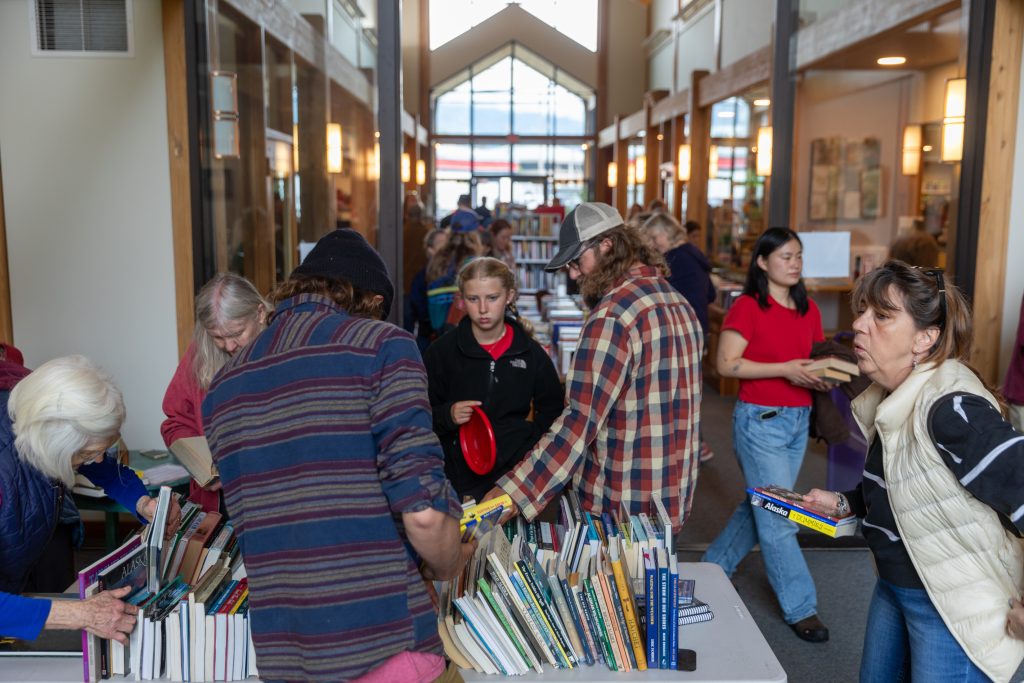
(Rashah McChesney/Chilkat Valley News) Dozens crowded in the Haines Public Library on Friday, July 4, 2025, for the annual Friends of the Library books sale in Haines, Alaska.
After three years as a finalist, the Haines Borough Public Library has won the 2026 National Medal for Museum and Library Services, the nation’s highest honor for libraries.
The Institute of Museum and Library Services awards the medal each year to five libraries and five museums nationwide. The Haines library is the only Alaska institution recognized this year.
And that recognition is rare for Alaska organizations. Between 2000 and 2026, just six organizations in the state have gotten it, including the Alaska Resource Library and Information Service in Anchorage, Homer’s Pratt Museum, Craig Public Library, the Alaska State Museum in Juneau, the Kuskokwim Consortium Library in Bethel and now the Haines Borough Public Library, according to IMLS data.
Library director Reba Heaton said the award recognizes years of programming and partnerships aimed at serving the entire community.
Among the initiatives cited in the library’s application were programs developed with the Chilkoot Indian Association, including the International Cultural Exchange, which brought speakers from the Yukon, British Columbia and Juneau, and the Chilkoot-Chilkat Storyboard project, which teaches Lingít language, place names and history in the Chilkat Valley. That partnership has seen hundreds of thousands of dollars in funding for library programs.
Heaton said the IMLS also cited the library’s youth programming, including trail walks, and a healthy snacks program.
The library is one of the community’s most heavily used public spaces. In 2024, patrons checked out more than 15,000 books, including more than 8,000 children’s titles, according to library statistics.
As her office has done in the past, Sen. Lisa Murkowski nominated the library for the honor. The Haines library was a finalist for the award in 2021, 2017, and 2016.
Heaton said the process was “a little weird” this year as the IMLS did not announce finalists.
“IMLS was sort of discombobulated with the funding, not funding,” Heaton said.
In March of 2025, President Trump targeted the agency for elimination with an executive order. The proposal created uncertainty for museums and libraries across the country that rely on IMLS funding, including in the Chilkat Valley where they reduced hours and staff. But that federal funding was returned in December after 21 states sued.
“I just got a phone call. Oh, congratulations you won. OK, there was no finalist warning. I have no idea who the finalists were,” Heaton said.
In the past, winners of the award have traveled to Washington, D.C, and been presented it by the First Lady. But Heaton said she was not sure it would happen that way again this year, she was still waiting on travel and ceremony details.
For now, she said, staff are basking in the glow of the announcement.
“I got a flooded email inbox, congratulating Haines,” she said.
Now, they have to figure out how to celebrate.
“We’ll do something. Obviously, it’s known. But I think we should brag about it a little bit ourselves,” she said.
Heaton said the award is valuable because it comes with $10,000 and a lot of attention from outsiders which can be valuable for things like grant-writing.
“Having the Best Small Library in America in 2005 and then the national medal in 2026 … puts us on the radar of people around the country,” she said. “They say, okay this is a city that supports a library that does that. It says what the people are like. The people support their library. We can’t do this with an unfunded library.”
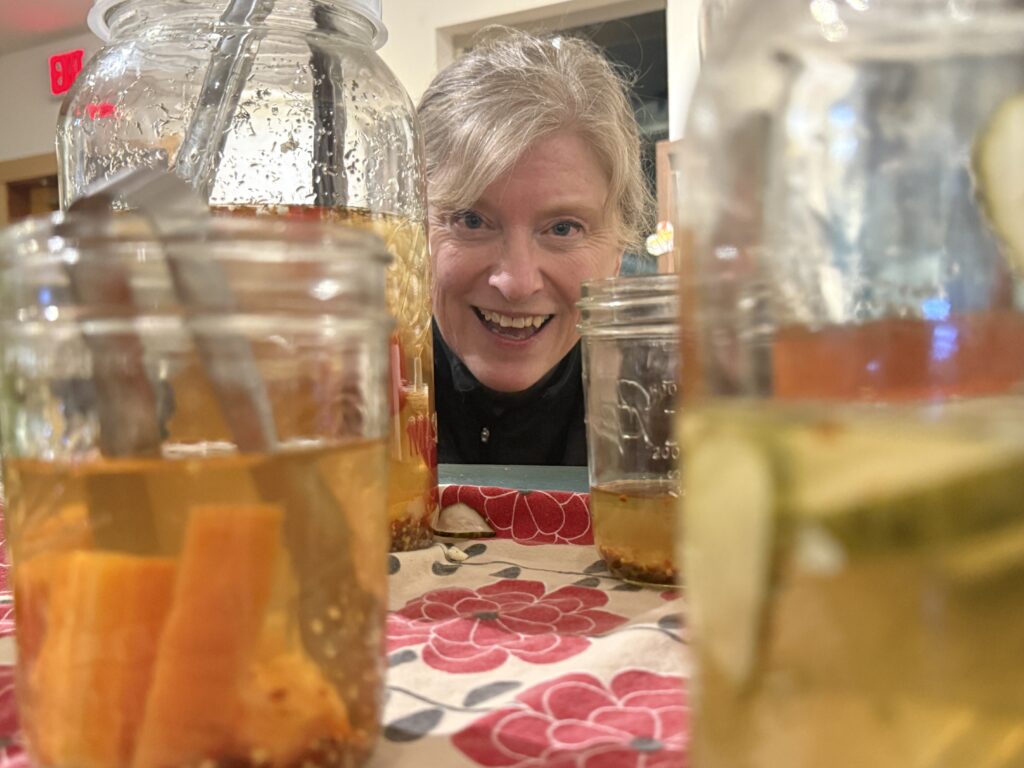
Rashah McChesney/Chilkat Valley News Leslee Downer poses with various pickled treasures from her garden during a Tuesday, Feb., 24, 2026, pop-up at Haines Brewing.
Great news for brewery patrons on a random Tuesday in February: Leslee Downer was cleaning out her fridge, which would not usually be of note. Downer shared some high quality garden leftovers including zucchini relish, pickled eggs, red peppers, cauliflower and hotdogs. Scott Rossman was thrilled.
Richard Cook escaped the winter weather in Haines for the winter weather in New York City. One red-eye flight and a pricey Uber ride landed him in the best hostel that he has ever stayed at. Cook met up with his cousin for brunch, enjoyed walking the city, ate a pretzel as he strolled across the Brooklyn Bridge, rode the Staten Island ferry with his daughter, Kara Cook,and they were off for warmer weather in Costa Rica. The two enjoyed horseback riding with friends. Richard Cook took surfing lessons, with excellent results, while Kara Cook — excited about the possibility of crocodiles — did some beachcoming instead. No crocodiles were encountered. They did a guided tour of Corcovado National Park and did see tapirs, anteaters, monkeys, stunning birds and the golden silk orb-weaving spider. They wrapped up the vacation with sushi and margaritas.
Leonard Rosenberry at the New Hope Fellowship Church with his mountain lion rug. Saturday, March 1, 2026. (Will Steinfeld/Chilkat Valley News)
The annual wild game feed at the New Hope Fellowship church featured a raffle for the kids that did not disappoint. Fishing poles, a handy machete, a hunting bow and other sporting equipment were just a few of the prizes handed out by pastor Sage Thomas. Fishing and hunting stories were swapped and a slide show with proof of the adventures was the backdrop for an amazing buffet of potluck-style dishes shared. There was halibut, goat, moose enchiladas, and even a moose-poop dessert, not made of moose or by moose. Candace Hall’s rabbit with home-grown carrots was a stand-out. Kim Rosado’s ducks had their moment to shine, with duck eggs for everyone. Heather Rogers’ cornbread complemented the chili very nicely, especially when adding spicy kelp pickles on the side.
February can be a difficult time to predict weather between Haines and Whitehorse. Debra Schnabel and her brother Roger Schnabel decided to roll the dice recently and spent an unplanned two-day hiatus in the Yukon. Due to challenging road conditions and a series of unfortunate events, they ended up at a lackluster movie with perfectly buttered popcorn. Debra says that she loves a good “crime thriller,” and the movie “ Rip” would have been ideal, but her brother was intent on seeing the latest version of Wuthering Heights. The two did manage to drop off a vehicle for a new windshield, so the trip was still a success. Doug Olerud had a different border experience recently. He learned that a single orange safety cone does not signify a pothole hidden beneath it, and he should not go around it. Olerud realized that it signifies a driver should pause, as Canadian Customs is not open. The Canadian border agent explained the situation. As of deadline, Katrina Zahnow and family are spending some unplanned time in the Yukon as well, she says they are off to the hot spring or swimming pool to regroup and make a plan and check 511 Yukon often to see when the road has reopened??…
The ice safety and rescue course offered at Chilkoot Lake last past weekend was a chilling experience for Peter Kohlstedt. Kohlstedt is one of the seven that attended the Friday presentation and Saturday hands-on training, which boasted temperatures around 10 degrees. He enjoyed being in a drysuit to practice his new ice-breaking skills, but also took the opportunity to go for a quick cold dip without the drysuit. Kohlstedt says that the day was made even better when Kate and MarkFinley smoked a brisket and shared it post cold dip.
Carol LaVerne Clifton, longtime Haines resident artist, cake decorator and mother of six died in Juneau on Feb. 27 at the age of 88. A full obituary will follow.
Robert Reid climbs alongside the Haines Highway on Friday, Feb. 20, 2026, near Haines, Alaska. (Rashah McChesney/Chilkat Valley News)
The sunlight is fading over the Haines Highway and it’s bitterly cold, but Robert Reid is moving methodically up a chunk of ice near the airport.
Ten feet above the Haines Highway, he chips away at the face of a slab until he can find a steady hold, then tests his weight on it over and over again before he finally shifts fully onto his crampons to take the next step.
There isn’t a rope or an ice anchor in sight; Reid is free-soloing, without climbing protection. And, while he’s only 10 to 12 feet up from the ground, the consequences are high. Ice climbing requires sharp-edged crampons and ice tools, so a fall can lead to deep lacerations, stab wounds or broken bones.
There’s little margin for error and Reid likes it that way.
“It’s the purest form of climbing. It’s just you and the ice or the mountain. It’s completely dependent on your competence and the conditions and your ability to judge them,” he said.
And, while that sentiment is conveyed with the confidence of someone who has been climbing for decades, this is the 25-year-old’s first season climbing. Reid moved to Haines last year to work for SECON.
He doesn’t really have anyone here yet, and said there’s no one in his family to ask about what he’s learning and how he’s doing. “My parents aren’t around anymore,” he said. “My dad died when I was 23, of cancer, and my mom … passed away when I was young.”
There are plenty of other climbers here, and, upon hearing of Reid, many seemed to reflexively offer help.
“I’ve got some ice anchors he could use,” said John Svenson. Once a mountain guide and climber, Svenson is now widely known for his paintings of mountaineering.
“Ice climbers come and go but there’s not like a group [in the Chilkat Valley]. There used to be, but we’ve all kind of grown up,” he said.
Reid is right at the beginning of that journey. He was born in Fairbanks, grew up largely in Arizona with stints in Hawaii and California. But, he describes his time in California as an economic prison and once he graduated with a construction management degree he said he beelined back to Alaska.
“I’ve had an interest in climbing since 2018 when Free Solo came out,” Reid said.
That documentary follows Alex Honnold as he climbs the 3,000-foot El Capitan in Yosemite National Park, with no rope.
It’s an alternative route to making it to the top of a mountain — one that doesn’t require chartering a plane and hauling a bunch of expensive gear around. While he was reading, he stumbled across the phrase “blue-collar alpinism.”
“I couldn’t think of a better way to describe it because… there are places where you just have to suffer to get there. You have to cut through brush and alder and there’s moose and bears. It’s so inaccessible,” he said. “That’s what leaves some of those peaks unascended.”
And it’s those peaks he’s aiming for. Reid is drawn to the range of steep, glaciated mountains within view of the Chilkat Valley where few routes are documented and, in some cases, may be unclimbed.
He started up his first ice route on Dec. 21 on a low-angle piece of ice. “So if I fell I would slide down it and come straight down,” he said.
Since that time he said he’s set five solo ice routes, three along Lutak and the rest up the Haines Highway. He’s reading books, including one by Canadian ice climber Will Gadd, the first person to ice climb Niagara Falls. Then he’s going out, practicing the fundamentals, and learning to read the ice.
“The ice changes every season. The medium is always fluctuating,” he said. “If you’re not precise and accurate enough, you could very well fracture the medium that you’re climbing on.”
There’s a route he called Nosebleeds near the one he was climbing at sunset on the Haines Highway. Part of that one flaked away and at the top the ice was hollow.
“I had to commit my front crampon to a mixed move because I was putting it on rock. Then commit a lot of weight onto that while I’m hooking underneath where the water had washed out underneath this little channel and you can’t swing at that or you’re going to fracture the edge of it,” he said. “So there’s a time and place to be precise and there’s a time where you… need to smash the ice out of the way and get to the good ice. So I’m just playing that game.”
As Reid talks, he seems to vacillate between the why and the how of what he’s doing.“I don’t want to die. I like living. It’s alright,” he said.
For Reid, one of the hardest parts of climbing in Haines so far hasn’t been the ice, it has been finding a partner.
“Climbing is pretty cliquish,” he said. “You’re trusting someone with your life when you’re on belay.”
So, for now, he’s practicing alone, on short routes close to the road, working on fundamentals and slowly expanding what he attempts.
Svenson said that kind of isolation is partly a function of the Chilkat Valley. Unlike places like Juneau, with easily accessible rock or large climbing scenes and a gym, Haines has always had a smaller, more scattered community of climbers.
He said at times there have been groups climbing the frozen waterfalls along the highway or near the cannery, but those waves tend to pass as people move away or find other hobbies.
And, Svenson said, in the Chilkat Valley, climbing has traditionally been more expedition-oriented – long approaches, remote terrain, and partners ready to spend days or weeks moving through mountains and glaciers.
For beginners especially, Svenson said, the safest approach is to rope up and climb with a partner. Particularly along ice flows near town where top ropes can be anchored to trees and allow climbers to practice without committing to a fall.
“You can protect each other.” There’s no reason to climb unprotected, he said.
But not everyone who hears of Reid’s experiments sees them as recklessness. Ryan Irvin, a snowboarder and climber who has spent years in the mountains, said the sport’s history is rooted in people figuring things out for themselves.
In his view, modern climbing culture – especially around rock gyms and mountaineering courses – has become structured. Cautious.
“I think the generation we’re in, it has gotten sanitized a bit,” he said.
Reid’s approach, Irvin said, echoes an older mentality: “It was all about taking risks and gumption.”
Irvin knows firsthand how quickly small mistakes can cascade. A few years ago, while ice climbing in Valdez, he was lowered off the end of a rope and fell about 45 feet, breaking his ankle and injuring his wrists. When he looks back on it now, Irvin said that the accident was the result of several small failures. A rope without a knot at the end, a partner distracted by falling ice and a climb he hadn’t reviewed beforehand.
“A lot of little mistakes added up,” he said. The experience changed how he thinks about risk.
But at the same time, when he hears about what Reid is doing it reminds him of his own journey into climbing.
“I did have a good partner but he wasn’t any more skilled than me necessarily. We were both just reading … we kind of just went and figured it out,” he said. “Going back, I kind of feel like that’s the energy of climbing to some extent. Not everybody is going to get an amazing mentor.
Longtime Haines climber Norm Hughes also recognizes the same impulse Reid has that drove Hughes into the sport a decade ago. He moved to Alaska in the mid-1980s and largely taught himself how to ice climb when there were few partners around.
“You look back and think: that was really stupid, or I got really lucky,” he said.
And, he warns about lifelong injuries.
“I used to break dance. ****ed my knee up, got two surgeries in one year,” he said. “Now, my knee, it’s talking to me a little. Is it worth it? I don’t know. I love dancing.”
Hughes thinks Reid will find a partner.
“A buddy will find him. He’s climbing next to the highway, eventually someone’s going to stop,” he said.
He spends hours studying the terrain on digital mapping tools, switching between satellite layers on CalTopo and older accounts of expeditions, trying to understand how other climbers have approached them. He sees possibility in the remote ridgelines.
One peak in particular has caught his attention, though he’s asked that it remains unnamed. It’s near Mount Emmerich and doesn’t seem to have seen a lot of climbing activity since the mid-20th century. It has been hard to track down information about it.
“There’s probably three or four photos that exist of that thing. But I haven’t seen any videos,” he said.
He feels uniquely positioned to reach that objective, living here within sight of it. But the challenge is building the skills required to reach peaks safely, and for now that means getting as much experience as possible. The short ice routes he’s been climbing this winter are the beginning of that process.
On a recent trip up Mount Ripinsky, Reid said he came within a few hundred feet of the summit before turning around as the sun was starting to set. Physically, he’s certain he could have reached the top.
But reaching the summit is just one measure of success and he repeats an old adage like an incantation. Turning around was the right decision and he’s proud of himself for making it.
“Going up is optional, descending is mandatory,” he said.