







Categories
Alaska News

Eradicating invasive plants in the Chilkat Valley

Crouching on the ground, surrounded by various plants, a crew of six from Haines, Skagway and Juneau worked to pull the invasive non-native plant known as white sweetclover, or Melilotus albus. Each member used their gloved hands along with garden shovels or even screwdrivers in some cases.

The team is currently pulling sweetclover by the airport, a location they started removing plants from in 2024. Locations have to be revisited annually or biannually to ensure that the small, new offshoots are caught and weeded out. In order to prevent the plant from further producing, the crew is hoping to remove as many plants as possible before flowering begins and the plant goes to seed. 

The plant is one of several in the Chilkat Valley that the Takshanuk Watershed Council is focused on eradicating. Others on the list include: creeping thistle, jewelweed, reed canary grass and European mountain ash. 

The plant in the crosshairs this week, white sweetclover, is a tall, branching plant that has small, white flowers when blooming.  It has been found along the Haines Highway since 2013. However, in recent years, it has begun to spread.  
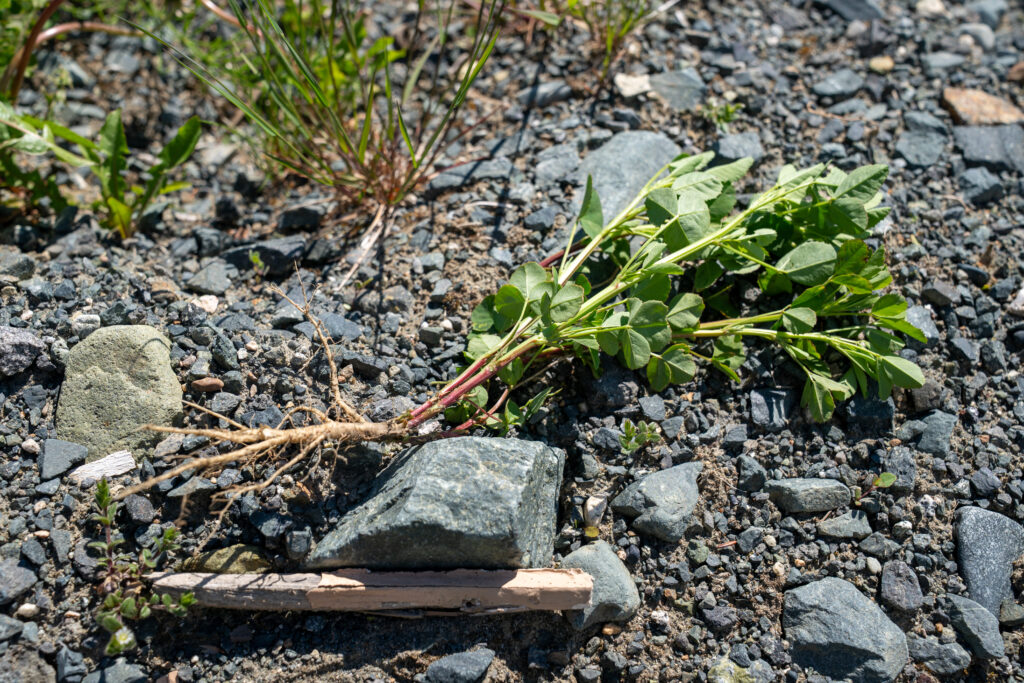
A white sweetclover plant lies on the ground after being pulled out on June 9, 2026. Sweetclover is an invasive plant that the Takshanuk Watershed Council is working to get rid of in Haines, Alaska. (Lizzy Hahn/ Chilkat Valley News)

Stacie Evans, science director at the watershed council, said staff are focusing their efforts on sweetclover to keep it from getting deeply established in the Chilkat Valley. 

The plant causes damage by outcompeting other plants. It also contains a chemical compound which is toxic to animals, according to the United States Department of Agriculture.  Evans said it can be damaging to riparian habitat on the edges of rivers, streams or lakes. That’s because sweetclover does not provide a lot of shade or bank stabilization, both of which are important for fish habitat. 

“The Chilkat Valley is known for having the most vascular plant species in Alaska, incredible biodiversity here but you see places where already the white sweetclover has taken over,” Evans said.

Evans said the plant has mainly been found along the highway because the seeds like disturbed habitats. While sweetclover is a relatively new infestation in Haines, it has been found in places like the Stikine River, Kake, Prince of Wales Island, and Skagway but has been eradicated in Juneau, according to Emily Reed, the Regional Invasive Plant Coordinator at the Southeast Alaska Watershed Coalition.

Sweetclover hasn’t spread too far away from the highway, Evans said. There have been small patches of it found along Beach Road and across the Porcupine Bridge.

“Now, we’re concerned that the seeds might get into the river, and then bring the plants to other vulnerable areas that are harder to get to,” Evans said.

Reed came to Haines from Juneau to help with efforts to map and eradicate the plant. She said sweetclover is an “annual to biennial” when it comes to producing seeds. 

“We’re kind of in a funny zone where sometimes it’s an annual, so it can do it [seed] in one year and then sometimes it takes two years,” Reed said. The seeds can survive up to 80 years. White sweetclover can produce 14,000 to 350,000 seeds per plant, according to the United States Department of Agriculture.

According to Reuben Cash, environmental coordinator with the Skagway Tribal Council, sweetclover also puts out chemicals into the ground to prevent other plants from establishing.

“It’s just got a lot of really aggressive techniques for being where it is and because it’s not from here, there are no natural checks and balances to kind of keep it in check,” Cash said.

According to Reed, sweetclover has spread significantly along the Haines Highway since it was first inventoried when the Constantine Mine did an invasive plant survey and then again through the Haines Highway project’s plant survey.

The Stikine River has the oldest known infestation of white sweetclover along a riverine system, according to Reed. She explained that other teams on rivers in Southcentral Alaska, including the Copper River watershed, have been tackling sweetclover for over 15 years.

“You look at the pictures from Copper River, and it’s really concerning,” Reed said. “It’s not at that point here, which means it’s the time to take action, because there’s a chance right now.”

Sweetclover is competitive and tends to push native plants out. So, along with removing the plant, Reed and Evans are gathering data to better understand its density and how best to control it. 

In 2024, Evans said a lot of people around Haines noticed the rapid spread of sweetclover, which prompted the watershed council to organize a community weed pull. In the two years since, the watershed council got grant funding to pay a small crew to pull invasive plants. Evans hopes to supplement this with the help of local volunteers.

On Wednesday, the Takshanuk Watershed Council hosted an iNaturalist workshop to educate people about how to identify plants. This app helps Evans and Reed map out where the invasive species are.

“We have a pretty good sense of where the jewelweed is at this point, however we haven’t looked everywhere,” Evans said.
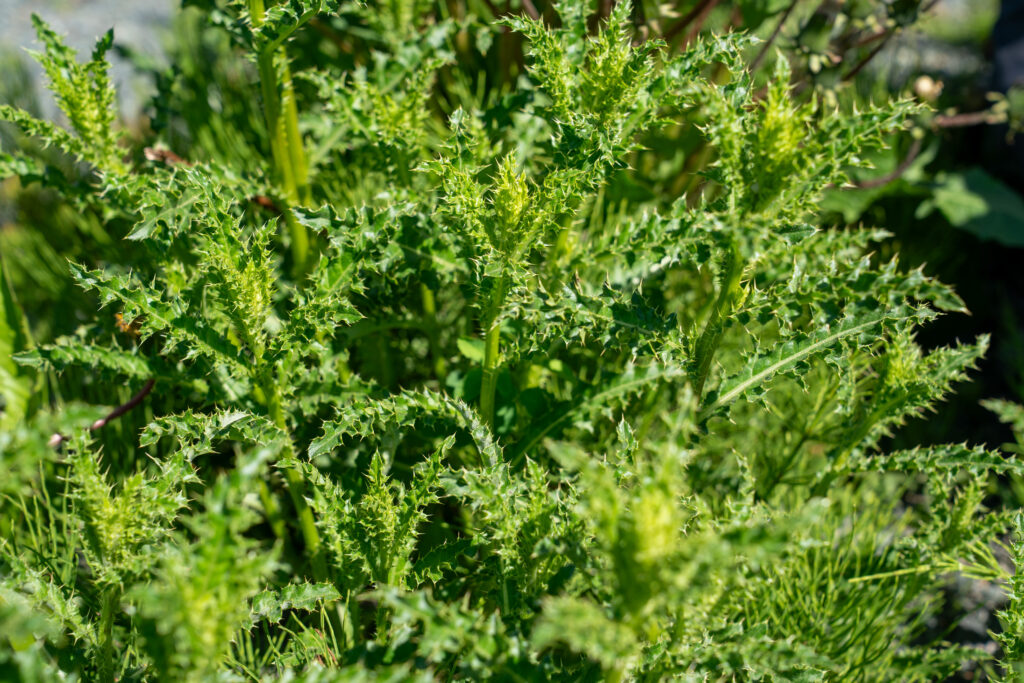
The invasive plant jewelweed can be identified with its unique leaf pattern. The Takshanuk Watershed Council is working to get rid of this plant along with others on June 9, 2026 in Haines, Alaska. (Lizzy Hahn/ Chilkat Valley News)

Sweetclover and jewelweed are safe to pull before they go to seed. Plants like creeping thistle and reed canary grass are harder to weed because if the roots don’t come out with the plant, it can lead to more robust growth according to Evans.

Cash came over to Haines with two other members to help pull sweetclover. Cash said that they have been mapping sweetclover in Skagway since 2019. By mapping and pulling sweetclover, Cash says that what once had been “really bad infestation spots” now have almost no sweetclover. 

This is the first time that people from Skagway have come to Haines to help manage sweetclover. Later in the summer, the Haines crew will go help remove sweetclover in Skagway.

The crew is working full-time until mid-July to eradicate the plant before it starts to flower and seed. But this job is not solely focused on pulling plants, they are also mapping different  invasive plants like jewelweed and creeping thistle. Because each of the plants flower at different times of the summer, the crew is able to focus on pulling sweetclover, which flower earlier than jewelweed. Reed estimates that it will take around 10 years of management before the plant is eradicated, however, the “idea is that the effort required tapers off” over that time.

“Ideally the first two years are a ton of work, and then after that it’s much less,” Evans said. 

A community weed pull was organized for 10 a.m. on Thursday, June 11, along the Haines Highway. Meet at the Takshanuk Watershed Council office to join the crew tackling white sweetclover along the highway.

The post Eradicating invasive plants in the Chilkat Valley appeared first on Chilkat Valley News.

Categories
Alaska News

Alaska House committee advances gas pipeline tax bill sought by governor, Glenfarne

Rep. Neal Foster, D-Nome and co-chair of the House Finance Committee, asks a question to Alaska Gasline Development Authority officials at a May 27, 2026, hearing in Anchorage. Shown with him are other members of the committee: Rep. Alyse Galvin, I-Anchorage, Rep. Andy Josephson, D-Anchorage,a nd Rep. Calvin Schrage, I-Anchorage. (Photo by Yereth Rosen/Alaska Beacon)

Rep. Neal Foster, D-Nome and co-chair of the House Finance Committee, asks a question during a May 27, 2026, hearing in Anchorage. Shown with Foster are other members of the committee: Rep. Alyse Galvin, I-Anchorage, Rep. Andy Josephson, D-Anchorage, and Rep. Calvin Schrage, I-Anchorage. The committe on Wedneday approved a version of a tax bill intended to encourage development of a natural gas pipeline. Lawmakers have been considering the bill during a special session called by Gov. Mike Dunleavy. (Photo by Yereth Rosen/Alaska Beacon)

Alaska lawmakers, meeting in a special session, advanced a bill intended to spur construction of a long-desired pipeline carrying natural gas from the North Slope to markets.

The legislature’s House Finance Committee approved the bill, House Bill 381, which would largely eliminate state and municipal property taxes on project-related infrastructure, replacing those revenues with money from gas flowing through the system.

The bill now heads to the House floor for consideration. For the bill to become law, it must be approved by the House and then reviewed and approved by the Senate before the special session ends on June 19. If the Senate makes changes to the bill, the House must vote to concur with them.

The Senate has its own version of the bill, Senate Bill 2001, which is currently under review in that body’s finance committee.

The House bill has been a top priority of Gov. Mike Dunleavy, who called the special session, and the Glenfarne Group LLC, a private asset manager and developer leading the current plan to commercialize long-stranded North Slope natural gas. They argue that property taxes are the major impediment to the project’s construction.

The Glenfarne project, which is in partnership with the state-owned Alaska Gasline Development Corp. proposes an approximately 800-mile pipeline from Prudhoe Bay to tidewater at Cook Inlet, where gas would be liquefied. Glenfarne became involved in the project last year, acquiring a 75% share from the Alaska Gasline Development Corp.

In comments just before their vote to move the bill, some House Finance Committee members said they had high hopes the measure will result in a pipeline project.

Rep. Frank Tomaszewski, R-Fairbanks, said the project will be as important as the trans-Alaska oil pipeline that his father helped build in the 1970s.

“I’m just humbled and honored right now to be able to be working on this legislation that is going to bring that next step, that gas pipeline, because 40, 50 years ago, that was what we were talking about,” Tomaszewski said at the hearing. “I’m looking forward to the groundbreaking ceremony for this project, because it will be transformational for the state, not only with lower gas prices and affordable energy but also tremendous amount of revenue for the state and local communities.”

Rep. Will Stapp, R-Fairbanks, had similar comments.

“Generally, at the end of the day, I think the vast majority of us and Alaskans really want to see the best chance possible to be provided to move forward with this transformational project,” Stapp said.

The bill went through numerous amendments, many of which were aimed at protecting local governments dependent on property taxes.

The special session began on May 21.

SUBSCRIBE: GET THE MORNING HEADLINES DELIVERED TO YOUR INBOX.

Categories
Alaska News

Juneau to pay for first HESCO barriers, sparing property owners from $6,300 bill

Hundreds of Mendenhall Valley property owners are being spared from paying up to $6,300 for HESCO barriers after the Juneau Assembly voted on Monday to cancel that plan due to the city taking on a more expansive protection effort against glacial lake outburst flooding this year.

The Assembly early last year approved the establishment of a Local Improvement District (LID), requiring 466 property owners within its boundaries to pay 40% and the city 60% of the projected $8 million cost of the semi-permanent levee along the Mendenhall River. But Assembly members and city administrators said the barriers protected more than just those land owners last August, and it turns out the ongoing maintenance cost of the barriers will far exceed projections.

“It doesn’t dissolve the Local Improvement District. It just says the city is going to pay for 100% of that share,” City Manager Katie Koester said in presenting the revised proposal to the Assembly just before Monday’s vote.

Property owners were being given 10 years to pay the amount due, but the city had not yet collected any money from them.

One payment that is still required is for four property owners who are being charged $50,000 for riverbank armoring installed along their land. Other property owners had installed similar rock armoring at their own expense before the HESCO levee was built.

The LID was controversial when first proposed, especially among the property owners set to have HESCO barriers in their backyards. The owners expressed concerns about the barriers causing damage to property, and reducing the accessibility of their lots and their value.

A lawsuit by two of the Mendenhall Valley property owners against the city, seeking compensation for the barriers, has a scheduled trial date of Oct. 12, according to the Alaska Court System’s online database.

City leaders and many residents in at-risk areas say the first phase of HESCO barriers succeeded in preventing a major disaster when a glacial lake outburst flood last August crested at a record 16.65 feet, with officials stating there was no damage to 90% of homes in the flood zone. However, the city is facing several million in costs beyond the original estimate to repair damage from that flood as well as raise the barriers to protect from potentially higher flood levels.

A second phase of HESCO barriers, extending the existing levee on both sides along one side of the river and installing barriers on the opposite side of the river for the first time, is scheduled for completion by July 15. The U.S. Army Corps of Engineers is installing and paying for the second phase.

The city is also working with federal and state officials on longer-term solutions that are still being determined, with the expectation of asking the federal government to cover most of the costs. But a long-term solution could take more than a decade to implement, according to USACE.

Concerns about the city’s process in implementing flood protection measures were expressed during Monday’s meeting by Debbie Penrose-Fischer, leader of the citizens’ group Juneau Flood Solution Advocates. She cited inequities in what various residents paid for riverbank armoring — asserting the “bank work exceeded the value charged” for the four property owners paying the city $50,000 under the LID, while some other owners paid $150,000 and some benefited from the improvements without additional cost.

“Please use this LID experience as a template of what to do and what not to do,” she said. “This is a chance to correct this inequity and to build a bridge between us. In the future, decisions of this nature concerning the GLOF need to come before all of the voting public.”

The post Juneau to pay for first HESCO barriers, sparing property owners from $6,300 bill appeared first on Chilkat Valley News.

Categories
Alaska News

Projected Social Security benefits cliff creeps up to 2032

WASHINGTON — Congress must act to shore up Social Security during the next six years to avoid an automatic drop-off in benefits in 2032, according to a report released Tuesday. 

The annual update on the Old Age and Survivors Insurance trust fund shows that it will “become depleted” in the fourth quarter of that year, a few months earlier than projected in last year’s report.

That would lead to recipients receiving 78% of their benefits — the projected yearly income to the trust fund — unless Congress acts before then. By 2100, benefits would be only 62%, according to the report.

That decrease would have a significant impact on the tens of millions of Americans who rely on the program to stay out of poverty, especially retirees. 

Social Security Commissioner Frank J. Bisignano wrote in a statement that in order to “protect the promise of Social Security, it is important for lawmakers and the Social Security Administration to work together to ensure the trust funds continue to provide financial stability now and for future generations.”

Bisignano is scheduled to testify before the House Ways and Means Committee on Wednesday, where he will likely face several questions about the new report and whether the administration has policy suggestions for Congress. 

More than 68 million Americans received Social Security payments in April, according to data from the administration. More than 56 million of the beneficiaries were 65 or older. 

Michael A. Peterson, CEO of the Peter G. Peterson Foundation, wrote in a statement November’s midterm elections will have an impact on who is in the Senate, where lawmakers have six-year terms, in the lead-up to the deadline. 

“It’s important to recognize that the Senators we elect this year will be in office when Social Security becomes unable to pay out full benefits, so this must be a central campaign issue,” he wrote. 

Peterson added that “there are many well-known solutions available” and that it’s “time for responsible, bipartisan leadership to strengthen Social Security and Medicare, ensuring the stability of these programs for generations of Americans to come.”

Maya MacGuineas, president of the Committee for a Responsible Federal Budget, wrote in a statement that “Washington is sleepwalking into a retirement crisis, allowing our nation’s most important trust funds to go insolvent at the expense of over 70 million beneficiaries who count on these programs.”

MacGuineas added that there is “no shortage of options out there to avoid this.”

“It’s time for our leaders to start telling the truth on Social Security and Medicare, and working on real plans to save these programs,” she wrote. “Time is running out.”

The post Projected Social Security benefits cliff creeps up to 2032 appeared first on Chilkat Valley News.

Categories
Alaska News

Fairbanks Weather: Wednesday, June 10, 2026

Wednesday night, clear skies. Low near 45F. Winds light and variable. Thursday, some sun in the morning with increasing clouds during the afternoon. High 72F. Winds SSW at 5 to 10 mph.

Categories
Alaska News

Juneau Weather: Wednesday, June 10, 2026

Wednesday night, overcast with rain showers at times. Low 48F. Winds E at 5 to 10 mph. Chance of rain 60%. Thursday, showers in the morning, then cloudy in the afternoon. High near 60F. Winds SSE at 5 to 10…

Categories
Alaska News

Anchorage Weather: Wednesday, June 10, 2026

Wednesday night, clear to partly cloudy. Low 48F. Winds SSE at 5 to 10 mph. Thursday, partly cloudy. High 62F. Winds W at 5 to 10 mph.

Categories
Alaska News

I’m a Mortgages Writer: Here’s the Homebuying Advice I Ignored

A senior beautiful woman planting flowers on her patio

Categories
Alaska News

I’m a Mortgages Writer: Here’s the Homebuying Advice I Ignored

As soon as I saw it, I knew it was a gardener’s house.Full sun. Full composter. Native perennials. While the raised beds had seen better days, the soil within them was soft and lovingly tended. It was exactly the kind…

Categories
Alaska News

Education Department admits it violated court order in Title IX cases

(The Center Square) – The U.S. Department of Education confirmed a whistleblower’s allegations that the agency violated a federal court order while handling Title IX cases tied to gender identity and sexual orientation, according to the U.S. Office of Special…