







(The Center Square) – While much of the national conversation about data centers focuses on the amount of energy and water they consume, the pros of building more of them outweigh the cons, panelists at the American Legislative Exchange Council’s…
Category: Alaska News
Categories
Everett Joyce

Everett Joyce poses as the newest recruit of Mizzou wrestling’s 2026 class. Mizzou coach Brian Smith announced the signing of the Wichita, Kansas, product on Thursday.

(The Center Square) – The Trump administration imposed forced-labor tariffs on 60 trading partners Thursday, covering most U.S. imports, but did not say what the duties will cost American consumers.

A student exits the University of Alaska Anchorage consortium library on Sept. 6, 2024. (Photo by Yereth Rosen/Alaska Beacon)
I didn’t learn about the permanent closure of the University of Alaska Anchorage Testing Center through a campus press release or a community town hall. I learned about it on a quiet summer afternoon while taking my 14-year-old son to sit for an exam for college credit. Watching a teenager step up, take initiative and unlock his potential early is an incredible feeling—a vivid testament to what is possible when accessible local infrastructure exists to lift our kids up.
But as we were leaving, a staff member warned us to schedule whatever remaining exams we could as quickly as possible. She was exasperated—and rightfully so. She had just been notified via a Friday afternoon email that the center was closing permanently on July 30th, and the entire staff was out of a job. Just like that, with only a few weeks’ notice in the dead of summer, dedicated employees were discarded and an essential public institution was quietly dismantled.
The staffer said that, according to the university’s email, the rationale centers on reallocation: stripping funds from existing student support services to concentrate resources on recruitment, registration and driving up top-line enrollment numbers. But this strategy reveals a shortsighted paradox: What is the point of pouring money into recruiting new students if we gut the very infrastructure required for them to test, advance and graduate?
What makes this closure so catastrophic is that UAA’s Testing Center was never just a room with computer desks. It was Southcentral Alaska’s only comprehensive, all-in-one physical testing hub. Unlike small, specialized private sites that handle only specific vendors, UAA’s facility managed the entire academic and professional spectrum—college course exams, ACCUPLACER placement, statewide professional licensing boards, trade certifications and national standardized tests like the ACT. No other civilian venue in Anchorage possesses the authorization, footprint or operational scope to absorb that workload. Closing UAA doesn’t shift that traffic elsewhere; it destroys the hub entirely.
When pressed on alternatives, the university points to automated online software and military facilities, but both fall apart under basic scrutiny. Automated proctoring like HonorLock relies on a myth of digital equity that Alaska’s infrastructure cannot support. In a state where broadband frequently stutters, a single Wi-Fi drop can void months of hard work. Additionally, invasive AI webcams present an insurmountable barrier for neurodivergent students or working adults in crowded households. Recommending the testing space at Joint Base Elmendorf-Richardson is equally flawed: JBER sits behind military security checkpoints. Public university infrastructure funded by Alaskan tax dollars should never require a visitor pass, background check or military sponsorship to access. Access to advancement should not be behind a locked gate.
The ripple effect reaches far beyond college classrooms and straight into our regional workforce. By eliminating our central testing anchor, we are stranding local nurses, teachers, contractors and ambitious young Alaskans in an administrative wasteland. Working Alaskans seeking career-advancing licenses now face the absurd prospect of spending thousands of dollars flying around the state—or worse, to the Lower 48—just to sit in a proctored room for a two-hour exam.
Alaska should be opening doors for its people, not slamming them shut on a Friday afternoon. Watching my son earn college credit showed me firsthand what happens when community infrastructure actually supports educational ambition. University leadership and local community partners must halt this closure immediately and establish an accessible, public-facing civilian alternative before the door locks Alaskans out for good.
SUBSCRIBE: GET THE MORNING HEADLINES DELIVERED TO YOUR INBOX.

House Judiciary committee chair Rep. Andrew Gray, D-Anchorage, and committee members Rep. Ashley Carrick, D-Fairbanks and Rep. Mia Costello, R-Anchorage, listen to Carol Beecher, director of the Alaska Division of Elections, answer questions about the division’s decision to disqualify a U.S. Senate candidate at a hearing on July 22, 2026. (Photo by Kyle Johansen for Rep. Gray’s office)
Members of the House Judiciary and State Affairs committees questioned Alaska Division of Elections director Carol Beecher on Wednesday about the state’s response to a U.S. Senate candidate with the same name as the incumbent — Dan Sullivan. It was the second investigatory hearing on the subject after elections officials failed to appear at an initial hearing in June. Alaska Lieutenant Governor Nancy Dahlstrom, who oversees the division, declined an invitation to appear.
At issue was the state’s decision to disqualify the U.S. Senate candidate Dan J. Sullivan of Petersburg and its determination that he was not a “good faith” candidate. The Alaska Supreme Court nixed that decision in late June.

Beecher testified for nearly two hours and defended the division’s actions from the choice to disqualify Sullivan to the choice to list him without a party affiliation on the primary ballot. She also answered questions about how 3,500 Alaskan residents received notices that they have inactive voter status pending verification of citizenship.
Since the first legislative hearing, the Sullivan from Petersburg challenged the state’s decision and the fast-tracked case reached the Alaska Supreme Court. The court upheld a lower court’s ruling that Sullivan was eligible and said the division did not have the authority to add additional eligibility requirements, like whether a candidate was acting in “good faith,” beyond what is outlined in the U.S. Constitution.
Lawmakers raised concerns about how the division chose to list the candidates on the primary ballot. They asked Beecher about why the division chose to list the challenger as “Sullivan, Daniel J, Jr.” without his party affiliation as a registered Republican. It listed the incumbent senator as “Sullivan, Dan S.” and identified him as the incumbent and a Republican.
The two Sullivans are among 16 candidates for the U.S. Senate seat, including Democratic former U.S. Rep. Mary Peltola, in the primary election on August 18. The top four vote-getters will advance to the general election on November 3.
Beecher defended the division’s position that Sullivan was running with the purpose to confuse voters. She cited complaints filed by national and state Republican groups, Sullivan’s party affiliation as Republican and campaign materials as evidence of his intention to mimic the U.S. Senator Dan Sullivan and confuse Alaska voters.
“The division acted then to prevent manipulation of the ballot and to protect voters from purposeful confusion, consistent with its responsibility to maintain fair, neutral, and trustworthy elections,” she said.
She noted that the division’s action was unprecedented, but said the situation merited such a response. “The division understood all along that this action could be challenged in court, and recognizes the court’s authority to review these important questions,” she said.
Judiciary committee chair Rep. Andrew Gray, D-Anchorage, had several questions about how the division determined Sullivan was not a “good faith” candidate. “Where is the evidence that he did this to trick voters, to mislead the voters whom we are here to protect?” he asked.
“The information that we were presented with painted for us a picture of someone who was trying to confuse the ballot,” Beecher replied.
Gray probed the division’s criteria later in the hearing.“In your opinion, Director Beecher, what does it mean for a candidate to have a good faith intention to serve?” Gray asked.
“In my opinion, that it would be someone who actually wants to win, and is running because they want to to get the seat,” Beecher replied. “And in this situation, all of the facts that were presented to the division were that this was an individual who was not running to be what I would call a true candidate. This individual was running to confuse the ballot. It was an intentional attempt to gain access to the ballot for the purpose of confusing.”
Lawmakers also raised this issue of of how the candidate was listed on the primary ballot after the state Supreme Court ruling. The challenger was listed as “Daniel J. Sullivan, Jr.” when he has publicly stated he goes by his first name as “Dan.”
Beecher said it was a choice by the division. “And it’s a bit of first in time, first in place, that Dan Sullivan has already been on the ballot prior, as Dan Sullivan is known as Dan Sullivan,” she said, referring to the incumbent senator. “So it was simply a way to differentiate between the two.”
Rep. Genevieve Mina, D-Anchorage, asked Beecher about the division’s decision not to list Sullivan’s Republican party affiliation.
Beecher said she believes it was also within the division’s authority to do so. “Whether or not it has to be on the ballot, we believe that has been left to the discretion of the division, and in line with that, we made that determination,” she said.
“It also could still be litigated,” Beecher added.
Rep. Ashley Carrick, D-Fairbanks and chair of the House State Affairs Committee, said she was concerned about the precedent and the agency’s discretion to remove party information that could be informative for voters.
“Having his party affiliation may help those voters feel like they’re more informed and directed to a candidate they would rather support,” she said. “But not having his affiliation included there seems to provide less information and be more confusing.”
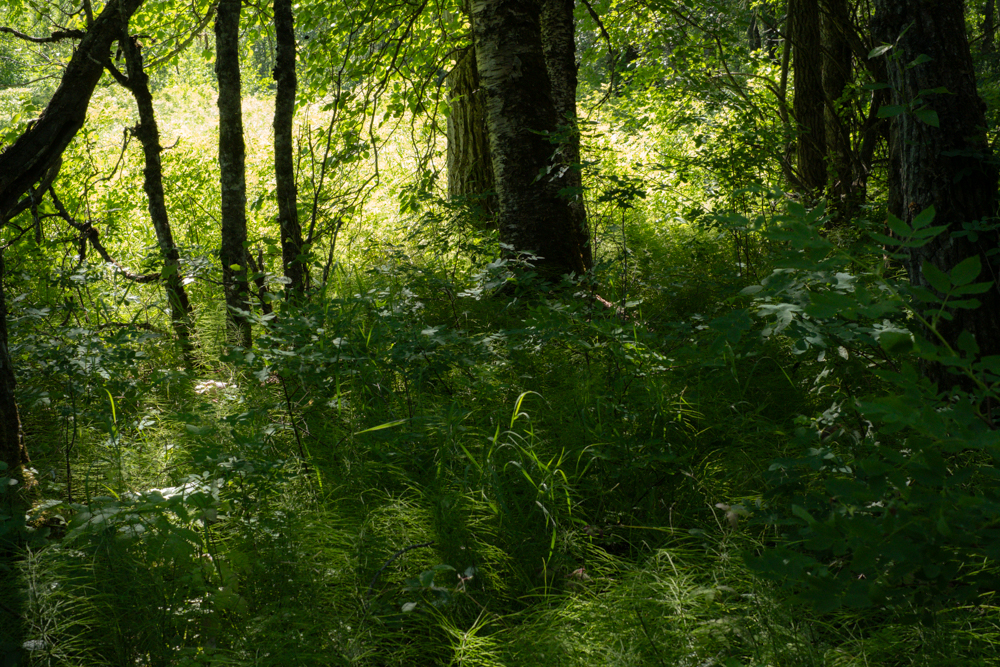
The land by the Haines Highway 18 mile marker holds a lot of personal history for Patrick Philpott.
It’s where Philpott, a hunter, got his first kill: “It was a rabbit, and I remember the rifle I used,” he said during borough assembly testimony last week. “It was a Montgomery Ward .410 single-shot bolt action. And the (the rabbit) tasted mighty good. He ate good carrots.”
Philpott also grew up gardening at the spot, on a plot his family cultivated for generations, stretching back to the early 20th century, when they opened a roadhouse near current-day Haines Highway 19 Mile.

“That’s where I learned to make my first dimes,” he said, recalling in his youth shoveling horse manure at the Port Chilkoot Dock to take to the garden as fertilizer.
The old garden footprint is now heavily overgrown, save for a small clearing separated by about a hundred yards of dense brush from the highway. Philpott, 71, a retired veteran and elder of the Frog House in Klukwan, is hoping once more to garden on that land — land that is now part of the state’s Alaska Chilkat Bald Eagle Preserve. In his estimation, he’s earned the right to grow one to two acres of vegetables by his and his family’s years spent gardening that very land, and he says state law supports that assertion.
The 48,000-acre eagle preserve was established in 1982 to protect large populations of bald eagles that fish in the Chilkat, Klehini, and Tsirku river confluence late into the year.
In applications to the state’s Division of Parks and Outdoor recreation, Philpott has cited a passage in the state statute creating the preserve which guarantees “continued opportunities for traditional uses of the Preserve at levels and methods and means that are compatible with the protection of the bald eagle population.” The statute, AS 41.21.618, goes on to say those uses include, but are not limited to, “hunting, trapping, fishing, berry picking, other subsistence and recreational uses, operation of motor vehicles and the harvesting of personal-use firewood.”
Philpott’s argument hasn’t gotten much traction at the Division of Parks, which manages the eagle preserve and is part of the Alaska Department of Natural Resources. Parks director Ricky Gease denied his permit application on May 26. Philpott is now appealing the decision to Department of Natural Resources commissioner John Crowther.
So far, state agencies hold that Philpott’s request is a land use distinct from subsistence activities like hunting and berry picking.
In the denial of the application, Gease wrote that a garden would alter the land from its “current use, open and accessible by the public in general, to a private use for a garden.”
That kind of private use, Gease wrote, would require Philpott to officially lease the land, not just use it under a permit.
While the DNR commissioner does have statutory authority to lease Eagle Preserve land, Gease wrote that eagle preserve land has never before been leased, and the agency has no process outlined to do so, specifically for how to solicit public input and consider a lease application.
Division of Parks spokesperson Wendy Sailors wrote in an email this week the decision “was not based solely on potential impacts to eagle use, but on whether the proposed activity was consistent with the statutory purpose of the Preserve and the legal framework governing management and leasing of lands within the Preserve.”
In an earlier email, Division of Parks staff told Philpott a lease application would likely include a $1,200 application fee, a land appraisal running an estimated $3,000–$5,000, and an annual lease fee “based on the fair market value of the parcel.”
In his initial application, Philpott had asked the state to lease him 2.5 acres for $1 a year and said his motivation for the garden in the first place was stretching a limited income.
“The purpose of this garden is personal food production and food security,” he wrote. “My wife and I are senior citizens living at the poverty level and producing our own food is an important step toward self sufficiency. We would rather grow our own food than depend on assistance.”
“I’m not the person to stand there with my hand out,” Philpott later said at the assembly meeting. “I want to be able to do it myself as long as I’m able.”
As Philpott’s appeal remains pending he has the written endorsement of the Eagle Preserve Advisory Council, the Chilkoot Indian Association, Chilkat Indian Village tribal administrator Brian Willard and the Haines Borough Assembly, which voted unanimously last week to write a letter of support.
Currently there are only two active special-use permits — the type of permit Philpott is seeking — in the preserve, said DNR spokesperson Wendy Sailors Monday. One is for U.S. Fish and Wildlife Service forest monitoring data collection sites. The other allows Alaska Mountain Guides to place outhouses at highway pullouts inside the preserve.
The post Philpott Eagle Preserve garden headed to appeal appeared first on Chilkat Valley News.
Categories
“The story is unfolding in real time”
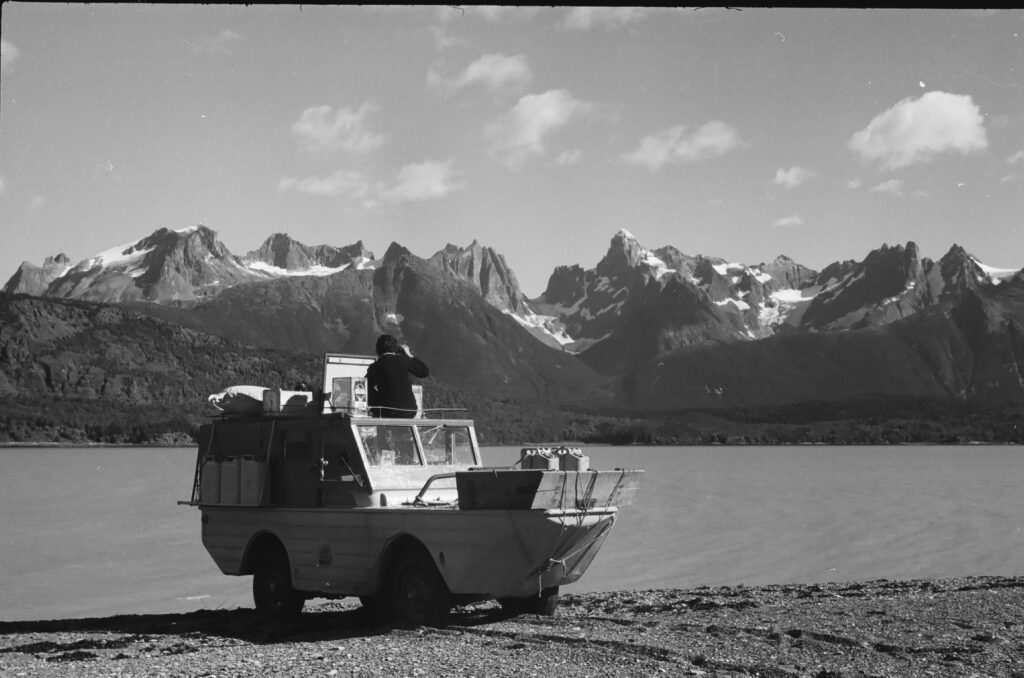
For the past few months, Christiane Leitinger has been hunting down a vehicle previously owned by her parents, named the Ugly Duckling.
The journey took her from Juneau to Haines to Anchorage tracing the path her family took in 1961 when they drove from Florida to Alaska in the World War II-era GMC that is part car, part boat. It took Leitinger’s parents from Prince Rupert, British Columbia up to Haines via the Inside Passage.
So, along with her husband and daughter, Leitinger came up to Alaska from Colorado with some of the nearly 600 negatives of images that she found in her mother’s journal detailing the trip. For Leitinger, this trip was another way to connect with her parents, who died in 2003 and in 2011. The Ugly Duckling was a central character in the stories her parents told when she was growing up.
“I wish I had been more curious as a kid, because I’m sure there would have been amazing stories had I been more curious, but it was just sort of family lore,” Leitinger said.
Leitinger’s parents, Ilse Abshagen and Hans Leitinger, immigrated to the United States from Germany and Austria to attend school, where they met. The couple bought the vehicle in 1957 in Minnesota and went on a trip through Central America, eventually ending in Patagonia. A few years later, they decided to drive clear across the United States. Starting in the summer of 1961 in Jacksonville, Florida, the pair drove to Seattle and followed the coastal mountains in British Columbia. When they got to Prince Rupert, they put the vehicle into the water and boated up through the Inside Passage, stopping in Ketchikan, Wrangell, Petersburg, Juneau and Haines. From Haines, they drove up to Fairbanks and back down to Anchorage, where they ultimately sold the vehicle to Ralph Centoni, who wanted to restore it. The trip from Florida to Alaska included nearly 6,000 miles of driving and more than 500 miles of boating.
In January, Leitinger’s husband Charley Shimanski told her that he would be traveling to Juneau for the Mountain Rescue Association’s summer conference in June. While she does not typically join Shimanski for these meetings, she realized this would be the perfect opportunity to see if she could find the Ugly Duckling. At first, she thought she might find it in Juneau.
“I had sort of this outline, sort of this initial mosaic of a story but sketchy,” Leitinger said. She said that each person who offered her what they knew would sort another part of the mosaic into place. After spending about five weeks researching where the Ugly Duckling ended up, Leitinger and her two daughters made a breakthrough. One of the pictures she has of her parents shows them on a beach with the jeep, overlooking a body of water with beautiful mountains in the background.
Leitinger’s daughter Eva Sophia looked at the photo and used Google Earth to pinpoint the location. She would go to the ground-level view and go up and down the fjords from Juneau, looking at different angles to match the mountains in the photo to a current geographical location. A few days later, Eva Sophia geolocated the photo to a spot on Mud Bay Road.
Once in Juneau, Leitinger made her way to the Alaska State Archives. She looked at microfilms of newspapers across Southeast Before setting off for Juneau, Chrisitiane went through boxes of her parents’ belongings. She found a box that was titled “Alaska” and found her mother’s journal from the trip and around 600 negatives. The journal entries were written in German, so Christiane was not able to comprehensively look through it before heading to juneau because she had to translate it. Instead, she put all of the dates in a spreadsheet, creating the path of their journey. She brought this to the archives, letting her look at the newspaper archives from around the time her parents made landfall. She found articles from Ketchikan, Petersburg, Wrangell, Juneau, Fairbanks and Anchorage.
Leitinger and her husband decided to extend their trip after realizing that one of the photos was taken in Haines – the photo from Mud Bay Road. Joined by their older daughter, the couple took the ferry up to Haines, where they met Martha and Michael Mackowiak. Leitinger began showing the duo her one-inch-thick binder full of photos from her parents’ trip. Leitinger opened to “another beautiful picture of my parents somewhere in Alaska,” and Martha Mackowiak instantly recognized the view, Letnikof Cove, something she sees daily while driving home.
“It’s just interesting to see that side of them that I didn’t really experience ever, it’s very sweet, sort of having a window into that chapter of their life,” Leitinger said.
Some newspaper archives mentioned how the Coast Guard asked Abshagen and Leitinger not to continue their trip.
“Almost every time you see a picture of it in the water, it looks like it could be sinking, it’s so low in the water,” Leitinger said. She said that her parents would only go out on calm water because of how low the boat sat.
Some parts of the historical journey were uncomfortable for Leitinger. During her parents’ trip, the couple were joined by Bob Broward, an architect from Jacksonville, Florida who traveled with them to Juneau. Leitinger said he brought a Confederate flag on the trip. When her parents landed in Juneau, they traded their Confederate flag to Gov. William Egan for an Alaska flag, she said.
Leitinger said finding the flag in pictures with her parents was difficult as it does not align with her values or what she would want to fly on a vehicle she’s bringing into a new place like Alaska. Her guess is that had her parents known what the flag symbolized, they would have not flown it. Abshagen’s father, Leitinger’s grandfather, was a part of the resistance against Hitler during World War II.
“That’s always the opportunity for human beings, to reflect deeply and learn from history and not make the same mistakes as others did in the past,” Leitinger said.
While looking through articles in the Alaska State Library in Juneau, Leitinger came across a story on the front page of the Ketchikan paper titled “Confederate Invasion.” The article read “the vanguard, the confederacy’s so-called invasion of Alaska, reached Ketchikan Monday, as a war surplus amphibious Jeep, carrying 3 adventuresome Jacksonville, Florida ‘soldiers’ completed a 90-mile water journey from Prince Rupert, B.C. The threesome, 2 men and a girl [my mother was like 36 at that time], pulled into Ketchikan Monday afternoon with the ‘stars and bars’ flying from the makeshift cabin on the Jeep.”
The article goes on to say that Jacksonville architect Bob Broward, as he set foot on Alaska’s soil, claimed, “ the South hasn’t forgotten,” according to the article. “The other members of the party, Hans Leitinger, an Austrian exchange student now living in Florida, and Miss Ilsa Abshagen, a Jacksonville geography teacher, laughingly told the customs and immigration officers that their mission really was peaceful.”
Leitinger said that reading this news article confirmed her suspicion of the lack of deeper understanding that her parents had about the Confederate flag.
Before showing people photos from her parents’ journey, Leitinger said she warns that they’re going to see the Confederate flag. The couple’s trip occurred three years before the Civil Rights Act was passed, meaning Jim Crow laws were still in effect in the South. Leitinger has yet to go through her mom’s manuscript but wonders if her mother touched on these events in her writing. One entry of her mother’s that she read on the ferry up to Haines described her parents camping on the side of the road in the South. While camped, Abshagen writes, cars would stop and point their headlights at them. Leitinger said that even as a white woman, her mother didn’t feel safe.
“The complicated part of this story of discovery is, what are the layers there of coming over as an immigrant, of coming into a country that has this history, trying to in some ways, escape a history of a fascist, authoritarian government,” Leitinger said.
After trading flags, the couple continued north without Broward.
Initially, Leitinger thought that her parents had sold the vehicle in Juneau, however after finding an online military vehicle forum, she discovered the car now lives in Anchorage. In a post from 2008, current owner of the vehicle Ralph Centoni recalled the couple’s trip. He wrote that the couple put their car on display at a local Anchorage hotel. Centoni’s friend asked Leitinger’s parents if the car was for sale and they agreed on a price.
“They took it over to Lake Hood and swam it across the lake,” Centoni wrote in 2008. The vehicle sat in his friend’s garage from 1961 to 1997, when Centoni purchased it. When he wrote the online entry, he said that he had been working on restoring it since 1997 and was about 85% finished at the time.
After reading the account, Leitinger reached out to the president of the Antique Auto Mushers of Alaska, who helped connect her with Centoni. Leitinger and her family were simultaneously on their way up to Anchorage for her husband’s work, when Leitinger made the connection with Centoni. He welcomed them into his garage, where the Ugly Duckling had been living for the past 29 years. After months of investigation, Leitinger was able to sit in her parents’ old vehicle and touch the car that was a main character in so many of their stories. Sitting in the car, she and her daughter Eva Sophia flipped through the binder of images, comparing dents they saw in person to the dents in the photos.
The vehicle built in 1942 had acquired a few dents during the multiple road trips, which helped Leitinger and her family solidify that it was her parents’ vehicle. She said she was overwhelmed when she first saw and touched the car. She said just putting her hand on it was like going through a space-time continuum, expecting to see her parents there on the other side.
“It was a way of sort of seeing my parents, and touching a little bit of that adventure that they took, and understanding it in a very concrete way,” Leitinger said.
Now, Leitinger has seen the Ugly Duckling with her own two eyes, in addition to having her mother’s detailed stories and photographs. Looking toward the future, Leitinger is unsure if she will publish her mother’s partially completed memoir or if she should write a book telling her parents’ story while also including her own personal discoveries along the way.
“There’s a parallel adventure that we’re on,” Leitinger said. “We’ve found it, we’ve touched it, we’ve sat in it.” For Leitinger, the story has been unfolding in real time.

Christiane Leitinger, left, and daughter Eva Sophia look through film photos from Ilse Abshagen and Hans Leitinger’s trip while seeing the Ugly Duckling in person in Anchorage on June 23, 2026. (Photo by Charley Shimanski, courtesy of Christiane Leitinger)

Ilse Abshagen leans against the parked Ugly Duckling in Haines in 1961. (Photo courtesy of Christiane Leitinger)

Hans Leitinger and Ilse Abshagen read a map in the Ugly Duckling in 1961. (Photo courtesy of Christiane Leitinger)
The post “The story is unfolding in real time” appeared first on Chilkat Valley News.
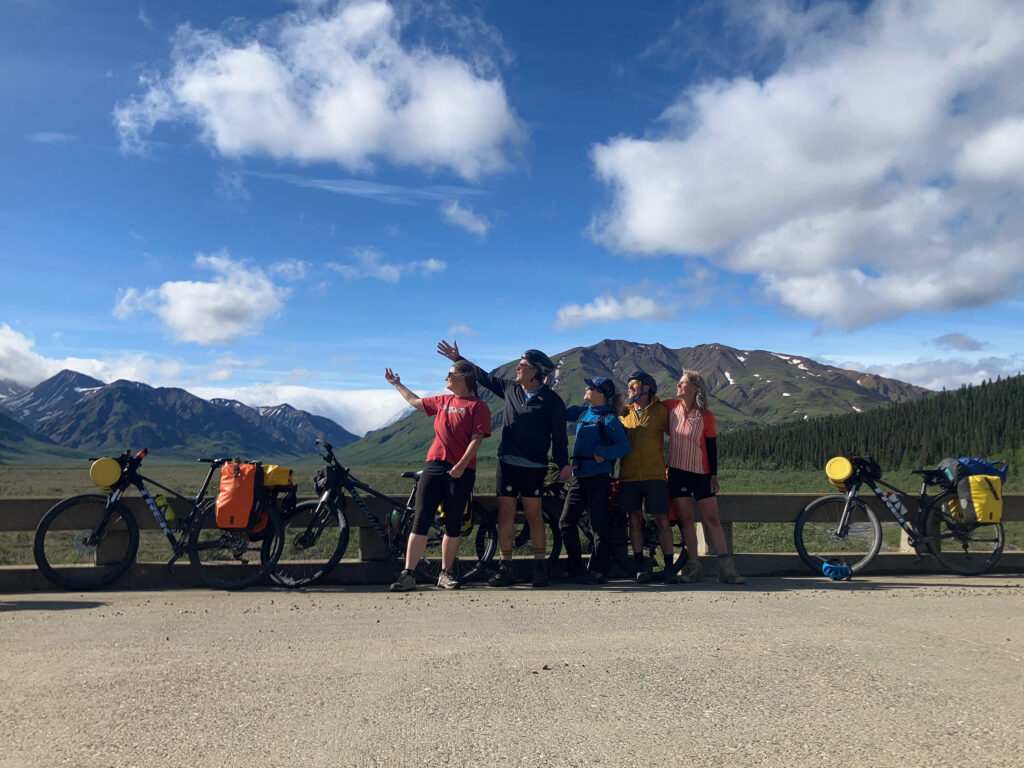
Matt Whitman, Leslie Evenden, Michelle Drucker, Steve Williams four bikers and friend Ori Badajos on a bikepacking trip to Denali.
Matt Whitman and Leslie Evenden are back from a five-night “bike packing” trip to Denali. They pedaled about 20 miles a day with former Haines residents Michelle Drucker and Steve Williams, viewing bears, moose, sheep and caribou on the trip. The bikes were outfitted with a bear barrel on the front of the cycle for food storage. They cooked and camped every night. Following the adventure all four met up in Fairbanks for dinner with Sara and Richard Chapell. The Chapells were in Fairbanks working on their cabin as well as attending a hosted discussion with the U.S. Supreme Court Justice Ketanji Brown Jackson. The conversation was cut short by an unspecified emergency the Justice had to attend to, but she did speak for roughly 30 minutes about her early influences and experiences coming up in her career. Jackson is the first black woman to serve on the Supreme Court.
And speaking of the Evendens, their dog Nori went on something of a staycation while they were gone. According to new CVN reporter Lizzy Hahn, who was tasked with watching her, Nori first disappeared from Evenden’s home for a day. After Hahn spent the evening wandering down the street with a leash, dog treats and a squeaky toy, she discovered that Nori had made her way down to Darsie and Courtney Culbecks’ Mud Bay home, a favorite hangout. Later on Nori disappeared from
Culbecks’ home and a call was put out via social media and a listener personal on KHNS seeking her return. All’s well that ends well, though, as Evenden said Nori is safe and sound at home with her and Whitman now.
And on the subject of dogs, the dog walkers and sitters of the community shared their tips for finding elusive hounds. Bryce Wortman might be Haines’ premier pet sitter. He has a client named Goose who has two different colored eyes. He says that you know by the way she looks at you if the Goose is on the loose. The best way he has for getting her back is to pick up Kim Larson’s dogs and inspire Goose to follow the dog pack.
Gabe Long has no problem getting dogs to approach him. He says that a big hairy malamute visits him at his yard twice daily. The dog is named Bodhi, short for Bodhisittva. Long says that Bodhi offers a path to enlightenment, just as the name implies.
Zombie, a 12-year-old Shiba Inu, is learning a new trick, riding on a motorcycle with some help from his human, Karla Peña. Peña is in Haines for work for a few months and has been enjoying the training on the Honda XR15L. She says that Zombie tolerated the doggles (that’s goggles for dogs…) and the motorcycle backpack was the next logical step. Peña said she started him out with just a few miles at a time and is increasing his riding time.
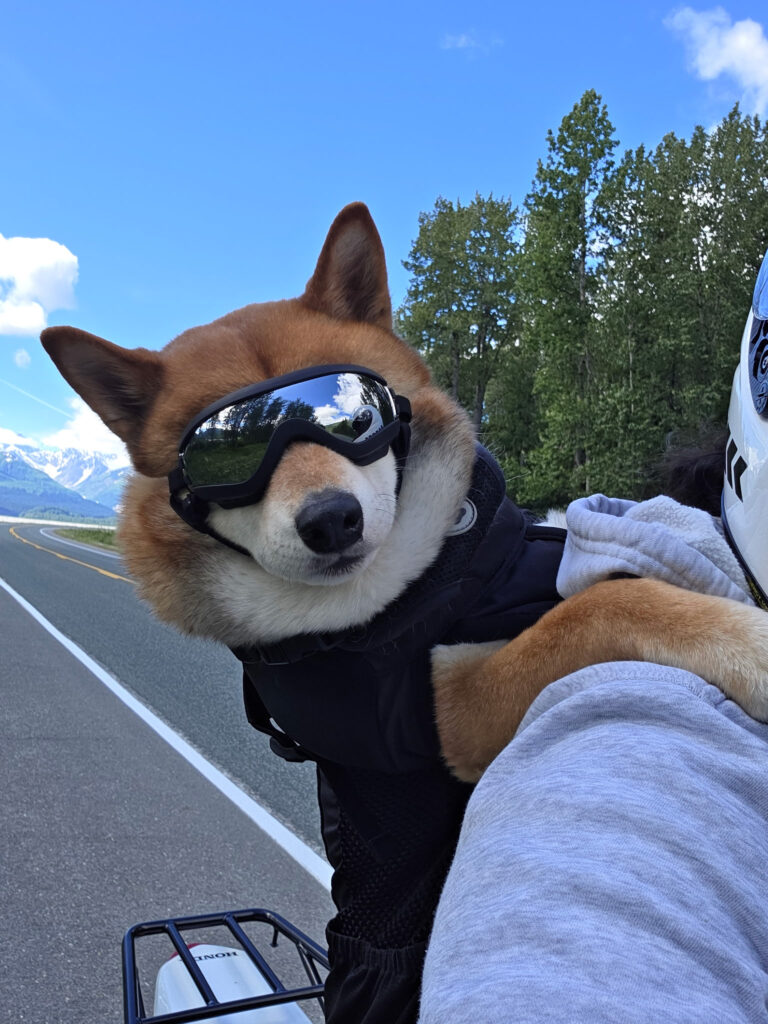
Zombie, on a motorcycle with owner Karla Peña on the Haines Highway.
Beau and Zane Bradley recently arrived home from a trip to Valencia, Spain. While there, Beau Bradley participated in the Gay Games XII placing second in the 50-meter butterfly, fifth in 50-meter freestyle and fourth in 100-meter freestyle.
They experienced record-breaking temperatures during a stop in Germany, fresh-squeezed Valencia orange juice from the legendary OJ capital of the world and came home with a couple of new tattoos to remember the adventure.
Chrissie White and Aly Zeiger combined their birthday party plans this year. They hosted a hobbit-themed celebration at Portage Cove last weekend, transforming the spot into the Shire on a sunny afternoon, overflowing with hobbit hospitality. There were flowing skirts, cloaks, waistcoats, plenty of crowns of flowers and a friendly croquet tournament. The “master of the mallet” (or winner of the croquet match), Ryan Eckert played the game on stilts while in character as Gandalf, complete with extended croquet mallet.
A sunny summer day and the opening of the Southeast Alaska State Fair just around the corner inspired Maren Billings to get into the lemonade business in downtown Haines. Her brother Oliver Billings helped for the low, low price of a $20 gift card for the Bookstore that Maren had on hand. Oliver Billings said he has previous experience selling lemonade with his friend Milo Beck. Oryn Stanford and Ava Stanford also assisted in the operation, refilling lemonade and snickerdoodle cookies.
Maren Billings said that she originally wanted to raise money to buy a cat but recently learned that she could get a pig for $250. The other kids said they wanted to save money to spend at the fair. ds said they wanted to save money to spend at the fair.
The post Duly Noted: Dogs and bikes and other fun stuff appeared first on Chilkat Valley News.
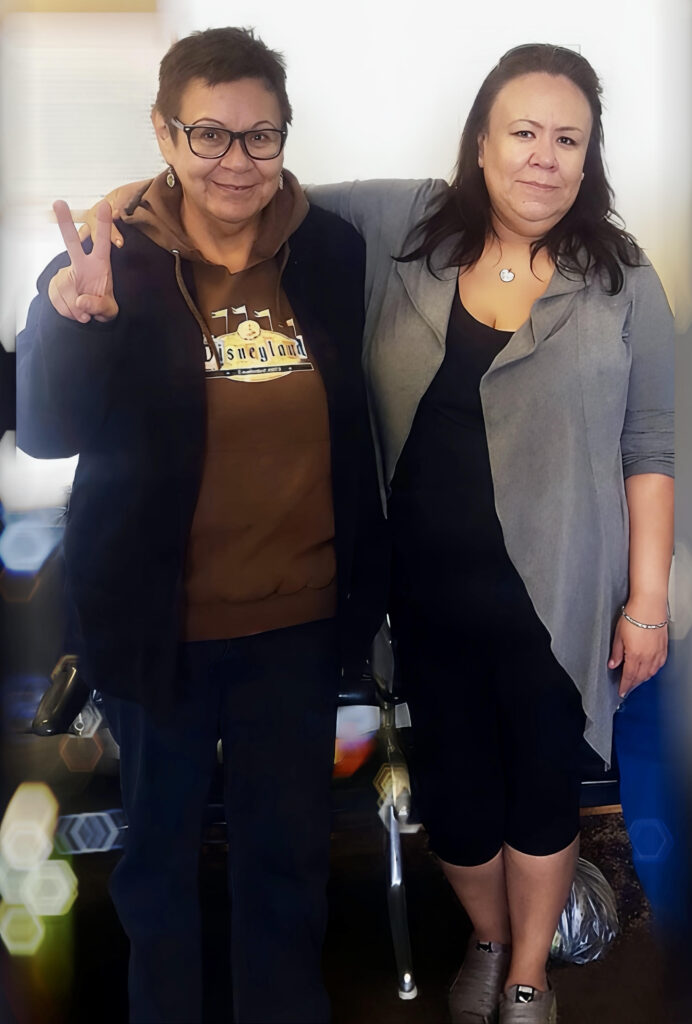
There will be a celebration of life for Ruth Dick, 76, on Aug. 1 at 3 p.m. in the Haines ANB Hall. A potluck featuring her favorite dish, chicken adobo, will follow. She died peacefully June 5 at the Sitka Pioneer Home, where she had lived for four years.
“It was just her time,” said daughter Rhonda Degtoff. Dick lived most of her life in Haines. She was a L’uknax.ádi (coho salmon) of the Raven moiety.
She loved her family, the singer Tom Jones, forget-me-nots, watching Native dancing and being with friends.
“Ruth was an ‘up’ kind of person,” said friend Doris Bell. She liked to lead her friends in singing “You Are My Sunshine.” “She had some hard knocks and kept soldiering on with a smile on her face and a little hat on her head,” Bell said.
Dick was a member of ANS Camp 5, the Chilkoot Indian Association, the American Legion Unit 12 Auxiliary and enjoyed volunteering at the Salvation Army Thrift Store.
Ruth Dick was born July 29,1949 in Juneau. Her parents were Mary Young and Richard A. Dick Sr. She grew up in foster care in Hoonah and did not have fond memories, her daughter said.
“Both my parents recalled beatings for speaking their language.” Because of that, Dick did not identify with her culture until later in life and then it brought her joy, Degtoff said
She married Randolph Williams Sr. in October 1968 and had the first of her four children the following year. She spent much of her life as a single parent. Degtoff’s earliest memories of her mother are in Juneau, climbing the steep stairs up the hill to their apartment, carrying groceries.
“She had all the bags and a baby on her hip, corralling three little ones. “I’m proud of her,” Degtoff said. “She was a great mom.”
She leaves brothers Wes and Paul Dick; children Rhonda Degtoff of Haines, Mary Uyanik of Juneau, Randy Williams Jr. of Juneau and Manette Hogue of Juneau; grandchildren Adam Williams, Nicholas Degtoff, Meganne Clarke, Ashley Williams, Sam Uyanik and Rebecca and Eliza Hogue.
Her brother Richard Dick preceded her in death.
Donations toward funeral expenses are gratefully accepted at the service on Aug. 1, or at P.O. Box 316.
The post Memorial service scheduled for longtime resident Ruth Dick appeared first on Chilkat Valley News.
The Chilkoot River sockeye run arrived in a large surge last weekend, bringing the fish count at Alaska Department of Fish and Game’s Chilkoot Weir to nearly six-times what it had been just 48 hours before.
As of Friday evening, roughly 3,000 sockeye had passed through the weir since it was installed at the end of May, a number below the historical average for mid-July.
When 6 p.m. hit, the start of the Friday evening shift for Fish and Game staff at the weir, that all changed. Over the three-hour counting period, an average of over 30 sockeye per minute came through the weir, totalling 6,500 fish, department salmon researcher Shelby Flemming said this week. A similar influx of fish continued the next day, with a small lull around midday.
All told, from Friday through Sunday, department staff counted 16,820 sockeye passing through the weir.
News of the sockeye arrival brought anglers and subsistence fishermen out in numbers. Fish and Game’s area sportfish biologist, John Whitinger, reported “hot” fishing around Letnikof Cove. “People pulling their subsistence nets out had sockeye bigger than I’ve ever seen,” he said. “People were telling me they had more fish than they even really needed.”
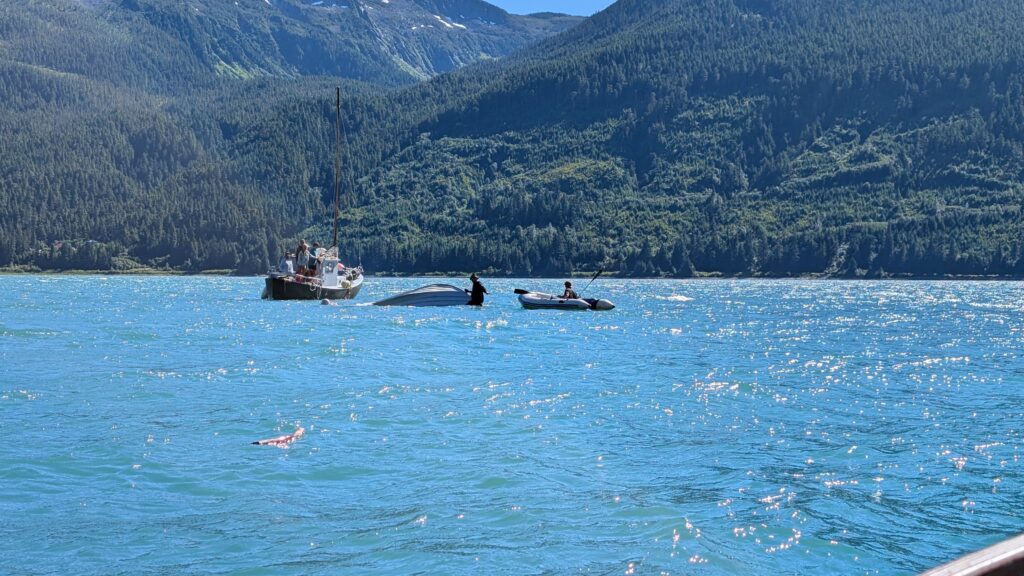
Amid the fishing frenzy, at least two boats capsized. One of the boats overturned Saturday and sank in Lutak Inlet. A second boat that capsized the next day was salvaged by borough staff. No one was hurt.
The first boat overturned Saturday mid-morning in Lutak Inlet, said Joanne Waterman, who was fishing from a nearby vessel.
Waterman said that while wind and seas were picking up, she and fishing partner Dean Heard saw a small skiff nearby sitting low in the water and a lone boater beginning to bail with a bucket.
Waterman and Heard assisted the other boat, which they found without power due to a subsistence net tangled in the prop.
“The boat took a couple of good waves over the back and it started to sink,” Waterman said. “(Boat owner Linda Huber) was hanging onto the boat and we got her into our boat and then backed off, because the wind was bumping our boats together.”
Huber was the lone person in the vessel, joined only by her dog, who Waterman said was wearing a personal flotation device and also was saved.
Haines Volunteer Fire Department chief Zak Overmyer said the department sent an ambulance to the scene, but Huber declined medical attention. Huber did not return calls seeking more information.
The second boat capsized Sunday afternoon in Lutak Inlet.
Haines resident Michael George said he was boating nearby when he saw the overturned skiff with a man hanging off.
George’s son, Siyel George, piloted a Zodiac his family had been towing toward the overturned boat and hoisted the stranded boater, who was not wearing a personal flotation device, out of the water. Another crewmember of the overturned boat had already swum to shore.
Michael George said the capsized boaters, who he did not know, told him they had rapidly taken on water over the stern of their boat. When he arrived at their boat, George said their subsistence net was underwater and snagged on their outboard motor.
Haines harbormaster Henry Pollan said he towed the empty boat on Sunday afternoon from the mouth of the Chilkoot River to the Lutak launch ramp.
The post Weekend sees surge of sockeye, capsized boats appeared first on Chilkat Valley News.