According to a newly unsealed report filed with the Draper City Police Department, Mortensen claims Paul attacked him earlier this year.
Taylor Frankie Pail and Dakota Mortensen on ‘Secret Lives of Mormon Wives’ reunion episode. (Hulu/YouTube)
ABC canceled her season based on footage of a 2023 attack, but now it seems that that was just one of several incidents.
In a filing obtained by Page Six, Mortensen outlines a series of alleged actions he says Paul took during an altercation that took place in February:
He accuses her of “grabbing and pulling his hair,” “pushing him into a wall,” and “scratching him repeatedly.”
The document also claims Paul “struck his arm” and made “hostile and aggressive physical contact,” resulting in injuries that required medical treatment.
According to the filing, the alleged incident occurred earlier this year, around the same time both parties reported separate allegations to law enforcement and the ensuing domestic assault investigation was launched.
Taylor Frankie Paul and Dakota Mortensen on ‘The Secret Lives of Mormon Wives.’ (Hulu/YouTube)
Paul has previously described the situation differently, asserting that she experienced abuse and that her past — including a 2023 incident involving Mortensen — has been unfairly resurfaced and scrutinized.
Her legal team has acknowledged that there were “mutual allegations” but has not publicly commented on the specifics of Mortensen’s latest claims.
Mortensen’s filing also paints a picture of being concerned for his safety and that of their two-year-old child, saying the alleged conduct was part of a pattern that led him to seek legal protection.
This development comes amid a chaotic legal backdrop: Mortensen has already sought a restraining order against Paul, and both parties have been embroiled in litigation connected to their former relationship and shared custody concerns.
Bodycam footage from Taylor Frankie Paul’s arrest shows her very intoxicated and upset. (YouTube)
“The West Jordan Police Department is currently investigating an incident involving Taylor Frankie Paul and Dakota Mortensen,” a spokesperson for the department told Page Six last week.
“The allegations were reported at the end of February 2026, and detectives have reviewed video believed to have been recorded in early to mid-2024.”
As of now, Paul has not directly responded to these specific fresh allegations in Mortensen’s filing, and no criminal charges tied to the 2026 claims have been publicly announced.
A hearing on the protective order request is expected soon, and legal experts say Mortensen’s most recent claims could play a central role in how a judge views the situation.
We will have further updates on this developing story as new information becomes available.
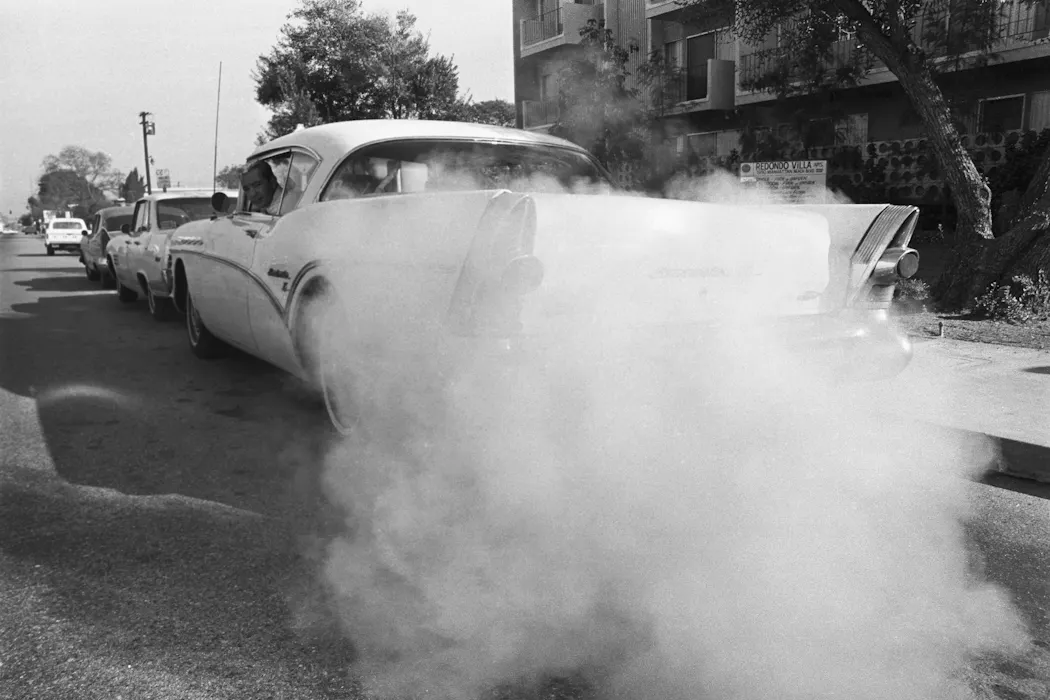
Before catalytic converters, starting a gas-powered vehicle could choke the surrounding area with smog.Bettmann via Getty Images
Cars on the road today are 99% cleaner than they were in 1970. Air quality in the United States is much, much better as a result. In Los Angeles, where I live, lead levels in the air were 50 times higher in the 1970s than today, and the amount of lead in kids’ blood has plummeted.
What made that drop possible is arguably the most important environmental technology ever invented: the catalytic converter.
California has long had the authority under the federal Clean Air Act to set emissions standards for cars and trucks that are higher than the nation’s, and its early use of that authority is a major reason why catalytic converters are now standard in vehicles and people are healthier across the country.
At a time when the Trump administration is attacking California’s ability to cut air and climate pollution and revoking its Clean Air Act waivers, it’s helpful to remember just how important the state’s leadership has been in making the air Americans breathe so much healthier.
But without California’s willingness in the early 1970s to push automakers to meet tough standards, the technology would have developed more slowly and the air would have remained dirtier for many more years.
Widespread car ownership altered American life, changing where people lived, worked and vacationed. But cars also brought terrible smog as their use skyrocketed. When Houdry realized his life’s work was choking the air of Los Angeles, he decided to do something about it. By the late 1950s, Houdry had invented a rudimentary catalytic converter.
What is a catalytic converter? The Engineers Post
You might think that this invention, which Houdry said could make “the lung cancer curve dip,” would lead carmakers to install the technology on their new vehicles.
But that is not what happened. Instead, auto manufacturers engaged in what the government described as a yearslong conspiracy to keep emissions-limiting technology off the market, ultimately leading to an antitrust legal settlement.
It wasn’t until the passage of the 1970 Clean Air Act that carmakers got serious about improving upon Houdry’s invention for mass market installation.
The Clean Air Act’s ambition
The 1970 Clean Air Act is a remarkable piece of legislation. Passed with only one negative vote and signed into law by President Richard Nixon, the act set wildly ambitious goals. They included a requirement that carmakers cut auto pollutants by 90% by 1975.
Congress passed this requirement knowing that the technology to cut emissions wasn’t ready for prime time. Houdry’s catalytic invention couldn’t work with leaded gasoline, and it hadn’t been tested in tough conditions, such as freezing cold or sweltering heat.
The Ford Motor Co., with Lee Iacocca as its president, told Congress in 1970, “If such (pollution cuts) are established … the technology as we know it today would not permit us to continue to produce cars after January 1, 1975.”
Ford Motor Co. President Lee Iacocca leans against a Ford Mustang in Bloomfield Hills, Mich., in 1974. John Olson/Getty Images
Automakers responded with two separate tactics. The first was to gear up – alongside companies like Corning Glass and the Engelhard Company – to develop technology to meet the 90% cuts. Most of their efforts focused on improving the catalytic converter, made more plausible when Engelhard determined that catalytic converters wouldn’t corrode with unleaded gasoline. The EPA’s Ruckelshaus ordered gas stations to make unleaded gasoline available as of Jan. 1, 1975.
While the auto companies worked to meet the congressional mandate, they also pressured Congress and the courts to weaken or delay it. The U.S. Court of Appeals for the District of Columbia Circuit obliged, ordering Ruckelshaus to extend the deadline for compliance by a year. Congress eventually extended the deadline to 1981.
But California did not let up.
A gamble that paid off
California has the authority under federal law to issue its own automobile pollution standards, as long as the standards are stronger than federal standards and the state receives a waiver from the EPA. No other state has similar power, but states can adopt California’s higher standards.
After the federal appeals court gave carmakers an extra year to comply with the federal rules, California decided it would not let car companies off the hook.
The state asked Ruckelshaus to grant a waiver for California to issue standards tough enough that carmakers would have to install catalytic technology to meet them.
After several of its motorcycle messengers became ill from driving in smog in 1955, a Los Angeles printing company bought gas masks for them. Bettmann via Getty Images
Ruckelshaus faced enormous pressure to deny the waiver, with automakers arguing that the technology was neither effective nor available. But in a hint of the resolve he would later show in refusing Nixon’s order to fire Watergate special prosecutor Archibald Cox, Ruckelshaus gave California the go-ahead in 1973, and the state’s rules went into effect for the 1975 model year.
He reasoned that doing so would maintain “continued momentum toward installation of (catalyst) systems … while minimizing risks incident to national introduction of a new technology.” In other words, California could serve as a guinea pig for the rest of the country by adopting tough standards.
Ann Carlson and PBS’s “American Experience” explore Los Angeles’ war on smog.
The gamble paid off. Since California was the nation’s largest auto market, companies had strong economic incentives to change their models to meet the state’s standards. Catalytic technology is now not only standard on American vehicles but also on vehicles around the world, and air quality in the U.S. is vastly improved.
Catalytic converters have removed 8 billion tons of pollution from the air in the U.S. They have saved hundreds of thousands of lives and led to the removal of a deadly neurotoxin, lead, from the atmosphere.
But the state’s ability to set higher standards is under attack. Congress – at the behest of the Trump administration – has overturned three waivers the state was granted to cut even more pollutants and the greenhouse gases that cause climate change. The Trump administration has also sued California to invalidate its mandates for automakers to sell zero-emissions vehicles.
Today, California officials are searching for alternative ways to continue to make cars and trucks cleaner. The state has set aside money to replace federal tax incentives for electric vehicles, and the Legislature is exploring creative ways to hold indirect sources of emissions, such as rail yards, ports and warehouses where vehicles are constantly running, accountable for air pollution.
But these alternatives aren’t as powerful as the authority to exceed federal standards to make the air cleaner.
Ann E. Carlson’s research was supported by UCLA. President Biden appointed her to serve as Chief Counsel and Acting Administrator of the National Highway Traffic Safety Administration from 2021-2024.
It turns out that she and Jim Bob are doing even more than that for Joseph’s wife.
The infamous Duggar couple are openly declaring their support for Kendra — and even hired an attorney for her.
Michelle Duggar confronts paparazzi near her home in Arkansas. (Image Credit: YouTube)
A Duggar family attorney is representing Kendra
If you’ve been following the Duggar cult as they sink to new depths (can’t really say highs and lows with this crowd), you’ve likely heard of Travis Story.
Story also helped the couple when they sought custody of Tyler, their great-nephew.
He’s essentially the Duggar family lawyer — or one of them.
Story will be representing Kendra Caldwell as she faces eight charges — of endangering the welfare of her minor children and of false imprisonment.
Following her arrest, Kendra Caldwell Duggar posed for a mugshot. (Photo Credit: Washington County Detention Center)
Jim Bob and Michelle are showing their support
A Duggar family spokesperson has opened up to Peopleon behalf of Jim Bob and Michelle.
“Jim Bob and Michelle are heartbroken over this entire situation,” the spokesperson expressed.
The entire situation, of course, refers to not only the shared charges between Joseph and Kendra, but also to Joseph’s charges of sexually abusing a 9-year-old girl. He has reportedly confessed twice to this crime.
“Right now, they are focused on loving their family,” the statement claimed, “and helping Kendra and her children during this difficult time.”
Vaguely, the spokesperson added: “They are praying for the victim. They ask for privacy and appreciate the kind words and prayers offered by so many.”
Joseph Duggar has been arrested for the alleged molestation of a 9-year-old girl. (Washington County Sheriff’s Office)
The attorney and support aren’t for Joseph
We know about Travis Story because of the now-public phone call that Joseph Duggar and Kendra Caldwell exchanged after Kendra’s brief time in custody, but while Joseph was still at the Washington County jail.
(Joseph is no longer at the jail and is believed to be in Bay County, Florida — or on his way there through the extradition process.)
Joseph asked his wife about the attorney situation, and she answered.
“I’ve been talking to Travis,” Kendra told her husband during the call. “I’ve got him as my attorney now.”
She added: “I wasn’t sure if you knew that, I’ve asked him to be my attorney.”
In this still from the Washington County Sheriff’s Office, a handcuffed Kendra Caldwell Duggar sits and speaks to a law enforcement officer. (Image Credit: Washington County Sheriff’s Office)
Kendra had to break the news to him
Joseph said: “I wasn’t sure who we settled with but this guy’s good.”
But Kendra objected to that, and moved swiftly to clear things up.
‘Well it’s not for you, it’s only for me,” Kendra clarified to her husband.
She then explained that she needed someone “for the case we’ve got going with the kids and stuff.”
Simply put, no matter what evidence the state presents, Kendra’s attorney will have a much easier time claiming that the kids are safe with her than one would claiming that they are both fit parents. Obviously.
Joseph Duggar and Kendra Caldwell appear on TLC, before a sequence of disgraceful events. (Image Credit: TLC)
Two bad men and counting
Some have suggested that the plan is to throw Joseph under the bus.
Whatever the state of that home — thus far, we have heard only about children’s rooms that lock from the outside, like jail cells, and expect more details to come — Kendra could hypothetically claim that it was Joseph’s decision.
It’s true that, in the horrific cult to which the Duggars belong, husbands and fathers essentially have ownership over their families.
Fortunately, the law does not see things that way. Unless they can prove otherwise, both parents bear responsibility for the treatment of their children.
We pity any child born into this family, into this cult. And, clearly, any child who is unlucky enough to come into contact with at least two of Michelle and Jim Bob’s sons.
The U.S. Army has launched an investigation into the circumstances surrounding why two Apache attack helicopters were hovering outside of Kid Rock’s Tennessee mansion. Continue reading…The Boot – Country Music News, Music Videos and Songs
A first-of-its-kind change is coming to U.S. currency, involving President Donald Trump in a way many won’t expect. Continue reading…The Boot – Country Music News, Music Videos and Songs
‘American Idol’ took an unexpected turn during its live show, leaving contestants and viewers waiting — and wondering what just happened. Continue reading…The Boot – Country Music News, Music Videos and Songs
MARIETTA, Ga. — As he settled into his podium seat for Monday’s packed pre-match press conference inside the sprawling and pristine training facility of MLS side Atlanta United, U.S. men’s national team coach Mauricio Pochettino cut a businesslike figure. The Argentine answered the first dozen or so questions matter-of-factly, displaying little sign of the charm that endeared him to fans of clubs across Europe — including the all-world squads like Chelsea and Paris Saint-Germain — during the 15 years he spent managing on the continent. – Will Defender Chris Richards Play vs. Portugal?- World Cup Schedule, Matches Exactly 24 minutes into the back-and-forth with reporters, Pochettino’s demeanor changed. Asked how the American squad can keep its intensity high for all 90 minutes, something it failed to do in Saturday’s 5-2 capitulation against Belgium, in Tuesday’s World Cup preparation match versus No. 6-ranked Portugal, the 54-year-old instantly became animated. He gesticulated as he spoke. That trademark charisma was suddenly on full display. “If you watched the game [between] France and Colombia, that is intensity,” said Pochettino, referring to Sunday’s exhibition between the 2018 World Cup champions (and 2022 runners-up) and Los Cafeteros in Landover, Maryland. Les Bleus won 3-1, yet the victory was anything but comfortable. “You can win, or you can lose,” Pochettino said. “But do you think the coach of Colombia, [despite] losing the game, is going to complain about [the effort of] some players? They played like this was the final of the World Cup. And France, when they saw the intensity and the aggression of Colombia, said, ‘If we aren’t as intense, they’ll kill us.’ That is intensity.” In stark contrast, the U.S. all but folded up shop when a Belgian penalty put the home side down two goals on Saturday with more than 30 minutes of the contest still left to play. The response, goalkeeper Matt Turner and others said afterward, should’ve been the opposite. As the saying goes: If you can’t beat them, beat them up. Pochettino didn’t go that far, of course. And although English is his third language after his native Spanish and the French he learned playing as a central defender for Ligue 1 sides PSG and Bordeaux in the early 2000s, he couldn’t have expressed himself more clearly. This isn’t the first time intensity has been a problem for the Americans since Pochettino arrived on these shores 18 months ago. Exactly this time last year, a flat and toothless USA dropped home games to regional foes Panama and Canada in the Concacaf Nations League finals. Pochettino was so upset that he and his staff “destroy[ed] what we needed to destroy” and began to rebuild the team in his own image by bringing in a gaggle of newcomers who have since become mainstays. By the end of last year, the lack of fight was no longer an issue: The U.S. literally brawled toward the end of a November win over Paraguay before beating the brakes off two-time World Cup champ Uruguay — arguably the hardest team, pound for pound, on planet fútbol. It’s something Poch’s lot must rediscover between this month’s two games. “It’s a conscious decision. It’s just an overall effort,” captain Tim Ream said when asked why the U.S. faded so badly against Belgium at Mercedes-Benz Stadium. “It’s not that guys don’t want to do it. I think sometimes it’s like ’I’ve just made an effort,’ and now it’s about making the second, the third, the fourth. And sometimes, that doesn’t happen. “That’s something that’s non-negotiable, really,” Ream continued. “It’s something that we were doing really well in the fall last year. And it’s something we have to get back to.” Pochettino noted on Monday that unlike last autumn, his players have been inundated with pre-World Cup media responsibilities this week. That wasn’t the case in November or in the two international windows that preceded it. Yet he also pointed out that it’s not a switch that can simply be turned on when the World Cup kicks off in June. That’s the big lesson from Saturday. It’s the mandate for Tuesday. The 2026 World Cup co-hosts still might not win the match. Portugal has a legitimate chance of hoisting the most coveted trophy in sports next July 19. Even at home, the U.S. would require a miracle even to reach the final four. Failure to rediscover their pugilistic spirit could end in catastrophe. As Pochettino asked rhetorically of whoever his team comes up against next summer: “Do you think that they are not going to fight?” “There’s still time to realize that we need to compete,” he reiterated on Monday. “The players need to believe in that.” We’ll find out on Tuesday how much. 2026 FIFA World Cup: How To Watch The World Cup will run from June 11–July 19, 2026. Spread across three countries, the tournament will culminate with the final on July 19 at New York New Jersey Stadium in East Rutherford, New Jersey. All 104 tournament matches will air live across FOX (70) and FS1 (34) with every match streaming live and on-demand within both the FOX One and the FOX Sports apps.Latest Sports News from FOX Sports
A snow-covered statue of William Henry Seward stands in front of the Alaska State Capitol on Wednesday, March 4, 2026. (James Brooks photo/Alaska Beacon)
Alaska has a loophole big enough to bury a body in.
Right now, if someone in Alaska witnesses a murder or another violent crime against an adult and does not report it, the law treats that failure as a violation. Not a misdemeanor. Not a felony. A violation with a $500 fine.
That should alarm people. The fine is less than the penalty for littering.
Kathleen’s Law was introduced last year, and one of those public safety loopholes that was aimed at fixing part of that problem. It would have raised the penalty for failure to report a violent crime against an adultfrom a violation to a criminal misdemeanor. It was not an extreme proposal. It was an attempt to say that when someone witnesses murder, kidnapping, or sexual assault, and says nothing, that silence should carry more weight than a ticket-level, $500 offense.
But the bill died.
Not because the law is good enough. It died because groups that work with victims raised concerns about the wording and potential unintended consequences, and the work needed to fix it was met with apathy.
Alaska law still fails to clearly distinguish between failure to report a violent crime and intentional concealment of a murder. Those are not the same thing, and pretending they are has consequences.
There is a world of difference between a person who fails to report a violent crime and a person who knows, or reasonably should know, that someone died by murder, has a safe chance to report it, and instead stays silent to keep that death from being discovered or investigated.
I have shared a draft bill with several legislators addressing concealment of murder. It creates a new criminal offense for someone who knowingly fails to report a death under circumstances showing an intent to prevent discovery or investigation.
That is not mere silence. That is concealment.
And it should be treated more seriously than Alaska law treats it now.
Under the current failure-to-report law, murder is lumped in with other violent crimes, even though the harm caused by intentionally keeping a homicide hidden is different in kind. A murder investigation can be delayed for months or years. Families can be left in the dark. Evidence can be lost.
Concealment of murder would remove murder from the existing framework of failure to report a violent crime and create a separate offense for concealment of murder, making it a class C felony. This creates a middle category that Alaska law does not currently have.
Right now, Alaska law can punish someone for actively helping an offender, hiding evidence, or tampering with a scene. But if someone intentionally keeps knowledge of a murder to themselves and does not cross one of those narrow lines, the law may have very little to say.
This gap is not theoretical. This loophole has had real consequences in Alaska. We have seen cases where silence delayed the truth and deepened harm. We have seen how slow disclosure shapes investigations and leaves victims’ families carrying the cost.
Recognizing that concealment of murder deserves its own category is a chance to modernize Alaska law.
Silence after a killing is not neutral, not when it protects the truth from coming out and not when it makes justice harder to reach. Alaska’s current law leaves room for people to sit on information after a homicide and face little or no meaningful consequences.
By early 2007, the excitement coming from the UK about Amy Winehouse was too overwhelming for the US record industry to ignore any more.
The British vocal sensation had failed to make the American charts with her debut album Frank, which made its UK debut in 2003, rising to an initial peak of No.13. But even in her home country, that first record was more of a critical favorite than a commercial success until Winehouse released the follow-up, Back To Black, on October 27, 2006.
Both albums would spend literally years on the British charts. In the week of the 15th anniversary of its release, in 2021, Back To Black was spending its 127th week in the UK Top 40, and 444th in the Top 100.
Produced by Mark Ronson and universally hailed in Britain as a modern-day masterpiece of contemporary soul music, the record entered the domestic bestsellers at No.3 in November 2006. Perhaps surprisingly in retrospect, it spent only four initial weeks in the Top 40, but then the effect of its first hit “Rehab” and the new year single “You Know I’m No Good” began to kick in.
In the second half of January 2007, Back To Black topped the UK chart for the first time, and would go on to spend all but two of the next 48 weeks in the Top 10. America couldn’t overlook Amy any longer, and the album entered the Billboard 200 on the March 31 chart.
Just in advance of the set’s US release on Universal Republic, Kim Garner, the label’s senior VP of marketing & artist development, told Billboard: “The feedback across the board here has been nothing short of amazing. Amy had two incredibly successful shows here in New York that generated a slew of excellent reviews.” Those mid-January gigs, at Joe’s Pub in mid-January, were her first-ever US shows.
‘It made people rethink music’
The album “made people rethink music,” Ronson told Billboard, “because it was so simple in its approach: the sound of five or six really good instrumentalists with an amazing singer.” Blender, greeting the record’s US appearance, said it “sounds fantastic – partly because the production nails sample-ready 60s soul right down to the drum sound and partly because Winehouse is one hell of an impressive singer.” The New York Times purred: “A 23-year-old English songwriter, Ms. Winehouse is decades too young for 60s nostalgia, but she has come up with a wonderfully time-twisted batch of songs.”
Click to load video
Back To Black went on to reach No.2 in the US, turning gold in May 2007, platinum in July and double platinum the following March. From it, that “Rehab” signature became a major pop item, hitting No.9 on the Hot 100, and by the end of the year Winehouse had six Grammy nominations, of which she would win five, missing out only in the Album of the Year department. But back at the time of the American release of Back To Black, Winehouse was typically and delightfully dismissive about the business aspects of the record.
“I love doing music and playing gigs,” she told this writer in that Billboard story, “and I’m really grateful for the opportunity to do so. But to be honest I’m not the kind of person that will think about the demographic. I’m just the ‘turn.’”
Kendra Duggar is preparing to head to court.
Hours after she was released from an Arkansas prison March 20 on charges of endangering the welfare of a minor and false imprisonment, the 27-year-old… E! Online (US) – Top Stories




























 Kendra Duggar is preparing to head to court.