Categories
Uncategorized

For the first time in a decade, the next election could be less secure than the one preceding it

The Election Security Group turns intelligence about foreign election threats into warnings and offensive operations. Charly Triballeau/AFP via Getty Images

With the 2026 midterms less than six months away, the Election Security Group would normally be busy helping prepare the nation’s election infrastructure. The federal task force typically briefs Congress on upcoming threats and engages with state and local leaders to game out scenarios ranging from ransomware to critical infrastructure attacks on Election Day.

But Gen. Joshua Rudd, director of the National Security Agency and commander of the U.S. Cyber Command – the two agencies that jointly run the Election Security Group – told the Senate Armed Services Committee on April 28, 2026, that he didn’t know whether the group had been set up yet. The Election Security Group has worked every federal election cycle since 2018, but, as of mid-May, there is no public indication it has been activated.

This pending Election Security Group activation follows the Trump administration’s 2025 decision to defund the Elections Infrastructure Information Sharing and Analysis Center, the threat-sharing hub that helped make 2024 the most cyber-secure election in U.S. history, according to the Center for Internet Security, a nonprofit focused on protecting against digital threats. A White House spokesperson said of the cuts at the time that EI-ISAC’s work no longer effectuated the priorities of the Department of Homeland Security.

These losses – and the disbanding of other federal offices that counter foreign influence operations – make it harder for local officials to learn of threats to election infrastructure, like AI-enabled targeting of voting tabulation systems or deepfakes of candidates. Little is known about whether the proactive cyber deterrence that has defined U.S. elections for much of the past decade remains in place in any other form.

I’m a scholar of global efforts to secure democracy, and I co-edited a book called “Securing Democracies” about cyberattacks and disinformation worldwide. I can attest to the importance of guarding against foreign efforts to undermine trust in U.S. elections and believe that, without groups like the EI-ISAC and the Election Security Group in place, the 2026 midterms could mark a milestone: For the first time in perhaps a decade, the next election may be less secure than the last.
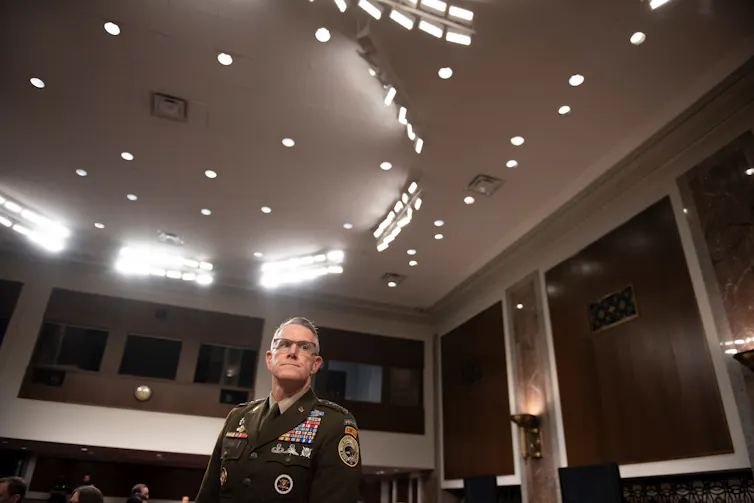
Gen. Joshua Rudd stands before the Senate Committee on Armed Services in Washington
Gen. Joshua Rudd, who’s in charge of the two agencies that jointly run the Election Security Group, told the Senate Armed Services Committee on April 28, 2026, that he didn’t know if the group had been set up yet for the midterm elections.
AP Photo/Cliff Owen

A decade of election defense

The Russian-backed Internet Research Agency began targeting the U.S. political system to sow divisions in 2014. Thanks to Internet Research Agency troll farms – organized groups paid to flood social media platforms with fake or divisive content – disinformation proliferated through the 2016 election. At the same time, Russia’s GRU – its military intelligence agency – homed in on the Democratic National Committee and probed all 50 state election systems. It breached Hillary Clinton’s campaign and compromised election systems in Illinois.

Though there is no evidence that votes were altered as a result, Russian influence exposed the country’s election vulnerabilities and set the stage for extensive investigations and hearings questioning how the U.S. government should respond. It left lasting damage in its wake, like lower trust in electoral processes and widened political divides.

In the final weeks of the Obama administration, the Department of Homeland Security designated election infrastructure as critical, akin to water and electricity. The first Trump administration built on that designation and created the Cybersecurity and Infrastructure Security Agency, a component of the Department of Homeland Security, in 2018. That same year, the National Security Agency and U.S. Cyber Command – the military nerve center for cybersecurity – partnered to launch what was initially called the Russia Small Group, a task force to guard U.S. election infrastructure against Russian interference.

Since at least the Obama administration, the U.S. had been largely focused on defensive measures to protect elections, like multifactor authentication and encryption, which make it harder to compromise systems in the first place. The Trump administration wanted to be more proactive, to put adversaries on notice and deter future attacks. This approach is known as defending forward, or persistent engagement.

The test for this new, more activist policy came during the 2018 midterms, as the Internet Research Agency again tried to widen divisions in U.S. society through hundreds of thousands of manufactured tweets and posts that made divisive views appear more widely shared than they were on both sides of hot-button issues. This time, however, the Russia Small Group took the Internet Research Agency offline during and immediately after the election. Although the details are classified, public reporting indicates that Cyber Command temporarily disrupted the Internet Research Agency’s internet access and sent direct messages to operatives warning them against such activities and instructing them to not interfere in U.S. elections.

A poster shows the photos and names of six Russian military intelligence officers
A Department of Justice poster shows six GRU officers charged with cyberattacks, Oct. 19, 2020.
Andrew Harnik/Pool via Getty Images

The Election Security Group

By the 2020 presidential election, the Russia Small Group had been renamed the Election Security Group, and its scope expanded beyond Russia to include China, Iran, North Korea and nonstate actors. It worked to “disrupt, deter and degrade foreign adversaries’ ability to interfere with and influence how U.S. citizens vote and how those votes are counted.”

The Election Security Group does this through detailed information-sharing across agencies and with local officials and the private sector. If, for instance, a foreign influence campaign falsely claims that polling places have closed early in a swing state, the Election Security Group can alert election officials, platforms and distributed cybersecurity teams before the claim goes viral. In true “defend forward” spirit, it can also help cut off foreign trolls and state-backed hackers from what’s needed to run an influence operation, like internet access, servers and accounts.

Typically, it is active during election years, serving as a vital coordination hub and turning intelligence about foreign election threats into warnings, defensive measures and offensive operations.

The Election Security Group’s absence comes at a time when both threats and technological vulnerabilities are multiplying.

The 2026 midterms

The current election cycle, in many ways, is more prone to targeting than previous ones because of the Iran war, AI-powered cyberattacks, nation state–sponsored attacks against U.S. election infrastructure, and the firing of key Cybersecurity and Infrastructure Security Agency personnel who worked with tech companies to spot election-related deepfakes and inaccurate or misleading content.

These challenges – combined with losing the EI-ISAC and, possibly, the Election Security Group – could leave the U.S. less prepared this November. Local and state election officials have fewer places to turn for the latest intelligence, and Congress is less informed about pressing threats – all while global U.S. standing is slipping and foreign adversaries could feel emboldened.

The Election Security Group, which was created by the first Trump administration – alongside both the Elections Infrastructure Information Sharing and Analysis Center and the Cybersecurity and Infrastructure Security Agency – has been an important weapon in the U.S. arsenal to defend vulnerable election systems. What fills these gaps remains unclear. One outlet has reported that plans to revive the Election Security Group are beginning to move through senior intelligence and defense channels, weeks after Rudd’s testimony. Even if the group is activated immediately, it will have less than six months to do what it has historically done across a full election year. With early voting beginning in some states even sooner, the clock is ticking.

The Conversation

The views expressed in this article are the author’s own.

​Politics + Society – The Conversation
Categories
Entertainment

Why This Popular Liqueur Is Actually One Of The Worst You Can Buy

Liqueurs are known for their densely-sweet taste with an alcoholic kick. Made from a variety of ingredients, liqueurs add concentrated hits of flavor to drinks.

​Mashed – Fast Food, Celebrity Chefs, Grocery, Reviews

Categories
Music

WATCH: Ella Langley Sets Five Big New Goals For Herself

Ella Langley’s on a winning streak after snagging seven ACM Awards, but she’s not slowing down anytime soon. What’s next for this country sensation? Continue reading…​The Boot – Country Music News, Music Videos and Songs

Categories
Music

WATCH: Ella Langley Sets Five Big New Goals For Herself

Ella Langley’s on a winning streak after snagging seven ACM Awards, but she’s not slowing down anytime soon. What’s next for this country sensation? Continue reading…​Country Music News – Taste of Country

Categories
Music

Where Does Riley Green Keep His Awards?

Green keeps his ACM and CMA trophies next to another, very different, prized possession. Continue reading…​Country Music News – Taste of Country

Categories
Entertainment

What Your Favorite Whiskey Says About You

Ever wondered what your preferred brand of whiskey reveals about your personality? We asked whiskey experts and bartenders what they really think.

​Mashed – Fast Food, Celebrity Chefs, Grocery, Reviews

Categories
Food

What Happened To Keystone Light’s Fruit-Filled Spinoff Beers?

Like a citrusy shandy, Keystone Light’s fruity spinoff beer was built for summer, but unfortunately, the first iteration didn’t last very long.

​Food Republic – Restaurants, Reviews, Recipes, Cooking Tips

Categories
Entertainment

Is It Really Illegal To Use Margarine In Wisconsin?

Dairy products rule supreme in “America’s Dairyland,” but how far is too far to dissuade Wisconsin consumers from substituting margarine for butter?

​Mashed – Fast Food, Celebrity Chefs, Grocery, Reviews

Categories
Politics

Trump completed his revenge tour. Allies wonder what it cost.

President Donald Trump has finally delivered on his promise a decade ago: He has made Republicans “so sick and tired of winning.”

The winning — a series of retributive primary challenges this month that settled scores up to five years old — has led to a fresh round of chest-thumping from MAGA allies boasting about their victories in Indiana, Louisiana and Kentucky.

Trump ended his vendetta spring Tuesday by dropping a two-stage MAGA bomb, backing Attorney General Ken Paxton for Senate in Texas on the same day he ushered Rep. Thomas Massie to the exits in Kentucky.

But the revenge tour is increasingly imperiling Trump’s midterm agenda on the Hill.

That’s because for every apostate ousted by Trump this month, there’s a sign of not only his waning political capital on the Hill, but that his backward-focused endeavors have damaged his own legislative ambitions, leaving him a victim of his own primary success.

“Those so-called victories over the last couple weeks are just a mirage. They are self-owns,” said one senior Senate Republican operative, granted anonymity to speak candidly about frustration with the White House. “We’re not actually beating Democrats, and we’re not actually advancing legislation. Instead, gas is up 45% due to our actions and the President’s decision to go to war with Iran. He’s focused on the ballroom. He’s announced a $1.8 billion restitution fund with zero details or congressional authority to do so. It just is crazy.”

In just one day, a conquered — and, consequently, unbridled — Sen. Bill Cassidy joined Democrats to become the 50th yes vote on a war powers resolution, opposed Trump’s ballroom funding in reconciliation and called Trump’s freshly picked Paxton a “felon.” And that was just day three of Cassidy unchained.

Cassidy is not alone. Trump’s ballroom funding is stalled, the SAVE America Act is mired in the Senate and Majority Leader John Thune is pushing back on his desire to fire the parliamentarian. That’s not to mention the pushback even from the likes of the friendlier senator from Louisiana, John Kennedy, who expressed doubt about the Justice Department’s $1.8 billion Anti-Weaponization Fund.

“There are still many, many months to go before the election, and this president is going to have to continue to deal and work with, and partner with, or battle with this group of lawmakers,” Sen. Lisa Murkowski of Alaska told reporters Tuesday. “Even though Bill Cassidy lost his primary, he is still a voting member of the Senate until January. … So the president may have just opened some opportunities for people.”

Now Cornyn could join their ranks. After Trump endorsed Paxton, the senior Texas senator faces increasingly slim chances of surviving next week’s runoff election. Should he lose, Cornyn will be liberated to vote his conscience — unmoved by threats of further political vengeance from Trump — for the final months of his term.

“What is the return on investment for Trump?” said Greg Lamantia, a Texas businessman who supports Cornyn, about Trump’s Paxton endorsement. “I don’t understand why you take this risk, versus sitting back and doing nothing. Now you’ve created an enemy for six months, when you have a razor-thin majority.”

“Republicans are united behind President Trump because we share one vision: securing the border, strengthening the economy, restoring common sense, and putting America First,” said RNC spokesperson Kiersten Pels. “While the media tries to manufacture division, Republicans remain focused on delivering results for the American people and building momentum heading into 2026.”

Come November, if Paxton loses to state Rep. James Talarico, this week and Trump feeling himself after victories in Indiana and Louisiana could be remembered as the week where he overreached.

“Some of the issues I hear about when I’m at home in the grocery store, in the hardware store, are not the same issues we’re talking about in Washington, so I think it’s really important that we prioritize what people are talking about,” said Sen. Cynthia Lummis (R-Wyo).

That daylight between Trump’s priorities and the top issues for voters is widening. The economy and cost of living remain voters’ top priorities, even as patience for the Iran war wavers. And though Trump has flexed his electoral muscle in primary after primary, his endorsement may hurt more than it helps in battleground races this November, according to a recent analysis from The POLITICO Poll.

“It seems to me his agenda is mostly vengeance,” said former Sen. Jeff Flake (R-Ariz.), who spent 15 months as a vocal Trump critic after deciding not to run for reelection during Trump’s first term. “It’s not just those that he’s going after he’s gonna have to deal with — Massie and Cornyn and Cassidy — it’s anybody who’s gotten past the filing deadline, or past their primary, and realizing that supporting a lot of what he wants is not good for the general election.”

At the end of a month that put on full display Trump’s dominance over his own party, his season of settling scores may not have advanced the ball toward November.

That dynamic could pose a problem for Republicans, Missouri Sen. Josh Hawley told POLITICO. “Congress doesn’t do much,” he said.

“In November, voters are going to say to Congress, ‘What have you done for me?’ And it’s not going to be enough to say that, ‘Well, you know, we liked some stuff President Trump did, but we didn’t do any of it,’” Hawley said. “I mean, we better do some stuff.”

What does it mean that Trump has vanquished his foes at the expense of his own agenda?

“It means President Trump and his team have completely lost sight of how DC operates and why the American people elected him in the first place,” said the senior Senate Republican operative.

Last year, chief of staff Susie Wiles told Vanity Fair that she had a “loose agreement that the score settling will end before the first 90 days are over.” That was 395 days ago.

Ali Bianco contributed to this report.

​Politics

Categories
Hip Hop

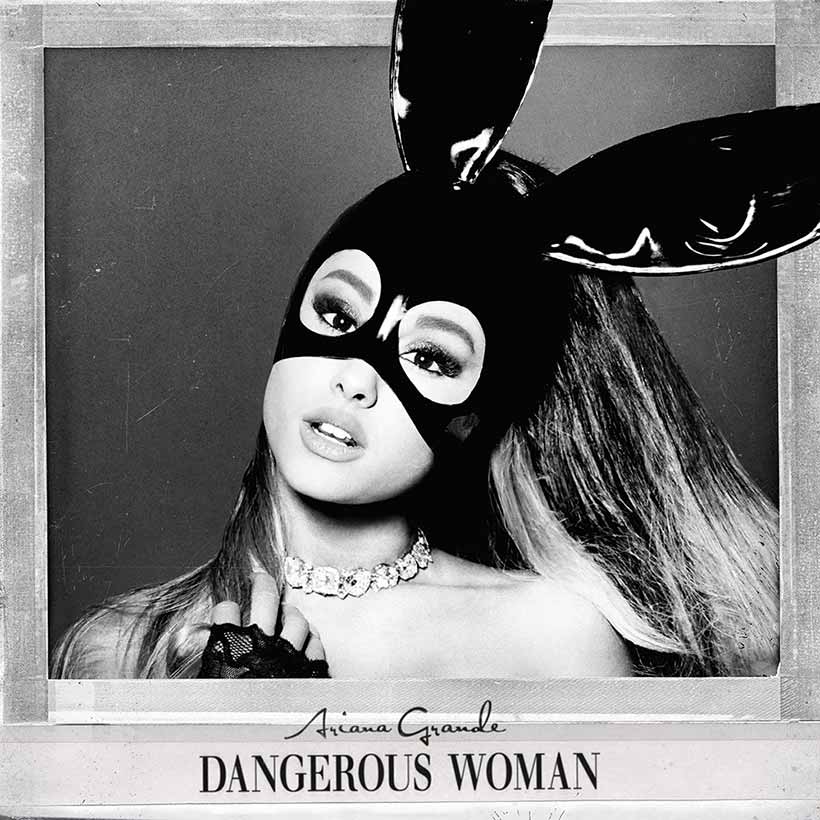
How Ariana Grande Shed Her Pop Persona To Become A ‘Dangerous Woman’

Ariana Grande Dangerous Woman album cover

Every Ariana Grande album cover features a photo of the singer, each one capturing the intention behind the release. On Dangerous Woman, she projects youthful playfulness with her signature ponytail, though her black-latex bunny mask hints at something more provocative beneath the bubble-gum surface. It was clear that Grande’s third studio album would showcase the singer’s more sensual side while exploiting her knack for interpreting any style or sound with transformative results.

Released on May 20, 2016, Dangerous Woman picked up from where My Everything had left off, delivering more floor-filling dance hits and moving further away from her ballad-heavy beginnings.

Over the hopping backing track of “You Don’t Know Me,” Grande sings, “The girl you see in photographs is only a part of the one I am.” Through its title alone, Dangerous Woman vowed to showcase a new maturity in Grande’s artistry. Sonically, the album furthered that mission, enhancing the retro R&B elements of her first two albums, Yours Truly and My Everything, while exploring more electro-pop soundscapes that would shape her future career.

Entering dangerous new territory

The Dangerous Woman era started with the promotional single “Focus,” which was in October 2015. While “Focus” featured the same upbeat, horn-driven energy of Grande’s 2014 smash hit “Problem,” it also teed up the album’s first official single, as Grande coquettishly instructed listeners to “focus on me.”

YouTube Video
Click to load video

Emerging five months later, the album’s title track found Grande venturing into moodier territory than the frothy pop of “Focus.” Sparked by an electric guitar, the singer climatically calls out, “Somethin’ ’bout you makes me feel like a dangerous woman!” throughout the track. We knew Grande could deliver arena-sized singalongs, and this slow jam channeled all the great power ballads of the 80s with a hook that promised, “All girls wanna be like that/Bad girls underneath, like that.”

Listen to Dangerous Woman now.

On the other side of the spectrum, “Be Alright” offered a stark contrast to the slow tempo and sensuality of “Dangerous Woman.” Dipping into a deep house sound, Grande’s celebratory single was adopted as an anthem for the LGBTQ community.

Embracing collaborators

A month later, she’d embark on the new course that trap-R&B had laid out in mainstream music, dropping the hypnotic “Let Me Love You,” featuring Lil Wayne. This paved the way for the dance-pop perfection of “Into You,” which signaled that Grande was ready to storm the summer of 2016.

YouTube Video
Click to load video

With a belting declaration of love that revolved around thudding EDM basslines, “Into You” is Grande and hitmaker Max Martin at their best. It contained all the hallmarks of a classic earworm, with Grande’s breathy falsetto floating over the thick beats. Grande finished off the album’s advance singles run with the retro-pop, uptown funk of “Greedy,” a song given away with digital pre-orders and which featured a choir of her exuberant vocals over a slick bassline.

Dangerous Woman opens with the swinging doo-wop ballad “Moonlight,” closely aligning with the sound Grande experimented with on Yours Truly. On the deep cut “Leave Me Lonely,” she brought Macy Gray back into the public eye, the latter expertly delivering some Nina Simone theatrics that fit in with the dramatic nature of the song.

A mature transition

Keeping in line with the album’s premise, Grande debuts her “adult” anthem, “Side To Side,” with help from hip-hop’s raunchiest queen, Nicki Minaj. Like many former child stars turned pop divas before her, Grande was consciously leaning into her “grown-up” phase, while at the same time side-stepping all the usual clichés that came with the territory.

One of the best pop and hip-hop collaborations of the decade, “Side To Side” capitalized on the dancehall trend of the time, with reggae riddims and plenty of sexual innuendo packaged in the campy imagery of the SoulCycle fitness craze. Just as Olivia Newton-John made her “body talk” in the iconic “Let’s Get Physical” music video, Grande and Minaj’s cardio-driven duet rode its way to the top of the charts, hitting No.4 on the Billboard Hot 100.

YouTube Video
Click to load video

Grande followed “Side To Side” with another collaborative effort on the Future-assisted “Everyday.” As trap-influenced pop started to gain more traction in the mainstream, “Everyday” helped fuel its dominance, paving the way for the trap leanings on her subsequent albums Sweetener and thank u, next.

Evolving the pop formula

Much of Dangerous Woman sees Grande playing with tempos, genres, and time shifts. “I Don’t Care” finds her embracing orchestral R&B to forget a lost love, “Sometimes” ventures into more acoustic pop (a rarity for Grande), and “Bad Decision,” “Touch It,” “Knew Better/Forever Boy” and “Thinking Bout You” all rely on Grande’s powerful pipes and EDM synth-pop production.

With her third album, Ariana Grande found success in evolving the pop formula she’d already established while venturing into uncharted, edgier territory. The gamble paid off, with Dangerous Woman debuting at No.2 on the Billboard 200 charts and notching her first No.1 album in the UK. It was clear that the ascending pop queen was just getting started.

Dangerous Woman can be bought here.

​Discover more about the world’s greatest R&B artists | uDiscover Music