Categories
Entertainment

Caleb Shomo, Beartooth Lead Vocalist, Comes Out as Gay After 14 Years of Marriage

Reading Time: 3 minutes

Though he is the former lead vocalist of Attack Attack!, Caleb Shomo is best known for taking the same roll in Beartooth.

The rocker has been married to his wife, Fleur Shomo, for more than 14 years.

He has now come out, publicly, after a prolonged period of self-examination.

Fleur is showing support for her husband.

Caleb Shomo and wife Fleur Shomo in 2022.
Caleb Shomo and wife since 2012 Fleur attend City of Hope’s Spirit of Life Gala on October 27, 2022. (Photo Credit: Jesse Grant/Getty Images for City of Hope)

‘I am a proudly gay man’

On Saturday, May 23, Caleb took to his Instagram page to share a lengthy and heartfelt message.

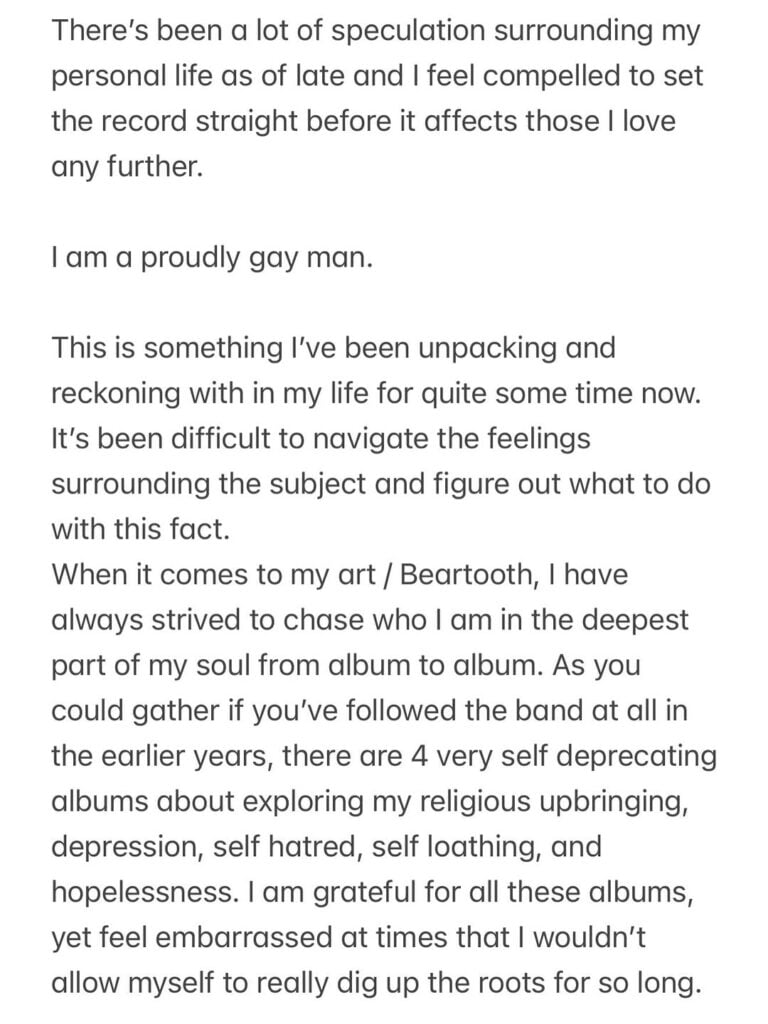
“There’s been a lot of speculation surrounding my personal life as of late,” he began, “and I feel compelled to set the record straight before it affects those I love any further.”

Caleb announced: “I am a proudly gay man.”

He shared: “This is something I’ve been unpacking and reckoning with in my life for quite some time now.”

The 33-year-old rocker, who grew up as the son of a pastor, wrote that his period of denial and suppression of his sexuality has been “difficult to navigate.”

A text post shared to Instagram, part 1 of 3.
This is the beginning of Caleb Schomo’s coming out message. (Image Credit: Instagram)

“I spent a decade burying feelings with alcohol,” Caleb confessed.

“And honestly when I decided to put it down and focus on exploring why I felt this way for so long,” he shared, “it’s been a direct path to me reconciling with my sexuality in hopes that it will eventually lead to me experiencing self love.”

Caleb shared that he will “whole heartedly and fully” express himself on his next album.

“Wherever it takes me I will follow and I refuse to water any part of it down, from the music, to the lyrical content, and way I portray myself,” he vowed.

Caleb emphasized: “I will only do what makes me happy at the deepest level and what is the most honest depiction of who I am. … I am trying to finally be proud of who I am and I think this is a massive part of that journey.”

A text post shared to Instagram, part 2 of 3.
Like many people who remain closeted or in total denial, Caleb Shomo shared that he used alcohol in a futile attempt to hide from his own feelings. (Image Credit: Instagram)

‘Holding these things in only hurt you and those around you’

“I encourage anyone who’s struggling with who they are to give yourself grace. Give yourself patience. Be honest with yourself,” Caleb encouraged.

“Do the hard work instead of burying it down as deep as you physically can thinking it will change like I did,” he counseled.

“Holding these things in only hurt you and those around you,” Caleb advised.

Ultimately, he concluded: “Love you all, and hopefully this is a step in the right direction to loving myself one day.”

Our heartfelt congratulations go out to Caleb. Being yourself is a key component to happiness. If our society weren’t riddled with homophobia, transphobia, and similar cultural bigotries, more people would be able to do so sooner.

A text post shared to Instagram, part 3 of 3.
As he concluded his message, Caleb Shomo urged followers to not repeat his mistake of waiting so long before living as themselves. (Image Credit: Instagram)

Obviously, many immediately thought of Caleb’s wife, whom he married around April 1, 2012.

Fleur made her own Instagram post, sharing an honest message about her husband’s revelation.

“I will always want to love, protect, and support Caleb,” she emphasized, even while acknowledging confusing and difficult months.

Some spouses sometimes feel that coming out — in any capacity, but particularly if they are gay or trans or otherwise expect the relationship to end — would be unfair to their partner.

However, like parents who loathe each other but avoid divorce because they share a child, trying to live a lie ultimately does a disservice to everyone involved.

Caleb Shomo, Beartooth Lead Vocalist, Comes Out as Gay After 14 Years of Marriage was originally published on The Hollywood Gossip.

​The Hollywood Gossip

Categories
Food

The Distinct Beer That Helped Make Colorado’s Craft Scene A Destination

One beer in particular cemented Colorado’s status as a craft beer destination, launching a legacy that extended far beyond the Centennial State.

​Food Republic – Restaurants, Reviews, Recipes, Cooking Tips

Categories
Health

Outdated Boomer Skincare Advice Millennials Absolutely Can’t Stand

With a wide variety of skincare products and practices to choose from these days, millennials seem to be keen on avoiding many boomer-era trends and attitudes.

​Health Digest – Health News, Wellness, Expert Insights

Categories
Food

The 12 Best Trader Joe’s Items For The Grill

Going to be firing up the grill sometime soon? Take the work out of prep work and head to Trader Joe’s for these goods that are perfect for the grill.

​Food Republic – Restaurants, Reviews, Recipes, Cooking Tips

Categories
Entertainment

This Italian Dish Is A Childhood Favorite Of Stanley Tucci’s

The actor loves this one dish his mom makes (and he even makes it with her). Learn what delicious appetizer brings him back to his childhood.

​Mashed – Fast Food, Celebrity Chefs, Grocery, Reviews

Categories
Music

50 Stunning Photos of America Honoring Memorial Day

Memorial Day became a federal holiday in 1971. Here is a look at how Americans have celebrated through the years while also honoring those who made the ultimate sacrifice for their country. Continue reading…​Country Music News – Taste of Country

Categories
Uncategorized

How community groups, activists and local media turned Camden into a model of police reform

Camden, New Jersey, has seen a dramatic drop in homicides over the past 15 years. peeterv/iStock via Getty Images Plus

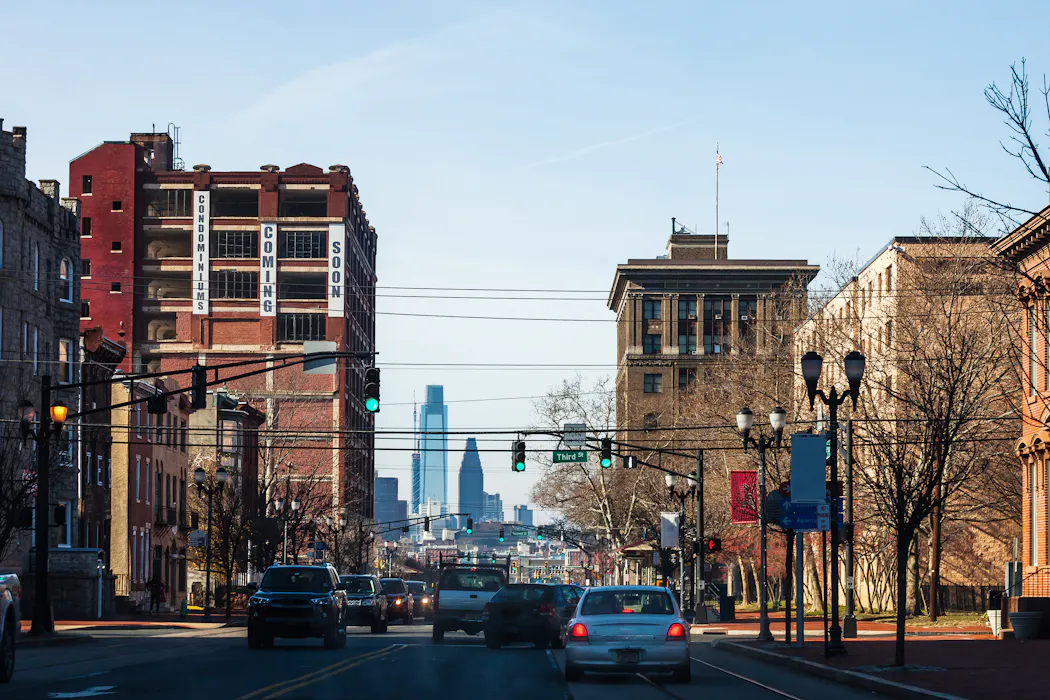
In 2025, Camden, New Jersey – a city of about 72,000 residents that sits across the Delaware River from Philadelphia – experienced its first homicide-free summer in nearly 50 years.

The city ended the year with 12 homicides – a stark drop from 2012 when it recorded 67, a per capita rate 18 times the national average at the time.

I’m a professor of criminal justice who wrote a book on police reform efforts in Camden over the last 15 years. The stunning turnaround in violent crime has led Camden and its newly formed Camden County Police Department, which was established in 2013 and replaced the Camden City Police Department, to be hailed as a model of reform. In 2015, then-President Obama visited the city to highlight the progress made.

Positive national and international attention on police reform in Camden continued in 2020 following the murder of George Floyd. This attention stemmed from the Minneapolis city council’s unanimous decision to dissolve the Minneapolis Police Department and start anew – much as Camden had done seven years earlier.

Yet one topic that I believe such discussions and commentary often overlook is the role that community and activist groups, as well as local media, played in better policing by the Camden County Police Department.

County takeover of city police department

Under-policing came to define the final years of the Camden City Police Department, or CPD. Police presence in the community was largely absent.

In contrast, the Camden County Police Department, or CCPD, began its new mandate with an aggressive, broken-windows style of policing that included targeting low levels of disorder and quality-of-life offenses, like loitering.

Residents were concerned about this new aggressive stance. The American Civil Liberties Union of New Jersey, researchers and local media used New Jersey’s Open Public Records Act to collect measures of the CCPD’s activity.

This data pointed to a troubling rise in officer-initiated vehicle and pedestrian stops, tickets for low-level violations, use of force, and citizen complaints of excessive force through 2014 and 2015.

CCPD officers in 2014 made 60,352 total stops, including 16,742 of people on foot. The per capita rate of pedestrian stops exceeded the rates in both New York City and Philadelphia during those cities’ peak stop-and-frisk years in 2011 and 2009, respectively, before stop-and-frisk tactics spurred court-ordered reforms.

Beyond the stops, CCPD officers issued more than 6,000 citations from May 1, 2013, when the new department launched, through the end of the year. They issued over 19,000 citations in 2014. During its first year or so, the CCPD’s total number of cases in municipal court increased by nearly 30% relative to the year prior.

Similarly, the number of tickets issued for minor infractions – such as riding a bicycle without a bell or a light, and disorderly conduct – rose steeply. For example, the number of citations for having tinted car windows more than tripled, while citations for not having proper car lights or reflectors more than quadrupled.

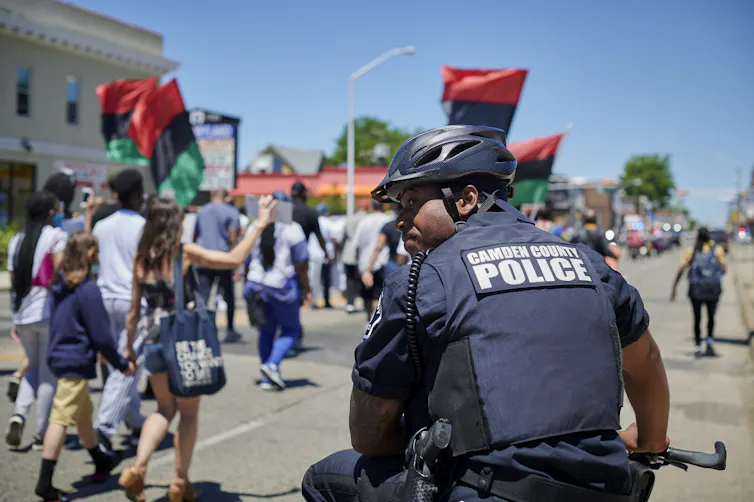
Police officer sits on bicycle as crowd of demonstrators waving red, black and green flags pass
A Camden County Police Department officer watches demonstrators take part in a Black Lives Matter protest march in Camden, New Jersey, on June 13, 2020.
Bastiaan Slabbers/NurPhoto via Getty Images

Backlash to broken-windows policing

Citizen complaints against CCPD alleging excessive use of force increased from 35 in 2013 to 65 in 2014.

Organizations like the Camden County chapter of the NAACP and the ACLU-NJ drummed up attention to these figures by issuing announcements and press briefings. On the same day in May 2015 that President Obama heralded the CCPD, the ACLU-NJ issued a scathing rebuke to the President’s message. It read, in part: “Before we hold Camden up as a model of community policing, we must address the troubling indicators that point to Camden’s use of practices that appear to take a page from a broken windows approach to policing.”

Tall man in suit talks with man in uniform as they stay in front of dozen of monitors
Former President Barack Obama tours the Real-Time Tactical Operational Intelligence Center at the Camden County Police Department headquarters in Camden, New Jersey, on May 18, 2015.
Nicholas Kamm/AFP via Getty Images

Mobilized residents and groups, including clergy members, made it clear that they did not appreciate this level and type of aggressive policing. The Philadelphia Inquirer and the Star-Ledger/NJ Advance Media amplified the coverage of Camden’s heavy-handed tactics.

What followed was a complete change in behavior among the CCPD from an activity, training and policy perspective. The numbers and rates of police stops declined. CCPD officers began issuing more warnings compared to tickets, to the point that “warnings over summonses” became an unofficial slogan of the department.

The top brass at CCPD sought out and implemented two types of de-escalation training, starting in the spring of 2015, for all officers. The CCPD also started to explore a complete overhaul of the agency’s use of force policy. It eventually adopted a more restrictive policy that emphasized de-escalation and the sanctity of life, while prohibiting tactics like chokeholds and shooting at moving vehicles. The CCPD’s innovative policy even inspired the New Jersey Attorney General to revamp its statewide policy years later.

As a result, complaints of use of force, in general, and of excessive force dropped from 43 in 2015 to 28 in 2016, and declined to 16 in 2017 and just three in 2018. Such complaints have usually been in the single digits each year since.

The CCPD deserves credit for course-correcting. But I believe it’s important to remember where that impetus came from: community and activist groups, as well as local media attention.

Many fewer murders, but persistent challenges

Camden has undoubtedly made progress. The city’s homicide rate in 2025 was four times the national average – a marked change from 18 times the national average in 2012. Homicides across the country have also declined in recent years.

Yet, problems persist. Camden is still a perennial contender for the most violent city in New Jersey. Despite a $1.6 billion economic package from the state to the city during the 2010s, which overwhelmingly took the form of tax subsidies to encourage businesses to either stay in or relocate to Camden, almost every census tract is among the most socially and economically disadvantaged in the state. Most companies that receive tax breaks do not employ a meaningful number of Camden residents.

The city is racially segregated from the rest of Camden County and the broader South Jersey region.

In my opinion, Camden, like most other cities, relies too much on the police, giving them a monopoly on public safety. I believe both the city and the CCPD should take a cue from places like Newark, New Jersey, and St. Louis, Missouri, to find innovative ways to collaborate and engage more with community groups, business associations and other non-police entities. Together they can co-produce public safety and take a more holistic approach to reducing crime, violence and disorder.

The Conversation

John A. Shjarback does not work for, consult, own shares in or receive funding from any company or organization that would benefit from this article, and has disclosed no relevant affiliations beyond their academic appointment.

​Politics + Society – The Conversation

Categories
Food

The California City That Has Banned Restaurant Chains Since The 1970s

Sure, California may have pioneered some fast food giants (In-N-Out, McDonald’s, and Taco Bell all come to mind), but this one town refuses all chains.

​Food Republic – Restaurants, Reviews, Recipes, Cooking Tips

Categories
Politics

Canadians are folding on Vegas. Democrats see a royal flush.

President Donald Trump’s trade war has driven Canadians from Las Vegas. Democrats think it will help them protect their Nevada battleground seats in November.

Last year, as Trump levied tariffs on Canada, visits from Canadians — who account for up to half of Las Vegas’ foreign tourism — dropped off by 17 percent. That played a large role in a 7.5 percent year-over-year decline in total tourist visits, making 2025 the worst non-pandemic year for Las Vegas since the city started tracking data in 1970. Now, as peak tourism season arrives in a battleground state where Republicans’ control of the House could be won or lost, Democrats are pushing voters to see the tourism slump as a direct impact of Trump’s levies.

“Trump instituted his reckless tariffs. In response, Canadians have literally boycotted traveling to America,” said Rep. Susie Lee (D-Nev.), whose Las Vegas-area seat is Republicans’ top target in the state. “That has had a significant impact on our tourism.”

Trump narrowly carried Lee’s district in 2024 and nearly won two other Vegas-area districts held by Democrats. Republicans are less bullish than they were a year ago about flipping the seats, but they view Lee’s as their best chance.

The races are a rare example of the international politics of tariffs — beyond their direct economic impact — playing a major role in an election. Unlike the upper Midwest or the Great Plains, Nevada doesn’t have a large manufacturing or agricultural sector jolted by the tariffs. Instead, the product most affected is the state’s Canadian visitors — who, on any given year, make up between 25 and 50 percent of Las Vegas’ foreign tourism market.

Spokespeople for the Republican National Committee and the National Republican Congressional Committee criticized Nevada’s Democratic congresspeople for voting against last year’s reconciliation bill, which included a “no tax on tips” provision. “If they actually cared about affordability, they wouldn’t have spent years making Nevada harder and more expensive to live in,” NRCC spokesperson Christian Martinez said.

Kush Desai, spokesperson for the White House, noted the “vast majority of Las Vegas tourists are Americans,” adding that the Trump administration “is focused on unleashing the historic job, wage, and economic growth that the American people experienced during President Trump’s first term with the President’s proven agenda of tax cuts, deregulation, and energy abundance.”

Many Canadians, incensed by Trump’s tariffs and his “51st state” taunts, have boycotted U.S. products and tourist destinations in retaliation. It coincides with an overall dropoff in Canadians’ view of their southern neighbor: According to a POLITICO Poll in February, a majority of Canadians now think the U.S. is an unreliable ally.

Even some Nevada Republicans acknowledge the problem. “The Canadians aren’t coming the way they were. Wonder why that is, huh?” Rep. Mark Amodei (R-Nev.), who isn’t running for reelection in his northern Nevada seat, said with a chuckle. “The communications for the tariff stuff was suboptimal.”

The dropoff in Canadian visitors played a role in stagnating a Las Vegas hospitality sector reliant on wealthy international visitors spending in the city’s casinos and hotels. A string of Las Vegas restaurants closed in recent months, some citing a downturn in visitors. And while employment has increased recently in the entertainment and recreation sectors, hiring in food and accommodation has been stagnant, according to Andrew Woods, an economist at the University of Nevada, Las Vegas.

The decline has been severe enough that local industry is taking dramatic steps to try to lure back lost business amidst an ongoing boycott from Canada. A group of Las Vegas resorts is offering to treat Canadian dollars at par with U.S. dollars, effectively a 30 percent discount, and hosting free concerts featuring Canadian artists. And the city’s tourism office recently launched a $3.5 million marketing campaign targeting Canadian visitors.

But it’s hard to overcome national patriotic fury with an ad campaign.

“Despite the efforts of our major operators in Las Vegas, the headwinds are coming from these external forces and the policies of this administration, and that’s what’s creating the economic uncertainty that we’re facing right now in Las Vegas,” said Rep. Steven Horsford (D-Nev.), whose district Trump lost by less than 3 points.

Overall tourist visits ticked up in February and March from those months the year earlier, offering a silver lining to the service industry. But the previous year of declining numbers created a deep hole to dig out of, said Ted Pappageorge, secretary/treasurer of the state’s powerful Culinary Union, which represents 60,000 cooks, roomkeepers and other hospitality workers in the state. If the low numbers continue, the union — which endorsed Democrats in all four of Nevada’s congressional races — is considering putting together relief efforts for its struggling members like it did during Covid, which included food, utility and rent assistance.

“If there’s anything like the reduction in visitation that happened last year, if that happens this year, then we’ll be in relief effort territory for our members,” said Pappageorge, noting “thousands and thousands of hours” have been cut for his union’s members this year due to reductions and restaurant closures.

Marty O’Donnell — the GOP front-runner to face Lee, who has the backing of Trump and the NRCC — was once skeptical of tariffs, but now says he “fully support(s)” the president’s trade policy.

“I’m now a convert, because what I see Donald Trump doing with tariffs is not something I ever anticipated,” O’Donnell said in an interview. “He uses it as a negotiating tool in a way that I never anticipated, and I actually love what he’s doing.”

O’Donnell said tariffs aren’t at the top of voters’ list of concerns. “I don’t hear anybody complaining about tariffs,” he said. “I just don’t think it’s an issue. I think there are way, way more important issues.”

One Nevada Republican strategist assisting multiple campaigns this cycle, granted anonymity to speak candidly about GOP strategy, admitted that Canadians were upset by Trump’s threats to make the country the “51st state” last year. But he and other Republicans pointed to an uptick in visitors in February and March. The strategist also noted the fact that Nevada added jobs at a faster rate than any other state in April, even though it has the nation’s third-highest unemployment rate. Those recent economic wins take the air out of Democrats’ attack, the strategist said.

“There are some bright spots,” O’Donnell senior adviser Keith Schipper said. “We’re talking about tariffs less so now than even six months, eight months ago.”

Republicans also point to the popularity of Republican Gov. Joe Lombardo, who they hope can win reelection in a tough environment and pull down-ballot candidates over the finish line. In a February poll, he was still viewed positively by a majority of Nevada voters even as Trump’s job approval dipped to 41 percent.

Not all economic indicators are dire, said Woods, the UNLV economist. The high-end hospitality sector is doing well, and an uptick in convention and business travelers has more than replaced the loss of Canadian tourists in numbers. “Canadian visitors, though, tend to stay longer and make Vegas their prime destination compared to other international tourists, which is good for our economy,” he said.

The local tourism drop lands on top of other economic concerns that are impacting everyone. A new CNN/SSRS poll conducted in late April and early May found that 77 percent of U.S. voters say Trump’s policies have increased the cost of living in their own community. And a surge in energy prices driven by the war in Iran led to inflation reaching its highest point in three years.

But Las Vegas is still an industry town. And with the main industry suffering, Democrats are banking on their races going their way.

“There’s a lot of service industry folks here, and so those folks are in the social circles in town,” said John Oceguera, the former Democratic speaker of the Nevada Assembly. “Whether you’re at a little league baseball game or a school event or whatnot, people are talking about that.”

​Politics

Categories
Music

12 Songs That Honor Fallen Soldiers

This is how you honor those who gave all. Continue reading…​The Boot – Country Music News, Music Videos and Songs