In this easy yet elegant recipe, butterflied, lightly dredged, and perfectly browned chicken breasts are covered in a luscious, umami-rich mushroom cream sauce.

Food Republic – Restaurants, Reviews, Recipes, Cooking Tips









In this easy yet elegant recipe, butterflied, lightly dredged, and perfectly browned chicken breasts are covered in a luscious, umami-rich mushroom cream sauce.
Food Republic – Restaurants, Reviews, Recipes, Cooking Tips

Frozen dinners can stay in the freezer when these 17 casserole recipes are on the table. Cheesy pasta bakes, chicken casseroles, beefy classics, and Tex-Mex dishes give dinner more range without extra fuss.The post 17 casserole recipes that made my…

It’s natural to reach for a snack while sipping on a glass of whiskey, and this classically simple staple is an easy way to elevate the spirit’s flavors.

Mashed – Fast Food, Celebrity Chefs, Grocery, Reviews

 Every year, suede reemerges as the ultimate fall fabric. This season, the luxe texture is trending again.
If you think suede is expensive, you’d be right. But that doesn’t mean there aren’t…
E! Online (US) – Top Stories

Propane grills are very capable machines, but they’re not perfect by any means. This is what owners of these gas-powered models should know.

Mashed – Fast Food, Celebrity Chefs, Grocery, Reviews

The latest news and information from your Alaska news station.

The latest news and information from your Alaska news station.

 A Winnie the Pooh journal and the promise of a trip to Disney World—those are the almost two-decade-old memories that stand out in Camila Cabello’s mind when she thinks about her and mom Sinuhe…
E! Online (US) – Top Stories
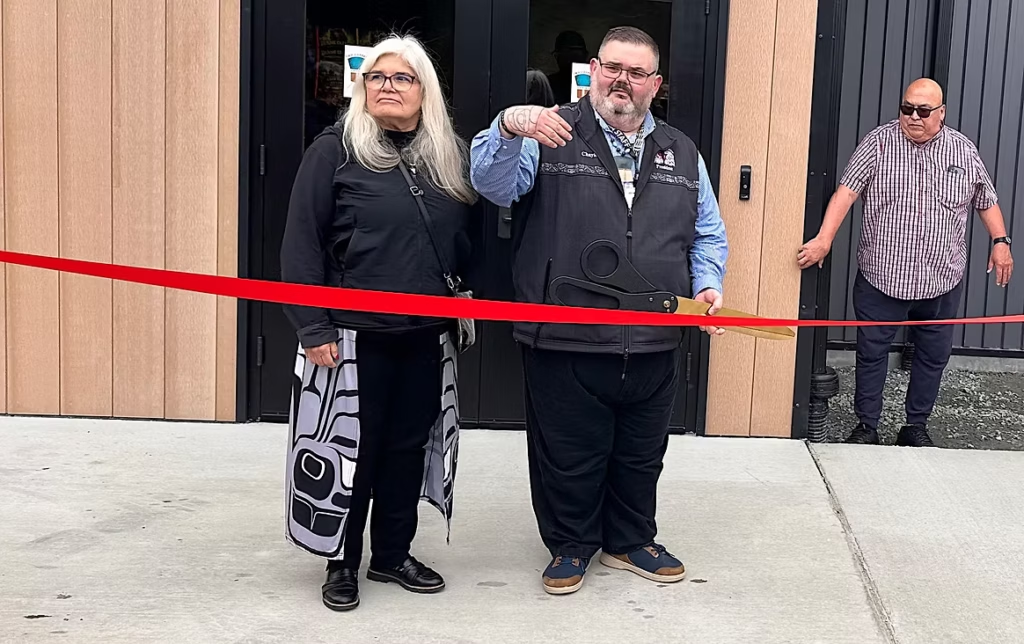
The top vice president is seeking to replace the longtime president of the Central Council of the Tlingit and Haida Indian Tribes of Alaska during its tribal assembly next week, following both significant achievements and controversies involving tribal leadership since the last election two years ago.
First Vice President Ku.seen Jacqueline Pata, who’s held that office since 2021, is seeking to replace Chalyee Éesh Richard Peterson, the tribe’s president since 2014. Three other presidential candidates — Alicia “Lisa” Gassman, Tasha Hotch and Melissa M. Kookesh — are also listed on the ballot.
Peterson was unopposed in the 2024 election.
Pata, in an interview Friday, said comments she’s heard from tribal citizens and the number of candidates running for president are indicative of “wanting to have some voice in the direction of their government.”
“I’m concerned about long-term sustainability,” she said. “I want to be able to make sure that we have financial accountability, we’re transparent and accountable to our tribal citizens, but also accountable within the tribal council and that we’re true to our values,” she said.
Attempts to reach Peterson on Friday afternoon were unsuccessful. In a social media post on Friday, he said the tribe is facing challenges because “we are living through unprecedented political times.”
“Federal administrative swings continue to challenge Tribal sovereignty and funding across Indian Country,” he wrote. “Through these shifts, my focus has been keeping Tlingit & Haida steady, protected, and moving forward.”
During the past two years the tribe has launched an education campus project, debuted a long-planned tribal casino, been prominently involved in glacial flood protection efforts and made other advances. But questions have been raised about some tribal business and leadership actions, such as a contract providing support services in Guantánamo Bay where the Trump administration has detained migrants.
Last summer tribal officials investigated abuse accusations by a former romantic partner against Peterson, with Pata announcing at a tribal council meeting a few weeks later the review had concluded with no finding of whether the accusations have merit.
Pata said she expects those accusations and other difficulties the tribe has faced to be part of the election debate when the three-day tribal assembly convenes Wednesday at Elizabeth Peratrovich Hall.
“I think all of those things create challenges, but they’re realistic, it happens,” she said. “We have challenges and we have to overcome. I think when you have those challenges, and you recognize where you need to strengthen your accountability, your responsibilities, it’s a good time to evaluate those and to think about what we need to do to put better checks and balances in place, and that’s definitely part of my campaign.”
Peterson, in his message Friday, wrote, “I will always put our people first, regardless of the role. Right now, I believe my experience, relationships, and energy are best used serving as your President to protect what we’ve built and complete the work ahead.”
A profile of Peterson at Tlingit and Haida’s website states he is Tlingit from the Kaagwaantaan (Eagle/Wolf) clan and a lifelong resident of Southeast Alaska. Before becoming the tribe’s president, he served as CEO of the Prince of Wales Tribal Enterprise Consortium, president of the Organized Village of Kasaan, mayor and a city council member for the City of Kasaan, and member of the Southeast Island School District Board of Education.
“Together we have launched major projects that reach far beyond what we initially imagined from expanding behavioral health care and broadband infrastructure to growing our economic sovereignty and laying the groundwork for Tribal Education Campuses,” he wrote in his post Friday. “I feel a deep responsibility and duty to our Tribal citizens to ensure these initiatives are fully realized and successful.”
Pata is a member of the Lukaax̱.ádi clan (Raven/Sockeye) in Haines. She has been the president and CEO of the Tlingit Haida Regional Housing Authority since 2019. Prior to that she was the executive director of the National Congress of American Indians (NCAI), and deputy assistant secretary for Native American Programs for the U.S. Department of Housing and Urban Development. She also currently chairs the tribal assembly’s Governmental Affairs (State and Federal) Committee.
“I spent 20 years in Washington, D.C., and working with Congress and various presidents, and all the tribal governments in the country on issues like housing and economic development, education, healthcare — the list goes on,” she said. “I sat at the UN negotiating for Indigenous rights and the right for the indigenous voice at UN forums, and I made a choice to come home because I wanted to make a difference for my own people, and that’s really why I’m running.”
Among the other three candidates, Gassman served in top leadership positions for the Sheet’ká Ḵwáan Sitka Tribe of Alaska before stepping down as its CEO last December.
Kookesh is the permit facilitator for the Alaska Broadband Office, where she also served as tribal liaison for three years, and has worked as a legislative staff member as well as nearly a decade working in Tlingit and Haida’s office of the president. Hotch, a longtime tribal health official, was the lone opponent against Peterson in the 2022 tribal assembly election.
All of the candidates except Peterson are also listed as vice presidential candidates on the ballot so, for instance, Pata could be elected to continue serving as first vice president if her presidential effort is unsuccessful.
Peterson is scheduled to give the annual State of the Tribe address at 11 a.m. Wednesday, with the declaration of nominees for council leadership positions and candidate speeches scheduled to start at 3 p.m. The elections are scheduled to begin at 1:05 p.m. Thursday, with winners taking their oaths of office at 4:30 p.m.
This story was originally published by the Juneau Independent.
The post Tlingit and Haida’s top VP challenging longtime president in next week’s tribal election appeared first on Chilkat Valley News.
Lizzy Hahn: Erika Merklin thank you so much for joining me in the KHNS studio today. Should we just jump right in?
Erika Merklin: Absolutely.
So my first question is: the Planning Commission has been an elected body for a few cycles now. How do you think that this has impacted land use regulation in the borough during that time, if at all?
Generally speaking, I’m not sure that it has changed much, other than it’s allowed for the opportunity for two upper valley residents to be serving on the Planning Commission. Both myself and Derek [Poinsette] were elected in that first-cycle three years ago, so I think that’s enabled us to bring more perspective to the townsite for borough-wide planning. But ultimately, we’re making decisions that are based on code.
What do you think the importance is for having people from the upper valley also on this board, and not just people from the townsite.
Well, I think it gives a perspective for the townsite of residents that are living within the borough, which is we have a very large borough, and a lot of people in the town site might not really understand the needs that we face in the upper valley. I think that really allows for us to share that insight, number one, and to bring forth ideas around, how do I say, like moving forward… we need more housing and there’s more there’s been more residential neighborhoods that have come up in the last say, you know, 10 to 20 years and I know that there’s been a lot of land that’s just recently been sold in the upper valley and so I think it’s really important to be able to have representation as that’s being developed, and two, the comprehensive plan has made recommendations about revisiting the general use rezone. So I think it’s really important to have people that actually reside in this area to be able to bring back what neighbors are saying, and also to be able to organize meetings so people can actually be present. A lot of times, people that are living outside the town zone aren’t willing to drive in in the evenings, and that makes sense, for meetings. And so, to be able to expand meetings to the upper valley has been really wonderful.
Have you had some planning commission meetings up in the upper valley?
We actually did have one that was a joint planning commission meeting with the assembly, and that was actually really successful and really well attended. And we’ve had some meetings with the Department of Natural Resources, some visiting scientists in the upper valley, so it’s really been great to get community input, even informally when it’s not even specific to borough government meetings.
There have been tensions between the Planning Commission and the Borough Assembly for the last few years, when the Assembly disagrees with a Planning Commission recommendation or chooses to go in a completely different direction. If elected, what would you like to do to deepen the collaboration or communication between these two bodies?
Yeah, that’s a great question. I know that when I first was elected to the planning commission three years ago, we didn’t have a lands planner, and we were also working with an interim borough manager. So I feel that we really got off on a footing where there wasn’t a lot of communication with staff, and again with the borough assembly, and I would really like to see that happen more. I think that that’s something that can be ultimately tasked with the staff to find ways that there can be maybe a biannual meeting or some way to actually be collaborative between the two bodies. Personally, I do attend the Haines Borough Assembly meetings, biweekly each Tuesday. So I’m staying informed that way. But as far as the two bodies working together to collectively problem solve, I think having the support of staff is ultimately really what we would need.
And then, what role do you think that the planning commission plays in helping the borough grow?
Well, I think ultimately what we need to do is utilize the comprehensive plan, which we spent a lot of time working towards completing. There’s a lot of really great information in there, and as far as growing the Haines Borough, that can mean a lot of different things. But ultimately, as far as identifying key priorities that residents want and moving those forward, I see the planning commission and commissioners each having the opportunity to find specific areas that they’re particularly either interested in or adept at pursuing to be able to bring forth new projects. Some of those that have come out from the past commissioners that I think are really fabulous is one that we’re currently working on, which is the new development being proposed off of Small Tracts Road. That’s been many, many years in the making.
I do know that it’s coming before the assembly again, the Third and Main property, and what to and how to incorporate that into our community versus selling it to a private entity. Another one is landslides planning, and so I know that both Derek [Poinsette] and Patty [Brown] have been very involved in that, so I think that it’s really a matter of, like, what each commissioner is willing to to put to bring forward and which projects they’re really interested in pursuing, You know ultimately we’re showing up at each meeting and making decisions, but it’s the work that happens outside of that that really brings projects to fruition.
What are some of the projects that you yourself are most interested in?
As a planning commissioner, one of the projects I’m focused on peripherally … would be really the Third and Main [parcel]. I know that that keeps coming back for discussion, and then sort of gets shelved, and then after a certain time frame, it gets brought back up.
But I do think that that’s a really important piece of property for our community, and I think that there have been some great proposals for that. And if we could get some conversation around what that could be for our community, I would love to have those discussions. Some other issues, I think, are around the cruise ship dock, and that’s proving to be controversial. I think, yeah, that’s going to be a really important one. More to come on that.
Yeah, and then what does responsible development look like for you?
For me, responsible development will be development that is something that’s been thought through in the comprehensive plan and something that the residents can get behind. I think also responsible development for the Haines Borough will ensure that the taxpayers aren’t responsible for cleanup, and that either the borough residents or the state isn’t responsible for that. And I know that that has been an issue in the past with private landowners, unfortunately, not cleaning up properties or and then leaving that for the taxpayers to do. I think that another really important thing is to be thinking about land use conflicts and making sure that we aren’t finding ourselves in lawsuits, which we currently are in now around land use. So anything that we can do to be efficient and effective with the money that we’re collecting from residents, I think is really important.
The planning commission members are often told to follow code, which still requires a fair amount of interpretation. How would you approach your decision making when reading a section of code that can be interpreted in multiple ways?
Well, yeah, that’s a tough situation, and in those cases, I think it’s really important to listen to the residents that are coming before – if anybody does have public comments – or also the comments from other planning commissioners, and to really lean into the lands planner for insights into whether there’s precedent that has already been set. Then really to go back to, again, really trying to utilize the comprehensive plan for our ultimate strategy … that’s been laid out. And so, how to be able to employ that strategy in the tactics of making those decisions. So, … really kind of leaning into also our lawyer because we’re we we really do need to have that expertise as we’re all volunteers. So even though many of us are very prepared, there’s really a lot to know, and there’s a lot of nuance within this. So I really go back to leaning into experts and paid staff.
Yeah, you mentioned that it’s kind of a complicated situation to figure it all out now that you have served on the planning commission for one term. Do you feel like if you were elected, you now have some steady footing to jump into some of the issues that you mentioned, or is there still a lot of learning with each topic that gets brought up?
I do feel like I have gained a lot of experience these last three years, especially with the hiring of the lands planner. I feel that that’s a lot of support that we never had in the beginning, and really were kind of left on our own to figure things out. And now I realize that we really have more support than initially I thought, so that’s been great as far as learning. I’m always learning, like planned-use development. I didn’t know what that was until just this last year, really, in delving into that with all of our discussions, and so I’m always learning, and that’s one thing that I really like about being on the planning commission is that it’s an opportunity for me to get to to learn more about our local government and our local residents, and how to actually make things happen.
Yeah, and then do you support the development and expansion of the local 5G cellular network?
Well, that’s a controversial question, but ultimately, I would have to say I don’t. And, that is because I’m really hearing a lot of pushback from the residents, and so on a personal level, I really want to be able to listen to them and make decisions based on that. Having said that, that is a situation that is unfortunately beyond the scope of something that I’m able to implement.
Yeah.. So the planning commission puts forward recommendations to the borough, and then is it ultimately up to the borough to decide things like this with the 5G cellular network, or what? What are some of the decisions that the planning commission makes that kind of end at the planning commission level?
Yeah. Well, ultimately we make recommendations, and then the assembly can either accept or veto those recommendations, or add their own caveats to them. My understanding with 5G is that it’s even beyond the borough, and that it’s the federal regulations, and so that’s my understanding of this situation, is that it’s not really a borough level decision to be made.
If elected for another few years, what would a successful term look like for you? Are there any other topics that you would hope to address within the next year, two years, or three years?
I think the biggest thing that I would like to address is to continue the discussion of the general use zone, to see if there are neighborhoods that are interested in rezoning. Because I do feel that once annexation had taken place, that really wasn’t a support that the borough had given to the upper valley residents, and I think that topic’s been neglected. And so I would really like to hear what people have to say about that. And I think that that is an opportunity [that could] happen over the winter. I know we had tried to have a discussion, and everybody’s really busy over the summer. And now it’s moose hunting season. So that’s really important to me.
The other thing too, I had mentioned, is the cruise ship dock, and what do we want our community to feel like? What do we want our community to be like, and who do we want to make those decisions? And I think that’s really important for us to be thinking about that. And if we’re going to give over that decision making to another entity, I think it would be really important to have a lot of community discussion around that, and then I think to just how do we want to grow our community? Are we focused on having a retirement community? Do we want young families to live and grow here? And what type of infrastructure do we want to really be focused on bringing to our community?
And you know, when we talk about community centers in town, I know that was a hot topic years ago about the Third and Main property. And you know, obviously, you know that requires funding, and so the initial knee jerk reaction is like, where are we going to get the money? But we are, as a borough, constantly grant-writing and trying to get funding for lots of things. You know, namely docks, but I do think that there’s an opportunity for expansion and for really focusing on what type of infrastructure we need to support people to live here and and and an infrastructure that’s really focused on residents and not necessarily just seasonal visitors.
What does some of that infrastructure look like? Would that be like apartments and more like single family homes, or how do you envision retaining year long residents?
Well, I think some of the infrastructure could be more third spaces. I’m a real proponent for community centers in having access to places where you don’t have to have money to to enter, and as far as some of the infrastructure needed to keep to keep and or build for year-round families, some of that would be potentially more housing, and some of the ways of doing that exist. I know in Sitka, for example, they have a land trust that’s working on small tiny homes for local residents. Sitka’s a little bit more advanced than we are, and has more money and funding to be able to push those projects forward. I don’t know that that’s something that our community would necessarily put forward.
I do think Dusty Trails is a wonderful asset to our community. I don’t know that we could necessarily get that type of funding in our current climate, but something like that would be really great to have an opportunity to have more housing, Haines Assisted Living has been really great too. So those kinds of things that have happened over the last few years really have made a huge difference. And so I would like to see more of that happen.
Is there anything else that you want to mention, or a topic that you want to bring up that I didn’t touch upon?
I don’t think so. I mean, yeah, those were great questions. I just thank you for having me here.
The post Watch: An interview with Erika Merklin, candidate for Planning Commission appeared first on Chilkat Valley News.