Categories
Politics

History is repeating itself at the FBI as agents resist a director’s political agenda

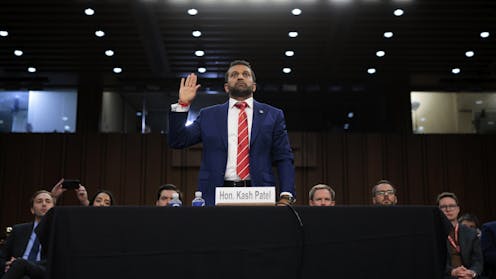
FBI Director Kash Patel is sworn in to testify before the Senate Judiciary Committee on Sept. 16, 2025, in Washington, D.C. Chip Somodevilla/Getty Images

Three converging events in the 1970s – the Watergate scandal, the chaotic U.S. withdrawal from the Vietnam War and revelations that FBI Director J. Edgar Hoover had abused his power to persecute people and organizations he viewed as political enemies – destroyed what formerly had been near-automatic trust in the presidency and the FBI.

In response, Congress enacted reforms designed to ensure that legal actions by the Department of Justice and the FBI, the department’s main investigative arm, would be insulated from politics. These included stronger congressional oversight, a 10-year term limit for FBI directors and investigative guidelines issued by the attorney general.

Some of these measures, however, were tenuous. For example, Justice Department leaders could alter FBI investigative guidelines at any time.

Donald Trump’s first presidential term seriously tested DOJ and FBI independence – notably, when Trump fired FBI Director James Comey in May 2017. Trump claimed Comey mishandled a 2016 probe into Democratic presidential nominee Hillary Clinton’s private email server, but Comey also refused to pledge loyalty to the president.

Now, in Trump’s second term, prior guardrails have vanished. The president has installed loyalists at the DOJ and FBI who are dedicated to implementing his political interests.

A lawsuit filed by three former FBI officials fired by the Trump administration asserts that the bureau is being politicized and is supporting Trump’s agenda.

As a historian of the FBI, I recognize the FBI has had only one other overtly political director in the past 50 years: L. Patrick Gray, who served for a year under President Richard Nixon. Gray was held accountable after he tried to help Nixon end the FBI’s Watergate investigation. Whether Trump’s current director, Kash Patel, has more staying power is unclear.

After Hoover

Ever since Hoover’s death in 1972, presidents have typically nominated independent candidates with bipartisan support and law enforcement roots
to run the FBI. Most nominees have been judges, senior prosecutors or former FBI or Justice Department officials.

While Hoover publicly proclaimed his FBI independent of politics, he sometimes did the bidding of presidents, including Nixon. Still, Nixon felt that Hoover had not been compliant enough, so in 1972 he selected Gray, a longtime friend and assistant attorney general, to be Hoover’s successor.

Gray took steps to move the bureau out of Hoover’s shadow. He relaxed strict dress codes for agents, recruited female agents and pointedly hired people from outside the agency – who were not indoctrinated in the Hoover culture – for administrative posts.

Gray asserted his authority with blunt force. FBI agents at field offices and at headquarters who resisted Gray’s power were censured, fired or transferred. Other senior officials opted to leave, including the bureau’s top fraud expert, cryptanalyst and skyjacking expert, and the head of its Crime Information Center.

Agents regarded these moves as a purge, and press reports claimed that bureau morale was at an all-time low, charges that Gray denied. According to FBI Associate Director Mark Felt, who became Gray’s second in command, 10 of 16 top FBI officials chose to retire, most of them notable Hoover men.

Gray surrounded himself with what journalist Jack Anderson called “sharp, but inexperienced, modish, young aides.” FBI insiders called these new hires the “Mod Squad,” a reference to the counterculture TV police series.

A man in a suit answers questions at a microphone.
Attorney L. Patrick Gray meets with reporters at the White House after his selection by President Richard Nixon as FBI acting director on May 3, 1972.
Bettman via Getty Images

Gray helps Nixon

In contrast to Hoover, who had rarely left FBI headquarters and publicly avoided politics, Gray openly stumped for Nixon in the 1972 campaign. He was so rarely spotted at FBI headquarters that bureau insiders dubbed him “Two-Day Gray.” At the request of Nixon aide John Ehrlichman, Gray told field offices to help Nixon campaign surrogates by providing local crime information.

Gray cooperated with Nixon to stymie the FBI’s investigation of the 1972 Watergate break-in and the ensuing cover-up. He provided raw FBI investigative documents to the White House and burned documents from Watergate conspirator E. Howard Hunt’s White House safe.

When Nixon had CIA Deputy Director Vernon Walters ask Gray, in the name of national security, to halt the FBI’s investigation, Felt and other agency insiders demanded that Gray get this order in writing. The White House backed down, but Nixon’s directive had been recorded. That tape became the so-called “smoking gun” evidence of a Watergate cover-up.

Felt, in classic Hoover fashion, then leaked information to discredit Gray, hoping to replace him. Gray resigned in disgrace.

While Felt never got the top job, he is now remembered as the prized anonymous source “Deep Throat,” who helped Washington Post reporters Bob Woodward and Carl Bernstein in their Pulitzer Prize-winning Watergate investigation. But it was internal FBI resistance, from Felt and agents at lower levels, that led to Gray’s departure.

After Democratic National Committee headquarters at Washington, D.C.’s Watergate Hotel was burgled in June 1972, the FBI was charged with investigating the break-in – as Director L. Patrick Gray tried to subvert his own agency’s investigation.

Political from the start

Campaigning in 2024, Donald Trump vowed to “root out” his political opponents from government. Realizing he was a target because of his investigation of the attack on the U.S. Capitol on Jan. 6, 2021, FBI director Christopher Wray, whom Trump had nominated in 2017, resigned in December 2024 before Trump could fire him.

In Wray’s place Trump nominated loyalist Kash Patel, a lawyer who worked as a low-level federal prosecutor from 2013 to 2016 and then as a deputy national security appointee during Trump’s first term.

Patel publicly supported Trump’s vow to purge enemies and claimed the FBI was part of a “deep state” that was resistant to Trump. Patel promised to help dismantle this disloyal core and to “rebuild public trust” in the FBI.

Even before Patel was confirmed on Feb. 20, 2025, in an historically close 51-49 vote, the Justice Department began transferring thousands of agents away from national security matters to immigration duty, which was not a traditional FBI focus.

Hours after taking office, Patel shifted 1,500 agents and staff from FBI headquarters to field offices, claiming that he was streamlining operations.

Patel installed outsider Dan Bongino as deputy director. Bongino, another Trump loyalist, was a former New York City policeman and Secret Service agent who had become a full-time political commentator. He embraced a conspiracy theory positing the FBI was “irredeemably corrupt” and advocated “an absolute housecleaning.”

In February, New York City Special Agent in Charge James Dennehy told FBI staff “to dig in” and oppose expected and unprecedented political intrusions. He was forced out by March.

Patel then used lie-detector tests and carried out a string of high-profile firings of agents who had investigated either Trump or the Jan. 6, 2021, insurrection. Some agents who were fired had been photographed kneeling during a 2020 racial justice protest in Washington, D.C. – an action they said they took to defuse tensions with protesters.

In response, three fired agents are suing Patel for what they call a political retribution campaign. Ex-NFL football player Charles Tillman, who became an FBI agent in 2017, resigned in September 2025 in protest of Trump policies. Once again, there are assertions of a purge.

Will Patel be held accountable?

Patel’s actions as director so far illustrate that he is willing to use his position to implement the president’s political designs. When Gray tried to do this in the 1970s, accountability still held force, and Gray left office in disgrace. Gray participated in a cover-up of illegal behavior that became the subject of an impeachment proceeding. What Patel has done to date, at least what we know about, is not the equivalent – so far.

Today, Patel’s tenure rests solely upon pleasing the president. If formal accountability – a key element of a democracy – is to survive, it will have to come from Congress, whose Republican majority has so far not exercised its power to hold Trump or his administration accountable. Short of that, perhaps internal resistance within the administration or pressure from the public and the media might serve the oversight function that Congress, over the past eight months, has abrogated.

The Conversation

Douglas M. Charles does not work for, consult, own shares in or receive funding from any company or organization that would benefit from this article, and has disclosed no relevant affiliations beyond their academic appointment.

​Politics + Society – The Conversation

Categories
Entertainment

Christina Haack: Tarek El Moussa Got Josh Hall Fired From ‘The Flip Off’ …

Reading Time: 4 minutes

Christina Haack is opening up about filming a show and divorcing a co-star all at once.

For the first time, Christina described Josh’s meltdown that should, in hindsight, have been the end of things.

As we know, the two married, and were all set to film The Flip Off together.

When they broke up, she was not the one who booted Josh from the HGTV series. That was her (other) ex-husband.

A The Flip Off promo with Heather Rae, Tarek El Moussa, and Christina Haack freshly after being Christina Hall.
Christina Haack, Tarek El Moussa, and Heather Rae El Moussa appear on a promo for The Flip Off on HGTV. (Image Credit: HGTV)

Sometimes, it takes an ex-husband to counter an ex-husband

During new interview with People, Christina Haack revealed that ex-husband Tarek El Moussa was instrumental in purging The Flip Off of more recent ex Josh Hall.

In July of 2024, Christina and Josh ended their marriage with a bitter fight.

Now, she’s sharing that she called ex-husband Tarek to tell him that she felt “worried” and “uncomfortable” around Josh.

Given how viewers saw Josh treat Christina on The Flip Off, that is no surprise.

Tarek then advised Christina to “leave.” And, from there, she says that he took matters into his own hands.

Christina Haack speaks to the confessional camera on 'The Flip Off' S01E05.
Addressing the confessional camera on ‘The Flip Off,’ Christina Haack discusses her miscalculations. (Image Credit: HGTV)

The Flip Off had only just begun filming. Josh was, at first, part of the cast — albeit the least interesting of the bunch.

“Tarek told our attorney and told the network for me that Josh would no longer be a part of the show,” Christina shared.

“In all honesty, I didn’t want to film the show with Josh,” she admitted.

“The network knew I didn’t want to,” Christina added. “I had even told Tarek I didn’t want to.”

She recaled: “And he had joked and said — well, I don’t know if he was joking — but said, ‘Whatever. You guys are just going to split up in Episode 2 and then the show will go on and everything will be fine.”

A frustrated Christina Haack on 'The Flip Off' Season 1, Episode 5.
On ‘The Flip Off,’ Christina Haack voices the feeling that her most recent ex is hoping to ‘retire’ off of her after their marriage, which spanned less than three years. (Image Credit: HGTV)

Christina Haack and Josh Hall hadn’t been happy for a while

“[Josh and I] hadn’t been getting along in a long time,” Christina Haack then acknowledged.

“And I’m not talking about weeks,” she specified. “I’m talking years.”

(Many relationships have periods of unhappiness or disagreement — but years of unhappiness in still-recent marriage? That’s not good!)

“There’s a lot of red flags that I ignored, and that could be a whole memoir that I don’t need to get into,” Christina acknowledged.

“But, we were not getting along and there’s a lot of insecurity on his side,” she summarized.

A smiling Christina Haack looks very cozy beside Josh Hall on Christina In The Country Season 2, Episode 1.
A smiling Christina Haack looks very cozy beside Josh Hall on Christina In The Country Season 2, Episode 1. (Image Credit: HGTV)

“He made filming very uncomfortable for me, very hard. It was not fun,” Christina lamented.

“I think the filming made things worse and [sped] things up that already were going really bad,” she assessed.

Overall, she’s so glad that the show booted Josh so early.

“The show would have been horrible if he had stayed on,” Christina said bluntly.

She described: “It would have been awkward; there wouldn’t have been any funny moments. There wouldn’t have been any of those real scenes.”

Heather Rae El Moussa, Christina Haack, and Tarek El Moussa on The Flip Off.
On ‘The Flip Off,’ Christina Haack, Tarek El Moussa, and Heather Rae El Moussa enjoy a friendly conversation even though they are supposed to be reality TV rivals. (Image Credit: HGTV)

Insecure dudes should probably not marry successful partners, generally speaking

According to Christina Haack: “I feel like I would have had to dim my personality” in order to soothe Josh’s ego.

She explained that it would have either been that “or I would get home and he would ignore me for three days.”

Folks, the silent treatment is not an appropriate way of communication. It is the opposite of communication.

“I couldn’t be myself, and that’s a really strange feeling to have,” Christina described.

“Especially when you’ve been on TV for 15 years, and it’s your show,” she noted. “And you’re the reason people are watching on your side, and you’re not allowed to be yourself.”

Christina admitted: “It’s a strange lesson to learn, especially as a 40-year-old woman.”

Christina Haack: Tarek El Moussa Got Josh Hall Fired From ‘The Flip Off’ … was originally published on The Hollywood Gossip.

​The Hollywood Gossip

Categories
Politics

Commuters have bemoaned Philly’s public transit for decades − in 1967, a librarian got the city to listen

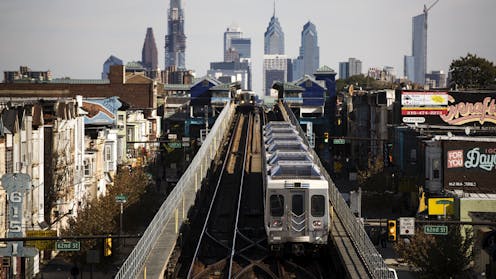
A SEPTA train moves along the Market-Frankford Line in West Philadelphia. AP Photo/Matt Rourke

On April 13, 1967, around 1:30 p.m., Lt. Joseph Larkin of the Philadelphia Police Department’s subway unit visited the Philadelphia High School for Girls to interview the school’s librarian, 61-year-old Miriam S. Axelrod.

Axelrod had written a letter to Mayor James H.J. Tate about poor conditions on Philadelphia’s Broad Street Line subway. In her letter, she stated that the escalators in the subway concourse of the Walnut-Locust station were out of operation for several weeks and requested that they “be put in running order.”

Axelrod also asked that “something be done” about people using the subway stairs “as a latrine.”

As a historian of post-1968 Philadelphia, a proud alumna of Girls’ High and a rider of Philadelphia’s mass transit, Southeastern Pennsylvania Transportation Authority – more commonly known as SEPTA – I was thrilled to find Axelrod’s story among 1960s administrative reports to the police commissioner in the city archives.

Axelrod’s story reminds us that for nearly a century, Philadelphia’s mass transit has been plagued by poor conditions and unstable funding. Commuters’ complaints have often convinced government officials to act. However, no effective plan has ever been implemented to definitively solve the city’s transit crises.

SEPTA’s current turmoil

On Sept. 15, 2025, SEPTA fully restored its service, by court order, after implementing 20% service reductions and a 21.5% fare increase due to a US$213 million budget deficit.

Service cuts began on Aug. 24, just one day before public school students returned to classrooms. This left kids, seniors and people from nonwhite, working-class communities with few alternative routes. Riders faced lengthy travel times or were even stranded on their daily commute.

Passengers board a red, white and blue city bus
Passengers at Olney Transportation Center in North Philadelphia board a SEPTA bus on Aug. 25, 2025, a day after major service cuts went into effect.
AP Photo/Matt Rourke

Over 600,000 people travel on SEPTA’s 172 routes each day. For weeks, state legislators could not agree on how to fund SEPTA within the state budget. City officials, transit executives and tourism experts advocated for a bailout because Pennsylvania will reap tax revenue when Philly hosts millions of tourists in 2026 for America’s 250th birthday, the FIFA World Cup and the Major League Baseball All-Star Game.

Ultimately, Gov. Josh Shapiro authorized the use of the Pennsylvania Department of Transportation’s capital funds to finance SEPTA’s operations through June 2027.

Some lawmakers have argued that SEPTA is guilty of mismanaging funds, since the agency already received over $1 billion in state subsidies last year for operating assistance and asset improvement.

Public transport in the 1920s

As a longtime Philadelphian who lived in Center City, Miriam Axelrod was familiar with the strengths and shortcomings of public transportation.

At the age of 4, her family emigrated from Russia to Carmel, New Jersey. By 1920, they made Philadelphia their home just as the city’s Russian community became the largest immigrant group due to Jewish people escaping pogroms in Europe. Axelrod grew up living in South and North Philadelphia.

At that time, dozens of private transit companies operated in Philly.

Southern Penn operated city buses. Red Arrow provided suburban trolley service. Pennsylvania and Reading railroads offered high-speed rail lines. The Philadelphia Rapid Transit Co. alone brokered deals with 64 underlying companies to annually rent their services under 999-year leases. Fiscal responsibility for quality transportation was complicated and often dependent on public funding.

During PRT’s early years, it paid the city $15,000 annually for snow removal. In return, the city spent $2 million for street paving and bridge repairs.

By 1922, the PRT and the city had built and unified two elevated train routes – with assistance from the Union Traction Co. and the Market Street Elevated Passenger Railway Co. – to create the Market-Frankford Elevated Train Line.

A page from a high school yearbook with photos of three young women
Classmates at William Penn remembered Miriam Axelrod’s ‘remarkable capacity for starting arguments.’
Ancestry.com, U.S. School Yearbooks, 1900-2016

That was the same year Axelrod graduated from William Penn High School for Girls. Her classmates keenly noted in their yearbook that she had a “remarkable capacity for starting arguments” in which “any debatable subject will do.”

Six years later, the first segment of the Broad Street Subway traveling from Olney Station in North Philadelphia to City Hall opened to the public. Unlike the bus, trolley and railways systems, the city owned the El, short for elevated, line and subway. The city leased both systems to PRT and made the transit company responsible for their maintenance.

Sepia-toned photo of busy street in a commercial area of a city circa 1930s
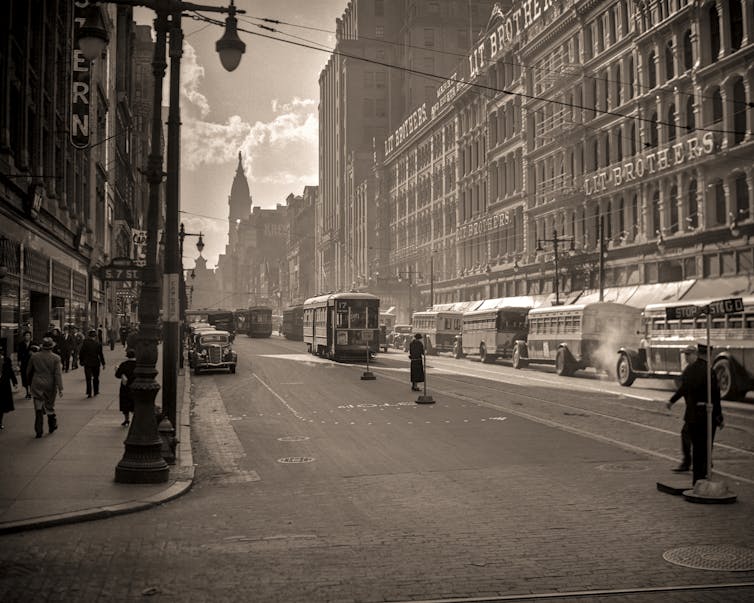
Buses and trolley cars drive down Market Street in Philadelphia in the 1930s.
Charles Phelps Cushing/ClassicStock via Getty Images

The Depression years

Philadelphia first witnessed underfunded mass transit during the Great Depression.

In 1934, PRT faced a budget deficit when it was unable to pay the $7.1 million annual rentals to the underliers. PRT later went to court to request a consolidation plan. To make matters worse, PRT had spent approximately $230 million from 1902 through 1939, but that didn’t include spending to modernize old transit equipment.

On Jan. 1, 1940, the Philadelphia Transportation Co., a private company with a 21-member board of directors that included five city representatives including the mayor, Robert E. Lamberton, merged the transit companies and took over PRT’s operations. PTC became responsible for 10,000 employees and providing transportation for 2 million passengers a day.

PTC also acquired extensive financial responsibilities. Payroll expenses cost $327,000 each week. The annual rate for leasing the subway and El was roughly $3 million. PTC had to provide its 25,000 bondholders an annual income of at least $959,207 while also fulfilling its promise to offer modern transit vehicles.

Overcrowding and frequent fare increases

During the 1940s through the 1960s, Axelrod took public transportation to her job as a librarian at Central High School and later Frankford High School.

Meanwhile, PTC made good on its promise to provide better transit service. In its first eight years of operation, PTC spent $22.8 million to purchase 1,506 new streetcars, buses and trackless trolleys while also improving terminal and plant facilities. The company even purchased advertisements in The Philadelphia Inquirer to highlight its achievements. PTC extended 38 existing routes and created 18 new routes that serviced old residential and industrial areas, along with newly developed neighborhoods.

By 1949, however, many of PTC’s 3.2 million daily riders were complaining about overcrowded subways, the end of free exchanges between popular routes and frequent fare increases.

Black and white photo of men and women, some reading newspapers, in a subway car
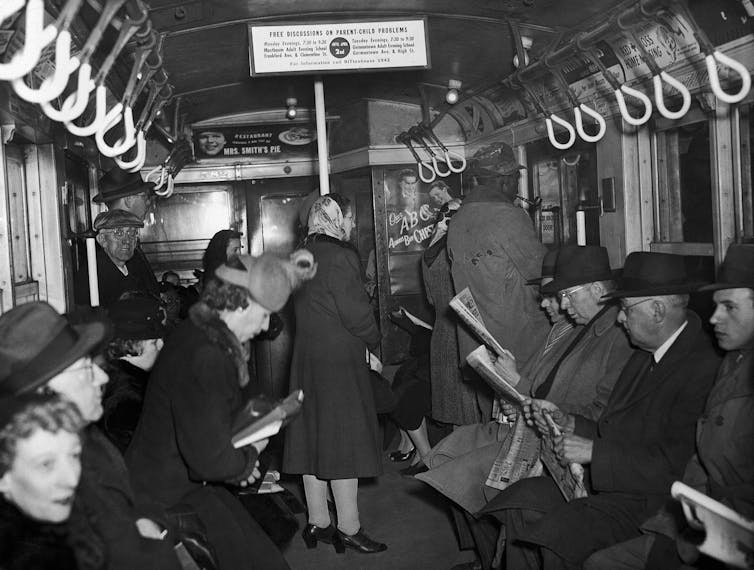
Passengers ride a subway car in Philadelphia on Feb. 15, 1946.
AP Photo

Both PTC and the city faced scrutiny for these issues, although each party had distinct transit obligations outlined in their joint contract. PTC had to provide “safe and adequate service” that included spending on maintenance and replacement of transit equipment. The city was responsible for police and fire services on mass transit along with auditing PTC’s records. Both parties had to agree on fare changes under the state Public Utility Commission’s supervision.

Nevertheless, when issues on mass transit occurred, the city could persuade PTC to improve conditions, but the city was only required to offer emergency services to commuters.

When Larkin personally addressed Axelrod’s 1967 complaint about the subway, he informed her that the United Elevator Co. was repairing the escalators. He also assured her that the subway unit arrested 45 to 50 intoxicated people each month because they were at risk of falling onto the subway tracks. In “isolated cases,” Larkin explained, police arrested people for public urination and defecation.

Larkin reassured Axelrod that PTC could keep subway conditions clean and under control. In reality, PTC was underwater in responsibilities and debt.

On Sept. 30, 1968, SEPTA, a state agency formed five years earlier, took over PTC and managed transportation for the city and its surrounding areas. SEPTA bought PTC for approximately $47.9 million, settling the company’s debt, accepting its pension liability and buying out the institution’s roughly 1.7 million shareholders. Now federal and state funding rather than fare revenue largely determined the quality of the city’s public transit.

Decades of unpredictable funding

Since the 1960s, annual government funding to SEPTA has been unpredictable. White flight, deindustrialization and job flight have contributed to depopulation, a declining tax base and government defunding of social programs in Philadelphia. These socioeconomic shifts continue to affect Philadelphia’s budget for education, public housing and recreation as well as SEPTA’s $2.743 billion budget as a public transit agency.

Five counties in Greater Philadelphia contribute subsidies to SEPTA in exchange for transit service. Philadelphia alone contributes $110 million. State subsidies also help finance SEPTA’s $1.74 billion operating budget, while federal subsidies support SEPTA’s $1 billion capital budget to pay for major repairs and new equipment. State politicians annually vote on funding for SEPTA, but there has not been a concrete solution to the funding crisis.

For years, politicians have proposed using county sales and gas taxes along with business licensing fees to fund mass transit, without success. Additionally, since 2008 rising rates of car ownership have also led to fewer commuters and reduced fare revenues for SEPTA.

However, Philadelphians never ceased to demand better transit service. During the 1980s, the Pennsylvania Public Interest Coalition established the Transit Riders Action Campaign, also known as TRAC, which advocated that SEPTA have better safety, funding, accountability, service and stable fares. The Transport Workers Union Local 234 advised TRAC, while several organizations partnered with them: the Action Alliance of Senior Citizens, the Clean Air Council, Disabled in Action and the Delaware Valley Interfaith Coalition.

Even today, local groups such as Save the Train with outspoken commuters – like Axelrod was in her day – have launched campaigns to halt service cutbacks and encourage residents to write and telephone legislators who can vote to fund SEPTA. Residents have consistently united to advocate for quality mass transit. All that remains is an agreement among lawmakers to make it possible.

Read more of our stories about Philadelphia and Pennsylvania, or sign up for our Philadelphia newsletter on Substack.

The Conversation

Menika Dirkson does not work for, consult, own shares in or receive funding from any company or organization that would benefit from this article, and has disclosed no relevant affiliations beyond their academic appointment.

​Politics + Society – The Conversation

Categories
Entertainment

Sister Wives Sneak Peek: Christine Brown Loses It Over Move…

Reading Time: 2 minutes

Christine Brown will be all up in her feelings on the October 5 episode of Sister Wives.

For a very understandable reason.

In a sneak peek posted by People Magazine, the long-time reality star assists daughter Mykelti in her preperation to move thousands of miles away with her husband and kids.

(TLC)

At one point, via confessional alongside this husband (Tony Padron), Mykelti tells viewers:

“Every time I talk about moving to my mom, I break her heart just a little bit more. She’s really sad. She’s really heartbroken.”

The scene then cuts to a clip of Christine as she explains the following:

“Mykelti’s moving tomorrow. We’re driving her and her kids cross country tomorrow.”

As you can see in this footage, Brown starts to get emotional as tears well in her eyes, simply saying “it’s really hard” to be saying goodbye to her child.

Christine Brown smirks
Christine Brown smirks in this scene from Sister Wives. (TLC)

Mykelti then delves into presciselt why her mother is so disappointed about her and her family leaving, aside from the obvious fact that they’ll be on the other side of the country in North Carolina.

“She’s really sad because she’s definitely going to miss out on a lot of the years that my kids are young,” Mykelti explains.

For the record, she shares three children — daughter Avalon and twin sons Archer Banks and Ace McCord — with husband Tony.

Christine, for her part, is now married to David Woolley and has moved far on from ex-spouse Kody. But not from the kids she shares with him, of course.

Christine Brown deserves props for getting away from Kody. (TLC)

Referring to her sisters, Mykelti adds in the clip:

“It’s like Aspyn and Ysabel don’t have kids yet and they won’t have kids for a while. And I want my kids to have cousins.”

The scene concludes with Christine asking Mykelti whether she told her father Kody about the move, to which she responds with regret:

“Yeah, dad knows I’m moving. Told him he should come up and see us before we leave and it didn’t happen. It is what it is.”

Later on, reflecting on her daughter’s strained relationship with Kody, Christine says “the whole thing’s just been sad.”

“Mykelti and Tony were just sad that they weren’t able to see Kody and Robyn and the kids before they moved,” she says. “Her relationship with them is just not what Mykelti hoped it would be.”

Sister Wives Sneak Peek: Christine Brown Loses It Over Move… was originally published on The Hollywood Gossip.

​The Hollywood Gossip

Categories
Entertainment

Taylor Swift’s ‘Father Figure’ Divides Fans: Is It Really About Olivia …

Reading Time: 3 minutes

A new Taylor Swift album is upon us, which means that fans are once again eagerly dissecting the lyrics in search of hidden disses and coded confessions.

Some of the most obsessed-over lines are featured in “Father Figure,” the song that — as Swifties correctly guessed when the track list was released last month — features an interpolation of the George Michael song by the same name.

As usual, Taylor’s sights seem squarely aimed at her haters — but there’s some debate over exactly which enemies she’s targeting this time.

Taylor Swift performs on stage during the "Taylor Swift | The Eras Tour" at Wembley Stadium on August 15, 2024 in London, England.
Taylor Swift performs on stage during the “Taylor Swift | The Eras Tour” at Wembley Stadium on August 15, 2024 in London, England. (Photo by Kate Green/Getty Images)

‘Father Figure’ seems to be Taylor’s way of lashing out at multiple foes

The song sees Taylor spinning a yarn about an ambitious young singer and the mentor who winds up exploiting her.

“Your thoughtless ambition sparked the ignition / On foolish decisions, which led to misguided visions / That to fulfill your dreams, you had to get rid of me,” Swift sings.

So the most obvious targets here are Scooter Braun, who infamously purchased the rights to Taylor’s music, and Scott Borchetta, the former head of Big Machine Records, who cut the deal with Braun.

“This empire belongs to me,” Taylor sings in a later verse, seemingly celebrating the fact that she’s finally managed to buy her masters back.

A display with exclusive edition merchandise for Taylor Swift's new album, "Life of a Showgirl" is seen at Target on October 02, 2025 in New York City.
A display with exclusive edition merchandise for Taylor Swift’s new album, “Life of a Showgirl” is seen at Target on October 02, 2025 in New York City. (Photo by Valerie Terranova/Getty Images)

So case closed, right? Well, there might be more to the story here.

How does Olivia Rodrigo factor into the ‘Father Figure’ narrative?

Back in 2021, a copyright dispute over Rodrigo’s song “Deja Vu” ended with Swift getting a songwriting credit and 50 percent of its royalties.

It’s been widely rumored that Rodrigo vented her frustration toward Swift — whom she’d once regarded as a mentor — on her 2023 song “Vampire.”

So when Taylor addressed an adoring protege and sang, “You remind me of a younger me” on “Father Figure,” it’s not surprising that many fans jumped to the conclusion that she was referring to Olivia.

Olivia Rodrigo attends The Drop: Olivia Rodrigo at The GRAMMY Museum on October 03, 2023 in Los Angeles, California.
Olivia Rodrigo attends The Drop: Olivia Rodrigo at The GRAMMY Museum on October 03, 2023 in Los Angeles, California. (Photo by Rebecca Sapp/Getty Images for The Recording Academy)

“I showed you all the tricks of the trade / All I asked for is your loyalty, my dear protégé,” Swift sings on the track, later adding, “I saw a change in you / My dear boy / They don’t make loyalty like they used to.”

Perhaps in a moment of self-reflection, Taylor saw the similarity between the two situations.

Or maybe fans are once again delving much too deep into Taylor’s lyrics.

Taylor Swift’s ‘Father Figure’ Divides Fans: Is It Really About Olivia … was originally published on The Hollywood Gossip.

​The Hollywood Gossip

Categories
Entertainment

Diddy Sentenced to 4 Years In Prison For Transporting Prostitutes Across State Lines

Reading Time: 4 minutes

Sean “Diddy” Combs learned his fate in a manhattan coutroom today.

Concluding a legal saga that began with his arrest back in September of 2024, Combs was sentenced to more than four years in prison Friday afternoon.

Back in July, Diddy was convicted on charges of transporting prostitutes across state lines but acquitted on more serious sex trafficking and racketeering charges.

The sentencing hearing got off to a rocky start for Team Diddy, when prosecutors presented their claim that the defendant was so confident of an early release that he had already booked speaking gigs for next week.

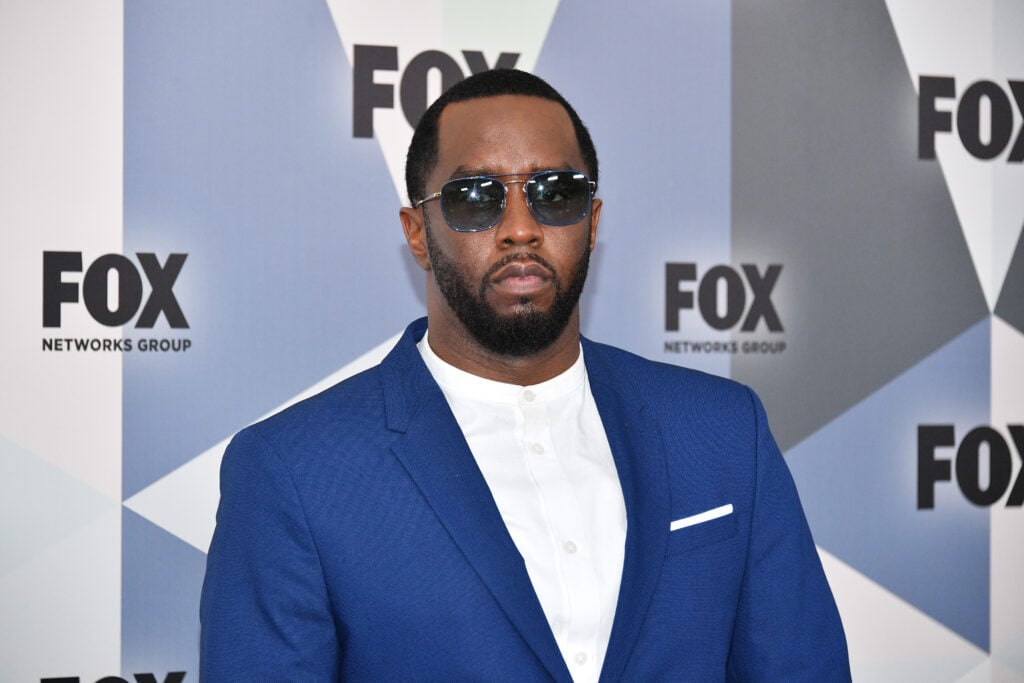
Sean "Diddy" Combs attends the 2018 Fox Network Upfront at Wollman Rink, Central Park on May 14, 2018 in New York City.
Sean “Diddy” Combs attends the 2018 Fox Network Upfront at Wollman Rink, Central Park on May 14, 2018 in New York City. (Photo by Dia Dipasupil/Getty Images)

A tale of two Diddies

Prosecutors portrayed Combs as a serial abuser with no respect for the law — one who has admitted to violent behavior but shown no remorse for his actions.

The defense offered a very different version of Combs:

They highlighted his involvement with New York City’s charter schools and the voter registration campaign he launched back in 2004.

The defense even put together an 11-minute documentary-style film highlighting Combs’ philanthropic efforts. According to CNN, Combs sobbed as the video was played in court.

As expected, several of Combs’ loved ones addressed the court, including his eldest son, 31-year-old Justin Combs.

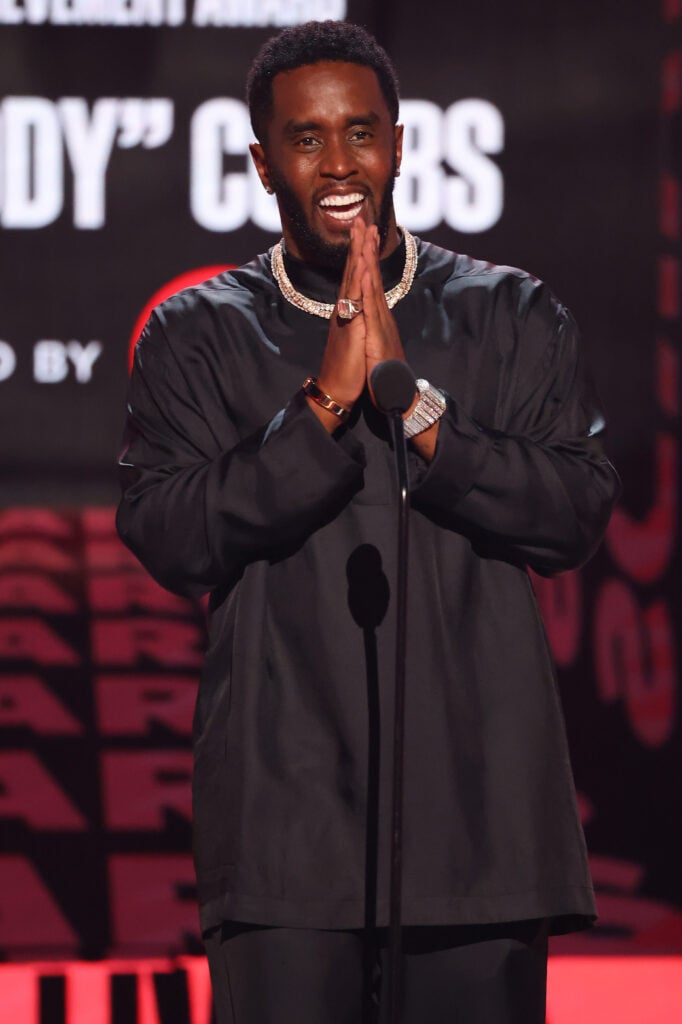
Honoree Sean ‘Diddy’ Combs accepts the BET Lifetime Achievement Award onstage during the 2022 BET Awards at Microsoft Theater on June 26, 2022 in Los Angeles, California.
Honoree Sean ‘Diddy’ Combs accepts the BET Lifetime Achievement Award onstage during the 2022 BET Awards at Microsoft Theater on June 26, 2022 in Los Angeles, California. (Photo by Leon Bennett/Getty Images for BET)

Diddy’s children plea for lenient sentencing

“I ask that you give my father a second chance, a second chance at life, a second chance to right his wrongs, a second chance to be the man he truly is,” Justin told the judge in a prepared statement.

“My father is my superhero. Seeing him broken down and stripped of everything is something I will never forget,” he continued.

Justin added that after years of addiction, Diddy is now drug-free and dedicated to his ultimate goal of being a leader to his family.

“I can truly sincerely say he’s changed for the better. Your honor, I believe my father still has so much more to give the world and, more importantly, so much more to give his children,” he explained.

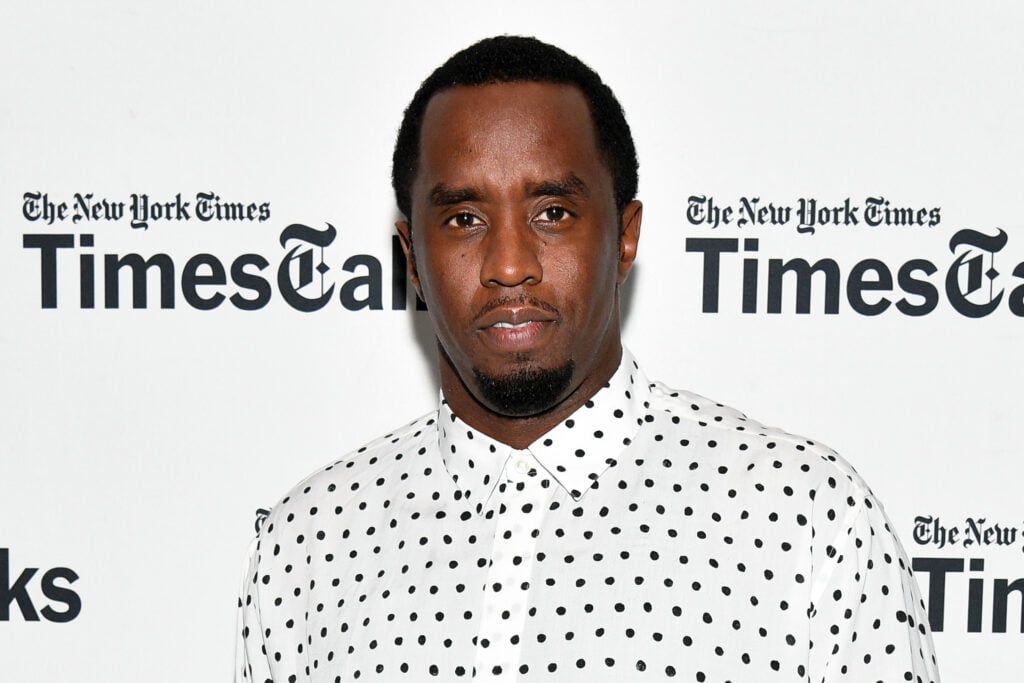
Sean "Diddy" Combs attends TimesTalks Presents: An Evening with Sean "Diddy" Combs at The New School on September 20, 2017 in New York City.
Sean “Diddy” Combs attends TimesTalks Presents: An Evening with Sean “Diddy” Combs at The New School on September 20, 2017 in New York City. (Photo by Dia Dipasupil/Getty Images)

“I know how hard it was to stand up here and tell me those things, but it’s important for me to hear,” told Diddy’s children after hearing their statements.

“You find yourself, I think, saying you have two people here — who’s the real Sean Combs?” defense attorney Xavier Donaldson asked at one point. “I like to believe that the real Sean Combs is in the grain of all those letters you read and what you heard from the family.”

The defense suffered a blow when Judge Arun Subramanian told the court that he saw no need to stray from the usual sentencing guidelines:

Mann Act violations of this nature typically bring a sentence of just under six years to just over seven years.

Cassie (L) and Sean 'Diddy' Combs aka Puff Daddy attend the "Rei Kawakubo/Comme des Garcons: Art Of The In-Between" Costume Institute Gala at Metropolitan Museum of Art on May 1, 2017 in New York City.
Cassie (L) and Sean ‘Diddy’ Combs aka Puff Daddy attend the “Rei Kawakubo/Comme des Garcons: Art Of The In-Between” Costume Institute Gala at Metropolitan Museum of Art on May 1, 2017 in New York City. (Photo by Mike Coppola/Getty Images for People.com)

Prosecutors recommended a sentence of more than 11 years, due to the abusive nature of Combs’ crimes.

The defense had argued Combs should get no more than 14 months, which would have likely had him back on the street as early as today, as the disgraced mogul has been locked up since September of last year.

Prior to his sentencing, Diddy addressed the court for the first time:

“One of the hardest things that I’ve had to handle is having to be quiet. Not being able to express how sorry I am for my actions,” Sean “Diddy” Combs said in his statement to the court.

“I want to personally apologize again to Cassie Ventura for any harm or hurt that I’ve caused her – emotionally or physically,” he continued, adding:

Diddy performs onstage during the 2023 MTV Video Music Awards at Prudential Center on September 12, 2023 in Newark, New Jersey.
Diddy performs onstage during the 2023 MTV Video Music Awards at Prudential Center on September 12, 2023 in Newark, New Jersey. (Photo by Mike Coppola/Getty Images for MTV)

“Growing up as a kid, I just wanted to be a shining example of what we could do,” Combs said. “I say we, as people of color, that we could own our own businesses, take care of our own communities, raise our own children, solve our own problems, create our own wealth, take care of our own problems.

“That was my mission. I got lost. I’m not this bad person. I’m sorry to my community for letting y’all down.”

““A history of good works can not erase the power and control you had over the women you professed to love dearly. You abused them physically, emotionally and psychologically and you used that to get your way,” Judge Subramanian countered in his address to Combs.

He added that the cour was the court was “not assured” that if Combs was released that “these crimes will not be committed again.”

Therefore, he explained, “a substantial sentence must be given.”

The judge rejected the prosecution’s request for an 11-year sentence and instead handed down a sentence of 50 months.

We will have further updates on this developing story as new information becomes available.

Diddy Sentenced to 4 Years In Prison For Transporting Prostitutes Across State Lines was originally published on The Hollywood Gossip.

​The Hollywood Gossip

Categories
Entertainment

Taylor Swift Took Shots at Travis Kelce’s Ex Kayla Nicole on ‘Opalite,’ …

Reading Time: 3 minutes

If you’re like millions of other Swifties, you’ve spent your Friday listening to The Life of a Showgirl and dissecting the lyrics for deeper meanings.

Already, fans have determined that Taylor Swift took a shot at Charli XCX on the song “Actually Romantic.”

And they think she took some jabs at Olivia Rodrigo on “Father Figure.”

Now, a third potential target has been identified, as some listeners are convinced that Taylor called out Kayla Nicole on “Opalite.”

Taylor Swift attends the 66th GRAMMY Awards at Crypto.com Arena on February 04, 2024 in Los Angeles, California.
Taylor Swift attends the 66th GRAMMY Awards at Crypto.com Arena on February 04, 2024 in Los Angeles, California. (Photo by Neilson Barnard/Getty Images for The Recording Academy)

Does Taylor Swift have beef with Travis Kelce’s previous girlfriend?

If you’re a Swiftie, you’re probably already aware that Kayla dated Travis Kelce before he and Taylor met.

For the most part, Kayla has been nothing but respectful toward her ex and his very famous fiancee.

Which is why the allegations of a diss from Taylor come as such a surprise that (and it’s important to note that these are merely allegations, as at no point in the song does Swift call Nicole out by name).

The controversial lines are as follows:

“You couldn’t understand it, why you felt alone / You were in it for real, she was in her phone / And you were just a pose.”

Taylor Swift celebrates with Travis Kelce #87 of the Kansas City Chiefs after defeating the Buffalo Bills 32-29 in the AFC Championship Game at GEHA Field at Arrowhead Stadium on January 26, 2025 in Kansas City, Missouri.
Taylor Swift celebrates with Travis Kelce #87 of the Kansas City Chiefs after defeating the Buffalo Bills 32-29 in the AFC Championship Game at GEHA Field at Arrowhead Stadium on January 26, 2025 in Kansas City, Missouri. (Photo by David Eulitt/Getty Images)

Now, that might not sound like a diss directed at anyone.

But there are some pretty major clues here. For one, Travis’ birthstone is opal, so based on its title, the song is almost certainly about him.

On top of that, there’s a famous viral clip from the time of Travis and Kaya’s relationship in which he repeatedly asks her to get of off her phone.

Taylor seems to be simultaneously referencing that moment and suggesting that Kayla was only in the relationship for the clout.

At least that’s the impression that some listeners were left with.

Kayla Nicole attends the 2024 ESSENCE Girls United Disruptor Summit on October 12, 2024 in Atlanta, Georgia.
Kayla Nicole attends the 2024 ESSENCE Girls United Disruptor Summit on October 12, 2024 in Atlanta, Georgia. (Photo by Paras Griffin/Getty Images for ESSENCE Girls United Disruptor Summit)

“TAYLOR SWIFT JUST CALLED KAYLA NICOLE TF OUT IM LIVING FOR TS12 #thelifeofashowgril,” one fan wrote on X, according to Page Six.

“Opalite- sweet song and the Kayla digs are savage,” another added.

“Did anyone clock the Kayla Nicole shade in Opalite?” a third chimed in.

Again, Taylor makes no explicit mention of Travis’ former flame on the new song.

But she’s generally not in the habit of naming her targets — and it’s not hard to see why fans believe that Kayla just suffered a direct hit.

Taylor Swift Took Shots at Travis Kelce’s Ex Kayla Nicole on ‘Opalite,’ … was originally published on The Hollywood Gossip.

​The Hollywood Gossip

Categories
Entertainment

The US Breweries That Have Sadly Closed In 2025 So Far

Craft beer is still popular, but brewery closures impacted the industry throughout 2025. This is a list of the U.S. breweries that have closed this year so far.

​Mashed – Fast Food, Celebrity Chefs, Grocery, Reviews

Categories
Health

Two Major Food Recalls You Need To Know About Right Now

In late 2025, the FDA ordered two major food recalls involving products sold in popular retail stores due to the detection of dangerous contaminants in them.

​Health Digest – Health News, Wellness, Expert Insights

Categories
Entertainment

Coffee Fans React To Maxwell House’s ‘Name Change’

It’s hard to imagine that Maxwell House didn’t anticipate how coffee customers would react to its name change, which makes the decision even more baffling.

​Mashed – Fast Food, Celebrity Chefs, Grocery, Reviews