The outside view of St. David’s South Austin Medical Center in Austin, Texas, USA.









The outside view of St. David’s South Austin Medical Center in Austin, Texas, USA.
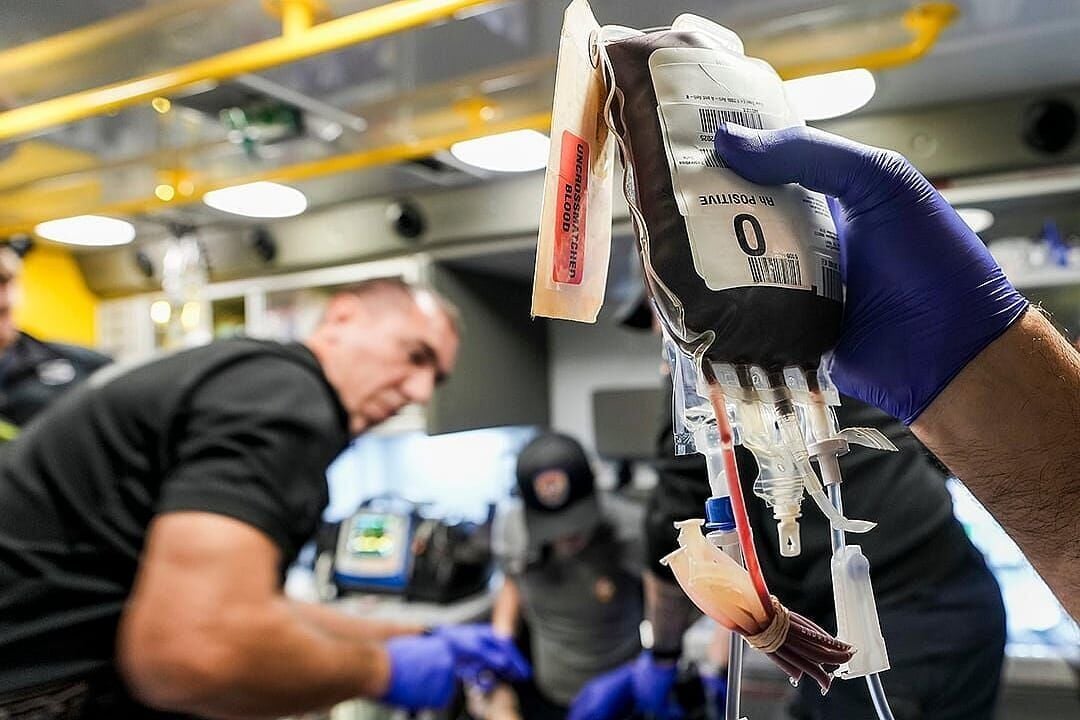
ImageTrend reports that receiving blood before reaching a hospital is far from universally available.
Fort Worth Fire Department Captain Trent Robinson works to transfuse a gunshot victim with a unit of blood in the back of an ambulance in Fort Worth on a late fall evening in 2025.
DoorDash order data shows sour candy, Takis and old-school picks like Circus Peanuts gaining ground in the Halloween bowl this year.The post Sour, spicy and retro are reshaping the Halloween candy bowl appeared first on Food Drink Life.
A look at building business trust and reputation by combining local presence with digital communication.WordPress Planet

Reading Time: 2 minutes
Some celebrity feuds date back to before one of the parties was even famous.
Taylor Swift has had a beef with Brad Paisley since almost a decade before she released “Bad Blood.”
He pulled a horrific prank on her that left her haunted.
During her Hall of Fame induction, Swift talked about exactly what that did to her — and how she feels about it today.
On Monday, October 26, Taylor Swift accepted an induction at Music City Center during the Songwriter’s Hall of Fame 56th anniversary gala.
Addressing the Nashville, Tennessee crowd, she became the youngest-ever member of the institution.
Country singer Brad Paisley performed her introduction. Given their history, that was a choice.
Swift could not help but comment on it.
“We’ve been estranged since 2007,” she told the audience, referring to a nearly two-decade beef with Paisley.
here’s a bit of her speech!! https://t.co/qF3URAvqGe
— caroline❤️🔥 (@hauntedwhatifs) October 26, 2026
Back in 2007, Swift was not a household name. She was opening for Paisley on his “Bonfires & Amplifiers” Tour.
“He took a tour prank too far,” Swift explained.
She detailed that Paisley “filled my entire tour bus with live crickets.”
According to Swift, there were “thousands of them.” That is arguably much more than a prank.
“For months I couldn’t sleep,” Swift recalled. “All night I considered buying a pet lizard to eradicate the problem.”
Taylor swift with her award at the Nashville Songwriters Hall of Fame!
— Taylor Swift Updates (@taylorswiftinfo.bsky.social) October 26, 2026 at 8:16 PM
To put it nicely, Swift has a reputation for being … vindictive.
Yes, that is the nicer way of phrasing it. It sounds better than petty, right? Right?
There are people who have truly wronged her — undercutting, sabotaging, betraying, or badmouthing her.
But there are also instances where someone either merely inconvenienced her, or wronged her in a way that is not public knowledge, where Swift seems to hold a grudge. Blake Lively comes to mind.
With that understood, how does she feel about Paisley today?
Taylor Swift and her mom at the Nashville Songwriters Hall of Fame tonight 🥹🤍 https://t.co/a9tnRZS8au
— Taylor Swift Updates (@TSUpdating) October 27, 2026
Almost 20 years after Paisley’s act of bioterrorism, Swift is a billionaire and apparently feeling magnanimous.
She made it clear that she’s willing to let bygones be bygones.
This is sort of uncharacteristically forgiving of her, especially for a “prank” that would engender lifelong hatred in many of us. (Me. I would hate someone for all time if they did this to me.)
Perhaps Swift is telling the truth.
Or maybe she still harbors hard feelings, and telling the audience what Paisley had done when she was just an opening act was a long time coming.
Taylor Swift Reveals Horrific Brad Paisley Prank that Haunted Her for ‘Months’ was originally published on The Hollywood Gossip.
The Hollywood Gossip
When Americans hear of child soldiers, they may imagine tragic images of children wielding rifles on distant battlefields.
But the conditions that help warlords recruit children into armed conflict abroad also help gang leaders draw young people into violent organizations in the U.S.
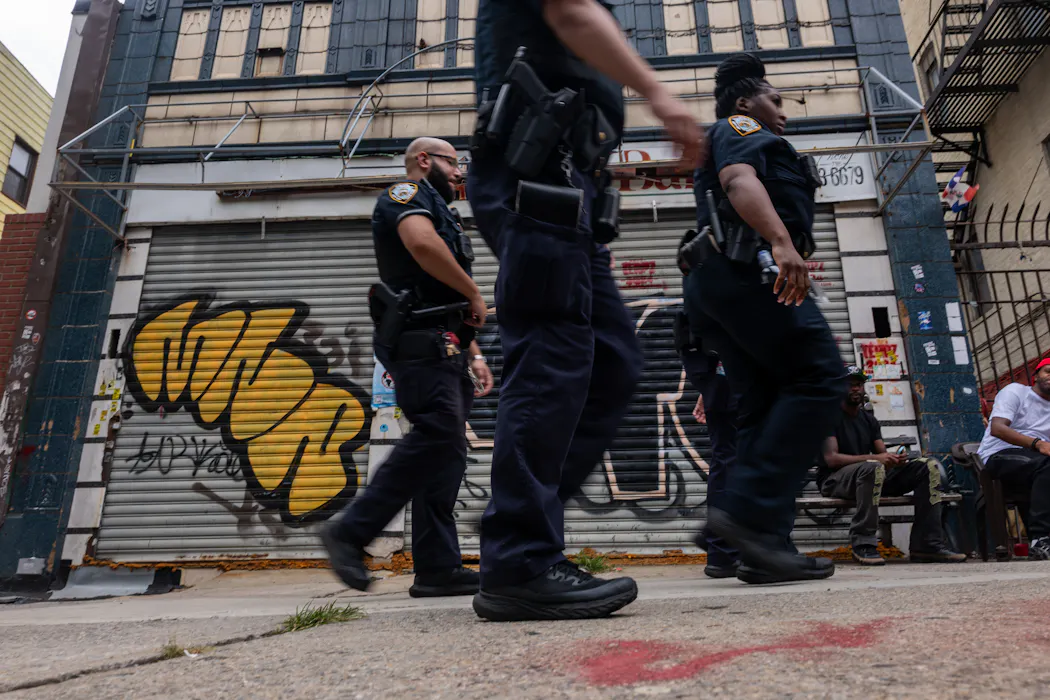
In cities across the country, gang violence continues to claim lives and fracture communities. A September 2025 FBI report recorded 69,273 incidents involving gang activity – most often assaults – between 2021 and 2024. Young people ages 13 to 16 were the most frequently reported offenders.
Policy responses to this crisis have largely focused on policing, prosecution and tougher penalties. Those responses cost federal, state and local governments billions of dollars annually.
Far less attention is paid to why violence offers some young people a sense of purpose, belonging and identity in the first place.
Gang-involved youth in the U.S. are not child soldiers in a legal or conventional sense, and American gangs are not rebel or insurgent groups. Nonetheless, the ways some young Americans become embedded in violent organizations – and the difficulty of leaving them – overlap remarkably with the child soldier experience.
As a former child soldier who is now a peace and conflict studies researcher, I have lived through organized violence and have since studied how violence shapes young people’s relationships, identities and opportunities. This work has led me to ask how decades of research on child soldier recruitment and reintegration might help young Americans caught in gang violence.

Research on child recruitment – and my own peacebuilding work, including negotiating the release of abducted children in Mali, South Sudan and northern Nigeria – shows that children are not always forced into armed groups at gunpoint. Their pathways into such groups cannot be understood as the result of coercion alone.
Armed groups may reach children through peers, community networks, relatives or other social connections. In places marked by insecurity and limited opportunities, children may not make a single decision to enter violence. Rather, relationships and constrained choices can draw them closer until entry seems like a viable way to gain a perceived sense of security and control over their own lives.
In many American cities, gang involvement follows a similar path: A 2025 study of 1,808 male adolescents in Multnomah County, Oregon, who have been referred to the juvenile justice system, found that exposure to gang-involved peers and relatives was associated with a greater likelihood of gang membership.
Through social networks, as well as music and online culture, gangs can project status, power and recognition. For young people who feel excluded by peers or disconnected in school, or who face instability at home, these signals can make gang involvement appear to offer something immediate and tangible: safety, identity and belonging. Researchers have found that some young people also join partly for protection, even though gang members face a higher risk of victimization than their peers.
Social media has intensified these dynamics, spreading images of violence, wealth, weapons and notoriety far beyond the neighborhoods and front lines where gangs and armed groups operate. The conflict in Sudan offers a stark example: Young fighters have been publicly celebrated and stylized online, including in videos portraying youngsters in military uniform as heroic “lion cubs” and in AI-generated clips placing them beside senior commanders.
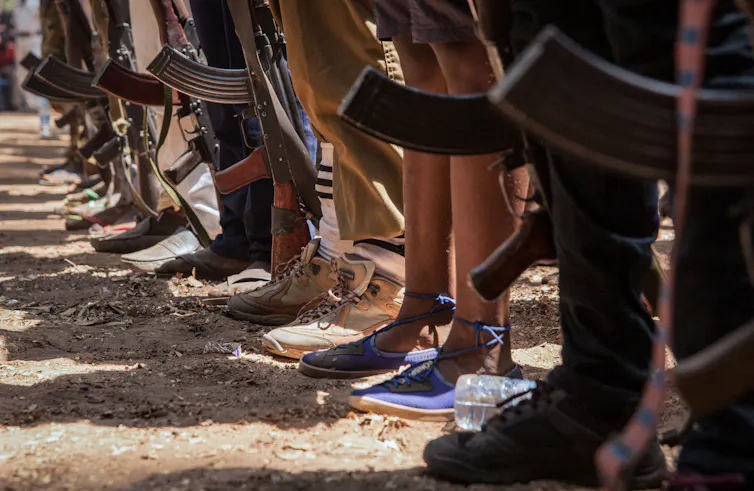
Young people in both gangs and armed groups may feel a sense of safety, connection and recognition. But what a young person sees as belonging can become a powerful mechanism of control.
Gang leaders in urban communities, like warlords in conflict zones, often position themselves as providers, protectors, mentors and father figures. They impose rules, settle disputes, reward loyalty and regulate access to opportunity and protection. For marginalized youth, they offer recognition where there is isolation, structure where there is instability and identity where there is exclusion.
That world gives young people purpose and belonging, but both are conditional on loyalty, obedience and participation, which makes leaving difficult even when the risks of staying become clear.
Arrests and incarceration can interrupt violence, but they do not necessarily dismantle the systems that draw young people into gangs.
As in conflict settings – where removing children from armed groups does not eliminate commanders, recruiters, networks or incentives – incarcerating young Americans can remove participants from the street without disrupting the structures, relationships or conditions that lured them to gang involvement. When they are released, those same influences may remain, making a return more likely.
This does not mean that young offenders should not be held accountable for violent acts they commit. But evidence from juveniles convicted of serious offenses, including felonies, suggests that punishment beyond what is necessary for public safety does not produce greater deterrence. Young people are rarely the architects of the systems that exploit them. When accountability is directed primarily at the young person at the bottom of that structure, the organization itself can remain intact.
Global prosecutions for child soldier recruitment have largely focused on commanders who direct and exploit children. Likewise, reducing youth violence requires attention to those who organize it, not only those caught in it. If a gang’s leadership, or the networks that profit from it, remain in place, billions spent deterring young offenders will not protect American streets or the children who walk them.
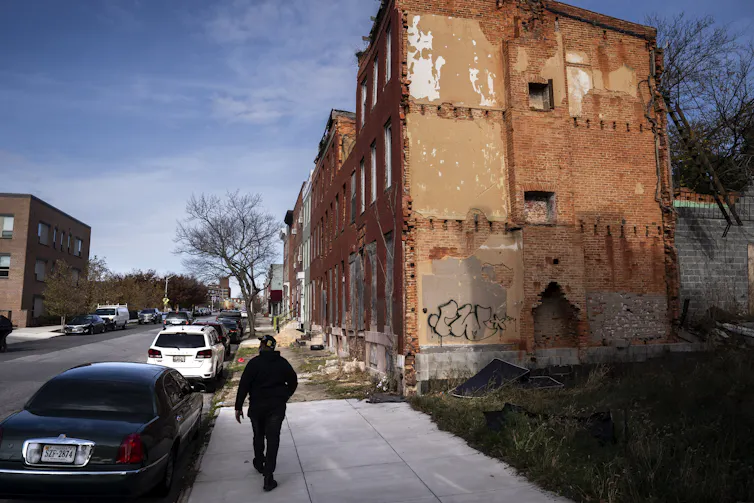
One of the hardest lessons from helping child soldiers return to their communities is that leaving violence does not mean the transition is complete.
Children who leave armed groups are often disarmed, demobilized and provided with vocational training, education and material assistance. But training someone to make a living is different from creating the conditions – a functioning market, infrastructure, mentorship and networks – in which that person can succeed.
For example, when a young person sells the sewing machine or other equipment that a reintegration program gave them to earn a living, it can look like a personal failure. But if the economic environment is unfavorable, or the infrastructure and support systems needed to sustain that new livelihood are absent, those shortcomings may explain the outcome as much as individual decisions do.
A 16-year study in Mozambique found that long-term reintegration of ex-child soldiers was shaped by livelihoods, sustained support, forgiveness and community acceptance. This has a direct lesson for the U.S.: A young person can leave a gang or come home from incarceration and return to a society that primarily sees them as an offender.
A 2021 study conducted across 12 U.S. states found that people with juvenile records face significant barriers to education, credentialing and meaningful employment. Another study found that a juvenile record can hurt an applicant’s employment opportunities.
If the neighborhood, family and institutions around that young person have not changed, the conditions that made violence attractive remain, and stigma can become a mechanism of re-recruitment.
The U.S. does not need to replicate child soldier reintegration programs, but it can learn from their successes and failures.
Removing young people from violent organizations is only part of the solution. The real measure of success is whether there are legitimate alternatives to the social world that violence provides and whether society can hold young people accountable while still creating pathways for them to build new lives.

Charles Wratto is affiliated with the Center for Peace and Violence Prevention (CPVP).
Politics + Society – The Conversation

Before most Americans step into the voting booth in November, they will already know their choices at the top of the ballot, in races for governor, the Senate and House of Representatives. But a race near the bottom of the ballot – for the chief prosecutor in their local district – will probably affect the voters’ lives more directly.
As a former prosecutor and as a scholar of the criminal courts for over three decades, I have seen how local district attorneys take the lead in responding to crime. This vote matters.
The chief prosecutor in local criminal courts – the titles vary, such as district attorney, prosecuting attorney, state’s attorney or county attorney – has enormous discretionary power over criminal law enforcement.
While state legislators pass the statutes that define crimes, local prosecutors decide where to spend limited enforcement dollars. They decide which cases to file and work with the police to address the crimes that matter most in each county.
Prosecutors also choose how to negotiate guilty pleas. While judges select criminal sentences in each case, prosecutors influence that choice with their own recommended sentence.
No official matters more than the chief prosecutor when it comes to using the resources of the courts and prisons.
Until the early 2010s, party labels did not matter in these local races, because Republicans and Democrats backed similar priorities. Prison was the central tool at every prosecutor’s disposal.
The prosecutor’s job centered on charging as many people as possible with crimes that could result in the longest possible prison term. Convictions for less serious crimes were valuable ways to build the defendant’s criminal record, making it easy to obtain prison sentences in the future.
Democratic and Republican candidates figured that voters wanted them to be “tough on crime.” Because the easiest way to send that signal was to press for more prisons, the size and cost of prisons mushroomed for decades.
And because most prosecutors presented the same basic options to voters, incumbents usually ran unopposed. Even when opposed, they beat the challengers in most races.
Over the past 10 to 15 years, however, prosecutor candidates have offered voters some real choices.
In King County, Washington, for example, voters in 2022 chose a candidate who emphasized prevention and mental health services alongside traditional criminal prosecutions. Her opponent had instead promised to file more criminal cases.
Voters today have more power to decide how many jail cells they want to fund and use. More traditional prosecutor candidates might continue to focus on prisons in their responses to crime, relying on its presumed power to incapacitate criminals.
This was the campaign strategy of a 2025 challenger in Norfolk, Virginia, who called for a return to heavier prison use after four years of efforts by the incumbent to reduce incarceration. Voters rejected this proposal and returned the incumbent to office.
Reform-oriented prosecutors, such as the district attorney in Milwaukee, are depending on less expensive nonprison punishments, including treatment programs for a wider range of crimes, reserving prison for more serious violent offenses. These reordered priorities seem to work as designed. They reduce prison use without increasing crime rates.
These reform-oriented prosecutors, like the county attorney in Minneapolis, might also develop diversion programs, sending some defendants into community service programs. Typically, prosecutors offer diversion to defendants under age 18. Some offices, such as the Pima County attorney in Arizona, offer diversion to adults accused of less serious crimes.
Some prosecutors, like the district attorney in Lancaster, Pennsylvania, design and lead some of these programs themselves. Often they partner with nonprofit groups that promote public safety.
Prosecutor candidates also give voters choices on which defendants to hold in the local jail, at public expense, while their charges are pending. Some offices have reduced or eliminated the use of cash bail, without increasing local crime. Candidates also give voters choices about new approaches to victim support services and programs designed to improve the reentry of convicted people into the community.

Apart from the various options that prosecutor candidates can offer, voters can expect prosecutors to work transparently. Candidates can commit to routinely releasing data about office operations. That’s what the Democratic candidate did in her successful race for commonwealth attorney in Arlington, Virginia. That data can allow journalists and researchers to evaluate trends over time, not just information about individual cases.
There are many offices – such as Jacksonville, Florida, and Boulder, Colorado – that show their work on data dashboards. That transparency allows the public to judge, between elections, how well the prosecutor delivers on campaign promises.
Recent political trends show that prosecutor elections are becoming more competitive, with more incumbents facing challengers. These races are also being driven by politics at the national level, as voters increasingly elect prosecutor candidates from the same party they prefer in national and state offices.
In this changing environment, I believe it’s worth voters’ time to explore expanded options in prosecutor races.

Ronald Wright does not work for, consult, own shares in or receive funding from any company or organization that would benefit from this article, and has disclosed no relevant affiliations beyond their academic appointment.
Politics + Society – The Conversation

Reading Time: 3 minutes
Meghan Markle is set to appear on Junior MasterChef Australia in 2027, and the announcement is already drawing backlash.
The Duchess of Sussex confirmed the new gig this week, saying the decision to sign on “was an easy yes” (via The Blast).
The series is a cooking competition featuring some of Australia’s youngest culinary talents.
The 2027 season marks the spin-off’s return to the country after six years away.
Exactly how big Meghan’s role will be depends on who you ask. Some outlets describe her as a special guest, while others report that she’ll co-host the show next year.
Either way, this won’t be her first time in a MasterChef kitchen. Earlier this year, Meghan filmed a one-episode guest appearance on the flagship MasterChef Australia, serving as a guest judge.
That episode was a hit, and the contestants seemed excited to have the duchess taste and critique their dishes, and the MasterChef team seemed extremely pleased with her.
Viewers at home were less unanimous. Meghan’s guest-judge stint sparked mixed reactions, and the Junior MasterChef news is splitting people along similar lines.
Some viewers have welcomed the announcement warmly, while others have pushed back hard. Reality Tea summed up the critics’ message in three words: “Read the room.”
The timing has put this announcement under a harsh spotlight. The announcement comes just days after disturbing allegations surfaced involving her estranged father, Thomas Markle Sr.
As we reported last week, Meghan’s half-brother, Thomas Markle Jr., claims to have discovered hundreds or potentially thousands of disturbing images among their father’s belongings at his home in Cebu, the Philippines.
The images allegedly involved child sexual abuse material, and Thomas Jr. contacted authorities after making the discovery.
Because the 82-year-old is an American citizen, the allegations could also prompt an FBI investigation. No criminal charges or findings of guilt have been announced.
Thomas Sr. has vehemently denied possessing the material, reportedly calling the accusations “sick lies.”
Meghan addressed the situation in a statement to the Post on October 23, revisiting an episode from 2018, the year she married Prince Harry.
She said a letter containing “troubling and disturbing allegations” about her father was sent that year to London’s Metropolitan Police and Royalty and Specialist Protection. According to Meghan, the letter was shared with her, and she was assured the allegations were being investigated.
She did not reveal what the letter said or who wrote it.
Meghan has also explained that her concerns about her father go back years, and that this is why she has not allowed him to have contact with her children, Prince Archie and Princess Lilibet.
Her estrangement from Thomas Sr. has been playing out publicly for years, but the new allegations have pulled it back into the headlines just as she’s promoting a family-friendly TV project.
For now, Meghan is moving ahead with the job. She’s slated to appear when Junior MasterChef Australia returns in 2027 — unless, of course, the ongoing controversy prompts either side to bail on this deal.
Meghan Markle’s ‘MasterChef’ Role Sparks Backlash Amid Father’s Scandal: ‘Read the Room’ was originally published on The Hollywood Gossip.
The Hollywood Gossip

For beer novices, categories like session and pale ale may seem interchangeable, but their Venn diagram does feature a few distinctions worth knowing.

Mashed – Fast Food, Celebrity Chefs, Grocery, Reviews