Categories
Uncategorized

Murder of Black suffrage leader Octavius Catto reveals why Election Day 1871 was one of the most violent in Philadelphia history

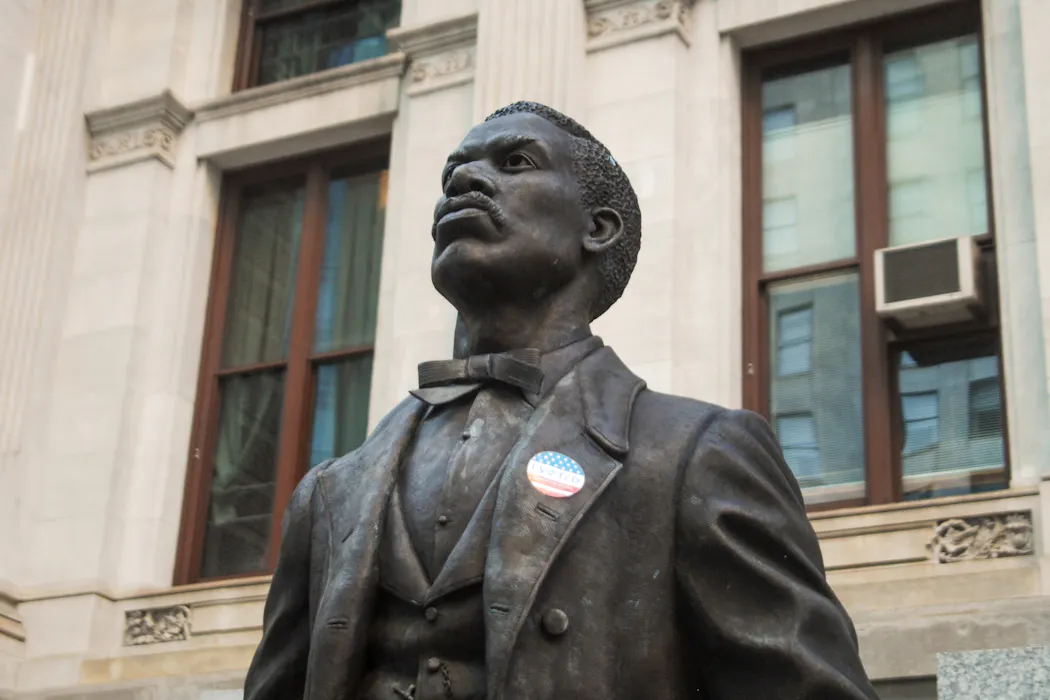
A 12-foot bronze statue of Octavius Catto was installed outside Philadelphia’s City Hall in 2017. Cory Clark/NurPhoto via Getty Images

Octavius Valentine Catto died as he lived, advocating for a more equitable society. Accordingly, the city of Philadelphia has decided to honor his legacy – again.

Philadelphia previously honored Catto with a commemorative statue outside City Hall in 2017. Of the city’s 1,500 public statues, it was the first to honor an individual Black person.

On Oct. 8, 2026, the intersection of 8th and South streets was formally renamed Octavius Catto Way. This is where Catto was assassinated 155 years ago during a tumultuous Election Day in 1871.

Speaking at the renaming ceremony, NAACP Philadelphia Branch President Catherine Hicks said the moment was about ensuring Catto’s legacy was remembered and understood.

As a civil rights lawyer and professor in the Africology and African American Studies department at Temple University, I find Catto’s activism immensely important. I hope more Philadelphians are encouraged to learn about Octavius Catto, the man former Philadelphia Mayor Jim Kenney described as the “Jackie Robinson and Rosa Parks of his day.”

A teacher, baseball player and civil rights leader

Octavius Catto was born in Charleston, South Carolina, in 1839 to a free Black woman named Sarah Isabella Cain and a formerly enslaved man named William Catto, who purchased his freedom and later became a Presbyterian minister.

William Catto brought his family north to Baltimore with plans to eventually travel to Liberia as missionaries. William Catto had to adjust his plans when members of Charleston’s Presbyterian leadership discovered a letter he had written they believed would incite an insurrection among enslaved people. They alleged the letter would “excite discontent and insurrection among the slaves.” An arrest warrant was issued for William and Sarah. They fled Baltimore and later settled in Philadelphia. There, William Catto would become an abolitionist, which had a profound influence on his son Octavius.
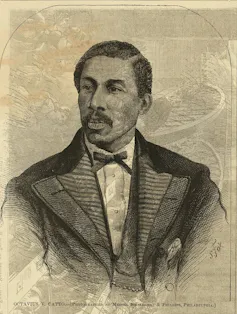
A photograph-like drawing of man with parted hair and mustache and wearing 18th-century suit
Octavius Catto was a teacher, baseball player and civil rights leader in 19th-century Philadelphia.
Library of Congress

Octavius Catto spent his formative years and subsequently launched his career as a public servant in Philadelphia. He attended the Institute for Colored Youth – now Cheyney University – and graduated at the top of his class in 1858.

The next year, he started teaching English and mathematics at the institute. By his early 30s, Catto had worked with Frederick Douglass to recruit all-Black regiments to fight for the Union Army during the Civil War. He co-founded, managed and played for an all-Black baseball team, the Philadelphian Pythians baseball club. He also worked with other civil rights leaders like Lucretia Mott and his fiancé, Caroline LeCount, to desegregate Philadelphia’s horse-drawn streetcars and the Franklin Institute.

The fight for Black suffrage in Philadelphia

More than a century before the civil rights protests erupted in Selma and Birmingham, Octavius Catto led desegregation efforts and voting rights campaigns in Philadelphia in the 1860s. The New York Times covered some of his desegregation efforts in 1867.

His civil rights advocacy was met with violent opposition, especially after the ratification of the 15th Amendment in February of 1870. The 15th Amendment guaranteed voting rights for citizens regardless of their “race, color, or previous condition of servitude.” Legal scholars such as Travis Crum argue the 15th Amendment “re-founded the United States as a multiracial democracy.” It gave the federal government key enforcement powers that prior legislative acts that secured the right to vote – such as the First Reconstruction Act – did not have.

In 1780, nine decades before Catto’s murder, the Pennsylvania General Assembly had passed the Act of Gradual Abolition of Slavery, which set the conditions freeing Pennsylvania’s enslaved people. It was the first legislation of its kind in America.

Despite these provisions, varying interpretations of Pennsylvania’s Constitution of 1776 left it unclear whether Black men could vote without restriction. The state Constitution restricted the vote to freemen, which it defined as “of full age of twenty-one years, having resided in this State for one whole year before the day of election … and paid public taxes during that time.”

Sixty-two years later, the state made it painfully clear who it intended to allow to vote. In 1838, Pennsylvania’s Constitution explicitly restricted the right to vote to “white freemen.”

Philadelphia became a key location for the fight for suffrage and other pivotal civil rights. The city had a large Black population, a storied history of abolition and an abundance of Black institutions, yet racial discrimination was still endemic.
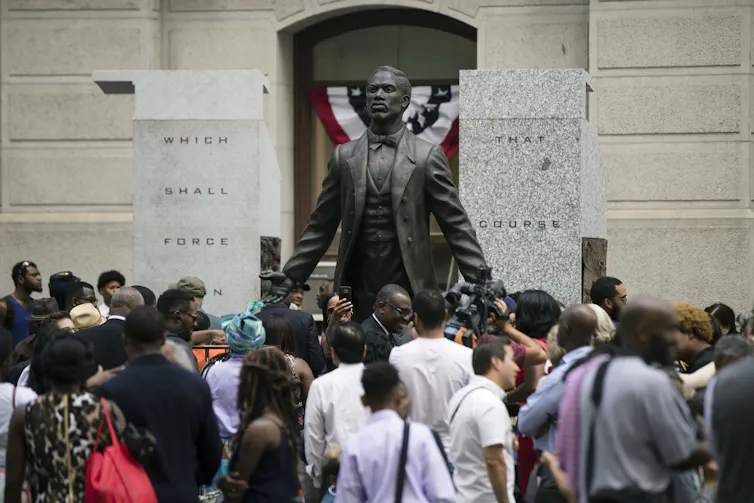
Large group of people surround a bronze statue of man
There were over 1,500 public statues in Philadelphia when Octavius Catto’s was unveiled in 2017. His was the first of an individual Black person.
AP Photo/Matt Rourke

Targeted by white supremacists

Election Day of 1871 was one of the most consequential in the history of Philadelphia, at the time an epicenter for the simmering tensions surrounding Black suffrage. According to W.E.B. Du Bois’ “The Philadelphia Negro,” about 5,500 Black men were eligible to vote in 1870. The prospect of Black men voting in the election sparked violent outrage in the city.

Both city officials and private citizens engaged in targeted violence to intimidate Black voters. Armed mobs harassed Black neighborhoods, attacked residents and forcibly closed polling locations.

Four Black Philadelphians – Levi Bolden, Isaac Chase, Jacob Gordon and Moses Wright – died during the coordinated racial violence that occurred that day and the evening before. It all left many of the city’s Black residents “considerably frightened,” according to a Philadelphia Inquirer report. Catto became a fifth victim.

Around 3:30 p.m., Catto was standing near his Philadelphia home when Frank Kelly, a political operative who opposed Black suffrage, fatally shot him.

Catto’s impassioned advocacy had made him a target of white supremacists in the region, but he did not waver in the face of this growing danger. In speaking of Catto’s legacy, Du Bois wrote, “And so closed the career of a man of splendid equipment, rare force of character, whose life was so interwoven with all that was good about us, as to make it stand out in bold relief, as a pattern for those who have followed after.”

Dedicated to empowering Black Philadelphians

Philadelphia Martyrs Day is an annual observance that pays homage to the five Philadelphia men who fought for Black suffrage and were killed in the 1871 election. These memorials often emphasize Catto because of his civil rights and voting rights advocacy.

Despite this and the statue outside City Hall, I and others in Philadelphia believe Catto’s influence remains largely unsung. In describing the importance of the street renaming, Leland Morroccos, executive director of It’s the Little Things Foundation, a local civic engagement and community advocacy organization, said, “Octavius Valentine Catto deserves to be remembered not simply as a name in Philadelphia’s history, but as a man who devoted his life to educating, organizing and empowering Black Philadelphians to participate fully in the civic life of their city and their country.”

“Philadelphia should forever remember Octavius V. Catto,” Morroccos continued, “not only for how he died, but for how he lived, what he believed, and the doors he worked to open for others.”

I hope all who stroll along Octavius Catto Way will come to learn that too.

Read more of our stories about Philadelphia and Pennsylvania, or sign up for our Philadelphia newsletter on Substack.

The Conversation

Timothy Welbeck does not work for, consult, own shares in or receive funding from any company or organization that would benefit from this article, and has disclosed no relevant affiliations beyond their academic appointment.

​Politics + Society – The Conversation

Categories
Uncategorized

Why the Paramount-Warner merger is a problem for democracy

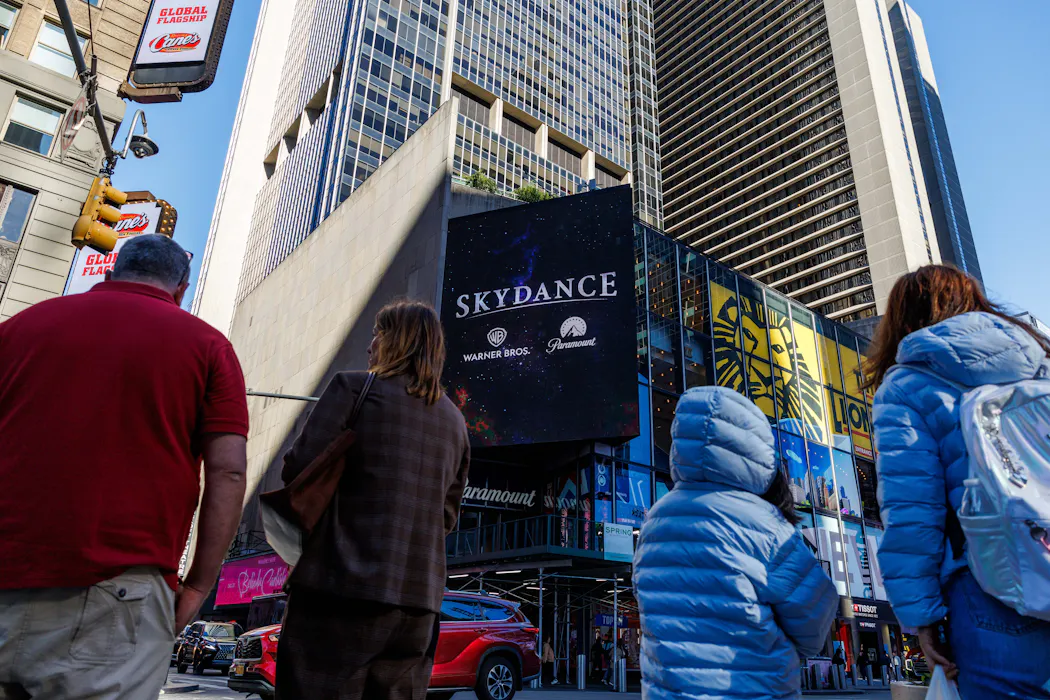
A Skydance billboard outside of Paramount headquarters in Times Square in New York on Oct. 6, 2026. Adam Gray/Getty Images

Media critic Ben Bagdikian warned in 2004 that five corporations had accumulated “more communications power than was exercised by any despot or dictatorship in history.” More than 20 years later, a major media merger is bringing his warning back into focus.

Paramount’s acquisition of Warner Bros. Discovery in October 2026 created a new company, Skydance Corporation. It now owns CNN and CBS News, Warner Bros. and Paramount Pictures, HBO and Paramount+, along with a sprawling collection of cable networks, live sports and entertainment franchises. The deal is valued at about US$110 billion including debt, and Skydance expects to cut at least $6 billion in costs within three years.

A coalition of 12 states sued to stop the merger on antitrust grounds, arguing that it would reduce competition in movies and television. The eventual settlement required a multiyear movie production and theatrical release guarantee and an editorial independence board for CNN and CBS News. CNN chief Mark Thompson and CBS News Editor-in-Chief Bari Weiss remain in charge, but both ultimately report to Skydance CEO David Ellison.

Lawmakers have already raised concerns about possible political influence over CBS News, though Ellison has denied interfering with coverage. President Donald Trump, a frequent CNN critic, publicly praised the merger.

As a scholar who studies the role of media in democratic societies, I believe that size and ownership matter. Whoever owns the media chooses its leaders, approves its budgets and decides where to cut $6 billion. The same market pressures pushing media companies toward greater scale and efficiency can undermine the independent reporting and diversity of voices that democracy depends on.

When media are more than ordinary products

Since broadcasting began, American media policy has wrestled with how to support the information needs of a democracy.

As my work on the origins of media systems shows, the United States built a largely private, commercial broadcasting system while Britain created the publicly funded BBC. Behind those choices were different ideas about whether broadcasting should operate primarily as a business or carry broader obligations to the public.

The market view became increasingly dominant in the U.S. In 1981, the Ronald Reagan-era chairman of the Federal Communications Commission, Mark Fowler, famously described television as “a toaster with pictures.” He argued that broadcasters should largely respond to audiences through ordinary market forces.

But as media scholar Robert McChesney argued in 1999, concentrated commercial media had become a “significant antidemocratic force.” What makes money for a media company and what citizens need from a media system are not always the same thing.

We’ve seen this film before.

Local television stations acquired by Sinclair Broadcast Group in 2017 shifted coverage away from local politics and toward national political stories. As research shows, communities that lose local media coverage can see less competition and participation in elections.

Mergers, however, make sense in the logic of the market. Warner and Paramount must compete with Netflix, YouTube, Amazon, Apple and other companies with enormous resources and global reach.

But having fewer competitors can also mean there’s less pressure to improve quality or hold down prices. And the efficiencies of media consolidation often come from producing less original content with fewer people.

An aerial view of a water tower with houses on a hill in the background.
An aerial view of the Paramount logo displayed on the water tower at Paramount Studios on Sept. 21, 2026, in Los Angeles.
Mario Tama/Getty Images

The new gatekeepers

Concerns about media power are hardly new.

The 1947 Hutchins Commission on Freedom of the Press warned about control of mass communication becoming concentrated in fewer hands, and it encouraged greater social responsibility. For decades, the FCC placed limits on broadcast ownership to support competition and diversity.

Digital media seemed to blow open the gates that limited participation, but a new class of gatekeepers arrived. While Bagdikian mainly worried about companies that owned newspapers, TV networks and movie studios, today’s media power lies in the hands of platforms, streamers and tech giants.

Social and video platforms have overtaken TV and news sites as the most common way people access news in dozens of countries studied in 2026 by the Reuters Institute. News organizations may still produce a story, but Google, YouTube, Facebook, TikTok and artificial intelligence can determine whether anyone sees it.

For social platforms, attention is the commodity. Likes, shares, comments, clicks and watch time help determine what gets promoted. And more time on the platform means more opportunities to sell ads.

It’s now well documented that social media feeds ranked for that kind of engagement expose people to more toxic political content and moral outrage than chronological feeds. They also increase perceptions of hostility between political groups.

Americans certainly consume enough media, with combined use at more than 13 hours a day.

Yet Americans do not seem especially well-informed or confident about the information they receive. Only 33% say they trust mass media to report the news fully and fairly, compared with 68% when Gallup first asked in 1972, and about half say they have difficulty determining what is true in the news. More than a third cannot name all three branches of the federal government.

Media concentration did not cause all of these problems. But decades of greater media abundance have not solved problems of knowledge, misinformation or trust.

Who produces the information democracy needs?

Democracy assumes that citizens will have enough information to make choices and hold powerful institutions accountable. But markets provide no guarantee that anyone will produce it.

As media scholar C. Edwin Baker explained in 2009, journalism creates benefits that extend far beyond the person who buys a newspaper or subscription. A monthslong investigation of corruption might benefit an entire city, including thousands of people who never pay for the reporting. But the media organization still has to cover the cost.

That’s why restoring journalism requires public and nonprofit alternatives to combat market failures, as media scholar Victor Pickard has laid out.

Other democracies already rely more heavily on a mix of commercial and public media. Research in 2009 comparing the U.S. with Britain, Denmark and Finland found that stronger public service outlets carried more public affairs and international news and were associated with greater political knowledge.

This doesn’t have to be a partisan issue. Regardless of who is in power, citizens benefit from vibrant journalism with the resources and independence to investigate government, business and other powerful institutions.

Media literacy can help citizens understand why the system works this way. As I argue in my 2019 book, News Literacy and Democracy, examining media means understanding the structures and institutions behind it – who owns them, how they make money and what pressures shape what gets produced.

But there are limits to what we can ask individual news consumers to fix.

People can learn to check sources and spot misinformation, but they can’t change market forces. The Paramount-Warner merger makes sense according to the logic of the market, and I believe that’s the problem. The same pressures that push media companies toward greater scale and lower costs can work against creating the media environment that democracy needs to thrive.

The Conversation

Seth Ashley does not work for, consult, own shares in or receive funding from any company or organization that would benefit from this article, and has disclosed no relevant affiliations beyond their academic appointment.

​Politics + Society – The Conversation

Categories
Entertainment

Skip Vodka And Try The World’s Bestselling Spirit In Your Next Cocktail

Neutral and internationally known, vodka is a natural go-to cocktail ingredient. However, a spirit that’s widely enjoyed in China could make a nice replacement.

​Mashed – Fast Food, Celebrity Chefs, Grocery, Reviews

Categories
Entertainment

Selma Blair Arraigned on 2 Felony Charges After Plane Incident Arrest

Selma Blair, Big PicMore details are coming to light about Selma Blair’s arrest in New York.
After the actress allegedly attacked the crew while onboard a Delta Airlines flight Oct. 11, she was arraigned on Oct. 12,…
​E! Online (US) – Top Stories

Categories
Entertainment

Open Channels FM: Open Channels FM Heading to the Web Summit 2026 in Lisboa

Next month in November, I’ll (Bob) be attending the Web Summit in Lisbon, Portugal. I have been to conferences in the past that have had attendance up to 15,000, but never one that has over 70,000 attendees. That’s a lot of people. A few months ago I applied for media creditation, unsure of their parameters […]​WordPress Planet

Categories
Entertainment

Collin Gosselin Reveals What It’d Take to Forgive Mom Kate Gosselin

Collin Gosselin, Kate GosselinCollin Gosselin isn’t ruling out a resolution with mom Kate Gosselin.

But it would take more than just words for the 22-year-old to build any bridge that leads to forgiveness after he says she was…
​E! Online (US) – Top Stories

Categories
Entertainment

Matt: Board Agent

Automattic is always 5–15 years ahead of other companies, but things happen faster now. I predict other companies will start scrambling to add great writers to their boards, because, well, look at the headlines in AI. United’s board already has Walter Isaacson. Authors are awesome, akin to founders in the startup/tech ecosystem.

Public offer to all the great sci-fi/etc writers out there who I’m a huge fan of (Ken Liu, Neal Stephenson, Ted Chiang, Andy Weir, Ramez Naam, Kim Stanley Robinson…) but not as close to as Hugh (I was part of him meeting his wife, officiated one of their weddings), I offer my services as your Board Agent to negotiate compensation and contracts for you! 1% fee, donated to the WordPress Foundation or Locus Magazine. I’ve become a bit of an expert in board protections, dynamics, compensation, and such. 🙂

Aside: If you haven’t seen the Robert Caro / Robert Gottlieb documentary Turn Every Page, run, don’t walk to your nearest streaming service!

​WordPress Planet

Categories
Entertainment

Who Supplies Trader Joe’s Smoked Salmon?

When you see smoked salmon at Trader Joe’s, you might imagine bringing it home with you. But do you even think about where Trader Joe’s obtained those products?

​Mashed – Fast Food, Celebrity Chefs, Grocery, Reviews

Categories
Entertainment

Novamira vs WPVibe vs MCP Adapter vs Easy MCP AI: Which One Fits Your Site?

Novamira vs WPVibe, plus the MCP Adapter and Easy MCP AI, compared: where each runs, what your AI can touch, real prices and caps, and which fits your site.

The post Novamira vs WPVibe vs MCP Adapter vs Easy MCP AI: Which One Fits Your Site? appeared first on Themeisle Blog.

​Themeisle Blog