Five months after Lainey Wilson and Duck Hodges said “I do,” the “4x4xU” singer is opening up about the new chapter they’re building together. Continue reading…Country Music News – Taste of Country









Five months after Lainey Wilson and Duck Hodges said “I do,” the “4x4xU” singer is opening up about the new chapter they’re building together. Continue reading…Country Music News – Taste of Country
Five months after Lainey Wilson and Duck Hodges said “I do,” the “4x4xU” singer is opening up about the new chapter they’re building together. Continue reading…The Boot – Country Music News, Music Videos and Songs

Six community members are competing for four seats on the school board this year. They all sat down with reporter Lizzy Hahn to talk more about why they want to run.
Editor’s note: This year the Chilkat Valley News partnered with KHNS on its election coverage in addition to hosting two candidate forums. A playlist of these profiles, as they are posted, can be found here.
Lizzy Hahn: Can you tell me why you’re running for school board?
Burl Sheldon: Well, I want to be a part of this group that meets and discusses and considers the needs of children and the ways that we can solve the problems of raising children in a very complicated environment, complicated for young families in our community, the complication of affordability, the complication of keeping great teachers. You know, we’ve had a lot of teacher turnover in the past decade and I’ve watched that and kind of been watching on the sidelines. And I want to be involved in that. I have some specific areas of interest, but the most important thing is just being a contributor and I guess sharing my passion about young children and helping families.
What are those biggest areas of interest for you?
The biggest areas of interest for me are that we’re aware of the health challenges that families and children face. We see that reflected in our national chronic disease statistics. And so children aren’t somehow immune to that. That’s where it gets going. And so health and things like cooking and making sure that children have clear information, that parents have clear information. The information that we have today, as far as the health side goes, is better than it’s ever been. So we have an opportunity there and I would say an obligation.
How would you approach that as a school board member to not alienate families?
Right. Slowly, slowly I think of it as a slow thing and the one thought that I’ve had and as a former school teacher and as a person who has spent, I spent a decade running a youth mentoring agency here, the Big Brothers Big Sisters program, and seeing children and families and understanding that in an interesting way. There’s really a neat opportunity and it’s not complicated, I don’t believe. But one integration that would be valuable is to integrate what is obviously a health issue, food, with classes like cooking and life science. You know, health class, cooking used to be called family and consumer science or before that it was home economics. I don’t know what they call it now, but life science, health and cooking are integral to our well-being and they are, it is integral to the well-being of children.
What do you think are some of the biggest challenges that you see for the Haines School District as a whole and how do you hope to address those? Like is nutrition one of those big issues?
You know, I think that it may be, no, I would say in terms of the obvious day-to-day things that Lily Boron and the school board have to deal with, we’ve had a really politically broken situation. Our relationship with the state funding of schools can best just be described as broken and I think that I won’t be shy in saying that Mike Dunleavy is perhaps the worst governor that Alaska has ever had.
He’s certainly been no friend of public school. So those are challenges that every school district in the state has to face. And so funding and as I started off talking about retaining great teachers, I think that if there’s one thing I want to emphasize in my interest in running for school board is that how do we over time develop the tools and the methods and the whatever it takes attitude so that we are recruiting and retaining great teachers because that’s what inspires children. I’m real interested in making sure that we’re talking about an in-person learning environment, a public school, a brick and mortar school, in-person learning. I’m not talking about online, nothing. I’m not saying we don’t need online or distance learning opportunities and more and more that’s become a reality. But I’m interested in a great in-person learning environment here in Haines.
What do you think makes a great in-person learning environment?
Great teachers. There’s just nothing, there’s no way to substitute that. Great inspirational people in the classroom who know what their subject, know their subject matter but more than that have the tremendous and unique characteristics of a teacher. And I know that from a person who came into teaching and really at one point hit the wall, I realized that this was really, wasn’t healthy for me. I was being tasked with too much and recognized that it wasn’t right for me and I didn’t do a career in public education. But you know it when you see it and your kids know it when they see it.
Do you have any children who have gone through the Haines school?
I have no children in the Haines Borough School District. I have no children. I grew up, my mother and father were both health and PE teachers. My father and mother coached, you know, swimming, football, baseball, diving, tennis. I met somebody not long ago who told me how my mother taught them how to swim in a lake. It was before the construction of, you know, pools, public swimming pools in the 1950s in our hometown. So I grew up literally two blocks from the school. And my dad was the guy with the keys to the gym. And so all that is something I grew up with, in a very intimate level. But no, I do not have children. But I did actually attend a pretty functional public education school and enjoyed a great athletic program. And that was really important to me then.
You touched on this a little bit earlier, but like school funding has been a common topic that we’ve been hearing about. What responsibility do you think the school board has in helping figure out, like, who helps fund the school?
Well, we can’t be doing it through bake sales. You know, we can’t be expecting that kind of, there literally are school functions that are funded by bake sales. I think the issues of funding principally at the state level are very important. We saw last year, if I’m not mistaken, the Haines Borough step up to fund at a level they’ve never been requested to fund before. And they did the absolutely right thing in doing that. If I were on that assembly, I would have done the same thing. And I applaud them for doing that. I think that the idea that a really huge part of the school district’s budget is going to be payroll and benefits and the idea that we’re going to get great teachers for less money. Good luck with that. At the same time, you know, we have a search clinic or a search system that is going to apparently build a hospital here. They have plans, I’ve been told secondhand, for staff housing. Now, all throughout Alaska, there are examples of communities where there’s housing for teachers. Was there housing for teachers in Nome?
There was.
There was. And the reality of it is the state of Alaska has also not maintained those housing units for teachers in many cases. They were built in rural places by the state and then allowed to go to you know what — and that’s tragic. But housing is an issue that teachers may need. And I’m not suggesting we house all teachers. But it’s my interest to, again, with the guidance of whatever it takes, consider some housing for teachers in Haines. And it doesn’t mean that we have to build every teacher a house. But perhaps there could be some transitional housing or transitional support so that great teachers can get here and not leave. That’s key.
If the Haines Borough School District were to build housing, where do you foresee the funding for this coming from? Do you think that would be a state or a borough issue?
I wouldn’t be able to say. I really wouldn’t be able to say. But again, I’m back to that, my original premise. How do we get great teachers here? And how do we get them to stay? So we need to discuss that.
AI is a very common topic now. Do you use AI? If so, how? And how would you like to see students either using it in the classroom or learning how to use it in a safe way?
I do use it. I use it in a query, you know, to just find out some source. Typically AI will provide you with a summary, but it will also give you the source. That allows you to go and look for yourself and consider whether that conclusion is a good one. I am concerned about AI and I’m concerned about the role of problem solving. Problem solving as a focus of education, what we call critical thinking and problem solving, those are synthesis level cognitive tasks, has always been part of the scholastic focus of schools, I think, for a long time. Beyond reading, writing, and arithmetic, like my grandfather who made it through the eighth grade. Once he knew reading, writing, and arithmetic in rural Wyoming, he was good to go. And he was back on the farm when he was 14 years old. That’s not the world we’re living in now. And we’re asking children to develop synthesis level cognition and things like problem solving and critical thinking are essential. So AI must not take the place of those things. Whether there’s AI involvement in education, and obviously there will be, we must not let go of the requirement for children to learn problem solving and that be a focus of education as well as critical thinking, meaning deciding in many cases whether it has merit and is appropriate.
What does a successful term look like for you in either a year from now or three years from now if you were to be elected?
I want to be part of the team. You know, I want to be part of the team. And I think I have no problem with the school board. I realized a couple days ago that I’m talking to Kevin Shove, who’s on the school board now, and he explained that I would be running against him. And it was like, ‘oh, I guess so.’
You know, I hadn’t even thought of that really. I just wanted to be on the slate. I wanted to run for public office. And the school board is where my passion is. The development of children and families and serving children and families through the Haines Borough School Board is really where I was focused. Could you repeat the question?
What does a successful term look like for you either a year from now or three years from now if you were to be elected?
That’s a great question. I think that, I mean, awareness of student health at the level of the school board, that it’s part of the conversation on a regular basis of the school board. And the health of students can be sort of distilled down. There’s stress and many, many stressors. We have new stressors, thousands, perhaps. They relate, they could relate to social media. There’s other physiological stressors, such as an inappropriate diet. That’s another huge one. There’s also the stressor of sleep. Are students getting enough sleep? So those are three very fundamental core issues that transcend learning, right? They’re really at the sub-level of student learning, that they are prepared to learn. Have they slept? Are they taking on undue stress? Have they been properly fed? Those are things I would hope that we would be talking about in three years and be aware of the challenges that modern families face in those areas and modern children.
All of the stressors that you bring up, like the diet and sleep and stress just in general. How do you as a school board member hope to help eliminate those problems? Is it like better nutrition in the cafeteria? How do you check on if a student’s getting enough sleep or not?
Well, that’s a great question. That’s really, really great. We’re not, generally, I mean, if you look at the United States population in 1940 and compare, and we’re essentially the same, biologically, we’re the same people as we were in 1940. We’re not getting nearly as much sleep as people got in 1940. And I don’t know exactly what the number is, but it’s significantly below the seven to nine hours that is generally recommended. And that goes for parents and parents as well. So being aware of that, there are no, there’s no human metric. That’s an example for just simply the discussion of sleep. There is no human metric for performance that is improved through the lack of sleep. And of course, that would include a child’s ability to learn, ability to solve problems, or ability to, you know, shoot baskets.
All human metrics of performance go down with the lack of sleep. There’s an example. We just experienced in our nation one of the largest, if not the largest lawsuit against a single company settled out of court for $17 billion. And that has to do with the Meta settlement that basically admits that they’re predatory on children, that their social media algorithms are predatory on children. And we should all be very concerned about that. We should not take that idly. School boards should be absolutely focused on that. States should be absolutely focused on that. And I believe that our states have a serious obligation because they have the financial and the legal muscle to do something about it.
Despite the thousands of stressors that children have, we only have one stress reaction. The body only has one, okay? And then the issues of nutrition. I mentioned three things. I mentioned sleep. I mentioned social media or chronic stressors. And then there’s the issue of nutrition. About 70% of the food that’s available, the individual food products in our local grocery stores would be fairly classified as highly processed. And the writing is pretty big, pretty on the wall that what we need to be consuming is the exact opposite. That foods lower on the totem pole, lower on the food chain, whole foods, whether they be meat or vegetables or whatever, are what we need. Frankly, the United States Department of Agriculture, the same organization that funds our school lunch program, is the cause, frankly, of a lot of this trouble and this trauma and drama that we see relating to food in America.
You mentioned this a bit earlier about how you’re running against Kevin, who’s currently on the board, and many others.
I didn’t even know, really, that I was running against him.
This is a pretty full ballot – there’s six people running for school board, yourself included, for four seats? Did you know this when you were applying? Did you realize that it was full?
Yes, I did. I thought I realized it was full at the time, and I don’t care. I want to be on the school board. And so the only way to get there is to file. Yeah. And I’ve had this conversation about some of these topics. These are not fresh. I’ve shared my in-depth concern with the school board in the past, in the past year in writing. And Lily Boron is very, very familiar with the concerns that I have. And it’s been a wonderful and friendly interaction.
What have been some of the reactions that you’ve gotten?
They think of it as somewhat tangential to what’s in front of them. And what I would say, and I’ll use a number. I’m a math guy. I’ll use some numbers because of its value in appreciating the extent to which I’m referring. We currently have about 30% of the United States walking around that is either pre-diabetic or diabetic, 30%. That’s pre and diabetic, 30%. And we have 40% of the population of the United States has a body mass index of over 30, which means they’re obese. In 25 years, that will be 60%. That’s the trajectory we’re on. Along with that is the chronic disease pandemic that is absolutely and has been proven to be linked to belt size. So those affect children, those in 2050, that 60% statistic will involve the children who are currently in Haines Borough schools. And I’m very concerned about that. We should all be concerned about the thriving of children. And in the face of, as with the Meta suit, as with the tobacco suit from the mid-90s, predatory marketing, predatory product development that is affecting the lives of children and their ability to thrive into the future.
Do you think that that just goes back to like the Whole Foods offered at the cafeteria? Or like how can the school board address that? Is that focusing on the cafeteria?
I mentioned one thing. It’s difficult, that’s a great question because we are offering a subsidized USDA school lunch. And yet we also have some benefits of being in Alaska. We have salmon and periodically there might be some moose on the menu. Those are all good things. I mentioned to you at the outset that I have a curriculum interest that I think will really benefit the health of youth and can benefit the health and well-being of youth and families. And that is integration of health, life science, and cooking. Those three are inextricably linked. You see the links once you appreciate the relationship between food, undue stress, lack of sleep, and chronic illness.
Is there anything else that you want to mention today about either running for school board or what it would mean to be elected or anything in general?
I’d just like to say that I have a lot of interesting and diverse experiences. I came here as a school teacher. I wrote grants for recreational use management at Chilkoot. I’ve written grants for PE programs, for U.S. history programs, for Alaska schools. I’ve done a lot of different grant writing projects over the years. I ran the Big Brothers Big Sisters program for a decade. I filed the articles of incorporation for Haines Friends of Recycling. I was its first board president for about five or six years and been involved in the community in a lot of different ways. Financially, I worked as a municipal grant manager and bookkeeper as well as working for a nonprofit museum as their grant writing, grant manager, and business manager. So I have a lot of budgeting and financial experience and knowledge as well as my interests in health and well-being and in children. So I have a lot to offer in terms of experience that is both volunteer and paid and feel like I’ll be an excellent contributor on the school board. And I have absolutely no problem with anybody who’s currently serving or with our school superintendent, who’s a lovely person who I’ve known for many years.
Thank you so much for joining me today, Burl. I appreciate you taking the time to explain why you’re running.
Thanks so very much.
The post Watch: An interview with Burl Sheldon, candidate for school board appeared first on Chilkat Valley News.

Six community members are competing for four seats on the school board this year. They all sat down with reporter Lizzy Hahn to talk more about why they want to run.
Editor’s note: This year the Chilkat Valley News partnered with KHNS on its election coverage in addition to hosting two candidate forums. A playlist of these profiles, as they are posted, can be found here.
Lizzy Hahn: Do you want to just jump right into it and explain why you chose to run this year?
Carlos Jimenez: Sure. My work has always been really busy. I own a construction company. I’ve had two sons in the school system since kindergarten. One graduated two years ago. And I’ve got time to try to help, maybe sit on a board and collaboratively make decisions that help the school. Yeah, I want to give back.
What grade is your current student in?
He’s a freshman.
I saw that you were recently appointed onto the school board. How do you feel like these past few, I don’t know, have you attended any school board meetings yet?
I attended the meeting where they voted me in. And then one more since then. It was interesting and I liked it.
Do you feel like you’re learning things that if you were elected you would try to continue bringing to the table or?
Definitely. I think it’s a good group they’ve got now and I’m interested to see who else gets voted in.
What are some of the biggest challenges that you see for the Haines Borough School District right now and how do you hope to address them if elected or re-elected?
If elected, well, either way, I think it’s too early for me to just jump in and say what all the problems I think are. Typically, I know just in the past it’s been enrollment, budget, building maintenance, things like that. But without sitting on the board, I don’t know currently what’s going on. But ready to jump in.
What are some of the issues that you’ve been talking about so far in the school board meetings?
Really, the only meeting that I went to, we talked mainly about the capital improvement project budget and projects that are funded, vehicles, building maintenance, but nothing too major.
A common topic that we’re currently seeing is education funding and who should fund schools at what level. Where do you sit on this issue and how do you think that you could respond to it as a school board member?
I’m going to have a pretty boring answer because until I have some time on the board, I don’t feel like I’m educated enough to answer that. Yeah, but I think collaboratively talking with other board members, parents, teachers, I’ll be more apt to make decisions.
Do you use AI yourself and if so, how? And how would you like to see students learn how to use it or would you like to see students use it in schools?
I don’t know. When my kids first told me about AI a couple of years ago, I hated the idea of it. I’m kind of a purist, but I have used it with my business for doing material takeoffs for projects and some simple things like that. But I don’t want it to take away from free thinking for sure. It’s a little scary.
Since you run a construction company, I would imagine that you’re pretty busy juggling that. How do you fit the ideas of thinking about the school into working?
I think with my business, I deal with clients, I deal with architects, engineers, crew, and there’s always issues with construction. So it’s just remaining calm and finding the best solution.
How long have you been running your business?
About six years.
Are you operating mainly in Haines?
Only in Haines.
What does a successful term look like for you, like either a year from now or in three years?
A successful term? Being present and just doing what I can, keeping a positive attitude and listening to people.
Did you attend school here in Haines yourself?
No, I grew up in California. I moved to Alaska the day after high school.
Have you been in Haines since leaving high school?
No, I lived in Juneau. And then we had my first son, Hayden. We decided to move here about 19 years ago, 18 years ago.
So both your children have grown up here in the Haines school district?
Yeah.
Do you feel like that has shaped them in any sort of way?
I do. I mean, I think for anybody growing up in Haines, it’s pretty special. They love to get out. We travel, love to visit cities and other places. But they’re always happy to come back here. Pretty simple pleasures here.
Do you feel like your freshman school has particular interests in the school that you’re also like, is he more on the vocational track or more on the college track?
I think Asher’s probably more on the vocational track. He’s a pretty solid wrestler. He loves wrestling. He’s excited to be in high school. And I know he’s excited for it to be over too.
Another common topic that we always hear about is teacher turnover in Alaska in general. And then also here in Haines, we’ve seen it a little bit. How do you hope to address this if elected?
I think getting all the information we can that I don’t know through the existing board and the superintendent. I know that Haines has posed problems for many people aside from just teachers for the cost of living, housing availability. I think people are pretty ambitious to come here sometimes, young families. It’s kind of like paradise but there’s some challenges, I think, with pay scales for certain jobs, for housing, accessibility, ferries, planes. It’s not easy.
Have you seen any struggles working on the construction side of it? Is it getting harder to build housing in any way?
Prices continue to rise every year. Materials, labor, it’s a challenge for sure.
What do you think is, like, because I know housing is one of the main stipulations, right? Is there a way to, like, if you were to build housing for teachers, what would that look like? Is it apartment-style housing or single unit? Like, think even more constructionally?
I personally think that Haines could stand some apartments or condos, townhomes. Costs of construction is not cheap, but I think there’s ways to reduce the cost, too. You know, they don’t have to be custom homes. I think there’s a lack of solid apartments and availability. For instance, with the hospital project going on right now, there’s going to be sometimes 40 to 60 out-of-town people here needing housing as well. So that’s a tough one.
What are some of the main projects that you work on? Like, is it mainly housing or?
We do custom homes and sometimes remodels. We just built the quick shop, built a couple shops in town, some search work and, yeah, anything. Commercial and residential.
Maybe this is not the easiest way to put this into a metric, but what’s, like, the average cost right now to build a home or an apartment?
I usually tell people $350 a square foot to get started. It could certainly be a little bit less and it could certainly be a lot more. And commercial can be $400, $600 a square foot, depending on what it is.
Are there any other issues that you see posing a potential problem for prospective teachers coming in or teacher retention?
I don’t know, except for what I’ve already mentioned, you know, the cost of living, the difficulty in accessing Haines or leaving Haines. I think those are the big ones.
Is there anything else you want to mention about the school as a whole, now that you have your kids going through school?
Sure. I think it’s a great school system. I’ve loved that it’s been there for my kids and I’m glad to be able to give back now. I think it’s important that the teachers feel supported, the kids feel safe and we challenge them for their futures, but I think it’s just a stellar place to attend school. I wish I attended [school] here.
Looking at the ballot, there’s six people running for school board and I believe it’s only four spots. Why did you choose to run this year and like over other years previous?
Just with my workload and looking at it this year and my son’s a freshman and I’ve got some time and I thought, let’s do it.
Are there any other questions that maybe I didn’t ask that you would like to address about running or being on the school board?
Not really. I think it’s a good board right now. I think it’s a good team and I’m looking forward to the opportunity of working with them for a few years.
Thank you so much, Carlos, for joining me today.
Thank you.
The post Watch: An interview with Carlos Jimenez, candidate for school board appeared first on Chilkat Valley News.
Cara Gilbert Q&A
By Lizzy Hahn
Six community members are competing for four seats on the school board this year. They all sat down with reporter Lizzy Hahn to talk more about why they want to run.
Editor’s note: This year the Chilkat Valley News partnered with KHNS on its election coverage in addition to hosting two candidate forums. A playlist of these profiles, as they are posted, can be found here.
Lizzy Hahn: Do you want to start by just telling me a little bit about yourself and why you chose to run this year?
Cara Gilbert: Sure. Well, I’m originally from Haines, I was born here at the clinic. And so I went through the school here, obviously. And when I was there, it was a good school. I really liked it.
And my husband and I have recently brought on two teens into our lives and so I’ve had more interaction with the school lately. And so I thought, why not help? And yeah, some of the things I’d like to see, I guess, would be retention of the teachers. I think that would be really nice. And then some of the things selfishly that I’d like to see for the kids are like dual credit classes, some more of those options. It’s so expensive now to go to college. And so if there’s anything we can do to help with that, that would be really nice.
Have you ever run for school board before? Or is this your first time running for the school board?
This is my first time. I’ve never really been into politics too much, like running myself. But sometimes you just got to help. And so I figured I’d have some time. And I’m attached with the kids, so why not try?
What grade are the two teens in?
They’re in 10th and 11th.
You touched on this, the teacher retention. We’ve seen that a lot in Haines and also just in the state in general, less teachers are staying. There tends to be a high turnover rate. How do you think you as a school board member could help either retain teachers or bring more teachers in?
It’s a good question. I’ve been thinking about that one. I think there’s varying factors. It’s hard to live here if you don’t have family here. It’s expensive to just move here. Finding housing is hard, obviously, childcare as well. And so I’m not sure exactly how to do it. But I think one of the things that made it great when I was in high school is we had the teacher retention. We did have some turnover, but we had some teachers that were there for a long time. And they were really good teachers. I’m not going to go into all the names because I might hurt somebody’s feelings. But I felt prepared when I went to school after high school. And so I would like to see the same thing here. I think part of it is housing. I think figuring out a way where we can house our teachers or maybe offer something where we can give them some kind of housing or reduced housing. I don’t know what the budget looks like exactly.
So I know that’s expensive. One of my ideas, one of the programs that I’d really like to see happen is I’m not sure if you’ve ever heard of those programs in the high school where they build houses. I think that would be a wonderful program if we could bring it here. Because I think besides just college track, there’s vocational track. And I think sometimes that doesn’t get enough focus. I mean, just look at going to those apprenticeships, you get paid to go to the apprenticeships. And it’s a good job. You want our kids to have a good job. And so I was kind of thinking if we could somehow bring that in. And maybe we could use those houses for our teachers. That might be some way to do it. I’m not sure.
What do you think are some of the biggest challenges either the school or the district as a whole is facing? Like, is it the teacher retention? Or do you feel like there are other issues that you would like to potentially help fix if you were elected?
I think budgets. There’s never enough money to do what you need to do. I think, again, teacher retention. I do think the staff that is there, they work their hearts out. It’s a hard job. Not something I personally could do. But, yeah. What exactly was the question again?
What are some of the biggest challenges you see for the Haines School District? And if elected, how would you try to eliminate these challenges or try to help solve them if possible? I think part of it’s the budget. I think you have to be creative in how you do it. And I do think they do do their best. Sometimes it helps to have more people look at other options and figure out how you can do it. You have to be creative.
That was actually going to be my next question. Education funding in general has been a complicated topic at both the local level and the statewide level. Schools all over Alaska are facing the challenge of, how do we fund our schools? How do you think that you would address this issue at the school board level? Is it looking into funding from different sources? Or how would you approach the tight budget issue that’s going on?
I think you have to look into funding and to other sources. You have to just be creative in how you go about it. OK, so here’s the story. I had this boss. I used to work for SEARHC in the dental division. And we only had so much money in order to serve all the communities that we served. And so we would, there was this one story where he went with some managers who were at this retreat and they were given three things. They were given like eight paper clips, a piece of paper, and a rubber band. And they were told you had to make it fly.
And the person who went the farthest would win. And so he said all the other managers were making all these really pretty paper airplanes. And they were just making it all nice. He was looking at it and he decided to put his paper clips in the middle of the paper. He scrunched it up and then he put the rubber band around it. So when it was his turn, he took it and he winged it as hard as he could. And so he obviously won. People weren’t very happy because it didn’t look like what they thought it should look like. I think that’s kind of how you have to look at the budget. You’re never going to please everybody. But you need to accomplish what you need to accomplish. And it might not look always pretty but if it gets the kids where they need to go, I think that’s how you kind of have to look at tackling the budget.
Another issue that has been kind of rising to the top is the use of AI. Do you use AI personally? And if so, how? And how do you think that students should learn to use it? Should they learn to use it? What are your thoughts on this?
Oh, I haven’t actually thought about that. Because I’ve hit the age where I feel like one of those dinosaurs. I have started to use AI at work because they’ve opened the door. A little caveat is the two teens that are at my house, they actually don’t like AI because of the way it uses water. So they’re very against it. I think that’s an interesting little tidbit. I think it’s a tool, I think it’s something they should learn to use. I don’t know how you manage it for the kids so that they’re not abusing it. That’s above what I would know. But I don’t think we should hinder the kids in not knowing how to use certain technologies. I think it’s good for them to know how to use it. I would let the IT people figure out how to manage it.
Since you have the two teens – were they the main reason to prompt you to go for school board this year?
They were. Seeing them in school, yeah, they were. I’ve had a lot of interaction with the school now with them. I’ve been really impressed with the staff and working with them, with the kids. Biologically, they’re not my children. So I’ve been like a nervous mom, like every little question I call them. And they always answer, and they’re always very gracious. To the ninth degree, I just constantly, ‘oh, I’m really nervous about so-and-so doing this and this’ and they always take my questions and they’re always helpful. And so I just have appreciated them.
Now that you have teens in school, do you feel like you see any difference in the school since you’ve gone to school? Do you feel like the school has ebbed and flowed in any way?
I feel like, again, teacher retention, I think that seems to be one of the bigger things to me. And then I think their budget might be a little bit less when I was in school, is what I’ve noticed.
You mentioned dual credit classes earlier. Did you take any dual credit classes when you were in school? Was that a thing?
I didn’t. And so I didn’t even realize that was an option when I was going to school. I always just thought, OK, if I have kids, I really would like them to get as much, if they want to go to college, if that’s their path, then if they can get those stuff done while they’re in high school, then that’s just less money that they have to pay for later. Because if you think about it, if you’re going for that four-year degree, the first two years are just extras, but it’s expensive extras.
Did you yourself go to school in-state after high school?
Ok, I probably shouldn’t say this, but when I was done, I was like, I need out of Alaska. I went to school in Oregon.
But then you moved back to Haines after school?
I did, and then I was in Juneau for like, I don’t know, 15 or 20 years.
What does a successful term look like for you if you were elected? What do you hope to have accomplished in either a year from now or three years from now if you were elected?
Sure. I think sometimes a year or two sounds like a long time, but it’s not always long. I think if you can start planting the seeds. Like I said, I would really like to see the school class where they can build a house. I think that would be wonderful. Working on teacher retention and just being creative in those areas, I think that would be. And then also, I know the dual credits, they cost money. Figuring out a way where we could offer that without breaking the bank, if that makes sense. I know right now you can. The school does offer in your senior year where you can take, I think, up to $1,000 worth of dual credit classes. But if you think about it, that’s maybe two classes.
Do you feel like you have any other goals currently besides teacher retention and looking into the budget? Is there anything else that you would go into the term focusing on?
I think it would be helpful. And I’m not sure what the school currently does, I will say. They might already have a program, but it would be nice to do something with suicide awareness. It’s just one of those things that happens. I think if we can bring awareness, there’s this first aid, CPR. Have you ever heard of mental health first aid? They have a program where you can take something very similar. And it will teach you the steps and all that kind of stuff. Just flat out asking somebody if they’re thinking, are you suicidal, which is very uncomfortable for people. But that class kind of helps you and coaches you. I think that would be really nice, if we could bring that to the school. Life isn’t easy and we don’t always know what the kids are going through. And I think sometimes they just need to hear somebody is there for them. So I think that would be another one.
Is there anything else you want to mention about why you’re running, why you chose to run now? It’s a pretty full ballot this year with six people running for four seats. Is there anything else that you want to add about this election?
Well, I have to think about that one. I’m good either way. I feel like even if I don’t get elected, I’m still going to be in the school helping, if that makes sense. They probably can’t get rid of me. So I’m good either way. I would like to, like I said, help bring in some of those programs. But if not, I’m ok with that too.
The post Watch: An interview with Cara Gilbert, candidate for school board appeared first on Chilkat Valley News.

Gov. Mike Dunleavy discusses proposed education legislation at a news conference on Jan. 31, 2025. (Photo by Corinne Smith/Alaska Beacon)
Gov. Mike Dunleavy on Monday lifted a statewide executive branch hiring freeze, removing restrictions on managers who had been required since May 2025 to obtain special permission before hiring new state employees.
The governor’s decision was revealed without fanfare in a new administrative order that took effect Monday.
This week’s order also repealed a freeze on new state regulations and on state employee travel. Both of those restrictions, and the hiring freeze, had been imposed by the same administrative order last year.
At the time, Dunleavy cited concerns over state spending, and his actions were similar to ones he took during the COVID-19 pandemic emergency. Both moves mimicked action by former Gov. Bill Walker during a mid-2010s slump in state oil revenue.
Since Dunleavy’s 2025 order, the state’s fiscal situation has improved because of the Iran war. Alaska North Slope oil is worth significantly more than it was last year, and the state has now had consecutive fiscal years with a budget surplus.
Jeff Turner, the governor’s communications director, said on Tuesday that no one from the administration was available to speak about the repeal of the freeze order.
While state agencies have been able to continue working amid the regulation freeze, it has nonetheless had various effects on operations.
On Tuesday, for example, the Regulatory Commission of Alaska announced that it was unable to allow the state’s electric utilities to buy more home-produced solar power.
The commission said it had requested a waiver of the regulations freeze in order to proceed but did not receive it, and thus utilities cannot buy as much solar power as they desired.
The hiring freeze has coincided with a general decline in the number of people employed by the state. In August, according to the Alaska Department of Labor and Workforce Development, the state had 23,500 workers. That’s down from 24,800 in April 2025, the month before the hiring freeze.
Doug Carson is the lead business agent for the Alaska State Employees Association, Alaska’s largest union for state workers.
“Hiring freezes … they’re a lot more PR stunts than they have any actual dramatic impact in terms of hiring,” he said by phone.
“It doesn’t stop hiring completely, but the one serious impact I think it has is it affects recruitment and retention. People are less inclined to apply for state jobs because they see a hiring freeze is on,” he said.
Carson said he also believes that a hiring freeze encourages state agencies to outsource jobs to private contractors. One example: The state’s Division of Public Assistance, which is working through a large backlog of applications and has continued to contract out much of the work to a company in Massachusetts.
“We think that money belongs in state, in Alaskans’ pockets,” Carson said.
Heidi Drygas, president of the Alaska AFL-CIO, said that while she sees the lifting of the hiring freeze as “a step in the right direction,” it doesn’t fix pre-existing problems in state agencies.
“Things were already pretty bad and pretty rough from department to department in terms of vacancy rates and burnout and just general working conditions, and the freeze just made it worse,” she said.
“It’s going to be for the next administration to deal with, just like a whole host of problems that this administration is leaving for the next governor,” Drygas said.
Haines seniors saw major savings in 2025 after voters decided to double a property tax exemption for seniors and disabled veterans. Now that exemption could change again – but in the opposite direction.
The state of Alaska requires all municipalities to exempt the first $150,000 in value on eligible primary residences from property taxes. In 2024, Haines voters boosted that exemption to $300,000.
Next month, local voters will weigh in on Ballot Initiative 1, which would drop that exemption to $200,000.
Outgoing Haines Mayor Tom Morphet championed the initiative. He said he thinks there’s good reason to give seniors more of a break, particularly amid surging home values. He just didn’t agree with doubling the amount.
“I just thought that the $300,000 break was excessive and unfair, quite frankly, to the younger members of our community who pay a full amount and also aren’t entitled to some of the other breaks that seniors get,” Morphet said.
With a median age around 50, Haines is Alaska’s oldest borough. Nearly 30% of the population is age 65 or older, according to census estimates.
Worry for younger residents and families has been a major theme of Morphet’s tenure. He’s repeatedly raised concerns over Haines’ ability to attract and support younger generations amid a persistent lack of affordable housing, childcare, and well paying jobs.
As he sees it, the situation merits a more balanced approach to taxation to ensure the burden is spread evenly.
“If we make this a great place for seniors to live, and not such a great place for young people to live, then we can only ever expect seniors to move here,” he said. “And then we’ll wind up with what I would call a lopsided community.”
Doubling the exemption to $300,000 last year cost the borough about $270,000, according to Haines Chief Financial Officer Jila Stuart. That’s about 4% of the general fund operating budget.
Opponents of the ballot measure say many seniors need the full break, and that higher tax bills could be the difference between some people staying in their homes and having to sell.
“They’ve worked all their lives for their home, and they’re comfortable in them,” said Jerry Lapp, who is 77 and has lived in Haines for fifty years. “Now, you just put more burden on them.”
If the initiative passes, he said he would owe an additional $1,000 on top of the $3,000 he already pays. Lapp said he could absorb that amount, but he feels like he’s already paying his fair share.
“To me, it’s just like a slap in the face to the seniors, because of all they’ve done for this community,” he said.
Not all seniors agree. In 2025, 32 property owners who applied for the state-mandated exemption chose to opt out of the additional $150,000 tax break, according to Stuart, the borough CFO.
Morphet said he thinks it comes down to the intent behind the exemption. He said it should be used to provide some reasonable relief for seniors who no longer make what they used to. But he doesn’t think it should be used to allow “people of modest means to live in big houses.”
“If you’re in a $600,000 house and you can’t pay taxes as if your house was only worth $400,000, then I don’t know that it’s the obligation of the rest of the taxpayers to make up that difference,” he said.
Some have advocated for an exemption based on income to ensure those who need help can get it – and that those who don’t, don’t. Asked about that path, Morphet said there’s already a similar option on the books.
Seniors and disabled veterans with lower incomes can apply for a so-called “hardship exemption.” If they qualify, the borough would exempt them from all property tax that exceeds 2% of their total income.
Early voting for the municipal election starts Sept. 21. Election day is Oct. 6.
This story was produced by the Alaska Desk, an Alaska Public Media project for strengthening rural reporting with support from the Corporation for Public Broadcasting. It originally appeared on KHNS and is republished here with permission.
The post Haines to vote on measure that would reduce a property tax break for seniors and disabled veterans appeared first on Chilkat Valley News.
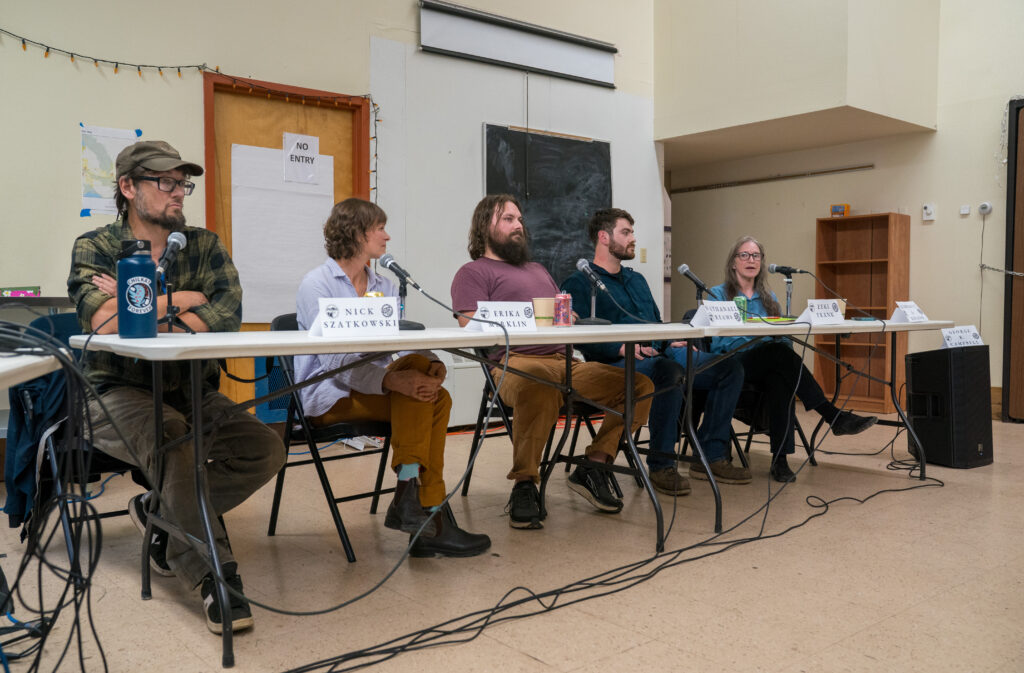
Haines voters will soon decide if Planning Commission seats should go back to being appointed by the mayor. The resident initiative asks voters to reverse what’s been in place for three years – voters electing commissioners.
Haines voters, in 2023, decided to change how seats were filled on the Planning Commission.
Tom Morphet, who is now mayor, was successful in putting an initiative on the ballot that changed planning commissioners from appointed members, to elected members. He said the move was, in part, a response to the commission’s controversial approval of a heliport. That decision was later overturned by the Assembly.
“There came strong public sentiment that the Planning Commission was no longer representing the views of the people that live here,” he said. “And also those appointed planning commissions tended to skew pretty heavily to developers. The people who served on them were equipment operators, developers, and real estate … Large property owners, people who had a stake in development. And that’s who tended to be appointed.”
Morphet argues that now, elected commissioners are more diverse, and more accountable. They don’t answer to just the mayor.
“Election gives you accountability,” he said. “If somebody’s on there doing things that run counter to the public good, the public can remove them.”
But Kim Rosado, who herself is running for Planning Commission this election season, feels differently. She collected enough signatures to get an initiative on the ballot that, if passed, would change the system back to the old way of appointing planning commissioners.
“I believe people with planning experience … that can read plans, whether property plans or building plans, are the experts in the field,” she said. “And that’s who should be on the Planning Commission, and that’s what we had before.”
Long-time Haines resident Roc Ahearns also supports appointing commissioners. He said electing commissioners has made the commission less friendly to growth and development.
Aherans said he would like planning commissioner to be appointed, “to try to at least proportion it out about how many are going to be pro industry or anti, or whatever. And get an even balance instead of letting it get so far out of hand like it has now.”
Seattle resident Amanda Warren has been dealing with the Planning Commission regarding her family’s allotment in Haines. She said there has been a big change since 2023, when appointments ended.
“When the mayor was appointing the Planning Commission, it seemed like it was better for the community, because they were able to appoint people who understood the laws, the codes, and kind of the process a little bit better,” Warren said.
Morphet rejects the idea that an elected commissioner is less qualified than an appointed one. Or that an elected commission is more political than an appointed commission.
“An elected Planning Commission is always going to be more critical, and I think more deliberative, than an appointed one,” he said. “But that’s their job to be critical and deliberative. Once they become kind of a rubber stamp, or an easy pass for somebody wanting a decision, all that work doesn’t make the decision easier. It just winds up in the lap of the full Assembly when those decisions are appealed.”
Rachel Saitzyk is in her second term on the Planning Commission. She supports electing commissioners, for many of the same reasons as Morphet.
“It is a crucial time to have thinkers and question askers, and people who are going to have community long-term planning in mind when they are making decisions … It is important to make sure that people are asking really thoughtful, and thorough, and educated questions to steer us in the right direction.”
Planning commissioners get compensated $50 per meeting. Saitzyk said it takes her about 10 hours a month to prepare for meetings.
General Elections will be held Oct. 6. Along with voting on the Planning Commission initiative, residents have six candidates to choose from to fill four Planning Commission seats.
The post Haines voters to decide if planning commissioners should be elected, or appointed by mayor appeared first on Chilkat Valley News.

Tuesday brought a fresh wave of concerning news out of the NFC, headlined by a significant setback for one of the league’s top young quarterbacks. Jaxson Dart is now facing a potential season-ending knee injury after initially appearing to have avoided serious damage, and Chicago backup Tyson Bagent has entered concussion protocol as Caleb Williams continues to work his way back from a hamstring injury. Elsewhere, the 49ers added some experienced depth at receiver, signing veteran Brandin Cooks to the practice squad. Here’s the latest from around the NFL on Tuesday. The outlook for Jaxson Dart took a turn for the worse Tuesday. The Giants quarterback’s knee injury, suffered in Monday night’s loss to the Rams, is more serious than initially believed and could keep him out for the rest of the season, according to multiple reports. The exact nature of the injury hasn’t been revealed, but Dart is expected to be sidelined for an extended stretch. Dart went down on New York’s opening drive after getting hit by a pair of defenders following an incomplete pass. He initially walked off under his own power and was evaluated in the medical tent before being ruled out, with the injury not appearing serious at the time. Jameis Winston took over on New York’s second drive and played the rest of the Giants’ 28-6 loss, and he’ll be expected to start any games Dart misses. The Giants host the Titans and Cardinals over the next two weeks before a stretch against the Commanders, Saints and Texans ahead of their Week 8 bye. Winston, for his part, went 0-2 as a starter for New York last season and 2-5 with Cleveland in 2024. Chicago’s quarterback situation grew more complicated Tuesday when backup Tyson Bagent entered the NFL’s concussion protocol, according to NFL Network. The news adds another layer of uncertainty for a Bears team already navigating the absence of starter Caleb Williams, who’s considered week-to-week with a hamstring injury suffered on a non-contact scramble during Sunday’s 9-3 loss to the Vikings. Bagent entered in relief of Williams and nearly led Chicago to a game-winning drive, going 5 of 9 for 54 yards before being sacked on the final play of the game — the same play that’s believed to have caused the head injury, though the exact timing remains unclear. With both quarterbacks potentially sidelined, third-string quarterback Case Keenum could be positioned to be Chicago’s starting QB against the Philadelphia Eagles in Week 3. Veteran wide receiver Brandin Cooks is signing with the 49ers’ practice squad, according to NFL Network, giving the injury-riddled receiver room a veteran option. Cooks, 32, joins San Francisco as wide receiver Demarcus Robinson is dealing with an ankle sprain from Week 2, and Mike Evans picked up a hip injury in the win over Miami. Both injuries add to an already thin 49ers receiver room that’s already missing Ricky Pearsall for the season and De’Zhaun Stribling for roughly two months following ankle surgery. The 2014 first-round pick has played for six teams across 12 NFL seasons, including stops with New Orleans, New England, the Rams, Houston, Dallas and Buffalo, and finished last season with the Bills after the Saints waived him in November. He brings career totals of 734 catches for 9,811 yards, 60 touchdowns and six 1,000-yard seasons to a 49ers offense that’s been hit hard by injuries at the position.Latest Sports News from FOX Sports

Welcome to the Quarterback Notebook, where I’ll cover the past week in NFL quarterbacking — from the most interesting passers, plays and storylines to some other stuff that caught my eye while watching film this week. This week, we’ll look at how Aaron Rodgers is holding the Steelers’ offense back, check in with Drew Lock, and ask Baker Mayfield to chill out. Let’s talk quarterbacks. The Steelers’ offense has been flat-out unwatchable to start the season. Even with the aid of a Cooper Rush turnover spree in Week 1, Pittsburgh ranks 31st in points per drive, expected points added (EPA) per play, and success rate. The offense is generating explosive plays at the fourth-lowest rate, and only the Packers have been worse on third down. Through two weeks, nothing is working, and Aaron Rodgers is pointing fingers at himself … kind of. “We need to be better, and it starts with me,” the Steelers quarterback said after Sunday’s three-point performance in a loss to New England. But just when you thought he was about to take some accountability, he kept talking: “It starts with me, at like, making sure Mike [McCarthy] knows what’s working and not working, so we can call stuff that has a better chance.” That’s right, Rodgers believes the solution to Pittsburgh’s offensive woes is more play-calling input from himself. In the second half of the Patriots game, we got a little preview of what the Steelers’ offense could look like with Rodgers running the show, and it looked a lot like the offenses we’ve seen him lead in Pittsburgh and New York over the past few years. Rodgers lined up in the gun and got rid of the ball as quickly as possible. The main aim of his preferred offensive approach seems to be reducing the hits he takes. Rodgers doesn’t want to hold the football any longer than he has to, and the explosive plays McCarthy is so keen on creating require it. And that’s the primary issue with the Steelers offense: Rodgers gets worse the longer he holds the ball. That’s what separates this version of Rodgers from the back-to-back MVP we saw in Green Bay at the start of the decade. On dropbacks that last more than 2.5 seconds, Rodgers is averaging just 5.6 yards per attempt through two weeks, per Next Gen Stats. That’s down from 6.8 in 2025, continuing a downward trend dating back to 2021. Rodgers wants to play a point-guard-like role but is no longer interested in creating. That, of course, would require him to hold onto the ball longer and expose himself to more hits. And maybe that’s for the best. Rodgers still has some talent left in his right arm. He’ll show it off a few times a week, but he can no longer hit tough throws with regularity, which was a hallmark of his game when he was playing at an MVP level. He has a sub-40 passer rating on throws with a completion probability under 50%, averaging just 2.9 yards per attempt, per Next Gen Stats. Back in 2021, Rodgers had a passer rating over 90 on such throws, averaging 7.9 yards per attempt. Once again, we’ve seen a steady decline in his production on those plays over the past few years. Rodgers seems to think he can make up for his waning physical abilities with his advanced football IQ by getting the Steelers into good plays based on what he’s seeing pre-snap. Rodgers likes to boast about his pre-snap acumen, but plenty of examples show him making poor decisions at the line. Take this play from Sunday’s loss. McCarthy has a toss play to the running back called, and the Steelers have the right blocking matchups to make it work. But Rodgers sees Pats cornerback Christian Gonzalez playing off-coverage on DK Metcalf and decides that flipping a quick pass out to him is the better option. It was not … Had Rodgers just stuck with the original play, the Steelers might’ve picked up a nice chunk that kept them ahead of the chains. Instead, they ended up in a second-and-long with a quarterback uninterested in pushing the ball downfield. You can probably guess how that series ended. I’m not sure if there are any remedies for what ails the offense, but leaning on Rodgers even more than they already have won’t fix anything. Like a Rodgers dropback, the sooner this era of Steelers football ends, the better. After three rough halves to start the season, the Broncos’ offense flipped a switch in their second-half comeback over the Jaguars. Whether it was first-year offensive coordinator Davis Webb or head coachSean Payton acting as a shadow play-caller, someone on Denver’s staff came up with the idea to get Bo Nix on the move, and it seemed to unlock something in the third-year passer. Nix connected on 4-of-5 passes made on the run and averaged over 11 yards per attempt in the second half, per Next Gen Stats. That doesn’t include this 49-yard dime to Jaylen Waddle, which led to Denver’s first points in the second quarter. Nix isn’t known for his downfield passing prowess, but when he gets outside of the pocket, that part of his game seems to open up. Nix has really struggled when throwing to the intermediate parts of the field, which is awfully important for sustaining an effective NFL passing game. He’s completed just 46% of his attempts into that range when throwing from the pocket, per Next Gen Stats. Put Nix on the move, though, and his completion percentage on intermediate throws jumps to 55%. He’s one of the rare quarterbacks who’s more accurate when throwing on the run. That’s more of an indictment of Nix’s ability to throw from a stationary position than anything else. His production when throwing on the run is around league average. It’s less of a superpower and more of a crutch — a crutch the Broncos coaching staff has leaned on heavily. Since he entered the league in 2024, Nix has thrown for more passing yards on the run than any quarterback in the NFL, per Next Gen Stats. I’m not sure Payton and Webb can squeeze any more juice out of Nix’s mobility than they already have. And calling designed rollouts can limit the passing game, as it usually cuts the field in half for the offense. Nix must improve his play from the pocket if this offense is going to take the next step and get the most out of a stacked supporting cast. The 26-year-old did offer some glimmers of hope against Jacksonville. This was a throw Nix has rarely made with confidence throughout his career. And there were a few other examples of Nix ripping a throw into a tight zone window with confidence and anticipation in Sunday’s game. That’s a good sign. As Nix gets more comfortable targeting the middle of the field, we should see even more of those flashes; but until he cleans up his footwork in the pocket, accuracy will be a limiting factor, and Denver’s coaching staff will have to find more creative ways to get him moving. The ink is barely dry on the three-year, $165 million extension Baker Mayfield signed with the Buccaneers right before the season, but I’m wondering if the last two weeks have the front office already looking for an off-ramp. General manager Jason Licht and head coach Todd Bowles said a lot of nice things about their quarterback throughout the somewhat contentious negotiations, but it wasn’t hard to read between the lines to figure out where their concerns lay. “The main thing is not turning the ball over and sometimes checking it down,” Bowles said in the offseason. “Understanding when he gets out of the pocket — he makes some great scrambles — but understanding how to get down and putting himself out of harm’s way.” We’re two games into Mayfield’s new contract, and not much has changed. He’s tied for the league lead in “turnover-worthy plays” (per Pro Football Focus), and we’ve already seen a handful of daring scrambles that make it look like Mayfield has been possessed by the spirit of Cam Skattebo. This play against the Bengals was a two-for, with Mayfield taking an unnecessary hit and coughing up the ball in the red zone. Hopefully, someone on the Bucs coaching staff talked with Mayfield after this play in the loss to the Browns, where he decided that taking a defender head-on was a better option than running out of bounds or throwing the ball away. Look, when Mayfield was on heavily discounted deals, those displays of toughness were admirable. Now that he’s making top-of-the-league money, they’re unacceptable. For better or worse, the Bucs are locked into the Baker Mayfield business for the next three seasons. In 2029, the team can get out of the deal without taking on a massive cap penalty. If his judgment doesn’t improve—whether it’s protecting himself or the football—that will feel like a long wait. I’ll give Drew Lock this: he’s a lot of fun to watch. Watch him whip a throw over the middle of the field, and you can see why the Broncos once viewed him as their quarterback of the future. If he can keep this up while Sam Darnold works his way back from a hip injury, another team may view him in the same light next offseason. My money’s on the Falcons. I’m still not a believer after Sunday’s impressive showing. Seattle’s offensive line kept him in clean pockets all day, and we still saw glimpses of the inaccuracy and shoddy footwork that sabotaged Lock’s stint in Denver. There are far better ways to spend $30 million. You have to watch this one from the end zone angle to fully appreciate the play Joe Burrow makes here. With pressure bearing down on him, Burrow throws a no-look pass that dekes the defender in coverage and opens up the window to hit Tee Higgins and move the chains on third down. The play requires pocket presence, accuracy, anticipation, and a little bit of creativity. Look, I’m not the biggest fan of Michael Penix Jr.’s game, but I am thankful that he’s returning for Week 3. I couldn’t do another week of Cooper Rush, who’s still making rookie mistakes in his 10th year. This pick was a high school-level blunder. Devin Lloyd barely moves on the play, and Rush throws it directly to him. To make matters worse, Rush badly whiffs on a tackle and nearly takes his teammate out in the process.Latest Sports News from FOX Sports