In court documents obtained by TMZ, Jax claims Brittany has repeatedly said cruel and humiliating things to him, including allegedly telling him that their young son doesn’t want him around.
Taylor claims that he has been sober for nearly two years and believes Brittany’s alleged comments are designed to push him toward a relapse.
TV personalities Jax Taylor and Brittany Cartwright attend the 2018 MTV Movie And TV Awards at Barker Hangar on June 16, 2018 in Santa Monica, California. (Photo by Christopher Polk/Getty Images for MTV)
Brittany has previously made serious allegations of her own against Jax and was granted a temporary restraining order against him in August.
She has accused her estranged husband of a longstanding pattern of emotional, psychological, and physical abuse.
Jax is now offering his own version of events.
In his filing, Jax claims Brittany “continues to say many insulting things and offensive things to humiliate, intimidate, and scare me,” adding that he believes she does so “as if she wants to shake me to my core and make me relapse.”
Jax also claims Brittany previously told him: “You’re never ever going to work again, nobody wants a disgusting abuser drug addict like you, you need to literally go away and never return.”
According to Jax, she continued by telling him to “Move away.”
And then came the claim that is arguably the most painful for any parent to hear.
“Your son doesn’t want you. We don’t need you in our lives,” Jax alleges Brittany told him.
He claims she added, “Everyone is on my side, nobody likes you. You have no friends. The producers have told me they will never work with you again, you’re finished.”
Jax insists he has relied on lessons from rehab to keep those alleged comments from derailing his sobriety.
“I love my son with all my heart,” he said in his filing, while also insisting that he has no interest in hurting Brittany.
Instead, Jax says he simply wants the conflict to end.
“I just want the truth to prevail and for her to stop abusing me and let me live my life in peace,” he stated.
Of course, “peace” appears to be in extremely short supply.
Jax and Brittany have each sought restraining orders against the other as their divorce and custody battle continues. Brittany’s temporary order currently requires Jax to stay away from her, her property, and their son’s school, ahead of a hearing scheduled for September 17.
So much for these two quietly going their separate ways.
After years of reality-TV drama, Jax and Brittany’s relationship has officially entered the phase where even their divorce filings are delivering more plot twists than an entire season of a Bravo reality show.
We will have further updates on this developing story as new information becomes available.
Alix Earle will always call her family for help.
More than a year after the influencer sparked rumors of a feud with Alex Cooper when her Hot Mess podcast was removed from the Call Her Daddy… E! Online (US) – Top Stories
Fall premiere season usually spreads across a few weeks, but this September is packing new and returning programming into two crowded weeks. Three series are … Read moreThe post Fall television premiere season just crammed a whole month of TV…
Stella Lefty’s ‘Boston’ almost became a dance track. The faster version was so bad that she’s hoping nobody ever hears it. Continue reading…Country Music News – Taste of Country
Stella Lefty’s ‘Boston’ almost became a dance track. The faster version was so bad that she’s hoping nobody ever hears it. Continue reading…The Boot – Country Music News, Music Videos and Songs
From Chrissy Teigen to Brett Young, many celebrities have become sober after turning 40, and science says that this can help many aspects of one’s health.
Health Digest – Health News, Wellness, Expert Insights
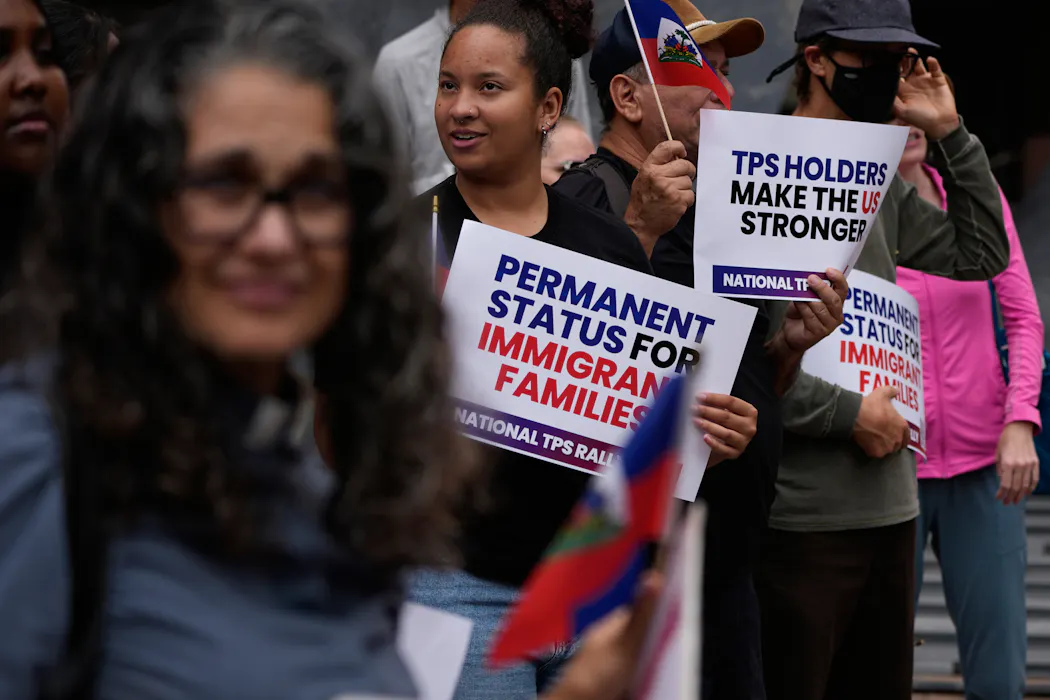
People hold Haitian flags and signs during a July 2026 rally in San Diego in support of immigrants living in the U.S. with Temporary Protected Status.AP Photo/Gregory Bull
At the beginning of President Donald Trump’s second term, 1.3 million individuals from 17 countries were living and working in the U.S. under Temporary Protected Status, or TPS.
TPS is a humanitarian form of protection from deportation for people who cannot return to their home countries because of an armed conflict, environmental disaster or other extraordinary circumstances.
In 2025, the Trump administration began terminating or not renewing TPS for those countries, making its way through 13 of them. As the administration turns its attention to the few remaining nations, most TPS holders have lost or will soon lose their protection from deportation and their authorization to work. Many will be separated from their families and the communities they have lived in for decades. Some will be forced to return to countries like Afghanistan, Haiti and Syria, all of which are on the U.S. State Department’s “Do Not Travel” list due to war, terrorism or other extreme violence.
As a law scholar who studies immigration detention, I can say that most people with TPS never had a path to anything more permanent, which means, as they face deportation, they have little recourse.
Challenges in court
In the fall of 2025, the Trump White House announced that it would not renew Syrian or Haitian TPS; Syria’s would expire in 60 days, Haiti’s in February 2026. Lower courts blocked both terminations, triggering appeals that took the cases to the Supreme Court.
In June 2026, in Mullin v. Doe, the Supreme Court ruled that federal courts cannot review most challenges to a TPS termination because, in the original 1990 law creating TPS, Congress barred judicial review of the decision to give a country TPS – or extend or end it.
James Percival, the general counsel of the Department of Homeland Security, celebrated the decision, saying “Temporary Protected Status was always supposed to be temporary and can be canceled at the appropriate time.”
But the ruling means no court can consider whether a cancellation is, in fact, “appropriate,” or whether it follows the law.
A local student holds a sign in support of Temporary Protected Status in Miami’s Little Haiti neighborhood in January 2026. AP Photo/Lynne Sladky
Unanswered questions
When Congress passed TPS as part of the Immigration Act of 1990, it was responding to a specific failure: the ad hoc and inconsistent use of something called Extended Voluntary Departure, which permitted a noncitizen to remain in the U.S. regardless of their immigration status.
That discretionary relief allowed some displaced Salvadorans to remain in the U.S. during their country’s civil war in the 1980s, but its application was arbitrary and often discriminatory. Because the U.S. backed the Salvadoran government, Salvadorans were denied both Extended Voluntary Departure and asylum more than 90% of the time – not for lack of merit but because of the government they were fleeing.
Congress recognized a humanitarian need for more uniform protection for people who, like Salvadorans, faced a return to violence or extreme danger but were not covered by narrow asylum laws that require proof of targeted persecution.
A new protected status would “standardize the procedure for granting temporary stays of deportation,” Representative Sander Levin explained at the time.
“Refugees, spawned by the sad and tragic forces of warfare, should not be subject to the vagaries of our domestic politics as well,” Levin added. When the 1990 Immigration Act passed, El Salvador was the first country designated for TPS.
Congress avoided placing time limits on these new TPS designations, leaving that to the discretion of the presidential administration, which would evaluate a country’s humanitarian needs at least every 18 months. Whether TPS holders should ever gain something more permanent was left for future congressional action.
No next step
Not every person from a TPS-designated country is eligible for it. Anything that disqualifies someone from asylum – national security concerns, persecuting others or criminal history – also disqualifies them from TPS.
Congress did not want to incentivize unlawful immigration. For that reason, it wrote the law in such a way that TPS itself could not lead to permanent residence. Lawful permanent residents are eligible to become citizens after five years. TPS recipients, though living in the U.S. lawfully, are not classified as lawful permanent residents.
Congress has since passed laws creating a pathway to permanent residence for certain nationalities, including some with TPS – the Nicaraguan Adjustment and Central American Relief Act, for example. It did not do so for most.
TPS designations for some countries have ended after a few years, like Rwanda and Guinea; others have been renewed for decades, like El Salvador, Honduras and Nicaragua. Over the years, TPS became a kind of limbo status, dependent on each presidential administration’s regular evaluation of a country’s humanitarian conditions – and on Congress to turn TPS into a pathway to lawful permanent residence. For most, the latter never happened.
A Salvadoran who has had Temporary Protected Status in the U.S. since 2001 walks along Boston’s Freedom Trail on his way to work in March 2026. AP Photo/Robert F. Bukaty
What happens when TPS ends?
Many people who lose TPS are not eligible for any other immigration status.
Lawful permanent residence, commonly known as a “green card,” is mainly available in three ways: through a close family relationship, like being married to a U.S. citizen or lawful permanent resident; through a job that requires special skills, like being a professional soccer player; or through asylum status.
Even if a person can apply for permanent residence, their immigration history, such as entering the U.S. without a visa or remaining in the U.S. without lawful status for a certain time, may be a permanent barrier.
TPS holders are given at least 60 days’ notice before termination takes effect, at which point they lose authorization to work and become undocumented, meaning they can be arrested by immigration officers at any time. There is little they can do in those 60 days that would allow them to lawfully remain in the U.S.
A TPS holder who has been continuously present in the U.S. for more than two years has a right to an immigration hearing before removal, where they may be able to apply for asylum or other relief. Others may hope to switch to a different status, but most TPS holders cannot obtain a student or employment visa. Some would have to apply from outside the U.S., some face years of quota backlogs, and some are from countries under a travel ban.
Past immigration violations or insufficient financial resources would also disqualify them. Most significantly, TPS holders are unlikely to convince an immigration officer that they intend to return home after their visa’s purpose is complete, as most visas require – especially someone from a country in distress due to violence or environmental disaster, the reason they have TPS in the first place.
Some 300,000 people from El Salvador, Sudan, Ukraine and Lebanon are set to lose status this year. Ukraine and Lebanon are in active war, so terminating TPS means deporting those people to war zones, which is what TPS was meant to prevent. Some TPS holders from El Salvador and Sudan have lived in the U.S. for more than 20 years.
Perhaps the 1990 Congress did not anticipate that individuals with TPS would make the U.S. their home for so long. Whatever it envisioned, it did not limit TPS to a fixed time. In my analysis, Percival’s assertion that TPS was always meant to be temporary is not, by itself, an “appropriate” reason to end protection.
As Justice Elena Kagan stated in her dissent to the recent Supreme Court ruling, even if TPS does not promise “never-ending humanitarian protection,” the end of it for certain individuals – like the plaintiffs in Mullin v. Doe – could deliver them to “devastating, and indeed life-threatening, injury.”
Jean Lantz Reisz is affiliated with the USC Gould School of Law Immigration Clinic.
When Wheel of Fortune suspended longtime announcer Jim Thornton, people wanted to know why.
There were unspecified allegations, but it didn’t seem like he’d gotten into any legal trouble.
Now, we know why he’s on suspension — with his role getting recast.
A disturbing chatroom appears to be at the center of this incident, and it got Thornton questioned by police.
Jim Thornton attends the Voice Arts Awards 12th Anniversary Gala on January 18, 2026. (Photo Credit: Robin L Marshall/Getty Images)
Why did ‘Wheel of Fortune’ suspend Jim Thornton?
Wheel of Fortune announcer Jim Thornton was on an American Airlines flight from Charlotte to Los Angeles.
During the flight, a passenger snooped on his laptop — even taking photographs of a disturbing chatroom.
The passenger spoke to TMZand even provided images of lines of text.
The vast majority of what we see are discussing poison oak, Golden Corral, the Mile High Club, and more.
But other lines make it appear that Thornton was, for whatever reason, in a chatroom for pedophiles.
One of the messages referred to spotting a “couple of cute boys and a hot little girl.”
While people of many ages might use “boys” and “girl” to refer to people their own ages, “little girl” almost always refers to a child, and no adult should be referring to her as “hot.”
Though the “all-you-can-eat Boyfett” pun might make sense while mentioning an unfortunate visit to Golden Corral, the previous context makes it uncomfortable at best.
(We should note that, from TMZ‘s photos, it appears that other members of the chatroom largely ignored the comments that apparently referred to children at the restaurant.)
A couple of times, amidst discussion of people who’ve gotten into legal trouble for having child sex-abuse material (CSAM) on their electronic devices out in public, members of the chat referred to “CP.” The passenger believed that this referred to “child porn,” an unfortunately casual reference to CSAM.
There is no evidence of any actual crime, but …
In addition to taking photos of the chat, the passenger notified a flight attendant and shared these photos.
The captain then notified authorities. When the plane landed at LAX, law enforcement questioned Jim Thornton.
However, barring any evidence that he had committed any actual crime, he was free to leave. Clearly, word got back to his workplace, and thus the suspension. (Wheel of Fortune is also scrubbing all mention of him, editing out his voice and even deleting old social media posts about his birthday.)
It is unclear if he actually participated in the chat. No part of the chat that appears in TMZ‘s photos contained any illegal material, and the chatroom itself appears to be a support group for adults experiencing pedophilic urges.
Thornton’s attorney told TMZ that her client was sent the link, which shares a very similar name and url to suicide prevention chats (apparently a passion project of the announcer’s), by mistake, and that he left the chat once he realized what it was. He was reportedly in the chat for less than one hour.
As we mentioned, there is no evidence that Thornton has done anything illegal — on the flight or at any other point.
Even if he was in that chatroom on purpose and for the same reason as others, that is also not a crime. Even some of the lines of the chat acknowledge that free speech allows people to communicate distressing or disgusting ideas without it being a violation of the law.
People having thoughts, fantasies, and personal struggles is not a crime — only when they create victims or perpetuate abuse, such as by sexually abusing a child or acquiring or sharing CSAM do they cross that legal boundary.
Though it is not a crime, this entire matter is deeply upsetting. And it is unclear whether Wheel of Fortune will permanently recast the role or allow him to return after conducting an internal investigation.
Even if he was only in the chat by accident, as his attorney has claimed, this is unfortunately a moment of bad publicity for the show. A lot of people struggle to separate predators from those who harbor abhorrent thoughts.
Our guess is that Wheel of Fortune will offer Thornton a generous severance so that they can part on good terms. It’s probably not fair, but it’s arguably the best outcome for everyone involved.











 Alix Earle will always call her family for help.