NOTN- The Juneau Assembly has indefinitely tabled a proposal that would have required nonprofits to collect sales tax on purchases, after a marathon debate that Mayor Beth Weldon described as increasingly confusing for the public.
Speaking on Monday night’s meeting, Weldon said the measure drew intense public interest, but efforts to carve out protections for smaller nonprofits only muddied the policy.
“We were just creating confusion. Just for instance, what’s intermediate fundraising? How do the raffle tickets fit in there? 14 days isn’t long enough for a raffle ticket period, and so at the end, especially after talking with the finance, Ms. Woll proposed an amendment to table it indefinitely. And what that means is, unless we bring it up at our next meeting, it dies at this time.” Weldon said.
At the meeting, 17 nonprofit leaders testified against the measure, raising concerns about fairness, added financial burdens and more confusion over how the ordinance would work.
“What I have a hard time understanding is the policy rationale for carving out certain types of non-profits as ineligible for the sales tax exemption, though we have an important charitable mission, it sends a message that it’s not important enough. Crafting tax law is tricky. Our Internal Revenue Code is 3000 pages. The regs are another 70,000. I get it. I understand interpretations have to be made and lines drawn, and I also understand-I truly do-the desire to protect basic human services, food, and shelter to those who need it most. But I question whether the city should be in a position of determining where to draw that line and what services and missions are important.” Said Bridget Lujan, Executive Director of Juneau Dance Theater.
The proposal was projected to raise closer to $1–2 million in new revenue, down from earlier estimates of $3 million, according to Weldon. She said the financial benefit no longer justified the level of community angst.
The Assembly also approved funding for Hesco barriers and other work related to glacial outburst flood mitigation.
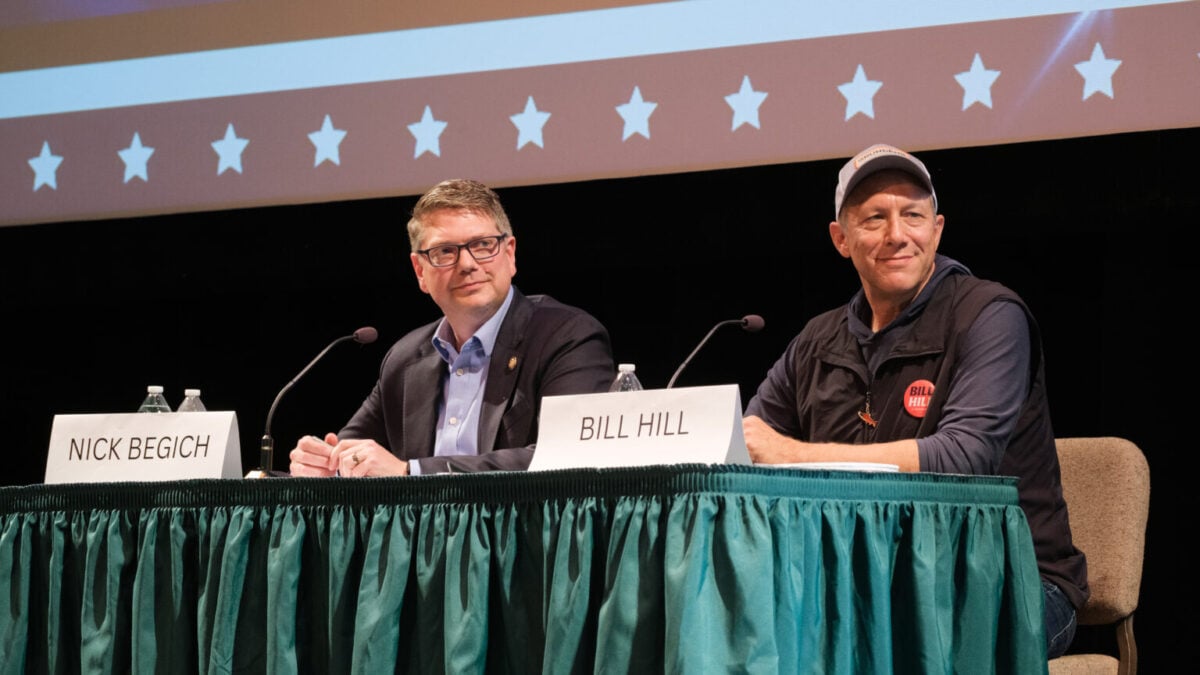
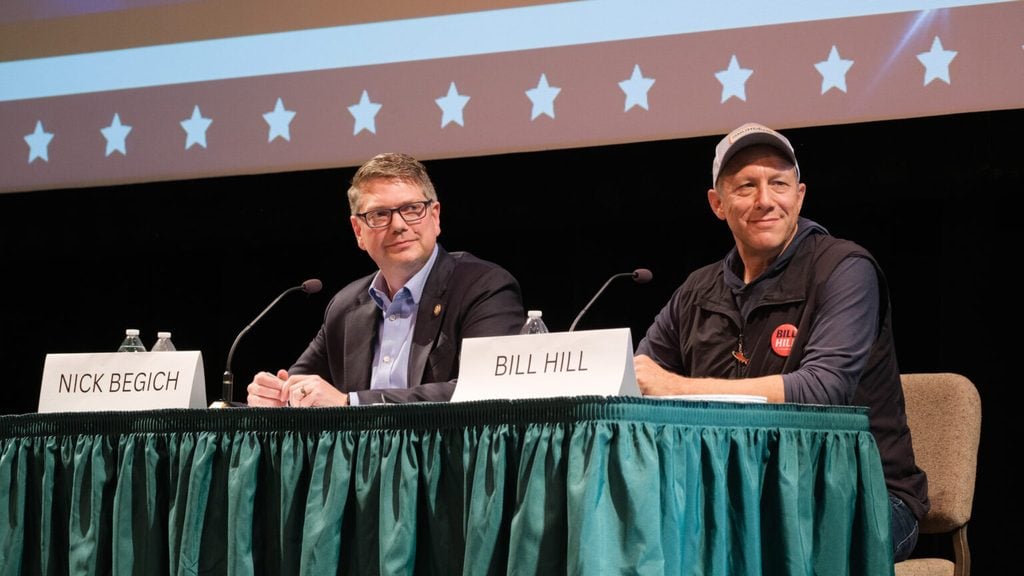
Alaska candidates for the U.S. House race incumbent Republican Nick Begich III (left) and independent challenger Bill Hill (right) squared off at a fisheries debate in Kodiak on Sep. 12, 2026. (Photo by Brian Venua/Alaska Beacon)
Front-runner candidates for Alaska’s sole U.S. House of Representatives seat expressed strong support for the fishing industry and coastal communities at a debate in Kodiak over the weekend.
Incumbent Republican U.S. Rep. Nick Begich III and independent challenger Bill Hill took very similar positions on issues including fisheries bycatch, declining fish stocks and representation in federal fisheries management, but there were some differences.
Begich touted his legislative record in his first two-year term as beneficial to Alaska fisheries, while Hill said his personal history as a lifelong fisherman in Bristol Bay is advantageous for representing Alaska in Congress.
Begich, a technology entrepreneur and business executive, garnered 44.6% of the vote in the primary election, while Hill, a former school superintendent and commercial fisherman, received 32.5% of the vote. Third and fourth place finishers in Alaska’s ranked choice general election include Eric Hafner — a registered Democrat serving a federal prison sentence in New York – with 3.8% of the vote, and Libertarian Jim McDermott of Fairbanks with 1.2%.
The winner of the November election will serve a two-year term as one of the 435 members of the U.S. House of Representatives.
Begich promoted his legislative record as a freshman in the Republican-controlled U.S. House. This spring, six bills he sponsored passed Congress to become law — a tie with another Arizona lawmaker for most bills passed as a freshman — but none of those bills directly address fisheries issues.
“I have passed more legislation than any freshman on record,” Begich said. “And those are good Alaska bills — they are bills that unlock lands for Alaskans, and they are bills that, in many cases, we’ve been working to achieve for decades.”
Hill repeatedly referenced his experience growing up subsistence and commercial fishing in Bristol Bay. “I raised three of my kids on my fishing boat, and understand the importance that state, national and international politics play in what happens on our back decks with our children, what happens in the income that we can take home, what taxation does to us, what tariffs do to us,” he said. “I’ve lived a life of fish.”
Bycatch
Several debate questions focused on bycatch, the accidental harvest of nontargeted fish. Bycatch has raised public concern around Alaska’s industrial trawl fleet, which has many vessels harbored in Kodiak, where the debate took place.
Both candidates said they support broader representation on the North Pacific Fishery Management Council, which oversees fishing policy in federal waters, including bycatch regulations.
Begich said he supports increasing representation for subsistence, sport fishers and small commercial operators, as well as large operators, in council decisions. He pointed to a bill he introduced, the Bycatch Reduction Act, which would require the council to implement gear performance standards to reduce bycatch, to make investments in fishing gear and fisheries research and to increase monitoring and reporting from the industry and the council, among others.
“We need transparency — more transparency for folks who may have conflicts of interest that currently serve on the NPFMC,” Begich said. He also expressed support for a chum bycatch limit established by the council this year for the Bering Sea pollock fishery.
Hill said he supports bycatch limits to protect salmon runs, and additional seats representing subsistence and tribal groups.
“Subsistence is sacred, and the very first thing that needs to happen, and I think you hear it from across the state — this is why there’s such a loud outcry — is because some of our subsistence users have not been able to access their resource, which is more than just protein, for quite a few years now,” he said.
In a question about Congress’ role in reducing bycatch, debate moderators noted all fisheries produce some bycatch harvest and said “a goal of zero bycatch isn’t reasonable.”
But both candidates pushed back on that framing and said that zero bycatch should be the ultimate goal.
The industrial trawl fleet, particularly boats that target pollock, has been the focus of public criticism because it contributes substantially to the state’s bycatch numbers for species including juvenile halibut, cod and salmon returning to spawning grounds throughout Alaska.
Begich said he agreed that every fishery produces some level of bycatch and it’s up to the council to manage each complex fishery. But he said the goal should be “aggressive.”
“I do think the goal should be zero. It’s going to be a long road to get there. But we also have to recognize that in every single fishery, whether it be subsistence, sport, small commercial or large commercial, they have a bycatch responsibility as well,” Begich said.
Hill said the goal should be zero bycatch. “We need to work towards that. We need to work towards a very low-threshold for our trawling industry, especially the out-of-state corporate trawlers,” he said.
And Hill expressed confidence that the trawl industry would be able to meet required limits.
“My perspective is when you set something out for industry to accomplish, they always find a way, and we’ve seen over and over again that our trawl fleet has met the standards that are being set for them. So, can we get to 0%? That would be everybody’s desire, but should we be working towards it? Yes, we should be,” Hill said. “But those who are bad actors, you’ve got to leave the fishery.”
When asked about the primary causes of king and chum salmon run declines, Begich responded it was “largely bycatch related.”
“You look at the Yukon, you look at the Kuskokwim — those runs are way down. We’re seeing some recovery in chums. I think that the cap that we put in with NPFMC is sort of that initial shot saying, ‘Hey, we’re going to be managing these more carefully,’” Begich said. “But I think that historical bycatch is the root cause.”
Hill said he agreed, and added that climate change driven factors are affecting Alaska’s salmon runs. “Climate change is a real thing, and we need to start mitigating for that,” he said. “But yes, we need to end bycatch.”
Processing and protecting Alaska’s fisheries
Both candidates said they would support investments in building the workforce in fishing and processing sectors, as well as more visas for hiring international workers in processing.
In a lightning round of questions, the candidates agreed on every issue. They supported science-based fisheries management, more investment in research and engaging with a wide range of fisheries interest groups prior to introducing new legislation or policies. They also agreed that rural and tribal communities should have more say in decisions affecting fish.
When asked how they would ensure the economic value of federally-managed fisheries would not come at the expense of Alaska communities, Begich said he supports labeling rules for farmed vs. wild-caught fish.
“Alaska seafood is competing with penned fish and farmed fish, and the end consumer doesn’t know it,” Begich said. “And so, when you’re buying an Alaska seafood product, we need to make sure that it’s labeled Alaska. That’s transparent because it gives us the best price for our product and it reduces some of the pressure on our fisheries.”
Hill said he would support more investment in in-state seafood processing to diversify processors to which fishing fleets can sell their harvests. “More processing in our state that’s not a consolidated, vertically integrated type of processing,” he said. “And we need to make sure that we’re legislating to make sure that farmed fishing does not come to our seas and that we keep them off for as long as we possibly can.”
Geopolitics
Both candidates expressed support for tariffs on international seafood to protect Alaska markets.
Hill also condemned the U.S. war in Iran for driving high costs of fuel and affecting fisheries.
“The Iran war is a terrible, terrible thing in terms of how it’s impacted our industry,” he said. “The fuel costs I paid this summer were $2 per gallon more than last year, and they were already high. And then we start talking about things like food and groceries, and the things that allow our crews to do good work for us while we’re fishing hard.”
Begich has expressed support for the Trump administration’s military action against Iran, and voted against a war powers resolution that passed Congress in June calling on President Donald Trump to remove armed forces against Iran, unless authorized by Congress or a declaration of war.
Should the townspeople of Widow’s Bay ever make it off the cursed island, they have the Pittsburgh Trauma Medical Center team standing by to help.
After all, The Pitt’s Patrick Ball revealed his… E! Online (US) – Top Stories
Savannah Guthrie is ready to give her own award to Allison Janney.
Indeed, the Today host expressed her gratitude to the Diplomat star for spotlighting Nancy Guthrie’s kidnapping again after she… E! Online (US) – Top Stories
Walking the red carpet at the 2026 Emmys, The Pitt’s Patrick Ball couldn’t help but wonder how he’d reached this full circle moment.
Because before the 36-year-old was nominated for Outstanding… E! Online (US) – Top Stories
Riz Ahmed has already won an Emmy, but he revealed he’s also part of an even more exclusive list: Tom Cruise’s coconut cake list.
Indeed, the Bait actor revealed that he was added to the circle… E! Online (US) – Top Stories
Brooks Nader’s love life may require some mouth-to-mouth resuscitation.
The Baywatch star revealed at the 2026 Emmys that while she may be stepping into a sexy onscreen role as bombshell… E! Online (US) – Top Stories
A polar bear walks onshore in Alaska on Sept. 6, 2019. This year’s Arctic Report Card, to be issued under new management after the Trump administration pulled federal support, is set to include a chapter updating the status of polar bear populations. (Photo provided by the U.S. Fish and Wildlife Service)
The Arctic Report Card, the annual peer-reviewed analysis of climate in the circumpolar region, will continue even without federal government support, scientists announced.
The American Geophysical Union, an organization representing tens of thousands of Earth and space scientists, announced last week that it has taken over as manager of the Arctic Report Card after the Trump administration pulled support last month.
The National Oceanic and Atmospheric Administration was, until this summer, the agency that coordinated and published the annual report since the inaugural edition in 2006.
But the Trump administration has slashed funding for climate science work at NOAA and other federal agencies, and Trump himself has repeatedly referred to climate change as a “hoax.”
The annual Arctic Report Card is now one of several NOAA climate-related programs which the Trump administration has eliminated or reduced.
The report provides status updates for permafrost thaw, sea ice extent, air temperatures, wildlife patterns, tundra vegetation and other subjects. It places a heavy emphasis on Alaska. Researchers from UAF and other Alaska universities are prominent among the chapter authors, and in recent years the report has included analysis from Indigenous Alaska scientists and community members.
Under AGU oversight, the Arctic Report Card’s editorial team remains intact, with continued leadership by researchers from the University of Alaska Fairbanks and the University of Colorado. Rick Thoman of UAF’s Alaska Center for Climate Change Preparedness remains one of the three main editors. The other two are from the University of Colorado’s Cooperative Institute for Research in Environmental Science, which includes the National Snow and Ice Data Center.
In a statement, one of the Colorado-based lead editors said the Arctic Report Card’s survival was a victory against censorship of climate science.
“Beyond the importance of sharing this key science, the fact that we can pull together and ensure the Arctic Report Card goes forward is a sign that science won’t be stopped or silenced,” Matthew Druckenmiller, a senior NSIDC scientist, said in the statement. “When we come together, we have a powerful platform for robust observational evidence to inform global decisions – we are counting on that same spirit of support to help us close the remaining funding gap and secure the report card’s future.”
This year and beyond
The AGU will issue the 2026 Arctic Report Card at its annual conference in December, the same event at which NOAA issued past report cards.
Thoman noted that much of the work was already completed before NOAA announced its withdrawal from the project, so changes might not be obvious.
“I suspect 2026 will have a look and feel very similar to what we’ve done in the past,” he said.
This year’s report will include, along with the usual updates on ice, air temperature, ocean and tundra conditions, some special chapters of interest to Alaska, Thoman said.
One chapter will examine Indigenous wildfire management practices, and another chapter will examine wildfire patterns more broadly, he said. There will be a polar bear update, he said. And a chapter led by UAF geophysicist Andy Mahoney will examine changes in shorefast ice, the land-attached type of ice that is important to Arctic coastal communities.
Beyond this year, the shape of future Arctic Report Cards “is really not thought out,” Thoman said.
Some operation changes are already underway.
The editors and authors are no longer using archived data, images or other information from climate.gov, a NOAA climate information website that the Trump administration took down last year. Instead, they are using an alternative nonprofit site called climate.us.
That site was established and is maintained in part by some of the same NOAA scientists and staffers who had worked on climate.gov but lost their agency jobs. “They know what they’re doing,” Thoman said.
The editors will be turning to an international source, the Arctic Monitoring and Assessment Programme of the eight-nation Arctic Council, for assistance with peer reviews. There might be similar outreach on other tasks, Thoman said. “There could be more robust international collaboration,” he said.
Trump administration policies on climate change
The end to NOAA support for the Arctic Report Card comes amid similar cuts.
Last year, for example, NOAA pulled its support for the National Snow and Ice Data Center’s satellite-based sea ice tracing program. The Colorado-based center switched to more reliance on satellite data from the Japan Aerospace Exploration Agency, that nation’s counterpart to NASA.
Trump administration officials have expressed particular animus toward NOAA.
The Heritage Foundation’s Project 2025, a blueprint for a second Trump administration, recommended breaking up NOAA. The agency’s six science-focused divisions, which include the National Marine Fisheries Service and the National Weather Service, “form a colossal operation that has become one of the main drivers of the climate change alarm industry and, as such, is harmful to future U.S. prosperity,” Project 2025 said.
Russell Vought, the lead author of Project 2025, now heads Trump’s Office of Management and Budget. He is seeking to dismantle the 66-year-old National Center for Atmospheric Research, a university-managed institution in Colorado that partners with NOAA. That effort has been blocked by legal challenges.













 Should the townspeople of Widow’s Bay ever make it off the cursed island, they have the Pittsburgh Trauma Medical Center team standing by to help.
 Savannah Guthrie is ready to give her own award to Allison Janney.
 Walking the red carpet at the 2026 Emmys, The Pitt’s Patrick Ball couldn’t help but wonder how he’d reached this full circle moment.
 Riz Ahmed has already won an Emmy, but he revealed he’s also part of an even more exclusive list: Tom Cruise’s coconut cake list.
 Brooks Nader’s love life may require some mouth-to-mouth resuscitation.