 Matthew McConaughey turned his latest movie screening into a family night.
The Rivals of Amziah King star was supported by wife Camila Alves as well as their three kids Levi, 18, Vida, 16 and…
E! Online (US) – Top Stories









Matthew McConaughey turned his latest movie screening into a family night.
The Rivals of Amziah King star was supported by wife Camila Alves as well as their three kids Levi, 18, Vida, 16 and…
E! Online (US) – Top Stories
The Scottish Highlands welcomed nearly 1.8 million overnight visitors in 2024, as people are drawn to the rugged mountains, ancient castles and island landscapes. Many … Read moreThe post The best way to explore Scotland’s Highlands and islands is without…
If you think you’ve missed your chance to book a European family vacation this summer—think again. From the United Kingdom and Greece to Portugal, France and beyond, Europe is still within reach, even for families who haven’t finalized their travel…
Reading Time: 3 minutes
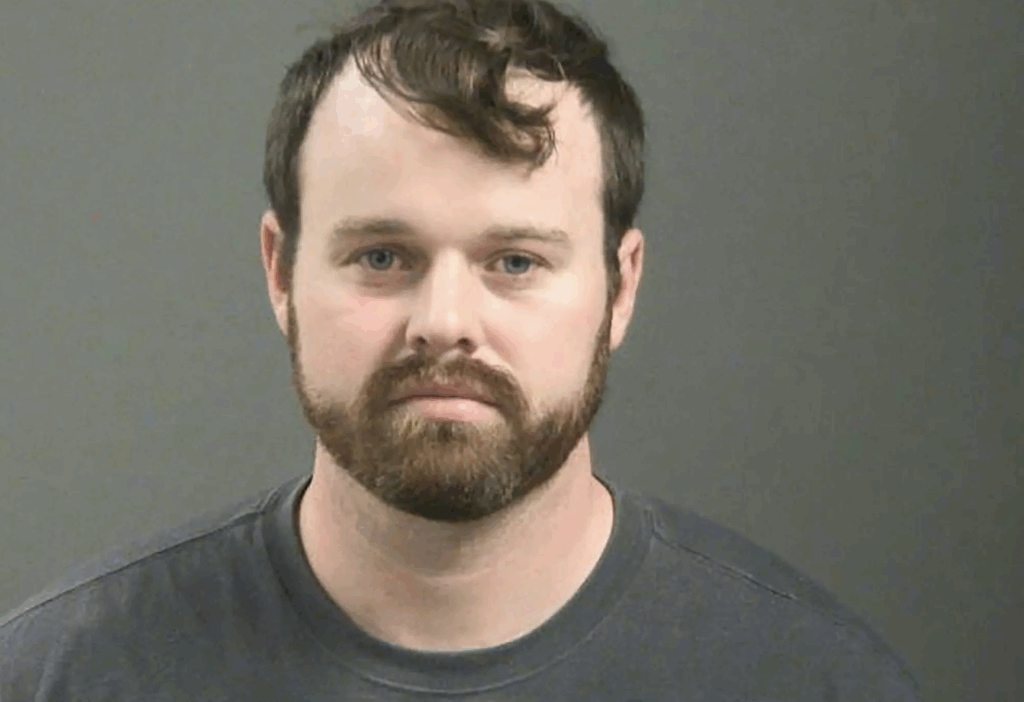
Joseph Duggar and Kendra Caldwell just changed things up with their child endangerment court case.
(It is an understatement to say that this court case is not Joseph’s biggest legal issue at present, as he is accused of sexually abusing a 9-year-old girl.)
Just hours before their scheduled court date, they withdrew their respective not guilty pleas.
What does this mean?
People reports that Joseph and Kendra withdrew their pleas of not guilty on Monday, August 10.
Instead, they submitted a “plea by order” to the court and were able to avoid the hearing.
Presumably, this means that Joseph and Kendra plan to either plead guilty or to plead no contest to the charges.
The judge will need to review the case and the couple’s updated response to the charges, and then determine what penalty they may face.
For Joseph and Kendra, that could mean up to eight years in prison. Though perhaps they hope to get off with a lesser sentence, such as a fine, by throwing themselves upon the mercy of the court.

The pleas are for the Arkansas case involving four counts of second-degree endangering the welfare of a minor and four counts of false imprisonment.
Kendra’s arrest followed Joseph’s ostensibly unrelated arrest for allegedly molesting a 9-year-old.
Authorities performed an automatic search of their home, and whatever they discovered there was enough for eight charges against both parents.
A source close to the Duggars claimed that this was due to the locks on the children’s doors, which allowed them to be sealed in their rooms like prisoners.
However, the obviously biased source is not reliable. No one has been able to confirm what authorities may have actually found inside the home of the cult members.
The Northwest Arkansas Democrat-Gazette shared a legal detail about Joseph and Kendra’s plea by order.
Apparently, this change means that their case can be diverted by up to a full year.
The local newspaper spoke to the court, who confirmed that cases against Joe and Kendra will remain open.
As a reminder, Kendra gained permission to see her four children despite the charges against her.
However, the court very sensibly denied Joseph’s request for unsupervised visits.

Remember, though Joseph Duggar and Kendra Caldwell are facing the same charges in Arkansas, he alone is also facing charges in Florida.
In 2020, he allegedly molested a 9-year-old girl. We do not know her identity (nor should we), only that she is not one of his own children and does not appear to be a Duggar.
Her father recently learned of it and confronted Joseph, leading to his reported confession. He actually confessed twice, the second time being to a detective, according to an affidavit.
In light of these reported confessions, his legal strategy remains murky, as he pleaded not guilty in the Florida case, too.
It would be nice if his upcoming plea with Kendra is a harbinger of things to come with his other case. Right now, there are fears that the victim — who is in her early teens — might have to testify in court.
If Joseph’s legal strategy is to convince prosecutors to offer him a more generous deal to avoid putting her through that … well, that’s an awful thought.
Joseph Duggar & Kendra Caldwell Abruptly Withdraw ‘Not Guilty’ Pleas in … was originally published on The Hollywood Gossip.
The Hollywood Gossip

Reading Time: 3 minutes
We have tragic news to report from the world of social media.
Chandler David Hendry, a popular Mormon YouTuber and podcaster, has died at the age of 27.
Hendry was killed in a three-vehicle crash in Lehi, Utah, on Friday, August 7, according to police.
The tragic accident occurred at approximately 8:25 am.
According to a Lehi police spokesperson, witnesses reported that Hendry ran a red light and collided with two other vehicles.
The occupants of those vehicles were not seriously injured.
Hendry was not wearing a seat belt at the time of the crash. He was transported to a local hospital, where he was pronounced dead.
The investigation into the circumstances surrounding the crash remains ongoing.
Hendry’s death was particularly heartbreaking for those who followed his religious content because of what he had shared online just hours earlier.
A member of The Church of Jesus Christ of Latter-day Saints, Hendry founded the Restored Truth podcast and built a significant following by discussing his faith, scripture, and Christian history.
He had more than 70,000 followers across his social media presence, according to the New York Post.
Earlier on the day of the crash, Hendry had attended the FAIR Conference in Lehi.
His final Instagram video was a reflection on something presented at that event: an illustration depicting the afterlife and the eternal connection between families.
“That is what the eternities will look like,” Hendry said in the video. “A link of the family unit of God.”
The post has taken on an especially poignant meaning following his unexpected death.
Hendry, who was affectionately known as “Chuck,” was also preparing to help young members of his church who were getting ready to serve missions.
An event he had organized went ahead following his death and became an impromptu memorial, with family members and friends sharing memories of the young religious creator.
His father, Chad, recalled that his son had not always been comfortable with public speaking. When Hendry was asked to speak as a high school senior, his father said, he initially refused.
That changed after Hendry’s first mission in Jackson, Mississippi.
“You will speak in the name of Christ and teach the gospel of Jesus Christ,” Hendry was told, according to his father.
Tributes have poured in from people who knew Hendry personally as well as those who followed his work online.
His sister, Chaleigh Rowley, remembered her brother as someone who had been present for important moments throughout her life.
“Thank you for loving me through all these phases of life we both endured,” she said. “Thank you for being at all my important milestones.” She added that his “light here on this earth will be missed.”
His wife, AnaLynn, also paid tribute to Hendry following his death.
“He was the best person that I knew,” she said. “I felt God’s love for me through him every single day.”
Hendry died just weeks before his second wedding anniversary.
A candlelight vigil was held in his memory on Monday, August 10, as loved ones and followers continued to mourn his sudden death.
Our condolences go out to all of Chandler David Hendry’s loved ones during this enormously difficult time.
Chandler David Hendry Cause of Death: Popular Mormon Influencer Was 27 was originally published on The Hollywood Gossip.
The Hollywood Gossip
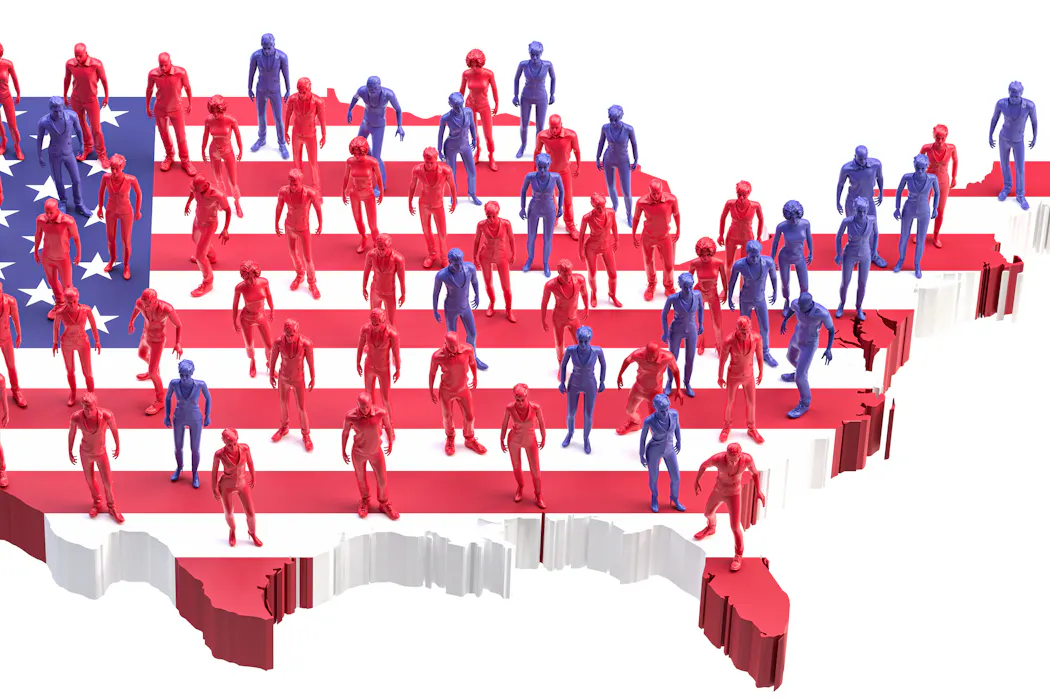
Beyond picking governors, state legislators, local officials and representatives to serve in Congress, voters in almost every state this year will have the opportunity to amend the language of their state constitution. In one state, they could potentially rewrite the constitution altogether.
Though the U.S. Constitution is rarely amended, voters frequently amend their state constitutions. In every election cycle, voters are asked to ratify constitutional amendments.
In recent years, around 100 amendments have been voted on in each cycle. Most of them are proposed by state legislatures, but some are proposed through the voter initiative process.
This year, however, voters in Michigan will decide whether to convene a state constitutional convention in 2027. At a constitutional convention, elected delegates consider editing or rewriting the state’s constitution, with virtually no limits on what they can do. Michigan’s constitution requires that voters be asked every 16 years whether to hold a convention, and the last three times the question appeared on the ballot, voters rejected the idea in landslides.
If Michigan voters do want to call a convention, an election for 148 delegates would be held in 2027, and the elected delegates would meet to discuss whether to completely overhaul the constitution or propose small changes, though they might not come to an agreement at all.
State constitutions play an increasingly important role in American politics, though voters may not know much about them.

Every state has a constitution, and each constitution has an individual bill of rights that provides parallel – and sometimes greater – protections for the liberties guaranteed in the U.S. Constitution’s Bill of Rights. The federal Bill of Rights sets a minimum for the rights and liberties that states must recognize, but state constitutions can increase the protections – or provide different ones.
Following the U.S. Supreme Court’s decision in Dobbs v. Jackson Women’s Health Center, which overturned Roe v. Wade and held that the U.S. Constitution does not protect a right to abortion, abortion rights advocates have turned to state constitutions to recognize reproductive rights.
Attorneys and advocates have fought state abortion restrictions, asserting that state constitutions implicitly guarantee the right to an abortion. They have had mixed success with that tack, and better luck proposing amendments to state constitutions to expressly recognize rights to abortion. Conservative efforts to add abortion restrictions or bans to state constitutions have seen more limited success.
As a scholar of state constitutions, I know that turning to such constitutions to recognize rights and liberties is not a new project. It is not an exclusively liberal or conservative one.
After Richard Nixon was elected president in 1968, he appointed Warren Burger as chief justice of the U.S. Supreme Court, succeeding Earl Warren. Under Warren’s leadership, the court had strengthened the protections in the Bill of Rights, required states to fully recognize them and ushered in many of the rights and liberties we know today.
Among them: Miranda warnings – the standard warnings that police are required to give suspects of crimes before interrogations, as well as the requirement that indigent defendants be provided counsel in criminal trials and the rule that unconstitutionally obtained evidence cannot be used against defendants, came from the Warren Court.
Burger’s appointment, therefore, was concerning to criminal defense attorneys and civil rights activists, who feared that the Warren Court’s landmark decisions would be weakened or overturned.
So they turned to state courts and state constitutions.
A group of scholars, advocates and judges began arguing that lawyers and courts needed to take state constitutional rights seriously. They started developing legal arguments that relied on state constitutional rights, which saw some early successes.
Though these efforts began with attempts to ensure rights for criminal defendants, they were not limited to that context.
In 1973, the Supreme Court held that the Constitution contained no right to education and that a funding disparity among school districts in Texas was not unconstitutional.
In response, advocates went to state courts. Relying on explicit provisions in state constitutions that require the legislature to provide students with an adequate education, they argued that funding disparities violated state constitutions.

Many courts agreed. Over the past 50 years, education financing lawsuits, aimed at eliminating inequalities in education funding, have made their way through state courts, with some important and high-profile successes.
Advocates have also brought cases that used state constitutions to recognize LGBTQ+ rights, sometimes well before the Supreme Court did the same.
In the 1980s, the high court refused to strike down a Georgia law that criminalized sexual relations between people of the same gender. Marriage equality was a long way off, too. In several states, LGBTQ+ rights activists successfully argued that their state constitutions protected rights to privacy that made similar laws unconstitutional, a position that the Supreme Court would later adopt.
And by the time the Supreme Court recognized a right to marriage equality in Obergefell v. Hodges in 2015, a growing number of states had come to the same conclusion under their own constitutions.
But the rights and liberties protected by state constitutions haven’t just evolved in a liberal direction.
During the movement for marriage equality, voters in many states ratified constitutional amendments defining marriage as between one man and one woman. Likewise, a handful of state constitutions expressly preclude courts from recognizing a right to abortion.
The National Rifle Association has successfully pushed for stronger rights to bear arms under state constitutions. Also, in many states, victims’ rights amendments guarantee to victims of crimes the opportunity to participate in criminal trials, and frequently constrain defendants’ rights.
As political polarization increases, and as the Supreme Court removes itself from many rights disputes, state constitutions will likely be more important than ever in rights adjudication. Voters, who can and do amend those constitutions, can play an important role in how that plays out.

Quinn Yeargain does not work for, consult, own shares in or receive funding from any company or organization that would benefit from this article, and has disclosed no relevant affiliations beyond their academic appointment.
Politics + Society – The Conversation
In this episode, Bob and Adam chat about managing digital workflows, tackling challenges like email overload, CRM usage, and the benefits and downsides of AI tools.

The migrant detention center known as Alligator Alcatraz is closed, but much about it remains unresolved. There are lawsuits over detainees’ treatment, environmental claims over damage to protected wetlands and uncertainty about the future of the airstrip it was built on.
One aspect of the South Florida facility has drawn far less attention, though: the name itself, and the long history of associating alligators with racist ideas about people of color.
I’m a historian of wildlife, the environment and American culture who has studied the cultural and environmental history of the American alligator. My research shows that the species has carried a variety of meanings in the United States, ranging from a prized source of leather for luxury fashion to an emblem of Florida identity. Less well known is the reptile’s role in the nation’s history of racial stereotyping. For generations, alligators featured prominently in imagery intended to demean Black Americans.
Whatever the intentions of those who named and promoted the facility, Alligator Alcatraz echoed a long tradition of using alligators in ways that have reinforced racist imagery and dehumanizing stereotypes.

Located on a remote landing strip surrounded by Big Cypress National Preserve, about 6 miles north of Everglades National Park, Alligator Alcatraz sparked controversy from the beginning. Critics argued that the detention center housed immigrants in unsafe and inhumane conditions, limited access for lawyers and family members, and imperiled sensitive, federally protected wetlands. Seminole and Miccosukee people denounced it as a threat to their sacred homelands. Some detractors even characterized it as a concentration camp.
In a lengthy exposé for The Atlantic, journalist Eric Schlosser decried the facility as “a uniquely cruel publicity stunt with an absurdly high price tag.” Based on figures from court filings and Florida’s grant application to the Federal Emergency Management Agency, Schlosser estimated that it cost about US$500,000 a year to hold a single immigrant at Alligator Alcatraz. By contrast, Florida spends only $30,000 a year to confine someone in a state prison.
The contentious center was the brainchild of Florida Attorney General James Uthmeier, who pitched the idea to federal officials in June 2025.
Uthmeier’s catchy name was meant to grab attention, particularly from President Donald Trump, who had recently proposed reopening the notorious, long-shuttered Alcatraz federal penitentiary in San Francisco Bay. During his first term, Trump had also reportedly floated the idea of constructing a moat filled with “snakes or alligators” to fortify his southern border wall. Keenly attuned to the power of provocative branding, Trump embraced Uthmeier’s proposal.
Once given the green light, the administration of Gov. Ron DeSantis hastily built a makeshift detention center designed to hold several thousand migrants. After touring the facility shortly before the first detainees arrived, Trump declared, “We’re surrounded by miles of treacherous swampland, and the only way out is, really, deportation.”
He added, “You have a lot of bodyguards and a lot of cops that are in the form of alligators.”
Ahead of Trump’s visit, the Department of Homeland Security posted an AI-generated image of menacing alligators wearing Immigration and Customs Enforcement hats as they stood guard outside the detention center. To cash in on the idea, the Florida Republican Party also began peddling Alligator Alcatraz–themed merchandise, like T-shirts, hats and beer koozies.
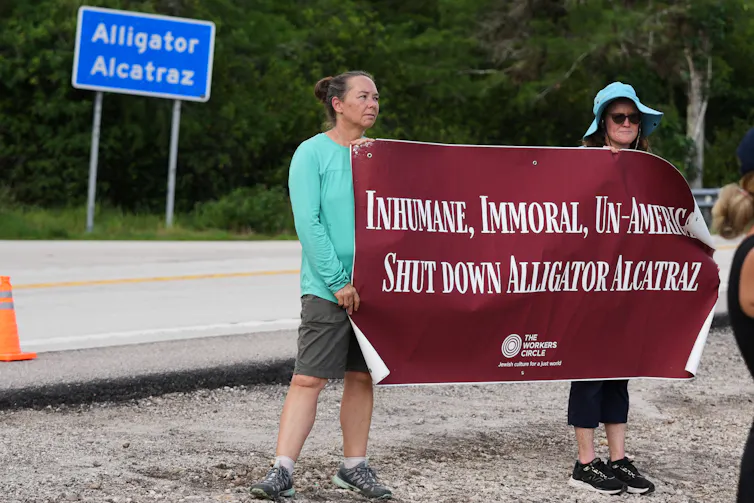
Whether he realized it or not, Trump’s depiction of alligators as enforcers of migrant detention echoed a much older tradition.
My research reveals that, as early as the 18th century, French explorers and naturalists began claiming that alligators and crocodiles showed a marked preference for attacking and consuming people of African descent. Plantation owners in the South eagerly repeated these stories because they discouraged enslaved people from escaping into marshes and swamps, where pursuing them proved difficult.
The idea gained much wider traction after the Civil War. As formerly enslaved people secured freedom and basic civil rights, pursued educational and economic opportunities, and gained political power, many white Americans sought to reassert white supremacy. They restricted voting rights, imposed Jim Crow segregation and inflicted racial violence.
They also employed demeaning racial stereotypes designed to humiliate African Americans while undermining their claims to freedom, dignity and citizenship. My work shows how the growing association between alligators and Black bodies was part of this larger campaign to reinforce notions of Black inferiority.
Many postwar accounts of alligator attacks centered on a dated racist slur that portrayed Black children as less than human. Typically depicted with exaggerated features and ragged clothing – or no clothing at all – these children were often shown being chased by alligators or other wild animals. Such images rested on the dehumanizing assumption that Black children were incapable of experiencing pain or suffering in the same way as their white counterparts.
Soon, stories about hunters using Black children as bait to lure alligators also began circulating. Some particularly improbable accounts claimed that African American mothers rented out their babies to hunters seeking to attract the reptiles.
These stories represented a grotesque inversion of the lived experience of slavery. For enslaved women, the forced separation from their children was among the institution’s most devastating cruelties. By suggesting that Black women would willingly place their own children in mortal danger for profit, such narratives provided yet another means of humiliating, degrading and dehumanizing African Americans.
By the late 19th century, these ideas had crystallized into the racial slur “alligator bait.” The phrase fused long-standing claims that alligators preferred Black flesh with newer stories of Black children being used to attract the reptiles. It soon became a fixture of American popular culture, appearing regularly in newspapers, editorial cartoons, postcards, photographs, songs and motion pictures.
Such imagery remained widespread until the modern Civil Rights Movement rendered it increasingly unacceptable.
The architects of Alligator Alcatraz may not have consciously sought to invoke the history of “alligator bait” stereotypes. Yet historical symbols often outlive the contexts in which they were created, and the American alligator bears the imprint of a long racial history.
Alligator Alcatraz drew upon a symbol shaped by generations of racial exclusion and dehumanization. In transforming migrant detention into political theater, the now-closed facility revealed a troubling disregard for symbolism and history. It also betrayed the cruelty and indignity that spectacle-based approaches to immigration enforcement inflict on human beings.
The tents may be gone, but the racist historical echoes embedded in the name “Alligator Alcatraz” remain.

Mark V. Barrow, Jr. has received funding from the National Endowment for the Humanities.
Politics + Society – The Conversation

With the amount of meat, both red and white, the United States eats, it makes sense that we import quite a bit, but where do we get most of those imports from?

Food Republic – Restaurants, Reviews, Recipes, Cooking Tips

What a weekend at The Oaks Waterfront Hotel on Maryland’s Eastern Shore is like, from the rooms and restaurant to the waterfront amenities and nearby towns.
