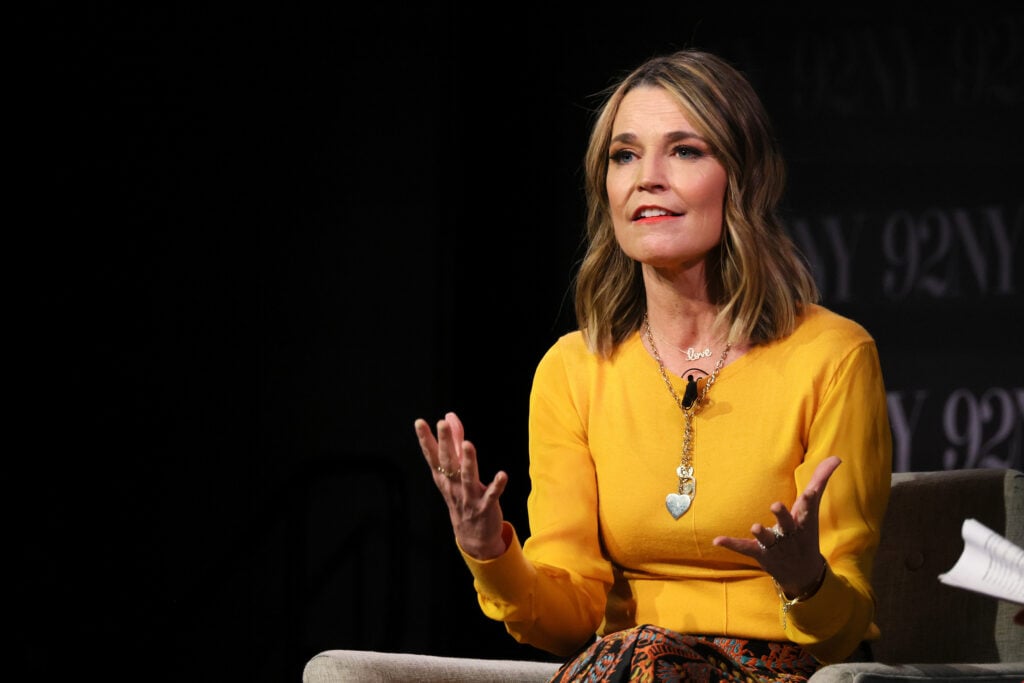
The Today show anchor shared an emotional video on Instagram this week, directly addressing the person or people responsible for her 84-year-old mother’s disappearance.
Savannah Guthrie speaks onstage during Savannah Guthrie in Conversation with Hoda Kotb: Reflections on Faith at 92NY on February 22, 2024 in New York City. (Photo by Dia Dipasupil/Getty Images)
In the video, Guthrie pleaded for compassion and urged anyone involved to reveal Nancy’s whereabouts.
“We are living through a nightmare that will not end,” Savannah said, adding that it is “never too late to do the right thing.”
She asked the parties responsible to tell her family “where to look for her” and said they continue to hope for Nancy’s safe return.
Savannah captioned the post simply, “Bring her home.”
Nancy Guthrie disappeared from her home in the Catalina Foothills near Tucson, Arizona, on February 1.
Investigators have said evidence at the residence suggested she did not leave voluntarily, and authorities have treated the case as a suspected kidnapping. The FBI and the Pima County Sheriff’s Department continue to investigate.
According to investigators, surveillance footage captured a masked individual outside Nancy’s home around the time of her disappearance.
Authorities have also examined multiple ransom notes sent during the investigation, though officials have indicated that some messages may not be authentic. No arrests have been announced.
Savannah has remained outspoken throughout the investigation, using both her national television platform and social media to keep attention on the case.
Earlier this year, her family announced a $1 million reward for information leading to Nancy’s recovery, while the FBI has also offered a separate reward for information that assists the investigation.
Despite the passage of nearly six months, Guthrie’s latest message made clear that her family has not given up hope.
“Please,” she said in the video. “Tell us where to look for her. Bring her home.”
Over a dozen years later, Katie Holmes has thoroughly moved on from the Tom Cruise chapter of her life.
So has her daughter.
Continuing the pattern of celebrity kids reaching adulthood and ditching the surnames of their dads who were really hot in the early 1990s, Suri has a new legal name.
There’s no “Cruise” in sight. And, interestingly, no “Holmes.”
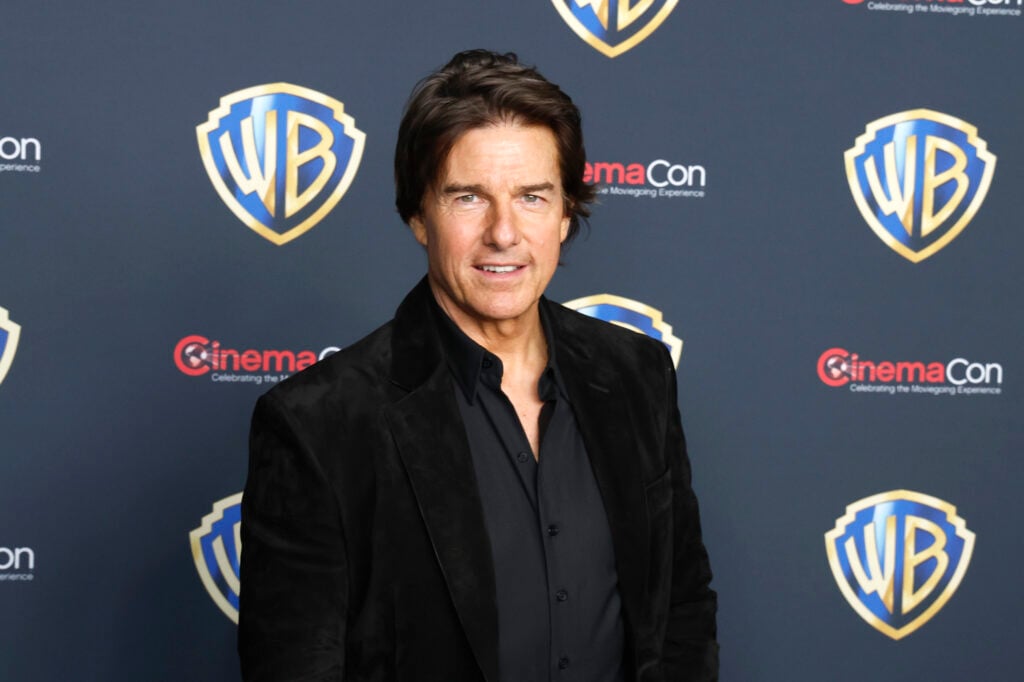
Tom Cruise promotes the upcoming film “Digger” on April 14, 2026. (Photo Credit: Gabe Ginsberg/Getty Images)
It’s official!
Page Six reports that Suri registered to vote during her freshman year at Carnegie Mellon University.
What makes this very standard activity — particularly for an election year (Suri was a freshman in autumn 2024) — remarkable is that voter registrations must be under one’s legal name.
She is registered to vote as “Suri Noelle.” That is the same name that she used in a pamphlet at the end of high school.
Registering to vote like this can only mean that Suri has changed her legal name.
Ditching the “Cruise” surname makes sense. Notably, she has done this very quietly while leading a relatively normal life.
NEW
Suri, Katie Holmes’s daughter, who was abandoned by her biological father, Tom Cruise, legally dropped the last name “Cruise” at some point, per a new report from Page Six.
Suri Noelle is the name she used to register to vote.
The report mentions that Suri did not file for her name change in Allegheny County.
From that, most conclude that she likely sought her name change in New York — before she left for college.
Having a legal name change carries many advantages.
Only one of which is not having to explain to multiple professors, resident advisors, and more why you’d prefer to not have your former name read aloud to a room full of your peers and potential friends.
That has broad applications even if your former surname wasn’t “Cruise.” It was smart of Suri to seek this change beforehand — possibly right after she turned 18.
She’s following Katie Holmes’ example (and saying very little)
Those of us old enough to remember Tom Cruise jumping on Oprah’s couch likely do not need a reminder of how things ended with Katie Holmes.
In 2012, Holmes filed to divorce Cruise after 6 years of marriage.
Divorcing Cruise is a notoriously daunting prospect. To this day, Nicole Kidman avoids speaking ill of Cruise or of Scientology, which some governments have branded as a predatory business rather than as a “religion.”
Holmes has not been outspoken about her erstwhile marriage or about her experiences during that time.
However, in December of 2024, she did confirm that Suri did not have a trust fund from her estranged father. (There were reports of such a fund, which Holmes denied.)
Shiloh Jolie 🤝 Suri Noelle dropping the last names of their problematic, deadbeat dads
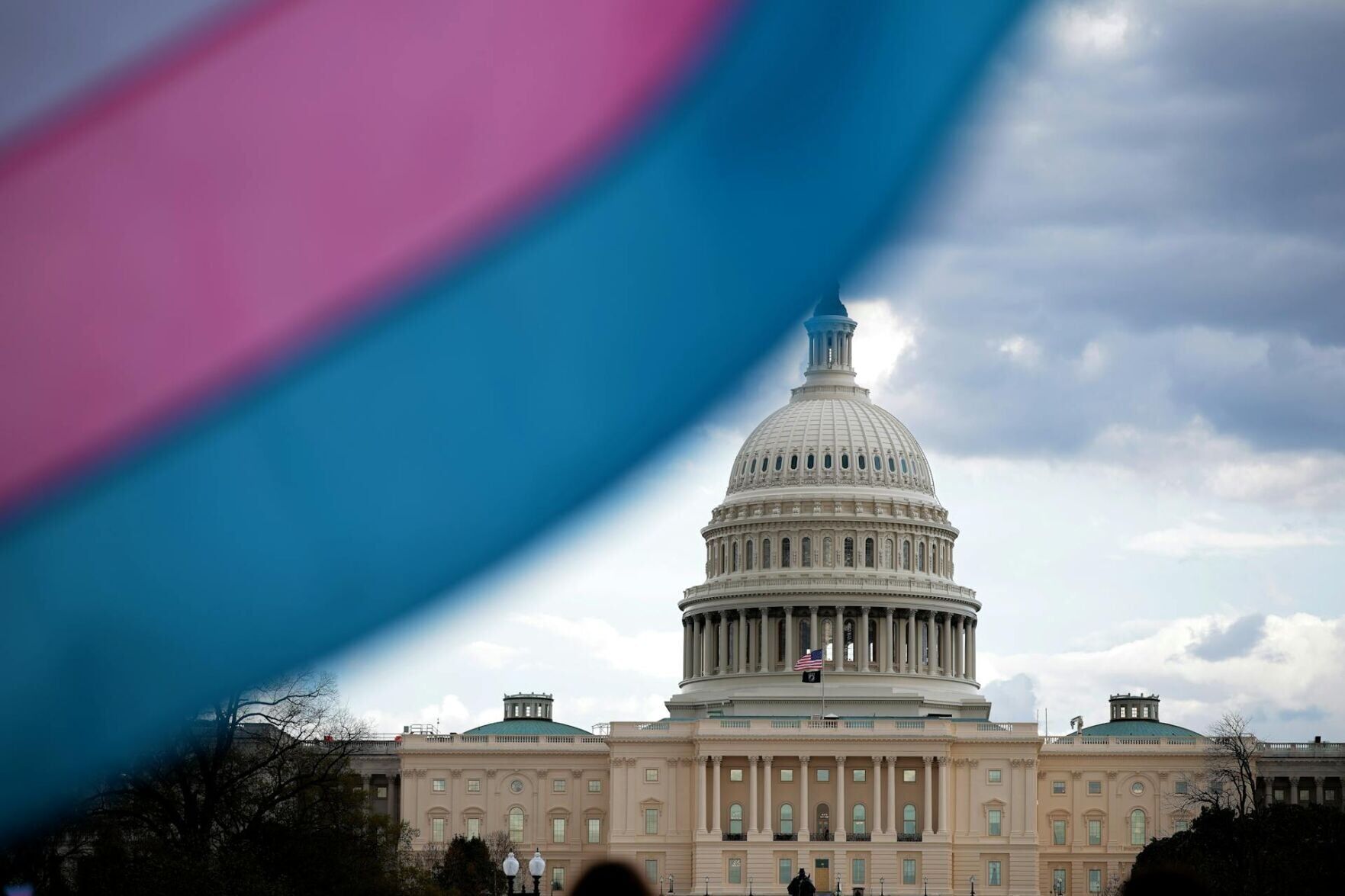
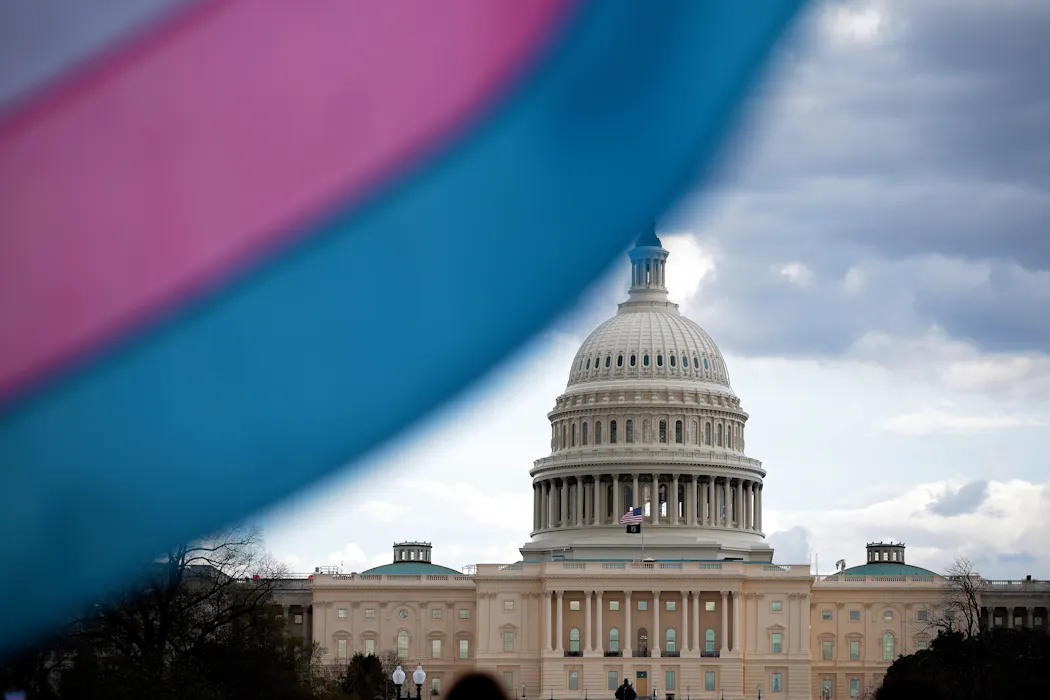
In the past few years, the Trump administration and state legislatures have restricted trans people’s rights and protections, from access to healthcare to passports.Kayla Bartkowski/Getty Images
Whether in an Oval Office proclamation signing about commercial fishing or during a Fox News interview while discussing Iran, President Donald Trump finds opportunities to share his views on transgender people.
During a June 2026 signing event, Trump claimed, in response to a question about proposed legislation regarding election procedures, called the SAVE America Act: “We are talking about saving America, right? No men in women’s sports.” He continued, “And we have no mutilization of your children for transgender purposes … where your child leaves your house, and they take your child from you. … In six states, they take the child and do what they want to do. What they do is, is I don’t even want to talk about it. No transgender mutilization of your children.”
Meanwhile, public approval of Trump’s approach to trans issues is relatively high, as compared with his approval ratings on other issues.
A 2024 report by the Human Rights Campaign decried an “epidemic of violence” against trans and gender-expansive people. A 2025 Pew report found that 70% of trans adults have feared for their personal safety, and only 13% of LGBTQ respondents reported social acceptance of trans people.
Though the causes for changing trans views are complex, research suggests Trump’s rhetoric and policies have powerful influence, the ramifications of which are clear. Anti-LGBTQ+ laws and debates negatively affect young queer people, according to the Trevor Project’s 2025 U.S. National Survey on the Mental Health of LGBTQ+ Young People, and are associated with increased stress, discrimination and suicide attempts.
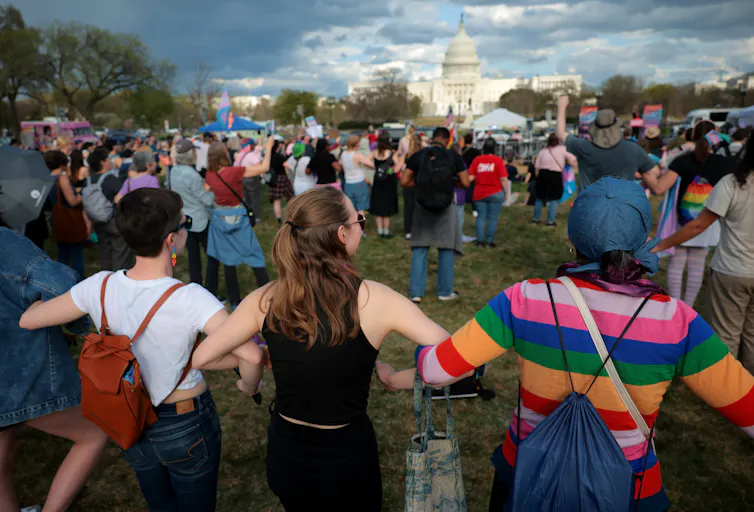
Trans people and their allies have pushed back against a recent wave of restrictions. Here, supporters rally for the Transgender Day of Visibility in March 2025. Kayla Bartkowski/Getty Images
Moral panic as political strategy
From the Salem witch trials in the 17th century to the war on drugs in the 20th century, moral panics have emerged across history to stoke fear against a perceived threat to a society’s values or well-being.
Moral panics, coined by sociologist Stanley Cohen in 1972, follow a similar pattern: a threat is defined, media exaggerates the threat, public concern increases, authorities respond with laws and policies, and society is transformed.
Moral panics elicit a range of negative emotions, but disgust and paranoia are especially potent. Originally a response meant to protect us from disease and spoiled food, disgust has evolved to also express social inappropriateness. Disgust asserts that its object is inherently bad. Since disgust is culturally dependent, it can also be used to marginalize groups of people.
Meanwhile, paranoia focuses on visualizing and preparing for future threats. When experienced as an emotion – outside of psychiatric disorders – paranoia has a righteous undertone, as it seeks to uncover perceived enemies.
Disgust and paranoia are a powerful combination for sustaining moral panics. While disgust produces an intense, immediate physical feeling, paranoia is long-lasting, stewing and existential.
Stimulating disgust and paranoia
Trump’s offhand remarks often invoke disgust and paranoia against perceived enemies – for example, toward immigrants, whom he has repeatedly described as dangerous criminals. These same patterns emerge in the Trump administration’s formal communication regarding trans issues.
The release asserts that former President Joe Biden’s 2024 Proclamation of Transgender Day of Visibility “desecrated Easter Sunday with a ‘transgender’ message that elevated radical leftist ideology over faith, family, and biological truth.” Rousing paranoia, “radical leftist ideology” (and later in the release, “gender ideology”) is portrayed as an existential threat that puts Americans and their beliefs in danger.
The release also claimed that “the Trump Administration is celebrating a decisive victory: the swift and unrelenting dismantling of subversive, woke policies that endangered children, eroded women’s rights, assaulted common sense, and dragged America toward moral and cultural decline.”
As a rhetoric scholar, I read these allusions to religion and war – using words like “desecrate” and “victory,” respectively – as implications that the U.S. is in a battle between good and evil. Schools, hospitals, bathrooms, locker rooms, sports facilities and military bases are spaces declared under attack.
The release also condemns “the chemical and surgical mutilation of minors” and “child mutilation programs” – revolting imagery that misleadingly depicts gender-affirming care and incites shock, concern and disgust.
Similarly, invoking images of nonconsenting, victimized children and women, the release denounces “the un-American indoctrination of schoolchildren” and “the unfair, demeaning practice of forcing women to compete against biological men in sports.” Stimulating anger and moral panic, these descriptions encourage anti-trans views and discrimination.
Recognizing these rhetorical patterns is key to understanding how politicians use inflammatory language to denigrate trans people and other marginalized groups, including women, Black people and immigrants.
Julie D. Nelson does not work for, consult, own shares in or receive funding from any company or organization that would benefit from this article, and has disclosed no relevant affiliations beyond their academic appointment.
Only a sliver of Americans say they support these kinds of antidemocratic actions. For example, just 8% of Americans support making it harder for their political opponents to vote.
So how do politicians who espouse antidemocratic views continue to win elections if these policies are so unpopular?
As scholarsaffiliatedwith theRooney Democracy Institute at the University of Notre Dame, we analyzed surveys of over 48,000 Americans conducted by YouGov, NORC at the University of Chicago and Bovitz between September 2022 and July 2025 to try to get an answer.
A key finding emerged: A significant swath of Americans were actually indifferent toward antidemocratic practices.
This is an important distinction. Prior research tended to assume that if a person doesn’t support antidemocratic practices, then they must oppose antidemocratic practices. In other words, if only 8% of the public supports making it harder for political opponents to vote, then roughly 92% of Americans must oppose making it harder for opponents to vote.
However, our research shows that there is actually a big chunk of Americans – at times a proportion as large as 52% of voters – who neither support nor oppose antidemocratic practices. While only a small number of Americans outright support violating core democratic norms, many Americans express no opinion about politicians who undermine democracy.
We call this attitude toward antidemocratic practices “democratic neutrality,” and we believe it’s an overlooked and understudied threat to democracy.
Ambivalence is not the same as opposition
We see democratic neutrality as key to explaining the success of antidemocratic politicians in America.
To illustrate: Only about 1 in 10 Americans agree that politicians should be loyal to their political party over the Constitution. But politicians who flout constitutional norms have won races at all levels of the government.
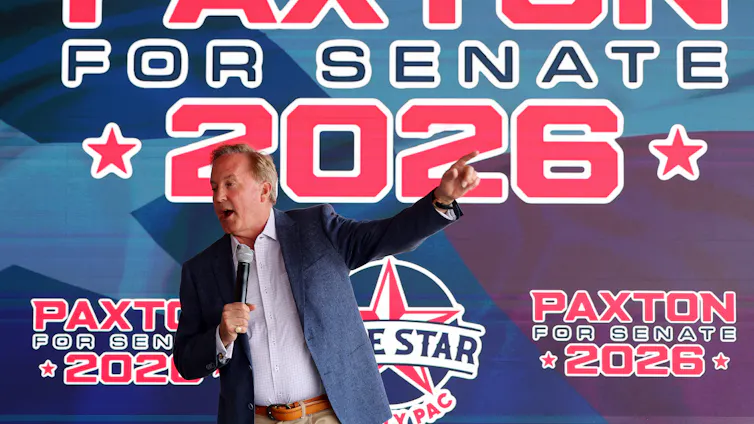
Dozens of Republicans won 2026 primary elections despite continuing to reject the outcome of the 2020 presidential election. The group includes Texas Attorney General Ken Paxton, who asked the U.S. Supreme Court to invalidate the certified election results in four states won by Joe Biden. In May 2026, Paxton defeated incumbent GOP Senator John Cornyn to become the party’s nominee.
Texas Attorney General Ken Paxton filed a lawsuit with the U.S. Supreme Court seeking to invalidate the certified presidential election results in four states won by Joe Biden in 2020. Paxton is now the GOP nominee in Texas’ 2026 U.S. Senate race. Richard Rodriguez/Getty Images
We show that this apparent contradiction has a straightforward explanation.
Around 25% of the public expresses neutrality when asked whether politicians should be more loyal to their party or the Constitution. When those who prioritize their party over the Constitution and those who are neutral toward the idea are considered together, more than one-third of Americans are open to voting for a politician who prioritizes partisan, rather than constitutional, loyalty.
One-third of the population is more than enough to win a partisan primary. And given the deeply polarized political climate and declining electoral competition in the U.S. – including increases in gerrymandered legislative districts – winning a partisan primary is often tantamount to electoral victory.
The prevalence of democratic neutrality is troubling because in survey experiments with hypothetical candidates, most Americans who express neutrality toward antidemocratic policies vote the same way as the small number of Americans who outright support antidemocratic policies.
We were also able to show that when candidates for elected office take antidemocratic stances, only Americans who explicitly oppose antidemocratic practices punish those candidates at the ballot box. Americans who are neutral toward or supportive of antidemocratic practices do not.
When we accounted for neutrality across multiple antidemocratic practices, from political violence to voter suppression, the picture became even more dire. Nearly two-thirds of Americans express neutrality or support for some form of antidemocratic practice.
In other words, a clear majority of the public is willing to tolerate a politician who undermines core aspects of American democracy.
Neutrality is not a passive stance
Using what’s called regression analysis, we were able to dig deeper into the behaviors and attitudes associated with democratic neutrality. We found that democratic neutrality appears to be tied to a variety of factors.
Some Americans appear willing to tolerate politicians undermining democracy if it means those politicians enact policies they support. Others seem ambivalent about democracy, indifferent to the issue or unsure what qualifies as an antidemocratic policy. And consistent with prior research, some people may actually support antidemocratic policies but express neutrality because of social pressure.
Regardless of why Americans express neutrality, those who do so are just as likely to vote for authoritarian politicians as the relatively small number of Americans who explicitly support undemocratic practices in some form.
The millions of Americans who simply remain neutral when democracy is threatened are a greater threat to the country’s system of government. These democratically neutral voters are, in our view, complicit in the continued erosion of democratic norms in the U.S, even if they do not openly express support for antidemocratic policies.
Indeed, our research indicates that neutrality is not a passive stance. Preventing further democratic erosion requires voters to reject candidates who undermine basic democratic principles, even – and especially – if they are candidates from one’s own party. As former President Theodore Roosevelt warned, “… to be neutral between right and wrong is to serve wrong.”
The authors do not work for, consult, own shares in or receive funding from any company or organization that would benefit from this article, and have disclosed no relevant affiliations beyond their academic appointment.
(The Center Square) — New Yorkers will get access to sharply discounted items at the city’s future municipally-owned grocery stores, under a new initiative unveiled Monday by New York City Mayor Zohran Mamdani.